


Erhalten Sie Zugang zu diesem und mehr als 300000 Büchern ab EUR 5,99 monatlich.
- Herausgeber: Plataforma
- Kategorie: Fachliteratur
- Sprache: Englisch
Could your company operate without a CEO? If purpose is the driving force behind the company, why not allow all members to share the responsibility of leading and making decisions? By doing so, the organization can become a true community in which everyone feels valued and motivated to contribute to shared success.
Sie lesen das E-Book in den Legimi-Apps auf:
Seitenzahl: 293
Veröffentlichungsjahr: 2024
Das E-Book (TTS) können Sie hören im Abo „Legimi Premium” in Legimi-Apps auf:
Ähnliche


















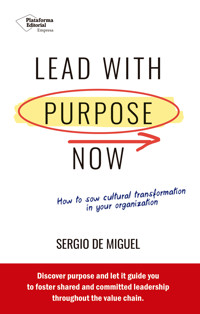
Lead with Purpose Now
How to sow cultural transformation in your organization
Sergio de Miguel
Presentation of Iñaki García
Original title Ahora dirige el propósito
originally published in spanish in 2023 by Plataforma Editorial
First English edition: December 2024
© Sergio de Miguel, 2023
© Foreword by Iñaki García, 2023
© Current edition: Plataforma Editorial, 2024
Plataforma Editorial
c/ Muntaner, 269, entlo. 1ª – 08021 Barcelona
Tel.: (+34) 93 494 79 99
www.plataformaeditorial.com
ISBN: 979-13-87568-46-7
Front cover by: Grafime S.L.
Photocomposition by: Grafime, S.L.
All rights reserved. Any reproduction of this work in its entirety or partiality is strictly prohibited without express authorisation of the copyright owners. Reproduction by any medium or procedure, including reprography, digitalised treatment and distribution of digital copies via lending or public loans is punishable under established legal sanctions. If photocopies or a reproduction of any fragment of this work are required please contact the editor directly or visit CEDRO (www.cedro.org).
Thank you Unax and Eider. You are my lighthouse and my engine, you have guided me here. Thank you for keeping alive the child within me. You are part of my purpose.
Thank you Belén. For accompanying me on my path and for sharing yours with me. I know, and you know, that walk along the beach is waiting for us.
Index
Presentation of Iñaki García
Foreword by Iñaki García
Introduction
Usage Instructions
1. Once upon a time 2033
2. The beginning of we didn’t quite know what
3. Very carefully
4. Preparing the Ground
5. Become a farmer
6. Being a farmer is not easy
7. What is organizational purpose
8. You come first. Find your purpose
9. The purpose of your organization
10. Let yourself be guided by purpose
11. How do I do it now?
12. Build your garden in ten steps
13. Nothing is what it seems. Trust yourself and the process
Epilogue
Acknowledgements
Recommended Readings
Landmarks
Cover
Title Page
Copyright Page
Dedication
Index
Start Reading
Acknowledgements
Notes
Colophon
Presentation of Iñaki García
I have known Iñaki García since 2017. He is a partner at the marketing agency LIN3S and I hired him to help me design and execute the digital marketing strategy of C4OL, a start-up I founded at that time.
Over the years we have kept in touch and shared good conversations. His vision of business and life inspires me. He works hard and at the same time cares about enjoying the present. He manages his company balancing the care of people with customer satisfaction and achieving results. Combining delegation and demand is very difficult, something I have seen few do like him.
Moreover, he sincerely cares about the personal and professional development of the people around him. He has surrounded himself with a good team and trusts them. He gives them space to decide, make mistakes, and learn.
In addition to all this, he has trained in various executive skills programs, those that set trends. His eagerness to learn is admirable. To top it off, he works closely with Google, and that adds an additional sex-appeal.
In the last five years I have seen a notable change in him that has been reflected in his organization. He is more focused, listens better, and flows more. When I asked him to write a book presentation, he loved the idea. At LIN3S they have worked on the purpose and he finds it an interesting concept that is still to be developed.
What had to happen, happened. In just a few lines he leaves deep reflections. Pay attention, in Iñaki’s words you will find messages as transformative as in the book itself.
sergio de miguel
Foreword
“Culture eats strategy for breakfast”.
peter drucker
Recently, I participated in a CEO event, and it seems there is unanimity among executives about the need for organizations to have a purpose.
Although it is indisputable that there is a fashion effect around the idea of the enormous added value that this intangible asset brings, I believe that this should not diminish its importance. The question would be: “Is it enough for an organization to define the “why” of its existence?”. Being this a strenuous and committed task, undoubtedly the answer is “no, it is not the only important thing”.
What I mean is that, no matter how sophisticated we design the purpose, it will be useless if it does not respond to a corporate culture and enables alignment among all components of the organization.
The purpose is the tip of the iceberg or, better said, the cherry on top. The ingredients that make up that cake are the corporate culture, and the pillars of sponge cake and custard cream that holds it together, the values and behaviors.
What is the purpose for? When things are complicated, and a difficult decision must be made, we have —like in cartoon movies— the angel on one shoulder and the devil on the other. It is at that moment when we use purpose and values to make momentous decisions. We succeed or fail, but we make it clear to the organization that we know where we are going in the long term.
Purpose is a metaphor that we share in an organization and that helps us interpret reality as a system (and not as the independent parts of the same). A great reference that everyone can follow. It is about a tool that allows us to focus on the long term and aligns the organization towards that point. The positive consequence of this reflection is twofold: at a human level, greater engagement of people and, at the same time, a differential value proposition.
“Effort and courage are not enough without purpose and direction”.
john f. kennedy
From my point of view, there is a lot to build before reaching the purpose. At LIN3S, the company where I am CEO, it took us more than seventeen years to formulate clearly the “why we are here”.
So, if it is so important and I should not be ashamed of not having found or formulated the purpose of my company, how do I find the purpose? I don’t know, I guess by working on it.
What happened to us? After many years of working and sharing a set of ideas as a team, we reached a point where we needed to professionalize the company. As a prelude to a restructuring of LIN3S, Luis Mauleón, CEO of the consultancy Asenta, suggested we do an exercise to define values, and the three founding partners set about doing this.
We began to sketch some ideas about the reasons and motivations that had guided us on the journey, which we presented to the entire company along with the new organizational chart.
From that point, we created a working group with different people from the company who volunteered to participate in refining and improving our initial sketch. From there, we came up with four values and twelve behaviors that represented the vast majority of the organization. We repeated them at many internal events, we internalized them, we repeated them over and over again…
One day, during a reflection on the talent area, Jon, our commercial director, formulated part of the purpose without being aware of it: “designing the businesses of the future…”. As soon as I heard it, I knew that was it, and that it had just appeared. From there, we only had to add the second part: “designing the businesses and developing the professionals of the future”.
So, returning to the cherry on top, or rather, to the tip of the iceberg, the purpose was already there from the beginning: it was part of the same ice that was at the base with which the organization was founded, it just had to emerge from the solid and strong root.
“What is not measured, cannot be improved”.
lord kelvin
Now, how do we make the purpose tangible? We have to measure it in order to work on it, question it, and implement it.
In our case, we have connected it with three major strategic objectives: brand, talent, and business. We break these objectives down into more concrete challenges, for example, in the case of business, one of them can be growth. And it is at this point that we can link it to one or several indicators that help us know if the actions we are developing contribute to that challenge. In the case of growth, it could be increasing revenue by 15 %.
In this way, by following a system that may resemble OKRs,1 we can connect purpose with a strategic plan that could have a three-year development and specific actions for each year. From there, we continue to break down the objectives towards areas, teams, and individuals. Everything connected and aligned.
“Finding a purpose will help you be happy”.
iñaki garcia
Purpose is something abstract, it has taken me many years to understand its utility. It makes sense that you might think so too, dear reader, but there’s a reason you are reading this book.
Without a doubt, as of today, I have changed my mind. I believe that purpose helps us connect the key points of our strategy. What are the main factors by which our business will succeed in the next ten years? Purpose is the radar that will help us detect them, connect them to each other, and at the same time, unite the people of the organization around the common goal to be increasingly better, more competitive, and, why not, happier.
With all this, I hope I have convinced you that purpose can be a tool to improve an organization or, at least, encourage you to continue reading Sergio’s book, whose knowledge and human quality have been a great inspiration for me.
iñaki garcía
Usage Instructions
Lead with Purpose Now begins with a conversation between two executives. Xabier is the CEO of a successful company that ten years earlier began a cultural transformation based on its purpose. Beatriz is a curious and restless executive looking for inspiration.
Go to Xabier to learn about his organization and see to what extent you can apply the same ideas.
Although the meeting of our protagonists takes place in 2033, much of the story unfolds in 2023, when Xabier’s company began its metamorphosis with the help of external consultants.
Flaubert said that madame Bovary was him. Well, the main consultant is me. It bears my name and is nourished by my experience and my dreams. The rest of the characters are fictional, although they have characteristics of people I have worked with.
In addition, I have wanted to enrich these pages with contributions from professionals I admire, people who inspire me. All of them have a vast business background, which gives authority to their point of view and enhances my perspective. I have asked a different question to each person.
You will find these texts in a final epilogue. And without further ado…
1.Once upon a time 2033
It’s raining. It rains like in that old poem by Antonio Machado, as it rained when we were children. “Monotony of rain on the windows”, Xabier remembers silently. But today is not a day like any other. Xabier awaits the visit of Beatriz, an executive in search of new ideas.
Xabier is the CEO of CWGD (Creating Wellbeing Generates Dividends), an international case study. A profitable company and a leader in employer branding. An organization that has achieved what the rest seek: to attract and retain talent.
The privileged situation of CWGD is the result of ten years of work, the outcome of a long process simmered slowly. It all started in 2023, when CWGD began its cultural transformation and became a unique entity within the business world: an organization guided by its purpose.
—Hello, Xabier, may I come in?
Beatriz is restless, somewhat nervous. Nevertheless, she opened the door to Xabier’s office with confidence and determination.
—Please, make yourself at home.
—Thank you very much. I must confess that for me, it is an honour to be here today. I admire what you have done these years and I am very excited to get to know you a bit more.
—For me, it is also a pleasure to meet you and to chat for a while. I am convinced that this meeting will help our purpose: to generate more quality employment in our community. —Xabier pauses and quickly adds—: Before we start… How are you?
—Fine, thank you.
Beatriz has answered the typical fine, intending to move the conversation forward.
—Yes, I understand… But what’s behind that fine?
—How?
Beatriz seems puzzled. She is used to getting to the point to not waste time and does not understand Xabier. —Tell me something more.
—Well…, I don’t know… I’m nervous, and I don’t really know why.
—Beatriz sighs—. How curious. I’ve said it out loud and now I feel a bit lighter.
Xabier smiles.
—I’m glad. It’s important to know how we are before starting any journey, no matter how small. And I get the impression that you are about to start one.
—Yes, I also have that feeling. Maybe that’s why I’m nervous. Honestly, I was looking forward to meeting you. Everything I’ve heard about your work here sounds incredible.
—Don’t believe everything you hear.
—I usually don’t, but sometimes it’s true that where there’s smoke, there’s fire… Experience tells me that when everyone speaks well of someone, generally, they are right.
—True.
Beatriz feels more comfortable, so much so that she is now the one asking questions.
—And you, Xabier, how are you feeling?
—Calm. —Xabier smiles—. Relaxed, very peaceful. With the feeling that things, although not completely under control, are as they should be.
—Sounds wonderful. I wish I could feel like that, even if just occasionally.
—Time will tell… Tell me, what brings you here?
—You see… Lately, I don’t really know which way to turn. I feel lost on all levels. I’m overwhelmed by so much uncertainty. I think I’m not making the best decisions, neither personally nor in my business.
Xabier nods. A complicit smile crosses his face.
—I know what you mean. I can see myself reflected in your words. That’s where I was ten years ago. —So, I can keep hope alive.
—Of course, woman! As long as there is life, there is hope. They both laugh.
—Let’s get back to you. What do you expect from this conversation?
—Let me tell you, Xabier. I want to make changes in my company. And, honestly, I don’t even know where to start. I am clear that the current context has changed; that the irruption of technology has solved many problems and at the same time has exposed many shortcomings. I want to give wings to my team, and I am not even able to take them myself. Worse still, I don’t even know if they want them. Sometimes I think they are more comfortable looking at me and waiting for me to solve everything. In short, I’m in a big mess.
Xabier can’t help but laugh.
—I see, yes.
Beatriz looks like an erupting volcano.
—Actually, the company is doing well. At least, from the outside. We are growing, we are profitable, and we have a forecast to maintain the positive trend for the next twelve months. However, I feel that something has been lost. People are not as excited, there is a concerning lack of energy, hardly any new change projects are emerging… It’s as if we were approaching the peak of a mountain and behind there was a cliff. As if we were reaching the end of something. It’s hard to explain. Xabier bursts into laughter at Beatriz’s astonishment. —You just described the situation of CWGD ten years ago.
—Really? I’m relieved to hear you say that. It’s what I’ve been looking for. I would like to know, firsthand, the process you have followed to make this transformation. Right now you are a benchmark, one of the best places to work. Talent seeks you out and everything that is seen and heard about you is exciting. Also, I have met various people from your executive team. All of you emphasize the importance of your purpose, something like that serves as a guide. And you transmit that peace you described earlier. I want that.
—Does the purpose guide you?
—No, I want that peace. I want to get rid of all this pressure I have as a CEO. I don’t feel capable of holding the entire company by myself. The weight of so much responsibility is overwhelming me.
Beatriz lowers her tone. She now seems smaller, more vulnerable.
—In summary, you don’t care about the purpose. You want peace —says Xabier.
—If the purpose brings me peace…, I’ll take it. I want that peace. I need that peace.
—Basically, they are the same thing. You can get a 2-for-1 deal.
—Great, that sounds like a good offer.
This time it is Beatriz who smiles, more relaxed now.
—We can call it that… Well, I’m going to share with you the transformation journey we have made at CWGD. I am authorized to be fully transparent, so you can ask me anything you want. I don’t think there is anything confidential. We have decided so in the Management Committee (MC). We believe that the more we share our story, the more companies that join this new way of management, the better it will be for our environment.
—Thank you very much.
—You’re welcome, it’s part of our purpose.
Xabier winks at Beatriz and they both smile again.
—I’ll start from the beginning…
2.The beginning of we didn’t quite know what
—It all started ten years ago —Xabier says—. These changes are slow, like the processes of nature. If today you plant a seed, do you know how long it will take to become a tree?
—Ten years?
—Exactly! Although it varies a lot depending on the species and the climate, ten years might be the minimum necessary. These changes need time.
—That long?
—You need to first think about them, visualize them, dream them.
Then, you must let them grow and expand. For that, you have to communicate them, share them. Only then can you begin to deploy them throughout the organization and apply them to the processes. They are long-term movements, you have to take them calmly. Rome wasn’t built in a day.
—I understand…
Transformation is a long-term process.
—I also thought I understood it. And I assure you that it cost me a lot. A thousand and one times I tried to run too much, pushing the change beyond what is possible. A thousand and one times I tried to turn the organization inside out as if it were a sock.
—Sounds familiar, I’ve tried it too.
—And did it work for you?
—No, that’s why I’m here.
—Of course. Do you know why? Because the idea that someone can change overnight what has always been a certain way… It doesn’t work. It’s like a marathon, you have to set a pace and move forward step by step, without speeding up too much. I will share our journey with you. For now, let’s start from the beginning: a Friday morning ten years ago.
Xabier takes a break. He is delving into his memory, taking a journey back in time. After a few moments, as if he had suddenly remembered everything, he resumes the conversation.
—It was the beginning of the post-COVID-19 era. We had gone from maximum tension at all levels to a kind of liberation, of calm, due to the end of the pandemic.
—Yes. After two very tough years, those were moments of true “decompression”. Everyone was eager to start living again. —Beatriz also remembers those days.
—Absolutely. Finally, the orders had stabilized, the organization was healthy, and the accounts were doing incredibly well. Of course, the uncertainty of the markets still continued. The need for transformation was felt, it was the beginning of this global change. —At the business level, people say it was a change of era.
—I experienced it that way too. It became important to give more emphasis to the personal aspect. People wanted to have a good balance, to dedicate time to what’s important.
Xabier takes another pause and, after a while, resumes sharing his memories.
—One day we started to notice Rafa, the CEO at that time, acting quite strangely. He had always been a jovial, lively, positive person, full of excitement. We were motivated just by seeing the energy he radiated around him. However, in the weeks leading up to the change, he seemed more subdued and distant, even gloomy. It was as if he was pondering something internally.
Beatriz follows Xabier’s story with curiosity.
—Everyone on the management team was scared. We anticipated that something big was going to happen, and it wouldn’t be good. In the last decade, Rafa had been the benchmark of the organization. If he collapsed, there was no one prepared to take over.
—How important it is to have someone who guides you well —Beatriz comments.
—Yes. For the good and for the not so good —says Xavier, and after a brief silence, he continues—. The thing is, Rafa had been nervous for a few weeks, even distracted. He was a person who listened a lot and, lately, we saw him somewhat absent in conversations. Among the executives, we suspected that maybe he was thinking about retiring. What if he was sick? Now I think we were too comfortable, we had a lot of free time to make up stories.
—That happens in my organization! —exclaims Beatriz.
—I think that’s going to change.
—Hopefully. —Beatriz likes what she hears.
—On the other hand —continues Xabier—, after having gone through several employment adjustments to adapt to the new reality, all the directors saw our jobs at risk. We were afraid. That strange yet so familiar feeling: the stomach somewhat contracted, worse mood, pressure in the chest, shortness of breath, difficulty sleeping…
—Unfortunately, that sounds familiar to me too —acknowledges Beatriz—. All that fear and stress concentrates in my shoulders and head.
—So that’s where we were. And so we continued for several weeks. Until Rafa called us to a meeting. It was a Friday at the last minute. There was no title or agenda. —Wow! Those kinds of calls are scary.
—I see you’ve experienced one before. Rafa wanted us to go home after the meeting to reflect calmly.
—When I send one of those appointments it’s usually to give bad news.
—That’s what we thought.
—And what happened?
—He told us what we feared the most. Something that, without us knowing, would change our way of working forever.
Beatriz’s anticipation is growing.
—He appeared on time, as always, and more serious than ever —continues Xabier—. He told us he had something important to tell us. We began to exchange glances. Everyone had that feeling of “it’s going to be me”. No one knew anything.
—Nobody?
—Nobody. And yet, normally, when changes occurred, there was always someone who knew something. Someone with whom different options had been shared or discussed.
—That’s what I’ve always experienced —agrees Beatriz, surprised.
—This situation —remembers Xabier— made us go to the meetings with some prior information. Even with some positioning agreed upon among several people from the Committee. However, not this time. This time our faces showed that we had no idea what was happening.
Beatriz’s face is now a mix of astonishment and stupefaction. Her eyes say “I wouldn’t want to be in one of those.”
—We were all thinking that we had done something wrong. We were mentally reviewing our last actions, justifying ourselves in silence. You can imagine the carousel of emotions…
Beatriz can feel the nerves and tension.
—And then —Xabier continues—, Rafa tells us that he is leaving the organization. We look at each other, incredulous. Rafa had been fired! It was a bombshell. Who could expect something like that? A breath away from retirement, after devoting himself body and soul to the company for the last fourteen years. It was like removing the main beam of the entire company. We were speechless, astonished.
Beatriz also turns pale with the turn of events.
—Rafa —remembers Xabier— told us that, at the beginning, he had a hard time. He didn’t understand the situation and didn’t share the decision. He had planned things differently. Suddenly, his life fell apart like a house of cards.
—It seems so hard to me.
—True. But, and this is the most curious thing, he also told us that this feeling only lasted a few weeks. Until he realized that some opportunities were opening up on the horizon. The truth is that Rafa was one of those who think that “in every problem there is a hidden opportunity waiting to be discovered.” He had phrases for everything.
In every problem there is a hidden opportunity waiting to be discovered.
Xabier pauses, as if he needed a breather.
—Everything was very strange. It seemed that he had already accepted it. At the same time, it gave us the impression that he was leaving the organization behind. His speech was one of the most emotional I have ever heard. In fact, I have a copy right here.
—A copy?
—Yes, Rafa always wrote them. In fact, he used to say: “A speech that isn’t worth writing is also not worth listening to”. One of his phrases. He learned this in a public speaking training. He placed great importance on how to communicate effectively.
—May I read it?
—Yes, of course. Here you go. I’ll make you a coffee while you take a look.
Beatriz takes the text handed to her by Xabier and dives into it.
We have achieved results above what was expected. Despite the difficult context, we have exceeded total sales by 2 % and the gross result by more than 5 %. The order book is stabilized and the forecast for the coming months is to maintain or even improve.
All indicators confirm that, in financial terms, we are at the best moment of the company.




