


19,99 €
Mehr erfahren.
- Herausgeber: John Wiley & Sons
- Kategorie: Fachliteratur
- Sprache: Englisch
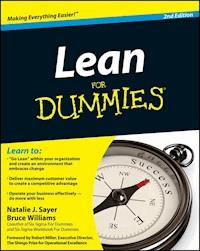
Take charge and engage your enterprise in a Lean transformation
Have you thought about using Lean in your business or organization, but are not really sure how to implement it? Or perhaps you're already using Lean, but you need to get up to speed. Lean For Dummies shows you how to do more with less and create an enterprise that embraces change. In plain-English, this friendly guide explores the general overview of Lean, how flow and the value stream works, and the best ways to apply Lean to your enterprise.
This revised edition includes the latest tools, advice, and information that can be used by everyone — from major corporations to small business, from non-profits and hospitals to manufacturers and service corporations. In addition, it takes a look at the successes and failures of earlier Lean pioneers — including Toyota, the inventors of Lean — and offer case studies and hands-on advice.
- The latest on the Six Sigma and Lean movements
- The role of technology and the expanding Lean toolbox
- Case studies enhance the material
Lean For Dummies gives today's business owners and upper level management in companies of all sizes and in all industries, the tools and information they need to streamline process and operate more efficiently.
Sie lesen das E-Book in den Legimi-Apps auf:
Seitenzahl: 585
Veröffentlichungsjahr: 2012
Ähnliche

















Lean For Dummies®, 2nd Edition
Visit www.dummies.com/cheatsheet/lean to view this book's cheat sheet.
Table of Contents
Lean For Dummies®, 2nd Edition
by Natalie Sayer and Bruce Williams
Lean For Dummies®, 2nd Edition
Published by John Wiley & Sons, Inc.111 River St. Hoboken, NJ 07030-5774 www.wiley.com
Copyright © 2012 by John Wiley & Sons, Inc., Hoboken, New Jersey
Published by John Wiley & Sons, Inc., Hoboken, New Jersey
Published simultaneously in Canada
No part of this publication may be reproduced, stored in a retrieval system or transmitted in any form or by any means, electronic, mechanical, photocopying, recording, scanning or otherwise, except as permitted under Sections 107 or 108 of the 1976 United States Copyright Act, without either the prior written permission of the Publisher, or authorization through payment of the appropriate per-copy fee to the Copyright Clearance Center, 222 Rosewood Drive, Danvers, MA 01923, (978) 750-8400, fax (978) 646-8600. Requests to the Publisher for permission should be addressed to the Permissions Department, John Wiley & Sons, Inc., 111 River Street, Hoboken, NJ 07030, (201) 748-6011, fax (201) 748-6008, or online at http://www.wiley.com/go/permissions.
Trademarks: Wiley, the Wiley logo, For Dummies, the Dummies Man logo, A Reference for the Rest of Us!, The Dummies Way, Dummies Daily, The Fun and Easy Way, Dummies.com, Making Everything Easier, and related trade dress are trademarks or registered trademarks of John Wiley & Sons, Inc. and/or its affiliates in the United States and other countries, and may not be used without written permission. All other trademarks are the property of their respective owners. John Wiley & Sons, Inc., is not associated with any product or vendor mentioned in this book.
Limit of Liability/Disclaimer of Warranty: The publisher and the author make no representations or warranties with respect to the accuracy or completeness of the contents of this work and specifically disclaim all warranties, including without limitation warranties of fitness for a particular purpose. No warranty may be created or extended by sales or promotional materials. The advice and strategies contained herein may not be suitable for every situation. This work is sold with the understanding that the publisher is not engaged in rendering legal, accounting, or other professional services. If professional assistance is required, the services of a competent professional person should be sought. Neither the publisher nor the author shall be liable for damages arising herefrom. The fact that an organization or Website is referred to in this work as a citation and/or a potential source of further information does not mean that the author or the publisher endorses the information the organization or Website may provide or recommendations it may make. Further, readers should be aware that Internet Websites listed in this work may have changed or disappeared between when this work was written and when it is read.
For general information on our other products and services, please contact our Customer Care Department within the U.S. at 877-762-2974, outside the U.S. at 317-572-3993, or fax 317-572-4002.
For technical support, please visit www.wiley.com/techsupport.
Wiley also publishes its books in a variety of electronic formats and by print-on-demand. Some content that appears in standard print versions of this book may not be available in other formats. For more information about Wiley products, visit us at www.wiley.com.
Library of Congress Control Number is available from the Publisher upon request.
ISBN 978-1-118-11756-9 (pbk); ISBN 978-1-118-22446-5 (ebk); ISBN 978-1-118-23772-4 (ebk); ISBN 978-1-118-26258-0 (ebk)
Manufactured in the United States of America
10 9 8 7 6 5 4 3 2 1
About the Authors
Natalie J. Sayer is the owner of I-Emerge, an Arizona-based global consultancy, and co-author of Lean For Dummies, 1st Edition. She has traveled the world extensively, working with leaders in English and Spanish to improve their daily lives, businesses, and results. Natalie began studying and applying Lean in the automotive industry in the United States and Mexico before it was formally known as Lean. She has trained, coached, mentored, and rolled up her sleeves to implement Lean in organizations ranging from Fortune 130 companies to micro-businesses.
She brings a unique blend of people, process, and cultural skills to every project. Natalie has a Bachelor of Mechanical Engineering, a Masters of Manufacturing Systems Engineering, is a graduate from Coachu, a professional speaker, a Six Sigma Black Belt, a Global Leadership Executive Coach, and an actress. She is a passionate people person who lives her life with the convictions that “there is always a better way,” “change won’t happen without the people,” “adjust yourself accordingly,” and “learn from every life experience and move on.”
“To strive, to seek, to find and not to yield” —Alfred, Lord Tennyson
Bruce Williams strives for perfection and added value as a scientist, educator, consultant, entrepreneur, and executive. Leveraging the Lean principle of standardized work, this is now his seventh For Dummies work, dating from 2005, on topics including Six Sigma, Lean, Business Process Management, and Process Intelligence.
His undergraduate degrees in physics and astrophysics from the University of Colorado testify to his early passion to uncover the ultimate nature of root cause. He then was a sculler in the value stream of aerospace systems, where he shot the rapids in the tumultuous whitewater of the Hubble Telescope program. With graduate degrees in technical management and computer engineering from Johns Hopkins and the University of Colorado, Bruce then elevated his value stream role to tugboat captain, leading and managing technical teams and projects.
Decades of kaizen inspired his continuous journey through high technology, software, process improvement, and strategic management. A kaikaku moment once unleashed his entrepreneurial self in 1999; he is now charting the deeper value-stream waters as an executive with Software AG.
He lives with his standard family in the rural desert foothills of northern Scottsdale, Arizona, flowing just-in-time value in response to their continuous demand pull. He regularly suffers the muri of 5S’ing around the house and occasionally pursues the unattainable ideal state of par golf.
Dedication
To all Lean leaders who “get it,” who know that Lean happens through the people, is sustained by the culture and is a long-term journey of excellence in enterprise. To my inner circle: you enrich my life by supporting, guiding, cheering, and challenging me at every turn. To my family who is always there no matter what. Thank you all.
— Natalie J. Sayer
To my children: my daughter, Hannah, who has always been keenly able to help net-out just what is and what isn’t “value-add,” and my son, Evan — the greatest personification of 5S I’ll ever know. You both just seem to practice kaizen naturally, and inspire me to do the same. I dedicate this work to you.
— Bruce Williams
Authors’ Acknowledgments
The authors acknowledge many people who have directly and indirectly contributed to this second edition of Lean For Dummies. We are especially thankful to Christine Dicken for her voice of the customer feedback, relentless pursuit of excellence and those trés cool ARIS value-stream maps.
As members of the Lean community, we have the highest regard for the outstanding service and contributions to industry excellence delivered by the team at the Shingo Prize, and recognize Bob Miller for his vision and leadership. And thank you, Bob, for your august and inspirational foreword.
For their contributions of connections, experiences or case studies, Linda LaGanga of Mental Health Center of Denver, Erica Gibbons, Elissa Torres, Frank Cooney, Todd McCann, Jon Miller, Tim Briones, Scott Kurish, Eleanor Clements, Pamela Oakes, and from Healthcare Performance Partners, Inc., Charles Hagood, and Jason Baldwin.
Thanks to Tim Mullett for contributing his years of wisdom as our technical editor. His practical experience has been an invaluable resource to this project. We appreciate his time, efforts and suggestions.
Thank you to Patricia Hatem and Mary Miller for obtaining permission to use the excellent wall chart from Diversey Inc., part of Sealed Air.
All people interested in Lean owe their ongoing gratitude to Mark Graban and his contributors, who through the Lean Blog (www.leanblog.org) translate Lean to the world around us.
As authors and researchers, we humbly bow to the continuing miracle that is Google, and also to the ubiquitous multi-sensory stimulative and collaborative experience that is Starbucks, whom we recognize both as consumers and for their Lean initiative.
As consumers, and on behalf of consumers everywhere, we acknowledge the contributions of the brilliant pioneers who have contributed to the evolution and dissemination of what we now know as Lean: W. Edwards Deming, Taiichi Ohno, Shigeo Shingo, Norm Bodek, James Womack, and Jeffrey Liker.
But most of all, we acknowledge the many thousands of leaders and Lean practitioners globally, who regularly confront established structures, functional silos, challenging business environments, arcane accounting practices, and entrenched procedures to cut waste and find the real customer value. You make Lean thrive. You are our heroes.
Publisher’s Acknowledgments
We’re proud of this book; please send us your comments at http://dummies.custhelp.com. For other comments, please contact our Customer Care Department within the U.S. at 877-762-2974, outside the U.S. at 317-572-3993, or fax 317-572-4002.
Some of the people who helped bring this book to market include the following:
Acquisitions, Editorial, and Media Development
Project Editor: Susan Hobbs
Acquisitions Editor: Michael Lewis
Copy Editor: Susan Hobbs
Assistant Editor: David Lutton
Editorial Program Coordinator: Joe Niesen
Technical Editor: Tim Mullett
Editorial Manager: Carmen Krikorian
Editorial Assistant: Rachelle Amick
Art Coordinator: Alicia B. South
Cover Photos: © iStockphoto.com / José Carlos Pires Pereira
Cartoons: Rich Tennant (www.the5thwave.com)
Composition Services
Senior Project Coordinator: Kristie Rees
Layout and Graphics: Claudia Bell, Corrie Niehaus, Mark Pinto, Christin Swinford
Proofreader: BIM Indexing & Proofreading Services
Indexer: Sherry Massey
Publishing and Editorial for Consumer Dummies
Kathleen Nebenhaus, Vice President and Executive Publisher
Kristin Ferguson-Wagstaffe, Product Development Director
Ensley Eikenburg, Associate Publisher, Travel
Kelly Regan, Editorial Director, Travel
Publishing for Technology Dummies
Andy Cummings, Vice President and Publisher
Composition Services
Debbie Stailey, Director of Composition Services
Foreword
Something deep inside of almost every person tells us that it is good to improve. It is better to move forward than it is to move backward. It is better to move faster than slower. Personal contribution to a relentless pursuit of perfection is perhaps the most exhilarating thing that can happen to an individual, followed closely by being recognized for that contribution.
I love being a part of an organization that has its roots in recognition. Recently, we substantially raised the bar for what is required to receive a Shingo Prize to include an evaluation of the culture. Many very experienced Lean leaders, when first exposed to this much higher standard, strongly advised against what we were attempting to do. They said, “The standard is too high; no one will be able to meet it. Your expectations are far greater than almost any organization is capable of performing.” This was exactly what we wanted to hear.
We knew that something had to shake business out of the wasteful cycles of program- and tool-oriented improvement initiatives that have become commonplace. In my role as executive director of The Shingo Prize for Operational Excellence (named for Japanese industrial engineer Shigeo Shingo who distinguished himself as one of the world’s thought leaders in building operational excellence), I have observed firsthand the many failed improvement programs that have come and mostly gone in most organizations all over the world. “flavor of the month” is the universal descriptor for these initiatives.
Everyone seems to recognize this wasteful practice, but few know how to stop it. Each new flavor seems so attractive, so logical! Doing nothing is never an attractive option, so in we jump, hoping against hope for a different outcome. Lean has the potential to become one such flavor.
This new edition of Lean For Dummies goes a long way toward exposing the necessities of a successful Lean deployment. The authors not only teach the tools and methodologies associated with Lean, but more importantly help to make the connections between the tools and techniques and the principles and concepts behind them. Shigeo Shingo said, “It is not enough to teach people how to do something; they need to know why.” Correct principles are “the why.”
When people understand “the why” behind “the how,” they become empowered to act independently and to take initiative. Creating a culture of Lean requires every single individual in an organization become fully engaged in continuous improvement. When people understand the principles behind the tools, they become capable of innovating the application of the tools to their unique problems. One successful improvement followed by another, slightly different, and then another, different yet, unleashes a continuous flow on innovation, enthusiasm, and commitment to a never-ending journey.
No one that has tasted the fruit of continuous improvement can ever again be satisfied in an environment of mediocrity and stagnation. Associates who learn the principles and tools associated with Lean become change agents, leaders, inspirational and powerful. This happens from the very top of an organization to the very bottom. I have observed over and over that a powerful leader at the bottom of the organization is no less impactful than one at the top.
This second edition of Lean For Dummies rightfully acknowledges that organizations cannot afford to implement Lean the same way they implemented JIT, TQM, and a plethora of similar programs. By emphasizing Lean principles and insisting on cultural transformation, Sayer and Williams empower the reader to break the cycle of failed programs and create a lasting culture of continuous improvement.
Robert D. Miller Executive Director, The Shingo Prize for Operational Excellence
Introduction
Lean is recognized globally as a one of the most powerful and effective ways known to build, improve, and sustain businesses and institutions. Following a Lean path, any business in any industry of any size or type can improve itself continuously — both in the short term and over the long term. Led by advancements first pioneered at the Toyota Motor Corporation over 50 years ago and since translated and refined by experts and practitioners world wide, the principles, methods, and practices of Lean constitute a successful approach to organizing and operating any enterprise.
If you’re in certain manufacturing industries, healthcare facilities, or public institutions, you’ve probably heard about Lean. You may even have been through a kaizen event or been part of implementing standardized work. If so, you’ve already experienced some of the power of Lean tools. But if you’re like many people, while the term Lean itself may be familiar to you, its principles and practices are not.
The Toyota Production System (TPS) was the incubator where the methods, techniques, and tools of Lean were pioneered and refined. But for decades, the whole system of Lean principles and practices was known only to specialized manufacturers, certain academic researchers, and quality gurus. Its full potential was a mystery to most organizations and professionals.
All that changed in the late 1980s, as the term Lean was coined to describe the fundamentals of TPS to the rest of the world. As the understanding of Lean spread across continents, industries, and organizations, it became less of a mystery and much easier to understand and implement.
Simply stated, Lean is a proven long-term approach to aligning everything in a business or institution to deliver increasing customer value. It’s about engaging people and aligning systems into processes that deliver a continuous stream of value to customers while continuously eliminating waste and deficiencies in the process. But Lean techniques are not just for specialists; Lean is an everyday practice, performed by everyone, at all levels, to consistently improve performance.
About This Book
This book makes Lean accessible to you. We wrote it because Lean is applicable everywhere — it’s applicable in large and complex corporations, but also in small businesses and industries, as well as public-sector institutions — and it applies at all levels.
We wrote this book for you, the individual. You may be a small-business owner, an ambitious career person, a hospital administrator, or a manager who wants to know what Lean is and how to apply it. Your company may be adopting and applying Lean. You may be a college student or job applicant who wants to have an edge in upcoming job interviews. No matter who you are, if you want to know more about Lean, this is the book for you.
Lean For Dummies is not just an overview or survey of Lean. It’s a comprehensive description of the principles of Lean, as well as the methods and tools to put Lean into practice.
This book is
A reference book that’s organized into parts, chapters, and sections, so that you can flip right to what you need, when you need it
A comprehensive text that addresses both the common tools of Lean and the improvement principles and practices
A guide for leading a Lean initiative, helping you identify and manage Lean projects and using Lean tools
A guide to engaging people successfully in a Lean organization
Step-by-step instructions for value-stream mapping and the methodology of Lean projects
Instructions on where you can go for additional help, because the field of Lean is much too large to fit in just a few hundred pages
Lean is different, and it contains Japanese terms and ideas that may be foreign to you. But we’ve taken this difficult subject and made it understandable through examples, simple explanations, and visual aids.
Conventions Used in This Book
When a specialized word first appears in our book, we italicize it, and provide a definition. We also italicize any foreign-language words, including the many Japanese terms that make up the lingo of Lean.
For terms and phrases that industry practitioners use as acronyms, we define the term first and then use it in its abbreviated form going forward.
We put any web addresses and e-mail addresses in monofont to set it apart from the rest of the text. When this book was printed, some web addresses may have needed to break across two lines of text. If that happened, rest assured that we haven’t put in any extra characters (such as hyphens) to indicate the break. So, when using one of these web addresses, just type in exactly what you see in this book, pretending as though the line break doesn’t exist.
We use some business-management and statistical concepts and language in the course of the book. To get extra smart on the statistical and problem-solving aspects, check out Six Sigma For Dummies, by Craig Gygi, Neil DeCarlo, and Bruce Williams; Six Sigma Workbook for Dummies by Craig Gygi, Bruce Williams, and Terry Gustafson. Also check out Managing For Dummies, 2nd Edition, by Bob Nelson, PhD, and Peter Economy; Statistics For Dummies, by Deborah Rumsey, PhD; and Coaching & Mentoring For Dummies and Managing Teams For Dummies, both by Marty Brounstein (all published by John Wiley & Sons).
Foolish Assumptions
We assume you’ve heard something about Lean and are intrigued and compelled to find out more, for one or more of the following reasons:
You’re contemplating using Lean in your business or organization, and you need to understand what you might be in for.
Your business or organization is implementing Lean, and you need to get up to speed. Perhaps you’ve even been tapped to participate in a kaizen event or a value-stream-mapping exercise.
You believe Lean is the pathway to better performance in your job and can help you advance your career.
You’re considering a job or career change, and your new opportunities require you to understand Lean practices.
You’re a student in business, international business, operations, or industrial engineering and you realize that Lean is part of your future.
We assume you realize Lean demands a rigorous approach to analyzing the value stream of business processes. We also assume you believe that change only happens through engaged people working together, intelligently to solve problems and improve processes and designs. And we assume you accept that Lean practice calls for capturing data and applying analytical tools to discover the true nature of value creation and the causes of waste in your environment. In addition, we assume you might be from any industry, including manufacturing, service, transactional, healthcare, or even government. For these reasons, we have devoted several chapters of this book to describing and defining the Lean toolset.
How This Book Is Organized
We break this book into six separate parts. Each chapter is written as an independent standalone section, which means you can move around the book and delve into a given topic without necessarily having to read all the preceding material first. Anywhere we expound upon or extend other material, we cross-reference the chapter or part of origin, so you can tie it together.
Part I: Lean Basics
Part I is an overview of Lean, including the principles and language of Lean. Chapter 1 is a comprehensive overview of Lean. Chapter 2 addresses the key principles as well as the language and lexicon of Lean.
Part II: The Lean Culture
Part II focuses on the often overlooked Respect for People aspect of Lean. Chapter 3 looks at Lean in the organization, including principles, behaviors, and change. Chapter 4 shows Lean and change at an individual level. Chapter 5 covers the organizational strategy and evolution of Lean.
Part III: Understanding Flow and the Value Stream
Part III gets into the essence of Lean: understanding the way value is created and flowed to the customer. In four chapters, we thoroughly describe the flow of value. Chapter 6 defines value precisely, in terms of the customer and the end consumer. Chapter 7 introduces and explains the process of value-stream mapping, one of the key tools of Lean. Chapter 8 explains how to use a value-stream map to define where you want to go and how you’ll approach getting there. Chapter 9 explains the principles and practices of kaizen — the basis for continuous improvement.
Part IV: The Lean Toolbox
In this part, we present a comprehensive listing and overview of the many customer, value stream, flow, pull, perfection, and management tools of Lean in four chapters. Collectively, Part III and Part IV cover the tools that form the Lean toolkit.
Chapter 10 describes the many tools used to understand customer needs/wants and to deliver customer value. Chapter 11 describes the flow and pull tools. Chapter 12 covers the perfection tools used within Lean to reduce variation, create standardized work, enable management-by-eye, and improve every day. Chapter 13 addresses the management tools of hoshin,gemba, and management information tools.
Part V: The Lean Enterprise
Part V contains three chapters and describes how Lean becomes part of the enterprise. Chapter 14 explains how Lean works in the different functions and organization of an enterprise. Chapter 15 addresses Lean in different industries. Chapter 16 shows five real-life case studies in different organizations.
Part VI: The Part of Tens
This part, in the For Dummies tradition, is a compilation of key points of reference. Chapter 17 discusses ten practices for success. Chapter 18 addresses ten pitfalls to avoid. And in Chapter 19, we tell you about ten additional places you can go for help.
Icons Used in This Book
Throughout the book, you’ll see small symbols called icons in the margins, and these highlight special types of information. We use these to help you better understand and apply the material. When you see any of the following icons, this is what they mean:
These are key points to remember that can help you implement Lean successfully.
When you see this icon, we’re cautioning you to beware of a particular risk or pitfall that could cause you trouble.
This icon flags a detailed technical issue or reference.
We use this icon to summarize information into short, memorable thoughts.
Where to Go from Here
The beauty of a For Dummies book is that you don’t have to start at the beginning and slowly work your way through. Instead, each chapter is self-contained, which means you can start with whichever chapters interest you the most. You can use Lean For Dummies as a reference book, which means you can jump in and out of certain parts, chapters, and sections as you want.
Here are some suggestions on where to start:
If you’re brand-new to Lean, start at the beginning, with Chapter 1.
Interested in the organizational and people elements of Lean? Go to Chapters 3 and 4.
Want to know about the basics of value-stream mapping? Check out Chapter 7.
If you want to know other Lean tools, jump in at Chapter 10.
If you are interested in real world examples, go to Chapter 16.
If you want to understand all the Lean lingo and terminology, flip to the glossary.
Lean is a journey. Like any journey, it is exciting and exhilarating, stretching and life altering, challenging and unexpected. But it is worth it. We wish you well on this journey. With this book by your side, you have what it takes to live Lean and thrive!
Part I
Lean Basics
In this part . . .
Think of Lean as a fitness program for your business. Like a diet and exercise regime for your body, Lean is a way to get your business fit for life, through a focus on your customer, the implementation of new business practices, and the ongoing commitment to continuous improvement. In this part we fill you in on the foundations, philosophies, and basics of Lean.
Chapter 1
Defining Lean
In This Chapter
Defining Lean as a philosophy, a framework, a methodology, techniques, and tools
Probing the Lean pedigree — what it is and isn’t
Understanding Lean and Toyota — the history and the present
Figuring out how Lean fits in with the global family of business improvement systems
When you first hear the word lean, it conjures up an image. Most likely, you’re seeing a mental picture of thin people — like long-distance runners, or those aerobics junkies who somehow don’t seem to have an ounce of extra fat on them. Maybe you’re thinking about lean food — the foods that are lower in fat and, of course, much better for you. The term lean also implies a sense of speed and agility, with a sort of edge or underlying aggressiveness that recalls the rhyme “lean and mean.”
Lesen Sie weiter in der vollständigen Ausgabe!
Lesen Sie weiter in der vollständigen Ausgabe!
Lesen Sie weiter in der vollständigen Ausgabe!
Lesen Sie weiter in der vollständigen Ausgabe!
Lesen Sie weiter in der vollständigen Ausgabe!
Lesen Sie weiter in der vollständigen Ausgabe!
Lesen Sie weiter in der vollständigen Ausgabe!
Lesen Sie weiter in der vollständigen Ausgabe!
Lesen Sie weiter in der vollständigen Ausgabe!
Lesen Sie weiter in der vollständigen Ausgabe!
Lesen Sie weiter in der vollständigen Ausgabe!
Lesen Sie weiter in der vollständigen Ausgabe!
Lesen Sie weiter in der vollständigen Ausgabe!
Lesen Sie weiter in der vollständigen Ausgabe!
Lesen Sie weiter in der vollständigen Ausgabe!
Lesen Sie weiter in der vollständigen Ausgabe!
Lesen Sie weiter in der vollständigen Ausgabe!
Lesen Sie weiter in der vollständigen Ausgabe!
Lesen Sie weiter in der vollständigen Ausgabe!
Lesen Sie weiter in der vollständigen Ausgabe!
Lesen Sie weiter in der vollständigen Ausgabe!
Lesen Sie weiter in der vollständigen Ausgabe!
Lesen Sie weiter in der vollständigen Ausgabe!
Lesen Sie weiter in der vollständigen Ausgabe!
Lesen Sie weiter in der vollständigen Ausgabe!




