


13,99 €
Mehr erfahren.
- Herausgeber: John Wiley & Sons
- Kategorie: Fachliteratur
- Sprache: Englisch
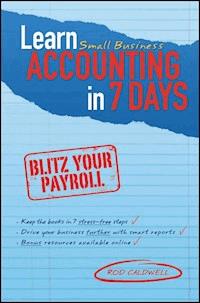
Learn Small Business Accounting in 7 Days is your step-by-step guide to managing the accounts for your business.
This small business guide moves beyond this basics covered in Learn Bookkeeping in 7 Days, exploring the trial balance stage, end-of-period adjustments, final reports, payroll and all that's in between. In 7 quick and easy steps this book arms you with the knowledge you need to successfully manage the financials of your business.
Packed full of tips, tricks and traps, this is essential reading for all small business owners and anyone wanting to quickly and easily learn accounting.
Sie lesen das E-Book in den Legimi-Apps auf:
Seitenzahl: 231
Veröffentlichungsjahr: 2011
Ähnliche


















LEARN SMALL BUSINESS ACCOUNTING IN 7 DAYS
Table of Contents
Day 1
We are at war!
This book is a shield
What is covered in this book?
What influences financial decisions?
Who wants to know?
What is a small business?
Small business tax concessions
Cash versus accrual
Small business structures
Sole proprietorship
Partnership
Family trust
Companies
Now we get complicated!
Chart of accounts revisited
Assets
Liabilities
Equity or proprietorship
Revenue or income
Cost of sales
Expenses
Other income and expenses
Accounting conventions and doctrines
Day 2
What is an asset?
Materiality
The cost of an asset — GST or no GST?
Second element costs
Repair and second element costs
Replacement items
Accounting for assets
Depreciation and amortisation
Micro businesses using the simplified depreciation rules
Low balance assets
Disposal of an asset
The total of all closing values is in credit
The total of all closing values is less than $1000
GST included in the cost
Standard depreciation rules (capital allowances)
Assets to which the capital allowance rules do not apply
Low cost assets of less than $1000
Closing value less than $1000
Assets in excess of $1000
Effective life
Learn by example
Recording the depreciation charge
Disposal of an asset under the UCA rules
Private use of business assets
Assets register
Special rules
Industrial buildings and structural improvements
Primary producers
Software and website development costs
Other special provisions
Motor vehicles — a special case
What is a car?
Business vehicles that are not cars
Motor vehicles that are cars require substantiation
GST and substantiation
Claiming the GST on motor vehicle purchases
Disposal of the motor vehicle
Balancing charge event
Cars for employees
Day 3
What is inventory?
Asset, inventory or consumable?
Cost of inventory
Recording inventory purchases
Periodic inventory system
Perpetual inventory system
Computerised accounting
Inventory management systems
Small business entity (micro businesses)
Annual stocktake
Inventory valuation methods
Procedures for undertaking an annual stocktake
At what date?
Step 1 — stocktake sheets
Step 2 — records update
Step 3 — records review
Valuation
Tax considerations
Inventory internal control systems
Private use of inventory
Work in progress
Primary production — livestock
Day 4
What is end of year?
Bookkeeping, accounting and taxation
The end-of-year process
Impairment review of assets
Inventory
Depreciable assets
Debtors
Other assets
End-of-period adjustments
GST and other taxes — end-of-period adjustments
Categories of end-of-period adjustments
Inventory
Depreciation
End-of-year ‘matching’ adjustments
Prepayments — alternative treatment
End-of-period accounting
Closing off the books
End-of-year accounting reports
Day 5
What is meant by cash?
Controls over cash
The float
Daily banking
Petty cash
Fraud — it will never happen to me!
Internal controls
What to do if fraud occurs
Internal cash control methods for small businesses
Internal control of cash
Internal controls for cash receipts
Physical protection of cash receipts
Securing cash at the end of the day
Internal controls for cash payments
Cash management
Debt management
Debtor management
Record retention
Step one — a good filing system
Step two — archiving and record retention
Day 6
The legal requirements of employing staff
Tax residency
Tax-free threshold
Higher education loan program
Financial supplement debt
Employee requests
Wages and salaries
Ordinary time earnings
Penalties and allowances
Allowances
Superannuation
Putting it all together
Doing the calculations
The payslip
Payday accounting
Annual reporting requirements
Day 7
Paying the boss — drawings versus salary
Employee or contractor?
Tax offsets
Holiday leave loading
Medicare levy variation
Termination of employment
Taxation of unused leave entitlements on termination
Employment termination payments
Keeping records
Payroll fraud
Phantom employees
Records manipulation
An overview of fringe benefits tax
FBT exemptions
Accounting for employee’s private use
Private use by company owners
Accounting for FBT
A final note on FBT payments
Appendix A: FBT gross-up factors explained
Appendix B: Useful resources
Appendix C: Revision exercise solutions
Appendix D: Glossary
Rod Caldwell
For my darling wife Robyn, without whose support and encouragement this book would never have been written.
First published 2011 by Wrightbooksan imprint of John Wiley & Sons Australia, Ltd42 McDougall Street, Milton Qld 4064
Office also in Melbourne
Typeset in 11.3/14 pt Berkeley LT
© Rod Caldwell 2011
The moral rights of the author have been asserted
National Library of Australia Cataloguing-in-Publication data:
Author: Caldwell, Rod.
Title: Learn small business accounting in 7 days / Rod Caldwell.
ISBN: 9780730376798 (pbk.)
Notes: Includes index.
Subjects: Small business — Accounting.
Dewey number: 657.9042
All rights reserved. Except as permitted under the Australian Copyright Act 1968 (for example, a fair dealing for the purposes of study, research, criticism or review), no part of this book may be reproduced, stored in a retrieval system, communicated or transmitted in any form or by any means without prior written permission. All enquiries should be made to the publisher at the address above.
Cover design by Xou Creative
Tables 2.7 and 3.5 and Figures 6.1, 6.2, 6.3, 6.6, 7.1, 7.2, 7.3, 7.4 and 7.6 © Australian Taxation Office. The ATO material included in this publication was current at the time of publishing. Readers should refer to the ATO website www.ato.gov.au for up-to-date ATO information.
Printed in Australia by Ligare Book Printer
10 9 8 7 6 5 4 3 2 1
Disclaimer
The material in this publication is of the nature of general comment only, and does not represent professional advice. It is not intended to provide specific guidance for particular circumstances and it should not be relied on as the basis for any decision to take action or not take action on any matter which it covers. Readers should obtain professional advice where appropriate, before making any such decision. To the maximum extent permitted by law, the author and publisher disclaim all responsibility and liability to any person, arising directly or indirectly from any person taking or not taking action based upon the information in this publication.
About the author
Rod Caldwell is a tax accountant by profession and a TAFE business lecturer by choice. He worked for the Australian Taxation Office (ATO) for 20 years before leaving in 2005 to start a new career as a lecturer in business studies at a Perth technical college. Rod has a bachelor of commerce degree from the University of Western Australia and a postgraduate diploma in advanced taxation from the University of New South Wales. Rod is also a Fellow of CPA Australia.
This book was written as a direct result of his involvement with small business owners through the Adult and Community Education courses he delivers in Western Australia. Rod is also the author of Learn Bookkeeping in 7 Days.
Additional resources are available from the author’s website www.tpabusiness.com.au. The author can be contacted by email at <[email protected]>. All comments from the readers of this book, students or lecturers are welcome.
Preface
Who should read this book?
Learn Small Business Accounting in 7 Days is aimed at the small business operator, often a home-based business, with an annual turnover of less than $2 million, as well as larger businesses with a turnover of up to $20 million. It is the second book in the Learn in 7 Days series, the first being Learn Bookkeeping in 7 Days.
This book assumes that the reader is aware of bookkeeping procedures to a standard at least equal to that covered in Learn Bookkeeping in 7 Days. It takes the reader from the trial balance stage, where we were at the end of Learn Bookkeeping in 7 Days, to the production of the final accounting reports. The book also covers payroll.
This book as a lecturer’s resource
If you are considering using this text for a non-accredited course in accounting, your course is probably a series of two- or three-hour sessions over six to eight weeks. This text has been deliberately constructed over seven evenly deliverable ‘days’ in order to facilitate this.
Resources for lecturers’ use, such as additional exercises and the exercise solutions, are available from my website at www.tpabusiness.com.au.
Rod Caldwell
Perth
May 2011
Day 1
Setting the scene
Key terms and concepts
International Financial Reporting Standards (IFRS): a legally enforceable set of accounting standards that apply to larger businesses.
Generally Accepted Accounting Practices (GAAP): a set of standards that apply on a voluntary basis to all entities.
Small to medium enterprises (SME): business entities that usually fall within the $20 million to $100 million turnover that are subject to IFRS.
Small business entity: a tax term for a business with a turnover of less than $2 million.
Lesen Sie weiter in der vollständigen Ausgabe!
Lesen Sie weiter in der vollständigen Ausgabe!
Lesen Sie weiter in der vollständigen Ausgabe!
Lesen Sie weiter in der vollständigen Ausgabe!
Lesen Sie weiter in der vollständigen Ausgabe!
Lesen Sie weiter in der vollständigen Ausgabe!
Lesen Sie weiter in der vollständigen Ausgabe!
Lesen Sie weiter in der vollständigen Ausgabe!
Lesen Sie weiter in der vollständigen Ausgabe!
Lesen Sie weiter in der vollständigen Ausgabe!




