


3,59 €
Mehr erfahren.
- Herausgeber: Pitkin
- Kategorie: Geisteswissenschaft
- Sprache: Englisch
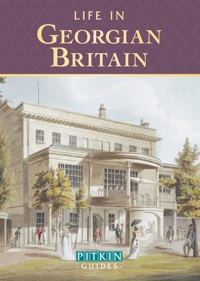
The eighteenth century laid the foundations for Britain's worldwide empire and economic prosperity. It was a period of great contrasts: between poverty and wealth, elegance and riotous ribaldry. This Pitkin Guide unwraps what made Georgian Britain in a fascinating text and beautiful contemporary illustrations. Look out for more Pitkin Guides on the very best of British history, heritage and travel, particularly the other books in the 'Life in' series: Medieval England, in a Monastery, Tudor England, Stuart England and Victorian Britain.
Das E-Book können Sie in Legimi-Apps oder einer beliebigen App lesen, die das folgende Format unterstützen:
Seitenzahl: 29
Veröffentlichungsjahr: 2000
Ähnliche




















Pitkin Publishing
The Mill, Brimscombe Port
Stroud, Gloucestershire, GL5 2QG
www.thehistorypress.co.uk
This ebook edition first published in 2013
All rights reserved
Text © Pitkin Publishing, 2000, 2013
Written by Michael St John Parker. The right of the Author, to be identified as the Author of this work has been asserted in accordance with the Copyrights, Designs and Patents Act 1988.
This ebook is copyright material and must not be copied, reproduced, transferred, distributed, leased, licensed or publicly performed or used in any way except as specifically permitted in writing by the publishers, as allowed under the terms and conditions under which it was purchased or as strictly permitted by applicable copyright law. Any unauthorized distribution or use of this text may be a direct infringement of the author’s and publisher’s rights, and those responsible may be liable in law accordingly.
EPUB ISBN 978-0-7524-9163-9
MOBI ISBN 978-0-7524-9162-2
Original typesetting by Pitkin Publishing
INTRODUCTION
IN 1700, AS A NEW CENTURY DAWNED, few people in the British Isles could have felt optimistic about the future. Still fresh in many memories were the strife and rancour of the Civil War, and the Glorious Revolution of 1688–89. Queen Anne, last of the Stuart monarchs, reigned until 1714. The succession had been decided by Parliament in 1701 and on Anne’s death, the crown duly passed to George of Hanover. So began the Georgian era.
From this uncertain beginning, Georgian Britain grew in wealth and power; trade, wars and voyages of exploration opened up new imperial vistas in Canada, India, Australia and the Pacific. In an age of elegance, epitomised by the landscapes of Capability Brown and the architecture of Adam and Nash, Georgian Britain also hummed with new ideas and energy. Breakthroughs in agriculture, industry and science laid the foundations for an industrial and social revolution that was to transform the nation. The 18th century proved a fortunate century for Britain: increasingly confident in the power of its navy and its industrial economy, proud of its liberties, and more assured of its unity. The Georgian dynasty survived the age of enlightenment and the turbulence of the American and French revolutions, to usher in the imperial and industrial dynamism of the Victorians. It was an age of high life and low life, every sort of extreme, splendour and sophistication: an age that left an elegant and entertaining legacy.
AN AGE OF REASON
WE CALL THE 18TH CENTURY the Georgian period simply because for most of that hundred years Britain was ruled by kings who were named George, but the adjective has also come to epitomise a culture.
Georgian Britain was economically prosperous, enterprising and sturdily self-sufficient; its politics were vigorous but essentially peaceable; its ruling aristocracy was preoccupied with the idea of liberty; its architecture, literature and art were all suffused with ideals derived from classical antiquity, but its religion was a stoutly Protestant, rather secular Christianity; its science was as rational and innovative as its manners were traditional and conservative. The lawyer William Blackstone described the British of his time as ‘a polite and commercial people’.
Education was highly valued even though the schools and universities were in a torpid state. There was a remarkable growth in learned societies, such as the Royal Academy, the Royal Society of Antiquaries and the British Academy.




