


Erhalten Sie Zugang zu diesem und mehr als 300000 Büchern ab EUR 5,99 monatlich.
- Herausgeber: Robert Hale Non Fiction
- Kategorie: Ratgeber
- Sprache: Englisch
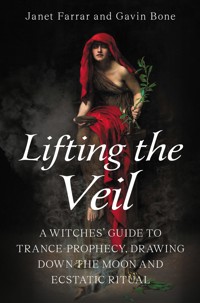
Written to fill the gap in available knowledge on trance, prophecy, deity-possession and mediumship within the neo-Pagan and Wiccan communities, Lifting the Veil has been developed from Janet Farrar and Gavin Bone's personal work and public workshops on trance-prophecy and ecstatic ritual over 25 years. The book covers the history and modern practice of trance as well as the methods of practice. It also explores the four keys to trance-prophecy, which include the importance of understanding mythical cosmology and psychology, understanding the role of energy in trance, the nature of spirits and deity, and understanding what trance is and the techniques involved. Because trance-prophecy is a very subjective process, the book includes descriptions of the personal experiences of others and transcriptions from several independent sessions by modern seers and priestesses.
Sie lesen das E-Book in den Legimi-Apps auf:
Seitenzahl: 632
Veröffentlichungsjahr: 2024
Das E-Book (TTS) können Sie hören im Abo „Legimi Premium” in Legimi-Apps auf:
Ähnliche


















Also by Janet Farrar, Stewart Farrar, and Gavin Bone:
The Inner Mysteries
The Healing Craft
The Pagan Path
The Complete Dictionary of European Gods and Goddesses (with Glenn Tyler)
Also by Janet Farrar and Stewart Farrar:
A Witches’ Bible: The Complete Witches’ Handbook
The Witches’ God
The Witches’ Goddess
The Witches’ Way
Eight Sabbats for Witches
Spells and How They Work
The Life and Times of a Modern Witch
First published in 2016 by Acorn Guild Press
This edition published in 2024 by Robert Hale, an imprint ofThe Crowood Press Ltd, Ramsbury, Marlborough Wiltshire SN8 2HR
www.crowood.com
This e-book first published in 2024
© Janet Farrar and Gavin Bone 2016
All rights reserved. This e-book is copyright material and must not be copied, reproduced, transferred, distributed, leased, licensed or publicly performed or used in any way except as specifically permitted in writing by the publishers, as allowed under the terms and conditions under which it was purchased or as strictly permitted by applicable copyright law. Any unauthorised distribution or use of this text may be a direct infringement of the author’s and publisher’s rights, and those responsible may be liable in law accordingly.
British Library Cataloguing-in-Publication Data
A catalogue record for this book is available from the British Library.
ISBN 978 0 7198 3163 8
The right of Janet Farrar and Gavin Bone to be identified as the authors of this work has been asserted by them in accordance with the Copyright, Designs and Patents Act 1988.
Cover design by Sergey Tsvetkov
Cover art by John Collier, “Priestess of Delphi” (1891)
Figures and illustrations by Marc Potts, Tommy Lindeman and Gavin Bone
Photo page 275 © 2016 Michel De Groot
Foreword by M. Macha NightMare
Preface
Part I:The History of Trance in Ancient and Contemporary Pagan Spiritual Tradition
Chapter 1 Sibyls and Shamans: Ecstasy and Trance in Ancient Times
Chapter 2 Mediumship, Spiritualism, and the Magical Revival
Chapter 3 Modern Trance Traditions: Shamanic Witchcraft, Seidr, and Vodoun Trance States
Chapter 4 Dancing With the Divine: Personal Experiences of Trance-Prophecy
Chapter 5 The Philosophy and Purpose of Trance-Prophecy: Prediction or Divine Direction?
Part II: The Four Keys to Trance-Prophecy: The Methodology of Oracular Work
Chapter 6 The Seer and the Psychopomp: Roles and Training in Trance-Prophecy
Chapter 7 The First Key: Understanding Spiritual Cosmology and Psychology
Chapter 8 The Second Key: Understanding Spiritual Energy
Chapter 9 The Third Key: Understanding Trance and Its Techniques
Chapter 10 The Fourth Key: Understanding Divinity and Spirits
Chapter 11 The Underworld Descent Technique: Creating an Oracular Ritual
Part III: The Practice of Trance, Prophecy, and Possession in Modern Paganism and Witchcraft
Chapter 12 Wiccan Drawing Down the Moon: Understanding and Enhancing the Experience
Chapter 13 Drawing Down the Moon: Its Origins and Practises
Chapter 14 Ecstatic Ritual and the Sacred Procession: The Gods Entering through Dance, Drumming, and Singing
Chapter 15 Divine Mysteries: Sex With the Gods
Chapter 16 The Oracle of the Dead: Speaking with the Deceased
Chapter 17 And Now a Word from Our Sponsors: The Gods Speak
Appendices
Appendix 1 “Leviter Veslis (Lift Up the Veil)”
Appendix 2 The Rite of Drawing Down the Moon and The Charge of the Goddess
Appendix 3 Prayer to Selene (from the Papyri Graece Magicae)
Bibliography
Glossary
Photographs
1 The Temple of Apollo in Delphi, Greece (photo courtesy www.dreamstime.com).
2 Michaelangelo’s Libyan sibyl, the Sistine Chapel, the Vatican, Rome (photo courtesy Wikipedia Commons).
3 Leila Waddel performing during the Rites of Eleusis, 1910. Taken from The Sketch, August 14, 1910..
4 Barbara Vickers, Gerald Gardner’s first initiate and a practising medium (photo courtesy Vickers’ family and Phillip Heselton).
5 Diana Paxson in traditional Norse dress, at Thingvellir, Iceland, 2002 (photo courtesy Diana L. Paxson).
6 Vodoun ceremony, Jacmel, Haiti. (Photo by Doron, under license: https://en.wikipedia.org/wiki/GNU_Free_Documentation_License)
7 Priest possessed by Dionysus during a neo-Pagan Blessing of the Vines, Tuscany, Italy, July 2010 (photo by Gavin Bone).
8 Neo-Pagan Blessing of the Vines, Tuscany, Italy, July 2010 (photo by Gavin Bone).
9 Three Seers—priestesses of Freya, the Morrigan, and Aphrodite—prepared for trance-prophecy ritual before the goddess’ appropriate altars, at Pagan Gathering Europe, 2008 (photo by Gavin Bone).
10 Drawing Down the Moon in Wicca. Janet and Stewart Farrar with their coven in Drogheda, Ireland, 1984 (photo by D. Hooley).
11 The traditional Hastings Jack-in-the Green Festival, which takes place every Beltane (May the 1), has all the hallmarks of a surviving ecstatic ritual, including a mock sacrifice of “Jack.” (Photo by Thomas Smith, courtesy www.dreamstime.com.)
12 Thaipusa devotees allow themselves to be skewered and hooked so they can hold not only fruit and weights but also elaborate bamboo designs. Taken at the Thaimpusam Festival, Little India, Singapore. (Photo by Wisnu Haryo Yudhanto, courtesy www.dreamstime.com.)
13 The Nekromanteio or Oracle of the Dead at Ephyra, Greece, was one of the most intense sites of ritual for connection with the souls of the dead in the ancient world. (Photo by Pavle Marjanovic, courtesy www.dreamstime.com.)
14 Priestess Anthea possessed by Aphrodite during tranceprophecy ritual (photo courtesy and copyright Michel De Groot. Used by permission).
Illustrations
1
Web of Wyrd
Gavin Bone
2
Deity Aligning with Chakra System
Marc Potts
3
The Path to the Bridge and Gates
Thomas Lindemann
4
Drawing Down the Moon
Thomas Lindemann
5
Nietzchian Ritual Scale
Gavin Bone
6
Energy Exercise
Marc Potts
Back in the days when most Witches and Pagans lived in the shadows of the broom closet, we had little contact with one another. There was mistrust. Because of the necessity for discretion—dare I say secrecy?—few practitioners of the Craft knew each other. Most of us feared being revealed. These fears were, in fact, well grounded. There was real danger of persecution or, at the least, disapprobation. Today we’re more visible, and in some segments of society accepted, although sometimes reluctantly.
Due to this wariness, opportunities for us to discuss and compare experiences and techniques were rare. As a result, there was little uniformity in the ways certain techniques, which I call “sacred technologies,” were taught.
Nor did we have a commonly understood vocabulary for these various phenomena. I think there’s a lot of confusion among terminologies. Add to that cultural differences and you don’t have much cohesion; you lack a mutual language and understanding. The glossary in Lifting the Veil helps immensely, as does the entire book.
We know that ‘mediumship’ is not ‘prophecy,’ for instance; nor is ‘Drawing Down’ parallel to being ‘ridden’ by a loa. Thanks to the glossary provided herein, we have a vocabulary, if not necessarily universally agreed upon, that facilitates discussion about the material in this book.
In addition to lacking any corpus of proven practices, many individual practitioners achieved successful deity contact due to inherent talent rather than through a broader knowledge, and subsequent practice, of the particular sacred technology. This fact led to the mistaken conclusion that only certain gifted persons were capable of what we then called “Drawing Down.”
My own knowledge lacked a solid foundation in Drawing Down and aspecting because at that time my primary teacher (who today is well known) was still developing her own teaching skills. As a result, at the first informal class I attended, when I was eight months pregnant, the teacher drew down the Goddess into my body, except that I had no clue and no preparation. So I stood there, receptive and listening, but hardly achieving a different state of consciousness.
From that class on, the teacher began invoking, or directing everyone present to invoke, deity into everyone present. I cannot attest that I felt it was especially moving, although I did, for the most part, love the words.
Following closely upon that practice, the pro forma practice became one priest/ess speaking words intended to imbue everyone in the circle with the presence of the particular deity being invoked.
It’s always bugged me when I see individuals using the opportunity to ‘carry’ a deity for self-aggrandizement and ego. I’m sure readers have encountered similar situations. I’m sure you recognise when someone is faking it. Now it’s understandable that a technique for manifesting the divine within a particular individual just doesn’t work every time. And we Witches do have The Charge of the Goddess as a backup, as the authors discuss.
Once I attended an event put on by a local “psychic institute” that purports to teach such things as trance mediumship. Well, I have strong streak of skepticism, which I happen to think is beneficial when exploring spirito-magical worlds. So I view these events with something of a jaundiced eye. And what I witnessed earned my leeriness.
The “channelers” or “trance mediums,” as they were called, sat in a row of chairs on an elevated stage, where alleged adepts stood behind them and waved their arms over the heads of each medium, perhaps spoke into their ears, and voila! a deity was assumed. I didn’t see much change in visage. It was when these channelers (media?) began to speak, however, that my suspicions were confirmed. The language they used—I especially remember the channeling of ever-popular “Aphrodite”—was psychobabble, pretentious pseudo-psychological gibberish. It doesn’t take an adept to spot a phony in such a scene.
I’ve also seen people speak authoritatively about something they deem must be done, being bossy and pushy and insisting it’s the god making those demands. Such people avoid taking responsibility for their actions by blaming their bad behavior on the deity. Those present who are new to such activities tend to be more credulous, allowing such scammers to con them into believing what they see. But alas, the world is full of flimflamming ego-trippers. It’s best to avoid them.
On the other hand, when I’ve witnessed what I identify as genuine deity assumption, the human begins to move differently from her everyday way of walking, to speak in a different voice, to use language differently, and to display a change of visage. Often the person’s “tender” or partner in the work needs to work hard to restore the person to a normal state of consciousness.
The effects upon a person ridden by a loa can be even more dramatic, and can require greater efforts on the part of those maintaining a normal state of consciousness to ease the ‘horse’ back to normalcy when the loa departs. In such cases, there is a tradition within the group; there is a community familiar with the phenomena and prepared to accept the change as well as to assist in reintegration.
The authors repeatedly remind the reader that humility is essential in order for anyone to genuinely achieve one of these nonordinary states. They emphasize the importance of mutual trust and understanding within a given group. Deity assumption and related states of consciousness are not, in my view, performance art. They require the surrender of individual consciousness, stepping aside from one’s own personality, an ability to let go of personal masks. In other words, these techniques cannot be successful if they are ego-driven.
Asserting that ecstatic techniques of shamanism evolved and became incorporated into religions, Witchcraft in particular, the authors have explored mediumship, channeling, aspecting, Drawing Down, prophecy, and these many similar, related, and overlapping phenomena. They’ve provided useful information from around the world, from different historical times, in different locations (for some, such as oracles, are place-centered), in different ethnicities and religions, showing readers the universality of these different names for different but related phenomena and sacred technologies. This reminds us that religious traditions and their dogmas are human-made.
Also of great help to our understanding is the inclusion of reference to Nietzsche’s theory of Apollonian and Dionysian approaches promulgated in his book The Birth of Tragedy. Although Nietzsche offered this theory to explain the dramatic arts, I find it’s very useful in helping us—well, me, at least—understand different styles of religious practice and different approaches to teaching. The former tends to be more orthopraxic, the latter more ecstatic. Orthopraxy tends to be more predictable. An Apollonian view tends toward distance and objectivity. Dionysian ecstatic practices, on the other hand, open participants to the unexpected, the extreme, to untamed wildness. The Dionysian does not invite analysis or quantification.
Generally, Witchcraft, if not other expressions of Paganism, tends to be orthopraxic: you perform certain specific acts, using prescribed language, and you achieve what you achieve—or not. Not every participant in a ritual will necessarily have the same experience as anyone else in the circle. The specific meanings and experiences of these rites are personal. This method eliminates the need for dogma.
The authors explore various approaches to achieving other-than-human states of consciousness, how to foster them, how to aide the changed-consciousness individual, how to restore one to normal consciousness (reground), how to evaluate the success, although what constitutes “success” is indeterminate and subjective. I am happy to see this book is a valuable addition to a growing corpus of work by many practitioners and thinkers about what our Pagan religions are all about.
M. Macha NightMare (Aline O’Brien)
Witch at large, activist, and ritualist
San Rafael, California
Midsummer 2015
“For mine is the ecstasy of the spirit …”
—The Charge
In recent years, there has been an upsurge of interest in the subject of trance-prophecy within the neo-Pagan movement. It is probably important to first define what we mean by trance-prophecy, as undoubtedly there will be some reading this book who are unfamiliar with its modern practice. We use the term trance-prophecy to define a collection of methods found in many different traditions, ancient and contemporary. They embrace trance to connect to the divine in its different forms, the purpose of which is to communicate with divinity and ask for guidance. This can take the form of simple visualization exercises, such as pathworkings, all the way to full possession by the deity’s spirit. It can also include ecstatic states on a personal level and as a group experience brought on by trance and ecstatic ritual. This is found in ancient traditions, such as the Dionysian practises of Greece and in contemporary traditions such as Vodoun, where the participant may be “ridden” by a loa (also spelled lwa or lwha, and pronounced “low-ha”), a deity or ancestral spirit. As we are writing this book primarily for Western neo-Pagans, we decided to title it Lifting the Veil: A Witches’ Guide to Trance-Prophecy, Drawing Down the Moon, and Ecstatic Ritual for several reasons. We decided on Lifting the Veil as it refers to the red veil of the sibyl and seeresses of ancient times, particularly the Oracle at Delphi, while also being a secondary reference to “The Leviter Veslis”—the piece of prose originating from Gerald Gardner, which was the basis of Doreen Valiente’s “Charge of the Goddess.” We are, of course, not the first to use this as a title. Diane Champigny, one of the contributors to chapter 4, used it as the title of her contribution to the book Priestesses, Pythonesses, Sibyls (edited by Sorita d’Este. See Bibliography). We, therefore, believe that in all fairness we must give Diane credit to this title as much as ourselves. Of course, the “lifting” in the title suggests the intention of this book—to show the face of the sibyl, the face of the mystery of oracular work. While it is our intention to do this throughout the whole of this book, nothing sums up this statement more than chapter 4 where several practitioners of trance techniques “lift their own veils” and share their personal experiences with trance.
Initially we thought about titling this book Diana’s or even “Hekate’s Children.” At first this may seem odd, but Diana, as Aradia, was present from the moment Gardner (and Valiente) conceived Wicca and gave it birth. Like all good organic works, it evolved beyond its initial working title. This is mainly because trance-prophecy goes beyond any one tradition of neo-Paganism. Our emphasis in this book is on Witchcraft and Wicca because it was the first neo-Pagan tradition,* excluding of course, contemporary traditions such as Vodoun, which has a trance technique built within its ritual structure.
Modern Witchcraft has had several ‘aunts’ and ‘uncles’ who have assisted its growth. From the aforementioned Gardner and Valiente, through to its rather eccentric Uncle Alex (Sanders), the esteemed Uncle Buckland, and on to the many competent teachers who did not just teach those entering into the Craft but have also guided its development and evolution. What was once Gardnerian and Alexandrian Wicca has evolved into other traditions of Witchcraft. Some have been more willing to explore and push the boundaries, which includes the areas of trance states. Diana, as Aradia, can be seen as the “Fairy-Goddess Mother” of this evolution. She acted as its inspiration, as well as the spiritual teacher who whispered words of guidance into the ears of her high priestesses during trance. Her inclusion in Wicca was very much due to the fact that the only truly traditional Witchcraft source material existent in the early days was from Leland’s Aradia, which was first published in 1899 (although we accept that some still debate its origin and authenticity). Of course, as time went on, those within Wicca have realised that Diana was one of many goddesses of witchcraft. By the 1990s her job was done; now other deities were being embraced, not just those of the Western world, including Isis, Freya, Hekate, and Cerridwen, to name a few, but also those from other cultures: the Durga of India, Kwan Yin of Buddhism, and the loa of Vodou, and orisha of Santeria. After all, spirituality knows no boundaries, and when our beloved Stewart (Farrar) described the world as “a global village” in the early ’90s, he was not just talking about the social and material world but also spiritual. This has, of course, created a dilemma for those who are more comfortable embracing the Judeo-Christian paradigm of “boxing” and labelling the magical traditions of the West. What happens when a priestess of Isis channels an orisha such as Oshun? Should she say, “Sorry, you are not part of my tradition, go away!” or should she recognise that spirit and accept its validity? Some would say, “Well, that doesn’t happen, does it?” But our experience, as well as that of others, is that this does occur. This is an important point to realise for anyone who is planning to study trance-prophecy seriously—it is a tradition of experience rather than one of academia or the human need to apply rules to the higher realms. What happens when the deity has other ideas? Who is right and who is wrong? Our view is that the deity-spirits make the choice, not man, and that traditions should change according to the experience of their practitioners. This is the divine nature of spiritual evolution.
A book based on experience will always have a subjective element to it. To use this book, it is necessary to discuss how we embarked on this strange journey, which, of course, gave us some advantages in understanding the subject. Janet’s journey started from an early age when she began to get spirit manifestations in her garden in Leyton in the late 1950s. For Gavin, it was when he first entered a Spiritualist temple in the early 1980s to learn about healing. We shall go into more detail on this in the next paragraph, but for us, it has been a journey related to what we have believed to be at the core of Witchcraft: the experience of divinity, of God and Goddess; the union, both personal and divine, with the Ultimate, the Divine Spirit, which manifests around the world as the many faces of the divine: the gods and goddesses who gave birth to the cosmos. We independently made a connection with Freya, the Northern European Goddess more commonly known as a goddess of love and beauty. In her older form as Freya-Vanadis, she was the goddess of trance and prophecy, and much of what we know about Norse cosmology comes from one of her valas or seeresses. In fact, we would have little knowledge of Yggdrassil and its nine worlds if it was not for the one seeress whose words were put to paper as the Voluspa (“Song of the Seeress”) in The Poetic Edda. We are dedicated as priestess and priest of Freya, acting as her servants and performing her wishes; and one of her wishes has been to speak and to allow the other deities to speak. She has not been the only one we have made connections with, although she remains our patroness. Hekate, Brid, and several others including those of Hindu and African origin have made their presence felt and made it clear to us that the old gods are “awakening” and want to communicate with us. This has very much become the focus of our work over the last decade: teaching that the deities of ancient paganism are real and wish to have their say in the world again after a gap of over one thousand years. With this connection comes the ecstatic experience hinted about in the title, an experience more often associated with shamanism. We are not the only ones, though, who have come to realise the importance of this work in the evolution of neo-Paganism: Diana Paxson, Jenny Blain, and Ivo Dominguez are all advancing neo-Pagan boundaries and encouraging reconnection with the divine.
As we mentioned, we feel it is important for the reader to understand our origins and the experiences we have had in dealing with spirituality. As most readers are aware, Janet was originally initiated into Wicca by Alex Sanders in the early 1970s. What most may not be aware of is that she was born a natural medium, although for years she had no idea that this was a gift. Her mother, Ivy, probably had “the sight,” too, but as she died when her daughter was very young, Janet can only go by what her family has told her over the last ten years. It does seem that while she was in her mother’s womb, her mother had an encounter with the spirit of a Druid, who pointed at the Ivy’s pregnant belly and in the process nearly scared her half to death! Such was the furore this incident caused, that the police were called in to hunt for the strange intruder. It is surprising that Ivy wasn’t incarcerated for the remainder of her pregnancy—well, you try telling the police about a bearded man wearing plaid and brandishing a sickle! It is interesting that her mother’s ancestry was Southern Irish and her father was Welsh, traceable back to Owen Glyndwr, the Welsh Prince. Owen was a Druid and, if we are to believe the statement in Shakespeare’s Henry IV, also a magician: “I can conjure devils from the vastly deep” was supposed to be one of his most famous statements. It is known that many of Janet’s ancient ancestors died on the Isle of Anglesey attempting to protect the druidical stronghold against the Roman Governor Suetonius Paulinius in 60 CE. Even today, many modern Druids will spit at the mention of this Roman’s name. Janet’s father, Ron, a devout Christian, also had a little of the sight into the spirit world. When he encountered his first member of the sídhe, the Celtic otherworld people, his reaction was a mixture of delighted surprise and Christian blessings. “Well,” he said, “they are God’s children, too!” From the age of five through puberty, Janet saw many of the spirit forms we mention in this book including the Fey, departed human souls, and what at the time she believed to be angels. Initially this was clairvoyance; she experienced it in visions. Later she also heard them, developing clairaudience after many years. The first deceased human spirit who spoke to her was her next-door neighbour, Kathy, with whom she was very close. The week following her death, she materialised beside Janet’s bed, kissed her on the cheek, and thanked her for the requiem she had cowritten with Stewart. (That same requiem appeared later in the book A Witches’ Bible.) It is not surprising, therefore, that Janet took her abilities with her into Wicca. In fact, it was her innate mediumship abilities that attracted several occultists to Janet, as well as her ability to easily invoke specific goddesses into herself during the process of Drawing Down the Moon, which she had been taught in Alex and Maxine Sander’s coven.
Gavin is not a natural medium, although he was born empathic and is energy sensitive, making him an effective spiritual healer. This is reflected in this book’s sections on energy work, as the same gifts related to his healing also have worked to his advantage when acting as a psychopompos—a guide for those entering trance and descending into the underworld (see chapter 6). Although he had been attending Spiritualist Temple for some time, where he had been learning about spiritual healing, Gavin’s first introduction to spirits came about after the first group ritual he was ever involved in. It was the mistakes of this group of would-be Witches, none over the age of twenty-four, with little knowledge of what they were doing, which started Gavin on his path in Wicca and in the realms of the spirits. It started with a mutual friend holding a dinner party, and resulted in a Samhain ritual on the south coast of England in the wind and pouring rain. When it was over, everyone was fine except for Gavin. He felt uneasy for a while afterwards, but he didn’t know why. The group came together a couple of times after this to discuss the ritual. Someone pointed out that no circle was cast and that it seemed customary in most rituals to cast one. Gavin had walked away with company of a spirit nature; it was nothing serious, but it did prompt him to seek advice as the uneasiness grew. Your average person would not have had this problem, but Gavin was empathic, giving off energy that attracted such entities. It was easily cured by removing the lower-form entity through spiritual healing. On the positive side, this resulted in Gavin’s introduction to his first magical group at the shop where he sought advice and healing. It was an interesting group of people. There were several spiritualist mediums, at least one of them being a Sufi practitioner, and a Cabalistic ritual magician. Gavin was the youngest member. For several months, Gavin worked with the group at every full moon. He got a real understanding of the importance of spirits in magical work. He discovered that it was not possible to separate working with spirits from magical practise. Mediums had always been incorporated into the Western Tradition of magic, although this was not Gavin’s path in the long term. When he trained and qualified as a registered nurse, he realized he was, in fact, “sensitive” to spirits. This came about from his exposure to death on a regular basis; he quickly found himself assisting many of his dying patients to pass spiritually over to the other side, particularly those who had died suddenly without warning and were at risk of becoming trapped between worlds. This is a subject we felt was very necessary to cover in this book, as anyone sensitive to the gods and goddesses as spirit forms will also be sensitive to other spirit forms.
It became very apparent to us when writing this book that it was necessary to cover many overlapping subjects, which anyone embarking on an exploration of trance would inevitably have to study. Obviously, our emphasis comes from our Wiccan backgrounds, which means we naturally put an emphasis on Drawing Down the Moon, although in recent years we have moved away from more orthodox Wiccan practices, and embraced and experimented with other Pagan traditions to get to the root of the trance experience. In a subject so vast, it is easily possible to write several books on the topic of oracular work. We leave this to such accomplished writers on the subject as Diana Paxson (see chapter 3), and have decided instead to create a guide for Witches and neo-Pagans who are encountering the subject for the first time. It should not be considered a definitive study by any means. This book also indirectly asks one of the most important questions facing the growing neo-Pagan community today: What is the ultimate purpose of spirituality and religion? For most people who decide to walk the spiritual path, this question is answered by their desire to connect with the divine, which manifests in Paganism as the myriad forms of gods and goddesses, past and present, found in the ancient and modern cultures around the world. It is the reason we came into Witchcraft, not for spells or magic, but to attain that connection, that feeling of union with a higher purpose—union with the Ultimate. The reality is that some will have the ability to connect more than others. Such people became the seers of the ancient religion of paganism, the priesthood. Their role was to connect for their communities, and relay messages from the spirits to their tribe or village.
The roots of the techniques, methods, and training systems we describe in this book started as a series of workshops in 2002 (the Inner Mysteries intensives), which quickly developed into full-on teaching of trance-prophecy in extended workshops, with amazing results. We discovered an untapped wealth of talent within the neo-Pagan community, and had experiences that few would believe, unless of course, you were there! Initially, the focus was on the Wiccan rite of Drawing Down the Moon, but as time went on, it became something more. The focus of these workshops taught four main things: working with magical energy, spiritual cosmology, the nature of deity, and the application of trance states in Drawing Down the Moon. While the first two—energy and cosmology—were originally used to give an underlying frame to ritual practise, it became very obvious that these subjects were applicable to the understanding and practise of trance-prophecy. As our experiences grew, it quickly became about applying an underlying system that could be used to teach anyone from any neo-Pagan background how to trance-prophesy. From all four core teachings, developed what we now call the Four Keys to Trance-Prophecy (outlined in chapters 7, 8, 9, and 10). We would like to point out that although many elements are of ancient origin, it is a modern system we have developed ourselves over the years. Apart from teaching a core system of trance that underlies most traditions, it was also important to teach it in a safe, controllable way. Quite simply put, if you aren’t ready for the experience and are in danger in any way by doing it, it won’t happen, as the techniques taught in the Four Keys have built-in safety mechanisms. Do the work, and what we teach here in this book will work for you in a safe manner. The same is true of the other method that we developed originally for teaching Drawing Down the Moon: the Underworld Descent Technique (chapter 11). Depending on your level of competency, this either works as a pathworking or as a method of trance induction. It is at the core of our training in trance and deity-connection techniques and, like the Four Keys, will only work on a higher level for you if you are ready to experience it. But when you are ready, the training you have learnt through these systems will enhance the experience and make it more controllable. This is important, as the subject of trance has always invoked strong emotions in many people; we are brought up in a society that teaches us to be in control rather than to “let go.”
Western culture has either encouraged us to dismiss the spirit world as fantasy or, if we are accepting of it, to be terrified of contact with it. It is something many neo-Pagans find themselves wresting with when they first become involved in trance-prophecy practises. It may seem strange to say this, but subconsciously we have been programmed to see communication with this realm as losing control of reality. For many, this is the realm of “maya,” of illusion. It means when first encountering someone who has the ability to talk to spirits in trance, we do one of two things: either dismiss the seer out of hand as needing possible counselling for psychiatric problems or, if we come into direct spirit contact, our reaction is one of fear, influenced more often than not by our monotheistic upbringing. We enter a state of fear and paranoia from a belief that we are possessed by an undesirable entity or ‘demon.’ This happens because our modern culture generally fails to recognise or accept that we humans have been surrounded by elemental forms, the dead, the gods, and many other perfectly joyous but invisible life-forms from the day we are born. We can honestly say that in all the years we have practised the magical arts, we have only once ever had to deal with a genuinely malevolent force. This was generated by a young alcoholic Witch with an axe to grind; this force being nothing more than an extension of his negative emotional state.
We do feel it important to point out that some of the traditional methods employed in native shamanistic techniques, particularly the use of hallucinogens, are fraught with dangers. While we are in no way prejudiced against the methods used in these aboriginal cultures, we do feel the use of herbal and fungal preparations, such as psilocybin mushrooms or ayahuasca, apart from their obvious illegality in some states, can have negative effects on the physical, mental, and psychic well-being of the Western practitioner of magic. We, therefore, cannot condone their use in any way. Any reference to them to them is purely for academic and anthropological reasons.
Regardless of your background, whether you are on an eclectic path or practising a specific tradition, whether you are a beginner or have been practising for many years, our hope is that even if you do not practise trance-prophecy, this book will be enlightening purely for its historical and magical aspects. And, of course, we hope that it will inspire you, the reader, to engage in the exercises we have outlined in this book in a safe way, therefore advancing the evolution of neo-Pagan practise.
No introduction would be complete without thanking all those who have contributed to the book. There are many: Courtney Weber, Tamrha Richardson, Gayleen Jacobs, Gede Parma, Susi Auth, Jaimie Plasiance, Diane Champigny, and Lora O’Brien, plus those not mentioned who are quoted throughout the book. Special thanks goes to those who took the time to read and check our work: Monte Plaisance for his help with the Greek language; Mary Caliendo for her help with the tantric aspects; our beloved Miriam, who did the first read through; and Macha NightMare for writing the foreword. Our thanks goes to all. Blessed be.
April 2016
Janet Farrar and Gavin Bone
Hernes Cottage
KELLS
Co Meath
Ireland
* We tend to use the terms Wicca and Witchcraft interchangeably throughout the book. This was common practice within our generation.
Dedicated to the memory of Maureen Wheeler (“Aunty Bunty,” 1938–2015), “a witch from the day she was born.”
Part I
The History of Trance in Ancient and Contemporary Pagan Spiritual Tradition
Chapter 1
On the east coast of Ireland, the green rolling hills and the agriculture that has gone on for centuries form a valley less than thirty minutes from where we live. At the bottom of the valley flows the mighty River Boyne. Her rushing torrent flows through many of the counties in Ireland, finally entering in to the Irish Sea at the estuary, just past the town of Drogheda. This river was sacred; it was sacred before the English came; it was sacred before the Normans and the Vikings came; and it was sacred before the Sons of Mil, the Keltoi or Celts, came. As you stand on the south side of the River Boyne, you see a sight that isn’t seen anywhere else in the world: a white wall of rain-polished quartz reflecting the sunlight back at you. This great wall is the face of Brugh na Boyne, or as it is more commonly known today, Newgrange. There is a predominant myth about Newgrange: it was the palace of Boann, the goddess of cattle and fecundity, which the Dagda, the Good God, gave to her. Eventually, Aengus Og, the god of wisdom and youth, wrestled it from her, but it remains named after her even today, and the area is still sacred.
Newgrange is a passage tomb that was constructed of quite a few hundred tons of rock over several generations. This burial mound nestles in the heart of Boyne Valley, where it broods expectantly, waiting for the sun to rise every winter solstice, its phallic rays piercing the vulva of the stone-mantled entrance, guaranteeing fertility of the cattle and crops of the ancient peoples who built it and lived in the Boyne Valley. At least once a year, or possibly more, the spirit-man or woman of the tribe would enter the cruciform chamber. But who were these peoples? Where did they come from? Nobody really knows, but they were travellers from the east, not the red-and blonde-headed Irish Celts that we see today. Rather, they were swarthy, dark Eurasians, possibly even relatives of today’s Saami-Lappish, Siberian, and Tunguska tribes. It was from them that the first spiritual and magical practises came to Ireland, as well as the rest of Europe. This was the cult of ecstasy and trance that is now commonly called “shamanism.”
But Newgrange is more than a tomb. To quote Stewart Farrar, in his sometimes gruff voice: “To call Newgrange a ‘tomb’ would be to call Westminster Abbey a family crypt.” It is a place where two worlds meet, where spirit touches the mundane world of man; where man can communicate with the world of the ancestors. Back in the mists of time, this journey began with a boat ride across the sacred river, what is now known as the River Boyne. This reflected in Greek myth of Charon ferrying the dead across the river Acheron. Then there was the climbing of the great stone, decorated in spirals and diamonds, which marks the passing into the transitory realm between life and death. Finally, there was the journey down the passage into the very heart of the dark, cold structure; a path which weaves like a serpent, narrowing as it descends into the central chamber. Carved on the stones on either side of this path are the patterns of journeying, the same spirals and diamonds found on the great entry stone, but also others more sublime.
Upon entering the chamber, the spirit-man found himself looking up at the great corbelled roof made of spiralling slabs. A roof that even today is jokingly referred to as “the driest in Ireland.” On both sides and straight ahead were the alcoves, where the remains of the ancestors were laid. These remains had been burnt, and powdered before being sorted into the stone basins found in each alcove. The skulls had been fractured at the back by a small marble hammer so that the spirit could leave, for this place was a place of the spirits; a place where the spirit-man could commune with them for the benefit of the tribe. This is where he could ask for their advice or assistance by entering a state of trance induced by chanting, wafting incense, and possibly by the use of hallucinogenic mushrooms, which grow abundantly in the valley around the River Boyne.
We do not know if the spirit-man returned to the world possessed by one of the spirits that he communed with, but it is a possibility, as we know that these same people were responsible for spreading shamanistic practises of prehistory. They were the shamans who dressed as deer, with skin and antlers, as we can see in the cave painting of Les Trois Frères in France, or of which we have accounts of from the Russian Steppes. Here the shaman was believed to be possessed by the spirit of the animal; the animal god, the Horned God, so that he could hunt his prey successfully. By doing so, he became both the hunter and the hunted, as he danced feverishly and ecstatically around the fire, while the men of the tribe symbolically killed him as part of the rites. During that time, he was the God who uttered predictions not only for the hunt, but also for the tribe in general, as the God-Spirit relayed messages to him in his ecstatic trance state. As time went on, the adorning of the animal skins and antlers would be used not just for the hunting rites, but also for magical practises such as healing when the power of the God-Spirit was needed. Although these were powerful experiences for the men of the tribe, they could not rival the effect the Goddess-Spirit of the Moon was having on the women folk of his tribe. The women seemed to enter such trance states more easily without the help of the mushroom spirits, which the men sometimes used to aid them.
The moon has always had a fascination for a man, and more importantly for a woman. It governs the flow of water, the tides of the sea, and the rising of the rivers. It was not long before a woman realised that there was a relationship between this heavenly body of the night and her monthly cycle of fertility and menstruation. She also realised that there were times when she was more intuitive and more psychic due to its influence; an effect that was lost on her father, her brothers, and her lovers. At its fullest, this Goddess of the heavens could induce some women to trance; to see visions more clearly than even the most accomplished shaman of the tribe. Sometimes they even became possessed by this dark Goddess-Spirit of the Moon and night, uttering prophecies and warnings, which even the most foolhardy would be stupid to ignore; those women become oracles. These oracles gained fame for their abilities, and were often visited from far and wide, which was customary around the Mediterranean. Of course, some oracles also travelled. This was the case in Northern Europe, where travelling was more limited due to geography and weather conditions. It was here that seidr or seith developed and continued to be practised for several centuries among what are known today as Germanic peoples. Undoubtedly a similar cult developed among the Celts, but little is known of these practises since not much was recorded. The early practises of German peoples were recorded by the Romans, most notably by Julius Caesar himself:
When Caesar inquired of his prisoners, wherefore Ariovistus did not come to an engagement, he discovered this to be the reason — that among the Germans it was the custom for their matrons to pronounce from lots and divination whether it were expedient that the battle should be engaged in or not; that they had said, ‘that it was not the will of heaven that the Germans should conquer, if they engaged in battle before the new moon.’ (Commentarii de Bello Gallico, Book 1, paragraph 50)
The Roman historian Tacitus describes a possible cult center in his work Germania, connected to the goddess Nerthus. Such centers were rare and not as common as the oracle centers of Greece and the classical world. The Northern oracles suffered at the hands of the Romans, as well as Christianity. The Northern European völva or vala, as she was known, was more likely to have travelled from village to village with her entourage during the seasonal cycles, rather than remaining in one place. On arrival at a settlement, she would often be perched on a high hill or on a platform specially built for her, where she would enter trance and answer questions prophetically, giving guidance on everything from planting crops to birth. This practise continued up until the early medieval period, with the last recorded vala practising in Iceland in the thirteen century.
The late demise of seidr practises among the Viking settlers of Iceland is pertinent for anyone studying trance-prophecy. And while there is some recorded history on these techniques, it does not come anywhere near the wealth of information we can obtain from the practises of Greece and the classical world. Even for modern seidr practitioners, those practises remain an important source of information on techniques and methods.
Alexander the Great and Siwah:The Oracles and Their Rise to Power
During the time of Alexander the Great (356 BCE to 323 BCE), it was said that there were ten known oracles in the world, which at that time stretched from the Western Mediterranean to the Black Sea. These were
• the Libyan sibyl at Siwah, Libya;
• the Delphic oracle at Mount Parnassus, Greece;
• the Cumaean sibyl on the Bay of Naples, Italy;
• the Samian sibyl on the Island of Samos, Greece;
• the Cimmerian sibyl, Crimea;
• the Erythraean sibyl, North East Africa;
• the Tiburtine sibyl, Rome;
• the Hellespontian sibyl at Marpessus, Greece;
• the Phrygian sibyl, Anatolia; and
• the Persian sibyls.
At these oracular centers, the prophetesses of the old religion of paganism plied their trade with the common persons, as well as the rulers of kingdoms. Empires and kings rose and fell according to the oracles’ prophecies, and the known world waited with baited breath at what their next words would be. Of course, there were some who doubted the prophecies, but few of them were willing to put these doubts into words in case they angered the gods, as each oracular prophet was a priestess or priest of one of the gods.
When Alexander the Great was young, his father, King Philip II of Macedonia, visited the Oracle at Delphi. It was predicted to him that his son, Alexander would one day rise to greatness and become one of the greatest rulers the world has ever known. In 332 BCE, Alexander, stirred by this prediction, visited the oasis of Siwah. His purpose was to consult the oracle of Ammon, and ask for guidance on how to defeat the all-powerful Persian army. This was one of the oldest-known oracles in the ancient world, having origins with one of the oldest-known seeresses, the wife of Ammon, or “God’s Wife.” This role in Egyptian society can be traced back as far as the Tenth Dynasty, 1470 BCE, and was always held by women of non-noble birth who served the gods Min, Amun, or Ptah. In the later kingdom, this position was changed, and it was then held by the wife or mother of the king. Going forward, there seems to be no evidence of oracular function, but this doesn’t necessarily mean that it didn’t take place. By the Twenty-Fifth Dynasty (747 BCE) there certainly is evidence of an oracle performing a prophetic role, but it was still primarily a political office and was often combined with that of the chief priestess of Amun. The oracular function was no doubt used to maintain the established political order, as any political decisions were always confirmed by the oracle through prophesies. As a child, Alexander had been brought up on the myth that both Heracles (Hercules) and Perseus had consulted this oracle before achieving greatness. His journey to the oracle was not uneventful: according to Ptolemy, Alexander and his entourage were escorted by two snakes which led them to the oracle, a place which was not easy to find among the shifting sands of the desert. Another account by Aristobulus states that they were escorted by two crows. Regardless, these signs and the subsequent prophecy from the oracle were seen as being divine intervention, which was to herald his conquering of the Persian army and led to him ruling one of the greatest empires of the ancient world.
The oracles gained such power and prestige due to the power of the human mind and the spiritual will of the individual. Many of the techniques used in classical times can still be found today in cultures we call shamanistic or magically trance-orientated: the Saami-Lappish, Native-American, the peoples of the South-American Rainforest, and the African diaspora religions of Vodoun and Santeria. This is because the oracles themselves originally derived from a time before the classical religions of Greece, Rome, or Persia appeared. The core of this practise was a belief in spirits of plants and animals, a belief in animism; that the world itself is alive, every stone and every object, animate or inanimate. From this simple belief developed the idea that it was possible to communicate with spirits, to ask them for help and guidance. Initially, the oracles were simple village people, prophesying for the tribe by communicating with the ancestors, the spirits of the dead, and with the many spirits of nature. As the belief in the classical gods and goddesses developed, they began to communicate with these “greater spirits” and convey their messages and their will to the people. The prophets passed their techniques down to their students, and news spread of their abilities far and wide. Soon they were not just divining for their people, but also for visitors and foreign dignitaries. The time of the great oracles had been born, and what was once a simple village, became a thriving temple of stone dedicated to the god or goddess of the oracle. Still at this time, the deities of trance were the goddesses of the earth—chthonic underworld deities, such as Gaea and Hekate. This was to change with the coming of the new gods and goddesses of order and light, such as the Olympian Apollo, whose priesthood suppressed the Dionysian rites of the old oracular goddesses.
Delphi and the Sibyls: From Dionysos to Apollo
The Oracle at Delphi remains one of the most famous and written about of the ten oracles in Greece and the ancient world. It is for this reason the oracle of Delphi is one of the most important ones to study when embarking on the practise of trance-prophecy. Delphi, positioned in lower central Greece, was neither the oldest, nor was it originally the most senior oracular site. It became important simply because of geography; its position was central to the major city-states of ancient Greece, which made it easily accessible to everyone. The oracle and the associated temples that surrounded it can still be found on the side of Mount Parnassus and in the Valley of Phocis, close to the Gulf of Corinth. From about 1400 BCE different peoples settled in the area, including the Minoans. This helped infuse the area with different cultures, which by 1000 BCE created a unique ecstatic tradition. Apart from the central figure of a seeress and the use of trance, the rites had little in common with what most classical writers wrote about after the eighth century. It was originally the site of a Dionysian cult, the memory of which was to continue in local myth: Apollo ruled the summer months, and Dionysos ruled the hillsides during the winter months. Originally the oracle was situated in a cave at Lykorei, some miles up the mountain from the valley. This is a common pattern in the spiritual cosmology of Europe, with entrances to the underworld commonly found on the side of mountains in the form of a cave. Where such caves were not present, as in the British Isles, passage tombs were constructed to perform the same role.
Photograph 1: The Temple of Apollo in Delphi, Greece
(Courtesy www.dreamstime.com)
The Temple to Apollo was built in 650 BCE, with other buildings and structures slowly being added to the temple complex (see Photograph 1). It was destroyed by an earthquake in 373 BCE and rebuilt forty-three years later. It was built in the same style as a Doric hexastyle temple, with the classic thirty columns in two rows on the three-step platform, or crepidoma. It was by climbing these that you reached the inner hestia, or hearth, where the eternal flame to Apollo burnt. Here was where the lower central chamber was situated—the adyton, where the seeress, the sibyl, sat, making her the central focus of the structure. The adyton measured only nine-by-twelve feet, and was reserved for the sibyl, the priesthood, acolytes of the oracle and, of course, those who had come to ask their questions. The oldest part of the complex was the omphalos stone, which represented “the navel of the earth.” It was kept in its original place, even though it dated to the pre-Apollonian period. In 586 BCE, a hippodrome, a gymnasium, baths, and accommodations were added for the athletes taking part in the Pythian Games. The Amphictyony League, a political and religious confederation of Greek states, added more treasuries. The most impressive was the Athenian Treasury, which was built to commemorate the Athenian victory at the Naval Battle of Salamis against the Persians in 480 BCE.* Even though zealous Christians destroyed much of the temple complex in the fourth century, the foundations of many buildings remain. Many were excavated from the eighteen century onwards.
Most writers on the classical period state that Delphi was a site of worship of “the Earth Goddess,”1 although only a few have given her a name. The site therefore links these practises to those in Northern Europe where Earth goddesses, such as Nerthus are also linked with prophecy. This suggests a common connection between earth goddesses and prophecy throughout Europe. She has been conflated with the Titan goddess Gaea or Rhea, even though there is plenty of evidence linking the oracle to the earlier cult of the Cybelean Siburi. The title Siburi means “cave dweller,” a term originating from Sumeria. A Siburi led Gilgamesh into the underworld, just as Medea later led Jason to recover the Golden Fleece in the classic story. Medea is clearly a sibyllae or sibyl; a prophetic priestess of Hekate. The term sibyl, in fact, derives from the word Siburi,* who were priestesses of the ecstatic cult of Inanna in ancient Sumeria (4000 BCE). Over the centuries, the Goddess Cybele was to emerge out of this cult, taking on many of its aspects. The cults of Hekate and Cybele were later to merge. Both goddesses hold Innana’s keys to the three worlds. The links with Dionysus and the maenads through this cult of ecstasy suggest that priestesses of Delphi were originally dedicated to Cybele’s service. A Boeotian plate found at Delphi dating from the middle of the fifth century supports this theory. The plate shows the Earth Goddess seated on her throne in front of the famous omphalos stone. She holds poppy heads, ears of wheat and, most importantly, a flaming torch. The poppy heads are clearly linked to ecstatic narcotic states, while the ears of wheat may be connected with the fertility nature of the Earth Goddess and the goddess Demeter. It is this last item, the torch, which is of importance. It is associated with Persephone, the daughter of Demeter, descending in to the underworld, as an aspect of Hekate and the earlier Cybele.2 In support of this, from about 550 BCE, the site became associated with Artemis of Eleusis, who had also merged with Hekate “to hold power equally in heaven and under the earth. Men paid honour to her both in association with her musician brother Apollo at the famous cult centers of Delos and Delphi and in combination with Hekate at crossroads as lunar and infernal deity. Above all else, however, Artemis was the divine symbol of chastity and its guardian.”3
The chaste nature of Artemis, no doubt, appealed to the patriarchal priesthood of Apollo. This association creates an interesting link between the modern Wiccan practise of Drawing Down the Moon (see chapter 12) and the Oracle at Delphi, as Artemis is, of course, the Etruscan Diana. Her association with Hekate, the Goddess of the three realms of heaven, the underworld, and the sea, were to further link the oracle with the earlier ecstatic period of the site. Eventually the cults of Cybele, Hekate, Persephone, and Artemis were all to be absorbed by the cult of Isis as the Great Mother Goddess during the Roman period. During the early years of the first millennium, Isis finally took over from Artemis in Delphi, Eleusis and Delos. Regardless of which name the Goddess took at Delphi, she was an ancient underworld goddess of ecstatic trance, whose chosen priestesses were, like the Suburi of Sumeria, young women who had just reached sexual maturity. Although goddess names may have changed, up until 800 BCE, there was clearly a continuing cult at Delphi which centered on an underworld goddess, whose symbolism changed very little over the centuries. The history of Delphi before the coming of the priesthood of Apollo is therefore essential to anyone analyzing the origins of trance-prophecy. Historically, it was a feminine ecstatic cult, and to use Nietzche’s term, a Dionysian one. The psychologist Nietzche used this term to define ecstatic ritual and ceremony in the form of theatre, just as he defined organised structured theatre as Apollonian.
By the seventh century, Delphi had become the most famous and most powerful oracular site in the known world, with visitors coming from everywhere, seeking the wisdom of the seeresses who prophesised there. Political changes resulted in Delphi being declared independent from the Phocians, who ruled it previously. The seat of the Amphictynoy League was transferred to Delphi. It was at this time that the patriarchal Apollonian priesthood finally had the opportunity to completely usurp the ecstatic feminine cult. The oracle center moved from the Lykorei cave, where it had once been situated, into the temple itself, which had carefully been built over the same system of volcanic fissures as the original cave. By shifting the oracle into a temple, they were able to reorganise and take over the internal workings of the oracle. These changes were rationalised in several myths, designed to explain the god Apollo’s right to be in charge of the oracle. According to the primary myth, found in the Homeric Hymn to Apollo, he took control of the area around Mount Parnassus when “the Gods of the sky vanquished the Gods of the earth,” symbolised in the myth by the infant Apollo killing the python, the dragon snake, who clearly represented the original ecstatic Earth Goddess, Gaea. This is important, because according to the myth, after Apollo’s victory, a dolphin swam out to a passing boat and chose its crew as his new priesthood for the oracle. Apollo represented the new patriarchal order of self-control and reason, which saw the excesses of the past as a threat to established order. The priesthood had never approved of the sexual excess which took place, or the lack of priestly control. Apollo was, after all, a god of moderation in all things. The older nature of the oracle could not be subdued completely; it was said that when Apollo wasn’t present, Pan played in the woods around the shrine, and the seeresses retained for some time their older title of pythia or pythoness.
It is said that after Apollo had slayed the python, its body fell into the volcanic fissure that the oracle was built around. Its decaying body created the fumes, which put the seeresses into trance. Symbolically, we see within the myth the descent of the seeress into the underworld (Jung’s realm of Shadow




