


12,99 €
Mehr erfahren.
- Herausgeber: Atlantic Books
- Kategorie: Lebensstil
- Sprache: Englisch
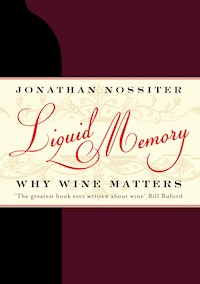
Jonathan Nossiter had his first taste of wine at the age of three in Paris, from his father's finger. For him, wine is 'memory in its most liquid and dynamic form,' as essential an expression of culture as film, books or painting. From the wine shops and three-star restaurants of Paris to the biodynamic vineyards of Burgundy, from the hipster bistros of New York to film locations in Rio de Janeiro and Athens, Liquid Memory investigates the infinite mysteries of terroir, the historical sense of place that makes wine a living, expression of cultural identity that can stretch back centuries. It is also a joyful master class in locating the soul of a wine, and in learning to trust your own palate and desires.
Das E-Book können Sie in Legimi-Apps oder einer beliebigen App lesen, die das folgende Format unterstützen:
Veröffentlichungsjahr: 2010
Ähnliche



















LIQUID MEMORY
Jonathan Nossiter is a film director and former sommelier. His feature films have won Best Film and Best Screenplay prizes at the Sundance Film Festival, and been shortlisted for the Palme d’Or at the Cannes Film Festival. He lives in Rio de Janeiro. Liquid Memory is his first book.
LIQUID MEMORY
Why Wine Matters
JONATHAN NOSSITER
Originally published, in different form, in 2007 by Bernard Grasset, Paris.
This edition first published in the United States of America in 2009 by Farrar, Straus and Giroux.
First published in Great Britain in hardback in 2010 by Atlantic Books, an imprint of Atlantic Books Ltd.
Copyright © Jonathan Nossiter, 2009
The moral right of Jonathan Nossiter to be identified as the author of this work has been asserted by him in accordance with the Copyright, Designs and Patents Act of 1988.
Every effort has been made to trace or contact all copyright holders. The publishers will be pleased to make good any omissions or rectify any mistakes brought to their attention at the earliest opportunity.
All rights reserved. No part of this publication may be reproduced, stored in a retrieval system or transmitted in any form or by any means, electronic, mechanical, photocopying, recording or otherwise, without the prior permission of both the copyright owner and the above publisher of this book.
1 3 5 7 9 10 8 6 4 2
A CIP catalogue record for this book is available from the British Library.
Hardback ISBN: 978 1 84887 455 8 eBook ISBN: 978 0 85789 210 2
Printed in Great Britain
Atlantic Books An imprint of Atlantic Books Ltd Ormond House 26–27 Boswell Street London WC1N 3JZ
www.atlantic-books.co.uk
To my wife, Paula, and our children, Miranda, Capitu, and Noah Bernard
CONTENTS
Introduction: The Liberty of Taste
PART I THE (NONE)SENSE OF PLACE
1. Why We’re Not Dogs
2. Legrand: The Old Curiosity Shop
3. Lavinia: The World of a Multinational
4. Lavinia and Burgundy: A Cosmopolitan Exchange
PART II WHAT DO WE TALK ABOUT WHEN WE TALK ABOUT WINE?
(With apologies to Mr. Carver)
5. L’Atelier de Jöel Robuchon: The Taste of Democracy
6. With (and Without) Alain Senderens: The Luxury of Having Taste
7. Le Dôme: Miss Rampling
8. La Cagouille: More Fish Tales
9. Chez Pantagruel: The Elitist Tastes (of the Democrat)
10. (Urban) Winespeak: Ex Nihilo, pro Nihilo
11. Tan Dinh: The Taste of Wine and the Words of Taste
PART III ALL ROADS LEAD TO BURGUNDAY
(In Search of the Holy Grail)
12. At the Home of Jean-Marc Roulot: A Vignerons’ Lunch
13. With Christophe Roumier
14. With Dominique Lafon
15. With Jean-Marc Roulot
PART IV THE TASTE OF AUTHENTICITY
16. Authenticity, Terroir, and Ideology
17. Authenticity: The Remake
18. The Special Olympics of Wine: New Is Always Better
Epilogue: The Fonsalette Mystery—Solved
Acknowledgments
Index
LIQUID MEMORY
Introduction
THE LIBERTY OF TASTE
This book is a highly personal journey through the liquid looking glass, an insider-outsider view of the world’s most mysterious, contradictory, and jubilatory drink. It’s an attempt to understand wine in its relation to culture (and even movies) and why that can bring pleasure to people who never even imagined putting a glass of wine to their lips (or for those who do drink but are, rightly, loath to talk). It might be a surprise to those justifiably wary of winespeak and wine snobbery to imagine that wine could be as powerful an expression of culture as books, paintings, cinema, music, baseball, and sex. Through an intimate examination of the relationship between taste and power as expressed in wine, I’ve hoped to uncover something of how wine expresses that relation in the world at large.
For those who’ve seen a film I made about the wine world, Mondovino, please note that this book is not a continuation of Mondovino by other means. While the film traces a kind of comic anthropology of the wine world, it barely brushes on the fact of wine itself, its taste, its use, its physical existence, and what has always fascinated me the most: its profound relation to the general culture. I grew up drinking wine by the finger drop at the age of two, courtesy of my expatriate American parents in Paris and their efforts to pacify four boisterous sons. As an adolescent in London, I spent my allowance on wine, in a quixotic attempt to improve my chances in the dating lottery. By my midtwenties, I was making wine lists for restaurants in New York and sporadically writing wine articles, which were even more sporadically published. But because filmmaking has been my primary craft for the last twenty-five years I’ve always been an outsider in the clubby, sometimes mafioso, and always culty world of wine. And this may be my one advantage for the lay reader.
At a dinner in Paris not long ago I was introduced to film director and formidable Parisian gadabout Anne Fontaine. Having heard I had some association or other with the wine world, she turned to me as I went to take my seat, sipping blithely from her wineglass: “Men who speak about wine at table are instantly condemned,” she hissed. “Death! The guy is done for. Conversation about wine is anonymous. A man isn’t speaking to me when he speaks about wine. He’s trying to prove something to me, but it has nothing to do with conversation. I think to myself: he’s a little macho shit trying to show off his power. Talking about wine is unbearably mediocre.” While this may be no more than one snob’s preemptive strike against another, I have to admit that I share her fear of the dreaded winespeak. Though it seeks to describe an innocent object of pleasure, I often have the feeling that the language of wine deployed by critics, sommeliers, restaurateurs, and the dreaded self-appointed wine connoisseur has most in common with Orwell’s vision of the willfully abusive inversion of language in totalitarian regimes.
Most winespeak—in any language—is designed not to enlighten or enchant but to exclude, bully, and belittle. What are we to think, for instance, if a critic assures us that we should spend $115 on a Washington state Cabernet because, as Harvey Steiman wrote in the Wine Spectator of July 2008 (the highest in circulation of the world’s rash of wine magazines), it’s “richly aromatic and brims with dark berry and currant aromas and flavors, shaded with espresso and dark chocolate overtones set against somewhat gritty tannins. A meaty note adds extra depth as the finish lingers on and on against the tannins. Best from 2010 through 2017”? Does he mean to say that our considerable investment will net us a substantial, if not entirely complete meal, beginning with the fruit cocktail, followed by a mystery meat, a chocolate dessert, and a postprandial coffee? And all of this with a mathematically determined shelf life, as scientific an exercise as predicting the eventual life-span of a child of two. Another wine writer at the same magazine describes a wine from the venerable Châteauneuf-du-Pape region in France like this: “A very grippy style, with lots of sweet tapenade, tobacco, hot stone and braised chestnut notes weaving through a core of dark currant and fig fruit. There’s a nice twinge of lavender on the structured finish. Best from 2010 through 2028.” Two thousand twenty-eight? Surely we’ve plunged through a (“dark berrylike”) hole and find ourselves, like Lewis Carroll’s Alice in Wonderland, trying to comprehend the Mock Turtle’s school curriculum, caught between “reeling and writhing” and “laughing and grief.”
Moreover, like the queens in Through the Looking Glass, there is, contrariwise, a diametrically opposed school of thought: the self-proclaimed populists, determined to dumb down wine at any cost. They urge us to “just say what you like and that’s what’s good,” like those signs in front of tourist mall art galleries that reassure us that “art is what you like.” With one insouciant phrase, they discount several thousand years of cultural and agricultural experimentation that have made wine interesting in the first place.
This book is an attempt to transmit something of the sensual and intellectual delight that wine has brought to me since childhood. It is intended for people who prefer not to be condescended to and yet who are rightly skeptical of jargon, defensive snobbery, or any use of power that obstructs the uncovering of one’s own taste. I don’t believe there are either rules or shortcuts to the acquisition of taste in relation to any subject of value and complexity. However, a few well-timed kicks to the rear end of the wine world (the part, alas, that leads us all by the nose) might help us appreciate why wine can in fact be a subject of universal value, whether or not we drink—or even think about it. A reappraisal of wine might also lead us to reconsider how and why we acquire a sense of personal taste (in wine, the arts, politics, anything) and how we might be able to affirm that crucial liberty without fear of intimidation by those who profess to know all—or, worse, by those who proudly profess to know little or nothing.
PART I
The (None)sense of Place
1
WHY WE’RE NOT DOGS
Terroir Is Where You Come From. Or Where You’re Going
The term globalization is frequently misused. This is particularly disturbing for me, a child of the globe. My father, Bernard Nossiter, an American journalist, moved our family from Washington, D.C., to Paris when I was two. I grew up across the cultures of France, Italy, Greece, India, and England, as well as the United States. So, where do I belong? A German filmmaker, Thomas Struck, told me that while riding his bicycle through the vineyards of the Rheingau, he stumbled across Stuart Pigott, one of the world’s most experienced drinkers of German wines. He asked Pigott, an Englishman who lives in Berlin, “What is your heimat?” Pigott paused before responding to this peculiar German term, which means, variously, “roots,” “origin,” “home,” or “homeland.”
“My heimat?” he repeated. “German Rieslings.”
I couldn’t agree with him more. Of course, my own heimat would include not just the Rieslings of the Rheingau, Mosel, or Franconia, but equally the wines of the Loire’s Vouvray or Burgundy’s Volnay. My heimat is globe spanning. It would also include the Aglianico del Vulture from the Basilicata region of southern Italy, which I drank recently in Rio de Janeiro, where I now live. Part of what makes it my heimat is that I drank this “Vulture,” a 1998 vintage from the producer Paternoster, in the company of my neighbors and fellow film directors, Karim Aïnouz and Walter Salles. Why is that a part of determining my heimat? Because the force of a wine—or any cultural expression (or expression of love, for that matter)—is also dependent on the context in which it’s understood. It was only in explaining the origins of the bottle to my film world friends that I remembered that this fiercely dry, earthy, and bittersweet drink is made not far from the dramatically barren rock formations of Matera where Pier Paolo Pasolini shot The Gospel According to St. Matthew. And this film gives the three of us a common heritage. In fact, we can go further. We could each one of us say that Pasolini—and Gospel especially—is our joint heimat. And this is the best explanation of what allows three such radically different filmmakers to sit down happily together at a dinner table.
It’s a strange film to link the three of us, just as it is strange that we three are linked. Through the story of Jesus, Pasolini made an uncompromisingly personal effort to reconcile his own devout Catholicism with a kind of exuberant homosexuality and Gramscian Marxism (an Italian humanist vision of utopian social justice). I wondered what Pasolini would’ve felt, knowing that Gospel (miraculously endorsed by the Vatican in 1963) begat three such disparate followers. What would he think of Karim, a half Algerian from the hardscrabble Northeast of Brazil, making Madame Satã (a radical, tender portrait of a boxing Rio transvestite); Walter, a debonair French-educated son of a Brazilian diplomat, launching his career with Terra Estrangeira (a delicate story of Brazilians adrift in Portugal); and me, a secular, rootless American Jew, shooting Mondovino (a black comedy about wine, shot on three continents)? It doesn’t matter.
Although we may all claim Pasolini as a heimat, he bears no responsibility for the claim. And it’s precisely this notion of claiming a heimat, without the heimat claiming you (or, like a country, having any claim on you), that is most essential to me. It has shaped my greatest pleasures in cinema and wine, and it’s this distinction from “belonging” or “nationalism” that is at the root of my understanding of terroir, the singularly French expression of heimat that I grew up with. Terroir formed my sense of taste, wherever I happened to be living. And it’s the reason for writing this book.
Without terroir—in wine, cinema, or life (I’m happiest when the three are confused)—there is no individuality, no dignity, no tolerance, and no shared civilization. Terroir is an act of generosity. The last thing it should be is sectarian or reactionary. In fact, the often willful misunderstanding of this concept led me to a number of fights during the release of Mondovino, because of knee-jerk anti-Americanism in Avignon—where reactionary locals misread terroir as an exclusively French birthright—or because of the smugly disingenuous political correctness of San Francisco’s affluent liberals with a vested interest in denying substantial value to Old World terroir. A true expression of terroir—say, a Meursault Luchets from Jean-Marc Roulot in Burgundy—is a very precise means to share the beauty of a specific identity, a specific culture, with the rest of the world. It is using the local not to exclude, but to include any one of us in the mystery and distinctive beauty of an “other.” Any other. It is an affirmation of difference in fact in many ways. Not only will the Meursault Luchets of Jean-Marc be distinct from that of his father, Guy, but each year his own expression will evolve, as his understanding and the soil and climate also shift.
In cinema, these notions are readily accepted. It’s a given that when someone sees Ira Sachs’s The Delta—one of the rare American films of the last twenty years that conveys the emotional and physical texture of a peculiarly American psyche, seen through the lens of misfits in Memphis, Tennessee—they feel included in the experience of American life. And America becomes more human and comprehensible. When you see Wong Kar-wai’s Fallen Angels, where an idiosyncratically Taiwanese spirit meets Hong Kong reality (a dumping ground at the time for global kitsch), a certain conception of “Chineseness” becomes intimate without losing its otherness. Though it’s very interesting to see how this quality of otherness has shifted in the decade since Wong Kar-wai made that film: how he’s repackaged it in subsequent movies for Western consumption on the back of his international success, losing, in my opinion, both his films’ intimacy and their otherness.
So why should wine be any different? The defense of terroir is not a reactionary, unquestioning clinging to tradition. It is the will to progress into the future with a firm rootedness in a collective past, but where that rootedness is left to evolve freely and continuously above ground, in the present, to create a sharply etched—and hard-earned—identity. It’s a way to counteract the relentless homogenization of certain global forces. It is the only way, I believe, to progress forward ethically, to respect and place oneself in relation to, but not to ape, the past.
Terroir has never been fixed, in taste or in perception. It has always been an evolving expression of culture. What distinguishes our era is the instantaneousness and universality of change. Before, the sense of a terroir would evolve over generations, hundreds of years, allowing for the slow accretion of knowledge and experience to build into sedimentary layers, like the geological underpinning of a given terroir itself. Today layers are stripped away overnight, and a new layer is added nearly each vintage. “Why is this dangerous?” ask those genuinely eager for progress and modernity, as well as the conscious (or self-deluding) profiteers of this new world order. Because it risks wiping out historical memory, which is our only safeguard against the devastating lies of marketing and the cynical exploitation of global markets, culture, and politics.
So the fight for wine’s individuality, for the survival of individual taste in relation to the homogenizing forces of impersonal power (especially when wielded by a very individual person) is a fight (as much as that in cinema) that concerns all of us. But if these differences, these expressions of diversity and cultural identity, these vital links to the past are being threatened, who decides what to preserve, what to safeguard? Who says what should survive? Why should a Burgundy Volnay be safe-guarded as something distinct as opposed to, say, a Uruguayan Tannat, a wine that only recently began to assert its identity and almost as quickly seems to be losing it? But what should its taste be, and who gets to judge? And what does it mean when we express our taste? And are we sure that it really is our own taste, when we do express it?
For that matter, what is taste? It could be described as the expression of a preference between, say, A and B. But what distinguishes taste from mere opinion is that such a preference emerges from a sensory, emotional reaction with the subsequent ability to intellectually decipher that reaction for the self (and, if really necessary, for others). But ultimately, the defining characteristic of taste is the coherent relation of that preference to one’s own conduct, to an ethical relation to oneself and to the world.
Taste and Memory
THE ART OF MEMORY HAS BEEN FORGOTTEN
I’m convinced that wine is among the most singular repositories of memory known to man. If historical memory is the essential quality by which we are distinguished from beasts, that which gives us shape and purpose and ethical structure, as the historian of Vichy France Robert Paxton said to me in an interview for the research of Mondovino, then it’s worth considering wine’s relationship to memory. Without cultivating memories of our dead parents, of acts of history, of our own prior conduct, we are lost and become prey to all evildoing, lies, and exploitation, especially our own.
A museum contains works of art that are fixed expressions of a specific sensibility, a specific memory, no matter how rich and varied our responses and our understanding of that sensibility. A novel is the same. And while one might argue that the patina of a building reflects both the original expression of a memory and the visible traces of that memory across time, it is still inert matter. Its fixity clings to it, even once decayed, restored, or buried underground.
Why is wine unique in its relation to memory? Because it is the only animate vessel of both personal memory—that of the drinker (or maker) and the subjectivity of his experience and the memory of that subjectivity—and communal memory. That is, it is communal to the extent that a wine is also the memory of the terroir, which the wine expresses as an evolving, active taste. As communal memory, it is above all an expression of place as a communal identity, the history of the civilization of that place and the history of the relationship to its nature (especially soil, subsoil, and microclimate).
A well-made wine from a terroir of some complexity, when the grapes are born healthy and the wine is allowed to develop in further salutary circumstances (i.e., when the process is chemical-free, organic), can live about the same life span as a human being, sixty to eighty years (this is also, perhaps not coincidentally, the life span of a well-cared-for vine). Consider further that the wine itself is constantly evolving in bottle, from its birth to its death (i.e., its consumption). The wine’s expression of “memory” is in perpetual, biological evolution, just as ours is. The memory of a wine is the closest thing to human memory.
In fact, nothing so complex, so dynamic, and so specific, nothing that links both nature and civilization, can be said in relation to memory in literature, painting, cinema, music, architecture: any of the other records of human civilization. However, precisely because neither terroir, nor nature, nor men are fixed, and because a wine itself is destined to be consumed—to vanish—a wine of terroir is by its nature, an ultimately indefinable, unquantifiable agent of memory. This is a curse for relentless rationalists, unrepentant pragmatists, and all the busy codifiers of this world, anxious for absolutes. And a blessing for the rest of us.
Since the beginnings of Near Eastern civilizations, since the Greco-Roman civilizations that have circumscribed (until recently) our own culture, across the entire Judeo-Christian tradition (and even a dash of the Moslem), wine has been a singular expression of who we are and, equally important, what we hope or pretend to be. Wine is bedrock truth, blood of the earth, but also a heightened agent of pretension, snobbery, and a double agent of deception (because, when false, it beckons us with promises of precisely that truth). The evolution across thousands of years of taste in wine has revealed fundamental things about the people who expressed (and repressed) those tastes.
Frances Yates, legendary historian of the art of memory, writes that when Charlemagne wished to restore the educational system of antiquity to the Carolingian empire after hundreds of years of barbarism, he summoned the scholar Alcuin, who wrote the following dialogue:
CHARLEMAGNE: What, now are you to say about Memory, which I deem to be the noblest part of rhetoric?
ALCUIN: What indeed unless I repeat the words of Marcus Tullius that “memory is the treasure-house of all things and unless it is made custodian of the thought-out things and words, all will come to nothing.”
From Homer through Primo Levi, we’ve learned that if there is a sacred trust that passes from one year to another, from one generation to the next, it is that testimony to experience, no matter how gruesome, is essential for our moral survival. Bearing witness and preserving memory is the bedrock of civilization. Wine is memory in its most liquid and dynamic form.
Taste and Power
Simonides of Ceos, the sixth-century BC pre-Socratic poet, said to be the inventor of the Greek art of memory, was asked by a queen whether it was better to be born rich or a genius. He replied, “Rich, for genius is ever found at the gates of the rich.” Taste is always subservient to power—though the great irony is that whenever true taste is expressed, power is subverted. The expression of taste is an expression of freedom. The moment you abdicate responsibility for your own taste is the moment you voluntarily abdicate your freedom. When you rely on others to largely determine your tastes, you are undermining your own liberty. Kant, among other philosophers, believed that judgments of taste are an expression of human autonomy, symbols of moral freedom.
The time we live in is quite peculiar. It seems to be distinguished by the voluntary, mass relinquishing of this liberty, from cinema to politics, from wine to academia (political correctness is nothing less than a voluntary suppression of one’s own tastes). We speak of the “taste for power,” but often that taste for power is merely power itself and is in fact a substitute for the absence of taste. One generally seeks power because one has no taste. That is, one doesn’t have the means to make taste an expression of one’s power. Power naturally accrues to those who do have taste. The difference is in the seeking of it. This distinction in wine and cinema is apparent everywhere.
Film producers—those responsible for the financing and administration of film production—can express this division quite clearly and brutally. They are anxious to be around artists, writers, directors, actors, people who try to express their taste for their living. But insecure producers can become deeply resentful of the power that gathers around these people because of their taste. They sometimes seek to unproduce as their only available means of expression. They look to undo, sabotage, actually undermine their own film productions, in an attempt to assert power over the artists, out of the rage of knowing either that they have no taste or that they lack the courage to express it if they do. And at least in this way, they insert themselves in a venerable tradition of arts patronage.
After my second feature film, Sunday, catapulted me, briefly, to Hollywood’s attention, my new agent explained to me, “The only rule you’ll need to know here is this: studio executives and their producers are in the business of saying no, of not making films.” “Why?” I asked naïvely. “Because the minute they say yes to a film, their taste and reputation, their job, is on the line. The clearest path to being a successful producer or studio executive is a career of saying no to movies.” Those in power often fear taste. Because the expression of taste devolves power back to the self, away from the voice of authority, the corporation, the institution, the state.
I recently saw Ettore Scola’s La Nuit de Varennes for the first time in many years. From my first viewing as an eighteen-year-old through later viewings in my twenties, I thought it was a slight, if charming entertainment. This was my inexperience. Its depth and brilliance are subtly disguised behind the lightness, the ludic tone (much like a highacid, impossibly low-alcohol Riesling from the Mosel Valley). Twenty-five years on, I now understand that Il Mondo Nuovo, as it’s called in Italian, is a profoundly graceful meditation on the irreconciliable tension between notions of liberty and matters of taste. Scola is surely one of the most underrated of the great Italian directors, author of at least four masterpieces (in my opinion): Nuit de Varennes, The Most Wonderful Evening of My Life, A Special Day, and We All Loved Each Other So Much. I think his reputation, in fifty years’ time, will eclipse that of Visconti, De Sica, and Rossellini . . . and he’ll be viewed alongside Pasolini and Fellini as part of the great Italian cinema trinity. (If, at the very least, this last phrase hasn’t provoked some disagreement of taste with the reader, then one of us isn’t doing our job.)
The twinned heroes of Varennes are Jean-Louis Barrault and Marcello Mastroianni, two of the most charming and complex masculine presences in the history of French and Italian cinema. Here Marcello is a physically decaying but cuttingly aware Giacomo Casanova, a deliquescent aesthete hovering on the periphery of radical political change. Barrault is Restif de la Bretonne, witty and libidinous chronicler of his times and someone more sympathetic to the demands of the people as they hunt down the fleeing Louis XVIth in the spring of 1791.
What emerges from their adventures from Paris to the border town of Varennes is a delightful expression of the struggle between taste and justice. While Mastroianni-Casanova is himself a victim of power (he’s in fact fleeing from his role as court jester to German nobles), his sympathies as a fop, a dandy, a lover of pleasures, a man of consummate good taste—and unquenchable tastes—lie completely with the collapsing ancien régime. He remarks acidly to Barrault-Bretonne, as they take a midnight pee side by side, that “The play has changed. The audience has taken over the stage from the actors.”
Is he a defender of aristocratic taste and privilege (or of terroir)? Is he an apologist for the status quo? Yes and no, since Mastroianni-Casanova—part of the genius of Scola is to induce us to view actor and character as twin spirits—is a radical and a libertine, a subversive, a maker of tastes as much as a follower. He is also enough of an outsider and permanent alien, as he freeloads off the various European courts, never to feel at home with any established order. His taste is therefore both for and against progress—or rather, like all tastemakers, he is for progress when it coincides with his taste, and against it when it does not.
Barrault-Bretonne is more clearly radical, but no less ambiguous. He is by his own description a chronicler or journalist, a voyeur, a filmmaker, as it were. He is someone who wishes both to observe and to participate, in a perverted sort of way (the only plausible definition of a film director). His taste perhaps could best be described as in opposition to any status quo. When he is with the aristocrat, played by the incomparable Fassbinderian muse, Hanna Schygulla, he argues for the rights of the people; when with the people, for the delight of the refinement of the ancien régime. Above all, he is against “la pensée unique”—any orthodoxy.
But the nostalgia that Barrault-Bretonne seems to feel as the king’s person and authority crumble, a nostalgia for the dolcezza di vivere (of which he took less than the crumbs) is contradicted by his instinctive sympathies for anyone denied his liberty, denied power. Seemingly against his own taste, his better judgment, he joins the people at journey’s end. It’s bittersweet, the sentiment that we’re left with—Scola’s and Barrault-Bretonne’s—a haunting suggestion that we cannot have liberty and refinement, justice for all and good taste. It touches on one of the essential paradoxes of what constitutes democracy in taste, one of the other central pursuits of this book.
This Is Not a Guide (nor a Pipe)
Wine is intimate. After sex, wine, like food—as Bill Buford points out in Heat, his hilarious and profound rumination on our food culture—is the most personal contact the outside world can have with your body. Your taste in and of wine becomes an essential—and literal—part of your identity.
This book is not a guide. I’m against wine guides and against a culture that induces us to submit our own tastes to the perverse rule of self-proclaimed experts. After all, would you leave your sexual tastes in the hands of a guru? Though this book is adamantly not a guide, it is the product of more than forty years of drinking wine. And as Paris has been—repeatedly—my base for traveling the world, I thought to take you on a tour of its wine shops and restaurants as a launching point for wine travels together across the globe, from Rio de Janeiro, where I now live; to New York, where I used to live; to Madrid, where I’ve never lived. Inevitably, I’ll lead you to the wines that have given me the deepest satisfactions and provoked the greatest indignation. (It’s not me, wine is anthropomorphic.)
So you could call this an involuntary guidebook, from not so much a reluctant guide as a guide with no pretense other than to offer a tour of his personal experience. I am not the voice of authority. My judgments, while I hope considered and grounded in experience, are not in any way definitive. This book in some ways is a polemic against all those critics and arbiters who purport to speak with authority and are taking most of the fun and almost all the culture out of wine these days. But in order to offer a credible questioning of their taste and authority, I have to expose my own taste, while inviting you to question my authority (a classic ruse, I know, for imposing it more forcefully).
Ultimately, this journey is an invitation to discover your freedom to taste.
2
LEGRAND
The Old Curiosity Shop
Liquid Madeleines
Wine bottles to me are not inanimate objects. And not just because the liquid inside them is biochemically alive. The shape of the bottle, the label, with its carefully printed place names, family names, and year of harvest, both evoke deeply human stories that remain vital even once the contents are consumed. When I see a wine bottle, I travel in space—of course to the place the wine comes from (if its identity and personality have been respected), but also to the place, people, and circumstances where it was consumed.
The bottle becomes the intersection of at least two strands of memory. I travel in time, in a way that is multiple, mutable, and unique. And not just because of the year of the harvest printed on the label, or the passage of time—if the wine was allowed to grow up, to age into wisdom or senility (or both!). A wine bottle is also time travel because it not only records the memory of its origins, but also evokes the memories of its destination. And not necessarily cloudy, nostalgic ones. The more precise and detailed the wine, the more complex and lucid is the association when that bottle is encountered a second time.
When I enter a wine shop—a magical place for me since adolescence (an arrested adolescent replacement for the childhood delights of a toy shop?)—or when I scan a restaurant wine list, I feel a surge of excitement, like someone arriving at the doorstep of a potential love affair. A tour of places in Paris where wine is critical—wine shops and restaurants—becomes for me a kind of triple Proustian journey. I might go back in time with one glance (a bottle last drunk or seen years before), forward with another (there are millions of bottles that are unknown to me that I hope one day to meet), and rooted in the present with a third turn of the head (because the choice of wines is like a choice of friends: it instantly reveals character and taste).
So in order to give concrete form to the following tale, I decided to spend several weeks back in Paris, visiting some old wine haunts and discovering potential new ones, in order to see how my liquid madeleines were faring.
Ghosts of Wines Past
On a bitingly cold November morning in Paris, I cross the halfhearted excuse for a park where the Les Halles market used to be. The unhappy medley of trees and concrete has been redesigned a number of times, but always with the same purpose: to hide the new “Les Halles” from sight. But the tawdry multilevel underground shopping mall extrudes from its grave anyway. In fact, it’s a double grave. Or an upside-down grave. Because this sprawling, lifeless subterranean mess was built in the 1970s in the area underneath the home of the legendary outdoor market of Paris.
I remember coming here as a small child with my mother in the mid-1960s, when it was the mecca for produce and meat for the entire city. People from all classes—housewives, bohemians, traders from the nearby stock exchange, and restaurateurs—flocked to this geographical center of Paris bursting with (above-ground) life. Les Halles was the belly that fed the bellies of Paris. My earliest memories are of the rustic, Chardin-tinged colors of the fruit and vegetables, much less bright and shiny than today’s produce, but rich and varied in detail and tone—infinitely fascinating for a little boy of three, four, five.
Just as captivating were the earthy, acrid smells of the surrounding cafés and the bitter, acidic, ruby red wine that the men in blue overalls were swilling from early morning on. The sharpness of these smells was consistent with the sharpness of taste I knew from the finger measures of wine my parents fed us four boys at home. My palate adjusted early to acidity, tartness, lightness—wines that were neither better nor worse than the global vin ordinaire of today, but were much less heavy, less obviously pigmented, and less sugared.
Laborers from the Middle Ages onward drank a thin, tart red wine during their lunch breaks. It was often no more than 6 or 7 percent alcohol (as opposed to the 12 to 14 percent that is now standard from the Loire to New Zealand). It was always a safer choice than water up until at least the nineteenth century. But I often wonder if they chose wine over water because in those lighter, tangier wines there wasn’t also more energy, a brightness, a spur to reaction, a dynamism. Seeing the Les Halles workers knocking back their verre de rouge at any hour, I took in with my own eyes the notion of vin comme carburant, wine as pick-me-up.
You could say that amid frequent trips with my mother—an avid cook and an untethered, if not entirely free spirit—to the sharp-edged, pluralistic rough-and-tumble of the marketplace, with all its characteristically Parisian hidden passageways, my palate, my sense of wine, was formed by mystery, acid, and a certain notion of democracy.
The Caves Legrand Today
But the biting cold of a recent November morning doesn’t remind me at all of my childhood. This kind of extreme temperature is the pure product of twenty-first century global warming. So I leave behind the ghosts of 1960s Les Halles and cross the Place des Victoires, into yet another century, where the forbidding Louis XIVth façades seem equally closed off against the gray-blue chill. I enter the rue de Banque and try the front entrance of the Caves Legrand, one of Paris’s most venerable wine shops (though from this side, it looks more like the antique grocery store it used to be). The gates are pulled shut.
I walk farther up the street and duck into the Galerie Vivienne. Built in 1823, this enclosed shopping arcade is one of the bourgeois jewels of the Empire style. It’s also one of the rare places of great architectural charm that’s resisted either a soul-removing renovation or the inevitable mummification that occurs when a building is reduced to a tourist attraction. Running the length of a city block, but narrow and elegant in its interior arcade, it houses not only the Caves Legrand wine shop but also restaurants, clothes shops, a hairdresser’s, and a usedbook shop. In other words it’s an active, absolutely contemporary shopping “mall,” but with vital links to its remembered past, a place as much for locals as for visitors, history in action: yet another possible definition of terroir.
From the interior gallery entrance, the Caves Legrand with its Beaux Arts woodwork untouched since 1900, is so “authentic” that it actually appears fake. It seems exactly like what a tourist—or a transatlantic film director—would conjure up for a wine shop. It reads “Ye Olde Paris,” a quaint museum piece, an image for sale. But that’s totally misleading. In fact, the Caves Legrand has such vitality that, like the surrounding “Galerie,” it’s absolutely contemporary.
Why? Because the choice of wines is so astutely selected that it remains of a piece with (the best of) its era. Actually, the wine shop has reflected (and sometimes created) contemporary trends in a continuous evolution since Lucien Legrand took over from his father in 1945 and converted it from a grocery store. To the bags of store-roasted coffee beans, Lucien added barrels of wines he bought at the Bercy wine depot in the eastern end of Paris. (Bercy itself was torn down and turned into an office complex and shopping mall in the 1980s.) He bottled all the wines himself from barrel, adding the label “bottled by the master grocer.” For the next forty years, Legrand was a meeting place for neighborhood wine lovers. They would sit at a table off to the side, drinking and gossiping and sampling the new wines that Lucien would uncover from his trips to Bercy and to the vineyards themselves (including the first samples in Paris of Aimé Guibert’s now internationally famous Mas de Daumas Gassac).
Lucien’s daughter Francine took over the shop in the mid 1980s. By this time, with most of the better vignerons* (winemakers) bottling their own wine, she shifted the emphasis to more conventional bottle sales. In 2000, diagnosed with cancer, she sold the Caves Legrand to one of her dad’s regulars, Gérard Sibourd-Baudry and a partner, Christian de Châteauvieux.




