


16,99 €
Mehr erfahren.
- Herausgeber: John Wiley & Sons
- Kategorie: Fachliteratur
- Sprache: Englisch
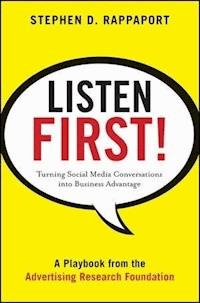
LISTEN FIRST! Shhh... Listen. Hear that? That's the sound of your business. The conversations taking place online and in the marketplace tell you nearly everything you need to know about your company and your customers--what people are saying about you, how they use your products, whether they'll buy or recommend your product, and how they respond to your marketing and advertising. Listening provides unrivaled insight. If you do it right, you'll have a decisive edge over your competition as you adapt faster to customer needs and market changes. Listening is ultimately about gaining business advantage. Based on authoritative research from the Adver-tising Research Foundation, Listen First! delivers a playbook for marketing and advertising success-fully in our conversational era. This book explains what listening is, how to do it, how it's used, and where it's headed. Done well, social media listening uncovers pivotal insights that guide marketing as well as product development, customer service, and just about all business functions that touch customers and other stakeholders. You'll learn the tools, winning plays, and proven tactics for listening so that you can: * Understand what customers are thinking, feeling, and doing in their lives that affect demand and interest in your products or services * Identify threats to your reputation * See how customers position competing brands in their minds, not as advertisers position them * Sense market shifts that threaten existing business or present new opportunities * Develop new products or refine your current lineup by bringing customer voices into R&D, innovation, and concept testing * Make your messages more relevant and sharpen targeting by directing messages to people according to their conversational interests * Keep sales humming, even when business conditions might be unfavorable--or better predict short-term sales based on the volume and specifics of conversational activity * Determine competitors' strengths and weaknesses * Plan and buy advertising based on where conversations are happening * Organize your company to maximize listening's value across all its departments Listen First! gives you evidence, research, and expert viewpoints that will enable you to take advantage of listening and build your business over the short term and for the long haul. If you want your company to have a sustainable business advantage in an uncertain world, it is time to start--and act on--listening.
Sie lesen das E-Book in den Legimi-Apps auf:
Seitenzahl: 562
Veröffentlichungsjahr: 2011
Ähnliche


















Contents
Cover
Title Page
Copyright
Foreword
Introduction
Part I: Steps to Effective Listening
ARF's Definition of Listening
Two Types of Research Using Social Media Listening
Benefits of Listening Research
Managing Listening Research
Summary
Chapter 1: Organize for Listening and Define Objectives, Key Measures, and Conversations
Organize for Listening
Set Objectives in Relation to Business Goals
Define Key Performance Indicators (KPIs)
Determine the “Research Subjects”: The Conversations, Sources, and Voices Best Suited for the Listening Program
Summary
Chapter 2: Evaluate and Select Listening Solutions
Five Types of Listening Solutions
Summary
Chapter 3: Field, Analyze and Report, and Evaluate Listening Research
Field the Research
Analyze and Report
Evaluate the Listening Initiative
Summary
Part II: Listening-Led Marketing and Advertising: Applying Listening Insights to Achieve Key Business Objectives
Chapter 4: Understand the Consumer's Mind-set
Start with the Big Picture
Winning Plays That Reveal Consumer Mind-sets
Search: Gateway to Discovering Consumers’ Mind-sets
Home In to Understand Category Mind-sets
Explore Widely to Understand Consumers and the Context of Their Lives
Summary
Chapter 5: Discover New Customers
Winning Plays for Discovering New Customers
Listen to the Story in People's Behavior
Track Voices in the Conversations
Look at Customer Data with Fresh Eyes
Listen to Light Purchasers
Summary
Chapter 6: Drive New Product Development and Innovation
Winning Plays for Innovation and New Product Development
Search Social Media Profiles to Gauge Market Interest
Develop New Product Ideas from Mind-sets
Co-Create New Products: Design to Consumer-Generated Requirements
Fine-Tune New Products, Services, or Features
Summary
Chapter 7: Create Messages That Resonate
Winning Plays That Create Resonant Messages
Search Social Media for Resonant Topics
Discover and Use Customer Language in Messaging
Combine Ideas to Address Consumer Perception
Monitor Buzz after Ad Exposure to Adjust Messaging
Summary
Chapter 8: Improve Products and Services
Winning Plays That Help Improve Products and Services
Keep Site Content Fresh and Relevant
Add User-Desired Features into the Core Brand
Tune Marketing to Meet Consumer Interests
Evolve Products and Services
Summary
Chapter 9: Increase Sales
Winning Plays to Increase Sales
Develop and Implement a Listening-Led Sales Strategy
Stimulate Product Trial for New and In-Market Products
Adjust to Real-Time Feedback for Product Rollouts
Engage Customers Around Their Passions
Track Buzz and Influence the Influencers
Summary
Chapter 10: Sense Change to Compete in the Present
Winning Plays to Sense Change and Compete in the Present
Build on Consumer Excitement
Champion New Uses
Listening in a Brand's Backyard
Listening in the Consumer's Backyard
Selectively Add Product Features
Create Line Extensions
Expand Business Line
Increase Loyalty
Summary
Chapter 11: Rebrand and Reposition Products and Services
Winning Plays for Rebranding and Repositioning Products and Services
Express Positioning in ”People's Words”
Frame Products in the Context of Issues Important to People
Attract New Customers While Keeping Core Customers
Summary
Chapter 12: Manage Reputation
Winning Plays to Manage Reputation
Discover Product Threats
Listen to All Relevant Social Media Sources, Not Just Some
Understand Which Voices Are Driving Comments
Listen to Customer Dissatisfaction
Share Listening Insights with Business Partners
Convert Negative Sentiment
Engage in Social and Environmental Issues
Summary
Chapter 13: Compete Strategically
Winning Plays to Compete Strategically
Identify Leverageable Competitive Strengths
Understand Product Positioning in Customer Terms
Keep Company Product Positioning and Customer's Product Positioning in Alignment
Interpret Competitor Risk in Customer Terms
Handle Challenges to the Core Brand
Summary
Chapter 14: Provide Customer Care and Increase Customer Satisfaction
Winning Plays for Customer Care and Customer Satisfaction
Listen, Assist, and Engage in Near-Real Time
Engage Openly, Respectfully, Ethically, and Civilly
Manage Customer Expectations
Make Sure Solutions Satisfy Customers
Summary
Part III: Listening-Led Marketing and Media Innovations
Chapter 15: Social TV Measurement
Social TV Ratings
Emerging Plays for Social TV Ratings
Summary
Chapter 16: Listening-Based Targeting
Behavioral Listening
Gender, Multicultural, and LGBT Listening
Offline Conversation Listening
Listen for Language in Context
Emerging Plays for Listening-Based Targeting Strategies
Summary
Chapter 17: Achieve Share of Market Goals
Emerging Plays for Achieving Market Share
Summary
Chapter 18: Listening-Based Sales Prediction
Post Volumes
Tweets and Status Updates
Search Trends
Online Advocacy
Product Reviews
Emerging Plays to Predict Changes in Sales
Summary
Part IV: Listening's New Frontiers
Chapter 19: Listen to New Signals
Chapter 20: Focus on Culture
Chapter 21: Change the Research Paradigm
Chapter 22: Rethink Marketing, Media, and Advertising
Chapter 23: Become a Listening Organization
Appendix: Vendor Profiles A Resource Guide
Search Engines
Social Media Monitoring
Text Analysis
Communities
Full-Service Listening Vendors
Advertising Research Foundation
Acknowledgments
References
Glossary
Index
Copyright © 2011 by Advertising Research Foundation. All rights reserved.
Published by John Wiley & Sons, Inc., Hoboken, New Jersey.
Published simultaneously in Canada.
No part of this publication may be reproduced, stored in a retrieval system, or transmitted in any form or by any means, electronic, mechanical, photocopying, recording, scanning, or otherwise, except as permitted under Section 107 or 108 of the 1976 United States Copyright Act, without either the prior written permission of the Publisher, or authorization through payment of the appropriate per-copy fee to the Copyright Clearance Center, Inc., 222 Rosewood Drive, Danvers, MA 01923, (978) 750-8400, fax (978) 646-8600, or on the web at www.copyright.com. Requests to the Publisher for permission should be addressed to the Permissions Department, John Wiley & Sons, Inc., 111 River Street, Hoboken, NJ 07030, (201) 748-6011, fax (201) 748-6008, or online at http://www.wiley.com/go/permissions.
Limit of Liability/Disclaimer of Warranty: While the publisher and author have used their best efforts in preparing this book, they make no representations or warranties with respect to the accuracy or completeness of the contents of this book and specifically disclaim any implied warranties of merchantability or fitness for a particular purpose. No warranty may be created or extended by sales representatives or written sales materials. The advice and strategies contained herein may not be suitable for your situation. You should consult with a professional where appropriate. Neither the publisher nor author shall be liable for any loss of profit or any other commercial damages, including but not limited to special, incidental, consequential, or other damages.
For general information on our other products and services or for technical support, please contact our Customer Care Department within the United States at (800) 762-2974, outside the United States at (317) 572-3993 or fax (317) 572-4002.
Wiley also publishes its books in a variety of electronic formats. Some content that appears in print may not be available in electronic books. For more information about Wiley products, visit our web site at www.wiley.com.
Library of Congress Cataloging-in-Publication Data:
Rappaport, Stephen D., 1952-
Listen First!: Turning Social Media Conversations Into Business Advantage/Stephen D.
Rappaport.
p. cm.
Includes bibliographical references and index.
ISBN 978-0-470-93551-4 (cloth)
ISBN 978-1-118-03372-2 (ebk)
ISBN 978-1-118-03373-9 (ebk)
ISBN 978-1-118-03374-6 (ebk)
1. Internet marketing. 2. Online social networks. 3. Social media Research.
4. Consumers—Research. 5. Branding (Marketing) I. Title.
HF5415.1265.R37 2011
658.8'72—dc22
2011005755
Foreword
Listening is hip! If you are a marketer and not doing it, you are likely to be criticized by somebody. Or do you look in the mirror and think you see someone who is out of it? So, what do marketers and agencies do? They put “listening” on their to-do list. And then they go off and do some listening. Good. It's a start.
But the problem just begins here, because there are so many easy ways to check “listening” off your list. Take a look at Google Trends, talk to some companies about sentiment and brand analytics, set up a community or two, or get IT looking into software solutions.
But is this listening? Is this consistent with the historic opportunity to hear your customers talk honestly about your brand? Or recognizing, as one pundit said recently, that “Twitter is free mind-reading!” I think not.
The Advertising Research Foundation (ARF) convened its first of four Listening Workshops in November, 2009. Listening is exploding, right? Well, it is, if you count all those projects that are started to get listening checked off the list. But the disturbing thing to me was that many speakers seemed to be preoccupied with the obstacles to effective listening—no budget, nobody in charge; where is the statistical rigor; is it projectable; tough organizational issues; hard to sell internally; ROI difficult to determine; legal has major issues….
So, what's up with this? True listening is scary, that's what's up. It's a big change from our traditional way of thinking.
Consequently, the single biggest opportunity in the history of consumer marketing lies dormant. The singular opportunity to tap into the brain of today's newly empowered consumer in such a natural way—that it gives us the purest “research” ever—is buried in naysaying.
The purpose of this book is to change that, to get you so excited about the promise of listening, the essentialness of listening, the unequaled power of the insight potential of listening, that you will not go another day without taking your important first step.
That little first step? Implement a continuous listening program in your company. Tomorrow. Not project listening; that's checklist stuff. This book will tell you how to do that, well. Welcome to a new world.
—Bob Barocci, ARF President
Bob, I agree. Listening changes the game for people and brands; it brings the promise of people centricity forward. As the IT sector learned, the “tyranny of the installed base” slams the brakes on modernization and innovation, because it is not compatible with existing systems, or because it may require new ways of working and people with new skills or training, or shift power toward customers. Let's hope that our readers will not cower before the “tyranny of the installed market research base” and that they figure out how best to discover, listen to, and act on the conversational “dark matter” that is all around them, and influencing the futures for their companies, products, and services.
—Stephen D. Rappaport, ARF Knowledge Solutions Director
Introduction
Nearly anywhere you turn online, people are talking about your products and categories, what they like and dislike, what they want, what pleases them or ticks them off, and what they would like you to do, or stop doing. Twitter, Facebook, YouTube, millions of blogs, forums, Web sites, and review sites make most of these conversations public, accessible, and researchable to every company. You also hear individuals talk about the richness and texture of their lives and your role in them. You learn about their aspirations, families, relationships, and homes; music and movies; vacations, hobbies, and sports; finances, jobs, and careers; education and technology; what they had for lunch, what they crave; and much more. By listening in on those conversations, you position yourself to develop powerful insights into people that, coupled with strategy, drive your business forward and create an enduring advantage. Listen First! Turning Social Media Conversations into Business Advantage will show you how.
You might be asking yourself, “How can conversational listening help create a business advantage?” The answer lies in the difference between competitive advantage and business advantage. Competitive advantage usually derives from superiority on some dimension in marketing, execution, or customer service. However, any competitive advantage can be matched or bested, every edge dulled, and any superiority lasting only until the next competing model, price cut, ad campaign, distribution change, or customer service fiasco. Business advantage is less vulnerable and longer-lasting, because it comes from you and your company's abilities to sense, respond to, and quickly adapt your business to changing customers and conditions.
Listening is ideal for sensing and responding because it interprets meaning from signals of change that are embedded in conversations. Listening tunes into what people are saying today, gives their thoughts and comments structure, and, when astutely analyzed, leads to business-building insights.
Listening is inherently biased toward anticipating, decision making, doing, and making progress all the time, not at one point in time.Listening is an emerging discipline that is plainly visible on companies radars. While many are still experimenting and dipping their toes into listening's waters, a good number are moving from the experimental stage to figuring out how to “bake” listening into their business processes. Still smaller groups are already running sophisticated listening operations. Yet each camp has questions. Newcomers want to know the basics; the more experienced want to compare notes and, especially, plan for what's next.Listen First! is a playbook in the true sense of the word; it combines education with strategy and actions for achieving specific marketing and advertising goals, all based on the best available research and evidence from more than 50 carefully selected case studies, which feature companies of all sizes and states of maturity. You can be confident that the plays and tactics you'll read about “have legs” and provide a supported foundation for your listening initiatives. This book gives you the knowledge necessary to deep-six the hype, misinformation, and anecdotes about listening, and exploit its full potential instead.
Listen First! answers three critical questions:
What is listening and how is it done?How is listening used to help achieve business objectives?Where is listening headed?The book is organized into four parts that answer them:
Part I, Steps to Effective Listening: This part explains how listening research is done, step by step. It begins by defining the initiative and moves on to reporting the results and evaluating the effort. The different types of software solutions available for listening research are given in Chapter 2. The Appendix complements Chapter 2 by furnishing summaries of more than 70 vendor companies and their solutions and services.
Part II, Listening-Led Marketing and Advertising: Applying Listening Insights to Achieve Key Business Objectives: Listening contributes to achieving the full range of marketing and advertising objectives set out by most businesses. Each chapter in this part identifies a single objective—such as understanding consumer mind-sets, developing new products, increasing sales, providing customer service, or managing reputation—and details listening's contribution to its success.
Part III, Listening-Led Marketing and Media Innovations: Listening is more than insight and input into strategy; it is a data source, too. The chapters in this part look at four emerging data-driven applications that will usher changes into traditional business practices, such as social TV ratings, listening-based targeting, achieving share of market goals, and predicting near-term sales.
Part IV, Listening's New Frontiers: In this part, leading listening practitioners and researchers contribute essays on the way forward for listening, its practice, adoption, and contribution to creating business value. We will need to pick up new signals, understand people and culture, change the research paradigm, rethink what we do, and become listening organizations.
In keeping with its description as a playbook, Listen First! is intended as a business tool. Here are just a few of the ways that you can use it to your business advantage:
Bring your colleagues and clients up to speed on listening research by reading Part I.Match a marketing problem you're working on to those in Part II.Sharpen your knowledge of what's next by consulting Parts III and IV.Jump-start the evaluation of listening solutions by turning to the Appendix, which presents summaries of more than 70 vendors.Learn the lingo by consulting the Glossary.After reading Listen First!, it won't be business as usual. And for many people settled into their careers, that's scary—especially when listening insights challenge the status quo: When you find that the market you think you're serving turns out to be—or is becoming—something else entirely. When you know you've got a great insight and colleagues don't take it seriously. This book presents case studies of exactly these situations, and what was done to address them. You'll also learn about the ways companies recognized and seized the opportunity to build their businesses through listening.
I'm bringing up these points because of what I learned in the year it took me to write Listen First! It's simply this: Understanding and doing listening is essential, but not enough to create business advantage. The most successful listening companies do great work, have the guts to act on compelling insights, let go of the past, and shape their futures. Just imagine what boldness it took for Hennessy's management to transform a centuries-old cognac associated with brandy snifters, genteel surroundings, and after-dinner pleasures into an urban, music-inflected brand, where the beverage is mixed into drinks and enjoyed at parties? Or to persuade an editor who built a career on parenting publications that the readers for a new mom-targeted magazine she has in development don't want that information? There's a related factor, as well: These companies tell convincing stories from the listening research; they connect listening to the business in ways that bring people fully to life; understanding people as they are, not necessarily as a company would like them to be, makes tough decisions easier and sets a path for growth.
Listening is not just another research technique; it furnishes a new platform for business and research, and needs to be recognized as such. This book gives reasons for that recognition. It will provide you with the know-how to listen and turn conversations into enduring business advantage. Above all, listening is about learning through time and engaging with a like-minded community. Visit the Listen First companion Web site: http://listenfirst.thearf.org, for news, updates, viewpoints, and developments and for you to comment and share your knowledge and experiences.
Part I
Steps to Effective Listening
ARF's Definition of Listening
A conversation about listening takes place nearly every day at the Advertising Research Foundation (ARF), and like most new concepts, people talk about it differently depending on their perspective. As an industry organization, we aim to be rigorous and inclusive on matters that affect our advertiser, media, research, agency association, and academic members. Since good investigators begin by standardizing definitions, that's where we will start. The ARF defines listening as:
The study of naturally occurring conversations, behaviors, and signals that may or may not be guided, that brings the voice of people's lives into the brand.
Let's dissect this definition and explain our reasoning.
“The study of naturally occurring conversations, behavior, and signals…”
The study of: People's authentic, unfiltered thoughts, feelings, and emotions
naturally occurring conversations: Those that take place among people and through interactions with brands or companies in an open, noncoercive manner
behavior: Observing what people do, such as shopping or using brands
and signals: That people emit silently, such as through gesturing or biometric measures
“That may, or may not, be guided…”
Thatmay/beguided: Directed by other people, brands, or organizations in ways that focus naturally occurring conversations on agreed-upon topics
Or may not/be guided: Conversations take their own direction
“To bring the voice of people's lives into the brand.”
To bring the voice of people's lives: Through deep insights and convincing stories
Into the brand: To evolve the relationship and take actions for mutual benefit
Our definition aims to convey several key ideas. First, listening is concerned with what people say, how they act, and how they react on the “inside.” In other words, it's not just focused on online conversations. Second, listening brands have responsibilities to people; they must be extraordinarily perceptive and respectful, and become their advocate. Last, brands and customers are in a learning relationship over time; both improve when each listens and responds to the other. The relationship is not reactive, but anticipatory and evolutionary.
You'll notice that our definition does not restrict conversations to online sources; rather, it acknowledges that they take place everywhere. Neither does it reference research methodology, tools, or techniques. Decisions about where and how to listen should be determined by the project, brand, customers, and expertise of those involved.
Listen First! Focuses on Social Media Conversations
This book is concerned with listening to social media conversations, because that's where the listening action is today. But since listening is also about anticipating, we sprinkle in a few instances of listening to behavior and signals. See Dr. Carl Marci's essay in Chapter 19 for a glimpse into the biometric future of listening.
Research Tasks: Social Media Listening Performs
Part II: Listening-Led Marketing and Advertising: Applying Social Media Listening Insights to Achieve Key Objectives shows how strategies based on listening research enable companies to accomplish a wide variety of marketing objectives. Social media listening provides different ways to perform many of the customary research tasks that are central to developing winning marketing and advertising strategies. In fact, listening's range of research applications often surprises people—“I didn't know it could be used for that!”—because listening is stereotypically thought of in fairly narrow terms, as a substitute for focus groups or other qualitative research, or as a way to monitor conversations for mentions of brands, people, or words or phrases of interest. Look at this range of uses, all taken from case studies in this book.
Understand mind-sets: Explore people's culture, views, values, and lifestyles that influence their interests, thoughts, feelings, and behavior. Companies seek to learn how consumers cope with changing economic circumstances, or take on new roles—such as caregiving (both in Chapter 4)—or act within a product category, such as credit cards (see Chapter 9).
Profile customers and prospects: Develop insights into people for marketing and advertising products and services, as was done for spirits, motorcycles, and e-tailer marketers (see Chapter 5). Go further by developing engaging loyalty programs (see Chapter 15).
Sense early market shifts: Anticipate changes that challenge existing business and present opportunities for new business, such as being able to recognize that customers are changing in unexpected ways—as a maker of electronic games detected (see Chapter 5).
Detect problems: Uncover the issues that impede sales and/or customer satisfaction, such as product or service issues, poor executions and experiences, or faulty retail strategy. Reveal unmet needs that companies can address, or remedies that can convert into new business opportunities or greater customer satisfaction (Chapters 8 and 14).
Analyze competitors: Compare rivals along various dimensions to develop strategies or tactics capable of creating advantage. For example, when new competitors enter the marketplace, learn and assess how customers position competing products on benefits, or size up strengths and weaknesses (see Chapter 13 for examples).
Target and segment: Categorize people based on their interests or actions as reflected in their conversations and the cultural contexts within which those conversations take place. Movie marketers, for instance, target and segment their audience according to facets such as interest in actors, type of movie, or special effects, whereas car companies target by reaching people who talk about them organically. Interest in multicultural listening is growing, as many realize how it can help marketers become more inclusive and expand their customer base (Chapters 5 and 14).
Uncover sales drivers and predict sales: Identify customer factors—such as the volume of social media activity, advocacy, and reviews—and the specifics within them that can be modeled to predict sales, as has been done in categories like books, consumer electronics, and entertainment (see Chapter 18).
Complement “asking” research: Bring multiple sources of data to bear on a marketing or advertising issue in order to enrich understanding. For example, one razor manufacturer surveyed and listened to lapsed users, or people who had stopped buying. The surveys documented the percentages of lapsed usage, and the listening research explained the reasons why people stopped buying (Chapter 12).
Innovation, R&D, co-creation: Develop new products, services, or enhancements by listening and, in some cases, involving customers and prospects in the process, as food companies, technology firms, and auto manufacturers have done (see Chapters 11 and 13).
Test concepts: Learn if new product ideas resonate with customers and prospects; acquire feedback on new services or features, as was done by a new food product (Chapter 11) and a venerable magazine (see Chapter 16).
Discover/evaluate brand attributes: Uncover the features most important to customers and prospects, as a car company (Chapter 14) or researchers did for a consumer electronics product (Chapter 18).
Develop and evaluate messages: Create messages that resonate with customer or prospect mind-sets, or modify them so they do. Chapter 12 shows how one personal care product learned its value proposition was off, and then repaired it accordingly. Cutting-edge techniques that gauge emotional responses to communication pave new pathways to insight and understanding effectiveness (see Chapter 19).
Identify threats to reputation: Understand and respond to the issues and events that can undermine and weaken a company, product reputation, or its future prospects (Chapter 17).
Though this list, generated solely from the cases discussed in this book, is extensive, it doesn't exhaust the research applications being explored, tested, and, probably, being kept under wraps for competitive reasons. For example, companies are developing brand trackers that incorporate listening data in two ways: as sources for attribute lists, so that the trackers are more in tune with people's conversations and interests; and as supplements to surveys, brand metrics, and regularly reported business measures like sales. Social media-based “numbers” essential to functions like media planning and buying are emerging that add insight into the quality of audiences and their marketing “fit” for specific companies, products, and services. Expect to see innovations like these and others appearing soon.
Two Types of Research Using Social Media Listening
Social media listening divides into two categories: social media monitoring and social research. Tom O'Brien and David Rabjohns (2010) supply working definitions of these terms:
Both types of effort deliver value; the trick is matching the right type of listening to the goals of your business. Monitoring applications tends to be more tactical, such as noticing comments, issues, or problems, and dealing with them expeditiously. Adept monitoring helps guide the response when someone calls out a particular product or company—whether it's negative, as it was for Hasbro (Chapter 17), or positive, as it was for Gatorade (Chapter 12). Poorly executed monitoring and response may lead to reputation problems that can range from trivial to severe. However, it's always best if these are handled properly and quickly, such as the Motrin Moms who ignited a firestorm of protest over an ad strategy, and pressured Motrin to pull the ad (Matson 2008). Chapters 12 and 14 provide many examples that rely on social media monitoring.
Social Media Monitoring: Tracking online brand mentions on a daily basis for PR, brand protection, operations and customer service, outreach, and engagement.
Social Research: Analyzing naturally occurring online conversation categories to better understand why people do what they do; the role of brands in their lives; and the product, branding, and communications implications for brand owners.
Social research is more strategic: It delves into underlying human concerns, attitudes, motivations, emotions, preferences, and the needs people have that shape their mind-sets and, ultimately, their actions, whether it is shopping, buying, or merely watching a TV program. Done well, social research uncovers pivotal insights that guide not only marketing and advertising, but also innovation, product development, customer service, and just about all business functions that touch customers, prospects, the trade, and other relevant stakeholders. Several of the case studies in Part II, where we show the contribution of listening research to achieving marketing objectives, provide examplary cases that all companies can learn from. Several particularly valuable ones to consider are the Hennessy Cognac and Suzuki Hayabusa cases in Chapter 10, the CPG manufacturer of home storage solutions in Chapter 12, and the example regarding X Factor in Chapter 15.
Benefits of Listening Research
We interviewed a variety of researchers experienced with listening at advertisers, media companies, advertising and media agencies, and research companies to share with us their hard-won learnings about the benefits and advantages of listening, compared with traditional surveys and focus groups. In their words, listening offers the ability to detect early signals, make timely adjustments, and understand people in their own terms. They value listening for its abilities to provide:
Speed and timeliness: Guidance can be acquired in days or weeks, not months.Flexibility and course correction: Changes can be made quickly if the research isn't being productive or if new avenues should be explored.The ability to frame research in consumer terms, not researcher language.Opportunities for listening to and analyzing unfiltered conversations.Answers to questions researchers did not think to ask.Large sample sizes.Cost advantages—although these need to be evaluated not only on dollars alone but also on efficiencies or results that are gained.To this list we will add the ability to use “historical” data, or “backcast,” for research initiatives. Unlike traditional methods, which have to start from day zero in most cases, listening research begins with an available datastream. That means that you can begin developing insights the day projects start, complete with trends, the ability to compare periods of time, and, perhaps most important, the freedom to ask new and different questions as the research proceeds, without requiring more money or extra time to collect and analyze new data. Because all data is automatically put into context, analytic and interpretive richness arises, and greater confidence in the insights results.
Listening research innovations are coming fast and furious. On the social side, researchers are gaining more experience daily by using listening data to do the nuts-and-bolts research that marketers and advertisers need, and by adapting research traditions to take advantage of social media data. An example of this is netnography, a digital form of ethnography (Kozinets 2010, Pettit 2010, Verhaege et al. 2009). There are more than 150 software applications and services available, and new ones appear daily that claim to address a new need or solve some problem. All this activity and innovation does not mean that we have to approach research differently; it simply requires that we do some new things and use different tools. The principles of doing good research endure.
Managing Listening Research
Planning, running, and evaluating social media listening programs require the same discipline as managing a research project or continuous research program. The differences—and they are crucial—reside in the operational specifics—the skills needed, tools, methods, data, and analysis—but not in the aims and ends to which the research insights are applied. For many readers, the differences will likely be challenging to what we know about market research (“How can we answer questions we didn't think of asking?”), but the chapters in Part I intend to explain the unfamiliar and guide the way forward to understanding listening and doing it effectively.
Principles for Effective Listening Research
The first three chapters explain the “how” of social media listening; it is intended to be a very practical, approachable guide for most readers. We do not get into very fine technical matters; rather, we highlight the issues or controversies that are generally important.
Listening initiatives follow a sequence of steps, and that is how the chapters are organized and progress:
Chapter 1: Organize for Listening and Define Objectives, Key Measures, and Conversations
Organize for listening.Set objectives in relation to business goals.Define key performance indicators (KPIs).Determine the “research subjects”: the voices and conversation sources best suited for the listening program.Chapter 2: Evaluate and Select Listening Solutions
Listening tools: overview and key features in five categories: Search, Monitoring, Text Analytics, Communities, and Full-service VendorsChapter 3: Field, Analyze, Report, and Evaluate
“Field” the research: Run the listening program; establish methods and tools for “data processing”—the harvesting, cleaning, and processing of conversations.Analyze and report the data: Communicate the insights.Evaluate, appreciate, and commit to next steps.Earlier, we distinguished social media monitoring from social media research. While both types of listening efforts share these steps, the types of work and levels of commitment are different. Those primarily monitoring conversations and alerting when something important comes up have different needs from those conducting research using heavy text analytics, working with full-service vendors, or running communities. As we move through the principles for effective listening research, we'll call attention to places where considerations for monitoring and social research differ.
Summary
Social media listening research is used for many of the same purposes as traditional market research. Listening research is divided into two spheres, social media monitoring and social research, which are tactical and strategic, respectively. Listening research is innovating rapidly, and there are many solutions available to companies. Although the tools and some of the methods are different from familiar research methods like survey research and focus groups, the principles guiding research are unchanging.
Kozinets, Robert V. (2010). Netnography: Doing Ethnographic Research Online, London: Sage Publications, Inc.
O'Brien, Tom, and David Rabjohns. (2010). “Social Media Monitoring Is Not Research,” essay prepared for the Advertising Research Foundation.
Matson, John. (2008, November 17). “‘Motrin Moms,’ a-Twitter over Ad, Take on Big Pharma—And Win,” ScientificAmerican.com news blog, www.scientificamerican.com/blog/post.cfm?id=motrin-moms-a-twitter-over-ad-take-2008-11-17 (accessed September 27, 2010).
Pettit, Annie. (2010). “From Bit and Bytes to Brilliant Breakthroughs,” essay prepared for the Advertising Research Foundation.
Verhaege, Annelies, Niels Schillewaert, and Emilie van den Berge. (2009). “Getting Answers without Asking Questions, www.insites.eu/02/documents/whitepapers/04_Getting_answers_without_asking_questions.pdf (accessed December 19, 2010).
Chapter 1
Organize for Listening and Define Objectives, Key Measures, and Conversations
This chapter outlines the first steps for doing listening research that were outlined in the Introduction:
Organize for listening.Set objectives in relation to business goals.Define key performance indicators (KPIs).Determine the research subjects: the voices and conversation sources best suited to the listening program.We will now discuss each of these in detail.
Organize for Listening
Because listening can be done by companies of all sizes, from small businesses to globe-circling enterprises, the ways that they organize to undertake the effort will vary depending on their goals, resources, and staffing. Organizational consultant Beth Kanter (2009) proposes three concepts for listening organizations that provide a helpful framework:
Centralized listener: A person responsible for overseeing listening and, possibly, a firm's social media strategy. The J&D Bacon Salt (Chapter 6) case illustrates this model and shows that it can be very valuable for concept testing and product development, even on a shoestring, as it was for this startup.
Listening team: A group of people dedicated to listening, made up of individuals in the company from either a single department or cross-functional. The Vitamin Water case (Chapter 7) demonstrates the value of multidisciplinary teams in creating a new product and bringing it to market.
Lesen Sie weiter in der vollständigen Ausgabe!
Lesen Sie weiter in der vollständigen Ausgabe!
Lesen Sie weiter in der vollständigen Ausgabe!
Lesen Sie weiter in der vollständigen Ausgabe!
Lesen Sie weiter in der vollständigen Ausgabe!
Lesen Sie weiter in der vollständigen Ausgabe!
Lesen Sie weiter in der vollständigen Ausgabe!
Lesen Sie weiter in der vollständigen Ausgabe!
Lesen Sie weiter in der vollständigen Ausgabe!
Lesen Sie weiter in der vollständigen Ausgabe!
Lesen Sie weiter in der vollständigen Ausgabe!
Lesen Sie weiter in der vollständigen Ausgabe!
Lesen Sie weiter in der vollständigen Ausgabe!
Lesen Sie weiter in der vollständigen Ausgabe!
Lesen Sie weiter in der vollständigen Ausgabe!
Lesen Sie weiter in der vollständigen Ausgabe!
Lesen Sie weiter in der vollständigen Ausgabe!
Lesen Sie weiter in der vollständigen Ausgabe!
Lesen Sie weiter in der vollständigen Ausgabe!
Lesen Sie weiter in der vollständigen Ausgabe!
Lesen Sie weiter in der vollständigen Ausgabe!
Lesen Sie weiter in der vollständigen Ausgabe!
Lesen Sie weiter in der vollständigen Ausgabe!
Lesen Sie weiter in der vollständigen Ausgabe!
Lesen Sie weiter in der vollständigen Ausgabe!
Lesen Sie weiter in der vollständigen Ausgabe!
Lesen Sie weiter in der vollständigen Ausgabe!
Lesen Sie weiter in der vollständigen Ausgabe!
Lesen Sie weiter in der vollständigen Ausgabe!
Lesen Sie weiter in der vollständigen Ausgabe!
Lesen Sie weiter in der vollständigen Ausgabe!




