


5,99 €
Niedrigster Preis in 30 Tagen: 6,49 €
Niedrigster Preis in 30 Tagen: 6,49 €
Mehr erfahren.
- Herausgeber: WriteLife Publishing
- Kategorie: Ratgeber
- Sprache: Englisch
“Just be who you are meant to be…”
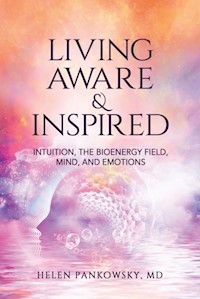
An inspired life means living to your highest potential---having a healthy body, a creative mind, the ability to take full responsibility for your choices, embracing who you are, and connecting to your spiritual life.
This book can teach you how. How to strengthen and trust your intuition. How to feel, test, and balance your energy flow. And how to understand your emotions, where they come from, where they are blocked, and how to resolve those blocks.
The information is accessible and easy to understand with exercises and illustrations to help guide you.
Das E-Book können Sie in Legimi-Apps oder einer beliebigen App lesen, die das folgende Format unterstützen:
Veröffentlichungsjahr: 2019
Ähnliche
















Living Aware & Inspired
© 2019 Helen Pankowsky, MD. All rights reserved
No part of this book may be reproduced in any form or by any means, electronic, mechanical, or digital (including photocopying and recording) except for the inclusion in a review, without written permission from the publisher.
Because of the dynamic nature of the Internet, any web addresses or links contained in this book may have changed since publication and may no longer be valid.
The views expressed in this work are solely those of the author and do not necessarily reflect the views of the publisher, and the publisher hereby disclaims any responsibility for them.
Limit of Liability/Disclaimer of Warranty: all effort has been done to ensure accuracy and ownership of all included information. While the publisher and author have used their best efforts in preparing this book, they make no representations or warranties with respect to the accuracy or completeness of this book and specifically disclaim any implied warranties of merchantability or fitness for a particular purpose. No warranty may be created by sales representation or written promotional materials. The advice and strategies contained herein may not be suitable for your situation. The publisher is not engaged in rendering professional services, and you should consult a professional where appropriate. Neither the publisher nor author shall be liable for any loss of profit or any other damages, including but not limited to special, incidental, consequential, or other damages incurred as a result of using the techniques contained in this book or any other source reference.
Published in the United States by WriteLife Publishing (an imprint of Boutique of Quality Books Publishing Company, Inc.) www.writelife.com
Printed in the United States of America
978-1-60808-207-0 (p)
978-1-60808-208-7 (e)
Library of Congress Control Number: 2018961942
Book design by Robin Krauss, www.bookformatters.com
Cover design by Marla Thompson, www.edgeofwater.com
Illustrations © 2017 Helen Pankowsky, MD All rights reserved
Image of Jimmy Durante from Wikicommons in the Public Domain.
Image of lobes of the brain— original: Henry Gray (1918) Anatomy of the Human
Body from Wikicommons in the Public Domain.
Line art separators by Vecteezy, www.vecteezy.com
First editor: Olivia Swenson
Second editor: Caleb Guard
CONTENTS
Acknowledgments
Preface
Introduction: How I Got to Where I Am
The Twists and Turns Along the Way
Forty-Four
NICABM and Valerie Hunt
Inspired Life Psychiatry
PART I
INTUITION
Chapter 1: What Is Intuition?
Chapter 2: The Basic Science of Intuition
Neurology of Intuition
The Yin-Yang of the Brain
Chapter 3: Women’s Intuition—and Men’s Too
Chapter 4: Children’s Intuition
Chapter 5: How Intuition Comes In
The Nature of Intuition
Clearing the Way for Intuition
Ways Intuition Comes In
Dreams
Synchronicity
Body Information
Meditation
Art
Mental Imagery
The Vesica Pisces of Intuition
Chapter 6: What to Do with Intuitive Information
Phases of Intuition
Intuition in Making Decisions
Obstacles to Intuition
Developing Intuitive Skills
Exercises for Developing Your Intuition
Developing Intuitive Skills
Insight Questions
Things You Can Practice Doing
How to Strengthen Intuition by Keeping a Journal
Guided Visualizations and Meditations
Meet Your Intuition
Intuition Self-Assessment
True Voice
PART II
THE HUMAN BIOENERGY FIELD
Chapter 7: Introduction to the Human Bioenergy Field
Cultural and Traditional Ideas
Chapter 8: A Little Science
What Atoms Do
Becoming Grounded
The Biology of the Human Bioenergy Field
The Physics and Importance of Waves
Chapter 9: Sound as Medicine
Valerie Hunt and Instrumentation
A Scientist-Mystic
Music of Light
Brain Wave Frequencies for Healing
Chapter 10: Parameters of the Bioenergy Field
Coherency and Anticoherency
A Hypothesis about Energy Flow and Disease
Reading the Bioenergy Field with a Pendulum
Exercises for Your Bioenergy Field
Getting Information from the Bioenergy Field
Using a Pendulum
Steps to Read the Bioenergy Field
How to Calibrate the Bioenergy Field
Steps to Calibrate the Bioenergy Field
Steps to Spin the Energy
Self-Healing with Bioscalar Energy
Bioenergy Field Self-Assessment
PART III
THE MIND-FIELD, EMOTIONS, BODY, AND SOUL
Chapter 11: The Bioenergy Field, Mind, and Emotions
Definitions
Chapter 12: The Energy of Emotions
Actions of Energy and Transactions
Choices in a Transaction
Atoms and Emotions
Chapter 13: The Three Strongest Emotions
Anger
Fear
Love
Subemotions
Chapter 14: When Emotions Get Blocked
How Emotions Get Blocked
Pattern Dynamics
How Pattern Dynamics Develop
Where Emotions Get Blocked
Chapter 15: Life-Preserving Energy Surge
Introduction to the Kundalini
Ways to Understand the Kundalini
Chapter 16: Reincarnation, Past Lives, and Lifehoods
Evidence for Reincarnation
What Is a Lifehood?
Lifehoods in Practice
Chapter 17: Lifehood Memory Recovery
Creation of Emotional Blocks
The Four R’s
Lifehood Memory Recovery Session
Recovering
Reliving
Rescripting
Resolving
Chapter 18: Life’s Destiny and the Inspired Life
Exercises for Your Mind-Field and Emotions
The Most Important Questions to Ask Yourself
Emotional Energy
Anger
Fear
Love
Questions to Stimulate Your Mind Capacity
Creativity and Skills
Emotions
Mystical and Spiritual
Exercise to Access Mind/Cell Memory
Preparation for Opening the Mind-Field
Quieting
Grounding
Expanding
Meditations for Accessing Mind-Field Information
Being with the Mind/Soul
This-Life Information
Lifehood Information
Mind and Emotions Self-Assessment
Open-Heart Meditation
Endnotes
Author Biography
Appendix
Kinesiology, the Unconscious, and Limiting Decisions
Ways of Muscle Testing Using Kinesiology
References
ACKNOWLEDGMENTS
There are no coincidences related to who comes into my life. Many people have helped and supported me in the process of writing this book, whether subtly or overtly. To thank everyone who has supported me would be a tome in itself, but I am compelled to acknowledge certain people. Many started as wonderful teachers—some without such intent—and ended as friends, mentors, or role models. The ones I have to thank for fulfilling this role are my patients, students, and all the skilled people who have enriched me. I am especially indebted to Valerie Hunt and Suzanne Lahl, my first guides to the relationship of the human bioenergy field, emotions, and the soul; to Harry Wilmer, MD, who showed me how to read the symbols, metaphors, and imagery within and outside; to Ming Xie and Weixsu Su, my extraordinary qigong and tai chi teachers, who have shown me the way of the Eastern mind, allowing me to integrate it with the Western; and to Brian Dailey, MD, my gentle, powerful, and compassionate Reiki teacher.
I am thankful for my friends and all the others who entered my life whether long-term or short, including my tai chi family, my colleagues, fellow healers and seekers. I am grateful for June Robinson, the most gifted healer I know and who believed in my capacity as an energy healer long before I did; Marjorie Brody for her friendship and advice on writing books and getting them out into the world; and for my friend-for-life Joan Zurakov, the only person in the world who can make me curse like a sailor and laugh uncontrollably as we unabashedly discuss our human foibles.
Many thanks to Terri Leidich, my publisher who gave the book a new life, Olivia Swenson, editor extraordinaire, and the behind-the-scenes staff of WriteLife Publishing.
I am immensely grateful to my family: my parents, Hanna and Jaime Pankowsky, for being my first teachers and for always supporting my endeavors; my son, Jacob Alonso, for his intelligence, technical expertise, his generous and compassionate heart, and for his incomparable humor; Liddy Morris, my lovely and brilliant daughter-in-law; and my husband, Dan Alonso, for being my rock, challenging me by playing devil’s advocate, often to the point of infuriation (although sometimes forcing me to see a different perspective in order to make a change), never questioning my need to explore, cheering me up and cheering me on, and lovingly supporting me through the entire journey. I am grateful to all of you who have stood by me and supported me with your generosity and love.
PREFACE
At the age when we tend to ask questions, I thought how much easier my life would be if I simply lived an orthodox life, unquestioningly believing what I was taught and allowing my life to be structured by precepts determined by my family, culture, society, and religion. But I am not made of such stuff. I decided, as difficult as it was and continues to be, that I would rather make my way questioning beliefs than blindly going along with them.
Somewhere around my eighth year, I had my first glimpse of what it meant to be human within the greatness of the universe. I was in bed when I saw myself lying in my bed, in my room, in our house, on our street, in the neighborhood, in the town, in the state, in the country, in the world, in the solar system, in the universe among the stars—and all this with a sense that there was a beyond I couldn’t see. It felt as if I had been rising, ascending, soaring into something awesome, amazing, mysterious. Startled by the immensity of the experience, I was jolted back into my bed.
In my home, science, history, and intellect were valued more than mysticism, so I kept the experience to myself. The only way I could make sense of it then was to see it as a reflection of my smallness in the vastness of the universe. Yet there was something profound in the idea that even if I was small, I could still see and feel an unknown so large.
In addition, the experience was something I was not ready to comprehend; it has taken me years to do so. What I experienced that night was an insight into what I have come to believe is our truth. It was a manifestation of what we are—divine humans. We have the vulnerability of a physical body and the capacity and power of the soul and the divine. When we embrace both our human vulnerability and our divine power, we are best able to live with expanded consciousness and to live an inspired life. This book is a guide to living that life.
As a psychiatrist, I have devoted myself to understanding the essence of healing and the ways we as human beings can live to our fullest potential, content in our lives. I have learned many modalities for treatment and therapy. Although all have some efficacy, very few have a deep, long-lasting impact. All have some value and may improve the quality of life for certain people, but too often the traditional approaches tend to be too superficial, the solutions reductionist or materialistic. And so the problems recur.
I have been privileged to learn from many teachers, but it is Dr. Valerie Hunt who was one of the most influential. Dr. Hunt successfully created a model of the divine human based on the human bioenergy field, which integrates behavior, emotions, the mind, and health. This model has led me to think and work within a new paradigm for psychiatry, one based not on pathology, symptoms, and medications, but rather on the essence and potential of the divine human. I have found that the application of this model in my psychiatric work goes deeper and has a more sustained effect on those who are ready to have the most profound insights and who desire to evolve to a greater level of awareness and expanded consciousness.
Throughout this book, you will notice that I refer to “expanded” self-awareness and “expanded” consciousness and not “higher” consciousness. The reason for this, as you will come to see, is that to be truly open, stable, and whole, we need a full range of awareness. In other words, awareness of the body—everything about being physical and grounded—is every bit as important as being creative, mystical, spiritual, and soulful.
There is a misconception that having self-awareness means being self-referential. When I speak of self-awareness, I do not mean it as self-absorption, self-centeredness, selfishness, or narcissism. There have been some arguments made that we are getting too “me” oriented and losing our ability to experience and feel empathy and compassion. To some extent I would agree, but I believe that when we are living with expanded self-awareness and expanded consciousness, we cannot help becoming even more aware of the world and the people around us in a greater empathic, compassionate, and proactive way. As we accept and love ourselves as a prerequisite to loving unconditionally, we come to accept and love others in a more sustained and sincere way.
This book is divided into three parts: Intuition, The Bioenergy Field, and The Mind-Field: Emotions, Life, Body, and Soul. Each of these parts builds on the one before it and is followed by insight-generating questions, exercises, and guided visualizations/meditations to help you toward your own expanded self-awareness. In describing the work I do through inspired life psychiatry and in writing this book, my intention is to make these ideas, skills, and possibilities for expanded consciousness and an inspired life available to all.
INTRODUCTION
HOW I GOT TO WHERE I AM
The Twists and Turns Along the Way
We all have a unique story—the one that tells our journey of becoming who we are. In becoming aware of the moments, people, and events in our stories, we begin to define the process of our evolution. Although I hesitate to spend time on my own story, it may serve as an example, a map that lets you see the path—the twists and turns—that I have taken so far. Like a jigsaw puzzle with many pieces that at first don’t seem to have a place, as more and more pieces snap together to define the picture, even the oddest-looking pieces fit. Although it is my story, it may encourage you to look at how your life’s map has unfolded and to find your own jigsaw pieces. My story may help you to understand how you and I have evolved into who we are through all of life’s changes.
No one who knew me as I was growing up would ever have expected that I would become a physician or a psychiatrist. I had always been an artist and an actor, a performer who loved the process and expression of creativity and art in all its forms. Clearly I was more intuitive than scientific. Although I was never discouraged from expressing creativity, I sensed that I needed to maintain the language of intellect to communicate well in my family. At some point I realized that I was “good” with people—that I had a capacity for compassion and empathy. Even without verbal communication from someone, I often could feel what he or she felt, have an insight to, or understand a detail about his or her feelings, life, and struggles. I had a sense of “knowing” about others.
At various points I shed my different artistic commitments. Although I loved dancing—at one point I was highly committed to being in that profession and was already a member of a ballet company—I realized that to pursue it further would mean a life entirely focused on my physical body. So I stopped.
I love art and originally majored in fine art and psychology with the idea of being an art therapist. For a time, the allure of art made me think I would be a commercial artist, but after two years of study, I began to have the same thoughts I had as a ballet dancer: that a life in art would be a very self-focused one. At my core I realized that I would never be fully satisfied in that profession, so I changed my major to psychology and sociology.
When I was almost done, I awakened one day knowing I needed to go to medical school. As the daughter of a doctor who had lived her entire life witnessing the demands and the pros and cons of medicine, being one myself had been the furthest thing from my mind. But that day I knew with unwavering certainty that medical school was the right place for me. It is an understatement to say that anyone who knew me was surprised, and some had little faith that I could do it. But I diligently launched into the premed course of study in spite of not having studied or taken a science course since high school. I experienced a great opening in my mind that I found exhilarating and exciting as I learned to view the world through the lens of the scientist.
I completed my requirements in a year and a half, applied to medical school, and was accepted. I had always been an excellent student, finishing among the top of my class, graduating summa cum laude and Phi Beta Kappa. However, attempting medical school with such a rudimentary knowledge of science and the minimum premed requirements presented great academic challenges and was intellectually a most humbling experience. In spite of consistently being in the bottom of the class the first two years, I loved every aspect of medicine. Every specialty I studied was one I could imagine pursuing. But in the end, psychiatry—with its promise of the unexplored frontier of the brain, the psyche, emotions, behavior, and relationships—won out.
I embarked on my residency, and in Harry Wilmer, MD, I found my first true mentor. He was a Jungian psychiatrist with an extraordinarily keen mind, a scientist, a brilliant therapist, and a highly intuitive man—a person ahead of his time, and in short, a perfect role model. I finished my residency, did a year of specialty as a fellow in child psychiatry, worked for the state mental health department as an adult and child psychiatrist, and followed that up by starting a private practice. Later I also worked part time as the medical director/psychiatric consultant for the San Antonio Rape Crisis Center.
For years I was on a schedule, one that dictated what time I got up and when I went to work. Work was defined in perfectly measured increments of fifteen, thirty, or sixty minutes, one person at a time. As a psychiatrist I empathically listened with my ears, my heart, and my mind. I listened so hard to what was said and not said that when I developed tinnitus and the doctor said, “You have hyper hearing,” I laughed. The metaphor was there, blatantly staring at me—the strain of listening so intently had manifested as constant ringing.
I tried numerous treatments: medications that made me sleep, gain weight, lose weight, pee. I tried herbs, homeopathy, meditation, insight, craniosacral therapy, adjustments, Oriental medicine, and energy manipulation. Nothing changed the shrill, high-pitched ringing that reminded me interminably of how much I had heard, of how hard I had tried to hear, and of what I was not hearing.
My preoccupation with tinnitus was a marker telling me I had reached a point of overload and burnout. I had spent time trying to listen—it was my job, after all. But there was much I was not hearing, not only from others, but myself as well.
I reached a point of dreading hearing anyone’s story. Wherever I went, I tried to steer clear of people. What a change for this person whose whole life had revolved around the idea of helping others! I, who had always been someone who listened to another’s life story, often random and unsolicited such as on an airplane or while waiting in a line, now became a person who put on headphones to avoid listening.
Tinnitus has been a persistent symptom, even to this day, but as I have searched for resolution it has led to me to ever deeper and greater levels of understanding, insights, and awareness about myself. In the process, I have become less concerned about getting rid of tinnitus and have been grateful that that particular symptom acted as a catalyst to get me to where I am now. If we are paying attention to the meaningful coincidences—also known as synchronicity, as we will discuss later—around us, we are usually led to what is needed for our next level of evolution. My next level of evolution occurred around my forty-fourth birthday.
I had always known I was intuitive, maybe even a little psychic, drawn to all things metaphysical, but I had spent a great deal of energy ignoring it. In fact, I felt as though my artistic/intuitive self and my scientific/rational self played a constant tug-of-war. Hard as I tried, they never seemed to be able to live in peaceful coexistence. A well-known medium in my tai chi class had once told me: “Your soul knows, but your brain gets in the way. It’s like you keep picking it up and putting it down again.” How right she was!
Forty-Four
The number four is a symbol for the orderly arrangement of that which is separate.
—J. E. Cirlot1
As an ardent student of Carl Jung’s analytical psychology, I sensed an auspiciousness to my forty-fourth birthday. The number four was given prominence in its symbolism by Jung and even earlier in history. Although the symbolic meaning can be obtuse, convoluted, and complex, in essence Jung saw it as a stabilizing number and therefore strongly linked with individuation.2 Individuation is the process through which an individual, as a result of personality, psyche, and life’s experiences, develops into a unique person who is becoming integrated into a whole being. It is a stage in the development of consciousness. I think of my forty-fourth year as the time when my transformation into a more integrated, conscious, self-aware person really began. I can mark the beginning of this transformation to a specific time, place, and occasion—a birthday celebration for an acquaintance. That is where I first met June.
June and I bonded instantly. Although we were five years apart in age, our lives had been on parallel tracks. Both of us had been born Jewish and had gone to the same temple yet were more inclined toward nonreligious spiritual ideas. We both had a favorite teacher, Mr. Bendiner, an ethics teacher of sorts, an old, complicated, wise curmudgeon of a man whom most students tried to avoid. June and I had been in the same high school, same social and youth clubs, even the same ballet company. We had gone to the same university, June starting as a science/premed student but ending up in art, and I having started as an art student but ending up in premed. Of course there were some differences, but those unfolded over time and were not as important in that first meeting, which was made significant by the commonalities we shared.
The coincidence was enough for me to ask my newfound friend, who worked as a massage therapist and bodyworker, if she could help with hip pain that I had begun to experience. June responded that she could work on me but also suggested I see a chiropractor who worked in “unusual, nontraditional ways.”
In this chiropractor I felt I had found a brother. He was well grounded in traditional chiropractic manipulations but open to alternative methods of working with the mind-body connection. As I read and studied his textbooks, I learned kinesiology—the study of muscle mechanics—along with learning about meridians, the energy pathways identified in Oriental medicine that are used in acupuncture (think of these as the energy version of the circulatory or lymphatic systems), and other energy systems (we will discuss the energy centers or chakras in Part II). A whole new world opened to me, one I sensed I had been waiting for.
What was happening, I believe, is best explained by one of my favorite quotes from W. H. Murray, who describes beautifully the process I was entering:
“Until one is committed, there is hesitancy, the chance to draw back. Concerning all acts of initiative (and creation), there is one elementary truth, the ignorance of which kills countless ideas and splendid plans: that the moment one definitely commits oneself, then Providence moves too. All sorts of things occur to help one that would never otherwise have occurred. A whole stream of events issues from the decision, raising in one’s favor all manner of unforeseen incidents and meetings and material assistance, which no man could have dreamed would have come his way. Whatever you can do, or dream you can do, begin it. Boldness has genius, power, and magic in it. Begin it now.”3
Jung is known, among other things, for defining the concept of synchronicity.4 Synchronicity is the simultaneous occurrence of events that appear significantly related but have no discernible causal connection—what we commonly call coincidence. Synchronicity might take the form of an event or chance meeting that leads to another, then another. Even if we miss some of the messages, they are often repeated until we become attentive to the guidance the synchronistic events are trying to give us. If we are lucky and aware and are willing to accept the guidance—the meaning and the mystery—we may end up with new relationships, new learning, and new insights. Paying attention to these “coincidental” experiences and what they might mean can lead to a wiser, more expanded state of consciousness.
Like everyone else, I have had many of these moments. Some I have eagerly snatched up and many I have missed. Fortunately, both my own inner compass, which has never relented in guiding me through understanding symbols and metaphors, and the persistence of “Providence” allowed me to pay enough attention to continue on a steady course toward evolving consciousness.
Synchronicity continued to cross my path. Realizing that I was open to ideas related to energy being an important and integral component to our body and mind, the chiropractor recommended a workshop. I was hesitant; the facilitator called herself a psychic, and the course was called Illume-a-Nation.5 But guided by that inner radar called intuition, I knew where I needed to be. In the course that weekend, I learned how to muscle test using kinesiology and how to “speak” to and access unconscious information by using the body. The information I accessed was related to limitations and blocks created by belief systems.
(Subconscious and unconscious are often used interchangeably. Subconscious is information that will surface when we focus on it. Unconscious is a term that was coined by Freud and refers to the deeper information, repressed thoughts, memories, or beliefs that are not as easily remembered. We can think of it like this: subconscious is like a mole on the side of your thigh that you are not likely to notice it unless you look down, see it, and note its presence; unconscious is like a mole on your back—you will not see it at all unless you make an effort to do so by holding up a mirror or unless someone else points it out to you. Kinesiology was a useful vehicle for getting to that level of unconscious information.
In the midst of the standard “new age” psychic jargon, I noticed a shift occurring within me, subtle yet noticeable. Even my family noticed a difference after the workshop. The workshop had shifted my perceptions about many of my own belief systems and uncovered emotional blocks I didn’t know I had. For example, I discovered I had numerous blocks related to being a woman and a professional at the same time.
The changes I noted in myself and others at the workshop were enough to motivate me to become a diligent student and an ardent, objective observer of myself. With myself as guinea pig, I set out to systematically test my experience.
As I learned at Illume-a-Nation, kinesiology is the primary yet limited form of communicating between the unconscious and the tester. This communication occurs through using the body as the conduit and liaison. Kinesiology is limited in that it is only a “yes/no” system of communication. The yes/no answer depends on muscle strength when any muscle is forced to resist pressure on it. Strong, unyielding muscles indicate a yes response while weak, collapsing ones are no. (In the appendix, I include information on this method and basic instructions on using kinesiology.)
Using the methodical, structured template I had learned from the psychic, I employed questions selectively formulated to identify unconscious blocks or “limiting decisions.” I thought of these blocks as inner programming. I diligently kept a journal while employing the method I had learned and soon saw patterns emerging, shifts in the way I perceived and reacted to certain situations, and clarity about what was happening. This allowed me to create a less obtuse—less “new agey”—vocabulary to describe the process. This method, though lacking the depth that I later developed, was my first conscious and systematic exploration of the mind-body-soul connection.
Many of my beliefs and attitudes were changing, including becoming more open about my trust in this “stuff” and in my own intuitive capacity. I dared to talk about kinesiology in the staff meetings of my office group and confessed to my once-a-month lunch colleagues what I was doing. I went so far as to demonstrate kinesiology to anyone who asked (and sometimes to those who didn’t). For the first time, I was not concerned about what others might think. Surprisingly, many of my colleagues were receptive, curious, and open. (There were also some who were not. I later heard that one of my colleagues at that time said, “Helen has gone off the deep end!”)
It is remarkable that when the universal consciousness (also recognized as destiny, God, the greater intelligence, or spiritual guides) wants to get our attention, dramatic events occur. The first occurred when I was faced with the possibility of using the kinesiology method with my patients. I suggested that Pam, a patient I had just started seeing in therapy, attend the Illume-a-Nation workshop. I was going to be there as a facilitator in training. Pam had come to me with a history that suggested she would be in therapy for a very long time. She needed several medications to control her symptoms of depression and anxiety. In the first day of the workshop, she had a profound experience that seemed to resolve many of her issues and symptoms in one fell swoop.
Pam came into our next therapy session looking like a different person, saying that her coworkers had noticed the change in her and asked her where she had been because she looked so relaxed and happy. She told them she had been on a retreat. The changes in her were so obvious that they all said they wanted to go on that retreat! Pam soon felt comfortable discontinuing all her medications, and only a few sessions were needed to process her profound experience. I saw her periodically in the outside world, and she always described constancy in the transformation she had experienced. Only once did she return for more therapy. By that time, I was doing something quite different in addition to kinesiology—but more on that later.
Even more dramatic was an event with another patient. Gina had been seeing me for a long time and was being treated with a combination of therapy and medications. The diagnosis was uncertain, but Gina often dissociated, expressing herself as if she were a child or teenager. As the mother of several young children, she would buy dollhouses and toys for herself, hiding them and not wanting to give them to her daughters. She was resistant to becoming independent, continuing to accept help from her parents following a painful divorce even though she had a profession that she chose not to practice. Realizing she needed to get a job, Gina went into a period of decline. She became anorexic and was on the verge of needing hospitalization. The worst moment occurred when she huddled into a fetal position on the floor in the corner of my office, tearful and uncommunicative. Not knowing what else to do, I muscle tested for blocks related to the issues of independence and the fears that accompanied them.
After going through the method, including a guided meditation for transformation that acts as the energetic vehicle for assisting with resolving the blocked decisions, she was relaxed, present, and clear thinking. The following week she returned and told me that she had been reading an article on massage therapy while in the waiting room and thought she might like that. Within a few weeks, she registered for massage therapy school and received certification. She began a massage therapy practice, and after steady improvement, she eventually decided that she could return to her profession.
When I asked what she thought had made the difference that enabled her to go back to work, she replied that the kinesiology work we had done had been a significant component. I agreed. That was the only thing we had done differently. From then on Gina seemed to need fewer sessions and less medication. She stopped dissociating almost completely, and subsequently faced her adult challenges with a serious commitment to her therapy and with increasing appropriate behavior. She now only comes in for medication checks every four months, and longer sessions only in infrequent times of crisis.
I restructured the format of the Illume-a-Nation course and, with the originator’s permission and blessings, created my own version of the method. I called it “Psy-Ki” and taught it in workshops to professionals, therapists, nurses, and lay people. My hope had been that they would continue to use the method on their own in order to continue identifying limiting blocks, clearing them, and making changes. Although everyone who learned the method liked it, very few people continued to use it after the workshops.
In my eagerness to share what I thought was a valuable tool toward healing, I explained and demonstrated the method wherever I went. At conferences, especially at the National Institute for Clinical and Applied Behavioral Medicine (NICABM) conference I attended in 1998 (I will share more on the significance of this particular conference to my process later in the chapter), I found myself giving mini workshops over breakfast, in the hallways, and late at night. People wanted me to explain, teach, and demonstrate. It was so easy to learn and could be so effective that I did not want to hold back on disseminating the information.
Muscle testing always seemed to reach quickly into the deep recesses of the unconscious and confront the most salient issues; the result was an immediate response to the demonstration. A well-known self-help author and conference presenter became fascinated by my unusual method when we talked about it. I demonstrated the method on her and she saw the immediate results. Since she was on the board of NICABM, she encouraged me to send in a workshop proposal for the next conference.
I submitted a proposal and did not hear back from them. Although I felt somewhat discouraged, I chose to pay attention to the synchronicity and wondered whether in being rejected, I needed to follow a different path. My path became one that would take me much deeper and to much more profound levels of awareness. Had I been accepted as a presenter, I would have most likely stayed with my method and possibly would not have evolved further. To do so, I had to go beyond and relinquish my focus on teaching Psy-Ki.
NICABM and Valerie Hunt
The National Institute for Clinical and Applied Behavioral Medicine (NICABM) held an annual conference entitled Psychology, Immunology, and Consciousness in La Jolla, California. Every year I received the brochure but had never attended. But in 1998, it was as if neon lights lit up the registration form, and I knew that I needed to go. I selected which workshops I would attend, registering for all the sessions that related to my use of kinesiology for accessing unconscious blocks. The real enticement to attend was Ilana Rubenfeld, a therapist who used bodywork as a way to attain psychological information.




