


17,99 €
Mehr erfahren.
- Herausgeber: John Wiley & Sons
- Kategorie: Fachliteratur
- Sprache: Englisch
Praise for LOADED "LOADED is that rare resource which somehow captures both theoretical and practical wisdom about money, personality, and life. Your views - and actions - with money will be much improved after reading the wonderful advice in LOADED." --James Grubman, PhD, author of Strangers in Paradise: How Families Adapt to Wealth Across Generations and co-author of Cross Cultures: How Global Families Negotiate Change Across Generations YOUR MOST VALUABLE ASSET...IS YOU. LOADED WILL TEACH YOU HOW TO MAKE THE MOST OF IT. Based on decades of research and years of hands-on experience with people from all walks of life, LOADED is a must-read for anyone who finds themselves caught between the desire to thrive financially and the complex emotions and conflicting priorities that money so often brings to our lives. Inside, you will learn to: * Check your stories. Pinpoint and change beliefs that hold you back. * Choose your strategies. Learn how to align your money with your needs. * Cultivate your value. Put your unique resources to use and earn more. Deeply researched, yet written in an approachable, conversational tone, LOADED offers insight into how your personal experiences have shaped your financial attitudes, and how you can build a healthier relationship with money.
Sie lesen das E-Book in den Legimi-Apps auf:
Seitenzahl: 305
Veröffentlichungsjahr: 2016
Ähnliche


















LOADED
Money, Psychology, and How to Get Ahead without Leaving Your Values Behind
Sarah Newcomb
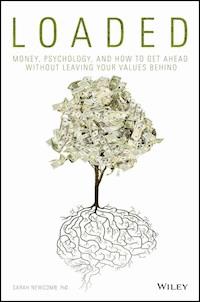
Cover design: Michael Pettit, Morningstar, Inc. Cover image: Michael Pettit, Morningstar, Inc.; brain root © thanaphiphat/iStockphoto; money tree © UpperCut Images/iStockphoto
Copyright © 2016 by Sarah Newcomb. All rights reserved.
Published by John Wiley & Sons, Inc., Hoboken, New Jersey. Published simultaneously in Canada.
No part of this publication may be reproduced, stored in a retrieval system, or transmitted in any form or by any means, electronic, mechanical, photocopying, recording, scanning, or otherwise, except as permitted under Section 107 or 108 of the 1976 United States Copyright Act, without either the prior written permission of the Publisher, or authorization through payment of the appropriate per-copy fee to the Copyright Clearance Center, Inc., 222 Rosewood Drive, Danvers, MA 01923, (978) 750–8400, fax (978) 646–8600, or on the Web at www.copyright.com. Requests to the Publisher for permission should be addressed to the Permissions Department, John Wiley & Sons, Inc., 111 River Street, Hoboken, NJ 07030, (201) 748–6011, fax (201) 748–6008, or online at http://www.wiley.com/go/permissions.
Limit of Liability/Disclaimer of Warranty: While the publisher and author have used their best efforts in preparing this book, they make no representations or warranties with respect to the accuracy or completeness of the contents of this book and specifically disclaim any implied warranties of merchantability or fitness for a particular purpose. No warranty may be created or extended by sales representatives or written sales materials. The advice and strategies contained herein may not be suitable for your situation. You should consult with a professional where appropriate. Neither the publisher nor author shall be liable for any loss of profit or any other commercial damages, including but not limited to special, incidental, consequential, or other damages.
For general information on our other products and services or for technical support, please contact our Customer Care Department within the United States at (800) 762–2974, outside the United States at (317) 572–3993 or fax (317) 572–4002.
Wiley publishes in a variety of print and electronic formats and by print-on-demand. Some material included with standard print versions of this book may not be included in e-books or in print-on-demand. If this book refers to media such as a CD or DVD that is not included in the version you purchased, you may download this material at http://booksupport.wiley.com. For more information about Wiley products, visit www.wiley.com.
Library of Congress Cataloging-in-Publication Data:
Names: Newcomb, Sarah C., author. Title: Loaded : money, psychology, and how to get ahead without leaving your values behind / Sarah Newcomb, PhD. Description: Hoboken, New Jersey : John Wiley & Sons, Inc., [2016] | Includes index. Identifiers: LCCN 2016001707 | ISBN 9781119258322 (hardback) | ISBN 9781119258339 (ePDF) | ISBN 9781119258346 (ePub)> Subjects: LCSH: Finance, Personal–Psychological aspects. | Economics–Psychological aspects. | BISAC: BUSINESS & ECONOMICS / Personal Finance / Money Management. | BUSINESS & ECONOMICS / Personal Finance / General. | BUSINESS & ECONOMICS / Personal Finance / Investing.
Classification: LCC HG179 .N447 2016 | DDC 332.024–dc23 LC record available at http://lccn.loc.gov/2016001707
To Zoë: May you never stand in the way of your own dreams.
CONTENTS
Acknowledgments
Introduction
1: When It Comes to Money, We’ve All Got Issues
Notes
2: Money Messages
We Don’t Talk about Money
We Talk about Money Constantly
From Freud to Frodo: The Stories We Tell Each Other
The Stories We Tell Ourselves
Stories Can Help or Hurt
Heuristics and Biases Shape Our Stories
Identifying Core Beliefs
Challenging Core Beliefs
Using Science to Our Advantage
Notes
3: Poverty, Privilege, and Prejudice
Money and Social Psychology: How Poverty, Privilege, and Comparisons Affect Our Minds and Behavior
Poverty: Why Not Having Enough Is a Major Drag
Privilege: Why Having an Advantage Is Great . . . and Not So Great
Prejudice—We’ve All Got It
Movin’ on Up
Money and Cognitive Psychology: How Specific Thinking Patterns Affect Financial Decisions
Why Retail Therapy Feels Good: Identity and Ego Depletion
Time and Money: Why We Always Want It NOW
Thinking in Circles
Finances and Emotions
Financial Knowledge
Making Change
Notes
4: The LOADED Budget
What’s Wrong with Your Budget?
Where Does Your Money Come from?
Assets and Resources
Where Does Your Money Go?
Rules of Thumb for Creative Resource Management
The Asset Test
Putting It in All Together: Your Personal Economy
Enjoying a Loaded Life: Living in Harmony with Your Money and Your Values
Notes
Appendix A: Self-Assessments
Write Your Personal Financial Narrative
Define Your Core Beliefs
Financial Management Behavior Scale
Emotions and Money (from HelloWallet’s 2014 Pilot Study)
Mental Imagery
Behavior Identification Form
How Impulsive Are You?
Big Five Financial Literacy Questions
Appendix B: Interventions and Exercises
Change the Narrative
Challenging Core Beliefs: Find a Counterexample
Age Progression
Future Visualization Exercises
Exercises to Combat MoneyThink
Affirm Core Values
Cash Flow Worksheet
Resources Worksheet
Expenses and Needs Worksheet
Your Personal Economy
Just-In-Time Financial Education Resources
About the Author
Index
EULA
List of Illustrations
Chapter 3
Figure 3.1
Saving Study: Four Groups
Figure 3.2
Who Saved the Most?
Figure 3.3
People Who Use Credit
Figure 3.4
People Who Don’t Use Credit
Figure 3.5
Time and Emotions
Figure 3.6
Control and Emotions
Figure 3.7
Assessments, Activities, and Worksheets
Chapter 4
Figure 4.1
Cash Flow
Figure 4.3
Assets Generate Income
Figure 4.4
How Income Maps to Resources
Figure 4.5
Liabilities Create Expenses
Figure 4.6
Maslow’s Hierarchy of Needs
Figure 4.7
Needs and Money
Figure 4.8
Expenses Come From Needs
Figure 4.9
The Things Humans Need in Order to Feel Fulfilled
Figure 4.10
Raphael’s Cash Flow
Figure 4.11
Raphael’s Real Cash Flow
Figure 4.12
Personal Economics
Figure 4.13
Raphael’s Actual Cash Flow
Figure 4.14
Raphael’s Personal Economy
Guide
Cover
Table of Contents
Chapter
Pages
xi
xii
1
2
3
4
5
7
8
9
11
12
13
14
15
16
17
18
19
20
21
22
23
24
25
26
27
28
29
30
31
32
33
34
35
36
37
38
39
40
41
42
43
44
45
46
47
48
49
50
51
52
53
54
55
56
57
58
59
60
61
62
63
64
65
66
67
68
69
70
71
72
73
74
75
76
77
78
79
80
81
82
83
84
85
86
87
88
89
90
91
93
94
95
96
97
98
99
100
101
102
103
104
105
106
107
108
109
110
111
112
113
114
115
116
117
118
119
120
122
123
124
125
126
127
128
129
130
131
132
133
134
135
136
137
138
139
140
141
142
143
144
145
146
147
148
149
150
151
152
153
154
156
157
158
159
160
161
162
163
164
165
167
168
169
170
171
172
174
175
177
178
179
180
181
182
183
184
185
186
187
188
189
191
192
193
194
195
196
Acknowledgments
THANK YOU to the following individuals, without whose contributions and support this book would not have been written:
First, to the incredible professors who have inspired and challenged me, and taught me to diligently question my assumptions: Jim Grubman, George Criner, Mario Teisl, Shannon McCoy, Caroline Noblet, Bill Halteman, and Linda Silka. Your scholarship and support have made this work possible.
To my colleagues, who have championed and supported this work through many stages and drafts: Rob Pinkerton, Steve Wendel, Amna Kanoun, Merve Akbas, Erik Johnson, Mary Dyer, Marion Syverson, Ryan Pickering, Caroline Collins, Pedram Rahmatabati, Diane Batty, Renee Benz, Carling Spelhaug, and Michael Pettit. Your patience, creative contributions, encouragement, and cheerleading made all the difference in the world.
To the team at Wiley who believed in the idea and helped turn out a great work in record time: James Belcher, Michael Henton, Meg Freeborn, Susan Cerra, and especially Tula Batanchiev, who first saw the value in this work, and held my hand through the entire process. You all have been amazing.
To my family, and those friends that I love like family: Chris, Amy, Jesse, and Jake Newcomb; Jason Mills; Robin and Jim Hamilton; Zoë and Graham Morehead; Jonathan McCullum; Kristen Brown; Stacia Dreyer; and Michelle Johnson. If not for all you’ve given, this book would simply not exist.
Lastly, to all of the people who I have had the pleasure to teach and counsel over the years. Thank you for sharing your stories and your struggles. I am sure I learned far more from you than the other way around.
Introduction
THERE IS NO SHORTAGE of books for those who love money. Enter any bookstore and you will find guides to help you think rich, attract money, or beat Wall Street. These may appeal to people who aspire to great wealth and luxury and those who associate money with opportunity, happiness, and freedom. But where is the book for the rest of us? Where is the book for the people who have come to equate money with stress, inequality, barriers, or greed? Where is the book that acknowledges the darker side of the financial world?
Lesen Sie weiter in der vollständigen Ausgabe!
Lesen Sie weiter in der vollständigen Ausgabe!
Lesen Sie weiter in der vollständigen Ausgabe!
Lesen Sie weiter in der vollständigen Ausgabe!
Lesen Sie weiter in der vollständigen Ausgabe!
Lesen Sie weiter in der vollständigen Ausgabe!
Lesen Sie weiter in der vollständigen Ausgabe!
Lesen Sie weiter in der vollständigen Ausgabe!
Lesen Sie weiter in der vollständigen Ausgabe!




