


Erhalten Sie Zugang zu diesem und mehr als 300000 Büchern ab EUR 5,99 monatlich.
- Herausgeber: The History Press
- Kategorie: Geisteswissenschaft
- Sprache: Englisch
In 1739, the London Foundling Hospital opened its doors to take in the abandoned children of the city. It was the culmination of seventeen years of campaigning by Captain Thomas Coram, driven by his horror at seeing children die in the streets. He was supported in his endeavours by a royal charter and by William Hogarth and George Frideric Handel. The Hospital would continue as both home and school for over 215 years, raising thousands of children until they could be apprenticed out. London's Forgotten Children is a fascinating history of the first children's charity, charting the rise of this incredible institution and examining the attitude towards illegitimate children over the years. The story comes alive with the voices of children who grew up in the Hospital, and the concluding, fully updated, account of today's children's charity Coram is an ongoing testament to the vision of its founder.
Sie lesen das E-Book in den Legimi-Apps auf:
Seitenzahl: 359
Veröffentlichungsjahr: 2011
Das E-Book (TTS) können Sie hören im Abo „Legimi Premium” in Legimi-Apps auf:
Ähnliche




















ABOUT THE AUTHOR
Gillian Pugh was chief executive of Coram from 1997–2005. She has advised governments in this country and overseas on services for children and families, and has published widely on early years and primary education, parental support, and joined up approaches to working with children, as well as a local history of her village in Hertfordshire. Before her retirement, she was visiting professor at the Institute of Education in London and chair of the National Children’s Bureau. In retirement she chairs her local educational trust, and enjoys spending time with her eight grandchildren, singing, walking and gardening. She was created a Dame in 2005 for services to children and families.
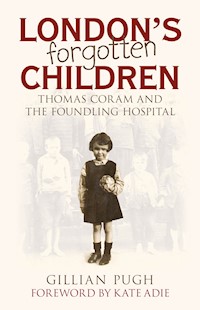
Cover illustrations:Foreground: Constance Millard at the Foundling Hospital School in Berkhamsted in about 1937. Reproduced by permission of Constance Millard. Background: Photograph from How They Were Taught published by Blackwell Publishing.
First published 2007
Reprinted 2008, 2013
This revised paperback edition first published 2022
The History Press
97 St George’s Place, Cheltenham,
Gloucestershire, GL50 3QB
www.thehistorypress.co.uk
© Gillian Pugh, 2007, 2008, 2013, 2022
The right of Gillian Pugh to be identified as the Author of this work has been asserted in accordance with the Copyright, Designs and Patents Act 1988.
All rights reserved. No part of this book may be reprinted or reproduced or utilised in any form or by any electronic, mechanical or other means, now known or hereafter invented, including photocopying and recording, or in any information storage or retrieval system, without the permission in writing from the Publishers.
British Library Cataloguing in Publication Data.
A catalogue record for this book is available from the British Library.
ISBN 978 0 75248 020 6
Typesetting and origination by The History Press
Printed and bound in Great Britain by TJ Books Limited, Padstow, Cornwall.
eBook converted by Geethik Technologies
CONTENTS
Acknowledgements
List of Illustrations
Foreword
Introduction
I
Thomas Coram: The Man and his Mission
II
The Foundling Hospital Gets Underway: the First Sixty Years
III
A Child’s Eye View: The Early Days of the Foundling Hospital
IV
Hogarth and Handel: Charity and the Arts
V
No Goodnight Kiss: Brownlow, Dickens and the Nineteenth Century
VI
The End of an Era: The Foundling Hospital in the Twentieth Century
VII
Who am I? Where did I come from? Former Pupils Look Back on their Childhood Experiences
VIII
From Thomas Coram Foundation for Children to Coram Family: 1955–2005
IX
London’s Forgotten Children: Then and Now
X
Afterword 2022
Notes
Bibliography
ACKNOWLEDGEMENTS
My interest in writing this book began well before I joined the Thomas Coram Foundation for Children – as it was then called – as chief executive in 1997. I had long been interested in both the children’s charity and its current work and past history, and in the historic picture collection for which, when I joined the organisation, I was also responsible.
My knowledge and understanding of the fascinating history of the organisation grew during the eight years at Coram, but it was not until I retired that I had time to do the further research that was required to put this book together. It has been a fascinating journey.
Many people have helped me in my quest to tell, for the first time, the history of the Foundling Hospital from the 1730s to the present day. I have drawn heavily on a number of key sources, particularly Ruth McClure’s Coram’s Children: The London Foundling Hospital in the Eighteenth Century; Gillian Wagner’s Thomas Coram, Gent, two books by my predecessors as senior officers of the organisation – John Brownlow’s Memoranda, or Chronicle of the Foundling Hospital published in 1847 and R.H Nichols and F.A Wray’s detailed History of the Foundling Hospital published in 1935 and a selection from the huge number of documents (weighing an estimated 8 tonnes) in the London Metropolitan Archives.
One of the great pleasures of my time at Coram was meeting so many former pupils and members of the Old Coram Association. I am indebted to those who have shared their memories with me and with Virginia Makins, and to those who were also interviewed by Chris Oliver and Peter Aggleton for their study Coram’s Children: Growing up in the care of the Foundling Hospital 1900–1955. I would particularly like to thank Harold Tarrant, John Caldicott, Lydia Carmichael, Mary Bentley and Jocelyn Gamble for their help and for permission to quote from their interviews and writings, Gillian Erskine for permission to quote from her late husband Tom’s autobiography and the Old Coram Association for permission to quote from Coram News.
Current and former staff and governors of Coram Family and colleagues in the Foundling Museum have been generous with the information they have shared with me, and many have commented on earlier drafts of this book. A particular thank you to William Barnes, Dorothy Baulch, Peter Brown, Steve Hudd, Jeanne Kaniuk, Colin Masters, Val Molloy, Gordon Parker, Wendy Rose, Lonica Vanclay and Lorna Zumpe and to honorary archivists John Orr and Gillian Clark. Also to Janet Snook who worked in the Thomas Coram children’s centre in the 1970s, to Bernadette Duffy who is the head of centre today, and to Sandy Wynn who runs Coram’s Fields.
Thank you also to Jenny Bourne Taylor, Professor of English at Sussex University for sharing with me her material relating to Charles Dickens and John Brownlow in the nineteenth century; to Virginia Makins who interviewed many former pupils and gave me access to her notes; and to Nicola Hilliard at the National Children’s Bureau for allowing me to follow up much of the historical material through the NCB library.
For permission to use photographs and help in finding and reproducing them, further thanks are due. To Coram Family for permission to reproduce the following which are in the care of the Foundling Museum and to Alison Duke from the Foundling Museum for her help in locating the images: portrait of Captain Thomas Coram and Moses Brought Before Pharoahs Daughter by Hogarth; portrait of Captain Thomas Coram by Nebot; the engraving of the Foundling Hospital; Admission of children to the Hospital by ballot by Wale; The Foundling Hospital chapel and Girls dining room by Sanders; A Foundling Boy and A Foundling Girl by Copping; The Foundling Hospital by Wilson; photograph of the marble chimney by Rysbrack; the bust of Handel by Roubiliac; The Finding of the Infant Moses in the Bulrushes by Hayman; The Foundling Restored to its Mother and The Christening by Brownlow King; Girls in the Chapel by Anderson; and visitors watching children eat Sunday lunch from the Illustrated London News.
The March of the Guards to Finchley by Hogarth and the tokens are owned by the Foundling Museum; the photograph of the Court Room is by James Robinson; the painting of the Foundling Museum is by Ann Usborne and is reproduced by permission of Persephone Books.
The photographs of Coram’s Fields are reproduced with permission of Sandy Wynn.
All other photographs are reproduced with the permission of Coram Family, with a particular thank you to Jocelyn Gamble for her help in reproducing photographs from the archives.
And finally thank you to Kate Adie for her interest in the work of the Foundling Hospital and the children who grew up in it, and for her Foreword to this book.
Gillian Pugh,November 2006
Postscript
The opportunity to publish a revised edition of the book in 2022 has enabled me to update the work of Coram and the Foundling Museum and to examine new insights from the archives. My grateful thanks to Dr Carol Homden, Group Chief Executive of Coram and Caro Howell and Alison Duke of the Foundling Museum for their support in this task.
Gillian PughSeptember 2022
LIST OF ILLUSTRATIONS
Mono Illustrations
1 Heading to the subscription roll designed by William Hogarth. © Coram Family.
2 Captain Thomas Coram by B. Nebot, 1741. © Coram Family in the care of the Foundling Museum.
3 Statue of Thomas Coram outside the Foundling Museum and Coram Family. © Coram Family in the care of the Foundling Museum.
4 Detail from a map of London by John Rocque, 1746. The site of the Foundling Hospital was north of the northern edge of London. © Coram Family.
5 Admission of children to the Hospital by ballot by Samuel Wale, 1749. © Coram Family in the care of the Foundling Museum.
6 The Foundling Hospital chapel looking west by John Sanders, 1773. Reproduced by permission of the Trustees of the William Salt Library.
7 Boys’ dining room, photographed in the early 1900s. © Coram Family.
8 Girls’ dining room by John Sanders, 1773, showing the Hogarth portrait of Thomas Coram hanging to the right of the picture. Reproduced by permission of the Trustees of the William Salt Library.
9 Boys’ dormitory, west wing, photographed in the early 1900s. © Coram Family.
10 The marble mantelpiece in the Court Room – Charity and children engaged in navigation and husbandry – by John Michael Rysbrack, 1745. © Coram Family in the care of the Foundling Museum.
11 Terracotta bust of George Frideric Handel by Louis-Francois Roubiliac, 1739. © Coram Family in the care of the Foundling Museum.
12 Invitation to the first performance of Messiah by George Frideric Handel, 1 May 1750. © Coram Family.
13 Leaving certificate for apprentice Esther Mayhew, 1855. © Coram Family.
14 The boys’ band, Foundling Hospital, early 1900s. © Coram Family.
15 Visitors watching children eat Sunday lunch, 1872. by J. Swain after H.T. Thomas, from Illustrated London News 7 December. © Coram Family in the care of the Foundling Museum.
16 The boys’ school room, Foundling Hospital early 1900s. © Coram Family.
17 The girls’ school room, Foundling Hospital, early 1900s. © Coram Family.
18 The infants’ school room, Foundling Hospital, early 1900s. © Coram Family.
19 The Foundling Hospital, Guilford Street. Site plan 1912. © Coram Family.
20 The Foundling Hospital, London, early 1900s. © Coram Family.
21 A parade outside the Foundling Hospital, early 1900s. © Coram Family.
22 The Duke of Connaught, president of the Foundling Hospital, inspecting the children, early 1900s. © Coram Family.
23 The Foundling Hospital School at Berkhamsted, Hertfordshire, in the 1930s. It was later known as the Thomas Coram School and is now Ashlyns Comprehensive School. © Coram Fields.
24 Children marching out of the Foundling Hospital for the last time in 1926. © Coram Family.
25 A foster mother in East Peckham, around 1900. © Coram Family.
26 Choir practice, Foundling Hospital 1924. © Coram Family.
27 The choir at a musical event in the Foundling Hospital chapel, 1920s. © Coram Family.
28 The school band practising at camp 1926. © Coram Family.
29 Summer camp – ring-a-roses 1926. © Coram Family.
30 Summer camp – jam roley poley 1928. © Coram Family.
31 Summer camp – boys trampoline. © Coram Family.
32 Summer camp – boys washing. © Coram Family.
33 Summer camp – girls in a sewing class 1926. © Coram Family.
34 Summer camp – girls lining up for lunch, with the older girls taking care of the younger ones, 1928. © Coram Family.
35 Summer camp – lunch time 1928. © Coram Family.
36 Going to the circus from the Foundling Hospital, early 1900s. © Coram Family.
37 Clowns at the Foundling Hospital, early 1900s. © Coram Family.
38 Meal time at the Foundling Hospital School, Berkhamsted. © Coram Family.
Colour Illustrations
39 Portrait of Captain Thomas Coram by William Hogarth, 1740. © Coram Family in the care of the Foundling Museum.
40 Engraving of view of the Foundling Hospital 1751. © Coram Family in the care of the Foundling Museum.
41 Tokens left by mothers with their babies. © Foundling Museum.
42 A Foundling Boy by Harold Copping 1914. The uniform had changed very little since Hogarth’s day. © Coram Family in the care of the Foundling Museum.
43 A Foundling Girl by Harold Copping, 1914. © Coram Family in the care of the Foundling Museum.
44 Moses Brought Before Pharoah’s daughter by William Hogarth, 1746. © Coram Family in the care of the Foundling Museum.
45 The Foundling Hospital by Richard Wilson, 1746/50, one of eight roundels painted for the Court Room. © Coram Family in the care of the Foundling Museum.
46 March of the Guards to Finchley by Wiliam Hogarth, 1749/50. © Foundling Museum.
47 The Court room, photographed in 2004, showing Hogarth’s and Hayman’s paintings of the foundling Moses (see photographs 46 and 48). Photograph by James Robinson.
48 The Finding of The Infant Moses in the Bulrushes by Francis Hayman, 1746. © Coram Family in the care of the Foundling Museum.
49 The Foundling Restored to its Mother by Emma Brownlow King, 1858. © Coram Family in the care of the Foundling Museum.
50 The Christening by Emma Brownlow King, 1863. © Coram Family in the care of the Foundling Museum.
51 Girls in the Chapel by Sophia Anderson, 1877. © Coram Family in the care of the Foundling Museum.
52 Sign at the entrance to Coram’s Fields in Guilford Street, 2006. © Coram Fields.
53 Coram’s Fields play area in 2006, with the original colonnades in the background. © Coram Fields.
54 Enjoying the annual Coram Family picnic for adoptive families. © Coram Family.
55 Then Prime Minister Tony Blair and his wife Cherie meeting adoptive parents at Coram Family, 2000. © Coram Family.
56 Children and parents at the Coram campus music event. © Coram Family.
57 Parents and children in the Coram parents centre. © Coram Family.
58 Children in the outside play area at the Thomas Coram children’s centre, with the Foundling Museum in the background. © Coram Family.
59 Young people from Coram’s education service celebrating their achievements, 2001. © Coram Family.
60 Painting of the Foundling Museum, 40 Brunswick Square by Ann Usborne, with the statue of Thomas Coram to the right. © Ann Usborne.
61 The Thomas Coram Story by Rosa Branson, 2002. © Coram Family.
FOREWORD
It seems strange that any child should be forgotten. However, there have always been familiar phrases which have hinted at children out of sight, out of mind: ‘She’s in trouble’, ‘there was a child, I believe’, ‘A boy – but the family doesn’t talk about it.’
For centuries, a combination of social prejudice and religious disapproval effectively banished some children from the family tree. Unwanted, illegitimate, abandoned, victims of dire poverty, such children were seen as a problem to be tidied away. Across Europe there were ‘turning wheels’ in every major city, anonymous gateways to huge institutions which cloistered the unwanted. In America, the railroad sped hundreds of thousands of boys and girls, cut off from their origins, to a new life in the West, with strangers. In Russia, the Tsars personally endowed immense Foundling Hospitals, encouraging the idea that the State was a more reliable carer than the family.
Those who sought to deal with the social ‘difficulty’ of the abandoned were sometimes benevolent, sometimes filled with reforming zeal – for these were the offspring of unacceptable unions and often thought to be tainted by their parents’ behaviour. The story in Britain has a touch of both influences, but centres on a true hero: Captain Thomas Coram, the creator of the Foundling Hospital in London.
The Coram story is the story of our attitude to children. And what makes it particularly poignant are the voices of those who were still in the Foundling Hospital within living memory – very much the heirs to a 200 year-old tradition – and still with us today.
It is a vitally important story, for we are now supposed to know so much more about the importance of childhood and the significance of the relationship between parent and child. The picture of gaunt and draughty buildings into which children used to be herded and disciplined according to the principles of the time fills us with dismay. However, although these institutions have disappeared, we are still grappling with problems within families and have no reason for complacency when confronted with the modern statistics for neglect and cruelty. (Even abandonment is still with us, a steady stream of foundlings every year left in bus shelters and doorways.)
We need to know how our attitudes to children have been shaped, and how much prejudice today stems from ancient ideas: mutterings such as ‘bad blood will out’ and ‘the child conceived in sin’ may sound Victorian (or more probably mediaeval), but they can still be heard in dark corners and live in the minds of those who are unwilling to see children as individuals at the mercy of circumstances. For an insight into what shapes our views, we have to reach back to the strong influences which religious teaching and economic necessity brought to bear on ordinary families. For centuries, legitimacy, inheritance, superstition, starvation and inequality swirled around a newborn child, with emotional well-being hardly registering. Hard to believe in today’s world? No, not when you hear arguments grounded in social agendas, cultural heritage and material circumstances advanced at the expense of love and care.
The attitude of Church and State needs to be reviewed in light of the Coram experience: who should take over from parents who are unable to look after their children? Institutions, wet-nurses, fostering, orphanages, even transportation – all have been tried. Today there is still debate as to the best kind of care for those outside the conventional family, and the roots of that debate are well embedded in the Middle Ages. Understanding the consequences of what has been tried is essential to assessing new courses of action. Nor is it long since children ceased to be regarded as property, rather than small people. Even so, the rights of the child are still a subject of debate in many sensitive situations, and it is well worth understanding how much has changed in the past couple of centuries.
Thomas Coram had a good notion of what might be right for a child, but like many kind-hearted and modest men, he didn’t carve his name prominently. He is remembered today in an open space in north London – Coram’s Fields. However, his good intentions live on, for if you cross Coram’s Fields – heading for the Foundling Museum – you will see a sign which is probably unique in the land: ‘Adults not admitted unless accompanied by a child’. You may also hear children’s voices, belonging to those who are being helped by Coram Family, the organisation which carries on the tradition of innovative action on behalf of today’s ‘forgotten children’.
This is a book about all such children, past and present – and if we care about any child’s future, we need to read about the past and the tradition of Coram.
Kate AdieFormer BBC Chief News Correspondent and author of three best-selling books including Nobody’s Child: Who are you when you don’t know your past?(Hodder and Stoughton, 2005)
INTRODUCTION
The buzz in the room gets louder as more and more people arrive. The majority are men and women in their sixties and older, but a few have brought their grown-up children with them. Snatches of conversation suggest that these are people who know each other well and have done so for many years. Some are greeting people as though they are long-lost family. There are jokes about former teachers, and nicknames are banded about. There are quips about money lent and not returned, and old grievances are aired. Boxes of old school photos are laid out on a table and there is much reminiscing as these men and women catch sight of themselves in their earlier days.
It might be any school reunion, except that people keep telling you: ‘This is my family’. For this is a meeting of the Old Coram Association, the former pupils of the London Foundling Hospital. Three times a year members meet together at 40 Brunswick Square under the watchful eye of the Hogarth portrait of their great benefactor Captain Thomas Coram: in June at Coram Day, hosted by the governors and staff of Coram Family; in October on Charter Day to remember the signing of the Charter that established the Foundling Hospital by George II in 1739; and in December for a Christmas carol service. During their childhood these former pupils were indeed each other’s only family. Some were foster brothers and sisters. What brought them together is, as often as not, the difficult times they shared and the sense of guilt and rejection and being ‘different’ that many have carried throughout their lives as they have tried to find out who they are and where they came from. But there is fun and laughter too, and many good friendships that have lasted over the years.
Drawing on contemporary sources and first-hand accounts from the archives,1 as well as interviews with former pupils and staff, this book tells the story of one of the most remarkable institutions in England, the first children’s charity, established in 1739 – the Foundling Hospital. During its long life as a residential institution, the Hospital provided a home for 25,000 children for their entire childhood. The story is told against a background of changing social mores: starting in the golden age of philanthropy; moving on through the Victorian era with its distinction between the deserving and undeserving poor and the need to ‘rescue’ children, particularly illegitimate children, from their fickle parents; and finally into the era of the post-war welfare state when the influences of child psychiatry and psychology drew attention to the importance of children’s emotional well-being, and of supporting parents wherever possible so that their children could stay with them.
The book begins with a short biography of Captain Thomas Coram, a man of extraordinary energy and tenacity who was dismayed at the sight of children dying on the dung heaps of London. After seventeen years of campaigning, he managed to persuade sufficient ‘persons of quality and distinction’ to support his petition to the King to grant a Royal Charter for what he called his ‘darling project’ – the building of the Foundling Hospital in a green field site in Bloomsbury.
The next two chapters recount the detailed work required of the Court of Governors as, with meticulous care, they put in place systems for receiving babies into the institution; for christening them with new names; for placing them with wet-nurses or foster parents in the country for five years; and then for bringing the children back into the Hospital. Once there, they were provided with excellent health care and education fit for their station in life, but with little knowledge of their emotional needs, before the boys were apprenticed to learn a trade and the girls to domestic service. Even at this stage, particularly during the years of open admissions, the governors were struggling to make ends meet as the demands were always greater than their ability to meet them. The daily routines are described – routines that appear to have changed little until the Second World War. We hear about what the children did, what they ate, what they wore, what they were taught in school, what happened when they were sick, and – the highlight for many – the music in the chapel.
Chapter IV explores the relationship between the Foundling Hospital and two of the artistic giants of the eighteenth century – the artist William Hogarth and the composer George Frideric Handel, both of whom helped to raise substantial sums of money for the charity and both of whom became governors. Hogarth was also an inspector of wet-nurses. Their legacy lives on in the extraordinary collection of paintings, other artefacts and musical scores that are now on display in the Foundling Museum.
Chapter V explores the very limited changes that were introduced into the Foundling Hospital during the nineteenth century, mainly changes in admission criteria which stipulated that the child must be illegitimate and the mother unsupported, but able to make her way in life if the child was accepted into the Hospital. Key figures of this period were Charles Dickens, who lived very close to the Foundling Hospital and wrote of his visits, and through whose pen pictures we get such a vivid sense of lives of the poor children of London; and his friend John Brownlow, a foundling who grew up in the Hospital and went on to serve it for fifty-eight years, only retiring from his post as secretary through ill health.
The next two chapters take us through the first half of the twentieth century. After a century of limited change, the governors found themselves having to sell the Foundling Hospital site, move the children to Redhill on a temporary basis, purchase the site and build the new school at Berkhamsted, then move the children to Berkhamsted. Finally, after a comparatively short space of time and under pressure from the government and the 1948 Children Act, they reduced the numbers of children living permanently in what was now called the Thomas Coram Schools, and returned them to their foster parents. The buildings were sold to Hertfordshire County Council in 1950 and by 1955 the now renamed Thomas Coram Foundation for Children returned to its base in London and became a fostering agency.
Chapter VII draws on interviews and written accounts by former pupils, recollected with varying emotions, many years after they had left school. There were undoubtedly some harsh and difficult times, as there are in many boarding schools, the difference being that most children attending boarding school know that they will be going home for the holidays. What was most painful for these men and women was the attitude towards them as illegitimate children, and the sense of guilt, inferiority and rejection that this implied. In contrast to the regime within the school, the memories of the first five years in the country with foster parents, and the month spent under canvas in the summer, are mainly full of sunshine, laughter and freedom.
Chapter VIII brings the Coram story up to date. From 1955 to 2005 Coram Family (as it is now called) has responded to the changing needs of children and families whilst continuing with the innovative tradition of its founder. At the same time it has moved away from residential care towards a focus on finding substitute families (through adoption) for children who cannot live with their birth families. Coram Family has also developed a range of community based services for vulnerable children and families that promote resilience and help children to develop the capacity to thrive in often difficult circumstances. Although very few children are now abandoned, and the dung heaps in the streets have disappeared, there are still too many children who do not get the love and care that they deserve and whose lives are blighted through the lack of a supportive family.
The chapter also relates the tale of the establishment of the Foundling Museum, set up as a separate charity to display the historical treasures and to bring alive the legacy of Thomas Coram and the story of London’s forgotten children.
Chapter IX concludes with reflections on this legacy, pulling out some key themes from the 265-year history of this unique organisation: the changing view of childhood; social perceptions of illegitimacy; and the particular contribution that the Foundling Hospital made to the history of childcare as well as its role as the first modern charity. There were times when the organisation led the way in developing new thinking about the care of children who were not able to live with their own families, and others when it took longer than it should to respond to the need for change. Today Coram Family continues to take risks on behalf of children and again lives up the pioneering spirit of its founder.
A final chapter in this revised edition, written in 2022, explores more recent research into the Foundling Hospital archives, and brings the work of the charity Coram, and the Foundling Museum, up to date.
I
THOMAS CORAM: THE MAN AND HIS MISSION
The man who gave his name to the first and only Foundling Hospital in England was a remarkable individual. He was determined and compassionate, sometimes brusque, and a man ‘of obstinate, persevering temper, as never to desist from his first enterprise, whatever obstacles lie in his way.’1 His perseverance was needed. Coram was seventy-one by the time the Hospital received the Royal Charter, and he had spent much of the previous seventeen years on what he called his ‘darling project’.
Coram’s biographer summarises his key qualities:
He was a man of startling integrity in an age of corruption, a man prepared to use his own limited resources to gain his objects, with little expectation of personal reward apart from the satisfaction of having contributed to the public good. From a modest family background, without wealth or a patron, in an age when both were considered a necessity, he triumphed through his own energy, persistence, and enterprise, combined with a rough charm of manner, made the more appealing on account of his patent honesty. Unfortunately his fierce temper, together with his injudicious habit of responding in an intemperate manner, both verbally and in writing, to perceived or real injustices, made for difficulties throughout his life.2
Thomas Coram was born in Lyme Regis in 1668, the son of John and Spes Coram. His mother died when Thomas was three, shortly after giving birth to his brother William, who also died. His father was left to bring up Thomas on his own, and perhaps the fact that Thomas makes almost no mention of his father in letters suggests that this was a difficult time and relationships were strained. Coram describes his comparative lack of education and impoverished early years in a letter written in 1724:
For my part I am no Judge in Learning I understand no Lattin nor English nither, well, for though Through Mercy I discended from virtuous good Parentage on both sides as any Body, they were Famelies of Strict hon’r and honesty and always of Good Reputation amongst the better sort of people, Yet I had no Learning, my Mother Dying when I was Young, My Father Marryed again 4 or 5 years after at Hackney Near this City. I went to sea, out of my Native place, the Little Town of Lyme in the West of England at 11 years and a half old until 5 years after my Father sent for me hither and put me apprentice to a Shipright.3
We have no written record of Thomas Coram’s early life at sea but as such a young apprentice, life is likely to have been hard. Aged sixteen, his father apprenticed him to a shipwright, a good foundation for a future career for a young man in a country with a merchant fleet that was expanding in line with its overseas trade and colonies. His apprenticeship was followed by two years working in shipyards in London before he left for New England aged only twenty-five but with a considerable amount of relevant experience.
Although he is best known for his work with the Foundling Hospital right at the end of his life, New England and the new colonies were to be a focus for much of the middle years of Coram’s life. The ten years that he spent in New England in particular had far reaching effects, both positive and negative. Shipbuilding was already well established when Thomas Coram arrived in Boston in 1693 but when he moved to Taunton (on a river south of Boston) in 1697 it was to set up the first ship builders.
He got off to a good start: buying land, building himself a house, establishing a business and – in 1700 – marrying Eunice Wayte from one of Boston’s oldest families. He became involved in the Christian education of the Indians, though despite his lifelong commitment to fighting for the underdeveloped, he was never directly involved in the abolition of the slave trade. He was energetic and hard-working and his business went well, but it was not long before he fell out with the local people. He was seen as an arrogant outsider, and his contempt for the local people included his dislike of their Free Church religion which did not sit well with his Anglicanism. His ships were attacked and burnt, and he narrowly escaped being murdered. Court cases were brought and eventually, burdened by debt, he returned to England. Typically, his final gesture was to bequeath a sum of money to the people of Taunton to enable them to build an Anglican church. Resplendent with reproductions of Hogarth’s portrait of Coram and a stained-glass window in Coram’s memory, St Thomas’ church (which still stands today), is Coram’s most lasting memorial in America.
Back in London, Coram was determined to return to America. He became involved in plans for the settlement of Maine and Nova Scotia. Writing to his brother the Prime Minister, Horatio Walpole described him as ‘the honestest and most disinterested and the most knowing person about the plantations that I have ever talked with’. Coram put much unpaid time and effort into petitions arguing for land to be put aside in the province of Georgia for disbanded soldiers and settlers from England. He was appointed as trustee for the settlement of Georgia by George II, the highest public office that he attained. He became involved in further trading and petitioning in relation to Hamburg, developing and using his extensive networks of contacts. The failure of the South Sea Company in 1720, which left thousands of people with considerable losses, led to a more cautious approach to investment and Coram had to put his plans for settlements in America on temporary hold.
The London that Coram returned to was a whirl of contrasting sounds, sights and smells. The social historian Roy Porter asks whether Georgian London had become a monster or a miracle. On the one hand there was its wealth, its energy and its diversity, illustrated by Johnson’s famous claim that ‘When a man is tired of London, he is tired of life’. On the other, Porter cites the moralists who lacerated London: ‘Henry Fielding exposed its vanity, deceits and cheats and William Hogarth’s capital was all disease and violence, filth, noise, falling building and fallen women, chaos, poverty, drunkenness, suicide, distress, disarray, infidelity and insanity’.4 All of these are vividly illustrated in Hogarth’s paintings and etchings, not least in the well-known Gin Lane: the gin craze had reached a point by the 1740s where two pints a week were being drunk by every man, woman and child in London.
Many of the streets were open sewers, drinking water was contaminated and the atmosphere was thick with sulphurous coal smoke. Huge numbers of children survived on the streets by prostitution, begging, boot blacking, mudlarking (scavenging on the Thames mud) and pickpocketing – as personified a century later by the ‘Artful Dodger’ in Dickens’ Oliver Twist.
As growing urbanisation began to replace a largely agricultural way of life and patterns of agricultural communities were destroyed, there was a rise in homelessness and in illegitimacy. In London there was alarm at the increase in poverty – which tended to be seen as a moral defect – and the threat that it posed to social order. The Poor Law system that had been established in 1572 (and was to remain in place until 1834) was struggling to cope with the demands made on it. The problems of the poor had far outstripped the ability of the parish relief system to cope, and there was a feeling that the parish system encouraged idleness, which led to vice and crime. A distinction was made between the deserving and the undeserving poor, and there was a strong view that the poor should work. Defoe, for example, said that true poverty was not among beggars but among families where death or sickness deprived them of the labour of the father.5 In this climate, unmarried mothers and their illegitimate children were seen as a particular burden, combining moral failing and a lack of financial responsibility.6
The mortality rate for children at the beginning of the century was extremely high – one in three babies died before the age of two, and one in two of those who survived died before the age of fifteen. In the workhouses the death rate was over 90% and in one Westminster parish only one in 500 foundlings survived. For lone mothers, both the mother and her child were at risk. If a mother gave birth alone and her baby died, she would be suspected of having killed the baby and would have been arrested. The Old Bailey Sessions’ papers are full of such cases, and mothers who were found guilty were executed.7 Around ten to fifteen women were tried for child murder every year in England throughout the eighteenth century and although many were acquitted, those who were found guilty would have been either transported or hanged. Even those who were acquitted would have found their lives in ruins, with few prospects of employment or marriage. Unsurprisingly, this led to an alarming increase in the number of abandoned babies left in churches or hospitals or the new workhouse in Bishopsgate. Many mothers would have seen abandonment as a temporary expedient until their fortunes improved, and huge efforts were made to find the mothers of such foundlings so that they would not be a burden on the parish.
When Coram decided to give up his seafaring life he found himself with more time on his hands and he began to notice the appalling state of London’s streets, with their heaps of rubbish, dead cats and dogs and abandoned babies. While he continued to work on his plans for settlements in Maine, Georgia and Nova Scotia over the next twenty or so years, the germ of a new project was born, which was perhaps given greater force by the inability of his wife to have children, and the early loss of his young brother William. Addison had first highlighted the plight of foundlings in The Guardian in 1713:
I shall mention a Piece of Charity which has not yet been exerted among us, and which deserves our attention the more, because it is practised by most of the Nations about us. I mean a Provision for Foundlings, or for those Children who for want of such a Provision are exposed to the Barbarity of cruel and unnatural parents. One does not know how to speak of such a subject without horror: but what multitudes of infants have been made away with by those who brought them into the world and were afterwards ashamed or unable to provide for them! There is scarce an assize where some unhappy wretch is not executed for the murder of a child … It is certain that which generally betrays these profligate women … is the fear of shame, or their inability to support those whom they give life to … This is a subject that deserves our most serious consideration.8
It was the burden of shame that Coram particularly emphasised. He also thought that despair, amounting almost to insanity, was a main cause of infanticide, as is clear from John Brownlow’s account of the Foundling Hospital written in 1847:
He found that it [infanticide] arose out of a morbid morality then possessing the public mind, by which an unhappy female, who fell a victim to the seductions and false promises of designing men, was left to hopeless contumely and irretrievable disgrace. Neither she nor the offspring of her guilt appear to have been admitted within the pale of human compassion; her false step was her final doom, without even the chance, however desirous, of returning to the road of rectitude.9
According to the philanthropist and author Jonas Hanway, attempts to set up such a hospital earlier in Queen Anne’s reign had not been supported by merchants because of the prejudice of public opinion – ‘ill grounded prejudices that such an undertaking might seem to encourage persons in vice, by making it too easy provision for their illegitimate children’.10 The opposition case was that parish officers would escape their duties and the poorer classes would shelve their responsibilities, as can be seen from a response to Hanway’s support for Coram: ‘In a Protestant Country like Britain, where the Poor are so amply provided for’ it would reflect:
dishonour, not only upon the State, but upon the whole community, as it tacitly implies either a Want of Wholesome Laws, or a Want in the due execution of them. A Foundling … reflects the highest disgrace on Human Nature, and supposes a depravity in the Morals, and a degeneracy in the Affections of Rational Beings … Destructive of all Social Order and Concord.11
Over the next seventeen years Coram saw at first hand the double standards that were in play, where illegitimate births amongst the aristocracy were seen as unfortunate but acceptable, whilst the provision of any support for the poor working classes was seen as encouraging promiscuous sex. A combination of this hypocrisy and the disaster of the South Sea bubble bursting (which made many potential backers suspicious of joint stock companies), were going to present Coram with many obstacles.
The response that Coram received for his plans to establish a Foundling Hospital were in stark contrast to the City’s willingness to establish Christ’s Hospital in 1552 for the poor children of the local parishes, although by 1676 this institution was prohibiting the admission of illegitimate children, taking only children born in wedlock. The 1722 Poor Relief Act gave church wardens and overseers of the poor the right to establish workhouses to accommodate children and adults, but conditions were poor, infant mortality rates very high, and any concept of education for the children had been superseded by the notion that they should be put to work as soon as possible. As a committed Anglican, Coram was disgusted at the Church’s hostility to his proposals for destitute children, though he did find support from the Dean of St Patrick’s Cathedral in Dublin, Jonathan Swift. Writing in 1720 in his satirical pamphlet A modest Proposal for preventing the Children of Poor People from being a Burthen toe their Parents or Country and for making them beneficial to the Publick, Swift tried to shock the public into action by proposing that pauper children be fattened and reared at public expense for gentlemen of refined taste: ‘A child will make two dishes as an entertainment for friend, and when the family dines alone, the fore or hind quarter will make a reasonable dish, seasoned with a little pepper or salt will be very good boiled on the fourth day’.
Although the Church did not support his plans, it is important to see Coram’s endeavours in the context of the eighteenth-century view of the role of the State. As Porter points out, no one dreamed that it was the government’s responsibility to educate children, heal the sick, house the homeless, provide pensions for the elderly or rehabilitate offenders:
This is not to imply that our Georgian forebears were so heartless as to believe that the weak should go to the wall: they weren’t. But the government, all agreed, was mainly there to fight the French and uphold law and order. Social problems should be dealt with on a personal and parish basis, and many important matters were best left to charity.12




