


139,99 €
Mehr erfahren.
- Herausgeber: John Wiley & Sons
- Kategorie: Fachliteratur
- Sprache: Englisch
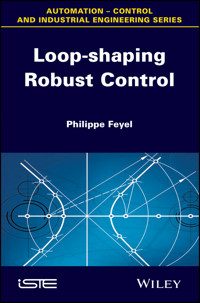
The loop-shaping approach consists of obtaining a specification in relation to the open loop of the control from specifications regarding various closed loop transfers, because it is easier to work on a single transfer (in addition to the open loop) than on a multitude of transfers (various loopings such as set point/error, disturbance/error, disturbance/control, etc.). The simplicity and flexibility of the approach make it very well adapted to the industrial context. This book presents the loop-shaping approach in its entirety, starting with the declension of high-level specifications into a loop-shaping specification. It then shows how it is possible to fully integrate this approach for the calculation of robust and efficient correctors with the help of existing techniques, which have already been industrially tried and tested, such as H-infinity synthesis. The concept of a gap metric (or distance between models) is also presented along with its connection with the prime factors of a set of systems shaping a ball of models, as well as its connections with robust synthesis by loop-shaping, in order to calculate efficient and robust correctors. As H-infinity loop-shaping is often demanding in terms of the order of correctors, the author also looks at loop-shaping synthesis under an ordering constraint. Two further promising lines of research are presented, one using stochastic optimization, and the other non-smooth optimization. Finally, the book introduces the concept of correction with two degrees of freedom via the formalism of prime factorization. Avenues for future work are also opened up by the author as he discusses the main drawbacks to loop-shaping synthesis, and how these issues can be solved using modern optimization techniques in an increasingly competitive industrial context, in accordance with ever more complex sets of functional specifications, associated with increasingly broad conditions of usage. Contents Introduction 1. The Loop-shaping Approach 2. Loop-shaping H-infinity Synthesis 3. Two Degrees-of-Freedom Controllers 4. Extensions and Optimizations Appendix 1. Demonstrative Elements on the Optimization of Robust Stabilization with Order Constraint Appendix 2. Establishment of Real LMIs for the Quasi-Convex Problem of Optimization of the Weighting Functions About the Authors Philippe Feyel is an R&D Engineer for the high-tech company Sagem Défense Sécurité, part of the defence and security business of the SAFRAN group, in Paris, France.
Sie lesen das E-Book in den Legimi-Apps auf:
Seitenzahl: 186
Veröffentlichungsjahr: 2013
Ähnliche

















Table of Contents
Introduction
I.1 Presentation of the book
I.2. Notations and definitions
Chapter 1: The Loop-shaping Approach
1.1. Principle of the method
1.2. Generalized phase and gain margins
1.3. Limitations inherent to bandwidth
1.4. Examples
1.5. Conclusion
Chapter 2: Loop-shaping H∞ Synthesis
2.1. The formalism of coprime factorizations
2.2. Robustness of normalized coprime factor plant descriptions
2.3. Explicit solution of the problem of robust stabilization of coprime factor plant descriptions
2.4. Robustness and υ-gap
2.5. Loop-shaping synthesis approach
2.6. Discrete approach
Chapter 3: Two Degrees-of-Freedom Controllers
3.1. Principle
3.2. Two-step approach
3.3. One-step approach
3.4. Comparison of the two approaches
3.5. Example
3.6. Compensation for a measurable disturbance at the model’s output.
Chapter 4: Extensions and Optimizations
4.1. Introduction
4.2. Fixed-order synthesis
4.3. Optimal setting of the weighting functions
4.4. Towards a new approach to loop-shaping fixed-order controller synthesis, etc
APPENDICES
Appendix 1: Demonstrative Elements on the Optimization of Robust Stabilization with Order Constraint
Appendix 2: Establishment of Real LMIs for the Quasi-Convex Problem of Optimization of the Weighting Functions
Bibliography
Index
First published 2013 in Great Britain and the United States by ISTE Ltd and John Wiley & Sons, Inc.
Apart from any fair dealing for the purposes of research or private study, or criticism or review, as permitted under the Copyright, Designs and Patents Act 1988, this publication may only be reproduced, stored or transmitted, in any form or by any means, with the prior permission in writing of the publishers, or in the case of reprographic reproduction in accordance with the terms and licenses issued by the CLA. Enquiries concerning reproduction outside these terms should be sent to the publishers at the undermentioned address:
ISTE Ltd27-37 St George’s RoadLondon SW19 4EUUK
www.iste.co.uk
John Wiley & Sons, Inc.111 River StreetHoboken, NJ 07030USA
www.wiley.com
© ISTE Ltd 2013
The rights of Philippe Feyel to be identified as the author of this work have been asserted by him in accordance with the Copyright, Designs and Patents Act 1988.
Library of Congress Control Number: 2013936315
British Library Cataloguing-in-Publication DataA CIP record for this book is available from the British LibraryISBN: 978-1-84821-465-1
Introduction
I.1 Presentation of the book
In an increasingly competitive industrial context, an automation engineer has to apply servo-loops in accordance with ever more complex sets of functional specifications, associated with increasingly broad conditions of usage. In addition to this, the product is often destined for large-scale production. Thus, the engineer has to be able to implement a robust servo-loop on a so-called “prototype”, whilst taking account of this broad spectrum in its entirety, at the very earliest stage of design.
An example of such a system, upon which most of the examples given in this book are based, is a mass-produced viewfinder, for which the automation engineer has to inertially stabilize the line of sight, whose usage conditions may be extremely varied – indeed there are often as many potential applications as there are types of carriers (aircraft, ships, etc.). In addition, the viewfinder is required to deliver increasingly high-end functionalities – e.g. target tracking, guidance, etc. In order to moderate and reduce development costs, there is a growing tendency to carry out so-called “generic” stabilizations. This is possible only if the servo-loop designed has a certain degree of robustness, which needs to be taken into account as an a priori constraint on synthesis.
In the 1990s, automation engineering made a great leap forward, with the emergence of H∞-based controller synthesis techniques:
Figure I.1.Standard form for control
where e represents the exogenous inputs (reference points, disturbances, etc.), z represents the signals being monitored (error signals, commands, etc.) and y represents the measurements used by the controller to calculate the command .
Lesen Sie weiter in der vollständigen Ausgabe!
Lesen Sie weiter in der vollständigen Ausgabe!
Lesen Sie weiter in der vollständigen Ausgabe!
Lesen Sie weiter in der vollständigen Ausgabe!
Lesen Sie weiter in der vollständigen Ausgabe!
Lesen Sie weiter in der vollständigen Ausgabe!
Lesen Sie weiter in der vollständigen Ausgabe!
Lesen Sie weiter in der vollständigen Ausgabe!
Lesen Sie weiter in der vollständigen Ausgabe!




