


11,49 €
Mehr erfahren.
- Herausgeber: Airlife
- Kategorie: Lebensstil
- Sprache: Englisch
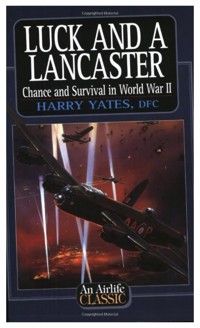
This book takes you, raid by raid, through the author's tour of operational duty over the last five months of 1944. It is a bomber pilot's story, but it is also about the grinding operational pressure, the brotherhood of the crew and fears of injury and death. It is about a squadron of Bomber Command that bore a barely-equalled burden in operational effort and losses. It is about young airmen the author knew, who lived and too often died amid the turmoil in enemy skies.
Das E-Book können Sie in Legimi-Apps oder einer beliebigen App lesen, die das folgende Format unterstützen:
Seitenzahl: 532
Veröffentlichungsjahr: 2012
Ähnliche



















Luck and a Lancaster
Harry Yates, DFC
Airlife England
Copyright
First published in 1999 by Airlife Publishing, an imprint of The Crowood Press Ltd, Ramsbury, Marlborough, Wiltshire, SN8 2HR
www.crowood.com
This e-book edition first published in 2012
© Harry Yates 1999
All rights reserved. This e-book is copyright material and must not be copied, reproduced, transferred, distributed, leased, licensed or publicly performed or used in any way except as specifically permitted in writing by the publishers, as allowed under the terms and conditions under which it was purchased or as strictly permitted by applicable copyright law. Any unauthorised distribution or use of this text may be a direct infringement of the author’s and publisher’s rights, and those responsible may be liable in law accordingly.
ISBN 978 1 84797 409 9
Dedication
Dedicated to the memory of Inia Maaka, great of stature and of heart, and held in great affection by all who flew and served with him. It was Mac who suggested that I write this book, and it was in no small measure as thanks to Mac for his lifelong friendship that I wrote it. But the task proved to be a long one. To my great regret, it was uncompleted at the time of his death at home in Napier, New Zealand on 16 January 1996.
Acknowledgements
For their memories, photographs, advice and encouragement, for their contributions great and small, I offer my gratitude to the following:
John Aitken, DFC Barry and Sue Aldridge John Barton, RAF Bomber Command Assn, New Zealand Gwenda Birnie Geoff Fallowfield S/Ldr P.N. Kirby, HQ New Zealand Defence Force June Maaka Ron Mayhill, DFC Bill Otway Bob Rodgers, DFM, DFC Randal Springer, 75 Squadron Association Ken Wootten and my wife, Eileen, and all the members of my family
CONTENTS
Title Page
Copyright
Dedication
Acknowledgements
1 If I only had Wings
2 An Apple for the Teacher
3 Stormy Weather
4 Graduate and Don
5 The Kiwis, the Callow, the Cleric & the Ladykiller
Plate Section
6 French for Beginners
7 P-Peter
8 Deutschland, Deutschland …
9 But God Disposes
10 Rio Rita
Plate Section
11 Cologne and Back
12 Again the Jinx
13 All over by Christmas?
14 N-Nan
Epilogue
Site Plan of Mepal Airfield
Index
CHAPTER ONE
IF I ONLY HAD WINGS
I remember it still, almost as though it was yesterday. The day was hot, indeed gloriously so. We stood in our flying gear on the concrete of the dispersal pan, seven of us gazing up to that familiar shape, the purposeful nose rounded in Perspex by the bomb aimer’s window, the front turret with its Brownings and the angular canopy beyond. No one spoke. No one needed to. We all felt the same, quiet pride.
The date was 18 August 1944, two weeks and five raids since we had reported for duty with 75 Squadron. The object of our attention, of our unbounded admiration, was a Lancaster B1 newly arrived from the Maintenance Unit. Aside from factory test pilots and the ATA girl who had brought it here, not a soul in the world had known the thrill of flying it. I was to be the first. Before any aircraft was taken onto an operational squadron it was subjected to an acceptance test. That we were now to fly. And then this beautiful machine would be allocated, amazingly, to us.
As yet only the squadron markings, the famous AA, graced each side of the fuselage, red against the black, metal skin. The identification letter had to wait until, on our return, we could pass the aircraft fit for service. A letter was not a matter of indifference to aircrew. The boys voiced several inventive if somewhat indelicate preferences as we climbed aboard. But Archie, the newest man in the crew, would have none of it. Turning to me he said, ‘I don’t give a damn which letter they give us, skipper … so long as it isn’t P-Peter.’
I knew he meant it. He was on board a Lancaster P-Peter on the night of the infamous Nuremberg raid of 30 March 1944. It was Bomber Command’s blackest night of the war. Ninety-six aircraft failed to return, twelve more crashed in England. Many things went awry during the operation, the worst an unforecast tailwind of atrocious strength. It carried the main force far ahead of the Pathfinders. They were left with no option but to wait and circle under a brilliant moon. For forty-seven minutes there was not a single marker to be seen, but many a night-fighter. All told, the enemy put up two hundred of them.
Archie’s P-Peter was mauled in several running battles. He witnessed the suffering of friends and crewmates. The survivors got the bombs away but couldn’t fly their crippled kite home against the wind. They were forced south. By the grace of God they made it to North Africa and landed wheels-up on a broad, sandy beach.
Archie struggled doggedly on to Gibraltar. By the time he set foot on English soil again three months had elapsed. Being indefatigable he sought an immediate return to operations. Being a New Zealander he requested a posting to 75. He was in the pool on the day we arrived only six strong (the seventh having quit us the night before). We were all rookies but Archie was a veteran of fifteen raids. To him we must have looked only marginally preferable to a series of different or scratch crews. To us he was a man of proven experience and resolve, a priceless asset.
Archie rarely mentioned the Nuremberg raid, but then aircrew tended to look forward, not back. It left its mark, though. No coincidental link went unnoticed. Some filled him with foreboding and real fear. He sincerely believed his presence on board another P-Peter would open the path to hell. He had walked it once and survived. Only a fool would willingly go that way a second time, and Archie was no fool.
As usual I flew the air test at under 10,000 ft so the boys could work without oxygen. We completed our checks and pronounced the aircraft battle-worthy. Her handling seemed markedly more responsive and accurate than the ageing kites I usually flew. I couldn’t resist a corkscrew (standard drill for evading an enemy fighter), then another, then one more. Our new charge, though nameless, did not disappoint.
As calm returned to us, a vivid and totally unexpected sense of home came upon me together with a great need to see my family one more time. I suppose this was natural enough. The Battle Order for the night would probably include us, and who knew what that would portend? And if the answer was nothing this time, we would still have all of two dozen ops of our tour to go.
But there was one other reason why home, that singular place of the heart, should spring to mind. At the end of my last leave I had made a promise to my father: when an opportunity presented itself I would return, but above the rooftops on a flying visit. Now I had a chance to make good on that promise.
I asked Bill for a course to Stony Stratford, my home town. We eased down to 200 ft. A mile north of Wolverton station we flew over the LMS railway line and the fields I had walked so often as a kid. The Ouse sparkled briefly below. We all but clipped the tall trees in whose shadows lay shoals of silvery roach and bream, the catching of which once occupied my every childish thought. Ahead stood a row of little houses, the sixth from the top my parents’. I pulled the Lancaster around in a wide circle and ran in over the rooftops, scattering cows in the surrounding fields.
Our arrival interrupted lunch. As we came around again my father appeared in the garden, extravagantly thrashing the air with a white cloth. At a circumspect distance my mother and sister, Joan, waved and gesticulated with equal vigour. I made a third low-level pass to return their waves. And then it was done. I climbed away to 2,000 ft for two steep turns and a farewell waggle of the wings.
So we took our leave for Mepal, my second home now and home for all of us in 75. We entered the circuit and received permission to land from Control. With the undercarriage down and locked I turned across wind, then again to straighten up on the runway ahead. And with flaps down and Tubby calling out the airspeed, we sailed over the airfield boundary and touched down.
As we clambered down the aircraft steps at dispersal a bowser pulled-up.
‘How many gallons?’ I asked the driver.
‘Two thousand’, he replied.
That meant no soft trip to occupied France, Holland or Belgium but, almost certainly, a penetration deep into the Third Reich. We made straight for B Flight office. Our names were indeed on the Battle Order, with twenty-four other crews. Briefing was not until 1800 hrs. There was time for an unhurried lunch and, for the boys, an hour or two relaxing in the sunshine.
For me relaxation was not on the agenda. I was still fired up from the air test and the sight of my family in the garden of our home. My mind was racing. It seemed an improbable slice of luck for a crew like us, virtual rookies, to be given a permanent aircraft. Usually that honour was reserved for the experienced crews, the gen men, on the station. It was pool kites for the rest of us.
I just had to have another look at my Lancaster, and grabbed my bicycle. As I pedalled towards her I saw a figure in overalls stroking red paint onto the starboard side. He was executing a letter P. I was utterly aghast. As it was, the dangers and demands of our night’s work would be daunting enough. But to take Archie to Germany in a Lancaster P-Peter was the final straw. I determined there and then to keep the news from him for as long as possible. I would tell the others to get him on board the aircraft even if they had to pick him up by the scruff of the neck and throw him in.
I cycled away wondering if Fate would deal us a double blow tonight and send us to Nuremberg. I glanced at my watch. The time was still only three o’clock. We would have to sweat it out for a few hours yet before we were told.
I was seventeen years old at the outbreak of war and worked as a junior clerk in the offices of a printing company. They paid me the handsome sum of thirty-two shillings and sixpence per week. After paying my dear old mother for food and board I was left with seven shillings for clothing, cigarettes and a weekly visit to the picture palace with my best girl. Destitution usually arrived by Wednesday of each week.
My education had been as basic as it could be. But in the thirties a basic education was a good education. I’d had a very happy childhood and left school three months after my fourteenth birthday with strictly limited ambitions. My birthplace was my father’s and my grandfather’s. No one thought of leaving for wider horizons. Stony was a quiet town of three thousand souls. I felt that I knew every one of them and they all knew me.
Like many lads my passion was soccer. I played as a kick-and-run right winger for Wolverton Town. Once, an Everton talent spotter came to watch us. It might have been the doorway to my dreams but nothing came of it. Still, I had the consolation of a few medals and a miniature silver cup for my dressing table. And, in any case, the war soon came to overshadow all things.
On the evening of 14 May 1940, as the BEF’s fate unfolded in Northern France, Anthony Eden made a broadcast in which he announced the formation of the Local Defence Volunteer Force (later called the Home Guard). Next morning I cycled to the Police Station in the town square and signed-up with my fellow patriots.
Now invasion was on everybody’s lips. Signposts were ripped out and place names obliterated. In the meadows by the river and in all the big fields stout posts were driven into the ground to snare enemy planes and gliders. If not these unwelcome guests then hordes of fearsomely armed parachutists were expected, or Fifth Columnists bent on sabotage. In preparation and perfect innocence we drilled with broom handles or mounted patrols and lookouts armed with a pair of binoculars. Our only recourse, should a silhouette cross the moon or someone mutter ‘Gott in Himmel’ in the darkness, was to run like hell to HQ. Stopping a bullet for King and country was firmly against orders.
The highpoint – probably the only point – of our patrols was the bacon and egg breakfast served at four a.m. in the town garage. If everything else had an air of unreality about it, this at least hit the stomach with a satisfyingly real thump.
But change was afoot. We were told that a consignment of Canadian Ross rifles was being sent. Two weeks later it arrived though the accompanying ammunition did not fit.
‘Don’t worry, chaps. Jerry will never know’, explained Charlie Green, the pork butcher who had appointed himself our Company Commander.
Luckily, his theory was never put to the test. When the correct ammunition finally arrived a major dilemma confronted our leader. We were thirty in number but there were only six rifles. After much deliberation we were summoned to the public bar at the Crown to hear the wisdom of Solomon. Standing on the bar Charlie announced a rifle shooting contest in the field behind the pub on the following Saturday afternoon. The best six shots would each be given a rifle to keep safely and in good working order, and to carry whenever on duty.
Saturday arrived and we all assembled to be given six rounds each. To my delight, when the firing ceased and the points were totted up, I was placed second. Charlie handed me my hardware but no ammo. This would be kept strictly under lock and key for issue only in dire emergency. As he so rightly said, ‘If we gave you the bullets you’d only waste them on rabbits.’
I could hardly get home quick enough to show off my prize. My Dad, in his duties as an air raid warden, had been put in charge of a mere stirrup pump which he kept in the shed at the bottom of the garden. But what was that compared to a Ross … and one of only six in the town? The house was empty. I stood the rifle in the hall and rehearsed my words. But the moment the front door opened and my mother walked in, triumph turned to dismay.
‘What’s that thing doing here?’ she demanded.
‘I won it in the contest, Mum. Now I can keep it and …’
‘Oh no, you don’t,’ she cried, ‘I won’t have a gun in my house. I mean it. You get on that bike of yours and take it back to Charlie Green now.’
She was incensed that an adult had blithely handed her boy a gun. I could see it was useless to argue. Utterly crestfallen, I did as I was told and explained my situation sheepishly to Charlie. But for a butcher he was a compassionate chap, and after that I was always given charge of the patrol binoculars.
Despite the privations of rationing and blackout, my remembrance of this time is of days of idyllic simplicity and peacefulness. The glorious summer of 1940 is vivid in my memory. With my father’s help I built a hen house. My grandfather presented me with a strutting cockerel whose life with fifteen hens must have been idyllic, too. Corn was scarce so I fed them potato mash. Most days yielded a dozen eggs to supplement our rations and earn me some sorely needed pocket money. The family ate well, my father’s allotment providing fine vegetables both for us and for our relatives in the town. Catching game fell to me and my faithful collie, Bob. Together we walked the fields to check my rabbit snares or went fishing for perch with redworms or a live minnow. If lucky I brought home two or three fat perch or even a small pike which mother used to soak overnight in salted water, ‘to take out the muddy taste’, she always said. And if the fish weren’t biting I gave it up and swam with my dog in the cool, reedy river.
Evenings found some of the men not yet called to arms taking guard with a cricket bat on the ‘rec’. As the shadows grew long and the skies red so we retired to the companionship of the pub. A pint cost threepence and sometimes a good few were sunk.
The well-worn cherry and batting pads and the cold, frothy ale had a certain, timeless appeal. But I was never a great cricketer, much less a carouser. That summer, the first call on my affections belonged to a dark-eyed girl named, as I well recall, Bess. Nothing on earth was sweeter to me than to idle with her across the fields to Cosgrove or haunted Passenham, hand in hand in the balm of evening. But not even this token of life’s ineffable beauty could divert a young man’s attention from the drama of war and, in particular, the drama enacted daily over southern England.
The Battle of Britain must have been the most glamorous recruitment campaign ever. Thousands of young men from all walks of life were inspired by the daily exploits of Fighter Command. A popular show song of the time said it all: If I Only Had Wings. Every pilot flying a Hurricane or a Spitfire was fêted. Some became household names, even idols. How could anyone but be stirred by the exploits of Ginger Lacey or the tin-legged Douglas Bader, Stanford Tuck with his swashbuckling moustache or Sailor Malan with his heroic demeanour and film-star looks?
For me there was also an infinitely more humble and personal example to follow. This was my oldest and closest pal, Cyril Downing, with whom I had shared a classroom in infants’ school and played football as a youth. He was a few months senior to me and at the beginning of 1940 he volunteered. In what seemed like no time at all he was posted to 42 Squadron of Coastal Command stationed at Lossiemouth. He began flying operationally as an air gunner on Beaufort twin-engine torpedo bombers.
On leave Cyril would visit our house and recount hair-raising scraps with the German naval squadrons docked at Kiel, Bremerhaven and Wilhelmshaven. How I envied him. The last time I saw Cyril, then a Flight Sergeant proudly wearing his air gunner’s wings, was in October, 1940. I told him that I, too, had volunteered for flying duties. A few days later his aircraft went missing in an attack on a cruiser off Cuxhaven. Cyril had left a deep and abiding impression on me. It was as if the cold waves had closed over my own brother that day.
Even so, my desire to fly was unchecked. I awaited the RAF’s reply with mounting trepidation and worried in case my limited schooling would count against me. Could it be that, in reality, becoming one of these pilot types required a university education or even an old school tie? Was it the preserve of sons of the well-to-do? But this, as I was to discover, was far from true. Terrible thing though it was, the war brought opportunity. The great British class system counted for surprisingly little. I saw nothing of it in all my RAF days.
So it was that one morning the longed-for official envelope rattled through our letterbox. I was requested to report to RAF Cardington for an interview and assessment.
Cyril had, of course, told me all about his day there. It began with a stringent medical examination. In one curious exercise he had to blow a mercury bubble up inside a tube and sustain it for sixty seconds. This was probably some check on the physical response to oxygen deprivation. But, naturally, Cyril knew nothing of that and saw only a large trapdoor to one of the less glamorous services.
With the advantage of Cyril’s hindsight I decided on a crash training programme. I practised holding my breath until my head was splitting. I practised in the street, on the bus, even one Sunday in the choir when I punctuated the Lord’s Prayer with an almighty exhalation. The Rev’d Steer’s beady eye searched for a sign in each angelic countenance. But my hour of judgement was postponed, at least until the RAF medical orderly asked me to blow. The mercury bubble shot up for ninety triumphant seconds. I thought I should be given command of a squadron.
Oral and written tests were the next obstacles to surmount. Finally in late afternoon, I faced a formidable selection panel of five very senior RAF officers of which the lowest rank was Group Captain. All wore the coveted pilot’s wings above rows of ribbons. One by one they plied me with questions but, no doubt well aware of an eighteen-year-old’s extreme nervousness, always with a kindly, approachable manner. I was elated on leaving Cardington and felt sure that, simple country lad or no, I would be given my chance.
Back on Home Guard duty in Stony I awaited my fate. Three months had passed since the Battle of Britain had been won. The Luftwaffe retreated from flights over southern England by day and began to bomb our cities by night, inaugurating the Blitz on London on 7 September. The air war had entered a new phase.
The fear of invasion hung on. More rifles and uniforms were bestowed upon the Home Guard – and even ammunition. Wild rabbit appeared on Stony dinner tables and, mysteriously, at the back of Charlie’s shop. Still my mother remained adamant. I was not allowed to bring a rifle into the house. In truth, the idea that Hitler might launch his stormtroopers against North Bucks was wearing a bit thin. I passed my hours of lookout duty perched on the town reservoir, binoculars scanning not the starry heavens but the hedgerows in search of courting couples.
Again one morning an official envelope dropped on to the doormat. I tore it open and read, ‘… pleased to inform you that you have been selected for training as a pilot/air gunner. You will receive call-up papers shortly.’
I let out a whoop of pure joy and danced into my parents’ arms, waving the letter above my head. There was still the little matter of avoiding an air gunner’s career, of course. For that I had to prove my suitability as a pilot. I vowed that I would, or break my neck in the process.
On 5 May 1941 I embraced my parents and left the family home to report to RAF Stratford-on-Avon. There, two weeks of unremitting square bashing was meted out to budding aircrew as an introduction to military life. Footsore, I finished my stint and transferred to No.10 Initial Training Wing, Scarborough, for a make-or-break course. Now the serious work began. Early morning PT on the seafront reduced us all to jelly. But this was light relief compared to the intensity of ground studies.
The syllabus initiated us into the mysteries of airmanship; theory of flight; armaments; aero-engines; navigation; astronomy, meteorology; instruments; map reading; photography; RAF law and aircraft recognition – all in just six weeks. This demanded a Herculean effort, even from the more academic among us. Looking again at my notebooks after all these years I am astonished at the technical content and variety of facts which we absorbed. To do so we studied all day and late into the evening. There was barely a moment for relaxation, and Scarborough’s publicans certainly weren’t on first name terms with many of us.
For all that, much of the syllabus was of little practical benefit. Parts of it had no connection to flying whatever. For example, in the dusty corners of RAF law we studied the abstruse restrictions placed upon civilians trading with airmen. Any such trade was at the civvies’ risk. No airman could be arrested or compelled to appear before the courts for any debt below £30.
Some of the boys thought it was safe to ignore such pedantry. No examiner, they argued, could seriously expect to determine our suitability as pilots with questions about trade or debt. Others suspected that the more eccentric the subject, the more inevitable was its appearance on the exam paper. Bereft of such subtle reasoning I just learned all I could, and fortunately so because the second opinion proved the more accurate.
Having scraped together a bare minimum of exam passes I was entitled to display the white flash of a Leading Aircraftsman on my forage cap. The pay increased modestly, too. But to me these were trifles. All along I had been driven by a single and once seemingly impossible ambition. But now I knew. I would sit at the controls of an aircraft in a matter of only days.
At the beginning of July I reported to the de Havilland School of Flying at Hatfield, officially titled No.1 Elementary Flying Training School. In those days the airfield was simply a large, green expanse. There were no runways. On the perimeter were the brick-built administration quarters. The office of the Chief Flying Instructor, Squadron Leader Pedley, was located in the centre to afford him an uninterrupted view across the field. Each new intake was mustered before this somewhat formidable man and treated to a pithy address, much mimicked afterwards by the barrack’s wags but never disregarded.
‘Gentlemen,’ he bristled, ‘I hope you appreciate how privileged you are to be here. We are going to give you the opportunity to bend one of His Majesty’s aeroplanes.’ And off he went, explaining in unmistakable terms how very unfortunate such an outcome would be.
‘No doubt you think accidents are just damned dangerous. But to me they are the result of sloppy work. They are costly. They are disruptive. They are far too frequent. For reasons beyond my control I can’t make ’em a hanging offence. But I can impose the maximum sentence within my power. That means the end of the course for the guilty party, and the end of his career as a pilot. Will you all reflect on that?’
We could hardly do otherwise.
Two mornings later, with that welcome still ringing in my ears, I awoke to my red letter day. A small party of rookies, myself included, was driven around the perimeter to a flight tent surrounded by half-a-dozen Tiger Moths. I was introduced to my instructor, Pilot Officer Eastwood. My first impression was of a clean-cut slight figure (for some reason all the instructors were flyweights). He was reserved, indeed rather formal and not at all the buccaneering spirit that the press accounts had led me to expect of these flying types. But he had an alert eye that was already sizing me up and a quiet authority that engendered my youthful respect.
After a lengthy and nervous wait I was called out to the aircraft. I climbed into the rear seat of Tiger Moth N6848 and stared at the sparse interior. The engine fired, roughly at first, then settled into a rhythmic crackle. Because of its noise P/O Eastwood had to communicate by talking into a length of rubber hose and by hand signals. I watched dumbly as he began by demonstrating the effect of the controls. Then he taxied downwind, turned crosswind and stopped, completing the standard drill prior to take off.
That done and without further ceremony, he turned into the wind. The Aldis light flashed green and he opened the throttle. The wash from the propeller hit my face. The grass under and around us was flattened to the soil. Slowly, we gathered speed. Contact with the uneven turf modulated from bumpy to jarring and then, before I even realised it, we were free and airborne.
I remember the novelty of looking down as we cleared the airfield boundary, then across to the widening horizon and up again into a lightly clouded sky. This is it, I told myself. This is what all the dreams and all the waiting had been for. The ground receded below and with it, I suppose, the small world of my boyhood. This was the start of a new and exhilarating life, albeit tempered by the wartime service values of duty, discipline and, if necessary, self-sacrifice.
CHAPTER TWO
AN APPLE FOR THE TEACHER
I had emerged from all the RAF’s sober interviews, lectures and examinations still wedded to a romantic notion of flying. Spitfires roaring away in defence of the realm, tearing into a marauding foe above the English Channel – that was the thing.
Yet far from an anti-climax, actual flying was a revelation. It may have been prosaic stuff in a pedestrian little biplane. But the rasping note of the engine, the blast of air and that exultant sense of space and freedom produced a reality quite beyond the power of my imagination to foretell.
At the same time, whereas the heroism and glamour of being a fighter pilot had lured me to the cockpit, the hunger to fly for its own sake quickly took over. I gained a more level-headed appreciation of my place in the order of things. Just to learn what was required of me day by day at Hatfield would be heroism enough for now.
In that first thirty-five minutes of instruction P/O Eastwood demonstrated the most basic precepts: ground procedure, straight and level flying, climbing, gliding and some gentle turns. Thereafter we generally flew twice each day. I learned to take off into wind, fly a circuit and, in theory at least, make a glide approach landing.
Like most trainees I found height deceptive to judge. Usually I came over the boundary far too high and correcting madly. But that only served to push down the nose and raise airspeed. When the approach was straightened out my airborne see-saw just refused to touch down. It floated on and on until, driven by sheer desperation, my instructor seized his controls and lifted us clear. Around we went again, circuit after circuit, with the same result until, gradually, I found Mother Earth with a little more assurance.
Of the sixty trainees on my course one or two experienced no such difficulty. They were the natural flyers who by some God-given gift could conjure whatever they pleased out of a Tiger Moth. Of the four categories under which our flying ability was assessed these chaps were Exceptional. They had ‘fighter pilot’ written all over them.
Not so the many more stragglers on the course who bore the emotional burden of a Below Average assessment. As their circuits multiplied and flying hours mounted, so did the tension.
At Hatfield time and tension were inextricable. From the moment we were first called to the aircraft a clock started ticking. It was the clock that ticked away our entitlement to flying instruction. It ran with each visit to the cockpit but for little more than ten hours in all. If a trainee had not soloed by then he was on the way to gunnery or bombing school.
Apart from The Comet, the airfield local, the only escape from this pressure, the only relief from learning how to land, was learning how to spin. For safety reasons this manoeuvre was a prerequisite for solo flying. The drill was to climb to 3,000 ft and, with the engine idling, pull the joystick hard into the stomach. The nose came up steeply until the aircraft stood on its tail. This was the brief, still moment when, it was said, the attentive trainee might hear the wind whistling Nearer My God To Thee through the wing struts. With or without the Aeolian accompaniment it was only a second or two until a wing dropped. Now he had to act fast, applying hard rudder before a stall and sending the aircraft spinning earthwards.
The real purpose of the exercise followed. To counteract the spin, opposite rudder was applied whilst easing the stick forward. This stabilised the aircraft in a simple dive. Next controls were centralised, then gentle back pressure applied. This eased the aircraft into a graceful, upward curve. If done correctly all the height was recovered and at 3,000 ft the sequence could be repeated.
Up to this point I had taken P/O Eastwood to be a scrupulously correct, even starchy individual. But to his spinning instruction he added some riotously chuck-about aerobatics. I marvelled at them and at my instructor. He was flying for his own enjoyment, though, and strictly off the teaching manual. No doubt he also needed an escape, not from pressure, perhaps, but from the numbing boredom of endless circuits and bumps.
On the morning of 14 July P/O Eastwood handed me over to his fellow instructor, F/Lt Connor. I completed two take offs and landings. Whilst I was taxying downwind for a third, F/Lt Connor asked me to stop. To my complete surprise he jumped down to the ground.
‘It’s all yours,’ he shouted, ‘Make a circuit and landing. If the approach doesn’t pan out or someone gets in the way, on with the juice and go around again. Do that as often as you want but finish with a daisy cutter. Off you go. Good luck.’
He sauntered towards the centre of the field, leaving me to stare at his back. Turning to the seat where his back had been, I never felt more nervous or alone. I kept my mind off it by bursting into song as soon as I was airborne – as I recall, a wholehearted rendition of Amour, Amour and my one and only public appearance as a tenor.
All too soon the boundary and the moment of reckoning came around. I took a deep breath and, to my huge relief, popped a tolerably smooth landing. It was no daisy cutter but F/Lt Connor nodded his approval just the same.
Up to then I had logged eight hours and fifteen minutes of instruction. Now the ten-hour clock was behind me. The pressure and the rivalry could be left to others. It was only necessary to keep improving and to complete the course without mishap.
Over the ensuing days the numbers flying solo burgeoned. Activity on the airfield became concentrated on perfecting take offs and landings and one or two more advanced manoeuvres. As training intensified so the accident rate rose. Under instruction there were always mature and skilled hands to lift the aircraft to safety. But instructors were in the air less and less, and flying solo was an unforgiving business. The toll in broken bones was low, but not so in broken Tigers.
One morning P/O Eastwood asked me to fly an hour’s solo. All the instructors had been summoned to a meeting at the Chief Flying Instructor’s office. Not for the first time the subject was the unacceptable accident rate. Squadron Leader Pedley opened the discussion in his inimitable style while, outside, I turned my aircraft into the wind and began building up to take-off speed.
As the airspeed indicator registered sixty-five mph something went profoundly wrong. The nose did not ease upward into the air. Instead, my Tiger underwent the metamorphosis into a high-speed plough. Huge clods of turf flew over my head, followed by chunks of wooden airscrew. There was a hideous crescendo and everything shuddered to a halt. The whole airfield was momentarily stilled. In this strange calm I tried to come to terms with my situation. The nose of the aircraft was buried in the soil. The wing assembly had all but disintegrated. The tail was pointing accusingly skyward. I was half out of the cockpit, having been restrained by my straps, thank God. My pride was badly bruised, but nothing else.
Everything burst upon me at once. People ran from out of nowhere, screaming at me to get the hell out of it. I took a moment to realise why and another to find that I couldn’t release my buckle. The fire tender bounced across the field, its bells echoed by the ambulance not far behind. The whole world was awash with chaos and cacophony, and all because of a hapless, one-time printer’s clerk and failed pilot. And misery upon misery, the whole show was taking place slap-bang in front of the Chief Flying Instructor’s office window.
‘Well, your timing was immaculate’, was P/O Eastwood’s verdict, delivered with a levity I found inexplicable. But, in fact, my spot of gardening was a source of secret amusement to all the instructors. I had committed the unpardonable crime of cutting short S/Ldr Pedley in full cry. The poor man had stormed over to his window, outraged at my temerity, and bellowed, ‘Look! Do you see what I bloody well mean?’
That afternoon an escort marched me solemnly to S/Ldr Pedley’s office. I was the condemned man on his final procession to the Lord High Executioner. Everything said I had flown for the last time. As I entered the room he stood facing the window, a small and upright figure with his hands behind his back. He spun around and I gave him my most martial salute.
‘Were you injured?’ he asked first and in an emollient, even kindly voice which surprised me. When I replied, ‘No, sir’, he smiled, of all things. I could almost feel him asking himself, ‘What the hell am I going to do with this chap?’ But what he said was, ‘You understand the regrettable position in which you place me?’
Then he spoke with no hint of regret, setting forth this position with the most brutal clarity. His tone had hardened. Any hope of clemency lingering in my breast was extinguished. S/Ldr Pedley became the personification of swift and terrible justice. Of course, he had been through this all before. He must have felt immense frustration at his pupils’ unchanging fecklessness. We feared him as a man given to anger or, at least, as one adroit in giving the impression of it. Now I saw that it was the former, unfortunately. His composure began to crack. He became visibly exercised and, finally, he let fly.
‘Have you the slightest idea what your stupidity will cost the RAF?’, he demanded. ‘Do you think Tiger Moths grow on bloody trees?’ He paced up and down, firing unanswerable questions at me. ‘How can we do our work here with idiots like you reducing every aircraft to matchwood? What kind of airman doesn’t know the damned difference between up and down?’ and so on.
I desperately wanted to defend myself with some questions of my own. Had anyone thought to examine the wreckage, especially the controls and the undercarriage? Had the last engineer to work on the aircraft been questioned? But in my heart I knew that being of such lowly station all blame would attach to me. There was nothing to be done but withstand the barrage in silence and to attention, and await the coup de grâce.
I waited, but it did not come.
Striving manfully for some restraint, S/Ldr Pedley said, ‘I’ve spoken to your instructor who thinks you might make a pilot. That’s saved you this time. But one more mistake and, by God, I’ll reduce you to the lowest form of life in the RAF.’
His fist hit the desk and I was dismissed. Shell-shocked by this development I sought out P/O Eastwood to express my profound gratitude. ‘Any accident that you walk away from is a bloody good bit of instruction’, he said and slapped me on the back.
I had not escaped official censure, however. S/Ldr Pedley autographed my logbook which reads, ‘Headquarters No. 50 Group (T) endorsement: Error of judgement taking off. I.I. Pedley, S/Ldr. July 22nd, 1941.’ That was the only endorsement of my flying career. One was more than enough, particularly when I could not quite bring myself to accept that justice was done.
Young men in uniform cannot be permitted the luxury of youthful rebellion. But young they still are and will be impulsive, if that is their way, or headstrong and sometimes foolhardy. At the age of nineteen I was probably all three. In any event only forty-eight hours after my reprieve by S/Ldr Pedley I hatched a strictly illicit flightplan that might have finished me off.
On 24 July I flew my first cross-country solo, Hatfield–Halton–Henlow–Hatfield. The flying time was sixty-five minutes and it immediately set me thinking. My home at Stony Stratford was only thirty-four miles north-west of the airfield. I needed no map to find it, just good visibility. My parents would be cockahoop at their son’s aeroplane over the roof. Half of the town would know about it by evening. My father would be stood his ale at The Case Is Altered, his local in Wolverton Road, for a week at least.
The more I thought it over, the more irresistible and foolproof the idea seemed. On the following Saturday the sun shone from a sky of china blue. Visibility was almost unlimited. I only needed to be allocated an hour’s solo, and I was.
Once airborne I quickly sighted the expanse of glasshouses which lay between the airfield and St Albans. The A5, the old Roman Watling Street, pointed a straight track north. I took up station wide on the port side, passing Dunstable and Fenny Stratford. Ahead, unmissable on the northern boundary of dear old Stony, rose the grassy embankment of the reservoir where I had spent so many hours on Home Guard duty.
To starboard was our familiar cul-de-sac of little, semi-detached houses, bordered on three sides by pasture. At all of 2,000 ft I banked the Tiger as steeply as I dare, lining up the port wing on the chimney pots of our house. On the second pass and the third no one appeared below. But by the fourth the back garden, which was recognisable, contained two tiny, agitated figures, which were not. What wouldn’t I have given then to loop the loop or, better still, to execute a slow roll? But my flying skills were embryonic. The steep turn was my limit, especially as I was employing one hand to wave wildly to the figures below or to punch the air in exultation.
It all lasted only a couple of minutes. Then I engineered a tentative wobble of the wings and made off to the south. Thirty minutes later I touched down at Hatfield, glowing with satisfaction.
P/O Eastwood greeted me with a cheery ‘Good trip?’ ‘Great’, I shot back, but not another word. Had those few moments of bravado become known to S/Ldr Pedley my career piloting anything more entertaining than a mop and bucket would have been over. But now I felt as I had as a boy, having braved the local farmer’s ire to scrump Coxes from his orchard. The evidence of my trespass had been eaten. And very enjoyable it had been, too.
By six o’clock every evening the day’s training activity on the airfield came to a close. The Tiger Moths were pegged-down and put to bed. Then the evening stillness was lost to the lovely roar of high-powered aero-engines. The doors of the great hangar at the far end of the airfield were pushed slowly back. Out of the shadows rolled a streamlined, twin-engined aircraft with the most beautiful proportions, reminiscent of the legendary de Havilland Comet. This was the prototype of the Mosquito and for an hour almost every evening it was flown by the chief test pilot, Geoffrey de Havilland.
For the humble trainees these were moments of wonder, chiefly at the sheer beauty and power of the thing. As it sped across the field the noise was thunderous. I swear the ground trembled beneath our feet. And to see it return over the boundary, engines spluttering on idle as only the Merlin could, was an inspiration to any pilot.
I imagine each of us also wondered if one day he and this fabulous machine, both in our way graduates of Hatfield, might be reunited in anger against the enemy. Certainly, I did. When my operational flying career finally began all of three years later this was still my most cherished ambition.
Meanwhile, by virtue of our presence we were party to the prototype’s flight schedule. This sort of information was highly-restricted. To permit such free access to it by sixty awestruck but by no means dumbstruck trainees seemed hardly credible to me. Not that careless talk could have cost much. Within minutes of touching down, the object of our desire was secreted away again behind the locked and guarded hangar doors.
Back in the less inspiring surroundings of my cockpit I continued my education. P/O Eastwood introduced me next to low flying, which I loved from the first. At 100 ft over open fields the sense of speed, always blunted at altitude, was restored in full. Even the Tiger’s sedate maximum of around ninety mph produced an exhilarating ride.
Of course, thrill-seeking only exacerbated some already very real dangers, and these the School addressed with rigid regulation. Under no circumstance were we allowed to low fly without an instructor, the only exercise where this applied. An area to the west was selected for its lack of population and topographical surprises, and low flying was permitted nowhere else. Not much more than a few fields across, access to it was granted to only one aircraft at a time. Always and in everything, the watchword was caution.
The cautionary factor also conditioned my introduction to the next staging post of powered flight: aerobatics. These comprised looping the loop, rolling off the top of the loop, and the slow roll that was so beloved of victorious fighter pilots on their return to base.
‘Tomorrow we loop the loop’, my instructor promised. But at ten o’clock the next morning he was missing from the flight tent. In his place, in person, was the Chief Flying Instructor. No explanation was offered, although one suggested itself as soon as we reached 3,000 ft.
Squadron Leader Pedley unleashed some truly bewildering combinations of loops, spins and rolls. His skill was of a different order to P/O Eastwood’s. Each element was so cleanly and decisively executed that even at the extremes of the action, so to speak, he was unhurried. The rapidity and precision of movement seemed impossibly at odds with what I knew of a Tiger’s handling. But more to the point, whereas P/O Eastwood’s style had a free-wheeling, knockabout quality to it and invited the passenger to be entertained, S/Ldr Pedley’s had no such object. This was a demonstration of disciplined technique and sang-froid, the very opposite of flying for the hell of it. Fly with caution, it said, until you can fly like this. It also said quite clearly, ‘You’re being watched, my lad’.
The Chief Flying Instructor did not usually initiate trainees into aerobatics. It wasn’t done for fun. Maybe the pile-up had marked me out for this treatment. Maybe I had expressed too much enthusiasm for low flying, or flying in general? Whichever it was, from now on I would volunteer as little as possible about anything, and contemplate no more runs over the rooftops of Stony Stratford. The apple scrumper in me would have to go.
No one could deny that S/Ldr Pedley’s caution had its purpose. Over-confidence had brought about the premature death of many more experienced flyers than me. One such was Cobber Kane, the great New Zealand fighter pilot. His exploits and victories in France before the Wehrmacht overran the country caught the imagination of the entire British public. His deeds were reported by the press almost daily. He was the leading fighter pilot in the RAF, credited with over twenty enemy aircraft, a truly phenomenal feat at that early stage of the war. And yet he could not resist the temptation to beat up the airfield, and failed to pull out of a hedge-high manoeuvre at great speed. He had been due to fly back to England that very afternoon on well-earned leave. But he had to put on a final show, and tragically final it proved.
One flying hour later I began my aerobatics instruction under P/O Eastwood. We flew north over the railway line which he liked to utilise for centring the loop. From 3,000 ft he dived straight for the tracks at full throttle. At maximum velocity he pulled back the stick and we soared up into the vertical. In the upside-down position at the top of the loop, with the ground now above us, I could see the tracks still dead centre. He closed the throttle, plummeting the aircraft earthward again. At the bottom he pulled out to resume normal flight and there below, running perfectly parallel to us, were the tracks again.
My attempts to emulate this miracle were fair enough. Two mornings later P/O Eastwood awarded me an hour’s solo practice. I flew ten miles north over the same tracks, took aim and dived. Straight and level after the loop I was surprised to find my silent, steel tutors bang in line. The next loop had the same, satisfying result. So did the next. Forty minutes later I was lost in a revelry of looping enemy fighters disintegrating under my fire or, in a vain bid to shake me off, smashing onto the tracks below. When, at last, I couldn’t ignore the time any longer I turned reluctantly south into the midday sunlight.
Ten minutes later the airfield had not come into view. I recognised nothing. A square search examining every landmark for familiarity yielded no clue. Over and again I asked myself what was going on. I had only flown out over the line and flown back again. It was illogical, impossible, but I was lost.
I could already hear myself bewailing life’s injustice to an implacable S/Ldr Pedley. But even this thought presupposed a more or less happy landing. In reality, however, the needle of my fuel gauge was flirting with the red zone. I had no air-to-ground radio, no map and no parachute. I was severed from all that was familiar and known, above a landscape I could not explain. I was, frankly, beginning to panic. In the event the inescapable and increasingly pressing need to force-land took over my thoughts and drove me on. I abandoned the landmarks and fell to studying the rolling patchwork of fields.
Before going solo every Hatfield trainee was familiarised with ‘agricultural work’. Gliding over the hedge at 20 ft and throttling back for a positive set down took about sixty yards. Stopping the aircraft used another sixty or seventy. But the fields where we practised were specifically chosen because they were flat, firm, grassy and blessed with a clear approach. In real life, of course, things just ain’t like that.
The larger fields bristled with anti-glider posts. Of the rest, many were heavy with arable crops. I didn’t fancy threshing my way through waist-high wheat, and then a ploughed surface might not have allowed the wheels to run. Grassland it had to be. I held a steady course, examining every green field possible. I let pass those with grazing livestock. A friesian could do a lot of damage to a little wooden kite. Of the remaining fields, most would probably do in extremis. But none was the proverbial piece of cake that I really needed. There were rolling hills, trees, banks and ditches, and tight corners where only a broad rectangle would do. It was easier to vacillate than to decide. Even so, I reckoned there was only ten minutes flying time left. I couldn’t risk the tank running dry. If something uncomplicated didn’t come along PDQ, I’d take the first available patch of green and damn the consequences.
A minute or so later I sighted a hazy, geometrical scar on the land. Barely able to contain my anticipation I flew straight for it. I made out a concrete runway, in fact a pair of them foreshortened by my angle of approach. At that moment it was the most beautiful sight in the world to me.
I could have wept with relief as I entered the airfield circuit at 1,000 ft. But my sense of deliverance was premature. Out of nowhere on the downwind leg a twin-engined Havoc, the night-fighter known as The Black Widow, slewed past from starboard with shocking violence and cut in dead ahead of me. Its slipstream snatched up my Tiger and left me powerless in the throes of a slow-motion flip. For several seconds I hung on grimly with no idea what to do. Then the turbulence subsided and order prevailed over chaos.
A training aircraft was not to be expected in this airspace, it was true. But the pilot must have seen me from some distance. Was it carelessness or some kind of joke? Either way, it was an unduly hostile welcome for a harmless biplane and a trainee whose nerves were already frayed bare.
On the crosswind leg I saw my tormentor turning off the runway. Justice demanded that I buzzed him back. But my fuel might not have stretched to another circuit. And, besides, trainees had to know their place. Such a gesture would have had disciplinary consequences, destroying my flying career for ever – assuming that I still had a flying career.
Wary of more jokers behind I hurried the final approach. There followed the inevitable long float but finally the wheels hit the runway. I was down and running on smooth concrete. No stout post nor spreading oak had claimed me, no hedge full of hawthorn, nettles and briar. Best of all, there need be no thorny telephone call to S/Ldr Pedley.
The perimeter seemed interminable. But it gave me time to recover my composure. I had to find out where I was and how to get back to Hatfield. And I had to beg petrol for the flight. This was deeply humiliating but there was no way out of it. I pulled up in front of the control tower. Not even here was the airfield name displayed. I mounted the steps with my stomach in my boots. A push of the door, and several faces turned to scrutinise me.
‘Please,’ I announced in supplication. ‘I’m afraid I’m lost. Can you tell me where I am?’
An officer inquired casually where I was from. To my reply he said, ‘Oh, you’re only twenty-five miles south. You can follow the railway line practically the whole way there.’ A railway line, I thought. It would have to be a railway line.
They gave me petrol, and for the first time I set off down a concrete strip. My Tiger accelerated effortlessly and slipped into the air at half distance.
Fifteen minutes later P/O Eastwood met me at dispersal with a breezy, ‘How did it go?’ He didn’t demand to know why I was late or where I had been. He didn’t realise I was late at all. Hardly believing my luck I just said, ‘Yes, great, thanks’, and kept it at that. The apple scrumper in me was ecstatic.
In the five decades since, I have forgotten the name of the airfield but not the helpfulness of the personnel, with the exception of the Havoc pilot, of course. They could have blown the whistle on me with a single-paragraphed letter. But my travails above the quiet farms and villages, winding lanes and copses of Home Counties’ England remained a secret.
With the aid of the wallmap at Hatfield I discovered the cause of it all. I had chosen to centre my loops downline of the only rail junction for miles. There were two south-bound lines below me. How frequently I switched tracks in the process of shooting down all those Messerschmitts one can only speculate. But Fate certainly sent me the wrong way on the final loop.
After this experience I was more kindly disposed to the ground syllabus, which ran throughout the course, and even to the dark and claustrophobic torture of the Link Trainer.
This formidable piece of apparatus was the ancestor of today’s flight simulator. I never met a pilot then or later, under training or fully qualified, who relished his thirty minutes in the cockpit.
We were introduced to it in the fourth week, though to little purpose, I think. Its raison d’être was to accustom us to flying in darkness without the benefit of a clear horizon. But all real flying at Hatfield was restricted to good, daylight visibility. Night-flying as such was for the future. Even so, use of the Link Trainer was intensive. Each trainee was allotted twelve sessions of thirty minutes duration, shoehorned into ten already busy days.
The apparatus was housed in a small, windowless room. To look at, it was just a box with wings. The victim, for that was what it felt like, climbed into the box and a hood was closed over his head. Darkness reigned, save for the luminous glow of the instrument panel. The controls were the same as a Tiger, and all the normal sensations of flight were there from the moment the pilot switched on.
He was linked to his instructor electronically, hence the name. Sitting at a desk outside the room the instructor had dual instrumentation recording height, airspeed, compass reading, track and altitude. An electrical device which moved like a crab over a celluloid map marked the course steered by the pilot. As often as not, this would have been a disaster course. The Link Trainer was far more difficult and sensitive to control than an aeroplane. It was a real pig to fly, added to which was the claustrophobia and, in August, the heat of the cockpit. When the lesson was finally over and the hood thrown back I, for one, always scrambled out drenched in sweat and feeling a hopeless failure.
Our elementary flying course was drawing to a close. Of the original intake more than half had fallen by the wayside. The survivors still had the most difficult task ahead of them, that of the Chief Flying Instructor’s test. This involved a half-hour flight during which the trainee was asked to execute every manoeuvre in the flying manual. Thirty long minutes under the critical eye of S/Ldr Pedley was perfectly sufficient to make a complete ass of oneself. My mind kept returning to the endorsement, and S/Ldr Pedley’s parting shot, ‘… one more mistake and, by God, I’ll reduce you to the lowest form of life in the RAF’. It could have been a promise … it sounded like a promise. I had to deny him any grounds whatsoever for making it good.
In the air S/Ldr Pedley issued his commands down the rubber hose like a parade sergeant. We rattled off every manoeuvre. Nothing went wrong and the minutes ticked by. An adequate landing finished off a test that, whilst gruelling, was essentially uneventful – and that was what mattered.
Walking away from the aircraft, I couldn’t resist asking somewhat smugly, ‘How did I do, Sir?’ S/Ldr Pedley was poring over his clipboard, probably and quite justifiably in search of the means to cut me down to size. But he gave it up. ‘I suppose’, he said grudgingly, ‘you might be worth persevering with.’
And so my name was posted on the notice board for transfer to Service Flying Training School, the next step in the long march to war.
On 14 August I said farewell to the instructors I had come to admire, and to P/O Eastwood who showed me special kindness. It had been an exhilarating, dangerous, fantastic experience. Of my fifty hours and thirty-five minutes flying, nearly half (the risky half) was solo. I had survived my own mischief and misadventure, an ‘error of judgement taking-off’, The Black Widow, even S/Ldr Pedley.
And this was but the beginning.




