


Erhalten Sie Zugang zu diesem und mehr als 300000 Büchern ab EUR 5,99 monatlich.
- Herausgeber: The Crowood Press
- Kategorie: Lebensstil
- Serie: Machine Knitting Techniques
- Sprache: Englisch
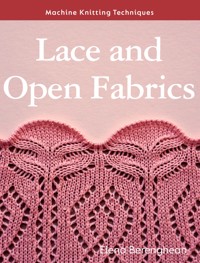
Lace knitting is a versatile technique used to create fabrics that are characterised by holes or open spaces in a specific pattern. This book introduces you to the basics of producing lace and guides you through the process of knitting a multitude of fun stitches. Supported by over 300 photos and charts, it serves as a stitch library that you can use for inspiration for your projects, while encouraging you to develop your own designs.
Sie lesen das E-Book in den Legimi-Apps auf:
Seitenzahl: 122
Veröffentlichungsjahr: 2023
Das E-Book (TTS) können Sie hören im Abo „Legimi Premium” in Legimi-Apps auf:
Ähnliche



















CONTENTS
Introduction
1 Eyelets
2 Lace Carriage
3 Long-Stitch Open Fabrics
4 Double-Bed Open Fabrics
5 The Magic of Yarn
6 Complete Your First Project
Index
INTRODUCTION
Ihave worked for a few years as a knitted swatch designer and that enabled me to spend a lot of time developing a variety of stitches. Lace has been one of my favourite techniques to experiment with as I particularly enjoy hand manipulating stitches. The fabrics produced by transferring stitches and creating open spaces have a special beauty to them and the creative possibilities are endless. In this book, I will share lace techniques I have learnt throughout the years, hoping to inspire you to practise and experiment with lace to develop some designs of your own.
The book begins by covering the basics, creating eyelets with simple and fully fashioned transfers, an introduction to charts and symbols, calculating the gauge and shaping knitted fabric. All techniques and stitches can be produced on most domestic knitting machines, except for those in Chapter 2 which focuses on the lace carriage for a Brother machine. This chapter takes you through the entire process of making a punch-card and tips for making a garment using the lace carriage.
Chapter 3 demonstrates that you do not always need to involve the knit carriage to create open fabrics. In this chapter you will learn how to knit and manipulate long stitches to create special fabrics, tuck stitches and adding beads to your knitting. If you have a double-bed knitting machine, Chapter 4 will cover the basics of casting on different types of ribbing. It moves on to some creative ideas to make your trims stand out by incorporating transfers to create a scalloped edge, combining lace techniques learnt in previous chapters with transfers between beds, and creating charts for double beds.
The yarn used for lace fabrics has a great impact on the outcome, therefore Chapter 5 will take techniques demonstrated in the book and show how you can experiment with yarn. I hope this chapter will encourage you to experiment and use yarns that you previously thought might be unsuitable for lace. In the last chapter, you will see the process of completing 4 projects of different complexity. I hope that seeing how a knitted accessory or garment is made from start to finish will give you confidence to make one for yourself or a loved one.
I am glad to be able to share all these techniques with you and I hope that you will find this book useful and inspirational.
Thank you.
Elena Berenghean
CHAPTER 1
EYELETS
In this chapter you will learn how to create eyelets by doing simple and fully fashioned transfers, understand what symbols are used when designing eyelets and how to use these symbols to plan a lace pattern on squared paper. This chapter also covers an introduction to calculating the gauge, shaping a knitted sample and blocking.
CREATING BASIC EYELETS
Eyelets are created by transferring one or multiple stitches at the same time and emptying a needle. If the emptied needle is left in working position on the next knitting row, an eyelet is formed. A knitting machine usually comes with a set of standard transfer tools with 1, 2 or 3 prongs in different combinations. These tools are essential for creating eyelets amongst other techniques. If you would like to start practising eyelets but you are not sure how to cast on, check the ‘Begin knitting lace’ section in Chapter 2 where you can learn step-by-step how to do an e-wrap cast-on.
These are the combinations in which tools usually come with the machine. From top to bottom: 1 and 2, 1 and 3, 2 and 3-prong tools.
STEP-BY-STEP: CREATING AN EYELET BY TRANSFERRING TO THE RIGHT USING A 1-PRONG TOOL
1. Pick a stitch to transfer, place your 1-prong tool on the hook of that needle and pull it all the way out.
2. Push the needle back so that the stitch slips off the needle and onto the transfer tool.
3. Going over the peg, transfer the stitch on the adjacent needle, in this case to the right.
4. Make sure to place that needle back in working position and knit 2 rows.
5. In the next knitting row, the needle will cast back on, and the eyelet will be formed.
6. The most common number of rows in between transfers is 2, but you could knit a different number if you prefer.
When the needle is left in non-working position, a ladder will be formed. If you have a single-bed knitting machine, ladders can be used in combination with lace patterns as borders to the design, just like you could add a purl stitch as a border if you had a ribber bed. There are other ways you can use a ladder stitch; it can be part of a design, combined with other techniques, or on its own. I strongly encourage you to have a go at it and develop some patterns using ladders as you could create some beautiful open fabrics.
The difference between eyelets and ladders
When creating ladders, you can choose to place the needle back in work at any time you want; when and how you do that can become a design feature or a design itself. As soon as you place the needle you emptied back in working position, it will cast on a stitch again and stop the ladder from forming.
A needle in working position has its hook almost in line with the gate pegs. This is also referred to as ‘B’ position, as the needle butt is aligned with the letter ‘B’ engraved on the machine. In this image, only one needle is in working position while the rest are in non-working position, pushed as far back as possible (with the butts aligned with ‘A’).
A ladder is essentially a float formed in between 2 needles in action. Ladders can be as wide as you like, which will depend on how many needles are left out of action in between.
To stop the ladder from forming you can either just push the needle back into working position or take the purl bar from the adjacent stitch, just as shown in this image, using a 1-prong tool.
Showing the difference between simply placing a needle back in work (left-hand side) and using the purl bar (right-hand side).
Weights
The number of weights needed when knitting a sample will depend on the number of needles in work, type of yarn and tension used and that applies when knitting lace as well. When knitting lace for the first time, if you feel too much resistance when transferring, it might mean that you are using too much weight. When working with transfers there is always a chance that you might drop a stitch; if you are using too much weight, the stitch will run and form an unwanted ladder that might be more difficult to fix. On the other hand, not having enough weight can also be an issue as stitches might drop or the fabric could pull as you transfer.
I have 50 needles in work while using 2 claw weights which I initially placed on my cast-on comb; as I knitted rows and the swatch grew, I kept on moving the weights upwards. From now on, I will keep moving them up at intervals of about 20 rows; the more needles in work the more weights are needed, and you might need to also place them at the centre of the fabric.
When hooking the claw weights, you must not worry about damaging the fabric; if you place and remove them gently the stitches will not be affected. If you are using the ribber weights when knitting on a single bed, make sure to use weight hangers and not to hook the weight directly onto the fabric as that could damage it. There are a broad range of weighting tools, and, with time and more practice, you will learn how to use them and to feel when the weight is just right.
Charting basic eyelets
Being able to read and create a chart, not exclusively for lace patterns, is an invaluable skill for a machine knitter; it enables you to be more creative and plan complex designs on squared paper. To begin designing and developing lace patterns you will need a squared paper notebook, a pencil or coloured pencils and a rubber.
Transfer using a 1-prong tool to the left. On row 2, the third stitch is transferred using a 1-prong tool on top of the second stitch.
Transfer using a 1-prong tool to the right. On row 2, the second stitch is transferred using a 1-prong tool on top of the third stitch.
A pair of eyelets created using a 1-prong tool. On row 2, the second and fourth stitch are transferred on top of the third stitch. Needles 2 and 4 remain without a stitch and needle 3 has 3 stitches.
The left-hand side chart shows a 2-needle ladder beginning on row 2 and ending on row 6. The right-hand side chart shows that on row 2, the second stitch has been transferred to the right and its needle has been left in a non-working position until row 6, creating a 1-needle ladder.
Reading a chart is quite straightforward: every square represents a stitch horizontally and a row vertically. A chart is read from bottom to top, just as fabric grows on the machine. When you look at it, you must imagine you are looking at the fabric as it hangs off the machine, with the purl side facing you. The numbers on the left side of the chart represent rows and the numbers below represent stitches. If there is a symbol on row 2, for example, that means you need to do that action and then knit row 2.
Two of the symbols used when creating eyelets with a 1-prong tool are a circle that shows which needle is being emptied or where the lace hole will be created, and the tilted capital letter ‘T’ that shows on which needle the stitch is being transferred or the direction of the transfer. The direction of the transfer can sometimes be a design feature or make a sample look neater. When creating a pair of eyelets and 2 stitches are transferred on the same needle, we have the 3-lines symbol that represents 3 stitches onto one needle.
There are 2 options available to chart or draw a ladder in a design or plan different patterns with ladders; you can use a semicircle symbol, or fill in the squares that represent needles out of action in a different colour. Make sure to write somewhere on your chart what every symbol or colour used means, to avoid confusion.
Next, you will see a collection of lace samples with the charts for each of these as examples of the variety of designs you can create. There are a few options I explored to make simple transfers a bit more interesting: combining transfers to the left and to the right and multiple repeat patterns in one sample, creating specific shapes, and mixing stockinette-stitch rows and lace repeats of different sizes. In a couple of these samples, you will notice that I combined transfers every 1 row and 2 rows. Spend time practising some of these samples and get comfortable with reading a chart before developing your own designs.
Samples and corresponding charts
FULLY FASHIONED TRANSFERS
To produce a lace fabric with more depth you can use a multiple-stitch tool to transfer when creating eyelets; this is also referred to as a fully fashioned transfer. In a fully fashioned transfer, the empty needle and the one with 2 stitches are not next to each other. Depending on the tool you are using there might be 2, 3 or more stitches in between.
Tools come in different sizes and can also be adjustable; they will make multiple stitch transfers much easier. These tools don’t usually come with the machine but can easily be purchased online.
By loosening and tightening the side screw you can create your unique combination tool. With this tool you could transfer every other needle and create 4 eyelets at once, which will make the process much faster.
STEP-BY-STEP: FORMING AN EYELET BY TRANSFERRING USING A 3-PRONG TOOL
1. Hold your finger against the fabric and, using a 3-prong tool, pick up 3 stitches and pull the needles all the way out.
2. Push the needles back so that the 3 stitches are sliding off the needles and onto the transfer tool.
3. Going over the pegs, transfer the 3 stitches all together to the right to empty one needle.
4. Lifting the tool like so as you complete the transfer can help you avoid dropping stitches.
5. Make sure to place the needle you emptied back in working position and knit 2 rows.
6. After knitting the 2 rows, the needle will cast on and an eyelet will be formed.
The more stitches you are transferring at once the greater the risk of dropping them. In this example I am transferring using a 7-prong tool. I have pulled the needles out and pushed them back; all 7 stitches are on the tool.
If you do not have these tools, you can do the transfer in 2 or 3 steps using the standard ones. To transfer 7 stitches, you can transfer 3 then 2 stitches twice or hold the tools together.
Before transferring the stitches to the right, I will use the tool to pull the needles back in working position, so they are ready to receive the stitches. This will make life a little bit easier and the process faster.
Charting fully fashioned transfers
Just like in a chart with basic eyelets, the circle and tilted capital letter ‘T’ symbols are used when charting fully fashioned transfers. The slanting-stitch symbol will help you differentiate between them, and depending on the direction of the transfer, it is drawn either as a line tilted to the left or to the right. The slanting stitches are what will give the decorative effect to your sample as their orientation will change once they are transferred. The more stitches you transfer at once, the more dramatic the effect.
Transfer to the left using a 3-prong tool. On row 2, the third, fourth and fifth stitches are transferred together one stitch to the left.
Transfer to the right using a 3-prong tool. On row 2, the second, third and fourth stitches are transferred together one stitch to the right.
A pair of eyelets created using a 3-prong tool. On row 2, the second, third and fourth stitches are transferred one stitch to the right. The sixth, seventh and eighth stitches are transferred one stitch to the left.
This chart shows how you can write what all the symbols represent or other information about the sample.




