


177,99 €
Mehr erfahren.
- Herausgeber: John Wiley & Sons
- Kategorie: Fachliteratur
- Serie: Performability Engineering Series
- Sprache: Englisch
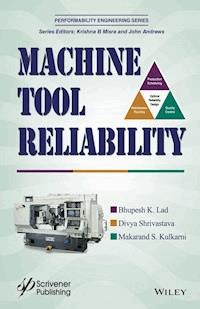
This book explores the domain of reliability engineering in the context of machine tools. Failures of machine tools not only jeopardize users' ability to meet their due date commitments but also lead to poor quality of products, slower production, down time losses etc.
Poor reliability and improper maintenance of a machine tool greatly increases the life cycle cost to the user. Thus, the application area of the present book, i.e. machine tools, will be equally appealing to machine tool designers, production engineers and maintenance managers. The book will serve as a consolidated volume on various dimensions of machine tool reliability and its implications from manufacturers and users point of view.
From the manufacturers' point of view, it discusses various approaches for reliability and maintenance based design of machine tools. In specific, it discusses simultaneous selection of optimal reliability configuration and maintenance schedules, maintenance optimization under various maintenance scenarios and cost based FMEA.
From the users' point of view, it explores the role of machine tool reliability in shop floor level decision- making. In specific, it shows how to model the interactions of machine tool reliability with production scheduling, maintenance scheduling and process quality control.
Das E-Book können Sie in Legimi-Apps oder einer beliebigen App lesen, die das folgende Format unterstützen:
Seitenzahl: 401
Veröffentlichungsjahr: 2016
Ähnliche


















Contents
Cover
Half Title page
Title page
Copyright page
Preface
Acknowledgements
Chapter 1: Introduction
1.1 Basic Reliability Terms and Concepts
1.2 Machine Tool Failure
1.3 Machine Tool Reliability: Manufacturer’s View Point
1.4 Machine Tool Reliability: User’s View Point
1.5 Organization of the Book
End Notes
Chapter 2: Basic Reliability Mathematics
2.1 Functions Describing Lifetime as a Random Variable
2.2 Probability Distributions Used in Reliability Engineering
2.3 Life Data Analysis
2.4 Stochastic Models for Repairable Systems
2.5 Simulation Approach for Reliability Engineering
2.6 Use of Bayesian Methods in Reliability Engineering
2.7 Closing Remarks
Chapter 3: Machine Tool Performance Measures
3.1 Identifying Performance Measures
3.2 Mechanism to Link Users’ Operational Measures with Machine Reliability and Maintenance Parameters1
3.3 Closing Remarks
Endnote
Chapter 4: Expert Judgement-Based Parameter Estimation Method for Machine Tool Reliability Analysis
4.1 Expert Judgement as an Alternative Source of Data in Reliability Studies
4.2 Expert Judgement-Based Parameter Estimation Methods
4.3 Some Desirable Properties of a “Good” Estimator
4.4 Closing Remarks
Chapter 5: Machine Tool Maintenance Scenarios, Models and Optimization
5.1 Overview of Maintenance
5.2 Machine Tool Maintenance
5.3 Machine Tool Maintenance Scenarios
5.4 Preventive Maintenance Optimization Models for Different Maintenance Scenarios
5.5 Closing Remarks
Chapter 6: Reliability and Maintenance-Based Design of Machine Tools
6.1 Optimal Reliability Design
6.2 Optimal Reliability Design of Machine Tools
6.3 Failure Mode and Effects Analysis
6.4 Closing Remarks
Chapter 7: Machine Tool Maintenance and Process Quality Control
7.1 Development of Statistical Process Control (SPC)
7.2 Economic Design of Control Chart
7.3 Process Failure
7.4 Joint Optimization of Maintenance Planning and Quality Control Policy
7.5 Joint Optimization of Maintenance Planning and Quality Control Policy Using -Control Chart
7.6 Joint Optimization of Preventive Maintenance and Quality Policy Incorporating Taguchi Quadratic Loss Function
7.7 Joint Optimization of Preventive Maintenance and Quality Policy Based on Taguchi Quadratic Loss Function Using CUSUM Control Chart
7.8 Extension of the Joint Optimization of Maintenance Planning and Quality Control Policy for Multi-component System
7.9 Closing Remarks
Endnotes
Chapter 8: Joint Optimization of Production Scheduling with Integrated Maintenance Scheduling and Quality Control Policy
8.1 Production Scheduling
8.2 Exploring the Link between Production Scheduling and Maintenance
8.3 The Optimal Scheduling Problem
8.4 Joint Optimization of Preventive Maintenance and Quality Control
8.5 Integration of Production Scheduling with Jointly Optimized Preventive Maintenance and Quality Control Policy
8.6 Numerical Illustration
8.7 Solving a Larger Problem
8.8 Extension of the Integrated Approach Multiple Machine in Series
8.9 Closing Remarks
Chapter 9: Machine Tool Reliability: Future Research Directions
9.1 Moving towards Servitization
9.2 Multi Agent-Based Systems
9.3 Closing Remarks
References
Appendix “A1”
Appendix “A2”
Index
Machine Tool Reliability
Scrivener Publishing 100 Cummings Center, Suite 541J Beverly, MA 01915-6106
Performability Engineering Series Series Editors: Krishna B. Misra ([email protected]) and John Andrews ([email protected])
Scope: A true performance of a product, or system, or service must be judged over the entire life cycle activities connected with design, manufacture, use and disposal in relation to the economics of maximization of dependability, and minimizing its impact on the environment. The concept of performability allows us to take a holistic assessment of performance and provides an aggregate attribute that reflects an entire engineering effort of a product, system, or service designer in achieving dependability and sustainability. Performance should not just be indicative of achieving quality, reliability, maintainability and safety for a product, system, or service, but achieving sustainability as well. The conventional perspective of dependability ignores the environmental impact considerations that accompany the development of products, systems, and services. However, any industrial activity in creating a product, system, or service is always associated with certain environmental impacts that follow at each phase of development. These considerations have become all the more necessary in the 21st century as the world resources continue to become scarce and the cost of materials and energy keep rising. It is not difficult to visualize that by employing the strategy of dematerialization, minimum energy and minimum waste, while maximizing the yield and developing economically viable and safe processes (clean production and clean technologies), we will create minimal adverse effect on the environment during production and disposal at the end of the life. This is basically the goal of performability engineering.
It may be observed that the above-mentioned performance attributes are interrelated and should not be considered in isolation for optimization of performance. Each book in the series should endeavor to include most, if not all, of the attributes of this web of interrelationship and have the objective to help create optimal and sustainable products, systems, and services.
Publishers at Scrivener Martin Scrivener ([email protected]) Phillip Carmical ([email protected])
Copyright © 2016 by Scrivener Publishing LLC. All rights reserved.
Co-published by John Wiley & Sons, Inc. Hoboken, New Jersey, and Scrivener Publishing LLC, Salem, Massachusetts. Published simultaneously in Canada.
No part of this publication may be reproduced, stored in a retrieval system, or transmitted in any form or by any means, electronic, mechanical, photocopying, recording, scanning, or otherwise, except as permitted under Section 107 or 108 of the 1976 United States Copyright Act, without either the prior written permission of the Publisher, or authorization through payment of the appropriate per-copy fee to the Copyright Clearance Center, Inc., 222 Rosewood Drive, Danvers, MA 01923, (978) 750-8400, fax (978) 750-4470, or on the web at www.copyright.com. Requests to the Publisher for permission should be addressed to the Permissions Department, John Wiley & Sons, Inc., 111 River Street, Hoboken, NJ 07030, (201) 748-6011, fax (201) 748-6008, or online at http://www.wiley.com/go/permission.
Limit of Liability/Disclaimer of Warranty: While the publisher and authors have used their best efforts in preparing this book, they make no representations or warranties with respect to the accuracy or completeness of the contents of this book and specifically disclaim any implied warranties of merchantability or fitness for a particular purpose. No warranty may be created or extended by sales representatives or written sales materials. The advice and strategies contained herein may not be suitable for your situation. You should consult with a professional where appropriate. Neither the publisher nor author shall be liable for any loss of profit or any other commercial damages, including but not limited to special, incidental, consequential, or other damages.
For general information on our other products and services or for technical support, please contact our Customer Care Department within the United States at (800) 762-2974, outside the United States at (317) 572-3993 or fax (317) 572-4002.
Wiley also publishes its books in a variety of electronic formats. Some content that appears in print may not be available in electronic formats. For more information about Wiley products, visit our web site at www.wiley.com.
For more information about Scrivener products please visit www.scrivenerpublishing.com.
Library of Congress Cataloging-in-Publication Data:
ISBN 978-1-119-03860-3
Preface
Reliability engineering as a subject matter is developed vastly in last few decades. Numerous books have been published on the subject, discussing basic principles, theories, models, tools and techniques, in general. However, every system is unique and some of them may require specific treatment while applying various tools and techniques of reliability engineering. This book explores the domain of reliability engineering for one such very important industrial system, called machine tools.
Machine tools are at the heart of the manufacturing systems. Manufacturing industries rely on machine tools to fulfil their customers’ demand. Failure of machine tool hampers their production efficiency and creates uncertainties in managing the shop floor operations resulting into significant economic losses. Moreover, the users of such systems are now sharing the risk of failures with the machine tool manufacturers by engaging into long term maintenance or availability contracts. This has created new business avenue for machine tool manufacturers for “Servicizing” their traditionally product focused business. Machine tool manufacturers have the opportunity to package effective life cycle maintenance services with the hardware products, i.e. machine tools. It is therefore important for machine tool manufactures as well as users to focus on core of reliability engineering to model machine tool’s failure/repair and its interaction with other measures of system performances.
This advanced text on machine tool reliability modelling aims to provide a consolidated volume on various dimensions of machine tool reliability and its implications from manufacturers and users point of view. From manufacturers point of view novel methodologies for reliability and maintenance based design of machine tools are covered. From users point of view novel methodologies are presented to integrate reliability and maintenance of machine tools with production scheduling and quality control. Application area, i.e. machine tools is very important and it covers entire manufacturing sector.
The target audience of the book are researchers and practicing engineers in the field of reliability engineering and operations management. The book can also be helpful to undergraduate students in the area of reliability to get an application flavour of the subject. It opens up various research dimensions for researchers. All the approaches are illustrated with the help of numerical examples. This makes the approaches easy to understand.
This book does not intend to provide coverage to basic of reliability engineering. It is expected here that the readers have some basic knowledge of the reliability engineering, probability and statistics. However, Chapter 2 is provided for the reader to refresh their basic of probability and statistics required to follow the text.
Acknowledgements
Authors would like to acknowledge the help received from Dr. Avinash Samvedi and Mr. Vikas Sankhla in writing some of the codes used in this book. We also acknowledge the help of Mr. Sandeep Kumar who helped in editing the references.
Chapter 1
Introduction
Reduced cost of production, timely delivery and high quality of products are the prime objectives for manufacturing industries. Breakdowns of production machinery or machine tools affect the manufacturer’s ability to meet the goals of Cost, Time and Quality (CTQ). One of the studies suggests that the economic loss due to an unexpected stoppage in industry can be as high as US $70,000 to US $420,000 per day [1]. Application of reliability engineering tools and techniques to machine tools for improving the manufacturing system performance is therefore a vital area of study.
The machine tool industry is one of the supporting pillars for the competitiveness of the entire manufacturing sector since it produces capital goods which in turn may produce manufactured goods. Customers of machine tool manufacturers (termed as “users” in this book) are, in many cases, vendors to other customers and have commitments to meet. Breakdowns of machine tools may jeopardize their ability to meet these commitments and also cost a lot of money to the users in terms of poor quality, slower production, downtime, etc. Since poor reliability and improper maintenance of a machine tool greatly increase the life cycle cost to the users, many machine tool users have changed their purchase criteria for a machine tool from initial acquisition cost to Life Cycle Cost (LCC) or Total Cost of Ownership (TCO).
As reliability engineering plays an important role in reducing the LCC of machine tools, this book will be equally appealing to machine tool manufacturers and users.
The book covers both the manufacturer’s and user’s viewpoint of machine tool reliability. Decisions made during the design phase of a product have the largest impact on the life cycle cost of a system. The inherent failure and repair characteristics of components and assemblies are frozen with the selection of the machine tool configuration at the design stage. Therefore, the maintenance requirements of the machine tools are also fixed at the design stage itself. For example, a higher reliability component may require a lower replacement frequency for the same operating profile compared to a lower reliability component. Therefore, machine tool manufacturers need to consider the reliability and maintenance aspects at the design stage itself. On the other hand, the cost effectiveness of machine tools at the user’s end also depends on the shop-floor level operations planning decisions, i.e., scheduling, inventory, quality control, etc. These shop-floor level operations planning decisions have interaction effect with machine tool reliability and maintenance. Therefore, machine tool users need to consider the reliability and maintenance aspects during operations planning. The goal of this book is to provide a consolidated volume on various dimensions of machine tool reliability and its implications from the manufacturer’s and user’s point of view.
Lesen Sie weiter in der vollständigen Ausgabe!
Lesen Sie weiter in der vollständigen Ausgabe!
Lesen Sie weiter in der vollständigen Ausgabe!
Lesen Sie weiter in der vollständigen Ausgabe!
Lesen Sie weiter in der vollständigen Ausgabe!
Lesen Sie weiter in der vollständigen Ausgabe!
Lesen Sie weiter in der vollständigen Ausgabe!
Lesen Sie weiter in der vollständigen Ausgabe!
Lesen Sie weiter in der vollständigen Ausgabe!
Lesen Sie weiter in der vollständigen Ausgabe!
Lesen Sie weiter in der vollständigen Ausgabe!
Lesen Sie weiter in der vollständigen Ausgabe!
Lesen Sie weiter in der vollständigen Ausgabe!




