


92,99 €
Mehr erfahren.
- Herausgeber: L'Erma di Bretschneider
- Kategorie: Geisteswissenschaft
- Sprache: Englisch
The studies in this book derive from an international workshop held in Budapest in 2012 on magical gems: precious stone amulets engraved with inscriptions, images and magical signs, which represent the most sophisticated amulet type of the Roman Imperial Period. With contributors from a number of scholarly disciplines (classical archaeology, classical philology, Egyptology, Jewish studies, history of religions), the book provides a comprehensive overview of its subject, highlighting the many perspectives from which it can be studied, and bringing this long neglected object group on the wider horizons of classical research.
Kata Endreffy is curator at the Collection of Classical Antiquities of the Museum of Fine Arts, Budapest. She is an Egyptologist and editor of the Campbell Bonner Magical Gems Database.
Árpád M. Nagy is Keeper of the Collection of Classical Antiquities at the Museum of Fine Arts, Budapest, with research focused on ancient iconography and sculpture. He is the editor-in-chief of the Campbell Bonner Magical Gems Database.
Jeffrey Spier is Senior Curator of Antiquities at the J. Paul Getty Museum in Los Angeles. His interests include Greek art, early Christian iconography, gems and jewelry from Greek to Byzantine times, and magical amulets.
Das E-Book können Sie in Legimi-Apps oder einer beliebigen App lesen, die das folgende Format unterstützen:
Veröffentlichungsjahr: 2021
Ähnliche




















STDIAARCHAEOLOGICA
229
Kata Endreffy – Árpád M. Nagy – Jeffrey Spier
MAGICAL GEMS IN THEIR CONTEXTS
Proceedings of the International Workshopheld at the Museum of Fine Arts, Budapest16–18 February 2012
«L’ERMA» di BRETSCHNEIDER
Kata Endreffy – Árpád M. Nagy – Jeffrey Spier
Magical Gems in their Contexts
© Copyright 2019 «L’ERMA» di BRETSCHNEIDER
Via Marianna Dionigi, 57 - 00193 Roma
www.lerma.it - www.lerma1896.com
Lay out:
«L’ERMA» di BRETSCHNEIDER
No part of this book may be reproduced or utilised in any form or by any means, electronic, mechanical or otherwise without the written permission of the owners of the rights and the publisher is available to beneficiaries for any iconographic sources.
On the Cover:
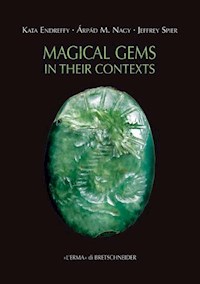
Magical gem with the lion-headed Chnoubis
Chrysoprase, 13.2 x 9.6 x 5.2 mm
Museum of Fine Arts, Budapest, inv. no. 53.155
Photo: László Mátyus
© Szépművészeti Múzeum
The publication of this book was kindly supported by
Magical Gems in their Contexts - Roma «L’ERMA» di BRETSCHNEIDER, 2019 - 362 + 22 p. : ill, ; 24 cm. - (Studia Archaeologica 229)
ISBN 978-88-913-1297-6 (carta)
ISBN 978-88-913-1300-3 (pdf)
ISBN 978-88-913-2188-6 (ePub)
CDD 736.2
1. Gemme incise
In memoriam David Jordan(1942–2018)
CONTENTS
Abbreviations
Foreword
SHUA AMORAI-STARK and SHIMON ILANI: Magical Gem Amulets from Caesarea Maritima: ‘Intact’ and ‘Broken’ Hematite Intaglios
GIDEON BOHAK: The Use of Engraved Gems and Rings in Ancient Jewish Magic
VÉRONIQUE DASEN: One God May Hide Another: Magical Gems in a Cross-Cultural Context
KIRSTEN DZWIZA: Magical Signs: An Extraordinary Phenomenon or Just Business as Usual? Analysing Decoration Patterns on Magical Gems
CHRISTOPHER A. FARAONE: Magical Gems as Miniature Amuletic Statues
FELICITY HARLEY-MCGOWAN: Jesus the Magician? A Crucifixion Amulet and its Date
DESPINA IGNATIADOU: Two Magical Gems from the Roman Cemetery in Thessaloniki
GENEVRA KORNBLUTH: Pilulae and Bound Pendants: Roman and Merovingian Amulets
SONIA MACRÌ: The Gems of Greco-Roman Literature: Real Features and Symbolic Reconfiguration
ATTILIO MASTROCINQUE: Iconographies of Ialdabaōth
SIMONE MICHEL-VON DUNGERN: Vom Erhellen des Verdunkelten und Sichtbarmachen des unsichtbar Gedachten: Zur Ausstellung als Medium der Wissenschaftskommunikation
ÁRPÁD MIKLÓS NAGY: Figuring out the Anguipes Gems, bis: A Statistical Overview
MARIA NILSSON and JOHN WARD: Mason or Priest? A Comparison between Graeco-Roman Signs on Magical Amulets and Symbols in Egyptian Quarries
JOACHIM FRIEDRICH QUACK: From Egyptian Traditions to Magical Gems: Possibilities and Pitfalls in Scholarly Analysis
VĚRA ŠLANCAROVÁ and DANIELA URBANOVÁ: Magical Gems from Collections in the Czech Republic
JEFFREY SPIER: Solomon and Asmodaios on Greco-Roman Magical Amulets and Rings
ELENI TSATSOU: Uterine Amulets: Amulets that Protect the Uterus or that Reinforce Erotic Desire?
PAOLO VITELLOZZI: The Sword of Dardanos: New Thoughts on a Magical Gem in Perugia
ERIKA ZWIERLEIN-DIEHL: Dating Magical Gems
List of Contributors
Plates
ABBREVIATIONS
The abbreviated format of journals and standard reference works in the notes to this volume follow the abbreviations used by the American Journal of Archaeology. The list below contains abbreviations of works closely related to the study of magical gems and referenced by multiple authors.
AGD I
E. Brandt, Antike Gemmen in Deutschen Sammlungen I. Staatliche Münzsammlung München (München, 1968–1972)
AGD II
E. Zwierlein-Diehl, Antike Gemmen in Deutschen Sammlungen II. Staatliche Museen preussischer Kulturbesitz: Antikenabteilung Berlin (München, 1969)
AGD III
P. Zazoff et al., Antike Gemmen in Deutschen Sammlungen II. Braunschweig, Göttingen, Kassel (Wiesbaden, 1970)
AGD IV
P. Zazoff et al., Antike Gemmen in deutschen Sammlungen IV. Hannover, Kestner-Museum, Hamburg, Museum für Kunst und Gewerbe (Wiesbaden, 1975)
Amorai-Stark, Engraved Gems and Seals
S. Amorai-Stark, Engraved Gems and Seals from Two Collections in Jerusalem, Studium Biblicum Franciscanum Museum 11 (Jerusalem, 1993)
Barb, “Magica Varia”
A. A. Barb, “Magica Varia,” Syria 49 (1972), 343–370.
Betz, GMPT
H. D. Betz, ed., The Greek Magical Papyri in Translation, including the Demotic Spells (Chicago, 1986)
Bohak, Ancient Jewish Magic
G. Bohak, Ancient Jewish Magic. A History (New York, 2008)
Bonner, in Hesperia 20
C. Bonner, “Amulets chiefly in the British Museum,” Hesperia 20 (1951), 301–345.
Bonner, SMA
C. Bonner, Studies in Magical Amulets Chiefly Graeco-Egyptian (Ann Arbor, 1950)
Brashear, GMP
W. M. Brashear, “The Greek Magical Papyri: an Introduction and Survey. Annotated Bibliography (1928–1994),” in ANRW II 18, 5 (1995), 3380–3684.
CBd
Campbell Bonner Magical Gems Database (classics.mfab.hu/talismans), developed at the Museum of Fine Arts, Budapest, ed. Á. M. Nagy et al. (Budapest, 2010–)
Dasen, “Représenter l’invisible’”
V. Dasen, “Représenter l’invisible: la vie utérine sur les gemmes magiques,” in L’embryon humain à travers l’histoire. Images, savoirs et rites, ed. V. Dasen (Gollion, 2007), 41–64.
Dasen, “Le secret d’Omphale”
V. Dasen, “Le secret d’Omphale,” RA 46 (2008), 268–270.
Dasen, in ‘Gems of Heaven’
V. Dasen, “Magic and Medicine: Gems and the Power of Seals,” in ‘Gems of Heaven’, 69–74.
Dasen, Le sourir d’Omphale
V. Dasen, Le sourire d’Omphale. Maternité et petite enfance dans l’Antiquité (Rennes, 2015)
Delatte, Anecdota Atheniensia
A. Delatte, Anecdota Atheniensia, I (Liège–Paris, 1927)
Delatte, “Etudes”
A. Delatte, “Etudes sur la magie grecque, III–IV,” MusB 18 (1914), 5–96.
Delatte and Derchain, Intailles magiques
A. Delatte and Ph. Derchain, Les intailles magiques gréco-égyptiennes (Paris, l964)
Dembski, AGCarnuntum
G. Dembski, Die Antiken Gemmen und Kameen aus Carnuntum (Wien, 2005)
Elgavish, Shiqmona
J. Elgavish, Shiqmona: On the Seacoast of Mount Carmel (in Hebrew) (Tel Aviv, 1994)
Entwistle and Adams, ‘Gems of Heaven’
C. Entwistle and N. Adams, eds, ‘Gems of Heaven’. Recent Research on Engraved Gemstones in Late Antiquity c. AD 200–600. British Museum Research Publications 177 (London, 2011)
Faraone, Talismans and Trojan Horses
C. A. Faraone, Talismans and Trojan Horses: Guardian Statues in Ancient Greek Myth and Ritual (Oxford and New York, 1992)
Faraone, Love Magic
C. A. Faraone, Ancient Greek Love Magic (Cambridge, 1999)
Faraone, “Stopping Evil”
C. A. Faraone, “Stopping Evil, Pain, Anger and Blood: The Ancient Greek Tradition of Protective Iambic Incantations,” GRBS 49 (2009), 227–256.
Faraone, in ‘Gems of Heaven’
C. A. Faraone, “Text, Image and Medium, The Evolution of Greco-Roman Magical Gemstones,” in ‘Gems of Heaven’, 50–61.
Faraone and Obbink, Magika Hiera
C. Faraone and D. Obbink, eds, Magika Hiera: Ancient Greek Magic and Religion (New York, 1991)
Frankfurter, Religion in Roman Egypt
D. Frankfurter, Religion in Roman Egypt. Assimilation and Resistance (Princeton, 1998)
Gesztelyi, Pannoniai vésett ékkövek
T. Gesztelyi, Pannoniai vésett ékkövek (Budapest, 1998)
Gesztelyi, Antike Gemmen
T. Gesztelyi, Antike Gemmen in Ungarischen Nationalmuseum, Catalogi Musei Nationalis Hungarici, Series Archaelogica III (Budapest, 2000)
Gordon, in ‘Gems of Heaven’
R. Gordon, “Archaeologies of Magical Gems,” in ‘Gems of Heaven’, 39–49.
Gordon and Marco Simón, Magical Practice in the Latin West
R. Gordon and F. Marco Simón, eds, Magical Practice in the Latin West: papers from the International Conference held at the University of Zaragoza, 30 Sept. – 1 Oct. 2005, Religions in the Graeco-Roman World 168 (Leiden–Boston, 2010)
Graf, “Prayer”
F. Graf, “Prayer in Magical and Religious Rituals,” in Faraone and Obbink, Magika Hiera, 188–213.
Halleux and Schamp, Lapidaires grecs
R. Halleux and J. Schamp, Les lapidaires grecs (Paris, 1985)
Hamburger, “Caesarea Maritima”
A. Hamburger, “Gems from Caesarea Maritima,” Atiqot 8 (Jerusalem, 1968), 1–38.
Jackson, The Lion Becomes Man
H. M. Jackson, The Lion Becomes Man. The Gnostic Leontomorphic Creator and the Platonic Tradition, Society of Biblical Literature Dissertation Series 81 (Atlanta, 1985)
Kotansky, GMA
R. Kotansky, Greek Magical Amulets: The Inscribed Gold, Silver, Copper, and Bronze Lamellae. Part I: Published Texts of Known Provenance, Papyrologica Coloniensia 22/1 (Opladen, 1994)
Maaskant-Kleibrink, Hague
M. Maaskant-Kleibrink, Catalogue of the Engraved Gems in the Royal Coin Cabinet, the Hague: the Greek, Etruscan, and Roman Collections (Den Haag, 1978)
Mastrocinque, Studi sul mitraismo
A. Mastrocinque, Studi sul mitraismo (Il mitraismo e la magia) (Rome, 1998)
Mastrocinque, Gemme Gnostiche
A. Mastrocinque, ed., Gemme gnostiche e cultura ellenistica. Atti del Convegno, Verona, 22–23 ottobre 1999 (Bologna, 2002)
Mastrocinque, From Jewish Magic to Gnosticism
A. Mastrocinque, From Jewish Magic to Gnosticism. Studien und Texte zur Antike und Christentum 24 (Tübingen, 2005)
Mastrocinque, SGG I
A. Mastrocinque, ed., Sylloge Gemmarum Gnosticarum parte I, Bollettino di Numismatica, Monografia 8.2.I (Rome, 2003)
Mastrocinque, SGG II
A. Mastrocinque, ed., Sylloge Gemmarum Gnosticarum parte II, Bollettino di Numismatica, Monografia 8.2.II (Rome, 2007)
Mastrocinque, Kronos, Shiva, & Asklepios
A. Mastrocinque, Kronos, Shiva, & Asklepios. Studies in Magical Gems and Religions of the Roman Empire (Philadelphia, 2011)
Mastrocinque, in ‘Gems of Heaven’
A. Mastrocinque, “The Colours of Magical Gems,” in ‘Gems of Heaven’, 62–68.
Mastrocinque, Intailles magiques
A. Mastrocinque, Les intailles magiques du département des Monnaies, Médailles et Antiques (Paris, 2014)
Merkelbach, Isis regina
R. Merkelbach, Isis regina – Zeus Sarapis: die griechisch-ägyptische Religion nach den Quellen dargestellt (Leipzig, 20012)
Meyer and Mirecki, Ancient Magic and Ritual Power
M. Meyer and P. Mirecki, eds, Ancient Magic and Ritual Power, Religions in the Graeco-Roman World 129 (Leiden, 1995)
Michel, BM
S. Michel, Die magischen Gemmen im Britischen Museum (London, 2001)
Michel, Bunte Steine
S. Michel, Bunte Steine – Dunkle Bilder: „Magische Gemmen” (München, 2001)
Michel, DMG
S. Michel, Die Magischen Gemmen. Zu Bildern und Zauberformeln auf geschnittenen Steinen der Antike und Neuzeit, Studien aus dem Warburg-Haus 7 (Berlin, 2004)
Michel-von Dungern, in ‘Gems of Heaven’
S. Michel-von Dungern, “Studies on Magical Amulets in the British Museum,” in ‘Gems of Heaven’, 82–87.
Mouterde, “Glaive”
R. Mouterde, “Le glaive de Dardanos. Objects et inscriptions magique de Syrie,” MelBeyrouth 15.3 (1930), 53–137.
Nagy, in ‘Gems of Heaven’
Á. M. Nagy, “Magical Gems and Classical Archaeology” in ‘Gems of Heaven’, 75–81.
Nagy, “Gemmae magicae selectae”
Á. M. Nagy, “Gemmae magicae selectae. Sept notes sur l’interprétationes des gemmes magiques,” in Gemme Gnostiche, 153–179.
Nagy, “Daktylios Pharmakites”
Á. M. Nagy, “Daktylios Pharmakites. Magical healing gems and rings in the Graeco-Roman world,” in Ritual Healing: Magic, Ritual and Medical Therapy from Antiquity until the Early Modern Period, ed. I. Csepregi and C. Burnett, Micrologus’ Library 48 (Firenze, 2012), 71–106.
Naveh and Shaked, Magic Spells and Formulae
J. Naveh and S. Shaked, Magic Spells and Formulae (Jerusalem, 1993)
Neverov, “Gemmes, bagues et amulettes magiques”
O. Neverov, “Gemmes, bagues et amulettes magiques du sud de l’URSS,” in Hommages à Maarten J. Vermaseren II, ed. M. B. de Boer and T. A. Edridge, ÉPRO 68 (Leiden, 1978), 833−848.
Pannuti, Napoli I
U. Pannuti, Museo Archeologico Nazionale di Napoli: Catalogo della Collezione Glittica I (Rome, 1983)
Peleg-Barkat and Tepper, in ‘Gems of Heaven’
O. Peleg-Barkat and Y. Tepper, “Engraved Gems from Sites with a Military Presence in Roman Palestine. The cases of Legio and Aelia Capitolina,” in ‘Gems of Heaven’, 99–104.
Petrie, Amulets
W. M. F. Petrie, Amulets, Illustrated by the Egyptian Collection in University College London (London, 1914)
PGM
K. Preisendanz, ed., Papyri Graecae Magicae. Die griechischen Zauberpapyri I–II (Leipzig, 1928 and 1931; 2nd ed. A. Henrichs, Stuttgart, 1973–1974).
Philipp, Mira et Magica
H. Philipp, Mira et Magica. Gemmen im Ägyptischen Museum der Staatlichen Museen Preussischer Kulturbesitz, Berlin–Charlottenburg (Mainz, 1986)
Quack, in Aegyptus et Pannonia III
J. F. Quack, “The so-called Pantheos. On Polymorphic Deities in Late-Egyptian Religion,” in Aegyptus et Pannonia III. Acta Symposii Anno 2004, ed. Hedvig Győri (Budapest, 2006), 175–190.
Ritner, “Uterine Amulet”
R. K. Ritner, “A Uterine Amulet in the Oriental lnstitute Collection,” JNES 43/3 (1984), 209–221.
Ross, Dumbarton Oaks Collection
M. C. Ross, Catalogue of the Byzantine and Early Medieval Antiquities in the Dumbarton Oaks Collection. II Jewelry, Enamels, and Art of the Migration Period (Washington DC, 1965)
Sfameni Gasparro, Culti orientali
G. Sfameni Gasparro, I culti orientali in Sicilia, ÉPRO 31 (Leiden, 1973)
Smith, “Relations”
M. Smith, “Relations between Magical Papyri and Magical Gems,” in Actes du XVe congrés international de Papyrologie, troisième partie. Problèmes généraux – papyrologie littéraire, ed. J. Bingen, Papyrologica Bruxellensia 18 (Brussels, 1979), 129–136.
Spier, Ancient Gems and Finger Rings
J. Spier, Ancient Gems and Finger Rings. Catalogue of the Collections. The J. Paul Getty Museum Malibu, California (Malibu, 1992)
Spier, “Medieval Byzantine Magical Amulets”
J. Spier, “Medieval Byzantine Magical Amulets and Their Tradition,” JWarb 56 (1993), 25–62.
Spier, Late Antique and Early Christian Gems
J. Spier, Late Antique and Early Christian Gems (Wiesbaden, 2007)
Vikan, “Art, Medicine, and Magic”
G. Vikan, “Art, Medicine, and Magic in Early Byzantium,” Dumbarton Oaks Papers 38 (1984), 65–86.
Waegeman, Amulet and Alphabet
M. Waegeman, Amulet and Alphabet: Magical Amulets in the First Book of Cyranides (Leiden, 1987)
Walters, Engraved gems and cameos
H. B. Walters, Catalogue of the engraved gems and cameos: Greek, Etruscan and Roman in the British Museum, rev. ed. (London, 1926)
Weitzmann, Age of Spirituality
K. Weitzmann, ed., Age of Spirituality: Late Antique and Early Christian Art, Third to Seventh Century (New York, 1979)
Zazoff, Die antiken Gemmen
P. Zazoff, Die antiken Gemmen. Handbuch der Archäologie (München, 1983)
Zwierlein-Diehl, Glaspasten Würzburg I
E. Zwierlein-Diehl, Glaspasten im Martin-von-Wagner-Museum der Universität Würzburg I (München, 1986)
Zwierlein-Diehl, AGWien III
E. Zwierlein-Diehl, Die antiken Gemmen des Kunsthistorischen Museums in Wien, III. Die Gemmen der späteren römischen Kaiserzeit, 2. Masken, Masken-Kombinationen, Phantasie- und Märchentiere, Gemmen mit Inschriften, christliche Gemmen, magische Gemmen, sasanidische Siegel, Rundplastik aus Edelstein und verwandtem Material, Kameen (München, 1991)
Zwierlein-Diehl, Köln
E. Zwierlein-Diehl, Magische Amulette und andere Gemmen des Instituts für Altertumskunde der Universität zu Köln. Abhandlungen der Rheinisch-Westfälischen Akademie der Wissenschaften, Papyrologica Coloniensia XX (Opladen, 1992)
Zwierlein-Diehl, Siegel und Abdruck
E. Zwierlein-Diehl, Siegel und Abdruck. Antike Gemmen in Bonn. Akademisches Kunstmuseum – Antikensammlung der Universität Bonn. Sonderausstellung vom 18. September 2002 bis 31. Januar 2003 (Bonn, 2002)
Zwierlein-Diehl, AGN
E. Zwierlein-Diehl, Antike Gemmen und ihr Nachleben (Berlin and New York, 2007)
FOREWORD
The papers in this book derive from a workshop held at the Museum of Fine Arts, Budapest between 16–18 February 2012. It has taken unusually long to publish the proceedings of the conference – the various reasons are irrelevant and the responsibility of the editors. The delay, however, has given the authors the opportunity to update their findings before publication, which might perhaps make up for the loss caused by the lengthiness of the process.
The Budapest workshop was the second conference solely dedicated to research on magical gems1. It is worth putting this in context and giving an overview of the achievements that took place in the period between these two events. During these years, there has been a radical change in the scope of our knowledge on magical gems.
II, J. Śliwa, Magical Gems from the Collection of Constantine Schmidt-Ciążiński and from other Polish Collections (Kraków, 2014); Mastrocinque, Intailles magiques.
It has been noted before that magical gems occupy a unique place among the material remains of classical antiquity. Through much of the history of classical studies magical gems have been relegated to the things not worthy of knowing – an approach encountered in all of the disciplines involved2. Despite this, there has been some exceptional scholarship on magical gems, notably the work of three scholars: Armand Delatte, Alphonse A. Barb, and, most importantly, Campbell Bonner, the author of the still fundamental monograph3. It is quite telling that in the two decades following the publication of the first catalogue of magical gems in the Cabinet des Médailles in Paris in 1964 only a few studies were written on the subject4. The change came in the mid-1980s, heralded by the catalogue of the Berlin gems by Hanna Philipp (1986), which was the first monograph to describe a collection of magical gems using the tools of classical archaeology5. The past decades have seen the publication of works that will define research on magical gems for a long time to come. Catalogues of the largest museum collections have been compiled6, enlarging the known corpus of magical gems to an enormous extent. Studies written with never before seen thoroughness focused on individual pieces and iconographical types7. Comprehensive works have also appeared8, the most momentous being Simone Michel’s 2004 overview9, the second monograph after Bonner’s to include all the gems known at the time, 2800 items (to compare: Bonner’s book was based on a catalogue of 389 pieces). Importantly, this period has also been characterised by a shift in the scope of research beyond ancient gems, thus creating the necessary conditions for studying the post-antique chapters in the long history of magical gems10.
Two new aims in the research on magical gems have also been formulated during this period: the organisation of an international exhibition of amulets, and the creation of an online database of magical gems. The first is yet to be accomplished, although it has come close to realization on four occasions since 200011, and Simone Michel has successfully organized two exhibitions on a smaller scale, relying on the collection of Wolfgang Skoluda and the material kept in German museums. Her achievements are a clear indication of the potentials of the concept12.
The second objective was met with success in Budapest, where the Campbell Bonner Magical Gems Database (CBd) is now maintained by the Collection of Classical Antiquities of the Museum of Fine Arts. Since its launch in 2010, the database has made more than 2700 amulets from over seventy collections worldwide openly accessible, and is continuously expanding. The description of the corpus follows a unified protocol, making the database an indispensable research tool in the field13.
It is worth highlighting here an important trait which has characterised research in the past decades, and played a crucial role in the success of the database. A unique synergy has developed among scholars in the field, and research on magical gems has been characterised by cooperation rather than rivalry. CBd would be poorer without the photographs of Christopher Faraone and Attilio Mastrocinque, the advice of Jeffrey Spier, and the work of the Fribourg branch directed by Véronique Dasen, just to name a few of the participants.
The workshop in Budapest was an important event during this productive research period. The various disciplines represented by the participants – there were philologists, Egyptologists, archaeologists, historians, scholars of religious history and Jewish studies – clearly show that magical gems have found their place in the classical tradition, and that one of our most important objectives is now to put this material in context. This fact is alluded to in the title of this book, and is also mirrored by the studies here published.
The papers fall into four loose groups. The first one undertakes the important task of publishing new material. Shua Amorai-Stark and Shimon Ilani introduce magical gems from a private collection in Israel: the scientific value of these pieces is greatly enhanced by the fact that all of them come from the same site, Caesarea Maritima, which the authors identify as a major center in ancient Palestine for the production of magical intaglios, raising the possibility that workshops in Caesarea may even have been responsible for the creation of the so-called reaper scheme. The analysis of the material characteristics of the pieces has provided the authors with new arguments to support the theory first proposed by Erika Zwierlein-Diehl that haematite gems were broken into two halves for medicinal purposes14. Despina Ignatiadou presents two magical gems that were unearthed at the Roman cemetery of Thessaloniki in 1972. The survey of the excavation archives allowed the reconstruction of the contexts of the two pieces: they formed part of the funerary equipment of a wealthy woman, probably buried in the third century AD. These are the first magical gems from excavation contexts in Greece ever to be published. Věra Šlancarová and Daniela Urbanová introduce magical gems preserved in Czech collections, which had previously been by and large inaccessible for scholars. Thanks to their efforts all the pieces can now be consulted in CBd. Genevra Kornbluth compares two rock crystal magical gems with a considerable corpus of undecorated rock crystal spheres of a similar size. Her meticulous observations categorize the chief groups dating from the Hellenistic period to the early Middle Ages and suggest that the voces and characteres were secondarily engraved on the two pieces. Her microarchaeological method may serve as a model to follow for the examination of other amulets as well.
Studies in the second group provide various methodologies for research on magical gems. One of the most important contributions in this volume is given by Erika Zwierlein-Diehl, who has created a framework for dating magical gems. She has surveyed and systematized the methods by which the gems can be dated and collected all the available evidence. Her results are the first to provide confirmation that the production of magical gems started in the late Hellenistic period and lasted until the end of the Roman imperial period. Sonia Macrì examines the ancient books describing the properties of stones known as lithika and asserts that the ancient classification of precious stones does not rest on mineralogical data but rather on their symbolic interpretation. Her study provides new directions for further research on magical gems to see if there is a correspondence between the names of precious stones, the motifs they bear, and the function of the gems. Kirsten Dzwiza analyses the decoration patterns of magical signs engraved on gems, based on a survey of 1075 pieces. Her paper is a step towards the important task of the systematic survey of characteres engraved on magical gems – one of the crucial desiderata in the field, which can only be accomplished by a comprehensive survey of magical signs that also includes other groups of ancient magica.
Most papers in this volume fall in the third group. They share the aim of integrating magical gems in the ancient religious tradition, and use various methods to place them in their religious historical contexts. Gideon Bohak gives an overview of the use of engraved gems and rings in ancient Jewish magic, and calls attention not only to the paucity of ancient magical gems that are “demonstrably Jewish” but also to the dearth of Jewish texts that reference such gems. Engraved gems thus played only a marginal role in ancient Jewish magic. Véronique Dasen provides a cross-cultural interpretation of two amulet types. The vessel-like shape of the womb engraved on uterus-gems recalls the cupping device used in traditional Graeco-Roman healing, but the background is Egyptian. Similarly, both Greek and Egyptian elements are found on a gem with the name Thoeris beside the image of Athena protecting two children. Christopher A. Faraone focuses on magical gems bearing a miniaturized image of a famous cult statue, often without additional voces magicae and characteres, arguing that these powerful images were miniaturized to make them portable and used for protective and healing purposes. The pieces he analyses show the close parallels between the Greek magical papyri, magical gems, and ritual elements known from other sources, and contribute to the deconstruction of the category of magical gems. Árpád M. Nagy also deconstructs the category: through a comprehensive statistical analysis of the corpus of Anguipes amulets, he aims to justify his earlier hypotheses that the scheme of the snake-legged deity is inseparable from Deus Israel. The makers of the Anguipes amulets attempted to integrate the God of Israel into their creations from a “pagan”, cross-cultural perspective, within a magical koine that regarded Deus Israel as a mighty deity, but not as God Almighty. His study only seemingly contradicts that of Gideon Bohak: while the latter discusses Jewish magic, the former focuses on Judaizing magic. Joachim Friedrich Quack uses two case studies to highlight an always topical question in research on magica: the tension between its comprehensive scope and scholarly specialization. From an Egyptological perspective, the interpretation of the Pantheos scheme usually encountered in the literature is inaccurate, whereas in the case of the Anguipes scheme, the Egyptian tradition provides no basis for interpretation. Drawing on the Jewish magical tradition that regarded King Solomon as having the power to control demons, Jeffrey Spier considers a unique gem that names Asmodaios, known as the “King of Demons” in Jewish texts. This gem and related rings show that complex Jewish beliefs that are rarely mentioned in the magical papyri were sometimes known to pagan magicians and found their way into early Christian magic as well. Paolo Vitellozzi analyses a case where a direct relationship exists between magical gems and a magical recipe: a piece in Perugia closely follows the prescriptions of a praxis known as the Sword of Dardanos (PGM IV 1716–1870), and a number of further gems (such as CBd-1555) can also be connected to the rite. His detailed analysis comparing the gem and the PGM-text paints a vivid picture of an amulet that was surely created after an archetypal model, and was the joint work of a magos and a daktyliographos.
Some papers in this group present radically new approaches in the study of magical gems, providing fertile ground for further discussions. The study of Attilio Mastrocinque relates to the much debated question of the relationship of Gnosis and magical gems. He argues that Ialdabaōth is not only represented on a single gem, but also on other amulets. Ialdabaōth, who is the creator of the world in the Gnostic tradition, appears as a lion-headed deity. Elements of Gnosis undoubtedly appear among the motifs on magical gems, and the problem certainly merits further research. Eleni Tsatsou gives a radical reinterpretation of uterine gems, a large group within the corpus. Going against the communis opinio since at least Armand Delatte’s 1914 paper that these pieces serve gynaecological purposes, she contends that they aimed at enhancing sexual desire, thus arriving at a conclusion in opposition to that of Véronique Dasen. Maria Nilsson and John Ward compare quarry marks from Gebel el-Silsile in Egypt with characteres that appear on magical gems at least 200 years later, arguing that these signs are not simply masons’ marks of a practical function, but may also have had symbolic significance.
A fourth group of papers focuses on the connection of magical gems with later tradition. Felicity Harley-McGowan surveys ancient representations of the Crucifixion, and brings convincing arguments to show that the jasper gem from Gaza in the British Museum (CBd-816), usually dated to late antique times, was created much later, in the Middle Byzantine period. This result is important not only because it gives a clearer picture of the late antique representations of Jesus on the cross, but also because it underscores the continuing amuletic efficacy of gemstones that feature the name and image of Jesus crucified into the Middle Byzantine period. Simone Michel-von Dungern, who has played a crucial role in renewing research on magical gems, surveys recent attempts at displaying them in museum exhibitions and gives a detailed description of the scientific concept and educational experience of the second magical gems exhibition she staged at Malerwinkelhaus, Marktbreit in 2012.
To sum up, this volume is an important step ahead on the road we started three decades ago. The studies presented here provide a rich illustration of the complexity of the archaeological group known as magical gems, which are gradually being integrated among other types of amulets and which reveal new aspects of the religious tradition commonly known as ancient magic.
We take this occasion to thank all the people and institutions, without whose help the conference and the publication could not have been realised. Ildikó Csepregi played a decisive role in organizing the conference. The Greek texts appearing in the book have been proofread by Katalin Bélyácz. The conference was hosted by the Museum of Fine Arts in Budapest, which also manages the Campbell Bonner Magical Gems Database. The conference and the proceedings have been generously sponsored by Vacheron Constantin in Geneva.
The sad news of the passing of David Jordan was received when this manuscript was prepared to go to print. With him, one of the greatest symmagoi is gone. This book is dedicated to his memory.
THE EDITORS
MAGICAL GEM AMULETS FROM CAESAREA MARITIMA: ‘INTACT’ AND ‘BROKEN’ HEMATITE INTAGLIOS
Shua Amorai-Stark and Shimon Ilani
The aim of this paper is twofold:
2. To study the plausible origin of the hematite gems in the collection (16 pieces) and to add, based on the possible geographical origin of their raw material and present conditions, a few preliminary remarks regarding the use of hematite by Caesarean magi, medical practitioners, and believers.
BACKGROUND TO THE COLLECTION
The engraved gems, cameos and finger rings in the large Hendler Collection come from a single site: Caesarea Maritima, Israel. This notable group of finds comprises the largest published group of glyptic items and finger rings from Israel and the biggest ever to be published from Caesarea2.
The number of other small finds of magical content, many of which are likewise considered to be amulets, such as lamellae, all-metal rings, small stone carvings compiled together with the discussed stone and ivory gems in this collection is impressive, and since they originate from a single site, also highly important.
The collection was amassed over nearly 30 years, beginning in the early 1950’s, from the surfaces of this significant Romano-Byzantine harbor city, capital and administrative center of the Roman province of Palestine3. The city was built by Herod the Great (building started in 22 BCE) on the site of the Hellenistic town of Straton Tower (probably founded in the fourth century BCE). Caesarea continued to be a thriving town during most of the early Islamic period4.
It is not inconceivable that the collection as a whole includes several items that may have surfaced above areas of fills. Over time, fills were moved from different areas within the city or brought to locations outside the city’s walls where repairs and new constructions were made. It is also possible that some items might have surfaced from above areas of cemeteries5.
In general, in Israel, intaglios and plain gems of known provenance mostly originate from tomb sites which are habitually adjacent to settlements and less frequently from areas within the settlements themselves.
PART I.PRESENTATION OF THE HENDLER COLLECTION MGA
The Hendlers collected most of their MGA from the present-day coastal areas of Caesarea. The sea, the land and sand near it covered or partially covered parts of the ancient harbor, many major public constructions of the Herodian-Byzantine city, including parts of the ‘Promontory Palace’, the circus, the theater, the baths, and structures identified as temples, mansions and other private dwelling and public quarters. It is unlikely that any of the objects originate from cemeteries now close to the seafront because the only cemetery found near the present coastline is a Hellenistic-period cemetery, which is situated within the compound of the Herodian–Byzantine ‘Promontory Palace’. This area also functioned as a larger cemetery during Caesarea’s Islamic and Crusader periods, that is, in periods which predate or postdate the 16 examined pieces. At different periods parts of the ancient city within its three walls functioned as gardens, agricultural fields, cemeteries, and presumably also as workshop areas. Large portions of these inner land areas and of the areas near the present coastline were desolate for long periods (chiefly since the fourteenth century) and became sand dunes6. Only two pieces (nos 12, 14 below) were discovered on the dunes that covered the city’s inner land and surrounding remains.
CAESAREA MGA BY TYPE: HENDLER COLLECTION AND FORMERLY PUBLISHED SPECIMENS: TABLES 1−11
Table 1. Reaper
Obverse
Reverse
Material & Condition
Hendler Coll. Total
Caesarea Total
Major goal / usage: medicinal
‘Reaper’
Variations on: C[ΧΙWΝ, C[ΧΙWΝ], CΧΙWΝ: ‘for the hips’
3 hematite, ca. half remains
27:
1 black jasper, missing parts on opposite contour sides; 1 unclear material (perhaps hematite), slightly chipped or cut contour
backaches and sciatica
3
5
No. 1 (Plate 1/1a−b). Hematite, opaque, 25.5 x 11.2 x 3 mm. Type F1, large horizontal oval8.
No. 2 (Plate 1/2a−b). Hematite, opaque, 20.4 x 9.2 x 2.7 mm. Type F1, large horizontal oval.
No. 3 (Plate 1/3a−c).) Hematite, opaque, 16.2 x 8.1 x 3.9 mm. Type F1, horizontal oval9.
TABLES 2–4. CHNOUBIS AND CHNOUBIS WITH WOMB-SYMBOL
Table 2. Chnoubis alone
Obverse
Reverse
Material & Condition
Hendler Coll. Total
Caesarea Total
Major goal / usage: medicinal
‘Chnoubis-snake’ + star
Inscription
White chalcedony, ‘intact’
1
Stomach and gynecological ailments; with star or crescent: + astrological; on white chalcedony: mainly to protect breastfeeding (?)
with unlooped tail + ouroboros
Inscription + 2 crescents
Hematite, ca. half remains
1
2: black jasper, ‘intact’
2
4
No. 4 (Plate 1/4a–b). Chalcedony, white, chiefly opaque, 14.95 x 12.5 x 4.8 mm. Type C4A, obverse: upright oval, reverse: horizontal oval.
Rev.: ΚΕ (or perhaps only K?) / ΧΝΟΥΜΙC (Chnoumis) / Φ10
No. 5 (Plate 1/5a–c). Hematite, reddish-brownish, 9.2 x 9.4 x 2.8 mm. Type F4, rectangle; obverse: upright, missing device top; reverse: horizontal. Broken, ca. 2/3 remains.
Rev.: 4-line inscription and 2 remaining crescent moons in the corners: [--]ΑWΘ / [--]CΑΧ / [--]ΘΙΑW / [--]WΧ11
Table 3. Chnoubis with attending deities and womb-symbol
Obverse
Reverse
Material & Condition
Hendler Coll. Total
Caesarea Total
Major goal / usage: medicinal
‘Chnubis-Snake’ + attending deities + womb-symbol within ouroboros
Inscription
2 hematite, ‘intact’, of which 1 with slightly chipped/rubbed contour
112: hematite, ‘intact’
Stomach + gynecological diseases & problems
2
3
No. 6 (Plate 1/6a– b). Hematite, opaque, 15.7 x 13.2 x 2.9 mm. Type F1, upright, elongated oval. Intact.
Rev.: 5-line inscription at center ending with star: ΛΟΟC / ΡΟCΤΙΜΑ / ΡΦΕΡΓΑΡΒ / ΑΡΜΑΦ / ΥΗΡΙ. Around the edge: ΟΟΛΟΑΔΧΑA13
No. 7 (Plate 7a– b). Hematite, opaque, 11.5 x 10.4 x 2.4 mm. Type F1, upright, wide oval. Chipped and part of design rubbed off.
Rev.: 4-line magical inscription: ΤΑΝ / ΤΑΛΑI / ΠΑΙΕ S (or S-like simplified Chnoubis symbol) / ΖΧ14
Table 4. Chnoubis and womb-symbol MGA from Caesarea
Subtypes
Hender Coll.
Other published pieces
Total
Chnoubis on its own
2
2
4
Chnoubis + Egyptian attending deities + womb-symbol
2
1
3
Chnoubis above womb-symbol without Egyptian attending deities
1 black jasper15
1
Womb-symbol with small Ares figure on reverse
1 black jasper16
1
4
5
Overall Chnoubis & Chnoubis + womb-symbol, and womb-symbol without attending deities from Caesarea
9
Material and condition
5 ‘intact’ quartz: 4 black jasper, 1 white chalcedony; 4 hematite: 1 ca. half remaining, 3 ‘intact’ of which 1 is set in an ancient gold ring, 1 with slightly chipped/cut off outer contour.
Table 5. ‘Holy Rider’
Obverse
Reverse
Material & Condition
Hendler Coll. Total
Caesarea Total
Major goal / usage: medicinal
‘Holy Rider’ / ‘Solomon’
Standing figure with spear (likely Ares)
Hematite, less than half remains
To overcome various evils. Medicinal: probably to preserve health & in some cases specifically to secure childbirth.
If with ‘Ares’: connected to planets and overcoming war and evil (?)
Within ouroboros
Inscription
Hematite, less than half remains
Within ouroboros
Inscription
Hematite, intact
417:
2 hematite: 1 with more than ca. 3/4 remaining; 1 small fragment; 1 dark-brown serpentine, less than ca. half remaining; 1 unclear material
3
7
No. 8 (Plate 1/8a–b). Hematite, black, opaque, 25.7 x 15.7 x 2.9 mm. Type F1 rounded up, upright oval with angled cut top narrow sides. Intact.
Obv.: Unclear letters (?) surrounding scene.
Rev.: 4-line Greek inscription, perhaps: ΑΠΙ (or AΓI?) / ΕC / ΚΕ. (or KP. ?) / Τ (or TI?)18
No. 9 (Plate 1/9a–b). Hematite, opaque, 28 x 9.8 x 3.5 mm. Type F1 rounded up, upright oval.
Obv.: Near edge: partially broken/cut letters. Two suggestions: Upper letter: H (?), lower one M (or rather Ω) (perhaps part of Solomon?) or upper letter: H (?), lower one: C (?) (perhaps part of Solomon?)19
Rev.: Likely Ares. Right part of standing male, nude upper torso, perhaps wearing military short skirt (?); upright right hand holding decorated lance/scepter above/next to flamed altar.
No. 10 (Plate 1/10a–c). Hematite, opaque, 10.6 x 28.3 x 3.7 mm. Type F1, horizontal oval.
Rev.: Very faint remains of first or last letter/s of a 3-line inscription (?) over rough surface: [.. or …PA (?)20
Table 7. Likely Seth
Obverse
Reverse
Material & Condition
Hendler Coll. Total
Caesarea Total
Major goal / usage
Seth [?] + attending deity [Isis?] behind ‘box’ (?)
Inscription: undeciphered
Hematite, ca. half remains
1
?
No. 13 (Plate 2/13a–c). Hematite, reddish-brownish color, opaque, 11.2 x 6.5 x 2.8 mm. Type F1, horizontal rectangular with rounded corners close to oval; obverse: upright rectangular/oval; reverse, semi-horizontal rectangular/oval.
Obv.: unclear details. Deity (Seth?), stands above (or behind) a linear structure; frontal body, animal-like head facing right (or head crowned with sun rays and thin kalathos); holds scepter in raised (?) right hand, left hand lowered. Small female (?) figure on right, facing center, crowned with tall thin crown; raising hands to central deity24.
Rev.: 4-line unclear inscription.
Table 8. Non-iconic
Obverse
Reverse
Material & Condition
Hendler Coll. Total
Caesarea Total
Major goal / usage
Inscription: invocations
Inscription: invocations
Ivory set in ancient gold pendant frame25, intact
1
1 carnelian26, ‘intact’ Obv.: ΧCZ, within ouroboros; Rev.: IAW; 1 black stone: names of 2 female + the magical word: Berberetastas
H. Coll. piece: likely for curative / healing or other protective aim/s
1
3
No. 14 (Plate 2/14a–b) Ivory, light brown. Pendant overall H: 20.9 mm, gem: 15.1 x 11.5 x 3.5 mm (see height), frame without suspension loop: 16.8 x 13.1 mm, suspension loop: 4.3 x 3.9, P.3 x 3.4 mm. Type F2, horizontal oval.
Obv./Rev..: 2-line inscription: ΝΙ .. ΑΛ / ΑW I I I I
Rev./Obv.: 2-line inscription: .. ΑΟΑ / Δ Ị Ạ Z. Ạ
Inscriptions on both sides of this ivory represent magical names but we have no certain suggestions as to their meaning27. Magical intaglio amulets with voces magicae accompanied at times with characteres, signs or vowels but no figural images constitute a well-known group of gems, whose inscriptions are frequently for healing or are intended to drive away evil28.
Table 9. Summary of the above motifs in the Hendler Collection, and their total in Caesarea; materials and conditions
Hendler Coll.
Other publications
Total from Caesarea
Reaper
3
2
5
Chnoubis alone
2
2
+ deities + womb-symbol
2
1
4
3
7
+ womb-symbol
1
1
8
Womb-symbol + Ares
1
1
Holy Rider
3
4
7
Anguipede
2
1
3
‘Seth’
1
1
Uniconic, Text
1
2
3
Total
14
15
28
Material and condition
Hematite
15 (3 ‘intact’; others ca. ½, ca. 2/3 or ca. ¾ remains, 1 small fragment)
Black jasper
5 (4 ‘intact’, 1 with straight cut/broken sides)
Jasper of unclear color
1 (unclear condition)
White chalcedony
1 (‘intact’)
Carnelian
1 (‘intact’)
Black serpentine
1 (ca. ½ remains)
Black stone
1 (unclear condition, ‘intact’?)
Unclear material
2 (1 perhaps hematite: slightly chipped or cut on contour; 1 unclear condition, ‘intact’)
Ivory
1 (‘intact’)
Table 10. Motifs, materials and conditions of other published MGA types from Caesarea
Material
Material subtype, motif and reference
‘Intact’
Ca. ½ or 2/3 remains
Total
Green-red (heliotrope) jasper
1: Hamburger, “Caesarea Maritima”, no. 107 (lion); 2: CIIP II, no.1697 mummy and naked demon surrounded by many secondary motifs; no. 1714 (lion/chimera)
3
Black jasper
2: CIIP II, nos 1699 (lion), 1708 (head of Gorgo Medusa)
2
Mottled jasper
2: CIIP II, nos 1701 (Harpocrates on lotus with two deities, all on papyrus boat); 1713 (‘Sacrifice of Isaak and Zodiac symbols)
1
1
Green jasper
1: CIIP II, no. 1710 (Harpocrates)
1
Red jasper
1: Hamburger, “Caesarea Maritima”, no. 109 (lion)
1
Yellow jasper
1: Hamburger, “Caesarea Maritima”, no. 108 (lion)
1
Jasper
1: CIIP II, no.1718 (mythological scene: god riding lion flanked by two figures)
1
Jasper
9
2
11
Black stone (likely lava)
1: CIIP II, no.1717
Unclear stone
1: CIIP II, no. 1683
1 unclear
13
Table 11. Materials of the total of MGA intaglios published from Caesarea
Material
Motifs in Hendler Coll. and same or similar examples from Caesarea in other publications
Other MGA topics from Caesarea (not in Hendler Coll.)
Total
Jasper of colors other than black
8
Black jasper
5 (not in Hendler Coll.)
2
7
Jasper of unclear color
1
1
Jasper total 17
Carnelian
1 (not in Hendler Coll.)
White chalcedony
1
8
11
Quartz total 19
Hematite
15 (1 not in Hendler Coll.)
Black serpentine
1 (not in Hendler Coll.)
Other stones (mainly black or dark brown-black, likely black jasper, hematite or ‘lava’)
3 (not in Hendler Coll., 1 might be hematite)
2 (1 likely black metamorphic stone)
5
Ivory
1
Total
18
13
41
These 41 MGA intaglios present ca. 9.8–10% of the known Caesarea engraved gems.
CONCLUSIONS
1. Material, forms and topics
1.1 MGA intaglios were cut from diverse materials, but mainly from stones including hematite, various microcrystalline quartzes, such as carnelian, different colors of chalcedony, various colors of jasper, agate, and less frequently from rock crystal, lapis lazuli, nicolo and serpentine. Occasionally they were cut also from organic materials such as coral, bone and rarely from ivory. In recent studies the relationships between stone types, their shapes and colors, their motifs and functions have been a major topic of research29.
1.2 The assortment of mediums, forms and motifs discovered at Caesarea is smaller than that published in the corpus of MGA, yet all the materials and the diverse colors encountered in Caesarea have parallels among published MGA, and some have parallels among similar items coming from other sites in Israel.
1.3 The majority of the MGA intaglios are of double-sided flat surface types (mainly types F1–F2). Some have a convex top and a flat underside (mainly Type C3). All of these have an oval or near oval shape. The number of pieces of rectangular form with flat surfaces from Caesarea is smaller, but still significant (see CIIP II, nos 1696, 1722; and our nos 5, 13). Similarlyshaped rectangular examples are at present absent from secured finds in other sites in Israel. The absence of stone magical amulets carved in uncommon shapes among the Caesarea pieces should also be noted30.
1.4 Most MGA in the Hendler Collection along with other specimens from Caesarea depict well-known motifs or types with their usual accompanying inscriptions. The main purpose of the vast majority of these Caesarea MGA is medical, that is they were chiefly used as magical-medicinal applications aimed to heal or to protect against diseases, such as various types of abdominal problems, birth difficulties, back pain, and unspecified evil forces. As such, they can also be termed ‘religio-magical’ therapeutic items31. The single example in the Hendler Collection which depicts an uncommon subject is hematite no. 13.
1.5 By the second century CE, but especially during late antiquity, MGA carrying many of the motifs encountered in the Hendler Collection and their parallels within the total of Caesarea MGA, for example, the lion-headed Chnoubis-serpent and the uterus-symbol with their various additional components, the Reaper, and ‘Holy Rider’ images, are usually thought to have played an important role mainly in popular syncretistic belief and magic. It is commonly believed that they and a wider range of deities or creatures (such as the Anguipede), symbols and their magical formulas were needed and used mainly within the sphere of popular belief and traditional medicine. Yet at the same time magical gems with depictions of the uterus-symbol, Chnoubis-serpent, Anguipede and Reaper motifs, for example, which are known almost exclusively from gems, were not in opposition to current medical-religious healing32. The line between religion, ‘classicalsecular’ medicine and magical healing is problematic, and at times impossible to be separated33. Thus this problem, as well as specific questions such as those pertaining to whether magician-healers practiced their craft regularly within temples’compounds as well as privately, and to what degree were MGA used habitually by members of the Roman elite is in need of further study. Belief in the potency of amuletic gems did not die overnight with the advance of Christianity. The fourth-century upper date limit of many Hendler Collection MGA and of others from Caesarea (for instance CIIP II, nos 1701, 1712) provide proof of the continued active medicinal magico-religious beliefs and their popularity among the population of Caesarea at least until the end of the fourth century; and together with the examples whose upper date limit is the seventh century, they give proof to the continued use of medical amuletic gems in Caesarea Maritima likely until the end of the Byzantine rule of the city.
2. Materials
2.1 Quartz and hematite are the most common materials among the MGA pieces from Caesarea. The majority are dark to black stones (dark jasper of diverse colors, hematite, serpentine and unidentified dark stones).
2.2 Table 11 shows that at Caesarea the most common basic mineralogical medium used for MGA is microcrystalline quartz (19 pieces). The Caesareans, as other ancients, employed microcrystalline quartz of diverse subtype stones and wide color range with a variety of magical devices and texts for magical amulets.
2.3 Within the large and diverse group of microcrystalline stones used by the Caesareans, jasper is the dominant subtype for MGA (17 pieces). In general, as well as at Caesarea and in the larger region, different MGA subjects and texts occur on jaspers of diverse colors34. Yet, no MGA jaspers are included in the Hendler Collection. That jasper was a very common stone for MGA is not unique to the Caesarea workshops. Scholars have pointed out the textual and practical evidence encountered from the general corpus of MGA for the close correlation between different colored jaspers and chalcedony (as well as of other stones of the same or close colors) and specific MGA devices35.
2.4 In total, the most common color of jasper used at Caesarea for MGA is black (7 pieces). Only three basic subjects corresponding to, or of close variants to those found in the Hendler Collection are securely represented on black jasper within the group of MGA gems from Caesarea. These are:
1: Reaper (Tables 1, 4, 9);
2: Chnoubis-serpent on its own (Tables 2, 4, 9);
3: Womb-symbol on its own and a small Ares figure on the reverse (Tables 4, 9);
Variant of 2 and 3: Chnoubis above womb-symbol (Tables 4, 9).
These Chnoubis and womb subschemes are obviously connected. They basically had similar protective aims and served the same or a similar range of medicinal problems. As pointed out by scholars, the media on which these Chnoubis and womb types are most commonly engraved are diverse types of dark stones. These include, among others, black (or dark brown) jasper, hematite, serpentine and metamorphic basalt36. That the above motifs at Caesarea were securely found to be depicted only on black jasper and hematite may be accidental, or alternatively show a local preference for these two stones for these images. When these motifs are present on dark stones, they were used mainly to protect from hemorrhages (whose red blood color quickly turns to red-brown or black), and perhaps also to protect births (which occur more commonly during night hours or in evening and morning twilight hours than during bright day hours37), and to aid in the safety of afterbirth.
2.5 No. 4 presents the only MGA example of a white chalcedony stone. The choice of a bright stone for the motif of the lion-headed Chnoubis-serpent has many parallels within the MGA corpus. This motif is frequently represented on bright colored stones elsewhere, including white-yellowish chalcedony and light green jasper, while at the same time it occurs on hematite or other dark stones38. The choice of bright colored quartzes for this motif, particularly when a star (sun or crescent moon) is depicted next to the Chnoubis-serpent is not unique to no. 4, nor is it an arbitrary choice39. This is because like most colored gemstones, the bright colored ones had symbolic meanings. Conceivably white and other bright color chalcedony, as well as yellow and white jasper (and clear yellowish stones rarely used for magical amulets such as citrine and topaz), were perhaps understood in antiquity as related to the sun and its light. Attilio Mastrocinque has recently suggested that when the lion-headed serpent appears on white quartz stones, such as our no. 4, they were used to aid and protect breastfeeding40. That this motif occurs on both bright and dark stones might symbolize the hope of the hours of the day versus the night hours of darkness and misery.
2.6 Hematite is the second most common medium within the MGA (12 pieces, Table 12). The word hematite (or haematite) is derived from the Greek word for blood αιμα; the stone was called in Greek: αι’ματίτης λίθος and in Latin, lapis haematites. The reference believed by Theophrastus in his On Stones (ca. 315 BC), is the earliest known; the name he uses translates as “bloodstone”, apparently based on the fact that its red powder was thought to be coagulated blood. Some four hundred years later, Pliny the Elder (23–79 CE), the Roman historian, used haematites, the Latin equivalent, in his widely cited Historia Naturalis, mentioning its use for blood disorders and as protection against bleeding. According to Pliny, Zachalias of Babylon stated in his books about precious stones (dedicated to Mithridates the Great, King of Pontus [d. 63 BC]) that hematite had wide-ranging powers: it was believed to cure diseases of the eyes and liver, aid those in battle, and even help petitioners in trials41.
2.7 The predominance of hematite, black jasper and other black stones among the total of MGA is clear. This preference is exemplified for instance by the Reaper specimens (Table 1). This tendency to depict the Reaper motif on dark stones finds support in the Reaper gems found elsewhere in Israel and other regions. All the Reaper stones discovered in Israel (11 examples, including the five discovered at Caesarea) are dark black (or black-reddish-brown) stones (Table 1, and note 9). All those recorded are made from hematite or black jasper, primarily the former. Thus we can conclude that the medicinal healing power invested in the Reaper motif was undoubtedly connected to these dark stones42.
2.8 There is only one dark serpentine amulet among the MGA from Caesarea (Tables 5, 9, device: Holy Rider), which is in line with the rare appearance of this stone in the general corpus of gems43. There is another serpentine from Caesarea depicting a typical Roman subject without additional script or symbols44. The image seemingly does not carry an amuletic content45.
2.9 The least common material is ivory (no. 14, Tables 8, 9). The use of bone for inscribed intaglios, including MGA ones, though known, is uncommon throughout Roman and Byzantine times, and ivory appears very rarely, if at all, as a material for Roman and Byzantine intaglios. Caesarea had, however, throughout this period (and early Islamic times) a thriving local bone working industry. Ivory objects were also manufactured at the city but on a much smaller scale46. No. 14 most likely belonged to a well-to-do patron.
3. General remarks
3.1 The total of published MGA from Caesarea (41 pieces, Table 11) forms the largest single extant group of MGA intaglios from any site within the Romano-Byzantine province of Palestine. The amulets bear many devices which have no parallels among finds from other sites in this province (which include sites in present day Jordan, such as Gadara). It is also among the largest group of similar finds with secured provenance originating from any specific site. The 28 MGA pieces in the Hendler Collection with their parallels from Caesarea (Tables 1–9) are the largest from any site in the Romano-Byzantine province of Palestine.
3.2 We think that Imperial Roman and Byzantine Caesarea Maritima was most probably the major center in ancient Palestine to produce magical intaglios (mainly up to the 5th or 6th centuries CE). We suggest that most of the MGA discovered in Israel, if not all, were made at Caesarea.
Caesarea Maritima was the most notable centre of glyptic and jewelry workshops in imperial Roman-Byzantine Palestine. From the time of its inauguration in 10 BCE, its lapidary workshops produced typical Graeco-Roman gems and at least since the second century CE also magical ones47. The majority of MGA found at other Palestinian sites, such as Tiberias, Dor, Shiqmona or Kefar ‘Othnay were not produced at their finding locations. Excluding perhaps Gadara and Jerusalem, there is no evidence that glyptic workshops producing typical Graeco-Roman pieces existed at other sites in Palestine. The high numbers of Reaper hematite magical amulets from Israel (11 specimens) dating from the second–sixth centuries CE are good examples. They present very similar engraving styles. The comparatively large number of Reaper MGA found at Caesarea suggests that at least these five specimens, but perhaps all the pieces found in Israel are products of this city’s workshops. Because some Reaper gems from this country date from the second century CE (or later first century CE, see note 9) (and this date is also possible for some of the Caesarea Reaper examples), and since the second century CE is the earliest period in which the Reaper device is found on excavated magical intaglios, we also raise the possibility that the idea for this intaglio device may have been formulated at Caesarea. Among the Caesarean Reaper MGA, some represent the basic typical design of the motif and inscription, while others depict elaborations of the motif such as the addition of a wineskin or cloth hanging on the tree (a detail which appears also among other Reaper MGA from Israel and on some unprovenanced pieces48). The Reaper motif is unique among the corpus of MGA because unlike the majority of MGA motifs, deities, combined creatures and symbols or magical words or signs are absent from this motif. Few nonmagical Roman gems, dated to the first–third centuries CE, depict the genre subject of the Reaper. None of these are depicted on hematite, a material rarely used for non-magical Roman gems. These were a direct source for the Reaper MGA. They may have also inspired the Antoninus Pius Reaper coins (141/142 CE)49. We think that the Reaper motif was chosen to become a magical device by a magus (or a group of magi) engaged in therapeutic magic, to bring relief to people of all religions who suffered from back and joint pains. Presumably they collaborated with glyptic craftsmen practicing their expertise in an imperial Caesarean workshop. To the earlier and concurrent non-magical Reaper gems, this assumed Caesarean workshop added the tree, and under the instructions of the magus/magi, the obverse inscription, enlarged the gems, and chose hematite as their most common material. This probably occurred during the late first century and up-to the early to midsecond century. We further assume that Caesarean workshops continued to produce the popular Reaper MGA during the later secondfifth centuries. They were distributed mainly by magi practitioners attending patients.
No. 13, if indeed it depicts a unique image of Seth, presents a known engraving style. Its chiefly linear engraving style combined with small rounded details is similar to or shows strong stylistic affinities with engravings of other MGA topics represented on stones from Caesarea (for example nos 6–7, 10 and CIIP II, nos 1697, 1701, 1718). As such, it too is perhaps a product of a Caesarean workshop. If this is valid, then no. 13 probably shows that local practitioners of magic and the artisans they employed were not averse to adding new motifs with magical texts to their repertoire.
3.3 The presently published total of amulets coming from Caesarea (that is MGA intaglios; metal jewels like rings, earrings, bracelets and pendants; other metal objects such as curse tablets, lamellae, and a key; and bone and ivory amuletic pieces) stands at close to 70 pieces. This large group shows that the city’s Romano–Byzantine population, primarily pagans but probably also Samaritans, Jews and Christians living in this metropolis were avid consumers of magical items, particularly during the third–fifth centuries and to a lesser extent up to the sixth century. But as some items found at Caesarea that may date as late as the seventh century show (for instance CIIP II, nos 1689, 1690, 1716–1718), amuletic (or religiousmagical) items with age old motifs, but also new Christian images, symbols (such as small personal crosses) and texts, continued to be used locally at least up to the end of the city’s rule by the Byzantines in the seventh century50.
PART II. EVIDENCE DERIVED FROM THE HEMATITE AND GOETHITE PIECES AND THEIR CONDITIONS
As seen above, a substantial number of MGA pieces coming from Caesarea are cut from hematite and a further two unengraved gems of typical Roman shape in the collection are also made from iron oxides. The majority are ‘broken’ specimens (Table 12).
Table 12. Hematite and goethite gems from Caesarea
A. The total of MGA from Caesarea is 41.
15 are made from hematite or goethite (but perhaps the total is 16, see Table 1), that is, more than 1/3 of the total.
Of these 15 (or 16) iron oxide MGA:
11 are ‘broken’, missing ca.1/2 of their stone; 2/3 or more of the total of hematites originating from the city are ‘broken’.
B. The total of hematite and goethite MGA and plain gems in the Hendler Collection is 1451:
12 are MGA intaglios; 2 are plain gems.
Of these 14 pieces:
4 are ‘intact’ (3 MGA + 1 plain gem);
10 are ‘broken’ (9 MGA + 1 plain gem: 9 are missing ca. ½ of their stone; 1 - ca. ¼), that is, over 2/3 are ‘broken’ (a similar ratio to the ratio among the Caesarea total of hematite).
Two groups of questions arise:
(1) Where did the raw material for the Caesarea hematite MGA and plain gems come from? What varieties and quality of iron oxides do they represent? Were they necessarily imports to the city from regions outside of Israel, or might they have come from sources within this country?
(2) Why are so many specimens missing large parts of their original shape and what is the nature of their ‘breaks’ and ‘chips’? Can an examination tell us something about the uses of their missing parts? And how may the results from such an examination be corroborated by archeological finds from Israel?
We wish to emphasize that many of the questions within the second group have been asked in the past, and some questions in both groups concerning stones other than hematite are often researched by scholars. However, to the best of our knowledge, not all the individual questions have specifically addressed iron oxides.
COMMENTS, EXAMINATIONS AND CONCLUSIONS RELATED TO QUESTIONS OF GROUP (1)
To try and answer some of the questions we first had to find if there is natural hematite in Israel and if so, could it be the source of the hematite gems in the Hendler Collection. Hematite is a relatively common mineral. It is a solid mineral substance, which is an important ore of iron. In hematite, iron is present in the form of ferric oxide and is composed of two molecules of iron and three molecules of oxygen (Fe2O3). Naturally occurring hematite has many different colors, including reddish-brown, red, black, and metallic gray. These are influenced by the epigenetic stages typical of iron ores, by the amount of iron and other elements.
When hematite is exposed to weathering processes it is altered to goethite (H2Fe2O4(H2Oz also termed limonite or yellow ochre), which has brown, yellow and ochre colors52. Usually in humid areas it is found on the surface as more goethite than hematite. The hematite may be just below the surface. This is not the normal case in arid climates where hematite ores are found also on the surface.
Hematite ores in Israel and its vicinity are found mostly in two types of deposits: a) Hematite veins such as those located along the Paran Fault in the Negev Desert in southern Israel and the Yaboq Valley in Jordan53. b) Iron concretions made of hematite and goethite (and iron sulfide)54 found for example in the Taqiye Formation of Paleocene age and within Eocene age strata in Israel and its vicinity (for instance in Jordan, the Sinai and Egypt). Iron concretions are also found in the Jurassic era formations of the Negev Desert, in southern Israel.




