


24,99 €
Mehr erfahren.
- Herausgeber: John Wiley & Sons
- Kategorie: Fachliteratur
- Sprache: Englisch
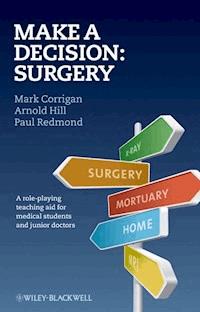
You're the general surgeon on call. It is you who has to decide every course of action over your shift. Make the right decisions or face the consequences...
Taking a role-playing approach, Make A Decision: Surgery allows you to be the book's main character - Dr A. Simpson - a junior general surgeon on call in a busy teaching hospital. Your decisions and actions determine the clinical outcomes of real patients within a number of scenarios. Each scenario branches out and unfolds as you make more decisions, but choose incorrectly and you may be sent home by your boss! Every decision you make is scored and evidence-based feedback is presented at the end of each scenario together with the correct clinical response and an explanation of what actually happened to the patient.
Blood work and radiological investigations presented in typical clinical formats allow you to practise your data interpretation skills, whilst your skills in clinical communication are tested to the full as you interact with patients and their families as well as co-members of staff.
Based on first-hand experience, the authors have selected real cases that have impacted on their practice and reflect important points of learning, making the book perfect for medical students, junior doctors, and surgery trainees who are looking for a scenario-based, interactive way to learn.
For further information and online interactive medical teaching visit www.pilgrimshospital.com
Sie lesen das E-Book in den Legimi-Apps auf:
Seitenzahl: 310
Veröffentlichungsjahr: 2011
Ähnliche


















Contents
Copyright
Acknowledgements
Introduction
How to use this book
Introduction to the staff and nomenclature of Pilgrims Hospital
Staff
Nomenclature
SECTION 1
PERSPECTIVES
Case perspectives: Karen Twentyman
Case perspectives: Sharyn Romanowska
Case perspectives: Jill Baruani
Case perspectives: Trent Goeken
Case perspectives: David Cummins
Case perspectives: Dan Schoenberger
INVESTIGATIONS
INVESTIGATIONS
SECTION 2
PERSPECTIVES
Case perspectives: Norma Nowak
Case perspectives: Marco Baldinelli
Case perspectives: Una Lordan
Case perspectives: Regina Appleton
Case perspectives: Susie Redback
INVESTIGATIONS
INVESTIGATIONS
SECTION 3
PERSPECTIVES
Case perspectives: Johnny Wasson
Case perspectives: Lizzie Thurston
Case perspectives: Elaine Cardosa
Case perspectives: Al Lopez
INVESTIGATIONS
INVESTIGATIONS
Make A Decision Online
This edition first published 2010, © 2010 by Mark Corrigan, Arnold DK Hill and HP Redmond
Blackwell Publishing was acquired by John Wiley & Sons in February 2007.
Blackwell’s publishing programme has been merged with Wiley’s global Scientific, Technical and Medical business to form Wiley-Blackwell.
Registered office: John Wiley & Sons Ltd, The Atrium, Southern Gate, Chichester, West Sussex, PO19 8SQ, UK
Editorial offices: 9600 Garsington Road, Oxford, OX4 2DQ, UK
The Atrium, Southern Gate, Chichester, West Sussex, PO19 8SQ, UK
111 River Street, Hoboken, NJ 07030-5774, USA
For details of our global editorial offices, for customer services and for information about how to apply for permission to reuse the copyright material in this book please see our website at www.wiley.com/wiley-blackwell.
The right of the author to be identified as the author of this work has been asserted in accordance with the Copyright, Designs and Patents Act 1988.
All rights reserved. No part of this publication may be reproduced, stored in a retrieval system, or transmitted, in any form or by any means, electronic, mechanical, photocopying, recording or otherwise, except as permitted by the UK Copyright, Designs and Patents Act 1988, without the prior permission of the publisher.
Wiley also publishes its books in a variety of electronic formats. Some content that appears in print may not be available in electronic books.
Designations used by companies to distinguish their products are often claimed as trademarks. All brand names and product names used in this book are trade names, service marks, trademarks or registered trademarks of their respective owners. The publisher is not associated with any product or vendor mentioned in this book. This publication is designed to provide accurate and authoritative information in regard to the subject matter covered. It is sold on the understanding that the publisher is not engaged in rendering professional services. If professional advice or other expert assistance is required, the services of a competent professional should be sought.
ISBN: 9781405196840
1 2010
This book is dedicated entirely to my wife Elaine and my son Alex, without whom simply none of what I do would be either possible, or worthwhile.
Acknowledgements
I would also like to express my debt and my gratitude to the many colleagues, friends and patients who have helped me directly and indirectly, in discussions, advice, support and in allowing me to participate in their care. In particular I would like to acknowledge the contribution of Mr. Daragh Moneley, consultant vascular surgeon, for his advice and particularly his critical appraisals.
Finally I would like acknowledge the co-authors of this book, Professors Paul Redmond and Arnold Hill for their continual encouragement, enthusiasm and mentorship.
Mark Corrigan
Introduction
Welcome to Make a Decision: Surgery. This book is designed to be a role-playing teaching aid for senior medical students and junior doctors, and represents a typical night on call or work day, in surgery. The reader takes on the role of Dr A Simpson, a junior doctor who is just starting a specialist career. Your job is to safely complete your night on call, prioritising, diagnosing and treating the patients you are referred. As sometimes happens in reality, help is not always to hand, and often you will have to make decisions armed with only the information you are given. Working in a hospital is far removed from the theory of textbooks, and this book has been designed to reflect this. Throughout the book, you will encounter characters typical of those seen in a large institution, some helpful and some not so helpful. Although core knowledge of the fundamentals is essential, hospitals are about people, primarily patients, staff and relatives. An inability to deal with people will make your clinical job impossible. Where practical, we have attempted to incorporate this into the book.
The book is divided into three sections of varying length, reflecting three breaks, or rest periods, within your shift. Before each section you will find the learning objectives expected from completing the section. Similarly, at the end of each section, you will be debriefed within the Perspectives section. This section is designed to dissect the scenarios you have completed and to incorporate evidence-based decisions into your approach. As you progress, your decisions will lead you to be awarded or deducted points - keep a score of these. At the end of the sections, and the book, you will find feedback according to the points scored. If a decision is especially dangerous, you may be ‘dismissed’ immediately. If you have been dismissed, you may restart the game at the beginning of the book or at the start of the next section.
At the end of each section you will find a short glossary of terms used. This will help explain some of the more unusual terms or disease categorisations used. Clinical experience is critical and as this book is made up of those cases which have taught us something important in our careers, we would encourage you to submit outlines of the cases that have impacted on you, along with the characters that you have encountered (good and bad) along the way. These can be submitted through the book’s website at www.pilgrimshospital.com.
We hope that you enjoy Make a Decision: Surgery, and that it gives you an opportunity to encounter some of the problems you are guaranteed to face as a junior doctor on call. While not designed in any way to be a reference text, it is hoped that it may act as a stimulus for further reading in the various topics. Please do not try and learn the facts and figures we present to you; it is this rote learning approach to medicine that we are trying to discourage. Instead, use these facts and statistics as a stimulus to question your practice and strive for making your decisions evidence based. Some of the websites and resources we have found helpful over the years are recommended at the back of the book. Good luck!
Mark Corrigan
Arnold Hill
Paul Redmond
How to use this book
1. Each paragraph is numbered.
2. Start at paragraph 001.
3. At the end of each paragraph you will be instructed to turn to a new paragraph or given a series of choices. For example ‘turn to 034’ means you should turn to paragraph number 034.
4. Depending on your choices, you are awarded or deducted points. You should keep a record of your total.
5. The book is divided into three sections.
6. When you have finished the section you will be given feedback based on your score.
7. Also, after each section there is a perspectives section which will dissect the cases you have completed, giving you the evidence for your decisions.
8. At various stages of the book you will be told to check the blood or urine reports on your patients. These will be labelled with your patient’s name and details, and are found at the end of this section in the Investigations.
9. After you have finished with Perspectives, move on to the next section of the book.
Introduction to the staff and nomenclature of Pilgrims Hospital
Staff
W. Halsted: The head surgeon
Ed Cahoon: Your senior
Mia Chang: Your intern
Nicola Pablo: Anaesthetist
Ruth Benedict: Radiologist
Margaret Hellman: Head nurse in the emergency department
Eileen, Joy, Ubeki, Caroline, Izzy: Nurses in the emergency department
Charles Winston: Your main competition in medical school and now in surgical training
Samuel Norman: The bed co-ordinator
Nomenclature
Pilgrims Hospital is a truly international institution and is not meant to reflect any particular country. However, the nature of medicine and surgery is that different countries and hospitals will have different terms for procedures, grades of staff, work practices, etc. To help with this, we have included a list of exchangeable nomenclature. If we have missed some you'll have to forgive us and let us know what they are.
The head surgeon: consultant, attending
Your senior (Ed Cahoon): registrar, resident
Intern: Foundation house officer, Foundation doctor, junior house officer
Emergency department: emergency room, accident and emergency, casualty
Head nurse: clinical nurse manager, sister, charge nurse
Medical school: university, college
Prescribe: chart
TDS: TID, three times daily
Rectal examination: digital rectal examination, DRE, PR examination
Round: ward round
SECTION 1
What you’re going to learn
After this section you should be able to prioritise surgical patients in the setting of a busy accident and emergency department. Patients should be triaged according to threat to life, limb or organ, with those patients at highest risk treated first.
What you might also learn
Following completion of this section, you will be capable of performing the following in an evidence-based fashion.
Using analgesia in the acute abdomen.Investigating and imaging the acute abdomen.Consider the conservative and operative management of the acuteabdomen, including laparoscopic and open approaches.Adapt a sequential approach to trauma.Understanding and managing hypovolaemic shock and fluid resuscitation.Controlling simple postoperative bleeding.Managing superficial tissue infections.Now, before you start, make sure you have read the background and the instructions.
16.40 SHIFT STARTS
It has been almost 3 months since the job offer arrived. The interview was tough – those old guys know how to hit you with some awkward questions – but you impressed them enough to get your first choice of hospital and your second choice of job. Pilgrims was one of the best surgical hospitals in the country, but recent cutbacks in government spending have hit even the biggest of institutions. You’ve just finished your first year after medical school and now your first rotation on the training scheme is with a busy general surgical firm and you are eager to impress. Your initial excitement was somewhat dampened upon hearing that Winston had received an identical offer. You competed neck and neck with Charles Winston through medical school but he narrowly beat you to first place in your final exams. You had hoped to put his smug face behind you, but now you will both be on the same training scheme, competing neck and neck once again. Only 8 hours into the job, you are faced with your first night on call. Your senior doctor, Ed Cahoon, will be on call with you along with the head surgeon W. Halsted. Cahoon is in theatre with a difficult case that started several hours ago and you will have to face the start of your shift alone. Cahoon has a mean reputation, but nothing is going to dampen your enthusiasm for your first night on the job.
001
It’s 5pm and your bleep goes off. Quickly finishing your dinner, you walk down the narrow corridor, passing the intensive care unit and the theatres and into the emergency department. Outside the main entrance, a stream of people queue to be seen and your heart races. The door to triage opens and you catch the eye of the triage nurse, surrounded by charts. Her face widens, the smile having no warmth. ‘You’re going to bebusy tonight,’ she grins. Suddenly that skip in your step disappears and the automatic doors slide open to reveal the chaos behind them. You take a deep breath and roll up your sleeves before reaching for the two charts in the surgical slot.
I. A 14-year-old girl with vomiting and low abdominal pain → 012
II. A 35-year-old man with cellulitis → 092
002
You rightly choose the most potential serious case, add 1 point.
Sharyn Romanowska, a 62-year-old lady with chronic inflammatory bowel disease, cardiac disease and COPD, presents with sudden onset of epigastric pain. In her past surgical history she has had a right hemicolectomy, open cholecystectomy and a small bowel resection for Crohn’s disease more than 10 years ago. Her pulse is 130 and her BP 92/72. Sharyn’s bloods are found in the Investigations at the end of this section. Currently she is sobbing with pain, lying absolutely still on the bed. Her elderly husband stands nervously in the corner of the resus room, insisting to you that it was the chicken she ate last night. ‘I told her not to eat it, I told her’. Do you:
I. Examine her → 038
II. Get more of a history → 033
III. Administer analgesia → 032
IV. Order four units of blood urgently → 105
V. Insert a second IV line → 053
VI. Give more IV fluids → 011
VII. Go to theatre for an exploratory laparotomy → 069
VIII. Group and save her blood type for future possible blood cross-matching → 165
003
You administer the prochlorperazine and within a short while she settles back. She tells you she has only a dull ache around her belly button. She has no urinary or bowel symptoms and this has never happened before.
I. If you want to take a further history → 065
II. If you want to examine her → 008
III. If you want to look at her investigation results → 118
IV. If you want to order radiological tests → 136
004
You administer the cyclizine and within a short while she settles back. She tells you she has only a dull ache around her belly button. She has no urinary or bowel symptoms and this has never happened before.
I. If you want to take a further history → 065
II. If you want to examine her → 008
III. If you want to look at her investigation results → 118
IV. If you want to order radiological tests → 136
005
It’s a good idea to examine the patient where possible, before starting treatment. However, in this case your diagnosis is right. The man’s urine output is reduced, his CVP is down, his urinary specific gravity is increased, his HCT is increased and his urea is increased with a normal creatinine. The picture is that of dehydration. You give him a fluid challenge of 500 ml over 30 minutes and his pulse slows to 88, BP rises to 134/76, urine climbs to 30 ml and CVP rises to 6. Give yourself 1 point. Do you:
I. Recheck in 1 hour → 058
II. Check again in the morning → 120
006
You get to the ward and see a relieved Mia holding the lady’s leg at the end of the bed. Add 1 point. Her pulse is now 78 and her BP is 126/76.
Mia tells you she had stripping of her long saphenous vein earlier today with stab avulsion of her varicosities. She takes her hand away and you see slow ooze from one of the stab avulsion sites on her calf. The staff nurse tells you that they have not needed to change the dressing until now. The dressings appear to have soaked up about 20 ml of blood. Do you:
I. Take over from Mia and ask the nurses to call Cahoon → 084
II. Take over from the intern, raise the leg in the air and apply a compression dressing → 086
III. Get the intern to continue, raise the leg in the air and place a stitchat the avulsion site → 139
IV. Apply a tourniquet proximal to the bleeding point → 148
007
The plain film of the abdomen is normal. Deduct 1 point.
I. If you want a chest x-ray → 036
II. If you want an ultrasound abdomen → 031
III. If you want a CT abdomen → 112
008
You lay the girl down flat for examination.
I. If you want to tell her mother to stay and carry on examining her →051
II. If you want to tell her mother to leave and then examine her alone → 154
III. If you want to ask her mother to leave and then bring in a nurse chaperone before examining her → 115
009
You try to perform a laparoscopy but there are dense adhesions secondary to her two previous laparotomies and previously active Crohn’s disease. You change to an open laparotomy and discover the bile-stained fluid of a perforated duodenum. You close this with an omental patch and the lady is returned to the ICU. Two days later she is transferred from the ICU to the ward and she eventually makes a full recovery. Well done, add 1 point.
Return to the surgical slot →067
010
The lady is diffusely tender with generalised guarding and rebound. Bowel sounds are absent and she is clammy to the touch. Her tongue is dry, fissured and cracked. Margaret is standing beside you and can’t believe you’re not going to theatre straight away. Do you next:
I. Get more of a history → 099
II. Administer morphine → 075
III. Get radiology → 060
IV. Go to theatre for an exploratory laparotomy → 069
011
Recognising that the lady is profoundly dehydrated, you administer IV fluids and insert a urinary catheter to monitor her output hourly. Within 30 minutes her pulse has slowed to 96 and her blood pressure has improved to 100/64. Add 1 point. Do you next:
I. Examine her → 010
II. Get more of a history → 099
III. Administer morphine → 075
IV. Get radiology → 060
V. Go to theatre for an exploratory laparotomy → 089
012
You obviously prioritise your patients and she is the more likely to need surgery; add 1 point. You flick quickly through the girl’s chart. Karen Twentyman is a 14-year-old girl with no medical history of note. Three days ago she developed mild suprapubic pain with associated nausea and vomiting. The triage nurse has sent off a urine sample for culture. You pull back the curtain and a stocky girl in a school uniform is vomiting into a kidney dish. Her mother rubs her back and looks up as you enter. Eileen, the nurse looking after her, asks you to prescribe an antiemetic in order to make the girl more comfortable.
I. If you want to give her prochlorperazine → 003
II. If you want to give her cyclizine → 004
III. If you want to give her ondansetron → 079
IV. If you want to hold off the antiemetics and try to elicit a history first → 029
013
She tells you that the patient has deteriorated and needs to be seen. Do you:
I. Tell her you’ll see her after you’re finished with this patient → 028
II. Go and see for yourself → 077
014
The lady is diffusely tender with generalised guarding and rebound. Bowel sounds are absent and she is clammy to touch. Her tongue is dry, fissured and cracked. Do you:
I. Get more of a history → 057
II. Order four units of blood urgently→105
III. Insert a second IV line → 053
IV. Give more IV fluids → 011
015
Cahoon becomes irritated at the argument. He tells you to take another case and to stop wasting his time. Deduct 1 point.
→037
016
Your hospital does not routinely check serum beta HCG and you must wait for another urine sample which takes another 20 minutes. It returns as positive. Add 1 point.
I. If you want to ask Eileen to tell the mother → 061
II. If you want to tell the girl → 062
III. If you want to tell the mother → 019
IV. If you want to ask Eileen to tell the girl → 061
017
The haematologist contacts Cahoon to complain about the potential waste of four precious units of blood. He asks ‘What the hell were you playing at, Simpson?’ and looks after the women from here on in. He tells you he will speak to Halsted in the morning. Deduct 1 point.
I. If you want to argue the case → 043
II. If you want to check the slot for more cases → 067
018
The girl agrees to this and you stay while she tells her mother herself. Her mother is shocked but you are surprised how supportive she is. Both seem grateful for your help and you link them up with an obstetrician to perform an ultrasound that confirms the pregnancy and helps with further planning. Pleased with yourself, you walk over to the charts. Add 2 points.
→037
019
The girl starts to cry uncontrollably and Eileen asks you to leave, complaining to her superior that you have upset the patient. Margaret calls in Cahoon who is currently having his supper and explains the situation. He asks ‘What the hell were you playing at, Simpson?’ and looks after the girl from here on in. He tells you he will speak to Halsted in the morning.
Deduct 1 point.
I. If you want to argue the case → 042
II. If you want to check the slot for more cases → 037
020
Cahoon can’t take it any more. He says ‘Give me your bleep and go home, I’ll get Winston to finish off’. Your shift is over.
021
Her mother overhears and refuses to allow you to perform a DRE exam, demanding to know what possible reason there is for such a procedure. She has lost all confidence in you and refuses to allow you to treat her daughter. Margaret Hellman, the head nurse, is called over and tries to defuse the situation. She calls in Cahoon who is currently having his supper and explains the situation. He asks ‘What the hell were you playing at, Simpson? I’ll look after the girl from here on in’. He tells you he will speak to Halsted in the morning.
I. If you want to argue the case → 042
II. If you want to check the slot for more cases → 037
022
As you are flicking through the charts in the slot, the girl’s mother storms out from behind the curtain and starts to scream at you for leaving her daughter alone in that state. You try to reason but she is hysterical and needs somebody to blame. Margaret Hellman is called over and tries to defuse the situation. She calls Cahoon who is currently having his supper and explains the situation. He asks ‘What the hell were you playing at, Simpson?’ and looks after the girl from here on in. He tells you he will speak to Halsted in the morning. Deduct 1 point.
I. If you want to argue the case → 042
II. If you want to check the slot for more cases → 037
023
Speaking softly and calmly, you tell her that everything will be fine and that you will find out why she is ill. She looks up at you and with her mother gone, whispers that she has had unprotected sex with her boyfriend several times over the past 3 months. She has not had a period for 8 weeks now. Add 1 point.
I. If you want to order an immediate pregnancy test → 016
II. If you want to perform a DRE exam → 021
III. If you want to tell her that you must bring her mother in and explain → 155
IV. If you want to leave and check investigations → 118
V. If you want to leave and order radiology tests → 136
024
Deduct 1 point. Will you give a course of antibiotics after draining the abscess?
I. Yes → 164
II. No → 027
025
Pleased with yourself, you begin to flick through the charts again. However, when the girl returns 2 days later with further vomiting, your rival Winston is on call and the first thing he does is order a pregnancy test which is positive. Winston takes great pleasure in sending you a copy. Deduct 1 point.
→037
026
You administer the diclofenac but the pain diminishes very little and she is still unable to give a history. Furthermore, the NSAID intensifies the damage to her kidneys over the next 2 days and she will require dialysis for renal impairment. Deduct 1 point. Margaret is standing beside you and can’t believe you’re not going to theatre straight away. Do you now:
I. Examine her → 038
II. Order four units of blood urgently → 105
III. Insert a second IV line → 053
IV. Give more IV fluids → 011
V. Get radiology → 060
VI. Go to theatre for an exploratory laparotomy → 069
027
Antibiotics have no benefit in the immunocompentent patient after the abscess has drained; add 1 point. Conscious that Cahoon does not like to sit through unnecessary outpatients, will you:
I. Discharge him → 047
II. Bring him back in 3 weeks → 082
028
She calls in Cahoon who is currently having his supper and explains the situation. He asks ‘What the hell were you playing at, Simpson?’ and looks after the woman from here on in. He tells you he will speak to Halsted in the morning. Deduct 1 point.
I. If you want to argue the case → 043
II. If you want to check the slot for more cases → 067
029
The girl vomits again but settles enough to answer your questions. Her mother becomes agitated that you don’t seem to be doing anything, and asks Margaret if there is anybody more senior or older available.
I. If you want to ask the mother to leave the room → 154
II. If you want to give her prochlorperazine → 003
III. If you want to give her cyclizine → 004
IV. If you want to give her ondansetron straight away → 079
V. If you want to tell the mother that it is important that you get anidea of what is going on before you treat → 065
030
You are wise to try to prioritise; add 1 point. The vital signs of all four patients are below:
I. Cellulitis: pulse 76, BP 126/82, Temp 37.7 → 110
II. Abdominal pain: pulse 102, BP 90/76, Temp 37.2 → 002
031
The ultrasound demonstrates a heartbeat and intrauterine pregnancy. Quickly you realise what you have done by ordering the x-rays without checking her pregnancy status. Margaret calls Cahoon in, who is currently having his supper, and explains the situation. He asks ‘What the hell were you playing at, Simpson? Give me your bleep and go home, I’ll get Winston to finish your shift and I’ll talk to Halsted in the morning’. Your shift is over.
032
What would you like to give?
I. Morphine IV → 049
II. Diclofenac PR → 026
III. Paracetamol/acetaminophen PR → 039
033
You try talking to the lady but she is too uncomfortable. Deduct 1 point. Margaret is standing beside you and still can’t believe you’re not going to theatre straight away. Will you:
I. Examine her → 038
II. Administer analgesia → 032
III. Order four units of blood urgently → 105
IV. Insert a second IV line → 053
V. Give more IV fluids → 011
VI. Go to theatre for an exploratory laparotomy → 069
034
You start him on his intravenous antibiotics and on the morning ward round Cahoon asks why on earth this man still has a rip-roaring abscess on the side of his neck. ‘My God, man, he needs an incision and drainage. Where’sWinston? I’ll get him to do it.’ Deduct 1 point.
→050
035
You flick through her chart again, conscious that more surgical charts are mounting up.
I. If you want to repeat her labs → 124
II. If you want to order a pregnancy test → 016
III. If you want to discharge her with clear instructions to return if hersymptoms progress → 025
036
The chest x-ray is normal. Deduct 1 point.
I. If you want an ultrasound abdomen → 031
II. If you want a CT abdomen → 112
037
There are now two charts in the surgical slot.
I. To see a 35-year-old man with cellulitis → 040
II. To see a 62-year-old lady with diffuse abdominal pain → 002
III. For more information regarding all cases before you decide → 030
038
The lady is diffusely tender with generalised guarding and rebound. Bowel sounds are absent and she is clammy to touch. Her tongue is dry, fissured and cracked.
I. Get more of a history → 057
II. Administer analgesia → 032
III. Order four units of blood urgently → 105
IV. Insert a second IV line → 053
V. Give more IV fluids → 011
039
Margaret stares at you incredulously as you give PR paracetamol/ acetaminophen alone as analgesia for this patient with peritonism and who is crying with pain. Margaret calls in Cahoon, who is currently having his supper, and explains the situation. He asks ‘What the hell were you playing at, Simpson?’ and looks after the woman from here on in. He tells you he will speak to Halsted in the morning. Deduct 1 point.
I. If you want to argue the case → 077
II. If you want to check the slot for more cases → 067
040
You pull back the curtain and see a man with a red swollen foot. Just as you are about to introduce yourself, Margaret puts her head around the curtain and asks you to see the lady with epigastric pain. Do you:
I. Tell her who the doctor is around here → 028
II. Apologise to the gentleman and go and see the other patient → 044
041
The girl stops crying and seems comforted by this. She asks what she will tell her mother and you suggest she could explain everything by saying it was a stomach bug. She hugs you in gratitude and you walk away feeling that you have done a good job. Four weeks from now, Halsted will hear from the girl’s mother and her legal representative complaining that her 14-yearold daughter was provided with no follow-up or support. Right now, you feel top of the world and check the charts in your slot. Deduct 1 point.
→037
042
Cahoon asks how you could have qualified from medical school. He takes your bleep from you and tells you to go home; he will finish the on call on his own. Tomorrow he will speak to Halsted about your behaviour. Your shift is now over.
043
Cahoon asks how you could have qualified from medical school. He takes your bleep from you and tells you to go home; he will finish the on call on his own. Winston can take over tomorrow and he will speak to Halsted about your behaviour. Your shift is over.
044
Sharyn Romanowska is a 62-year-old lady with chronic inflammatory bowel disease, cardiac disease and COPD, who presents with sudden onset of epigastric pain. In her past surgical history she has had a right hemicolectomy and small bowel resection for Crohn’s disease more than 10 years ago. Her pulse is 130 and her BP 92/72. Sharyn Romanowska’s blood reports can be found in the Investigations at the end of this section. Currently she is sobbing with pain, lying absolutely still on the bed. Margaret is standing beside you and can’t believe you’re not going to theatre straight away. Do you:
I. Examine her → 038
II. Get more of a history → 033
III. Administer analgesia → 032
IV. Order four units of blood urgently → 105
V. Insert a second IV line → 053
VI. Give more IV fluids → 011
VII. Go to theatre for an exploratory laparotomy → 069
045
Do you ask for:
I. An ultrasound → 129
II. A CT → 158
046
Knowing that a large percentage of laparotomies for penetrating trauma are negative, you decide to keep a close eye on the patient. Over the next 40 minutes he complains of more pain around his abdomen and requires more analgesia. He now has a tachycardia of 124. What will you do?
I. Schedule theatre → 130
II. Increase the analgesia and continue to observe → 131
047
Two months later Winston is on call and the man returns with another infected sebaceous cyst. Although you performed an incision and drainage, the underlying cyst still remained and has caused further problems. When the man asks why he keeps getting this problem, Winston takes great pleasure in telling him that it is because the first doctor failed to follow up and deal with the cyst. Deduct 1 point.
→050
048
You try to perform a laparoscopy but there are dense adhesions secondary to her two previous laparotomies and previously active Crohn’s disease. You change to an open laparotomy and discover the bile-stained fluid of a perforated duodenum. You close this with an omental patch and the lady is returned to the ICU. Two days later she is transferred from the ICU to the ward and she eventually makes a full recovery. Well done, add 1 point. Return to the surgical slot.
→067
049
You administer intravenous morphine and the lady’s already low blood pressure falls a little but you respond by increasing her fluids.
→075
050
You return to the triage slot to find two more charts. Just as you pick them up, a nurse grabs you by the arm, saying ‘Hurry, we need you in the resuscitation room’. Your heart quickens as you follow her, feeling important as the people in the department stand out of your way.
→090
051
You press firmly around her abdomen but she has no tenderness and no significant findings.
I. If you want to perform a DRE exam → 021
II. If you want to check her investigations → 118
III. If you want to order radiology tests → 136
052
You hang up and decide what to do next.
I. Examine her → 106
II. Administer analgesia → 032
III. Insert a second IV line → 053
IV. Give more IV fluids → 011
V. Go to theatre for an exploratory laparotomy → 069
053
You insert a second IV line to help with your resuscitation. Add 1 point. Margaret, the head nurse, still wants to know why this patient hasn’t gone to theatre yet. Do you next:
I. Examine her → 150
II. Administer analgesia → 032
III. Give more IV fluids → 011
IV. Go to theatre for an exploratory laparotomy → 069
054
You go and see the girl who now sounds like a priority. You flick quickly through her chart. Karen Twentyman is a 14-year-old girl with no medical history of note. Three days ago she developed mild suprapubic pain with associated nausea and vomiting. The triage nurse has sent off a urine sample for culture. You pull back the curtain and a stocky girl in a school uniform is vomiting into a kidney dish. Her mother rubs her back and looks up as you enter. Eileen, the nurse looking after her, asks you to prescribe an antiemetic in order to make the girl more comfortable.
I. If you want to give her prochlorperazine → 003
II. If you want to give her cyclizine → 004
III. If you want to give her ondansetron → 079
IV. If you want to hold off the antiemetics and try to elicit a history first → 029
055
Rightly, you start with a good history. Add 1 point. He tells you that his GP put him on co-amoxyclav 3 days ago, but the lump has become more painful. You find a 2 × 2 cm tender, fluctuant mass on the right side of his neck, in keeping with an infected sebaceous cyst.
Trent Goeken.
Will you:
I. Change him to 500 mg flucloxacillin PO, three times daily → 059
II. Admit him for IV flucloxacillin and benzylpenicillin → 034
III. Perform incision and drainage of the abscess → 066
056
You tell Ruth that the girl is tachycardic and peritonitic and will need to go to theatre tonight. Reluctantly she agrees to your request. However, before performing the CT she orders a pregnancy test which is positive. She then examines the patient and realises you have lied. In a fury, she calls Cahoon, who is currently having his supper, and explains the situation. ‘What the hell were you playing at, Simpson? Give me your bleepand go home, I’ll get Winston to finish your shift and I’ll talk to Halsted in the morning,’ he tells you. Your shift is over.
057
You try talking to the lady but she is too uncomfortable. Deduct 1point. Meanwhile Margaret cannot understand why the patient has not gone to theatre yet.
I. Administer analgesia → 032
II. Order four units of blood urgently → 105
III. Insert a second IV line → 053
IV. Give more IV fluids → 011
V. Go to theatre for an exploratory laparotomy → 069
058
This is exactly what to do. Both Dan’s CVP and urine output remain stable since his fluid challenge. You maintain his fluids and he comes down on his inotropes. Well done. Give yourself 2 points and
→156.
059




