


Erhalten Sie Zugang zu diesem und mehr als 300000 Büchern ab EUR 5,99 monatlich.
- Herausgeber: The Crowood Press
- Kategorie: Geisteswissenschaft
- Sprache: Englisch
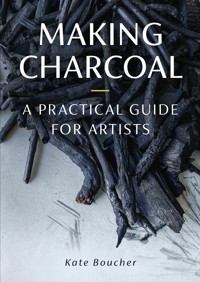
This practical book explains how to make charcoal using the simplest processes. Once understood, it encourages artists to experiment with the technique and to enjoy its unpredictable results. A sister title to Drawing with Charcoal, it will inspire artists and makers to look further into this sustainable material and to embrace its exciting potential.
Sie lesen das E-Book in den Legimi-Apps auf:
Seitenzahl: 124
Veröffentlichungsjahr: 2024
Das E-Book (TTS) können Sie hören im Abo „Legimi Premium” in Legimi-Apps auf:
Ähnliche



















CONTENTS
Introduction
1Why Make Your Own Charcoal?
2What Do You Need To Know?
3How Do I Do It?
4How Do I Use It?
5How Else Can I Use It?
6Who Uses It?
Index
Artist Contributors
INTRODUCTION
This book isn’t intended to be a bible of charcoal making: instead it aims to show you some of the simplest processes with which you can make small batches of charcoal to make art with. I’m not a professional charcoal burner, I am a professional artist who works with charcoal, so my interests lie in the mark-making qualities of the charcoal, rather than how well it will cook my food (although it does do that excellently too!). There will be some experimental techniques, some discoveries of unexpected things that will make interesting charcoal. There will also always be an encouragement to experiment, within the scaffolding of safe practices and the basic understanding of how charcoal is made. I will be making charcoal with the organic materials I have available to me where I live in North Wales, UK.
Homemade, mixed species charcoal on my studio table, ready to draw with.
You may have different plants available to you, and some will be known to be used in charcoal production where you live, and some will be those in your surrounding landscape that you decide to experiment with. I can’t promise that every batch will work, or even that every batch of the same plant, using the same method, will turn out the same! There are a lot of variables at play, such as moisture content, density of the material, temperature of the fire, even wind direction and air temperature (professional charcoal burners are so skilled), but if you approach making your own charcoal with an open and experimental mindset, you’ll enjoy the process and the results – even if they are not quite what you expected.
This charcoal daffodil is too fragile to draw with and really a bit too beautiful, although it is robust enough to handle and does make marks on paper. Later in the book I’ll explain how to bake them and grind them up into a fine powder to make ink, paint or charcoal pastels – ‘daffodil charcoal pastel’ does have a nice ring to it, doesn’t it!
These are bones from cooked lamb chops. They were an experiment, a ‘what if...’. They were wrapped in foil at the end of the meal and put on the embers of the log burner. While they turned out to be too hard to draw with, they are very beautiful in and of themselves. They will find their way into a sculpture at some point. They’ll sit on my mantlepiece for now.
It’s not only wood that can be charred, but any organic material. When I say ‘organic’ here I mean something derived from living materials, not something grown without pesticides. Not all these materials are entirely suitable for drawing with, as some can be too fragile or too hard. Those qualities can make them just right for sculpture, or making paint. But all of them will have a beauty to them as objects in and of themselves.
What we are going to be investigating in this book are ways to bake all sorts of organic materials, with reduced oxygen (pyrolyze) to create charcoal that you can use as an artist, whether that’s to make marks with, or in some other way. We’ll also look at some of the regulations you need to bear in mind when you’re gathering plants other than in your own garden.
Arguably, charcoal is one of the earliest drawing materials. You can imagine moving pieces of charcoal that remained in the ash of a fire gone cold, and noticing that it made marks on your fingers and wondering what else it would make marks on. It has always been a readily available drawing material. In some way whenever I use charcoal to draw with, there is a sense of continuity, or immediacy to using such a simple and yet versatile drawing media, and an extra little joy when I’ve made it myself.
I first became interested in the possibilities of making my own charcoal in 2018, when I attended an annual charcoal-making festival. It’s traditionally held on 11 August in various places in the UK; this one was in West Sussex on the south coast of England. You can see, from left to right, an earth-burn, a ring kiln and a retort – though all of these make somewhat larger amounts than we’ll be making in this book!
I’ve been drawing with charcoal as my primary media for several years now, and I’m lucky enough to have got to know some very skilled charcoal burners in recent times, who have been willing to answer my many, many questions, and to experiment to find interesting organic materials to make drawing charcoal from.
beating the bounds, series, no. 25, Kate Boucher. I use all sorts and types of charcoal in my work. They each have qualities that I can exploit or avoid, helping me to draw the different tones and lines of the landscape in the photographic source image I’m working from. There are at least four different types of plant here, including bramble (Rubus fruticosus), hazel (Corylus avellana), birch (Betula) and field maple (Acer campestre).
Monsters by Ben Boucher. This isn’t in any way a book aimed at children, but I’ve seen such positive effects on them when they get involved in making their own drawing materials. We gathered the wood on a little walk through the woods, made charcoal with it, and then used it to draw monsters, his current obsession. He keeps this charcoal in a ‘special drawing tin’.
Many of the example drawings that I’ll show you in this book will be landscape based because that’s my practice, but this doesn’t mean this book is about drawing landscape, or that you must use charcoal in the same way as I do. What you draw, paint or sculpt with your homemade charcoal is up to you! There’ll be examples of other artists’ work included, to show a range of experiences, styles and subject matter.
Issues of safety will be addressed, including appropriate equipment, considerations of where and how you make a fire, and always about being prepared and thinking through the processes with care and common sense, before beginning.
CHAPTER 1
WHY MAKE YOUR OWN CHARCOAL?
Icould argue that there are many reasons to make your own charcoal: it’s inexpensive and sustainable, most of the materials are gathered for free, it needs only a few simple pieces of equipment, and it makes interesting and varied marks. The artist William Kendrick, when speaking about his use of charcoal, said:
A lot of artists in South Africa did drawing because it was cheap. You could find a scrap of paper and a ball-point pen, or a piece of charcoal and you could be an artist. You didn’t need an easel and stretchers and canvas and turpentine and expensive oil paint.
In addition to all this it can also give a sense of direct connection to the medium you’re using to make art with, because it’s in your hand – no mediation of the brush. Also, there’s a connection to the land that the charcoal came from, and the drawings that you’ll make from it. There is definitely something wonderful, and hard to define in the feelings you get when you open that tin and see charcoal you’ve made, and then the marks that that charcoal makes on paper.
Detail of a charcoal drawing on paper by Kate Boucher, with a piece of bramble (Rubus fruticosus) charcoal.
QUALITY CONTROL AND COURTING THE ACCIDENTAL
When I say ‘control’, I use the term loosely because one of the most interesting things about making your own charcoal to draw with, is the element of surprise inherent in using small-scale production methods and natural gathered materials with all their beautiful imperfections and quirky characteristics. But what you do have control of, is what materials to use, and what qualities these may give you in your drawings. You may not always get precisely the same result from the same method or plant, but you will always get something interesting.
In your work, this non-uniformity can be really exciting as you respond to the variability – a sort of collaboration with the material. The more charcoal you make, the more you will quickly develop the knowledge and skills needed to make more consistent batches of charcoal, especially if you use a limited range of plant material to start with, and test how best to char it to have the quality you want. I often find, though, that as I get more proficient, I like to push the process in some way, make it a little more difficult, or court the accidental to bring that element of surprise into the charcoal, and in turn, into my drawings.
Rotating this piece of charcoal shows how many different drawing ‘tools’ might be found from its facets. This piece, from a recent batch of common hazel (Corylus avellana), has an uneven surface with different parts of the wood exposed. The bark and core might give soft, velvety, light-toned or dense marks. Some areas will rub away easily, and others will grip the paper more, some have brown undertones, some very black ones.
On some species where the bark has been left on, the charcoal may be quite scratchy, which leaves beautiful etched-style grooves in the paper when you blend the loose powder in. You may not always want a scratchy mark though, which is why I test each piece in my sketchbook before using it on a drawing. You then have choices as to which facet (or piece) to use, or which to avoid.
beating the bounds, no.24 and no.27 by Kate Boucher. I use many different types of charcoal in my work, exploiting their qualities to render different elements in the photographs I’m working from. There are at least four types of plant in these two drawings, including bramble, hazel, birch and field maple. I’ve used bramble outer skin to make bold lines but scratchy marks, and birch over the top, which is very soft and smooth, sitting in the grooves made by the bramble.
The ground and tree were made using the piece of charcoal tested on the sketchbook page. The piece was turned, to find soft parts for smooth velvety marks, hard edges for linear marks, and scratchy areas to give texture. Just as you would select a different brush for the marks it will make, so you can select facets of a single piece of charcoal, or by selecting different pieces or species.
A work-in-progress by Benjamin Murphy: ‘I’m making the charcoal on a remote island in the middle of Finland’s largest lake. Silver birch is abundant but it’s not really the ideal wood for drawing charcoal, so I’m experimenting with different burn temperatures and durations to try and improve the quality. Currently it’s either too brittle or too shiny, and so the process of trial-and-error experimentation feels very much a part of the work as the drawing that will be the result of it.’
Benjamin Murphy’s birch charcoal being made in a metal tin ‘retort’. ‘It’s a slow and steady process, but it makes me feel much more connected to the work than when I use materials I had no hand in producing. The plan is also to make paper from the birch bark, and make artworks that are both of and from the island, and I look forward to getting started on that part of the process once I’ve perfected the charcoal.’
Benjamin Murphy, a visual artist and writer based between London and Helsinki, works with natural charcoal on raw canvas. He has moved from using commercially made willow and compressed charcoal to making his own from the silver birch (Betula pendula) that surrounds him on Lake Saimaa.
QUALITIES OF COLOUR AND TONE, AND EASE OF ERASING
When you use different types of plant material to make your own charcoal, you’ll begin to see how different they are from each other when you draw with them. Willow (Salix viminalis), the traditional wood for artist’s charcoal (and willow weaving), is a black with a silvery note, and can have a slight warm brown tone when blended. Alder (Alnus glutinosa) also has a silvery black tone and very fine texture. In fact, alder used to be used in gunpowder because it can be ground down so finely. Ivy has a little blueness to the colour, and can be scratchy and a little brittle. It has less scratchiness when you use dead rather than dried wood. Grape vine (Vitis vinifera) gives a rich black to dark grey. Older knuckles of vine can have their bark left on as this turns very soft and very black, almost like fine soft pastel. Raspberry canes (Rubus idaeus) have a brownish tone, and are very crumbly; they are good for adding large areas of tone. Thick blackberry stems (Rubus fruticosus) have a hard outer skin that gives fine black lines and an inner soft, powdery core that’s a light blown black.
These thick stems of blackberry (Rubus fruticosus) have dual qualities: the hard outer skin makes beautiful thin, crisp black lines that are hard to erase, which can allow the marks to stay visible as you build layers of marks. The inner core is light and powdery, with a rich brown tone that sits on the surface and can be brushed away and erased easily. These stems were charcoaled when still green and freshly cut.
This drawing, shown in sections, has been made with scratchy pieces of common ivy (Hedera) to create a foreground under-drawing of directional marks; soft, black grapevine (Vitis vinifera) bark for the flat, dark-toned areas layered on top; and small willow (Salix viminalis) sticks to add details. I’ve used a pure rubber eraser across the foreground and to add highlights: the variation in how it has erased is dependent on the type of charcoal it runs through, or lifts off.
though wishing slanting, no. 42, Kate Boucher. Hot press paper. The different woods used here, and the methods of pyrolyzing them, give slight variations in the colour, texture and tone. Some I’ve used for their fine hard edges that don’t erase easily, and some for their very black crumbliness, especially on the final layer to add texture. A drawing of a mixed wood, drawn with mixed woods!
All these species will erase differently, blend differently, and respond to paper surfaces differently. What you’ll be building as you make your own charcoal is a toolbox of variety, of non-uniform mark-making possibilities.
Sometimes the pieces of charcoal I make are so beautiful that they become like little sculptures. I’ve many pieces of interesting charcoal ‘too nice to use’, sitting on shelves around my house! They have also become plinths or components in sculptural work.




