


19,99 €
Mehr erfahren.
- Herausgeber: John Wiley & Sons
- Kategorie: Fachliteratur
- Sprache: Englisch
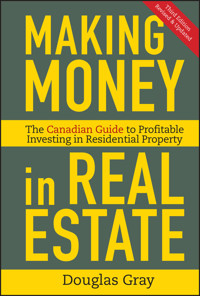
Successful real estate investments play an essential role in Canadian investors' portfolios. The growth in wealth in real estate markets has presented investors with tremendous opportunities to capitalize on and expand their range of investments, and has moved real estate investing from a niche product to a pillar of smart portfolio diversification. In Making Money in Real Estate, 2nd Edition, Douglas Gray demystifies the Canadian real estate market for novice investors and presents new strategies for veteran investors. Learn to:
- Understand the real estate market cycles
- Find a property and assess its investment potential
- Build a trustworthy real estate team
- Arrange financing on good terms
- Use negotiating tactics that work
- Understand tax and legal issues
- Manage a property
- Avoid the pitfalls that many investors fall into
- Examine the pros and cons of non-residential property investment options
Readers of previous editions will appreciate the vital changes to mortgage rules, taxation and legislation, and the inclusion of information on commercial real estate. Thorough coverage in plain English makes Making Money in Real Estate, 2nd Edition the next logical step for investors who want to begin or expand their real estate portfolios, and is a critical and indispensable tool in investment decision making.
Sie lesen das E-Book in den Legimi-Apps auf:
Seitenzahl: 635
Veröffentlichungsjahr: 2012
Ähnliche

















Contents
Cover
Praise for Books by Douglas Gray
Title Page
Copyright
Books by Douglas Gray
Preface
Acknowledgments
Chapter 1: Understanding Real Estate Investment
Why Consider Investing in Real Estate?
Understanding the Real Estate Market
Establishing Your Investment Strategies
Key Investment Strategies to Consider
Buying with Partners
Summary
Chapter 2: Types of Residential Real Estate
Condominium
Single-Family House
Property for Renovation
Recreational Property
Multi-unit Dwelling
Apartment Building
Raw Land
Summary
Chapter 3: Finding and Evaluating the Right Property
What to Consider When Selecting a Property
Where to Find a Property for Sale
Determining the Value of the Property
Summary
Chapter 4: Selecting Your Advisory Team
Common Selection Criteria
Selecting a Realtor
Selecting a Lawyer
Selecting an Accountant
Selecting a Lender
Selecting a Financial Planner
Selecting a Mortgage Broker
Selecting a Building or Home Inspector
Selecting an Insurance Broker
Summary
Chapter 5: Understanding the Financing Aspects
What Is a Mortgage?
Types of Mortgages
Sources of Mortgages
Key Factors to Consider When Selecting a Mortgage
General Contents of a Mortgage
Determining the Amount of Mortgage Available
Applying for a Mortgage
Cost of Obtaining a Mortgage
Defaulting on Your Mortgage
Creative Financing
Dealing with Negative Cash Flow
Summary
Chapter 6: Understanding the Legal Aspects
Types of Ownership of Property
Understanding the Purchase-and-Sale Agreement
Services Provided by the Purchaser's Lawyer
Services Provided by the Vendor's Lawyer
The Listing Agreement
Forms of Legal Structure to Hold Investment Property
Other Legal Cautions and Protections to Consider
Summary
Chapter 7: Understanding the Tax Aspects
Local and Regional Taxes
Provincial Taxes
Federal Taxes
Income Tax
Tax Implications of the Purchase Structure When Buying an Apartment Building
Summary
Chapter 8: Understanding the Insurance Aspects
Organizing Your Insurance Program
Types of Property Coverage
Types of General Insurance
Summary
Chapter 9: Buying Your Property
Selecting the Right Real Estate Agent
Determining a Property's Value
Preparing the Offer
Presenting the Offer
Giving a Deposit
Making a Deal
Using a Lawyer
Insuring Gain
Closing the Deal
Summary
Chapter 10: Managing Your Property
Types of Management
Keeping Records
Finding the Right Tenant
Maintaining Rental Properties
Avoiding Common Fire Hazards
Improving the Bottom Line
Saving on Expenses
Summary
Chapter 11: Selling Your Property
Determining When to Sell
Determining How to Sell
Preparing to Sell
Preparing the Property
Closing the Sale
Moving On
Summary
Chapter 12: Understanding Financial and Estate Planning
An Introduction to Financial Planning
An Introduction to Estate Planning
Summary
Appendix
Glossary
Further Education and Information
Index
Praise for Books by Douglas Gray
The Canadian Guide to Will and Estate Planning (with John Budd)
“The authors have done a masterful job.... This is a shelf reference every Canadian taxpayer and every Canadian family should have.”
—The Globe and Mail
“An informative, practical guide... The authors... cover all the bases.”
—National Post
“This guide promises a general, practical, and objective overview of the issues, options, and terminology involved in estate planning. Fortunately, it delivers on all counts.”
—CAmagazine
The Canadian Snowbird Guide
“... an invaluable guide to worry-free part-time living in the U.S.... by one of Canada's bestselling authors of business and personal finance books... most comprehensive book to address issues for retired part-time residents of the United States...”
—The Globe and Mail
“... I hate to sound like a cheerleader for Gray and his Canadian Snowbird Guide, but RAH! RAH! RAH! Regardless... the book is a complete how-to—written in his characteristically thorough style... Gray delivers the goods right where the Snowbirds live. If you or someone close to you winters in the U.S., you should have this book...”
—Business in Vancouver
“... Gray has written a reference book, thoughtful and complete, and prepared with the authoritative research skills and knowledge of a fastidious solicitor... as practical as a sunhat on a Tampa afternoon, and that alone warrants it a place on every southbound RV's bookshelf.”
—Quill and Quire
Mortgages Made Easy
“... Gray's latest endeavour is a good educational tool... no legalese here, just some good ol' street-level English that explains—mostly for the benefit of novices—all the real and perceived complexities of mortgages...”
—Calgary Herald
Making Money in Real Estate, 1st Edition
“Gray delivers the goods. It is all-Canadian, and not a retread book full of tips that are worthless north of the U.S. border. It's chock-full of practical street smart strategies and advice, pitfalls to avoid, samples, what-to-look-out-for checklists and information.”
—Business in Vancouver
The Complete Canadian Small Business Guide (with Diana Gray)
“... This guide is truly a gold mine... taps into the authors' extensive expertise... an encyclopedic compendium... the bible of Canadian small business.”
—Profit Magazine
“...Detailed, very informative, scrupulously objective as well as being written in a style that is refreshingly clear of jargon... This one is a ‘must-buy’...”
—BCBusiness
Home Inc.: The Canadian Home-Based Business Guide (with Diana Gray)
“Should be required reading for all potential home-basers... authoritative, current and comprehensive.”
—The Edmonton Journal
The Complete Canadian Franchise Guide (with Norman Friend)
“... This book tells it like it is, a realistic look at franchising and what it takes to be successful. The information provided is clear, concise, practical and easy to apply...”
—Canadian Franchise Association
Raising Money: The Canadian Guide to Successful Business Financing (with Brian Nattrass)
“... The authors have combined their formidable talents to produce what may be the definitive work on raising money in the Canadian marketplace... written in plain language, with a user-friendly question and answer format and contains invaluable checklists, appendices and information sources... a definite keeper for potential and practicing entrepreneurs alike...”
—Canadian Business Franchise
Risk-Free Retirement: The Complete Canadian Planning Guide (with Graham Cunningham, Tom Delaney, Les Solomon, and Dr. Des Dwyer)
“... This book is a classic... will be invaluable for years to come... it is arguably the most comprehensive guide to retirement planning in Canada today...”
—The Vancouver Sun
Copyright © 2005 and 2012 Douglas Gray
All rights reserved. No part of this work covered by the copyright herein may be reproduced or used in any form or by any means—graphic, electronic or mechanical—without the prior written permission of the publisher. Any request for photocopying, recording, taping or information storage and retrieval systems of any part of this book shall be directed in writing to The Canadian Copyright Licensing Agency (Access Copyright). For an Access Copyright license, visit www.accesscopyright.ca or call toll free 1-800-893-5777.
Care has been taken to trace ownership of copyright material contained in this book. The publisher will gladly receive any information that will enable them to rectify any reference or credit line in subsequent editions.
Library and Archives Canada Cataloguing in Publication
Gray, Douglas A.
Making money in real estate: the essential Canadian guide to investing in residential property / Douglas
Gray. — 3rd ed.
Includes index.
Issued also in electronic formats.
ISBN 978-1-118-11594-7
1. Real estate investment. 2. Real estate investment—Canada.
I. Title.
HD1382.5.G73 2012 332.63'24 C2011-907373-0
The material in this publication is provided for information purposes only. Laws, regulations, and procedures are constantly changing, and the examples given are intended to be general guidelines only. This book is sold with the understanding that neither the author nor the publisher is engaged in rendering professional advice. It is strongly recommended that legal, accounting, tax, fi nancial, insurance, and other advice or assistance be obtained before acting on any information contained in this book. If such advice or other assistance is required, the personal services of a competent professional should be sought.
John Wiley & Sons Canada, Ltd.
6045 Freemont Blvd.
Mississauga, Ontario
L5R 4J3
Production Credits
Managing Editor: Alison Maclean
Executive Editor: Don Loney
Production Editor: Pauline Ricablanca
Cover Design: Adrian So
Composition: Thomson Digital
Books by Douglas Gray
Real Estate Titles
Making Money in Real Estate: The Canadian Guide to Profitable Investment in Residential Property
Real Estate Investing for Canadians for Dummies (with Peter Mitham)
The Canadian Guide to Buying and Owning Recreational Property in Canada
The Canadian Landlord's Guide (with Peter Mitham)
101 Streetsmart Condo-Buying Tips for Canadians
Mortgages Made Easy: The All-Canadian Guide to Home Financing
Home Buying Made Easy: The Canadian Guide to Purchasing a Newly Built or Pre-Owned Home
Condo Buying Made Easy: The Canadian Guide to Apartment and Townhouse Condos, Co-ops and Timeshares
Mortgage Payment Tables Made Easy
The Complete Canadian Home Inspection Guide (with Ed Witzke)
Small Business Titles
Start and Run a Profitable Consulting Business
Start and Run a Profitable Business Using Your Computer
Have You Got What It Takes? The Entrepreneur's Complete Self-Assessment Guide
Marketing Your Product (with Donald Cyr)
The Complete Canadian Small Business Guide (with Diana Gray)
Home Inc.: The Canadian Home-Based Business Guide (with Diana Gray)
Raising Money: The Canadian Guide to Successful Business Financing (with Brian Nattrass)
The Complete Canadian Franchise Guide (with Norman Friend)
So You Want to Buy a Franchise? (with Norman Friend)
Be Your Own Boss: The Ultimate Guide to Buying a Small Business or Franchise in Canada (with Norman Friend)
The Canadian Small Business Legal Guide
Personal Finance/Retirement Planning Titles
The Canadian Snowbird Guide: Everything You Need to Know about Living Part-time in the USA & Mexico
The Canadian Guide to Will and Estate Planning (with John Budd)
Risk-Free Retirement: The Complete Canadian Planning Guide (with Tom Delaney, Graham Cunningham, Les Solomon, and Dr. Des Dwyer)
Software Programs
Making Money in Real Estate (jointly developed by Douglas Gray and Phoenix Accrual Corporation)
Preface
The past decade has seen one of the biggest real estate booms and busts in living memory. The boom times attracted many to become real estate investors, and the bust led to many more picking up bargain properties. And still others have hesitated due to concern over their lack of knowledge of just how to profit from the boom and bust periods. Others, of course, invested anyway, but lacked a due sense of caution or any clear plan or objective and lost money. The key to success is an approach that's ambitious and informed, prudent when it comes to sizing up the opportunities, and satisfied with the financial wealth and independence that prudence brings.
This book is a practical step-by-step guide designed to assist you in attaining your financial and investment objectives through real estate. It provides a realistic awareness of market conditions, and the basic knowledge for applying sound judgment to the opportunities that are available.
While sound judgment is always important, the information that makes it possible changes. This book appeared 20 years ago, in 1992, well before most investors were looking online for information: then again, in 2005, at the height of the real estate boom of the last decade. While it retained the core content of the original edition, it was revised to reflect the growth in popular interest in real estate investment and connected readers with the many new online sources of information.
This latest edition again updates the information regarding online sources, which have increased in scope and quality since 2005. Revised with the assistance of Peter Mitham, my co-author on Real Estate Investing for Canadians for Dummies (Wiley), it is designed as a reference to help you navigate the wealth of information now available while providing street-smart advice on investing in real estate in the post-boom era. Changes to lending practices, a more conservative attitude, and a focus on cash flow that will help reduce risk are all factors that contributed to this edition. Accordingly, the material in Chapter 5, “Understanding the Financing Aspects,” is significantly updated while Chapter 10, “Managing Your Property,” is expanded. Changes to tax policies, particularly the harmonization of federal and provincial sales taxes in Ontario, have prompted updates to Chapter 7, “Understanding the Tax Aspects.” Chapter 9, which in previous editions was devoted to negotiating strategies, has been fleshed out as a full-fledged guide to buying a property.
These changes, and a comprehensive review of the entire text, are designed to fine-tune the content to today's reality. The hope is the new information and a clearer presentation will increase your confidence when sifting through information and making significant decisions regarding your real estate investment. Whether you've bought a property as a principal residence, a home with a secondary suite, or as straight-up investment, the guidance this book provides aims to boost the return you see on your investment.
I hope you enjoy this book and find the information helpful and encouraging. Your candid feedback on how this work can better meet your needs is welcomed and will assist in preparing future editions. Please refer to my contact information and website at the back of the book under “Further Education and Information.”
Good luck and good fortune!
Douglas Gray
Vancouver, B.C.
www.homebuyer.ca
Acknowledgments
I am grateful for the kind assistance given to me by many parties, including the Canada Mortgage and Housing Corporation and the Canadian Real Estate Association.
Thanks to Ken Chong of DMCL, chartered accountants, in Vancouver, B.C., for all his helpful assistance from time to time on tax implications of various business and investment scenarios.
I would like to express my appreciation to Don Loney, Executive Editor at John Wiley & Sons, for his patience, encouragement, and insightful suggestions in the development of this new edition. I have had the pleasure of working with Don for over 20 years, since the first edition of this book was published. I have indeed been fortunate to work with such a consummate professional in the publishing business.
Last but not least, I would like to thank Peter Mitham, a talented professional wordsmith and real estate expert, and collaborator on this new edition. Peter has been my co-author on two other Wiley publications—Real Estate Investing for Canadians for Dummies and The Canadian Landlord Guide.
Chapter 1
Understanding Real Estate Investment
Many Canadians have made a fortune in residential real estate and have become financially independent in the process. Many, even when financial markets plummeted on the back of U.S. housing woes in late 2008, didn't see the same sort of losses on real estate that their stock portfolios did. By following a prudent investment strategy, you can mitigate the risks of investing in real estate and come out a winner—even during a downturn. Since real estate is often a long-term investment, you have time to pursue a methodical approach that lets you do the necessary research and acquire the background knowledge that lets you feel comfortable with the decisions you're making. This book provides that knowledge, enabling you to make informed decisions that minimize the risks and maximize the profits possible from your real estate investment.
According to a recent survey by the wealth management division of Merrill Lynch and private consulting firm Capgemini, there are approximately 282,000 millionaires in Canada. But this number accounts for investable assets only—not those with cash in real estate assets. Add those whose total net worth, including real estate, is more than $1 million, and the number of millionaires would be far greater. Many ordinary Canadians have profited simply through long-term home ownership and regular contributions to their Registered Retirement Savings Plans (RRSPs), both of which yield tax-free gains.
There are distinct advantages to starting your real estate investment by purchasing a principal residence. A starter home—whether it's a studio apartment or an older, 750-square-foot bungalow in need of some TLC—gives you a foothold in the market and a chance to start building equity. Data from the Canadian Real Estate Association shows that between 1981 and 2010, sale prices for homes increased an average of 1 per cent a month nationally. Of course, not all months or geographic areas were equally favoured, but it is indicative of the long-term trend. Another Canadian study showed that residential real estate appreciates with an average margin of 4 to 5 per cent over the rate of inflation. Still, a third Canadian study demonstrated that the average return on residential real estate investment exceeded other forms of investment.
The key conclusion is that making money in real estate is not an impossible dream, one only for professional tycoons, but a realistic possibility for the average Joe. Sure, as with any investment, there are risks and pitfalls. But by learning some basic principles and applying the strategies outlined in this book, you can make a profit, build your personal wealth, and even ease your way into an early retirement. The tips in this book will also save you money in many different ways.
The preface gives you an overview of what to expect from this book. Although each chapter is self-contained, they should all be read thoroughly as the concepts, tips, strategies, and pitfalls are frequently interconnected in terms of the overall real estate investment environment. Look through the detailed table of contents, including the appendix material, to get an idea of what to expect.
This first chapter is an important foundation chapter to assist you in understanding the framework in which you will be operating. Whether you are buying your first home or other residential revenue property, you can't operate in a vacuum in terms of the market. Knowing how the market works will develop self-confidence, street smarts, and improve your chances of making the right choices. This chapter covers why you should consider investing in real estate, understanding the real estate market, establishing your investment strategies, buying with others, and avoiding the pitfalls.
Why Consider Investing in Real Estate?
Before investing in real estate, it's worth considering the advantages and disadvantages. There are many advantages to a sound real estate investment. There are also risks that can make an otherwise sound investment a disadvantageous prospect, and personal factors may work against your investment plans, too. Nevertheless, here are some of the reasons why you should consider investing in real estate. (The disadvantages are outlined on page 7.)
Advantages of Real Estate Investment
Here are the main advantages that make real estate investment attractive, compared to other types of investments. Many are interrelated and work together for the success of your investment.
Low risk. Any investment has a potential risk, and you can indeed lose money in real estate (the reasons why are covered in this book to help you avoid them); however, real estate has traditionally been a secure, stable investment compared to other investments. Buying prudently and with a knowledgeable strategy helps reduce the risks you face as an investor. The strategies for mitigating risk vary depending on macroeconomic factors, the geographic area, and stability of the local market, among other considerations. Some of the things to take into account include population changes and density, the amount of land available for development, the proportion of renters in a given area (it's usually higher in cities, which works in your favour), and the ease of financing in terms of availability and competition. Supporting these factors (and lowering your risk) is the intrinsic need and demand people have for a place to live and the consistent appreciation of land values over and above the inflation rate as land is developed to meet that need. The market is cyclic and, depending on location and so on, property values tend to eventually increase.Part-time involvement. Real estate investments require close attention, but they don't need to be a sinkhole for your time. Once you learn the techniques, you will be more efficient, selective, and confident in how you manage your investments. Many investors have been able to start with a single property or even a partial investment with others, and build a portfolio of properties while running their own businesses. The real estate is merely a place to invest savings. Determining how much time you are prepared to spend researching the market, negotiating, buying, managing, and selling properties at the outset will help you determine how deeply involved you want to be.Moreover, the skills required to be a successful investor can be learned—again, without taking up all your time. Naturally, if you are buying real estate for investment other than your principal residence, more knowledge and skills must be acquired. The essential knowledge is covered in this book.
Low starting capital. Real estate allows you to take a minimum amount of money, sometimes as little as $10,000 to $20,000, and borrow the rest using the property itself as security—an infrequent strategy with most other kinds of investments. You might start off with a $150,000 condominium, for example, putting 10 per cent down, and obtain a mortgage for the remaining 90 per cent. This is considered high-ratio financing (a conventional mortgage requires a 20 per cent down payment; further details are discussed in Chapter 5, “Understanding the Financing Aspects”), but the payoff to you can be just as great—with a wise strategy—as if you borrowed a smaller amount.The key is leverage. Take the example of the $150,000 condominium. You borrowed 90 per cent ($135,000) and put in 10 per cent of your own money ($15,000). Perhaps the property's value increased by 10 per cent over the course of a year. What would be the return on your original investment of $15,000? The answer is 100 per cent. In other words, the increase in value of your home of $15,000 (10 per cent appreciation of the $150,000 original price) is a 100 per cent return on your down payment of $15,000. Conversely, if you had put all your own money into the home—that is, $150,000—your return would have been merely 10 per cent.
By the same token, the condominium is a highly leveraged investment; nine times as much money was borrowed as invested. But the risk to the lender is low or non-existent, as the property is the security. If the lender has to sell, the net proceeds from the sale should cover the amount of the mortgage, given real estate's ability to maintain its value and even appreciate. And if the market enters a downturn, the requirement for high-ratio mortgages to carry insurance (provided in Canada primarily by the Canada Mortgage and Housing Corp. [www.cmhc.ca], Genworth Financial Canada [www.genworth.ca], and Canada Guaranty Mortgage Insurance [www.canadaguaranty.ca]) would cover your payments to the lender.
A concept related to the idea of leverage is pyramiding. This strategy involves borrowing on the increasing equity in your existing properties, applying the principal of leverage, to acquire additional properties over time. Done prudently, this strategy compounds the increase of equity in your portfolio and the potential accrual of considerable wealth.
Appreciation. This simply means the increase in value of the property over time. It is the growth in value of your original capital investment. The national average has been approximately 10 per cent annually over the past 30 years. As a caution, it should be stressed that it is an average. Certain geographic areas or locations can have less than that, and some considerably less. Conversely, a well-selected, located, and maintained property in a growing community could be higher than the average. If the real estate cycle is going up in a high-demand area, the appreciation could increase as much as 25 to 50 per cent in one year. A basic axiom in real estate is that what goes up rapidly and in a sustained fashion tends to come down—sometimes rather suddenly.Equity buildup. When you make payments on your mortgage, you are paying down on the principal over time. As you reduce your debt, you are at the same time building up your equity—that is, the portion of your original house price on which you no longer owe any money. This is independent of the percentage increase in appreciation or value of the property. In practical usage, most people commonly refer to equity as the amount of clear value in the property that the investor owns, free and clear of any debt. It is the amount of equity that a lender will lend further money on and place a mortgage on as security. In realistic terms, your true equity is what you would net upon sale, after all real estate commissions and closing costs are taken into account. Lenders realize this as well, which is why they generally do not like to lend on 100 per cent of the equity in order to minimize risk and leave a margin for safety.Inflation hedge. You are probably well aware of the concept of inflation, a phenomenon that sees the cost of products and services increase over time and your own purchasing power decrease. Something that cost $5 three years ago might be priced at $10 today. People on fixed incomes that are not indexed to inflation are keenly aware of the loss of purchasing power that inflation inflicts. The inflation rate in Canada has been stable at about 2 per cent in recent years, but it varies seasonally and regionally. Canada experienced double-digit inflation in the 1980s, but current policies—set by the Bank of Canada (www.bankofcanada.ca)—aim to keep inflation as close as possible to 2 per cent.The appreciation of the value of property over time naturally accounts for inflation. Historically, land appreciation value for residential homes has been 4 to 5 per cent greater than the inflation rate. A benefit for real estate investors is that financing is repaid in inflated dollars. That is, you are probably getting more money now in terms of salary increases (and rental revenue) to repay a loan that's worth less in today's dollars than when you took out the original mortgage.
Tax advantages. There are numerous types of tax advantages to investing in real estate, whether you have a principal residence or investment income property. For example, all the interest you receive from a savings account (even a tax-free savings account, or TFSA), term deposit, or a guaranteed investment certificate (GIC) is eroded by inflation. Savings that earn you 3 per cent when the inflation rate is 3 per cent will earn you an effective, or real, rate of return of 0 per cent. Deposits outside a TFSA that are subject to taxes push your return into negative territory. Real estate does not have this problem, so wisely investing in real estate—starting with a principal residence—is attractive.Other tax advantages of real estate investing are discussed in Chapter 7, “Understanding the Tax Aspects.” It's fair to say that few investments have as many benefits as real estate, some of which include:
tax-free capital gain (on your principal residence);the ability to write off principal residence suite rental income against your home expenses;the ability to write off a portion of a home-based business income against your home expenses (the home-based business could even be to manage your residential investment income);lifetime personal capital gains exemption of $750,000;reduced tax rate of 75 per cent of capital gain from investment in real estate;flow through of losses from negative cash flow against other sources of income;deduction of real estate property investment expenses against income; andthe ability to write off depreciation of the building against income.Income potential. A prudent real estate investment could result in a net positive cash flow income to you every month—that is, after all expenses and debt servicing have been taken into account. The income not only provides additional money, but the fact that you have a positive cash flow is a factor that automatically increases the value of your income-producing real estate. This is discussed in greater detail in Chapter 3, “Finding and Evaluating the Right Property.”Attractive return on investment. For all the reasons outlined in earlier points, clearly the potential for an attractive return on your investment—not only before tax but after tax—is very high in real estate. Keep in mind that it is not what you make before tax, but what you can keep after tax that is the important investment criteria.Increasing demand for land. Land is a finite commodity. Due to the population increase and decreasing supply, real estate prices go up. Many communities have slow growth or no growth policies, due to rapidly expanding needs for community services. This restricts land availability for new development, causing existing land to go up in value. Real estate is a commodity that the public needs. Other investment commodities are not so reliable because they don't constitute a public need and therefore demand. In addition, many people want to have a second home, as a retreat, vacation property, or for retirement. This creates further demand on land.Disadvantages of Real Estate Investment
To provide some balance, there are some limitations to investing in real estate that may not be present in other forms of investment. But by being aware of these limitations, you are going into the investment realistically in terms of expectations and planning. Most of the limitations can be dealt with or eliminated satisfactorily. Here is a brief outline:
Subjective feelings. This problem is particularly common when people buy their first home. Some people make decisions based on emotion, rather than sound preparation, knowledge, and objective assessment. Developing a sound investment strategy should help mitigate the role of emotions, while honing your knowledge to ensure you can trust your gut feelings when it comes to investment decisions.Lack of liquidity. A liquid investment doesn't always mean a bottle of wine or fine single-malt Scotch; rather, it refers to the ease with which you can realize its cash value via a sale. Several factors affect liquidity, but one of the most common is demand. The least liquid assets are often found in the least desirable locations. On the other hand, an asset that hasn't attracted demand might be your ticket into a market that's about to become one of the country's star investment areas (but always do your homework).Extended holding period. Many real estate investments are held for 5 to 10 years, or longer. This is often a wise strategy that helps avoid the cyclical nature of the market. You will have to wait, however, to see a return on your investment. You may wish to consider alternative investments if your investment time frame is short.Time expenditure. The investment could take a considerable amount of your time, but with advance planning, this should not happen unexpectedly. If it does, you have other options, as explained in Chapter 10, “Managing Your Property.”Potential high risk. Again, the potential for loss exists, but with prudent and cautious decision making and following the tips and strategies outlined in this book, the risk should be minimal or non-existent, in practical terms.Lack of accurate comparisons. Real estate, by its nature, is a market of diverse assets, conditions, and buyers. This makes a standardized reference point for comparing two or more properties difficult. While rules of thumb and other formulas exist to help gauge value (see Chapter 3, “Finding and Evaluating the Right Property”), the only true determinant of value for your particular property is its sale under a given set of conditions. The other values are proxies for its true worth, making it difficult to know what a property is actually worth until it changes hands.Exposure to government control. All levels of government have an impact on real estate. There are laws and regulations covering a wide range of areas, including planning, zoning, property use, building codes and licences, rent controls, and environmental regulations. Some provinces have considered introducing a special real estate speculators tax. In addition, governments can expropriate and require rights of way. All these factors could certainly have an impact on your investment. The best way to eliminate a potential problem is to avoid it to begin with. That is why you have to do your research thoroughly and obtain expert legal advice, especially in the case of income real estate investment.Pitfalls to Avoid
It is probably timely, at this point in the book and in conjunction with a consideration of the disadvantages of real estate investment, to outline some of the classic pitfalls to avoid in buying real estate. In most cases, investors who have problems generally succumb to a combination of the following traps. By being aware of these problems at the outset, it should help you place the discussion and cautions in the rest of the book in context.
Some of the classic pitfalls that will exacerbate the disadvantages of your real estate investment and prevent you from enjoying its full advantages include not
understanding how the real estate market works;understanding personal and financial needs;having a clear focus and a realistic real estate investment plan, with strategies and priorities;doing thorough market research and comparison shopping before making the purchase;selecting the right property considering the potential risks, money involved, and specific personal needs;verifying representations or assumptions beforehand;doing financial calculations beforehand;buying at a fair-market price;buying real estate at the right time in the market;buying within your debt-servicing capacity, comfort zone, and skills;understanding the financing game thoroughly, not comparison shopping, and not getting the best rates, terms, and right type of mortgage;making a decision based on an objective assessment but on an emotional one;determining the real reason why the vendor is selling;having the property inspected by a building inspector before purchasing;selecting an experienced real estate lawyer and obtaining advice beforehand;selecting an experienced professional tax accountant when selecting real estate property, and obtaining advice beforehand;selecting an experienced realtor with expertise in the type of real estate and geographic location you are considering;negotiating effectively;putting the appropriate conditions or “subject clauses” in the offer;buying for the right reasons, in other words buying for a tax shelter rather than for the inherent value, potential, and viability of the investment property;verifying financial information beforehand, including rental income, expenses, and property taxes;obtaining and reviewing all the necessary documentation appropriate for a given property before making a final decision to buy;selecting real estate investment partners carefully;having a written agreement with real estate investment partners, prepared by a lawyer;detailing precisely what chattels are included in the purchase price;seeing the property before buying it, but relying on pictures and/or the representations of others;managing property well, or not selecting the right property management company; orselling the property at the right time in the market or for the right reasons.Understanding the Real Estate Market
You need to understand the cycles and factors that influence prices to have a better appreciation of how the real estate market operates, and how to operate prudently within it. The market is a dynamic entity, and no buying or selling decisions should be made without first assessing its conditions.
The Real Estate Cycle
Real estate is cyclical, which means there will be good and bad times, shortages of supply relative to demand (and vice versa), and fluctuations in property values: too many available properties of a given type reduce values, too few increase them. It is essential to know where you are in the economic cycle and appreciate that different provinces, regions, and communities may be at different stages of the cycle. Therefore, timing is important when making buying or selling decisions.
One of the reasons for the cycle is that many developers are entrepreneurial by nature and operate primarily by short-term planning. If financing and credit are available, developers tend to build without regard for the overall supply and demand. If a glut occurs and the demand is not there, prices drop as houses and condominiums go unsold. The phases of the real estate cycle will be discussed later in the chapter.
External economic cycles that can affect the real estate cycle include:
General economic cycle. The economy goes through periods of growth followed by recessions. The impact is greater, of course, in certain parts of the country than in others in any given cycle. During a recession, people lose their jobs and have to sell their houses. Real estate prices drop as potential purchasers decide to wait until the economy is more secure.It is difficult to know for certain when the economy will turn around, but various indicators should give you some insight. (Chapter 3, “Finding and Evaluating the Right Property,” provides sources of information about particular markets.) However, if the economy has been in a recession for a sustained period of time, there could be definite opportunities to buy. Once the economy emerges from a recession (a recovery is deemed to have occurred after two consecutive quarters of economic growth), prices tend to climb. Conversely, if the economy has been on a growth trend for an extended period of time, be very cautious about your purchase decision because a change in the cycle, and therefore a drop in real estate prices, could be imminent.
Local economic cycle. A local economy, such as a city or province, has its own cycle and factors that have impacts on real estate prices. Some factors are related to the general cycle above; others may be related to local events such as business closures, natural disasters, and the like.Community economic cycle. Specific communities within a city can have their own economic cycles, as well as particular issues affecting supply and demand, all of which affect real estate prices. In addition, a community has its own life cycle from growth to decline to stagnation to recovery. When investing in real estate, it's wise to find areas of future growth and be ahead of a market upswing.Awareness of economic, business, and community cycles is critical to prudent decision making. Before buying or selling real estate in a certain area, determine what external factors are prevalent and how they impact the cycle of the real estate market. Different types of real estate, such as condominiums, new homes, resale houses, and small apartment buildings, can be in different parts of a cycle.
A real estate cycle has four distinct stages. Each segment exhibits characteristics that are helpful in assessing market conditions and determining at what stage the real estate cycle is. (Refer to Chart 1 in the Appendix.)
The real estate market is commonly described in three ways:
Seller's market. In a seller's market the demand, or number of buyers wanting homes, exceeds the supply, or number of homes on the market. It is characterized by homes that sell quickly, a low inventory of homes, and an increase in prices. These characteristics have implications for the buyer, who has to make decisions quickly, pay more, and frequently has his or her conditional offers rejected.Buyer's market. In a buyer's market, the supply of homes exceeds the demand. Characteristics of this type of market include: homes that are on the market longer, high inventory, and a reduction in prices. The implications for buyers are: favourable negotiating leverage, more time to search for a home, and better prices.Balanced market. In a balanced market, supply equals demand. The characteristics of this type of market include: houses selling within a reasonable period, stabilized prices, and sellers accepting reasonable offers. The implications for the buyer are that the atmosphere is more relaxed and that there are a reasonable number of homes from which to choose.Factors that Affect Real Estate Prices
Many factors influence real estate prices. Whether you are a buyer or seller, you need to understand what factors are having an impact on the market, so you can make the right decisions at the right time and in the right location. Many of these factors are interconnected.
Position in real estate cycle. The position of any particular real estate market in the cycle—whether at the general, local, or community level— will have a bearing on prices. During a seller's market, prices will be high; during a buyer's market, prices will be low, and a balanced market will offer no distinct advantage to buyers or sellers in terms of pricing.Interest rates. There is a direct connection between interest rates and prices. High interest rates typically mean lower prices because buyers have to allocate more cash to financing their purchase than to actually buying it. When interest rates are low and financing is cheap, prices climb. The cost of financing and the price of properties will influence buyer demand and overall market health.Taxes. High property taxes can be a disincentive to a purchaser, contributing to a drop in real estate prices. Provincial taxes, such as a property transfer tax or speculators tax, will restrict some buyers. Changes in sales taxes, such as the harmonized sales tax (HST) in place in many provinces or the goods and services tax (GST), may influence buyers of new homes or building lots. Federal tax legislation on real estate, such as changes in capital gains taxes or the personal lifetime capital gains exemption (currently set at $750,000 for eligible property), could have a negative influence on investors. All these factors would affect the overall amount of real estate activity, including prices.Rent controls. Provinces have the power to establish rent controls in Canada, which limit the scale and frequency of rent increases landlords can levy on tenants. Rent controls, and similar legislation governing landlord-tenant relations, could have a limiting effect on investor real estate activity. This could lead to fewer buyers in the market for certain types of properties. Alternatively, the removal of rent controls may provoke an investment surge.Economy. Confidence in the economy is important to stimulate home-buyer and investor activity. If the economy is buoyant and the mood is positive, more market activity will occur, generally resulting in price increases. Conversely, if the economy is stagnant and the mood is negative, less market activity occurs, resulting in price decreases. If real estate purchasers are concerned about the same problems, a predictable loss of confidence occurs in the market.Population shifts. Geographic locations with attractive business, employment, tourism, and retirement opportunities will attract people from across the country and around the world. This increased demand will increase prices. Conversely, if there is net migration out of the area due to closure or potential closure of industry, environmental problems, or other factors, real estate demand and prices will decrease.Vacancy levels. High vacancy levels could reduce investor confidence due to the potential risk, and real estate sales could go down. Competition for tenants increases, creating more favourable conditions for renters. On the other hand, low vacancy levels could stimulate activity among investors and first-home buyers. Renters who can't find a place to rent may borrow from relatives or find other creative ways to enable them to purchase a home.Location. A highly desirable location will generally see steadier and faster increases in price versus a less desirable location, or one that has fallen out of favour.Land availability. A natural shortage of land because of barriers including rivers, mountains and oceans, municipal zoning restrictions, and other regulations that restrict its use for housing and development will generally cause prices to increase. This occurs because the stock of developable land is limited relative to the existing and long-term demand.Public image. The public perception of a certain location, type of residential property, or developer of a specific building will affect demand and, in turn, price. Some areas or types of properties are hot and some are not at any given time.Political factors. Provincial or municipal government policy concerning real estate development will naturally have a positive or negative effect on supply and demand and therefore prices. A potential change of government, particularly in an election year, may affect market activity depending on whether market participants expect a change of government to be positive or negative for real estate sales and development.Seasonal factors. Certain times of year—such as winter and summer vacation times—are traditionally slow months for residential real estate sales, hence prices decline. The same seasonal factor impacts on recreational property. There are ideal seasons for purchase and sale, the most common being spring.Establishing Your Investment Strategies
To attain the maximum financial benefit from real estate investment with a minimum of risk, you need to have clearly defined goals and objectives, and a plan for achieving them. There are four steps in the process of determining your plan.
Step 1: Self-Assessment of Skills and Attributes
Your success in real estate investment has a lot to do with the qualities that you bring to the process. It is important to know your strengths and weaknesses so that you can capitalize on your strengths and compensate for your weaknesses. This self-assessment is particularly important if you are considering group investments or owning several properties. It will help you identify your interests as well as your skills, attributes, and talents that are relevant to the business of real estate investing.
Step 2: Determine Your Current Financial Status and Needs
Start by completing Form 1, “Personal Cost-of-Living Budget (Monthly),” and Form 2, “Personal Net-Worth Statement” (see pages 333 and 336 in the Appendix). Then fill out Forms 3 and 4, in which you will calculate your gross debt-service ratio and total debt-service ratio, respectively. Forms 3 and 4 will give you some guidelines in terms of mortgage eligibility. Keep in mind that these are only guidelines. There are exceptions, and there are other creative ways of achieving your financial objectives. This is explained in more detail in Chapter 5, “Understanding the Financing Aspects.”
Step 3: Determine Your Future Personal and Financial Needs
This essential step gives you an idea of the degree of risk you are prepared to take. It will also clarify your time commitment, financial involvement, and realistic short-, medium-, and long-term goals and objectives. For example, maybe you want to be financially independent, primarily through real estate investment, in 10 or 15 years.
Step 4: Plan Your Investment Strategies
Take the time to develop your investment program thoroughly. Like any plan, you will need to monitor and possibly modify it regularly due to changing circumstances. The safest way to make money in real estate is through prudent and cautious investment.
Don't look on real estate as a “get-rich-quick” scheme. There are many who have adopted that attitude, to their misfortune. Avoid the prophets of profit—that is, the self-styled gurus and pitchmen touting U.S.-oriented real estate investment programs. In many cases these real estate investment programs are not directly applicable to the Canadian context (due to differences in legal and tax matters). Some programs are barely ethical or unrealistic. Some real estate seminars and books promote the concept of becoming rich through property tax sales, foreclosure sales, quick flips of property, or the selling (assigning) of the agreement of purchase and sale before closing. In most cases in the Canadian context these options are not applicable or applicable only with considerable difficulty, risk, and skill, so considerable caution is advised.
Key Investment Strategies to Consider
Here are some the key real estate investment strategies to consider:
Research the market thoroughly before making any decisions. Consider at least three potential investment opportunities, if possible.Give yourself a realistic time frame to achieve your investment objectives. For example, normal real estate cycles are 5 to 8 years and in some cases 10 to 12 years.Buy specific types of revenue property that are in demand and are easy to maintain and/or manage; for example, a single-family house (ideally with a basement suite for separate revenue), a condominium, duplex, triplex, or fourplex. Don't buy an apartment building until you have experience as a landlord with several smaller properties, or unless you are going in with experienced investors.Attempt to make a low down payment (for example, 5 to 10 per cent) unless, of course, you can only obtain a maximum of 75 per cent financing. If you can make a purchase with a low down payment, this frees up your available cash for the purchase of additional properties. Offset a low down payment with a vendor-take-back mortgage, high-ratio financing, or a second mortgage.Strive to have a break-even cash flow. In other words, try to avoid debt servicing the property because of a shortfall of rental income over expenses. Make sure you cover all expenses from cash flow such as mortgage payments, taxes, property management, condominium fees, insurance, repairs and maintenance, and allowance for vacancies.Ensure that you have competent property management, whether you do it yourself or hire an expert.Rely on professionals—including a lawyer, accountant, financial planner, building inspector, appraiser, contractor, realtor, property manager—at all times for peace of mind, enhanced revenue potential, reduced risk, and realistic budgetary projections.Never pay more than fair market value unless there are other collateral benefits to you that you have identified. These types of potential benefits are discussed in more detail in Chapter 9, “Buying Your Property.”Use all the tax-planning strategies available to you after receiving expert tax advice. These options are explained in Chapter 7, “Understanding the Tax Aspects.”Keep rents at market maximums and manage expenses to keep at market minimums.Buy when no one else is buying and sell when everyone else is buying. This is the so-called contrarian view of investment, which is the opposite of conventional wisdom.Always view and inspect property before you buy. Verify all financial information. Obtain your advisers' guidance.Have a minimum three-month contingency reserve fund for unexpected expenses (repairs) or a reduction in cash flow (vacancies).Buy investment properties within a four-hour drive from where you live, so you can easily monitor your investment. There are exceptions to this general principle, of course.Consider applying the principle of pyramiding—that is, purchasing selected real estate on a systematic basis. For example, you may purchase one or two or more properties a year—when the cycle is in your favour, of course.For additional guidance, refer to Checklist 6, “Master Checklist for Successful Real Estate Investing,” on page 376 in the Appendix.
Buying with Partners
Investing with others is not for everyone. Most people prefer to invest on their own, if possible. Occasionally, people may choose to buy in a group. On the one hand, some people prefer to start out investing with a group as it may provide mutual support; shared (and therefore reduced) risk; pooled skills and expertise; greater investment opportunities; shared responsibility and time; and collective energy, synergy, and momentum. On the other hand, if you do not select your group investment wisely, it could be a financial and emotional nightmare. The key is to know the benefits and limitations of the various group investment options and the pitfalls to avoid. Never go into a real estate purchase with others without obtaining prior professional advice from your lawyer and accountant. Always make sure that you have a written agreement in advance.
Factors to Consider When Buying Real Estate with Others
It is important to remember that approximately 80 per cent of business partnerships don't work out. The statistical odds, therefore, are very high that any real estate group relationship in which you are involved may not survive. By cautiously assessing the individuals who will make up a potential group, you can minimize the risk immensely. Here are some key factors to consider:
Goals and Objectives
Ensure that your goals and objectives are consistent with those of the rest of the group. For example, some members may want a long-term investment (say, five years) with positive cash flow from rents; others may want a medium-term investment (perhaps three years) and be prepared to subsidize the negative cash flow in the hope that the property value will appreciate due to rezoning or subdivision potential; still others may want to flip the property within a few months of purchase because of its desirability or a because of a rapid increase in property values in a hot market.
Expertise
You know what skills you can bring to an investment partnership, and if your partners are friends and relatives, you probably have a clear idea as to what skills they bring to the table. But if you are joining an investment group of strangers or people you know only casually, it is important to clarify exactly what, if any, skills they will bring to the group investment. It may not matter, if they are silent investors—that is, if the investors are just putting their money in and are not actively involved. Sometimes these types of investors are also referred to as passive investors.
If they are active investors and it is a small group, you need to determine what skills they will contribute and in what form. If you are buying into an investment group that will be totally managed by one of the group members, make sure you know the person's credentials and track record, and get it in writing. If you are going to rely on the person to protect your investment, it would be prudent for you to be careful and cautious.
Liquidity
Basically, this means how easily and quickly you can get your money out of the investment. Your financial resources and needs will determine your liquidity needs. For example, if you need to get your investment capital back quickly, then you probably won't want a long-term investment. In addition, you should reconsider the investment if you would suffer if your money was tied up or put at risk. You should not invest money you cannot afford to lose. Therefore, be cautious about investing retirement money or contingency reserve funds if you need immediate liquidity.
In practical terms, most investments are tied up for the duration of the deal. That relates back to the investment group's goals and objectives. If you are buying shares in a real estate investment on the public stock exchange, you may have liquidity, but not necessarily at an attractive price. Also, consider having a buy-out clause in the investment group agreement. This means the group would buy you out within a fixed period, although normally at a discount price, to discourage investors from leaving the group early.
Liability
This issue is, of course, a critical one to consider. Make sure, if at all possible, that your risk is limited to the amount of your investment. You want to avoid personal liability for any financial problems that occur, either to mortgage companies, other investors, or the investment group as such. For example, if you are investing in a corporation that is holding the property for the group and the corporation has taken out a mortgage with a lender, the lender may require personal guarantees from the shareholders of the corporation. Another example of risk would be a partnership. If you went into a general partnership with two other investors whose actions resulted in financial problems, you would still be liable for the full amount of the debt if the other two couldn't pay.
A third example of risk would be if you signed an investment group agreement and it stated that any shortfall of funds would have to be paid by the investors on a basis proportional to the percentage interest. A last example of risk would be in a limited partnership. If you stopped being an inactive partner and started to actively manage the investment, you could be liable. Also, some limited partners are asked to sign personal guarantees up to a certain limit. Avoid this scenario. You can see why you need a lawyer to look at the agreement and advise you of the implications and ways of limiting or eliminating personal liability risk.
Legal Structure
There are several types of legal structures: a general partnership, limited partnership, corporation, or joint venture agreement. Group investments fall into these categories or variations of them. Some legal structures allow more flexibility than others. The degree of personal liability exposure varies depending on the structure and the group investment agreement. Some of these were discussed in the previous point. Obtain advice from your lawyer. Also, refer to the sections on legal structures on pages 190–3 in Chapter 6, “Understanding the Legal Aspects.”
Control Issues
Certain types of investment groups allow for more investor control than others. Control relates to the degree of influence that you have on the management of the investment and related decision making. Obviously, smaller groups tend to allow more individual control than others. For example, in some cases, unanimous consent is required for major decisions; in other cases, 75 per cent consent is needed; and in still other cases, a simple 51 per cent majority vote of investors will do. In some instances you do not have any vote at all. You put your money in and hope for the best. If you are buying into a limited partnership or other form of investment that is being touted to you, make sure you thoroughly check out the promoter's previous history, experience, and reputation. You can see why management and quality of management are so important.
Tax Considerations
One of the main reasons for investing in real estate would be for the tax benefits in your given situation. Certain types of investments are more attractive than others from a tax perspective. Be very wary of salespeople or financial advisers who attempt to induce you into buying a tax shelter. That area is fraught with pitfalls and risks. You can see why you need objective and impartial advice in advance from your lawyer and professional tax accountant before making your investment decision. The property should be inherently viable from an investment viewpoint first, with tax benefits then taken into account. Refer to Chapter 7, “Understanding the Tax Aspects,” for a more detailed discussion.
Compatibility
Look at the other people in your investment group. Are there similarities in personality, age, financial position, and investment objectives? What do the other group members think about issues such as control, management, and liability? What contributions, if any, are the other people making to the success of the investment? If the people in the group have diversified skills, this could save the group money and make the investment more secure. In general, people you know are safer than people you don't know. Ego, power, greed, arrogance, and unrealistic expectations are common causes of group stress or disintegration. You can't afford the risk, so be selective with your investment partners.
Risk Assessment
As discussed throughout this section, you need to look objectively at the potential risks: the nature of the investment, the potential for profit, the degree of potential personal liability, the type of legal structure, the nature and degree of control, the quality of management, and the compatibility of other investment group members.
Contribution
Find out what contribution is expected of you in terms of money, time, expertise, management, personal guarantee, and contingency backup capital. Do you feel comfortable with others' expectations of you?
Percentage of Investment
Do you feel comfortable with the percentage of investment that you are getting, relative to the contribution you noted in the above point? For example, let's say that there are four people in an investment who incorporate a holding company. One is an active partner and finds and manages the property, and the other three are silent investors. The active partner has 55 per cent of the investment, did not invest any money, and did not sign any personal guarantees. The three silent partners invested all the money equally, signed personal guarantees to the bank for the mortgage, and hold 15 per cent of the investment each. Would you feel comfortable with that investment percentage if you were a silent partner? What if you were the active partner?
Getting Out or Buying Others Out
One of the important things to consider when investing with a group is getting out. What if you want to leave for any number of reasons? Is there a procedure to follow? What penalty do you pay, how is it calculated, and how long will it take to get your money? Conversely, what if you want to buy out the other investors because of a personality conflict or some other reasons? Can you do so? If there is nothing in the agreement outlining how an investor can leave the group before the property is sold, you could have a problem.
Management
How will the group investment be managed? Will it be managed by a professional management company, a resident manager, a group of investors, one of the investors, or the original promoter? How confident do you feel about the issue of management? What are the management fees? Are they reasonable under the circumstances?
Profits and Losses
Determine how these aspects are to be dealt with. For example, what about excess revenue from the income property? Will that be kept in a contingency fund, or will a portion of it be paid to the investors? What about decisions such as selling the shares of a corporation holding the property or the property itself? How will those decisions be made and who will make them? These decisions have tax implications that will affect you. What about losses? Will the shortfall be covered by a bank loan, or by remortgaging the property, or by the group investors? In practical terms, how will that be done?
Now that some of the key factors have been discussed, you can see why you have to be careful and selective before going into a group investment.
Types of Group Investments
There are many options available in terms of group investing. The most common options are co-tenancy, general partnership, limited partnership, joint venture, syndication, and equity sharing. (See also Chapter 6, “Understanding the Legal Aspects,” and Chapter 7, “Understanding the Tax Aspects.”) The following discussion will explain how these types of group investments operate.
Co-tenancy




