


4,99 €
Mehr erfahren.
- Herausgeber: J.C. De Ladurantey
- Kategorie: Geisteswissenschaft
- Sprache: Englisch
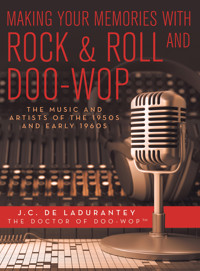
Making Your Memories With Rock & Roll and Doo Wop: The Music and Artists of the 1950's and Early 60's digs back through the catelogue of popular music and brings to life the solo artists, duos, and groups whose music once filled the airwaves and turntables with rock and roll and doo wop. "Joe D, The Doctor of Doo Wop" brings his expertise, honed by hosting a weekly radio, "Making Your Memories," to his revelation of the backstories of these trendsetting artists. Listen live on Southern California's KSBR, FM 88.5 or on the web at www.ksbr.orgUntil the British Invasion in mid 1963 changed the direction of American music, the sounds created by the artists profiled in "Making Your Memories with Rock & Roll and Doo Wop shaped the entertainment soundtrack of a generation. THis music history shares little known details of the lives of these artists, the history of the period, the distinctiveness of the music, and the power and influence of the songs lyrics.Making Your Memories with Rock & Roll and Doo Wop: The Music and Artists of the 1950's and Early 60's will leave echoes of the time's memorable songs in your mind's ear, their lyrics on the tip of your tongue, and their memories in your heart. You'll discover a fresh desire to find the recordings and give them another spin on your record player, even if your digital music lives in the cloud.
Das E-Book können Sie in Legimi-Apps oder einer beliebigen App lesen, die das folgende Format unterstützen:
Veröffentlichungsjahr: 2017
Ähnliche

















J.C. DE LADURANTEY THE DOCTOR OF DOO-WOP
Making Your Memories withRock & Roll andDoo-Wop
THE MUSIC AND ARTISTS OF THE 1950s AND EARLY 1960s
MAKING YOUR MEMORIES WITH ROCK & ROLL AND DOO-WOP
THE MUSIC AND ARTISTS OF THE 1950S AND EARLY 1960S
Copyright © 2016 J.C. De Ladurantey The Doctor of Doo-Wop.
All rights reserved. No part of this book may be used or reproduced by any means, graphic, electronic, or mechanical, including photocopying, recording, taping or by any information storage retrieval system without the written permission of the author except in the case of brief quotations embodied in critical articles and reviews.
iUniverse
1663 Liberty Drive
Bloomington, IN 47403
www.iuniverse.com
1-800-Authors (1-800-288-4677)
Because of the dynamic nature of the Internet, any web addresses or links contained in this book may have changed since publication and may no longer be valid. The views expressed in this work are solely those of the author and do not necessarily reflect the views of the publisher, and the publisher hereby disclaims any responsibility for them.
Any people depicted in stock imagery provided by Thinkstock are models, and such images are being used for illustrative purposes only.
Certain stock imagery © Thinkstock.
ISBN: 978-1-4917-8402-0 (sc)
ISBN: 978-1-4917-8401-3 (e)
Library of Congress Control Number: 2016900475
iUniverse rev. date: 02/17/2016
Contents
Foreword
Preface
1. Introduction—The KSBR Story
2. A Simpler Time
3. Simple Music
Section A — Rock and Roll and Doo-Wop History
4. The Days the Music Died
5. Good Old-Fashioned Rock and Roll
6. Behind the Scenes
7. Crossovers
8. Covers, Versions, and Tributes
9. The Orchestration of Rock and Roll
10. Songs That Salute the Music
11. Do Ya Wanna Dance?
12. “But, Daddy, Where Are the Words?”
13. American Bandstand and Dick Clark
Section B — The Magic of Song
14. Sad Songs, Heartaches, and Tragedies
15. Pure Romance
16. The Magical Songs of June and Summer
17. Music from the Movies
18. Places, Destinations, and Cities
19. The Weather
20. Cars and Novelty Songs
Section C — Doo-Wop-Doo-Wah
21. An Analysis of Rock and Roll and Doo-Wop Music
22. The Art of Falsetto
23. Nonsense Songs
Section D — It’s All about the Music!
24. Positive Messages—Songs That Made You Feel Good
25. Great Songs That Never Hit the Charts
26. One-Hit Wonders
27. The Magic of One Word
28. Music of the Surf
29. Music by Geography
Section E — The Artists of the 1950s and Early ’60s
30. Teen Idols
31. The Ladies and Female Groups of Rock and Doo-Wop
32. The Name Game
33. Saluting Those Who Served Our Country
34. The Influencers
35. The Duos
36. They Wrote It and Sang It
37. Still Performing
38. The Era of Elvis—His Many Faces
39. The Three Faces of Bobby Darin
40. What Is in a Name?
41. Interviews and Greetings
Epilogue
Acknowledgments
Doo-Wop / Rock and Roll: Level 1 Trivia Quiz
Doo-Wop / Rock and Roll: Level 2 Trivia Quiz
Oldies Fan Quiz
References
Foreword
Mr. Brian Beirne has been one of the most familiar voices on the airwaves and is considered to be one of the foremost modern music historians in America. As Mr. Rock N’ Roll, his trademarked moniker, he was honored after five decades on the air, which included his twenty-nine years at KRTH 101 in Los Angeles, representing the longest continuous stint in FM radio history. He is currently the producer of Legendary Shows, presenting ’50s’, ’60s’, and ’70s’ artists throughout the world. In 1991 he was honored with a star on the Hollywood Walk of Fame.
By Brian Beirne, Mr. Rock N’ Roll
Some fifty-plus years ago, as a kid of thirteen, I played my first record on the radio. I can still feel the thrill of cueing up my first 45 rpm record and throwing the mike switch for the very first time. DJs like myself had full creative freedom with our show, and we had the pulse beat of the American teenager. We were their friends, and they were ours … we spoke the same language … music! Teenagers from all walks of life were enthralled with this new expression of freedom we labeled rock and roll. Kids sang on the street corners looking for an echo … still others picked up a musical instrument for the first time. Everyone wanted in on the excitement.
For those of you who lived it, you’ll enjoy this reflection of those golden years. For those of you who didn’t, you’ll have a firsthand glimpse of what you missed. This book truly captures what I like to call “that gentle period in time” when we had drive-ins rather than drive-bys. Enjoy it … and rock on.
Preface
We are a culture of people forever fascinated by our pasts and our futures. We look into crystal balls; check our horoscopes; dream of lives less complicated; and wish for houses on hills, luxury cars, and ideal mates. We also reflect back on our childhoods and adolescence. We embrace fond memories of times that were fun and full of adventure, heartbreak, and a lack of responsibility. That was a description of the 1950s in the United States. It was clearly a simpler time.
The 1950s was a very unique period. It was before the civil rights movement, the Vietnam War, and the assassination of President John F. Kennedy. It was before the Beatles. Our country could have withstood any one of those events—but not all four. Facing just one event, we would have continued unabated into the later ’60s much as we had been in the late ’50s—with stability, innocence, and simplicity. But that was not to be. The ’50s represented a time of long periods of stability with only periodic episodes of chaos. After 1963–64, that all changed. The later ’60s were a time of infrequent levels of stability, with more and more chaos.
Those of us who matured in the years from 1954 through 1960 were exposed to the innocence that the music of the day captured. We would be at an eighth-grade graduation party, with boys on one side and girls on the other. It was 1956 when we were captivated by Shirley and Lee’s “Let the Good Times Roll,” just to hear a faint grunt that said, “We do not have to follow all the notes in the song.” We watched 45 rpm records spin and drop down “Eddie, My Love” by the Teen Queens and looked for someone, anyone, to hold in a small embrace. And then we would thank our musical dance partner and look for someone else.
With the development of the jukebox industry during the 1930s, Billboard began publishing music charts as an expansion of their business of selling sheet music for the vaudeville theaters. Information for rankings was based upon records sold and jukebox plays. In 1953 there was not one rock and roll song on the Billboard Top 30. The charts reflected artists such as Tony Bennett, the Four Aces, Eddie Fisher, Patti Page, Rosemary Clooney, Doris Day, and Kitty Kallen, who had the number one song of the year, “Little Things Mean a Lot.” Those artists had two songs each in the Top 30 and dominated the industry. Nat King Cole and the Four Knights represented African Americans on the charts.
One of the most powerful influences of the ’50s and early ’60s was clearly the music. World War II was over, the Korean conflict went to the second page, and music was having a more profound effect on our lifestyle. Rock and roll, with its beat, the influence of rhythm and blues, and an emphasis on lyrics, as unique as they were, precisely expressed the feelings between two people. We would “watch” the radio and listen intently to the words and how they affected us. The car radio played music that extended to our hi-fi record players that spun 45s and 33 1/3 rpm long-playing albums. Early rock and roll eventually faded out those 78 rpms in favor of the smaller 45 rpm discs and twelve-inch 33 1/3 albums.
The turning point for music in the ’50s was to occur in 1954. Two songs made the Billboard Top 30 that forever changed the fabric of what was listened to: “Sh-Boom” and “Shake, Rattle and Roll.” Billboard recognized “Sh-Boom” by the Crew Cuts and “Shake, Rattle and Roll” by Bill Haley and the Comets, while much of the country listened to the versions recorded by the Chords in 1953 and Big Joe Turner at house parties (Whitburn 2010).
In the era of the 1950s, innocence and immaturity dominated. We could do whatever we chose to do with family support systems and our own visions of the American dream. When bread was only twenty-three cents a loaf, we knew we would never go hungry. Our happiness and innocence were being reflected in the music. They were in the words, nonsense syllables, instrumentation, and, of course, the beat. Radio was king, and it clearly was a world for teenagers.
Making Your Memories with Rock and Roll and Doo-Wop (MYM) is more than a book chronicling an industry. Most importantly, it is intended not to reflect all elements of the music listened to but to tell the reader a story—a love story, an affair of the heart, mind, and soul. This particular era of music was one that was listened to, watched, and danced to. MYM also chronicles our thought processes, our feelings, hopes, dreams, and heartaches. Today this same music still makes us feel young again and provide a time to shed the years.
In my later years, I had a unique opportunity to go back to school and take classes in broadcasting. I took that opportunity, obtained a time slot on a local radio station, and created a format titled—you guessed it—Making Your Memories. This book follows that journey and highlights the various shows produced by category and theme. MYM focuses on the music, lyrics, and artists and their stories. Absent the “truth in music” discussion, I leave any conflict, legal, or race issue aside for other, more knowledgeable authors. MYM is about the love affair with the music and the artists. It is my memories, as I remember them, almost off the top of my head. Any references are to ensure I do not misquote an important part of the story told regarding love of the music.
While the times may have been simpler, today’s technology offers many options. It is my intent to utilize this technology to aid you, my readers, in consuming yourselves in the music. As you read each chapter, pull out your own collection of CDs, and listen to a few bars of the song or artist being discussed. You will not only be able to reflect on the music but also “see” it through the magic of your memory. As Freddy Johnson, bass singer for the Marcels of “Blue Moon” fame, wrote (Gribin and Schiff 2000 Foreword):
Nothing can change a memory, especially a time,
When music had meaning to it.
Memories are glimpses to a legendary time.
JCD
Chapter One Introduction—The KSBR Story
All of my love, all my kissin’, you don’t know what you’ve been missin’ … OH BOY – BUDDY HOLLY
As a young teenager, I was always enthralled with the music of the ’50s. The challenge was to listen to the song, remember the words, and try to sing along with the message delivered by the artist. Some of the songs were more challenging than others. For many of us, the song, its melody, and many times its nonsensical nature were easier to remember than the dates, times, and figures that were taught in high school classes.
The first MYM business card. We were on our way!
I started collecting 45s and 33 1/3 albums and listening to the radio at the age of twelve. With limited funds from a limited allowance, I could only buy a few at a time. Not satisfied with the size of my collection, I shoplifted the small 45s, putting them under my shirt and sliding out of a neighborhood market that would later employ me. My collection of music grew rapidly, and I became known as the one with the best collection. I was invited to small gatherings after school or a Friday-night party—but only if I would bring my collection of records. It was only after I was caught shoplifting my favorite song of the moment that my collection stabilized.
I was invited to a party one Friday night at the tender age of fourteen. I was asked by a very charming young girl in class to bring my collection of 45s for the music. I could not go for some reason and advised her of that fact. She asked if she could borrow the collection, and I agreed to loan her a portion of what I had accumulated. I was totally unaware that this was a going-away party for her and her family. The next day, they moved and took my collection with them! I went back to shoplifting.
My collection grew again and over the years became a big part of my devotion to the music and artists. It was only when I went into the United States Marine Corps that my collection was again given away, this time by my mother. There is no doubt that she knew the source of the majority of the collection, so in hindsight, I guess I deserved it.
And that is where the story really begins.
Taking on my various careers and pursuit of education, I spent time commuting or traveling. Listening to the collection became my therapy to defeat the Los Angeles–area traffic. There were still visits to Tower Records, Sam Goody, Barnes & Noble, Best Buy, and my favorite discovery for music, Penny Lane. Antique stores with their collection of old 45s and albums hidden in the back aisles also called to me. I would purchase an entire album just for the one song that brought back that memory.
My taste in music had expanded. Orange County had its own station, KSBR, located at 88.5 FM on your radio dial and broadcast worldwide on the web at www.ksbr.org.
KSBR is the most listened-to jazz station in the world, with audiences in Japan, Australia, the United Kingdom, and Europe. The studios are located on the campus of Saddleback Community College, and the station is licensed to the South Orange County Community College District Board of Trustees. Their legal ID is “KSBR, Mission Viejo,” as they are located in that city. The licensed transmitter power output is a mere 471 watts. Because it is a nonprofit student-run station located in the lower FM band, there are never on-air commercial announcements or personal statements regarding the music. It is just pure contemporary jazz.
While I respect jazz and those who wrote and performed it, it always seemed to be background music to life as we did other things. The station called to me because of its local news, delivered informatively by Dawn Kamber, and their specialty shows on the weekend with alternative jazz, blues, and music of the late ’60s and early ’70s. There was even an ’80s show on Sunday nights. But no ’50s or early ’60s.
One typical, beautiful South Orange County Saturday afternoon in mid-2010, I was listening to KSBR’s air talent Bob Goodman and his show, “A Whole Nuther Thing.” I do not remember the song, but he actually played a song from the ’50s. It could have been the Everly Brothers or a tribute to Ritchie Valens, the Big Bopper, and Buddy Holly; quite frankly I do not remember. I went crazy! There was no other radio station in the Los Angeles area playing “my music.” The one big station in the Los Angeles and Orange County area that was known for oldies was playing ’70s and ’80s for their new audience demographic.
I drove home and looked up the station on the web. I scrolled to the KSBR site and located the name of the general manager, Terry Wedel. I had an idea. I would ask him if I could loan the station a portion of my collection so they could play more ’50s music for their listeners. I obtained his e-mail address from the website and sent him a brief message offering my collection for airplay. A few days later, to my surprise, I received a response. “Sounds interesting,” he said. “Come down to the station, and maybe we could talk about it.”
We settled on a date and time to meet. We talked about the music and my knowledge of the artists and background of songs, and after about thirty minutes, he shocked me with his proposal: “I don’t think we have anyone available that knows the music like you do. I’ll make you a deal. You go to broadcasting school—we will see if you can do it—and we will give you a time slot to play the music yourself.” I would have to take a series of five classes in order to produce, mix, engineer, and announce, as it was a student-run station with no support from any full-time employees.
For the next five months, I went back to community college and took a series of classes that enhanced my appreciation of the world of radio and broadcasting. I learned the historical and technical side of the house to a minimally acceptable level, all with the assistance of very patient and professional instructors, fellow students, and even a tutor.
Returning to community college was an eye-opener. After settling in to the course work and adjusting to being around young boys and girls, I shared my vision with them as I produced musical interludes utilizing ’50s and ’60s music to learn the technical side of broadcasting. During class we were required to present our projects. I was overwhelmed to find that the younger set knew and recognized many of the songs from the ’50s. Other classmates of Gen X, Y, and millennials heard my music and inquired regarding the artists and song titles. I would later hear them humming “Earth Angel” or “Sixteen Candles” during our technical sessions. It was then that I knew that there was a new generation that could be captured by the sounds of the ’50s and early ’60s. It became my inspiration to bring my vision of Making Your Memories to all generations.
In January 2011 Terry Wedel took a big chance and gave me a Monday morning time slot playing jazz that had been programmed in to the Selector automatic-play system of KSBR. Within the first week, I had accidentally shut the station down by hitting the wrong buttons, played two songs at the same time, and talked for three minutes without turning my mike on. I was on my way!
During the spring of 2011, Terry Wedel asked me to put a concept paper together to give him an idea of what a 1950s and early ’60s show would look and sound like. As a college professor, I taught classes in strategic management and decided to apply those principles to my plan. With only minor revisions, the proposal was accepted and is now known as Making Your Memories, with Joe D, the Doctor of Doo Wop. I have a great time slot of 10:00 p.m. to midnight on Sundays. My goal is to have people listen for at least one hour, even if it is a two-hour show. We do not play background music, but present songs that you really must listen to for full enjoyment and memories.
Here is the proposal as presented to Mr. Wedel:
Mr. KSBR— Terry Wedel.
Making Your Memories (MYM) focuses on the music of the 1950’s and 1960’s with emphasis on the Doo-Wop sound.
There currently is not a commercial radio station in the Los Angeles / Orange County area market that presents, as its format, the music of the 50’s and 60’s (generally pre 1963). This genre of Doo-Wop music evolved from the Louis Armstrong, Bing Crosby, the Ink Spots, Mills Brothers and Ravens era through the early 1950’s and was paralleled with a new era of Rock and Roll music from a variety of artists.
With the British invasion that started in mid-1963 the presentation and complexity of the music changed the landscape, for many of those artists had developed and performed in the 50’s and earlier 60’s. Today’s music in the second decade of the twenty-first century reflects many of the original characteristics of those groups, duo’s and individual artists. Sadly, many of those artists have faded into oblivion, passed away or are performing in small niche markets in an effort to keep their music alive. Others have attempted to maintain their stage names and replaced various artists with newer performers and held on to the ‘SOUND’ the groups/duo’s and individual artists are known for.
MISSION / VALUES/ VISION STATEMENT:
It is the Mission of the “Making Your Memories” show to highlight the lost music and artists of the 50’s and 60’s with special emphasis on the Doo-Wop sound.
We value the purity of the sound, respect for the artists, and the desire to keep the music in the forefront of the interested public. We value their contributions, artistry, talent and message. Our vision is, that if exposed to the music and artistry of the 50’s, 60’s and Doo-Wop music, there will be a new generation of music lovers, in addition to the generation that grew up with it.
MAKING YOUR MEMORIES (MYM) was created as a format by Joseph C. De Ladurantey, President of JCD & Associates Inc. a.k.a., The Doctor of Doo-Wop. The primary focus of MYM is to present groups, duo’s and single artists who wrote, performed and made recordings in the 50’s and 60’s with an emphasis on the Doo-Wop sound. Presentation of the music will be interspersed with specialty segments to highlight the sound, artistry and history of the music, its creators and performers. The format will not just play the music of the 50’s and 60’s but provide the back story of many of the artists, stories about how and why the songs were written and produced, and who were the key players in the background. Most importantly, it will also provide the opportunity to reflect on a time of innocence when the music was in the very fabric of our lives.
The target demographics are divided into a number of areas. While historically commercial radio identifies a specific demographic such as male adults twenty-five to forty-five, MYM will initially target the fifty–seventy-five age and beyond, that has time to listen, enjoy and reflect on the sounds of the 50’s and 60’s. Currently the fifty–seventy-five market is relegated to talk radio, smooth jazz or mindless television with few prompters of the years gone by.
The Orange County area (the OC) has a significant target population of potential listeners (the Traditionalists born prior to 1945 and the Baby Boomers born 1945-1965). Many are in communities that are adults only, for seniors, or retirement homes for active adults. With discretionary income and a history of being music lovers and collectors in their yesteryears, this demographic is clearly underserved and prepared to embrace MYM.
The second target audience is the generations that were not exposed to the music of the 50’s, 60’s and Doo-Wop, the Gen X, Y and yes, even the Millennial. Recent experience has noted that, when exposed to the music which is the subject of this format, there is a recognition and almost instant appeal.
With a focus on the music as the basis for the show, there are a number of specialty segments/sessions that can be utilized periodically as a programming highlight through the combination of music and talk. Focusing on specific elements of the music, artists, and songwriters from a number of different perspectives permits the listener to not only hear the music from a separate context but also “see” the music through the magic of the “theater of the mind.” Programming can be done so that each segment can be advertised or announced or perhaps to let the listener ask “what will he do next?” It is estimated that each segment could combine the discussion and music in at least a one to two hour long session.
Elements to be considered include but are not limited to:
1. Analysis of the sound of Doo-Wop, what constitutes the term and the methods of performance that set it apart from other music. Includes analysis and musical examples of the following:a. Beat instrumentationb. Simple lyricsc. Group harmonyd. Use of range from bass, tenor and falsettoe. Nonsense syllables2. Identification of the immortals, those who impacted and contributed to the genre and where they are now.3. The various degrees of Doo-Wop and the groups and songs that are identified with them.4. The one-hit wonders. Why only one song? Where did they go? Do you remember?5. Presentation of the standards from the 50’s and early 60’s from groups, single artists, duo’s and instrumentals.6. Black/White, Black/Black, White/White versions of songs. Cover songs that are the same song, different groups. Who did it first?7. Movement of the members between groups. Observations of those artists that went from group to group and group to solo careers.8. Names of the groups. The origin of names and where do they come from?9. Those who have passed away. Their contributions.10. Where are they now? Those who left the music for other careers.11. The nonsense syllables. How many are there?12. Where are the Doo-Wop concerts with live performances and PBS television specials (nationwide) and radio stations, websites and Podcasts that play the music?13. Is there still a Doo-Wop Society out there?14. Famous falsettos and basemen as lead and background.15. The talking songs. Songs that use words to convey the meaning or combine with singing.16. Songs with girls’ names and the artists and groups that gave them to us.17. The study of using vocabulary for the sake of rhyming.18. Interviews with Doo-Wop lovers from East Coast to West Coast and everything in between.19. Interviews with Doo-Wop artists to include those who emulate them today to those who are still with us.20. Doo-Wop and 50’s songs in the movies and commercials.21. The duo’s of Doo-Wop (male/male, female/male).22. Doo-Wop quizzes: How much do you really know about the music we love?23. Girl Doo-Wop groups and solo artists.24. Non Doo-Wop songs and instrumentals of the 50’s.25. Surf music.26. The geography of Doo-Wop: East Coast, West Coast and Midwest Doo-Wop.27. Key songwriters that contributed to the music/sound and message.Joe D. on location broadcasting from the San Juan Capistrano Mission on the day the swallows returned to Capistrano. Does it get any better?
From this original proposal, I created a format that has a different theme every week. There are a number of challenges with the format for MYM. Music of the 1950s and early ’60s is short in comparison to that of other eras. The average song is under three minutes, with many barely making two minutes. The system at KSBR is not automated, so all programming must be done prior to each show and the collection of songs brought to the station. The CD changer is a relic that is both temperamental and challenging. There are no commercials at KSBR, and with limited underwriting recognition, the music is the entire focus of the two-hour presentation.
The themes utilized over the last few years comprise the remaining chapters of this book. Songs and artists may be mentioned more than once but are repeated to ensure context of the subject matter. We can never thank the artists and songwriters enough.
Mr. Rock N’ Roll, Brian Beirne, backstage at the Cerritos Performing Arts Center. He is a legend in West Coast radio!
During the course of a nonmusical career, I have had the opportunity to meet many of those disc jockeys that brought the music of the 1950s and early ’60s to the airwaves. Being in the presence of and sharing a microphone with Robert W. Morgan and Sammy Jackson and later on meeting Brian Beirne (Mr. Rock N’ Roll) has been an incredible opportunity. I have also been fortunate to personally meet some of the artists who are still performing, take pictures (many not of top quality due to the spontaneity of the moment), and interview them for Making Your Memories. Photos have been dispersed throughout the book.
Enjoy the trip down Memory Lane. Thanks for letting me live the dream.
Chapter Two A Simpler Time
The darkest hour is just before dawn … DEDICATED TO THE ONE I LOVE – THE SHIRELLES
Of all of the influences that affected the lives of young people in the middle 1950s and early ’60s, none had impact like music. It was not just any music, but rock and roll, pop, and rhythm and blues. It was the music of sinners, or so we were told. It began to chronicle the American dream in small towns, big cities, the entire nation, and ultimately the free world. Much of it started in a garage. Much like the tech giants of today, garages were where we could hide out and listen to the radio, learn to play an instrument, or try to sing along with the artist or backup group behind the artist.
Lesen Sie weiter in der vollständigen Ausgabe!
Lesen Sie weiter in der vollständigen Ausgabe!
Lesen Sie weiter in der vollständigen Ausgabe!
Lesen Sie weiter in der vollständigen Ausgabe!
Lesen Sie weiter in der vollständigen Ausgabe!
Lesen Sie weiter in der vollständigen Ausgabe!
Lesen Sie weiter in der vollständigen Ausgabe!
Lesen Sie weiter in der vollständigen Ausgabe!
Lesen Sie weiter in der vollständigen Ausgabe!
Lesen Sie weiter in der vollständigen Ausgabe!
Lesen Sie weiter in der vollständigen Ausgabe!
Lesen Sie weiter in der vollständigen Ausgabe!
Lesen Sie weiter in der vollständigen Ausgabe!
Lesen Sie weiter in der vollständigen Ausgabe!
Lesen Sie weiter in der vollständigen Ausgabe!
Lesen Sie weiter in der vollständigen Ausgabe!
Lesen Sie weiter in der vollständigen Ausgabe!
Lesen Sie weiter in der vollständigen Ausgabe!
Lesen Sie weiter in der vollständigen Ausgabe!
Lesen Sie weiter in der vollständigen Ausgabe!
Lesen Sie weiter in der vollständigen Ausgabe!
Lesen Sie weiter in der vollständigen Ausgabe!
Lesen Sie weiter in der vollständigen Ausgabe!
Lesen Sie weiter in der vollständigen Ausgabe!
Lesen Sie weiter in der vollständigen Ausgabe!
Lesen Sie weiter in der vollständigen Ausgabe!
Lesen Sie weiter in der vollständigen Ausgabe!
Lesen Sie weiter in der vollständigen Ausgabe!
Lesen Sie weiter in der vollständigen Ausgabe!
Lesen Sie weiter in der vollständigen Ausgabe!
Lesen Sie weiter in der vollständigen Ausgabe!
Lesen Sie weiter in der vollständigen Ausgabe!
Lesen Sie weiter in der vollständigen Ausgabe!
Lesen Sie weiter in der vollständigen Ausgabe!
Lesen Sie weiter in der vollständigen Ausgabe!
Lesen Sie weiter in der vollständigen Ausgabe!
Lesen Sie weiter in der vollständigen Ausgabe!
Lesen Sie weiter in der vollständigen Ausgabe!
Lesen Sie weiter in der vollständigen Ausgabe!
Lesen Sie weiter in der vollständigen Ausgabe!
Lesen Sie weiter in der vollständigen Ausgabe!
Lesen Sie weiter in der vollständigen Ausgabe!
Lesen Sie weiter in der vollständigen Ausgabe!
Lesen Sie weiter in der vollständigen Ausgabe!
Lesen Sie weiter in der vollständigen Ausgabe!
Lesen Sie weiter in der vollständigen Ausgabe!
Lesen Sie weiter in der vollständigen Ausgabe!
Lesen Sie weiter in der vollständigen Ausgabe!
Lesen Sie weiter in der vollständigen Ausgabe!
Lesen Sie weiter in der vollständigen Ausgabe!
Lesen Sie weiter in der vollständigen Ausgabe!
Lesen Sie weiter in der vollständigen Ausgabe!
Lesen Sie weiter in der vollständigen Ausgabe!
Lesen Sie weiter in der vollständigen Ausgabe!
Lesen Sie weiter in der vollständigen Ausgabe!
Lesen Sie weiter in der vollständigen Ausgabe!




