


5,90 €
Mehr erfahren.
- Herausgeber: Poets & Sailors
- Kategorie: Geisteswissenschaft
- Sprache: Englisch
Drawn from the memories of daily life, from a childhood spent in Asmara in an Italian-Eritrean family,
Mama Demmechesc reveals episodes of racism, segregation and adversity, but also joy and discovery – all of which left a mark on the author. Enzo Mazzola, now a lively octogenarian, had a dramatic yet happy upbringing. The story he recounts – while set in a time of unrest and strife – is profoundly heartwarming.
Gently, and with a childlike gaze, Enzo tells us about his own life and about that of his Eritrean mother, who lived for ten years and had seven children with an Italian settler.
Enzo’s testimony is particularly valuable because it offers the opportunity to embark on a historical journey: the reader sees the era of Italian colonialism and Fascism from the perspective of a unique family. The story unfolds as if in a movie: through Enzo’s eyes we try to understand Salvatore – engineer, inventor, family man, Fascist – who, despite everything, is clearly fond of the young Demmechesc, Enzo’s beloved mother. Colonial exploitation is rife: Asmara’s “mixed-race” ghetto, illegal work (even child labor) and hidden relations are all experienced first-hand by Enzo. We learn about the good and the bad through the eyes of the protagonist, a bright, strong, affectionate child.
The forgotten crises, the drama, the violence and the cruelty of that era are smoothed over by the optimism of the child. That resilience and goodwill is still evident in the man today. Indeed, as a grown-up, Enzo achieved a good measure of social redemption, along with his mother and his many siblings.
In the afterword here, Angelica (who gathered and edited Enzo’s tales) retraces the historical contours of the colonial era. She investigates the setting and the context of Enzo’s youth, in a period that saw racial laws, violence against women and slavery. Angelica touches on the collective denial of the whole experience and laments the impunity granted to those responsible.
This book helps us to understand human values and the importance of communities. It reminds us that behind the narrative of every war, behind all the tales of persecution and depravity, there lies the very human story of individual children, women and men.
Today, mothers like Demmeschesc live and persevere in Afghanistan, in the Middle East, in Ukraine, and in far too many other places still ravaged by war.
Demmechesc was a petite Eritrean woman who in the 1930s left her remote village, on foot, to go to Asmara – a bright, booming city full of goods, dreams and projects for il Duce’s colonial empire.
There, she will meet an Italian engineer who will change her life forever: Salvatore Mazzola, an eclectic and creative man, embodied all the contradictions of that African adventure.
After fathering seven children, and adventurously moving homes across town several times, he abandoned Demmechesc to her own destiny in 1949. Salvatore Mazzola returned to Italy, along with many others, leaving his family in Africa, in the midst of an economic boom and a civil war.
At the time, Enzo was ten years old. This book retraces his childhood and youth: from his carefree adventures up to the day of his father’s abandonment, and from his first encounter with his future wife, Adriana, up to their arrival in Rome.
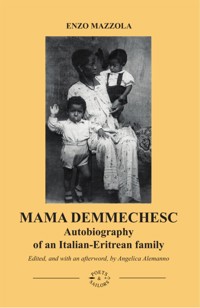
Photo on the cover:
Mama Demmechesc with Alberto next to her and baby Enzo in her arms, in the apartment in Via Abruzzo, in Asmara, 1941, from author’s collection.
Das E-Book können Sie in Legimi-Apps oder einer beliebigen App lesen, die das folgende Format unterstützen:
Veröffentlichungsjahr: 2024
Ähnliche




















Forgotten crises
Enzo Mazzola
MAMA DEMMECHESC
Autobiography of an Italian-Eritrean family
Edited with afterword by Angelica Alemanno
Poets & Sailors by Francesco Mizzau
Via Renacci, 1, 52027 San Giovanni Valdarno (AR) - Italy
www.poetsandsailors.com
© 2024 Poets & Sailors
All rights reserved
ISBN 9791280551078
Editorial direction: Francesco Mizzau
Translator: Daniela Travaglini
English-language editor: Gyneth Sick
Cover: Daniela Annetta
On the cover: Mama Demmechesc with Alberto and little Enzo in her arms in the house in Via Abbruzzo, Asmara 1941.
We would like to thank all the friends who contributed to the fundraising for the Church of Ewanet which began on 14 December 2019 following the first self-published release of this volume. Thanks to that edition, the collaboration with the Poets and Sailors publishing house was born and the publication in the Forgotten Crises series.
Index
Forgotten crises
FOREWORD
INTRODUCTION
PROLOGUE
PART ONE
PART TWO
PART THREE
DOCUMENTS
AFTERWORD
GLOSSARY
BIBLIOGRAPHY
Landmarks
Title Page
To the most important women in my life
A special word of thanks goes to Angelica for her tireless efforts in bringing this book to life.
Over months of discussions and despite any number of setbacks, our ultimate goal always remained clear. This product is a happy result, meeting all my expectations and more.
Thank you also to Gyneth Sick, for her friendship and for her help with the English translation.
Enzo
FOREWORD
by Angelica Alemanno
One might wonder what purpose it serves today to publish a very personal testimony from a man born in Eritrea, when the country was an Italian colony – that is, before 1941.
Well, we believe that this testimony is crucial. Not only for the author – as he explains in his Introduction – and not only for historians or academics. It is crucial for anyone who wants a snapshot of a time and place that is dangerously destined for oblivion. This memoir serves to expand the (too small) collection of direct testimonies that relate to Italy’s colonial experiences during the Fascist period. It also offers surprising detail to anyone yearning to hear of authentic episodes – sometimes comical and sometimes dramatic – of a life actually lived between the two great wars. What these stories illustrate is difficult to index by the algorithms of the internet: they are well-preserved pieces of an infinite puzzle of personal memories; they recount the lives of Italian men and women who, by chance or by necessity, were born African. Enzo opens our eyes to the reality of a childhood and adolescence spent in what is now an extinct world: Italian East Africa.
Italian roots have been planted and spread across the globe – up to and including the Horn of Africa – and yet most of us do not have a clear idea of how the African adventure developed. The Italian Fascist period upset local habits, expectations, and international relations. While, on the one hand, the hope was to cultivate an undefined Italian vigour, on the other, this attempt took shape through actions that were questionable, to say the least. Such actions ranged from simple false propaganda to more specifically criminal acts, passing through behaviours that did not respect human emotions. Enzo’s story, and that of his father Salvatore, represent a special case: in many respects this memoir helps us to understand the exceptional nature of an actual life, as compared to a context that is often viewed differently.
At the end of this memoir, readers will find an Afterword, which explains habits and customs, provides some data, and points out curiosities from the relevant period in time. We hope that this concluding essay contributes to the reader’s appreciation of Enzo’s very human story, putting his experiences into a broader context, the implications of which are still relevant today. Far be it from us to want to address all aspects of the varied colonial experience; what we care about here is rather to highlight the lights and shadows of that time, with quick brushstrokes. We aim to awaken the reader’s curiosity, in hopes he or she will delve deeper into one or another of the era’s myriad problems.
Whether Enzo’s story is the result of a racist culture (a shameful one of which many Italians are unaware) or whether it is a life blessed by luck (after all, Enzo escaped a miserable destiny and has led a life filled with love) is up for interpretation: we will explore the various dynamics together. Enzo’s autobiographical narrative presents a collage of heterogeneous ideas and images, backed up by period documents, references to current events, and even a small glossary.
The context
Italian East Africa, established by royal decree in 1938, was made up of six regions corresponding to what are currently three large states: Ethiopia, Somalia and Eritrea. Somalia was in turn divided into Italian and British colonies: Great Britain retained the most important and strategic possessions (the Suez Canal and areas along the coast). Let us not forget, however, that the Italian colonial possessions also included the Dodecanese (Greek islands) and Libya, also divided into three states (Cyrenaica, Tripolitania and Fezzan). Italian Libya deserves a separate discussion: it was in fact made up of a territory more or less as large as that of Eritrea, Somalia and Ethiopia combined, and it overlooked the Mediterranean Sea (not the Red Sea or the Indian Ocean). Not far from the Italian coast, it was a sort of intermediate space, providing a buffer for the Ottoman Empire (present-day Turkey) with which rivalry has been constant. Italy took Libya and the Dodecanese from the Ottoman Empire during the Italian-Turkish war (1911-1912) and retained them until the end of the Second World War. But while we can imagine that some characteristic elements of the Italian-Eritrean relationship also occurred in the other colonies, we would like to focus here on the particularities of life in Eritrea, where Enzo was born.
With the Paris Peace Treaty of 1947, Italy lost all its colonies, with the sole exception of Somalia: in 1950 Somalia was assigned to the newly formed Italian Republic in the form of a “trustee administration” of the United Nations. That too soon ended, when Somalia gained independence, definitively ending Italy’s sixty-year colonial period. Over those sixty years, Italy exercised its dominion in a partly innovative way (thanks to propaganda, for example) and partly in a traditional way, by perpetuating the classic trends of colonial imperialism: trade, looting, negotiations, wars, rebellions, genocide and slavery.
Testimonies like Enzo’s enrich the academic sources available. This book describes the Italian “adventure” in the first person, helping us to understand its myriad implications. And many of those implications live on, even today.
Let us take imperialism: understood in a broad sense, it is not a modern development, but a complex and ancient historical one. The people of our planet have been divided into the colonisers and the colonised since time immemorial. The Roman Empire stretched from Armenia to the Atlantic; the Inca and Aztec empires of Central America were founded thanks to the subjugation of some ethnic groups by others; the Ottomans controlled territories that stretched from the Mediterranean to the Indian Ocean; the Chinese empire, at its peak, was larger than all of Europe today. But “contemporary” colonialism (also called imperialism) can be distinguished from its pre-industrial forms in terms of Marxist thought, which clearly divides pre- and post-capitalist colonialism.
“Modern colonialism” (French, American, Fascist, and so on, up to current forms in complex and areas, like Afghanistan, the Middle East, and beyond, where Italy is still a co-protagonist) is nothing if not “the little brother” of capitalism. Only by immediately focusing on the fact that relations between countries are and remain based on economic-financial dynamics – especially today – can we understand the profound reasons behind the Eritrean occupation of the 1930s. By occupying Eritrea, Italy did not only or even primarily aim to enrich the “Mother Country”; the goal was ultimately to produce that economic imbalance necessary for the very growth of capitalism as a global economic system. And while twenty years of occupation did not suffice to trigger a process of univocal and radical change, they nevertheless certainly contributed to defining the relationship between the West and Africa.
Lenin had already proposed a clear and concise reading of this global situation back in 1916, in his famous essay “Imperialism, the highest stage of capitalism”. Lenin summarised the theories of Karl Marx in this work, describing the market mechanisms that sponsored imperial colonialism. He argued that the growth of financial capitalism and of Western industry had created “an enormous glut of capital”. This money, Lenin posited, could not be invested conveniently at home, where the workforce was limited, but would work wonders in the colonies, where there was a lack of capital and an abundance of workers. Capital, to sustain its growth, necessarily needed to expand and thus to subordinate non-industrialised countries. We could say that the same thing happens today, albeit with a slightly different dynamic: practices such as offshoring encourage factories to move abroad, for example, where labour is less expensive. This penalises Italian workers.
Many of the asymmetries and aberrations that led to civil war in Eritrea have profound implications for our global economic system today. Indeed, such asymmetries and aberrations continue to lead to civil wars in countries such as Afghanistan, Yemen, Somalia, Burma, or Kurdistan today. We often declare that we want to “export democracy” to such places and yet we end up exacerbating inequalities. Although colonialism today may seem to be over, formally, it is undeniable and clear for all to see that imperialism – as an economic system that penetrates and controls new markets – carries on. While it may not require direct political control of colonies – as happened in Italian East Africa – it nevertheless leverages feelings of superiority.
Let us focus here on one particular declination of this theme: the one that manifested itself in Eritrea. Enzo’s memoir – unique insofar as it is just one man’s story – represents in many respects a positive exception to the norms of his times. This is true both with regard to the role of women in his “mixed race” family – one persecuted by Fascism – and with regard to the settler Salvatore’s relationship with his “mixed race” children.
How did Italy end up in Africa?
The “Scramble for Africa” – as Europe’s mid-nineteenth to mid-twentieth century expansionist movement towards the neighbouring continent was called – essentially began on the coasts. Africa’s central region – with the most hostile and least interesting territory for economic traffic – remained independent for the longest time. Starting in 1889, the states involved in this movement were initially Turkey, France, Germany, Portugal, Italy, Spain and Great Britain. Shortly before the First World War, the same states had made inroads towards the centre of the continent, and Belgium had joined the effort. Little by little, then, and according to different processes and various methods, each African country eventually regained its independence. Most passed through a stage of being a “protectorate” before then moving on to actual independence.
Italy first showed interest in Eritrea in 1882 and ended up holding on to the colony for a full 60 years. Somalia was next, which Italy held on to for 54 years, then Libya (22 years) and finally Ethiopia (just 8 years).
The Italian government chose Eritrea as the seat of its Italian East African industries, particularly in the metalworking sector. There was also a small shipyard in Massawa. Some munitions and armaments factories were located in Asmara and were used for the conquest of Ethiopia in 1935-1936. Extending over approximately 230,000 square kilometres, of which almost one thousand are coastline, for a total of only 1.5 million people, the country of Eritrea essentially had the population of the city of Milan. But in a short time, this population grew to include many Italians, who moved to Massawa, with its beautiful port on the sea, or to Asmara, inland. Indeed, the latter area, over time, came to be called “little Rome”, as we will learn about in the Afterword.
It is therefore in Asmara that our journey begins.
Let’s go!
Angelica Alemanno
Mama Demmechesc
Father Salvatore
INTRODUCTION
Memory is our conscience, our reason, our feelings, even our actions.
We are nothing without it. Important even when short-term,
because we find a sense of relief from the intensity of our memories,
and not from their duration.
(Franco Scaglia)1
I have often been asked why I decided to write a book, now as I am about to turn 80.
Mainly, I wanted to write it as a tribute to the lives of our wonderful Mother Demmechesc and of my wife Adriana, as well as for my siblings. But deep down, I think I felt the need to write it also for my own sake.
I wanted to record all that I was still able to remember, and luckily I have quite a remarkable memory! I wished to collect all my memories as a child: what I had experienced first-hand and what I had witnessed with my own eyes, all the smells that surrounded me. Perhaps some of these stories are very personal, and difficult for others to identify with; but others will allow readers to trace their own individual journeys. Some of these memories I wish I had forgotten, but unfortunately they were forever etched in my mind and had scarred me for life. Moreover, when you reach a certain age, memories and hopes tend to overlap; you are thus mercilessly forced to rethink events of your past. For instance, the more I think about Mother Demmechesc, the more I wish I had showed her more often how grateful I was for all she did for us.
My mother may have looked delicate, but she had an iron will. Mama Demmechesc had received no education and worked incredibly hard all her life. She was never acknowledged by her partner as his legitimate wife because of the racial laws in place at the time; nonetheless, they raised eight children together. Despite this, without looking back, one day that partner – my father – abandoned us all to our destiny, for good. But her incredible journey had started years before, when she reached Asmara on foot, coming from the rural areas around the new Eritrean city, Asmara. Despite the many hardships she endured all her life, she never gave up. Most important of all, she had the strength, on her own, to keep us all together through difficult years, which was not an easy task: at the time, the youngest child was just about one year old and the eldest already 18. Neraio, a strong and lanky boy, was a reminder of her previous life, spent on the outskirts of Asmara. He went to great lengths to help our mum, and I will always be grateful for his efforts. Since he passed away, I took up the baton as head of the family and I was called to give my blessing for the marriage of my niece, his eldest daughter. But none of that could have happened without the teachings of Mama Demmechesc, who was strong enough to keep the family united through thick and thin, and who supported each of us with endless love, until we all had the opportunity to build our own lives. In the end, we all settled down: we have worked, loved, got married, had children and grandchildren, and lived fulfilling lives, on our long journey from poverty to prosperity.
Writing this book is my way to express my gratitude once again, and to pay homage to the memory of our great Mother Demmechesc. After all, I am no longer searching for answers, though I do hope to encourage the youth of our time to ask themselves some important questions: “Why are we here?”, “Who truly loves us?”, “What are the important things in life?”. Being abandoned by my father, who chose to return to Italy and leave us all behind, made me look at him from a completely different perspective. A man who had made some brave and daring decisions (such as setting off to the Italian East Africa colony in the first place), but who then revealed his cowardly and deceitful self, when he abandoned us all and never looked back.
I do not intend to hurt anyone with these memoirs, nor do I want to trouble my father's soul. Despite everything, he had been there for me during some very eventful years of my life. Indeed, I could not exactly say what I might have missed by not having him around, but I certainly know what he has lost: the love and respect of his seven strong, healthy and sensible children.
I don't want to lay blame, neither on him nor on History itself, which has been overwhelming in the years we were growing up... But still, I torment myself over something: I wonder why the Italian side of my father's family, which was there all along, never showed the slightest interest towards us, the “Italian Eritreans”. It was as if this great woman and their seven children had merely been a passing phase, to be forgotten and erased.
As I write in the third and final part of this book, during all these years, there have been many opportunities for us to get in touch and get to know each other. Not long ago, I even spoke with my father's only Sicilian daughter (I will not mention her name here, out of respect), and asked her if she was aware that I was working on a book about my family which, to some extent, was her family too... I asked her if she had talked to her daughter, who knew that I had been writing this book also as a way to reconcile with the past. But her approach was the same that I had encountered when I first arrived in Italy years earlier, when I had managed to reach her by phone and enquire about my father (who at that time had already passed away). Back then I had asked her: “...What was he doing in Palermo, in via Malaspina 23, when he returned to Italy? Where did he work? How come he never wrote us back?”. She replied curtly: “He worked at the National Museum. All the others have passed away. But why are you still looking into the past? Let it go. The family held him back here, as they did not want him to go back to Eritrea. I was only a child at the time, how should I know?” So, that's it? End of story? I was deeply hurt by her cold-heartedness.
I believe that we have been abandoned twice: first by our father, and then by his family. Blood relatives, like my sister, who behaved like strangers and joined forces to keep us at arm's length, instead of trying to get closer, like my great Mama Demmechesc had taught us.
Was that part of a wicked plan that we were unaware of? Had they foreseen it all? Forget the past and leave everyone behind; wipe out the mistakes that had been made. This was the typical approach of the “great” Fascism towards us. But you cannot wipe out history, nor can you erase people's lives. I am aware that thousands of books have already addressed the issues of this particular era, and that I could not possibly add anything new to those well structured historical analyses. What I would like to highlight here is that we, the mixed race side of the Mazzola family, had to overcome many challenges during our whole life, but with my father's family our efforts have been hopeless, like hitting a brick wall. Perhaps that wall was thrown up due to fear, ignorance, a general code of silence and, above all, the will to forget, which is one of the ills of our modern society. As Don Ciotti would say, the rapid loss of memory goes hand in hand with the end of civilization.
Enzo Mazzola, 1 May 2019
1Franco Scaglia (Camogli, 27 March 1944 – Rome, 6 July 2015) was an Italian writer and journalist, as well as a manager at RAI for over forty years, where he created and hosted several successful programmes. He won many literary prizes, including the Campiello prize with the novel Il custode dell'acqua. Enzo was fascinated by this brief and rich passage, which he felt conveyed the true and profound meaning of the adventure he was about to undertake with this book.
PROLOGUE
LESSONS LEARNED FROM MAMA DEMMECHESC
It might not be common knowledge, but after Eritrea proclaimed its independence from Ethiopia in 1993, the government approved reforms and programmes aimed at restructuring the country's school system, which had been severely crippled by a war that lasted for decades. One of the most ambitious goals was to reduce the rate of illiteracy, also among adults. And so it was that tiny Mama Demmechesc, at the age of 80, surprisingly began a brief but intense schooling experience, and for the first time learnt to read and write her own name. The woman who had been our patient and wise guide was humble enough to undertake this new journey, thus recognising its crucial value. Once again, she set an example for us all.
When I was six, my brothers and I were constantly fighting.
Mama's eldest son, Neraio, who was much quieter and about eight years older than me, used to play the role of the peace-maker. One day though, I had a really big fight with my brothers and was very upset about it. I was furious and kept complaining about my brothers, from the oldest to the youngest.
I said, “Mum, we are brothers but we fight all the time! Why?”.
That's when Mama Demmechesc held my hand and told me, “Hold up your little hand and place it above mine. I will explain this to you, Enzo Wuoddei (Enzo, my son, in the Tigrinya language). Do you see your five fingers? What strikes you about them? Although they are not the same, they stick together.” She used this example to make me understand that being brothers is one thing, but getting along is another: we are all different. Human beings have their own individual ideas and personalities, which may not be compatible with one another: we may often fight, we may struggle to fully express our opinions, and at times we may even end up insulting each other. Nonetheless, it doesn't take much to make peace again: all you need is love, compassion and respect for each other's differences. Thanks to my mother's teaching, I understood while I was still very young, that there are no good and bad children: we are just different, and the challenge lies in our ability to be patient and make the others feel welcome.
Even now, I often bring up mum's example of the hand – when talking to adults too – and it always hits home.
I was at a party with my wife, some friends and one of my brothers, and we were dancing and drinking. Although we were all married and had families, we were still young and ready to pick a fight! That evening we started to argue about work and labour rights. We disagreed on something, and the tone of the conversation got so heated that we ended up insulting each other... To be honest, I think I was the only sober one, as I have never been much of a drinker. All the others were pretty drunk. As there seemed to be no way to placate them, I took my wife by the arm and made to leave. Before walking away though, I told my brother and my friends that we couldn't keep arguing so fiercely, and added that we should all cut down on alcohol, especially for our health's sake. God forbid! They – including my brother – told me and my beloved wife to go to hell.
We stopped seeing each other for some time. We even avoided talking over the phone. This situation hurt me deeply and I did not know what to do, so I decided to turn to my wonderful mum again for advice, and told her what had happened. She immediately said, “Were you drinking water or alcohol when you argued with your brother and your friends?” I told her that of course we had something to drink and were all merry, and that we had been talking for hours on end...
With her usual calm and wisdom, she told me, “Enzo Wuoddei, remember that when you are engaged in important discussions, whether you are with friends, with your brothers or even with your own children, you must only drink water and avoid alcohol. When you are drunk, you never think straight. When alcohol hits your head, nothing good will come of it. No matter who you are with, you can only end up in a fight!”
How true!
As a matter of fact, I have travelled the world and even lived in Russia for nine years, where I have seen outrageous behaviours inside and outside the bars, or even in the streets where there were drunk people everywhere! Thanks to my mother's precious and wise advice, which I still cherish, I never got into trouble. I only got drunk once in my life, and I made sure not to get involved in any important conversations! I still thank her for her invaluable teaching.




