


20,99 €
Mehr erfahren.
- Herausgeber: John Wiley & Sons
- Kategorie: Fachliteratur
- Sprache: Englisch
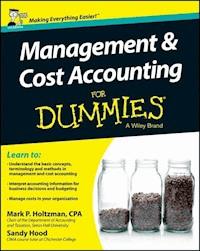
With easy-to-understand explanations and real-life examples, Management & Cost Accounting For Dummies provides students and trainees with the basic concepts, terminology and methods to identify, measure, analyse, interpret, and communicate accounting information in the context of managerial decision-making.
Major topics include:
- cost behaviour
- cost analysis
- profit planning and control measures
- accounting for decentralized operations
- budgeting decisions
- ethical challenges in management and cost accounting
Sie lesen das E-Book in den Legimi-Apps auf:
Seitenzahl: 454
Veröffentlichungsjahr: 2013
Ähnliche


















Management & Cost Accounting For Dummies®
Published by: John Wiley & Sons, Ltd., The Atrium, Southern Gate, Chichester, www.wiley.com
This edition first published 2013
© 2013 John Wiley & Sons, Ltd, Chichester, West Sussex.
Registered office
John Wiley & Sons Ltd, The Atrium, Southern Gate, Chichester, West Sussex, PO19 8SQ, United Kingdom
For details of our global editorial offices, for customer services and for information about how to apply for permission to reuse the copyright material in this book please see our website at www.wiley.com.
The right of the author to be identified as the author of this work has been asserted in accordance with the Copyright, Designs and Patents Act 1988.
All rights reserved. No part of this publication may be reproduced, stored in a retrieval system, or transmitted, in any form or by any means, electronic, mechanical, photocopying, recording or otherwise, except as permitted by the UK Copyright, Designs and Patents Act 1988, without the prior permission of the publisher.
Wiley publishes in a variety of print and electronic formats and by print-on-demand. Some material included with standard print versions of this book may not be included in e-books or in print-on-demand. If this book refers to media such as a CD or DVD that is not included in the version you purchased, you may download this material at http://booksupport.wiley.com. For more information about Wiley products, visit www.wiley.com.
Designations used by companies to distinguish their products are often claimed as trademarks. All brand names and product names used in this book are trade names, service marks, trademarks or registered trademarks of their respective owners. The publisher is not associated with any product or vendor mentioned in this book.
Limit of Liability/Disclaimer of Warranty: While the publisher and author have used their best efforts in preparing this book, they make no representations or warranties with the respect to the accuracy or completeness of the contents of this book and specifically disclaim any implied warranties of merchantability or fitness for a particular purpose. It is sold on the understanding that the publisher is not engaged in rendering professional services and neither the publisher nor the author shall be liable for damages arising herefrom. If professional advice or other expert assistance is required, the services of a competent professional should be sought.
For general information on our other products and services, please contact our Customer Care Department within the U.S. at 877-762-2974, outside the U.S. at (001) 317-572-3993, or fax 317-572-4002. For technical support, please visit www.wiley.com/techsupport.
For technical support, please visit www.wiley.com/techsupport.
A catalogue record for this book is available from the British Library.
ISBN 978-1-118-65049-3 (pbk), ISBN 978-1-118-65046-2 (ebk), ISBN 978-1-118-65047-9 (ebk)
Printed in Great Britain by TJ International Ltd, Padstow, Cornwall
10 9 8 7 6 5 4 3 2 1
Management & Cost Accounting For Dummies®
Visit www.dummies.com/cheatsheet/mgmtcostaccountinguk to view this book's cheat sheet.
Table of Contents
Introduction
About This Book
What You’re Not to Read
Foolish Assumptions
How This Book Is Organised
Part I: Getting Started with Management and Cost Accounting
Part II: Understanding and Managing Costs
Part III: Planning and Budgeting
Part IV: Using Management Accounting for Evaluation and Control
Part V: The Part of Tens
Icons Used in This Book
Where to Go from Here
Part I: Getting Started with Management and Cost Accounting
Chapter 1: Planning and Control: The Role of Management Accounting
Understanding What Management Accountants Do, and Why
Distinguishing management from financial accounting
Identifying costs
Analysing costs
Planning and budgeting
Evaluating and controlling operations
Gathering information needed for decisions
Concentrating on Costs
Defining types of costs
Predicting cost behaviour
Driving overhead
Costing jobs and processes
Distinguishing relevant costs from irrelevant costs
Accounting for the Future: Planning and Budgeting
Analysing contribution margin
Budgeting capital for assets
Choosing what to sell
Pricing goods
Setting up a master budget
Flexing your budget
Exercising Control
Allocating responsibility
Analysing variances
Producing a cycle of continuous improvement
Getting Certified
Following the code of ethics
Becoming a chartered global management accountant
Chapter 2: Using Management Accounting in Your Business
Classifying Companies by Their Output
Checking out service companies
Perusing retailers
Looking at manufacturers
Measuring Profits
Earning revenues
Computing Cost of Sales
Incurring operating expenses
Measuring Net Profit
Working out the Operating Profit Margin
Meeting the Three Es of Performance
Making comparisons using the three Es
Assessing Asset Turnover
Putting Profitability and Productivity Together: Return on Capital Employed
Part II: Understanding and Managing Costs
Chapter 3: Classifying Direct and Indirect Costs
Distinguishing Direct from Indirect Manufacturing Costs
Costing direct materials and direct labour
Understanding indirect costs: Production overhead
Valuing Inventory of Materials and Finished Goods
Completing an inventory record
Finding out about First-In First-Out
Making use of Average Cost (AVCO)
Learning about Last-In First-Out
Examining the Treatment of Labour Costs within the Accounting System
Working with overtime premium
Analysing timesheets
Two Other Ways to Classify Costs
Assessing conversion costs
Telling the difference between product and period costs
Chapter 4: Allocating, Apportioning and Absorbing Overhead
Introducing Budgeting Overhead Costs
Charging Production Overheads into Products: Traditional Approach
Calculating overhead allocation
Allocating and apportioning overhead
Re-apportioning production service centre overhead
Absorbing overhead as part of product costs
Dealing with overhead as work is carried out
Reporting on overhead and overhead absorbed: Monthly management accounts
Taking Advantage of Activity-Based Costing for Overhead Allocation
Identifying the major activities in the organisation
Creating a cost pool for each activity
Determining the cost driver for each major activity
Assigning the cost of activities to products according to the product’s demand for activities
Working Through an Example: Rusbridge Limited
Chapter 5: Costing Products Flowing Through a Business
Tracking the Flow of Products
Following the Phases of Production and Sale
Accounting for direct costs and production overhead
Charging (debit) production costs to work-in-progress
Crediting work-in-progress when products become finished goods
Chalking up the inventory and charging Cost of Goods Sold
Creating the income statement
Cracking Cost of Goods Sold
Computing Units Sold
Chapter 6: Job Costing: Pricing Individual Orders
Keeping Records in a Job Costing System
Getting the paperwork in order
Allocating overhead
Completing the job cost calculation
Understanding the Accounting for Job Costing
Purchasing raw materials
Paying for direct labour
Paying for overhead
Requisitioning raw materials
Using direct labour
Applying overhead
Chapter 7: Process Costing: Tracking What’s Produced and How Much it Costs
Comparing Process Costing and Job Costing
Maintaining Process-Costing Books
Debiting and crediting
Keeping track of costs
Moving units through your factory – and through the books
Meeting the two key aspects of process costing
Demonstrating Process Costing in Action
Introducing the Process Account
Valuing the WIP: The Cost of Production Report as a workings table
Chapter 8: Observing How Variable and Fixed Costs Behave
Investigating Cost Behaviour
Understanding that how much you produce and/or sell affects variable costs
Discovering what causes fixed costs to change
Separating Semi-variable Costs into Variable and Fixed Components
Employing the high–low method
Analysing accounts
Using a scattergraph
Fitting a regression
Sticking to the Relevant Range
Part III: Planning and Budgeting
Chapter 9: Using Contribution Analysis to Make Better Decisions
Calculating the Contribution
Looking at the big picture: Total contribution
Narrowing your focus: Contribution per unit
Considering contribution as a proportion of sales: C/S ratio
Meeting Net Profit Targets with Cost-Volume-Profit Analysis
Drafting a cost-volume-profit graph
Finding the total contribution
Discovering contribution per unit
Using the C/S ratio
Bringing up Break-Even Analysis
Drawing a graph to find the break-even point
Employing the formula approach
Modifying to Achieve a Target Profit
Feeling Secure: Margin of Safety
Depicting margin of safety with a graph
Making use of formulas
Revealing volume: Profit volume graph
Juggling Variable and Fixed Costs: Operational Gearing
Identifying decision points – when to invest in fixed cost production methods
Deciding when to outsource products
Graphing operational gearing
Looking at the operational gearing formula
Using contribution with a mix of products
Chapter 10: Decision-Making within the Reality of Limited Capacity
Understanding the Reality of Limited Resources
Coping with limited capacity
Identifying limiting factors
Focusing on Relevant Costs
Distinguishing the relevant costs
Accounting for opportunity costs
Ignoring Certain Costs Safely: Irrelevant Costs
Diving into sunk costs
Considering committed costs
Chapter 11: Deciding on Long-Term Purchases: Capital Budgeting
Identifying Incremental and Opportunity Costs
Getting Your Money Back: The Payback Technique
Using the payback method
Finding the payback period
Understanding Time Value of Money and Net Present Value (NPV)
Homing in on NPV and decision-making
Calculating the present value
Working that NPV
Putting Payback and NPV into Practice
Task the first: Payback
Task the second: NPV
Tackling tax
Investigating Internal Rate of Return (IRR)
Looking beyond the Numbers: Qualitative Factors
Chapter 12: Naming Your Price: Approaches to Decision-Making
Differentiating Products to Decide on Prices
Taking All Costs into Account: Absorption Costing
Pricing at Cost-Plus
Calculating fixed mark-ups
Setting a cost-plus percentage
Considering problems with cost-plus pricing
Short-Term Pricing Based on Relevant Costs
Hitting Your Bull’s-Eye: Target Costing
Calculating your target cost
Knowing when to use target costing
Carrying out value engineering
Acting after value engineering is carried out
Chapter 13: Doing Deals between Company Divisions: Transfer Prices
Pinpointing the Importance of Transfer Pricing
Setting out the problem
Resolving discord and creating harmony
Negotiating a Transfer Price
Finding the selling division’s minimum transfer price
Setting the purchasing division’s maximum transfer price
Trying to meet in the middle
Managing with full capacity
Transferring Goods between Divisions at Cost
Setting the transfer price at variable cost
Establishing the transfer price at variable cost plus a mark-up
Basing transfer price on full cost
Positioning Transfer Price at Market Value
Chapter 14: Planning Budgets for the Future
Preparing a Manufacturer’s Master Budget
Budgeting backwards
Obtaining a sales budget
Generating a production budget
Setting a direct materials budget
Working on a direct labour budget
Building an overhead budget
Adding up the product cost
Fashioning a selling and administrative budget
Creating a cash budget
Constructing a budgeted income statement
Applying Master Budgeting to Non-Manufacturers
Budgeting for a retailer
Co-ordinating a service company’s budget
Moving Beyond Budgeting
Rolling forecasts and plans
Moving away from tradition
Part IV: Using Management Accounting for Evaluation and Control
Chapter 15: Using Flexible Budgets to Exert Control
Appreciating the Need to Control Your Business
Dealing with Budget Variances
Example exam question 1: Comparing the fixed budget and the actual results
Example exam question 2: Comparing a flexed budget and the actual results
Dealing with variances
Implementing a Flexible Budget
Separating fixed and variable costs
Comparing the flexible budget to actual results
Chapter 16: Variance Analysis: Flexing Standard Costs
Setting Up Standard Costs
Discovering the different types of standards
Establishing direct materials standards
Determining direct labour standards
Calculating the overhead rate
Adding up standard cost per unit
Identifying Factors that Give Rise to Variances
Working out the direct materials variances usage and price
Finding direct labour variances efficiency and rate
Calculating variable overhead variances
Figuring out fixed overhead variances
Viewing the full worksheet – cost variances
Reporting variances to management: Operating Statement
Remembering key facts that are always true
Watching out for other things
Teasing Out Variances
Focusing on the big numbers
Tracing little numbers back to big problems
Chapter 17: Establishing Accountability with Responsibility Accounting
Linking Strategy with an Organisation’s Structure
Allocating responsibility
Decentralising decision-making
Distinguishing controllable from non-controllable costs
Identifying Different Kinds of Responsibility Centres
Revenue centres: Scoring on sales only
Cost centres: Counting costs
Profit centres: Controlling revenues and expenses
Investment centres: Being responsible for the lot
Chapter 18: The Balanced Scorecard: Reviewing Your Business’s Report Card
Introducing the Balanced Scorecard: Key to Strategy
Making money: The financial perspective
Ensuring your clients are happy: The customer perspective
Keeping the clock ticking: The internal business perspective
Appraising the ability to change and improve: The learning and growth perspective
Demonstrating the Balanced Scorecard in Action
Sketching a strategy that incorporates all four perspectives
Identifying measures for the balanced scorecard
Testing Times: Exam Advice
Measuring performance
Contributing towards improved profits
Explaining performance measures
Chapter 19: Squeezing Out of a Tight Spot with the Theory of Constraints
Understanding the Nature of Constraints
Identifying manufacturing constraints
Considering service constraints
Managing Processes with the Theory of Constraints
Step 1: Identifying system constraints
Step 2: Exploiting the constraint
Step 3: Subordinating everything to the constraint
Step 4: Breaking the constraint
Step 5: Returning to Step 1
Putting you to the test: Exam tip
Part V: The Part of Tens
Chapter 20: Ten Key Management Accounting Formulas
The Accounting Equation: Working with Assets and Liabilities
Profit: Focusing on the Bottom Line
Cost of Goods Sold: Handling Inventory
Contribution: Measuring the Impact of Decisions on Profit
Cost-Volume-Profit Analysis: Considering the Effects of Changing Volume
Break-Even Analysis: Ensuring You Don’t Make a Loss
Calculating the Effect of Direct Materials Price Variance on Total Cost
Determining the Effect of Direct Materials Usage Variance on Total Cost
Future Value: Computing the Value of a Cash Investment
Present Value: Deciding How Much to Invest
Chapter 21: Ten Careers in Management Accounting
Corporate Treasurer
Chief Financial Officer
Financial Controller
Group Accountant
Financial Analyst
Cost Accountant
Budget Analyst
Internal Auditor
Fixed-Assets Accountant
Cash-Management Accountant
About the Authors
Cheat Sheet
Connect with Dummies
Introduction
Language is a funny thing, necessary but full of pitfalls. After all, as humorist Franklin P. Jones wrote, ‘skating on thin ice can get you into hot water’! But if, as people say, accounting is the language of business, management accounting is the language inside a business. Accountants establish specific definitions for terms such as revenue, expense, gross profit, assets and liabilities. Everyone uses these same definitions when they announce and discuss these attributes, so that when a company reports sales revenue, for example, investors and other businesspeople understand how that figure was calculated. This way, companies, investors, managers and everyone else in the business community speak the same language – a language for which accountants wrote the dictionary.
Management accounting allows a company’s managers to understand how their business operates, and gives them the information needed to make decisions. It helps them plan their business’s activities and control its operations. For example, suppose that a marketing executive needs to set a price for a new product. To do so, that person needs to understand how much the product costs to produce, which is where management accounting comes in. Furthermore, the price needs to be set at an appropriate level so that at the end of the year (after the company sells all the products it’s supposed to sell at whatever prices it sets), the firm earns the profit and cash flow that it projected. Here, too, management accounting proves its usefulness.
We often take management-accounting classes, and we always like to point out to students who the users of management-accounting information usually are: the managers, marketing professionals, financial analysts and information systems professionals working within a company. All have a role not only in developing management accounting information, but also and more importantly in using it to make better business decisions.
About This Book
If you accept that management accounting is the language inside a business, clearly running a business without understanding this topic is pretty difficult. Therefore, we’ve written this book for businesspeople – present and future – who want to better understand how to use management accounting to make decisions and how management accountants develop the information in reality.
We have a confession to make: we really love to do accounting, especially management accounting. And better yet, we love to convey our knowledge and enthusiasm for it. We believe that contribution margin (see Chapter 9) is the greatest thing since sliced bread and that the theory of constraints can solve most of life’s problems (see Chapter 19).
In our view, an urgent need exists to redress the balance – to counter the bad rap that accounting gets for being boring (even financial accountants, of all people, trash their poor management brethren for being the most boring of all accountants). We want to show what we believe makes management accounting engaging and (yes) exciting, right here in this book.
Therefore, when you start reading our handiwork and find that you can’t put this book down, don’t blame us and our lame little puns. Instead, appreciate that after you start discovering accounting, it can be quite difficult to stop.
What You’re Not to Read
We tried to write this book so that it spellbinds you, so that you can’t stop reading until you’ve consumed every last word (though we don’t mind if you’re tempted to peek at the last few pages to see how it ends!).
That said, if you’re very busy, feel free to focus on the most important stuff that you need to know and skip some of these less important elements:
Technical stuff: Anything marked with this icon is especially interesting to management-accounting geeks like us. But if you’re in a rush, you can skip these paragraphs safe in the knowledge that you aren’t missing anything essential.
Sidebars: These fascinating grey-shaded boxes include additional information that we think you may like, but you can pick up management accounting just fine without reading them.
Foolish Assumptions
We assume that you’re one of the following:
A college student taking a management-accounting course who needs some help understanding the topics you’re covering in class. Specifically, you’ll certainly find this book helpful supplementary reading if you’re taking the level 3 and 4 AAT courses, or operational or managerial level CIMA courses, or the fundamental ACCA courses.
A businessperson or entrepreneur who wants to know more about how to collect accounting information to make better business decisions.
A recent college graduate interested in pursuing a career in management accounting, perhaps as a chartered management accountant.
A professional accountant or bookkeeper looking for a straightforward refresher in the basics of management accounting.
How This Book Is Organised
Each of the five parts of this book tackles a different aspect of management accounting. The following sections explain how we organise the information so that you can find what you need quickly and easily.
Part I: Getting Started with Management and Cost Accounting
Part I gives you a taste of what management accounting is and why it’s important. The chapters also review some important aspects of accounting that every businessperson needs to know. We hit profitability, efficiency, productivity and continuous improvement especially hard.
Part II: Understanding and Managing Costs
At its crux, management accounting is all about costs – be they direct, indirect, overhead or whatever – and how they behave. Part II explores the world of costs – what drives them up, down or sideways.
Part III: Planning and Budgeting
An important part of managing an organisation is planning for the future, and management accountants play a critical role in this process by preparing budgets, the topic of Part III. These budgets integrate information from every part of an organisation to develop a plan to meet managers’ goals.
Part IV: Using Management Accounting for Evaluation and Control
Accountants have a reputation for being control freaks, but it’s part of the job. Managers and management accountants not only plan but also need to control. This duty means that they monitor a company’s performance carefully and compare that performance to their budgets. In this way, managers can identify and address problems quickly, before they become crises. We describe how managers can flex their budgets – that is, prepare budgets that can adapt to changing facts and circumstances. Part IV also explains how to evaluate and control the activities throughout an organisation, including using responsibility accounting, variance analysis and two techniques that managers use to run their companies: the balanced scorecard and the theory of constraints.
Part V: The Part of Tens
The chapters in this part provide you with a quick reference to the most important formulas in the book. We also share some career options for management accountants.
Hop online and visit www.dummies.com/extras/managementcostaccountinguk for a bonus Part of Tens chapter 'Ten Ratios to Know for Management Accountants', which includes helpful exam practice.
Icons Used in This Book
Throughout the margins of this book, we use certain symbols to emphasise important points. Watch for these icons:
This icon marks simple hints that can help you solve problems on tests and in real-life management accounting situations.
We use this icon to highlight information that’s especially important to keep in mind. Tucking these facts away helps you keep key concepts at your fingertips.
This icon pops up alongside examples (surprise, surprise!) that show you how to apply an idea to real-world accounting problems.
Like building Titanic II, not every idea is a good idea. This icon alerts you to situations that require caution. Iceberg ahead!
We just had to share these interesting snippets of knowledge with you. If you’re in a hurry, however, don’t panic; just skip them.
This icon shows where we provide an exercise for you to try, so that you get to put some of your recently acquired expertise into practice.
Where to Go from Here
All the chapters in this book are modular, and so you can study and understand them without reading other chapters. Just go through the table of contents and select a subject that you want to know more about. We provide cross references to topics in other chapters where appropriate, so that if you skip a foundational concept crucial to what you’re reading about, you know where to find what you need.
If you’re looking to discover management accounting from scratch, or to unlearn some aspect that you fear you’ve got wrong, start with Part I to get the basics under your belt. We take special care to explain all the fundamentals that some management accounting texts skip. If you’re a student with little or no background in accounting, make a point to read Chapter 2.
Management accounting itself is built on a few basic principles. In our experience, most students who have trouble with management accounting usually improve their performance after becoming more familiar with these basics. Therefore, to better understand these foundations, take a look at Chapter 3 (cost principles), Chapter 8 (cost behaviour) and Chapter 9 (contribution margin).
If you’re studying for an accountancy exam, make sure that you know the relevant key formulas in Chapter 20.
Part I
Getting Started with Management and Cost Accounting
For Dummies can help you get started with lots of subjects. Visit www.dummies.com to learn more and do more with For Dummies.
In this part . . .
Discover what management accountants do and why they do it.
Find out what you can do to become a management accountant.
Learn how different kinds of companies operate.
Know how accountants measure profits, efficiency and productivity.
Find out how managers apply continuous improvement.
Chapter 1
Planning and Control: The Role of Management Accounting
In This Chapter
Appreciating the importance of management accounting
Costing business activities
Planning for profits and cash flow
Monitoring and evaluating company performance
Before embarking on a journey, you need a clear plan. Even if you’re driving a familiar route and know where you’re going and how you intend to get to your destination, you may well have landmarks along the way in mind. Perhaps you plan to take an hour to reach the motorway, spend another hour on it and allow 20 minutes for the final section of your trip.
Lesen Sie weiter in der vollständigen Ausgabe!
Lesen Sie weiter in der vollständigen Ausgabe!
Lesen Sie weiter in der vollständigen Ausgabe!
Lesen Sie weiter in der vollständigen Ausgabe!
Lesen Sie weiter in der vollständigen Ausgabe!
Lesen Sie weiter in der vollständigen Ausgabe!
Lesen Sie weiter in der vollständigen Ausgabe!
Lesen Sie weiter in der vollständigen Ausgabe!
Lesen Sie weiter in der vollständigen Ausgabe!
Lesen Sie weiter in der vollständigen Ausgabe!
Lesen Sie weiter in der vollständigen Ausgabe!
Lesen Sie weiter in der vollständigen Ausgabe!
Lesen Sie weiter in der vollständigen Ausgabe!
Lesen Sie weiter in der vollständigen Ausgabe!
Lesen Sie weiter in der vollständigen Ausgabe!
Lesen Sie weiter in der vollständigen Ausgabe!
Lesen Sie weiter in der vollständigen Ausgabe!
Lesen Sie weiter in der vollständigen Ausgabe!
Lesen Sie weiter in der vollständigen Ausgabe!
Lesen Sie weiter in der vollständigen Ausgabe!
Lesen Sie weiter in der vollständigen Ausgabe!
Lesen Sie weiter in der vollständigen Ausgabe!
Lesen Sie weiter in der vollständigen Ausgabe!
Lesen Sie weiter in der vollständigen Ausgabe!
Lesen Sie weiter in der vollständigen Ausgabe!
Lesen Sie weiter in der vollständigen Ausgabe!
Lesen Sie weiter in der vollständigen Ausgabe!




