


62,99 €
Mehr erfahren.
- Herausgeber: John Wiley & Sons
- Kategorie: Fachliteratur
- Sprache: Englisch
This new edition examines management of built heritage through the use of values-led decision making, based on an understanding of the significance of the cultural asset. It considers how significance is assessed and used as an effective focus and driver for management strategies and processes.
The authors consider key policies and procedures that need to be implemented to help ensure effective management. The book will be useful for specialists in built heritage - conservation officers, heritage managers, architects, planners, engineers and surveyors - as well as for facilities and estates managers whose building stock includes protected or designated structures or buildings in conservation or other historic areas.
- describes management strategies and tools for a wide range of built heritage assets
- a reflective and informative guide on current conservation management
- explains how understanding and using conservation values (significance ) is essential to the protection of the built heritage
- uses real-life examples to draw out best practice
Sie lesen das E-Book in den Legimi-Apps auf:
Seitenzahl: 516
Veröffentlichungsjahr: 2016
Ähnliche


















Managing Built Heritage
The Role of Cultural Values and Significance
SECOND EDITION
Stephen Bond
Heritage Places UK
Derek Worthing
Uppsala University Sweden
This edition first published 2016 © 2016 Stephen Bond and Derek Worthing First Edition published in 2008
Registered OfficeJohn Wiley & Sons Ltd, The Atrium, Southern Gate, Chichester, West Sussex, PO19 8SQ, United Kingdom
For details of our global editorial offices, for customer services and for information about how to apply for permission to reuse the copyright material in this book please see our website at www.wiley.com.
The right of the author to be identified as the author of this work has been asserted in accordance with the Copyright, Designs and Patents Act 1988.
All rights reserved. No part of this publication may be reproduced, stored in a retrieval system, or transmitted, in any form or by any means, electronic, mechanical, photocopying, recording or otherwise, except as permitted by the UK Copyright, Designs and Patents Act 1988, without the prior permission of the publisher.
Wiley also publishes its books in a variety of electronic formats. Some content that appears in print may not be available in electronic books.
Designations used by companies to distinguish their products are often claimed as trademarks. All brand names and product names used in this book are trade names, service marks, trademarks or registered trademarks of their respective owners. The publisher is not associated with any product or vendor mentioned in this book.
Limit of Liability/Disclaimer of Warranty: While the publisher and author have used their best efforts in preparing this book, they make no representations or warranties with respect to the accuracy or completeness of the contents of this book and specifically disclaim any implied warranties of merchantability or fitness for a particular purpose. It is sold on the understanding that the publisher is not engaged in rendering professional services and neither the publisher nor the author shall be liable for damages arising herefrom. If professional advice or other expert assistance is required, the services of a competent professional should be sought.
Library of Congress Cataloging-in-Publication Data
Bond, Stephen, 1955- author. Managing built heritage : the role of cultural values and significance / Stephen Bond and Derek Worthing. – Second Edition. pages cm Includes bibliographical references and index. ISBN 978-1-118-29875-6 (pbk.) 1. Historic buildings--Conservation and restoration. 2. Historic sites -- Management. 3. Historic buildings -- Management. 4. Cultural property -- Management. I. Worthing, Derek, author. II. Title. TH3401.W675 2015 363.6′9--dc23
2015024769
A catalogue record for this book is available from the British Library.
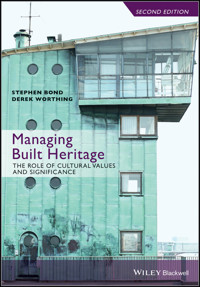
Cover image: Copenhagen © Derek Worthing.
CONTENTS
About the Authors
Chapter 1 Introduction
Note
References
Chapter 2 Heritage Assets: Their Nature and Management Implications
Introduction
Some introductory thoughts about heritage assets
Heritage assets and their management implications
Owners, managers and management approaches
References
Chapter 3 Heritage Values and Cultural Significance
Benefits of conservation
Understanding the cultural significance of a heritage asset
Development in the idea of values
Value characterisation: typologies
Categories of values
Some examples of assets and their values
References
Chapter 4 Assessing Significance
Establishing and analysing the origins and development of an asset
Gathering evidence about significance
Research and types of evidence
Primary source material
Secondary material
Interpreting the building/physical remains
Establishing and analysing the character, dynamics and setting of the asset
Assessing community values
Analysing significance
Assessing significance: comparisons and relativity
Comparisons
Some issues in value assessment
Sensitivity to change
References
Chapter 5 Using Significance in Management Tools and Processes
Introduction
The conservation plan
The management plan
Management tools for historic areas
Historic area appraisals
Characterisation
Heritage impact assessments
Heritage statements within the development planning process
Local management agreements
Care, design and quality standards guidance
References
Chapter 6 Maintenance Management
Introduction
A strategic perspective
Recording
Financial management of maintenance management
Information management in maintenance management
Performance indicators
References
Chapter 7 Sustainability, Built Heritage and Conservation Values: Some Observations
Introduction
Sustainable development
Sustainability and the built heritage
Trade-offs
Charters and guidance documents
Sustainable management of historic buildings
References
Chapter 8 Conservation Principles
Introduction
Development of conservation principles
Core conservation principles
The relationship between significance-based management and traditional conservation principles
References
Chapter 9 Case Studies
Case Study 1: Royal Dart Hotel, Kingswear, Devon, England
Case Study 2: Baixa, Maputo, Mozambique
Case Study 3: The Site of the Former Taunton Gaol, Taunton, Somerset, England
Case Study 4: Maintaining the Commonwealth War Graves
References
Index
EULA
List of Tables
Chapter 3
Table 3.1
Chapter 5
Table 5.1
Table 5.2
Table 5.3
Table 5.4
List of Illustrations
Chapter 2
Figure 2.1
Ephesus is a well-known archaeological site in Turkey (a, b). The library of Celsus is shown in (c).
Figure 2.2(a)-(c)
Examples of archaeological sites that are to be found in Coventry (a), (b). The
SS Great Britain
, which is moored in the Harbour at Bristol, is a Scheduled Monument (c).
Figure 2.3
Subak in Bali – a cultural landscape shaped by centuries of use and Hindu custom.
Figure 2.4(a)-(c)
Silbury Hill in Wiltshire (a) lies in close proximity to the standing stones at Avebury (b) and (c). They are both part of the wider cultural landscape in this area that includes Stonehenge. Silbury Hill is the largest man-made mound from prehistoric Europe (at 40 metres). Its purpose is unknown. Silbury Hill was built approximately 4600 years ago at about the time that Avebury was being completed.
Figure 2.5 (a)–(c)
The Colleges of Oxford University are a historic urban estate. Photograph (c) courtesy of Lee Stickells.
Figure 2.6 (a),(b)
The
Spaarndammerplantsoen
in Amsterdam is another example of a historic urban estate.
Figure 2.7 (a),(b)
The Barbican development in the City of London.
Figure 2.8 (a)–(c)
In Conservation Areas, both the buildings and the spaces between buildings are important.
Figure 2.9
The remarkable survival of Barcelona's historic city plan. Copyright QuickBird © Digital Globe, 2001, distributed and by courtesy of Eurimage.
Figure 2.10
The Sydney Opera House is a World Heritage Site.
Figure 2.11 (a),(b)
Pamukkale in Turkey is an example of a natural site on the World Heritage list.
Figure 2.12
Ha-Long Bay in Vietnam is another example of a natural site on the World Heritage list.
Figure 2.13 (a)–(c)
Venice (with the Lagoon) is an example of a city that is a World Heritage Site.
Figure 2.14 (a)–(d)
The City of Bath is a World Heritage site; much of it is also defined as Conservation Areas. In addition, it contains many individually protected scheduled monuments and listed buildings. Photographs (c and d) courtesy of John Bailey.
Figure 2.15
View across the former Central Docks in Liverpool: The boundaries of World Heritage Sites and their buffer zones can sometimes be complex. Here, the dock space in the foreground, including Victoria Clock Tower to the right, is part of one of six character areas in the Liverpool Maritime Mercantile World Heritage Site. The empty space behind is part of the World Heritage Site's buffer zone. Beyond that, in turn, is another small ‘island’ of the same World Heritage Site character zone, then another section of buffer zone (where high rise buildings can be seen), and finally in the distance a second character area of the World Heritage Site where the two towers of the Liver Building are just visible. This arrangement makes consideration of settings and management of development impacts highly problematic.
Figure 2.16 (a)–(b)
The Tower of London and its modern urban setting in 2006 and 2013.
Chapter 3
Figure 3.1
Sydney Harbour Bridge.
Figure 3.2
The Eiffel Tower.
Figure 3.3 (a)–(c)
Coventry Cathedral. The ‘new’ Coventry Cathedral is a post-war Grade I listed building (a). It contains many specially commissioned works of art, including Graham Sutherland's tapestry of Christ (b). The ruins of the medieval Cathedral were incorporated into the new design (c).
Figure 3.4
The Palm House at Kew Gardens.
Figure 3.5 (a),(b)
The Byker Estate in Newcastle upon Tyne.
Figure 3.6
St Paul's Cathedral, London.
Figure 3.7 (a),(b)
The Bauhaus, Dessau.
Figure 3.8
The Radiator Building (foreground) and the Empire State Building, New York.
Figure 3.9
Lutyen's Great War memorial on Tower Hill in London.
Figure 3.10
Parkhill housing estate, Sheffield. The estate consisted of nearly 1000 dwellings in a ‘streets in the sky’ design inspired by the work of the architect Le Corbusier. The photograph shows the existing structure alongside recent ‘remodelling’ work.
Chapter 5
Figure 5.1 (a),(b)
Important historic landscape features in an overgrown state within the reserve.
Figure 5.2 (a),(b)
Historic areas take many forms. Here, views of university buildings within Tyndall's Park Conservation Area in Bristol (a), and along the High Street in the Dorset village of Sydling St Nicholas (b). Despite their considerable differences, some key issues, such as the management of street furniture, bollards, cables and the like, are often similar.
Figure 5.3
Hampton Court Palace. Historic Royal Palaces developed what was, in effect, a local management agreement with English Heritage which applied to all five of the palaces in its care.
Figure 5.4
Nineteenth-century terraced housing in East Lancashire – unlisted but deserving of proper care steered by value-based quality standards guidance.
Figure 5.5
An example of the wealth of decorative detail to housing within the Aldersbrook Estate Conservation Area.
Chapter 6
Figure 6.1 (a),(b)
The cost of items, such as scaffolding, which are necessary to gain access and work effectively on roofs, spires and walls, etc. may have an effect on decisions about such issues as ‘minimum intervention’.
Figure 6.2
A ‘cherry picker’ being used to inspect the Wellington Monument.
Figure 6.3
Evidence of extensive past repair of varying kinds and ongoing fracturing and opening of stonework joints immediately above the junction between different construction phases roughly 37 metres above ground level on the Wellington Monument in Somerset.
Figure 6.4
Ongoing fragmentation of previously repaired stone ornament on the tower of a nineteenth-century mansion roughly 48 metres above ground level. Almost every similar feature on the tower (of which there were many) exhibited similar defects, in each case caused by corrosion of concealed iron rods and cramps.
Figure 6.5
Taylor's 1890s wing of the former Public Record Office (also known as the Rolls Estate) in Chancery Lane, London.
Chapter 8
Figure 8.1
The story that the fabric of a building can tell is illustrated by the town walls of Spoleto. It is important that all the significant developments of a place are respected. Photograph courtesy of Tony Bryan.
Figure 8.2 (a), (b)
An example of an ‘honest repair’ to concrete on the Grade 2 star Parkhill estate in Sheffield, South Yorkshire, England.
Figure 8.3
These late nineteenth-century metal buttresses (or
stötta
in Swedish), which are used as props on a section of the medieval town wall in Visby, Gotland, are a good example of honesty, reversibility and minimum intervention.
Chapter 9
Figure 9.1
The Royal Dart Hotel beside Kingswear Station, with the upper part of the town of Dartmouth behind on the hill across the River Dart.
Figure 9.2
The Royal Dart Hotel forms the focal point of the view down Fore Street towards the river.
Figure 9.3
An Art Deco structure in front of Maputo's main railway station.
Figure 9.4 (a), (b)
Buildings within Baixa's planned industrial zone.
Figure 9.5
Buildings by architect Pancho Guedes near to the main railway station.
Figure 9.6
The 1942 police station frontage building on the site of the former Taunton Gaol.
Figure 9.7 (a)–(c)
The inspirational Memorial and Commonwealth War Grave Cemetery at Cassino between Naples and Rome in Italy, designed by architect, Louis de Soissons, who was also the master planner of Welwyn Garden City.
Figure 9.8
The recently rebuilt entrance feature to the First World War Military Cemetery at Hebuterne in France's Pas de Calais.
Guide
Cover
Table of Contents
Chapter
Pages
ix
1
2
3
4
5
6
7
8
9
11
12
13
14
15
16
17
19
20
21
22
23
24
27
28
29
30
31
32
33
34
35
36
37
38
40
41
42
43
44
45
46
47
48
49
50
51
52
53
54
55
56
57
58
59
60
61
62
63
65
66
67
68
69
70
71
72
73
75
77
80
82
83
85
86
87
88
89
90
91
92
93
94
95
96
97
98
99
100
101
102
103
104
105
106
107
108
109
110
111
112
113
114
115
116
117
118
119
121
122
123
124
125
126
127
128
129
130
131
132
133
134
135
136
137
138
139
140
141
142
143
144
145
146
147
148
149
151
152
153
154
155
156
157
158
159
160
161
162
166
167
169
170
171
172
173
174
175
176
177
178
179
180
181
182
183
184
185
187
188
189
190
191
192
193
194
195
197
198
199
200
201
202
203
204
205
206
207
208
209
210
211
212
213
214
215
216
217
218
219
220
221
222
223
224
225
226
227
228
229
230
231
232
233
234
235
236
237
238
239
240
241
243
245
246
247
248
249
250
251
252
253
254
255
256
257
258
259
260
261
263
264
265
266
267
268
269
270
About the Authors
Stephen Bond runs the UK-based consultancy, Heritage Places, providing advice on the historic environment to national and local government, management and institutional clients, and charitable trusts. In the 1990s, he undertook a seven-year secondment to Historic Royal Palaces, initially as its Surveyor of the Fabric, and subsequently as Director of the Tower Environs Scheme – a major regeneration scheme focused on the urban setting of the Tower of London. Today he works throughout the UK and on international projects, most recently providing heritage input into area-wide plans and capacity building programmes in Africa, Asia and Europe. He was involved with the Master's Programme in Conservation of the Historic Environment at the College of Estate Management for more than 20 years, lectures widely on heritage matters, and holds an honorary doctorate from De Montfort University.
Derek Worthing has a professional background as an academic and a Chartered Building Surveyor. Until recently he was Head of the School of Land and Property Management at the University of the West of England, Bristol, where he was also co-director of the Centre for the Study of Sustainable Buildings in the Faculty of the Built Environment. He has carried out consultancy work in relation to the built cultural heritage for a number of national UK heritage organisations and has published research papers in relation to conservation plans and the maintenance and repair of listed buildings. He now works as a consultant and as a Visiting Professor at Uppsala University in Sweden where he has carried out research on the sustainable management of built cultural heritage as well as work on conservation plans for the Swedish Heritage Board.
Chapter 1Introduction
In recent years, increasing focus has been placed upon the identification of heritage values that are enshrined in our built environment and in cultural landscapes. This is based on the notion that all buildings and spaces, whatever their age and however modest, make some form of contribution or have value to society.
This book is primarily concerned with how heritage is managed in order to protect and enhance it. Although it focuses on built heritage, we believe the principles and processes that we discuss are applicable to many aspects of cultural heritage. The book brings together our experience of research, consultancy and practice over a number of years, and integrates this with current thinking on approaches to the management of built heritage. It inevitably, and deliberately, does this within the context of a discussion of the benefits and the value of conserving heritage. In our view, this remains a much-needed publication. More than seven years after the first edition, surprisingly little has been written and published on the practical application of heritage values and its importance to the management of heritage assets. This is disconcerting, given that the need to assess significance and use it to manage change is being ‘written in’ to heritage policy in an increasing number of countries around the world.
This book is chiefly about the important role that effective management plays in protecting and enhancing the historic environment. It concerns itself with what has now become known in some quarters as ‘values-based management’, but which we have referred to generally as ‘significance-based management’. Essentially the book is concerned with the need to identify and assess what is important about a heritage asset, and with devising management strategies, processes and actions that focus on the need to protect and enhance those values.
The collection of values associated with a heritage asset is generally referred to as its ‘significance’. The idea of significance has been around for some time, but it was perhaps clearly articulated for the first time, and more importantly linked specifically to the management of a heritage asset by the original Burra Charter, dating from 1979 (Australia ICOMOS, 1979). The idea was developed in several later versions of the charter, with the latest (at the time of writing), being the 2013 edition (Australia ICOMOS, 2013). Building from that, modern conservation planning says that, by understanding the particular significance that a heritage asset holds for society, informed and better management decisions can be taken that will respect and potentially enhance that significance.
The basic premise behind this ‘significance-based management’ approach, then, is that in order to manage and protect a heritage asset, one has first of all to be able to identify and articulate why it is important and which of its different elements contribute to its importance – and how they do so. That is, we are concerned with determining why a heritage asset is valuable and what embodies and represents those values. This may seem like a simple and rather obvious concept – that you cannot protect something unless:
You understand why it is important; and
You know what it is about it that contributes to that importance.
Yet, until recent years, this was not an explicit approach. However, if we accept that as English Heritage (2008) observe: ‘Change in the historic environment is inevitable, whether caused by natural processes, through use, or by people responding to social, economic and technological advances’, then the key challenge in conservation is essentially about managing change to an asset while protecting, and hopefully enhancing, its significance. In order to meet this challenge, it is vitally important that heritage values are clearly identified and assessed.
If heritage values and their interrelationships can be identified and fully comprehended, this knowledge can then be used to assist in taking management decisions now and in the future that will strengthen and enhance the benefits that accrue to society from that asset. The sense is that there needs to be an understanding of the significance of an asset to be able to articulate and justify its designation, but it can also be, and in fact should be, both a focus and driver for managing the asset.
The concern addressed in this book is the need to develop an approach that guides management planning so as to optimise the benefits that can be gained from an asset without diminishing its value and potential for the future.
In this sense, the management process for a heritage asset is not dissimilar to approaches in other organisational arenas, which effectively ask a series of questions, such as:
Where do we want to be?
What have we got now?
How do we get to where we want to be?
How are we doing?
In recontextualising this, we can suggest that a coherent approach to the management of heritage assets, whether a single asset, a complex site, an area or indeed a town, will involve:
Identification and measurement of heritage values;
Identification of the attributes or elements of the asset that embody and represent those values – so that it is clear what needs to be protected and hopefully enhanced;
Identification of any factors that may adversely affect heritage values now and in the (measurable) future. That is, in what way are the values vulnerable and what are the processes and situations that may lead to an erosion and loss of those values? Therefore what are the actions that need to be put in place in order to avoid or nullify those threats – or at least mitigate them?
Identification of opportunities to protect and enhance significance, including by proactively seeking out opportunities for positive changes;
Identification of ‘where are we now?’ in relation to matters such as the condition and use of the asset;
The development of a management strategy and process that link the assessment of heritage values to the operational needs and activities of the asset and to the objectives of the organisation that owns or occupies it (and which integrates built cultural management planning into the general built asset planning on ‘mixed’ estates). Such a management approach must focus actions, processes and priorities on the protection of built cultural heritage values, i.e. be primarily concerned with the implementation of management practices that maximise protection and enhancement of heritage values;
The development of evaluation and review processes that address issues of ‘how are we doing?’ while also considering the continuing validity of (heritage) objectives.
Note
This second edition of the book reflects new international guidance concerning heritage values and significance, as well as developments in national heritage policy in the UK since the first edition was published in 2008. The first edition put considerable focus on the preparation and use of conservation plans in the management of heritage assets. While much of that content has been retained and updated, in this new edition we have felt it appropriate to lay greater emphasis on the process of assessing significance (which, after all, lies at the heart of conservation plan preparation, too) and the use of assessments of significance as a ‘plug-in’ front end to a wider range of conservation management documents and tools.
Shortly after the completion of the text for this second edition, English Heritage, England's national advisory body for heritage and conservation of the historic environment, was split in two. A new charitable body, retaining the name English Heritage, has taken on responsibility for running the nation's National Heritage Collection of historic sites and monuments. The current organisation's wider duties and responsibilities as the UK Government's independent expert advisory service for England's historic environment has been handed over to a new body known as Historic England. This edition of the book retains the name English Heritage where this relates to the published work of the unified single organisation of that name.
References
Australia ICOMOS (1979)
The Burra Charter: The Australia ICOMOS Charter for Places of Cultural Significance
. Burwood, VIC, Australia, Australia ICOMOS Inc.
Australia ICOMOS (2013)
The Burra Charter: The Australia ICOMOS Charter for Places of Cultural Significance
. Burwood, VIC, Australia, Australia ICOMOS Inc.
English Heritage (2008)
Conservation Principles, Policies and Guidance for the Sustainable Management of the Historic Environment (Second Stage Consultation)
. London, English Heritage.
Chapter 2Heritage Assets: Their Nature and Management Implications
Introduction
The premise running through this book is that management decisions about the care and use of an asset will only prove to be sustainable in the long term if they have been shaped by a coherent understanding of its wider significance to society and the ways in which that significance has, is, or could yet be, compromised by change, misuse or neglect. Planning and management decisions built from any other platform are likely to result in the heritage interest and cultural value of the asset being diminished in some way. A significance-based approach to management can be applied to any kind of cultural heritage or built asset. It is just as appropriate to use an evaluation of significance and vulnerability as a means of developing conservation management policies and consequent strategies for action for an historic area – for instance, the core of a town like Delft or a city such as Baalbek – as it is for a relatively simple historic monument such as Nelson's Column or the Taj Mahal. Indeed, a consideration of significance can be made at sub-regional or even regional levels, permitting this approach to heritage management to be fed beneficially into regional and national planning processes.
Lesen Sie weiter in der vollständigen Ausgabe!
Lesen Sie weiter in der vollständigen Ausgabe!
Lesen Sie weiter in der vollständigen Ausgabe!
Lesen Sie weiter in der vollständigen Ausgabe!
Lesen Sie weiter in der vollständigen Ausgabe!
Lesen Sie weiter in der vollständigen Ausgabe!
Lesen Sie weiter in der vollständigen Ausgabe!
Lesen Sie weiter in der vollständigen Ausgabe!
Lesen Sie weiter in der vollständigen Ausgabe!




