


1,90 €
Mehr erfahren.
- Herausgeber: Lebooks Editora
- Kategorie: Sachliteratur, Reportagen, Biografien
- Sprache: Englisch
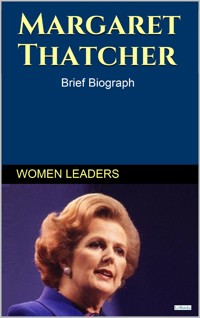
"I will transform England from a 'Give me everything' society into a 'Do it yourself' nation." This phrase was spoken by Margaret Thatcher in one of her campaign speeches, and once elected Prime Minister of England, she followed it as a mantra. The beginning of her term was marked by strikes, protests, and even food shortages. But Thatcher, nicknamed "The Iron Lady" by the press, remained true to her principles. Within a few years, the situation improved, and the Prime Minister managed to modernize England's productive system, reduce inflation and unemployment, cut taxes, and privatize deficit-ridden state industries. Due to the success of her government, Thatcher remained Prime Minister of the United Kingdom for 11 years before resigning. In these times when tough but necessary reforms are being discussed in Brazil, it is worth knowing the example of Margaret Thatcher's leadership, a prepared and determined woman who transformed her country and made history.
Das E-Book können Sie in Legimi-Apps oder einer beliebigen App lesen, die das folgende Format unterstützen:
Seitenzahl: 54
Veröffentlichungsjahr: 2024
Ähnliche


















LeBooks Edition
MARGARETH THATCHER – BRIEF BIOGRAPHY
Contents
MARGARETH THATCHER - Brief Biography
I - LIFE
II - POLITICAL CAREER
CONCLUSION
THE LIFE OF MARGARETH THATCHER - TIMELINE
MARGARETH THATCHER - Brief Biography
I - LIFE
Margaret Thatcher. 13 October 1925 — 8 April 2013
A politician of global stature in the late twentieth century, Margaret Thatcher (née Roberts) studied chemistry at Oxford University during World War II and worked as an industrial scientist in the late 1940s and early 1950s. Entering Parliament in 1959, she served as Secretary of State for Education and Science under Edward Heath in the early 1970s. In 1979 she became not only the UK's first female Prime Minister but also the first with such a scientific background. Elected a Fellow of the Royal Society in 1983, under Statute 12, she oversaw significant changes in science policy and her administration faced many major political issues that depended on scientific advice, notably the AIDS crisis, biomedical uses of human embryos, decisions over civil and military nuclear projects, acid rain, and climate change.
Early life
Margaret was born in the Lincolnshire town of Grantham, daughter of Alfred and Beatrice Roberts. She had one older sister, Muriel. The family lived over their grocer's shop; her father had an active civic life, serving as a local Independent councillor, lay Methodist preacher, school governor and, between 1945 and 1946, town mayor. The family values were of self-help, hard work, self-reliance, duty before pleasure (Cannadine 2017). Margaret attended Huntingtower Road County Elementary School from the age of five, and, aged ten, won a scholarship to attend the fee-paying grammar school, Kesteven and Grantham Girls’ School (Campbell 2000). While she also enjoyed history, by age 16 Margaret Roberts’ best subject was chemistry, one that suited her practical, methodical manner and was taught by an inspiring teacher, a Miss Kay. The Thatcher archives, held at Churchill College, Cambridge, contain a notebook on ‘qualitative chemistry’ dating from 1942, her lower sixth form year, in which Margaret has written out ‘confirmatory tests for metals and acid radicals’ in neat handwriting.
Oxford
In late 1942, aged 17, Margaret Roberts sat for a scholarship to Somerville College, Oxford. While she narrowly missed the scholarship, she was offered a delayed place for October 1944. In the event, she was able to start her university chemistry degree a year early, in October 1943. Thatcher's biographers agree that she spent increasing amounts of time and energy at university on politics, being particularly active in the Oxford University Conservative Association (the Union, at the time, barred women). They also tend to repeat two assessments of Margaret, the science student, from senior Oxford women scientists, Janet Vaughan (FRS 1979) and Dorothy Hodgkin (FRS 1947). Vaughan, a haematologist, had organized blood transfusion services in London and assisted the medical care of liberated inmates at Belsen, when she became Principal of Somerville College in 1945, a post she would hold for over twenty years. How well she got to know the young chemistry undergraduate, given her intense work, is unclear. However, Vaughan, four decades later, recalled Margaret Roberts as a ‘perfectly adequate chemist. I mean nobody thought anything of her. She was a perfectly good second-class chemist, a beta chemist’ (Young & Sloman 1986; Young 1989; Campbell 2000; Moore 2013).
The relationship with Hodgkin was deeper, although not without tensions. ‘I came to rate her as good’, said Hodgkin, ‘One could always rely on her producing a sensible, well-read essay’ (Young & Sloman 1986; Young 1989; Campbell 2000; Moore 2013). According to one biographer, Charles Moore (Moore 2013), Thatcher ‘felt an enormous respect for Mrs. Hodgkin’. Indeed, she would keep in contact with the Nobel Prize-winning X-ray crystallographer, corresponding into the 1980s. In her memoir, Thatcher described Hodgkin as ‘ever-helpful’, ‘a brilliant scientist and a gifted teacher’, and she had a picture of Hodgkin installed at Number 10, Downing Street (Gamble 2014). Hodgkin, by contrast, could be openly critical of Thatcher's politics. (The relationship has been the subject of a radio play, Adam Ganz's The chemistry between them, 2014, and is discussed in Georgina Ferry's 1998 biography of Hodgkin (Ferry 1998).) While she could have received an unclassified Oxford degree after three years, Margaret Roberts decided to try for a classified BA with honors, a choice that meant that she would stay for a further, fourth year and conduct research. Her thesis was supervised by Hodgkin, who directed her to work with one of Hodgkin's research assistants, a Jewish refugee scientist, Gerhard Schmidt, on the structure of the antibacterial peptide gramicidin S (Moore 2013). The work made some progress, although the full structure was not determined until many years later. ‘I did not see Gerhard Schmidt again until some fifteen years later when I went to visit the Weizmann Institute’, Thatcher recollected, ‘I walked through the laboratories and there I met Gerhard Schmidt who had completed the structure on gramicidin S which had turned out to be much more complicated than we first thought.’
Early career in industrial science and politics
Margaret Roberts finished her Oxford undergraduate degree in 1947. She might have turned to law or sought a role in politics, but she did not, or at least not immediately. Instead she took two posts within industrial science, first within the Essex company BX Plastics and, second, as a food chemist in the innovative J. Lyons & Company based in Hammersmith, London. Her working experience as an industrial scientist, even more so than her university studies in science, distinguishes her as an extreme rarity among high-achieving British politicians. Not only would she later draw upon her chemistry to help her understand some of the policy challenges facing her, but also she knew what science in practice was like, and therefore did not have to, as many other politicians do, rely on what others say about how science works.
Little is known about Margaret Roberts’ stint at BX Plastics. The firm itself had its origins in East London in the late nineteenth century when ‘xylonite’ (hence BX — British Xylonite) was a rival new plastic to Bakelite. By mid twentieth century BX Plastics had moved further east, to Manningtree (where the labs and offices were) outside Colchester (where Margaret found digs). Our main source is Thatcher's own memoir:




