


95,99 €
Mehr erfahren.
- Herausgeber: John Wiley & Sons
- Kategorie: Fachliteratur
- Serie: Oliver Wight Manufacturing
- Sprache: Englisch
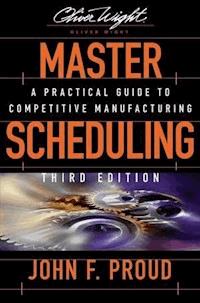
Master scheduling is an essential planning tool that helps manufacturers synchronize their production cycle with actual market demand. The third edition of this easy-to-follow handbook helps you understand the basic and more advanced concepts of master scheduling, from implementation to capacity planning to final assembly techniques. Packed with handy checklists and examples, Master Scheduling, Third Edition delivers guidelines and techniques for a world-class master schedule.
Sie lesen das E-Book in den Legimi-Apps auf:
Seitenzahl: 851
Veröffentlichungsjahr: 2007
Ähnliche

















Contents
Acknowledgments
Foreword
Introduction
Chapter 1: Chaos in Manufacturing
Problems in Manufacturing
And the Solutions
Getting Out of the Overloaded Master Schedule
Chapter 2: Why Master Scheduling?
Between Strategy and Execution
What Is the Master Schedule?
Maximizing, Minimizing, and Optimizing
The Challenge for the Master Scheduler
MPS, MRPII, ERP, and SCM
Enterprise Resource Planning
Supply Chain Management
The Four Cornerstones of Manufacturing Revisited
So, Why Master Scheduling?
Chapter 3: The Mechanics of Master Scheduling
The Master Schedule Matrix
Master Scheduling in Action
How Master Scheduling Drives Material Planning
The What, Why, and How of Safety Stock
Planning Time Fence
Demand Time Fence
Master Schedule Design Criteria
Chapter 4: Managing with the Master Schedule
The Master Scheduler’s Job
Action and Exception Messages
Six Key Questions to Answer
Answering the Six Questions
Time Zones as Aids to Decision Making
Planning Within Policy
No Past Dues
Managing with Planning Time Fences
Load-Leveling in Manufacturing
Lean Manufacturing and Continuous Improvement
Mixed-Model Scheduling
Planned Plant Shutdowns
Chapter 5: Using the MPS Output in a Make-to-Stock Environment
The Master Schedule Screen
Working a Make-to-Stock Master Schedule
Time Phasing the Bill-of-Material
Understanding the Action Messages
Bridging Data and Judgment
The Six Key Questions Revisited
Scheduling in a World of Many Schedules
From Master Scheduling to Material Requirements Planning
Chapter 6: What to Master Schedule
Manufacturing Strategies
Choosing the Right Strategy
Master Scheduling and Product Structures
Multilevel Master Scheduling
Master Scheduling Capacities, Activities, and Events
Chapter 7: Scheduling in a Flow Environment
Different Manufacturing Environments
Similarities between Intermittent and Flow Environments
Product Definition
The Planning Process
An Extended Example
Catalysts and Recovered Material
Line Scheduling
Chapter 8: Planning Bills
The Overly Complex Bill-of-Material
Anatomy of a Planning Bill
Creating Demand at the Master Schedule Level
Chapter 9: Two-Level MPS and Other Advanced Techniques
The Backlog Curve
Identifying Demand
Creating the Master Schedule in a Make-to-Order Environment
Option Overplanning
Calculating Projected Available Balance
Calculating Available-to-Promise
Using ATP to Commit Customer Orders
Option Overplanning in the Make-to-Stock Environment
Master Scheduling in Make-to-Order and Make-to-Stock Environments: A Comparison
Chapter 10: Using MPS Output in a Make-to-Order Environment
Using Planning Bills to Simplify Option Scheduling
The Scheduling Process
The Common-Items Master Schedule
Analyzing the Detail Data
Balancing the Sold-Out Zone for Common Items
Handling Abnormal Demand
Action Messages
Working the Pseudo Options
Master Scheduling a Purchased Item in the Planning Bill
Linking Master Schedule and Material Plan
Chapter 11: Master Scheduling in Custom-Product Environments
The Unique Challenges of the ETO Environment
The Case of New-Product Introductions
Master Scheduling Activities and Events
Prices and Promises to Keep
What Can Go Wrong
Integrating Design and Operation Activities
Plan Down, Replan Up
Make-to-Contract Environments
The Need for Standards
When Supply Can’t Satisfy Demand
Chapter 12: Finishing Schedules
Manufacturing Strategy and Finishing Schedules
Manufacturing Approaches
Other Manufacturing Issues
Sequencing
Traditional Means of Communicating the Schedule
The Kanban System
Tying It All Together
Final Assembly or Process Routings
Configuring and Building to a Customer Order
Finishing or Final Assembly Combined Materials and Operations List
Choosing the Most Effective Approach
Finishing Schedules versus Master Schedules
Chapter 13: Sales and Operations Planning
Workable, Adjustable Plans
S&OP and the Master Schedule
Synchronizing Demand and Supply
Chapter 14: Rough Cut Capacity Planning
Know Before You Go
Rough Cut Revealed
The Rough Cut Process
Creating Resource Profiles
Finalizing the Resource Profile
Capacity Inputs
Overloading Demonstrated Capacity
Rough Cut at the Master Scheduling Level
Working the Rough Cut Capacity Plan
What-If Analysis and Rough Cut Capacity Planning
Screen and Report Formats
The Limitations and Benefits of Rough Cut Capacity Planning
Implementing the Rough Cut Process
Final Thoughts
Chapter 15: Supply Management
Supply Management in Action
Product-Driven, Aggregated Inventory Planning
Will the Plan Work?
Product-Driven, Disaggregated Inventory Planning
Product-Driven, Aggregated Backlog Planning
Product-Driven, Disaggregated Backlog Planning
Production-Driven Environments
Interplant Integration
Should Companies Have Supply Managers?
Chapter 16: Demand Management
What Is Demand Management?
Problems with Forecasting
It’s about Quantities
It’s about Time
Demand and Forecast Adjustment
The Problem of Abnormal Demand
Customer Linking
Getting Pipeline Control
Distribution Resource/Requirements Planning
Available-to-Promise
ATP with Two Demand Streams
Should Companies Have Demand Managers?
Chapter 17: Effective Implementation
Proven Path to Successful Operational Excellence
The Decision Point
Going on the Air
The Path to Master Scheduling Implementation
Stage 1: Evaluation and Preparation
Stage 2: Design and Action
Stage 3: Launch and Cutover
Deterrents to Successful Implementation of the Master Scheduling Process
The Master Scheduler’s List of Responsibilities
Epilogue: Order from Chaos
Appendix A: Class A Master Scheduling Process and Performance Checklists
Appendix B: Master Scheduling Sample Implementation Task List
Appendix C: Master Scheduling Policy, Procedure, and Flow Diagram Listing
Appendix D: Master Scheduling Sample Process Flow Diagram
Glossary
Index
Copyright © 2007 by John Proud. All rights reserved.
Published by John Wiley & Sons, Inc., Hoboken, New Jersey
Published simultaneously in Canada.
Wiley Bicentennial Logo: Richard J. Pacifico
No part of this publication may be reproduced, stored in a retrieval system, or transmitted in any form or by any means, electronic, mechanical, photocopying, recording, scanning, or otherwise, except as permitted under Section 107 or 108 of the 1976 United States Copyright Act, without either the prior written permission of the Publisher or authorization through payment of the appropriate per-copy fee to the Copyright Clearance Center, Inc., 222 Rosewood Drive, Danvers, MA 01923, (978) 750-8400, fax (978) 646-8600, or on the web at www.copyright.com. Requests to the Publisher for permission should be addressed to the Permissions Department, John Wiley & Sons, Inc., 111 River Street, Hoboken, NJ 07030, (201) 748-6011, fax (201) 748-6008, or online at http://www.wiley.com/go/permissions.
Limit of Liability/Disclaimer of Warranty: While the publisher and author have used their best efforts in preparing this book, they make no representations or warranties with respect to the accuracy or completeness of the contents of this book and specifically disclaim any implied warranties of merchantability or fitness for a particular purpose. No warranty may be created or extended by sales representatives or written sales materials. The advice and strategies contained herein may not be suitable for your situation. You should consult with a professional where appropriate. Neither the publisher nor author shall be liable for any loss of profit or any other commercial damages, including but not limited to special, incidental, consequential, or other damages.
For general information on our other products and services or for technical support, please contact our Customer Care Department within the United States at (800) 762-2974, outside the United States at (317) 572-3993 or fax (317) 572-4002.
Wiley also publishes its books in a variety of electronic formats. Some content that appears in print may not be available in electronic books. For more information about Wiley products, visit our web site at www.wiley.com.
Library of Congress Cataloging-in-Publication Data
Proud, John F.
Master scheduling: a practical guide to competitive manufacturing / John F. Proud. — 3rd ed.
p. cm.
Includes bibliographical references and index.
ISBN: 978-0-471-75727-6 (cloth: alk. paper)
1. Production scheduling. 2. Manufacturing resource planning. I. Title.
TS157.5.P76 2007
658.5’3—dc22 2006020713
This book is dedicated to manufacturing professionals worldwide, especially those who have chosen master scheduling as a career.
Oliver Wight Manufacturing Series
The Marketing Edge
George E. Palmatier and Joseph S. Shull
Gaining Control: Managing Capacity and Priorities, Third Edition
James G. Correll and Kevin Herbert
Purchasing in the 21st Century: A Guide to State-of-the-Art Techniques and Strategies, Second Edition
John E. Schorr
Manufacturing Data Structures
Jerry Clement, Andy Coldrick, and John Sari
Distribution Resource Planning
Andre J. Martin
Inventory Record Accuracy, 2nd edition (in press)
Roger Brooks and Larry Wilson
Orchestrating Success
Richard C. Ling and Walter E. Goddard
World Class Production and Inventory Management, Second Edition
Darryl V. Landvater
The Executives Guide to MRP II
Oliver Wight
The Oliver Wight Class A Checklist for Business Excellence, 6th edition
Oliver Wight International
Master Scheduling: A Practical Guide to Competitive Manufacturing, Third Edition
John F. Proud
ACKNOWLEDGMENTS
If you don’t know where you are going, any road will get you there.
I am deeply grateful to a number of people who have shaped as well as enhanced my professional career through education and idea sharing. Many of these people are current and past members of the Association for Operations Managemant (APICS), which I have been a member of for over twenty-five years. However, two people have had more influence in that career than the many others:
Dick Ling, former Oliver Wight associate and former president of Arista Education and Consulting, exposed me to the real profession of master scheduling. If I had not crossed paths with Dick Ling and several other Oliver Wight associates, I would not have been able to write this book. I learned my master scheduling skills from the best in the industry—Dick Ling, Oliver Wight associates, and professional master schedulers working in Class A companies worldwide.
Dick Pugliese, while serving as general manager of a Xerox plant, gave me the opportunity to be part of a Class A Manufacturing Resource Planning system implementation. It was during this time that I learned how a manufacturing company should work if it is to be successful and achieve Class A results.
Other colleagues and associates have also taught me much about this complex subject. John Dougherty literally spent hours with me discussing and developing concepts that we hope furthered the industry’s understanding of how important master scheduling is to the manufacturing environment. Walt Goddard, John Sari, and Al Stevens also developed numerous master scheduling concepts over the years and were kind enough to share them with me. Oliver Wight associates Tom Gillen, who helped me with the engineering issues, and George Palmatier, who made sure I did justice to the demand side of the business, also deserve recognition.
Several other people whom I would like to thank and acknowledge are: Dick Luecke, who was instrumental in taking my thoughts and structuring them into sentences and phrases that actually make sense; Lori Stacey, who spent hours upon hours typing, correcting, re-typing, and re-correcting the lengthy manuscript; the Oliver Wight Publications staff, who have been effective, cooperative, patient, and understanding throughout this book’s entire process; and the John Wiley & Sons, Inc. staff who added the professional flavor.
Once the manuscript draft was available, Mike Bales, former vice-president operations, G & W Electric; Dick Pugliese, retired executive; John Sari, Oliver Wight Alliance; and Larry Wilson, Oliver Wight Americas Principal worked their way through the many pages, challenging my thoughts and recommending changes as appropriate. Without their critical input, this book would be less than the book that it is today. My “severest and best critic” was former Oliver Wight associate Darryl Landvater, who challenged not only content but organization. A special thank you goes to Darryl for his effort, time, and patience.
Another special thanks goes to my original editor and publisher, Jim Childs, as well as my current editor, Matt Holt, whom I am sure I caused great grief when I missed several milestones along the way—what, the person who wrote the book on valid master schedules was “past due?” If you ever doubt how important it is for a manufacturing company to create valid schedules and then perform to these schedules in order to satisfy its customers, just give my publisher a call. In addition to Jim Childs, Dana Scannell was the first to give me the chance to write this book and encouraged me to keep going when my frustrations were high and my stamina was low.
My final thank you goes to my lovely wife, Darlene, who gave me the time necessary and seldom complained about being left alone while I worked in the office. Darlene is truly my best friend, and without her understanding and encouragement, I would never have found myself in a position to write these acknowledgments for what I still believe is the first and only definitive book covering the subject of master scheduling.
Foreword
Planning comes before performance and performance comes before success.
It took someone with knowledge, understanding, breadth of experience, and passion for the subject to write this book.
A book that fills a gap in the literature of manufacturing.
A book that took tremendous effort to produce.
I have known John Proud for more than fifteen years. I have worked with him, taught with him, and debated concepts with him, developing a respect that he deserves both personally and professionally.
John has accomplished a monumental task in writing the definitive work on master scheduling. There are very few people who have the combination of user experience, software understanding, and consulting and teaching experience in a variety of industries that would enable them to present master scheduling in both an understandable and readable format.
This is not a theoretical book. John has taken great pains to help the reader to thoroughly understand the application of the principles of master scheduling, describing what works in great detail. When first reading the book, the reader could become mired in the technical detail of an environment that is different from his or her own company. My suggestion is to concentrate on those areas that apply to your environment and, at a later time, return to those areas that have no direct bearing on your experience for further understanding.
The manufacturing community, academia, and professional organizations will need to look very seriously at this work. It has the characteristics to make it the standard text for any course on master scheduling and the standard resource for all manufacturing companies who desire to do master scheduling well.
John, my sincere congratulations for writing such a definitive book on master scheduling.
Richard C. Ling
President, Richard C. Ling, Inc.
Introduction
The Master of All Schedules
I seek not to know all the answers, but to understand the questions.
The 1960s were times of radical change in America; the youth of the country challenged almost every traditional value, rebelling in ways unheard of in previous generations. In manufacturing, a much quieter, though no less dramatic, revolution also was taking place. Traditional means of production and inventory control went by the boards as companies like Twin Disc and J. I. Case made effective use of Material Requirements Planning (MRP) a reality. Though crude by today’s standards, these early attempts at MRP gave manufacturing professionals their first real weapons in the war on production inefficiencies.
When companies first began using MRP, they drove it with a forecast and/or customer orders (demand). In other words, to calculate material requirements, computers multiplied the latest demand numbers by the quantities required in the bills-of-material (BOM). The problem with this approach was that it blindly assumed that the resources would be available to manufacture a product in sufficient quantities just as it was sold. Unfortunately, manufacturing rarely produced each product as it was sold. And as demand numbers inevitably changed over time, material requirements changed with them. With computer-driven tools, it was very possible to generate overwhelming change to schedules that plants and suppliers could not handle. This meant that the information in the system was often in chaos. And so was the production line. The frequent result was an overloaded schedule, underutilized resources, or both.
Some of the MRP pioneers quickly realized that their formal systems were of little value if they failed to predict and control the resources needed to support the way production was actually scheduled. They also realized that they had left the computer too much decision-making power; nowhere in the process was there a human being who ensured a true balance between supply (manufacturing and supplier resources) and demand (customers). These insights led to the development of a “master schedule” that controlled all other schedules: plant, mill, suppliers, and so forth. Equally important, a new position was created: that of the master scheduler. These developments really marked the birth of Master Production Scheduling (MPS), or to use the term favored in this book, master scheduling. (The acronym MPS will be used throughout the book when referring to master scheduling.)
Master scheduling is the pivotal point in a manufacturing business when demand from the marketplace is balanced with the capabilities and capacities of the company and its suppliers in real-time terms. As the modern manufacturing environment has grown more complex in terms of products and product options, and more demanding in terms of the competitive requirements for quality, fast and on-time delivery, low prices, quality service, and technology enhancements, this balancing mechanism has been a vital tool for management at many levels. At the executive team level, sales and operations planning has become the integrator of all top-level plans: sales, marketing, quality, engineering, financial, and production. At middle-management levels, and on the plant or mill floor, master scheduling spells out in detail what needs to be produced so that the company can ensure that capacity will be available, that materials will be on hand when needed, and that customer requirements will be satisfied on dates specified by the customers.
Master Scheduling as Part of Enterprise Planning Systems
Like all other enterprise planning systems, master scheduling is geared to satisfying market demand. It coordinates that demand with resources in the company to schedule optimal production rates. To help management make decisions about aggregate production rates, companies developed a process called Sales and Operations Planning (S&OP)—sometimes called Integrated Business Management. In the S&OP process, the leaders of each major function meet at least once a month and develop a company game plan that synchronizes planned supply output with marketplace demand.
The sales and operations planning team considers products by aggregate families, and it is the job of the supply manager or master scheduler to break down those aggregate build rates into detailed, weekly and/or daily production schedules for each item. In this way, S&OP drives and guides the master schedule.1
The expansion of the original material requirements planning technique into a set of functions encompassing demand management, supply management, sales and operations planning, master scheduling, material requirements planning, capacity planning and control, and supplier and plant scheduling has become known as Manufacturing Resource Planning (MRPII).2 It’s fair to say that the addition of MPS was a key ingredient in the evolution of MRP to MRPII to ERP (see chapter 2 for schematics of the MRPII and ERP processes).
Just having a master schedule does not ensure success. As with all processes and tools, the master schedule must be managed. Failure to manage the master schedule results in the company’s manufacturing and supplier resources being poorly deployed. This in turn means that the company may be unresponsive to customer needs or wasteful in its use of resources. Ultimately, the company risks losing its competitive position. Moreover, if the master schedule is improperly managed, many of the benefits from the sales and operations planning process will be lost.
Managed well, the master schedule provides the basis for good customer order promising and good resource utilization. By maintaining an up-to-date picture of the balance between supply and demand, master scheduling allows each customer to get the best service possible within the constraints of inventory, resources, and time. And by providing updated information about the current status of company schedules and their ability to support customer commitments, the master schedule focuses the company’s leaders’ and management’s attention where it is needed. In short, master scheduling plays a major role in helping companies stay responsive, competitive, and profitable.
Who Should Understand Master Scheduling?
This book is not intended solely for master schedulers, but also for those who should participate in designing their company’s approach to master scheduling. For master schedulers—both new to the job and those who have been doing it for years—this book can help them to do their jobs more effectively. Beginners will find a complete framework for understanding the MPS process and how it connects with the rest of the business. Seasoned professionals will be challenged into rethinking master scheduling at their companies. And all readers will benefit from numerous tricks of the trade, drawn from years of practice management, consulting, and teaching experience.
Leaders and managers in sales, marketing, manufacturing, materials, design, engineering, information technology, and finance will also benefit from knowledge of master scheduling, which is, after all, the integration point for other planning, analysis, prioritizing, and performance measurement. They will find the chapters that cover the general principles of the MPS process useful reading.
Executive team members should familiarize themselves with the basic concepts of this book and should understand the later chapters, which cover sales and operations planning, rough cut capacity planning, demand and supply management, and effective implementation. This is because master scheduling balances resource utilization and customer satisfaction while supporting the strategic as well as tactical directions determined in the sales and operations planning process. As one manufacturing manager put it, “No one ever got to Class A without doing MPS well.”3 It therefore behooves everyone of authority in the company to understand what goes into and comes out of the master schedule.
The master scheduler and people in special environments will benefit from the middle chapters, which cover specific environments and advanced techniques. Overall, the book has been designed to have something for just about everyone connected with competitive manufacturing.
How This Book Is Organized
Master scheduling involves many functions of business and crosses most departmental lines. This is the first and only book designed to pull together a comprehensive body of knowledge about master scheduling and to discuss the MPS process within the context of various manufacturing environments. It not only paints a broad perspective across the whole canvas of manufacturing but provides the fine details needed to understand MPS in specific types of businesses. Whether you make finished goods to stock, assemble or finish to customer order, or design and build products to customer specifications, you will find information and tools relevant to your business.
Chapters 1 through 6 of Master Scheduling: A Practical Guide to Competitive Manufacturing define the master scheduling process by explaining why and what to master schedule, the basic terminology, calculations, formats, mechanics, and how to manage change using master scheduling. Chapters 7 through 12 cover specific tools and techniques used in various manufacturing environments (make-to-stock, make-to-order, engineer-to-order, make-to-contract). Chapters 13 through 16 describe the supporting functions of MPS, such as sales and operations planning, rough cut capacity planning, supply management, and demand management. The book’s chapters conclude with chapter 17 and the appendices—guidelines for implementing and operating a successful master scheduling process across the entire enterprise and supply chain.
Master Scheduling is not intended to be read cover to cover in one sitting. Rather, the general sections should be covered first, followed by those chapters that address the reader’s manufacturing environment.
This book is intended to impart a thorough understanding of the master scheduling process, how it interfaces with other manufacturing processes, the roles various people play, and the technology as well as other tools necessary to support it. It aims to arm the reader with the knowledge required to fine-tune the master schedule process to the needs of his or her own company with the goal of improving customer satisfaction and enhancing competitiveness.
No company ever gets to Class A without managing the master scheduling process well, nor does anyone ever perform master scheduling well without having a firm grasp of the basic concepts and principles underlying the process. In the manufacturing arena, knowledge is truly power. Use that knowledge well, and you and your company will prosper.
Notes
1 For a complete discussion of Sales and Operations Planning, see George E. Palmatier with Colleen Crum, Enterprise Sales and Operations Planning (Boca Raton, Fla.: J. Ross Publishing, Inc. 2003) Richard C. Ling and Walter E. Goddard, Orchestrating Success (New York, N.Y.: John Wiley & Sons, Inc., 1988).
2 For a complete discussion of Manufacturing Resource Planning, see Darryl V. Landvater, World Class Production and Inventory Management (New York, N.Y.: John Wiley & Sons, Inc., 1993), and Manufacturing Resource Planning: MRPII, Unlocking America’s Productivity Potential (New York, N.Y.: John Wiley & Sons, Inc., 1981), Appendix 1, pp. 403–17.
3 The term “Class A” refers to the top rating a manufacturing company can achieve, based on the Oliver Wight ABCD Checklists for Operational and Business Excellence. The original checklist was developed by Oliver Wight in 1977 and has been updated since to reflect the evolving standards of performance achieved by world-class manufacturing companies. (See the Appendix, page 573.)
Chapter 1
Chaos in Manufacturing
Don’t mistake activity for accomplishment.
What had been a quiet and sporadically busy area three weeks ago has turned into a three-ring circus. Lift trucks careen through the stockrooms at full tilt, barely avoiding head-on collisions. Every inch of the shipping department is piled with partially completed products waiting for missing components. Normally neat and orderly work areas now resemble obstacle courses as excess materials clog the aisles.
Over in one of the assembly areas a worker complains that she has gone as far as she can without the next skid from the processing department. A supervisor moves from worker to worker, asking people to sign up for weekend overtime. A chart on the wall shows that 30% of the month’s shipments still need to be made.
Outside the supervisor’s office an angry manager berates an expediter, demanding to know why the night shift ran the wrong size product. The expediter shifts his weight from foot to foot as he explains that the required product had been at the top of the hot list—and maybe the night supervisor did not get that revision of this week’s list (of which there had been three).
The cost variance reports that were the burning issue of the manufacturing meetings just two short weeks ago are now buried under a stack of quality control reject reports. Management has temporarily waived the rejects so that needed materials can be used to meet this month’s numbers.
Off in a corner by the coffee machine, a gray-haired foreman shakes his head and mumbles: “So this is the manufacturing of the future that the guys in corporate promised. It looks like the manufacturing of the past to me.”
This scene plays itself out in many manufacturing companies today. Worse, like a recurring nightmare it returns to haunt companies month after month. It happens, in part, because many companies still operate in a reactive mode, in which all decisions, priorities, and schedules are driven by the day-to-day fluctuations of the marketplace, momentary changes in the plant, and the performance of individual suppliers. It is a cycle of action and reaction, and until companies break the cycle, they will never rid themselves of the end-of-the-month crunch and nightmare.
Breaking the cycle entails four steps:
Problems in Manufacturing
Consider the scenario again, this time through the eyes of the plant manager, who sees that although everyone is attempting to do a conscientious job, the efforts are often misdirected. The use of hot lists to set priorities in getting products out the door causes major disruptions and confusion in manufacturing. Schedule changes prompted by these hot lists satisfy some short-term requirements but throw a monkey wrench into others. Shipment dates are missed, the customers complain to the sales force, and the sales manager vents his anger onto the production manager.
Although there appears to be much work in process, the reality is that most of the work is sitting in queues. In addition, staggering amounts of unplanned overtime and quality problems are mounting. After inventorying the problems, the plant manager begins to look for their underlying causes. The hot lists, he finds, are used because of frequent part shortages, some of which result from late deliveries from engineering (specifications) and suppliers (materials), late ordering by the company, and the poor quality of materials actually delivered by manufacturing (inside supplier) or outside suppliers in general. Other part shortages result from inaccurate bills-of-material and inventory record inaccuracies that report materials as being in stock when they are not.
Lesen Sie weiter in der vollständigen Ausgabe!
Lesen Sie weiter in der vollständigen Ausgabe!
Lesen Sie weiter in der vollständigen Ausgabe!
Lesen Sie weiter in der vollständigen Ausgabe!
Lesen Sie weiter in der vollständigen Ausgabe!
Lesen Sie weiter in der vollständigen Ausgabe!
Lesen Sie weiter in der vollständigen Ausgabe!
Lesen Sie weiter in der vollständigen Ausgabe!
Lesen Sie weiter in der vollständigen Ausgabe!
Lesen Sie weiter in der vollständigen Ausgabe!
Lesen Sie weiter in der vollständigen Ausgabe!
Lesen Sie weiter in der vollständigen Ausgabe!
Lesen Sie weiter in der vollständigen Ausgabe!
Lesen Sie weiter in der vollständigen Ausgabe!
Lesen Sie weiter in der vollständigen Ausgabe!
Lesen Sie weiter in der vollständigen Ausgabe!
Lesen Sie weiter in der vollständigen Ausgabe!
Lesen Sie weiter in der vollständigen Ausgabe!
Lesen Sie weiter in der vollständigen Ausgabe!
Lesen Sie weiter in der vollständigen Ausgabe!
Lesen Sie weiter in der vollständigen Ausgabe!
Lesen Sie weiter in der vollständigen Ausgabe!
Lesen Sie weiter in der vollständigen Ausgabe!




