


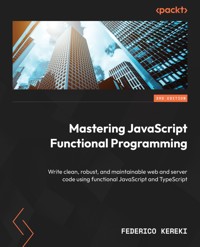
35,99 €
Mehr erfahren.
- Herausgeber: Packt Publishing
- Kategorie: Fachliteratur
- Sprache: Englisch
Functional programming is a programming paradigm that uses functions for developing software. This book is filled with examples that enable you to leverage the latest JavaScript and TypeScript versions to produce modern and clean code, as well as teach you to how apply functional programming techniques to develop more efficient algorithms, write more concise code, and simplify unit testing.
This book provides comprehensive coverage of the major topics in functional programming to produce shorter, clearer, and testable programs. You’ll begin by getting to grips with writing and testing pure functions, reducing side effects, as well as other key features to make your applications functional in nature. The book specifically explores techniques to simplify coding, apply recursion, perform high-level coding, learn ways to achieve immutability, implement design patterns, and work with data types.
By the end of this book, you’ll have developed the practical programming skills needed to confidently enhance your applications by adding functional programming to wherever it’s most suitable.
Das E-Book können Sie in Legimi-Apps oder einer beliebigen App lesen, die das folgende Format unterstützen:
Seitenzahl: 720
Veröffentlichungsjahr: 2023
Ähnliche
















Mastering JavaScript Functional Programming
Third Edition
Write clean, robust, and maintainable web and server code using functional JavaScript and TypeScript
Federico Kereki
BIRMINGHAM—MUMBAI
Mastering JavaScript Functional Programming
Third Edition
Copyright © 2023 Packt Publishing
All rights reserved. No part of this book may be reproduced, stored in a retrieval system, or transmitted in any form or by any means, without the prior written permission of the publisher, except in the case of brief quotations embedded in critical articles or reviews.
Every effort has been made in the preparation of this book to ensure the accuracy of the information presented. However, the information contained in this book is sold without warranty, either express or implied. Neither the author, nor Packt Publishing or its dealers and distributors, will be held liable for any damages caused or alleged to have been caused directly or indirectly by this book.
Packt Publishing has endeavored to provide trademark information about all of the companies and products mentioned in this book by the appropriate use of capitals. However, Packt Publishing cannot guarantee the accuracy of this information.
Group Product Manager: Pavan Ramchandani
Publishing Product Manager: Bhavya Rao
Senior Editor: Mark D’Souza
Technical Editor: Joseph Aloocaran
Copy Editor: Safis Editing
Project Coordinator: Sonam Pandey
Proofreader: Safis Editing
Indexer: Rekha Nair
Production Designer: Shyam Sundar Korumilli
Marketing Coordinators: Namita Velgekar, Nivedita Pandey, and Anamika Singh
First published: November 2017
Second edition: January 2020
Third edition: May 2023
Production reference: 1040423
Published by Packt Publishing Ltd.
Livery Place
35 Livery Street
Birmingham
B3 2PB, UK.
ISBN 978-1-80461-013-8
www.packtpub.com
Writing a book involves many people, and even if I cannot mention and name all of them, there are some who really deserve to be highlighted.
At Packt Publishing, I want to thank Larissa Pinto, senior acquisition editor, for proposing the theme for this book and helping me get started with it. Thanks must also go to Mohammed Yusuf Imaratwale, content development editor, and Ralph Rosario, technical editor, for their help in giving shape to the book and making it clearer and better structured. I also want to send my appreciation to the reviewers, Gerónimo García Sgritta and Steve Perkins, who went through the initial draft, enhancing it with their comments.
There are some other people who deserve extra consideration. This book was written under unusual circumstances, around 10,000 miles away from home! I had gone from Uruguay, where I live, to work on a project in India, and that’s where I wrote every single page of the text. This would not have been possible if I hadn’t had complete support from my family, who stayed in Montevideo, but who were constantly nearby, thanks to the internet and modern communication. In particular, I must single out my wife, Sylvia Tosar, not only for supporting and aiding me both with the project and the book but also for dealing with everything and the rest of the family on her own in Uruguay—this book wouldn’t have been possible otherwise, and she is the greatest reason the book could be written!
For the second edition: Revisiting and expanding a book for a second edition was an interesting task. I had great support and must thank Aamir Ahmed, content development editor; Jane D’Souza, technical editor; and Crystian Bietti and Steve Perkins (again, for double merit!), the reviewers who helped produce a much better text.
For the third edition: Expanding the book for a third edition was, once more, a challenging task. In this case, I had support from Bhavya Rao, publishing product manager; Mark D’Souza, senior editor; Joseph Aloocaran, technical editor; and Anu Nagan and Markandey Pathak, reviewers, all of whom greatly aided my work, aiming for an even higher quality final text.
- Federico Kereki
Contributors
About the author
Federico Kereki is a Uruguayan systems engineer, with a master’s degree in education, and over 30 years of experience as a consultant, system developer, and writer.
He is currently a subject matter expert at Globant, where he gets to use a good mixture of development frameworks, programming tools, and operating systems. He is familiar with languages such as JavaScript and TypeScript; modern backend runtime environments such as Node.js and Deno; frontend frameworks such as React, Vue, and Angular; and services, microservices, and cloud components for systems architecture.
He has taught several computer science courses at Universidad de la República, Universidad ORT Uruguay, and Universidad de la Empresa. He has also written texts for these courses.
He has written articles and booklets on programming, web development, security, and open source topics for blogs, magazines, and websites. He has also written several books, including Modern JavaScript Web Development Cookbook and the upcoming Data Structures and Algorithms in JavaScript.
Kereki has given talks on functional programming at public conferences (such as JSCONF 2016 and Development Week Santiago 2019) and has used functional programming techniques to develop internet systems for businesses in Uruguay and abroad.
His current interests tend toward software quality and software engineering – with Agile methodologies topmost – while on the practical side, he works with diverse languages, tools, and frameworks, and Free/Libre Open Source Software (FLOSS) wherever possible!
He resides, works, and teaches in Uruguay, but he wrote the first edition of this book while working in India, and the second edition during a sojourn in Mexico; the third edition was the first actually completed in his homeland!
About the reviewers
Markandey Pathak is an accomplished full-stack developer and software architect with over 11 years of experience. Currently, he works as an expert engineer and vice president with one of the biggest financial firms. He has also worked with top firms such as Deloitte, PwC, and Sapient in the past. In addition to his technical work, Markandey is also passionate about teaching coding to kids and playing with robots in his spare time. He is an avid traveler and enjoys spending time in nature and exploring new destinations with his wife and son whenever possible. Markandey’s diverse interests and impressive professional experience make him a well-rounded and highly respected member of the software engineering community.
Anu Nagan G has worked in various corporate organizations, from a SaaS start-up (Gendeep) to a mid-size organization (GAVS) and a Fortune 500 company (DXC). He has held various positions such as technical product manager, full-stack product lead (Angular, Java, Python, and AWS), and delivery lead in his 9+ years of tenure. He has experience in leading advanced AI and analytics product Cortex AI (API automation), Salesforce CRM B2B automation, and mobile app development, and contributed to various AIOps products such as ZIF, Gcare, and Gavel in the past. Currently, he is leading parallel projects with Bounteous, which include data integration with the Braze marketing platform with a custom middleware and digital experience transformation for Fintech customers using AEM. He is an avid reader and cinephile who loves to play the guitar and make short films with his friends.
I would like to thank my wife, Hema, and my daughter, Chekhov, for always giving me the freedom to pursue my interests.




