


43,19 €
Mehr erfahren.
- Herausgeber: Packt Publishing
- Kategorie: Fachliteratur
- Sprache: Englisch
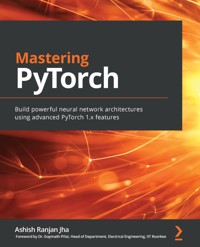
Deep learning is driving the AI revolution, and PyTorch is making it easier than ever before for anyone to build deep learning applications. This PyTorch book will help you uncover expert techniques to get the most out of your data and build complex neural network models.
The book starts with a quick overview of PyTorch and explores using convolutional neural network (CNN) architectures for image classification. You'll then work with recurrent neural network (RNN) architectures and transformers for sentiment analysis. As you advance, you'll apply deep learning across different domains, such as music, text, and image generation using generative models and explore the world of generative adversarial networks (GANs). You'll not only build and train your own deep reinforcement learning models in PyTorch but also deploy PyTorch models to production using expert tips and techniques. Finally, you'll get to grips with training large models efficiently in a distributed manner, searching neural architectures effectively with AutoML, and rapidly prototyping models using PyTorch and fast.ai.
By the end of this PyTorch book, you'll be able to perform complex deep learning tasks using PyTorch to build smart artificial intelligence models.
Das E-Book können Sie in Legimi-Apps oder einer beliebigen App lesen, die das folgende Format unterstützen:
Seitenzahl: 441
Veröffentlichungsjahr: 2021
Ähnliche


















Mastering PyTorch
Build powerful neural network architectures using advanced PyTorch 1.x features
Ashish Ranjan Jha
BIRMINGHAM—MUMBAI
Mastering PyTorch
Copyright © 2021 Packt Publishing
All rights reserved. No part of this book may be reproduced, stored in a retrieval system, or transmitted in any form or by any means, without the prior written permission of the publisher, except in the case of brief quotations embedded in critical articles or reviews.
Every effort has been made in the preparation of this book to ensure the accuracy of the information presented. However, the information contained in this book is sold without warranty, either express or implied. Neither the author, nor Packt Publishing or its dealers and distributors, will be held liable for any damages caused or alleged to have been caused directly or indirectly by this book.
Packt Publishing has endeavored to provide trademark information about all of the companies and products mentioned in this book by the appropriate use of capitals. However, Packt Publishing cannot guarantee the accuracy of this information.
Group Product Manager: Kunal Parikh
Publishing Product Manager: Devika Battike
Senior Editor: Roshan Kumar
Content Development Editor: Tazeen Shaikh
Technical Editor: Sonam Pandey
Copy Editor: Safis Editing
Project Coordinator: Aishwarya Mohan
Proofreader: Safis Editing
Indexer: Priyanka Dhadke
Production Designer: Nilesh Mohite
First published: February 2021
Production reference: 2090221
Published by Packt Publishing Ltd.
Livery Place
35 Livery Street
Birmingham
B3 2PB, UK.
ISBN 978-1-78961-438-1
www.packt.com
To my mother and best-friend - Rani Jha, my father and idol - Bibhuti Bhushan Jha, for their sacrifices and constant support and for being the driving forces of my life and career. Without their love, none of this would matter. To my sisters, Sushmita, Nivedita, and Shalini, for teaching me what and what not to do in life.
Packt.com
Subscribe to our online digital library for full access to over 7,000 books and videos, as well as industry leading tools to help you plan your personal development and advance your career. For more information, please visit our website.
Why subscribe?
Spend less time learning and more time coding with practical eBooks and videos from over 4,000 industry professionalsImprove your learning with Skill Plans built especially for youGet a free eBook or video every monthFully searchable for easy access to vital informationCopy and paste, print, and bookmark contentDid you know that Packt offers eBook versions of every book published, with PDF and ePub files available? You can upgrade to the eBook version at packt.com and, as a print book customer, you are entitled to a discount on the eBook copy. Get in touch with us at [email protected] for more details.
At www.packt.com, you can also read a collection of free technical articles, sign up for a range of free newsletters, and receive exclusive discounts and offers on Packt books and eBooks.
Foreword
I am happy to know that Ashish, who was my student on the artificial neural networks course 8 years ago at IIT Roorkee, has now authored this hands-on book that covers a range of deep learning topics in reasonable depth.
Learning by coding is something every deep learning enthusiast wants to undertake, but tends to leave half way through. The effort needed to go through documentation and extract useful information to run deep learning projects is cumbersome. I have seen far too many students become frustrated during the process. There are tons of resources available for any beginner to become an expert. However, it is easy for any beginner to lose sight of the learning task while trying to strike a balance between concept-oriented courses and the coding-savvy approach of many academic programs.
PyTorch is uniquely placed as being pythonic and very flexible. It is appealing both to beginners who have just started coding machine learning models and to experts who like to meddle in the finer parameters of model designing and training. PyTorch is one library I am happy to recommend to any enthusiast, regardless of their level of expertise.
The best way to learn machine learning and deep learning models is by practicing coding in PyTorch. This book navigates the world of deep learning through PyTorch in a very engaging way. It starts from the basic building blocks of deep learning. The visual appeal of learning the data pipeline is one of its strong points. The PyTorch modules used for model building and training are introduced in the simplest of ways. Any student will appreciate the hands-on approach of this book. Every concept is explained through codes, and every step of the code is well documented. It should not be assumed that this book is just for beginners. Instead, any beginner can become an expert by following this book.
Starting from basic model building, such as the popular VGG16 or ResNet, to advanced topics, such as AutoML and distributed learning, all these aspects are covered here. The book further encompasses concepts such as AI explainability, deep reinforcement learning, and GANs. The exercises in this book range from building an image captioning model to music generation and neural style transfer models, as well as building PyTorch model servers in production systems. This helps you to prepare for any niche deep learning ventures.
I recommend this book to anyone who wants to master PyTorch for deploying deep learning models with the latest libraries.
Dr. Gopinath Pillai Head Of Department, Electrical Engineering, IIT Roorkee
Contributors
About the author
Ashish Ranjan Jha received his bachelor's degree in electrical engineering from IIT Roorkee (India), his master's degree in computer science from EPFL (Switzerland), and an MBA degree from the Quantic School of Business (Washington). He received distinctions in all of his degrees. He has worked for a variety of tech companies, including Oracle and Sony, and tech start-ups, such as Revolut, as a machine learning engineer.
Aside from his years of work experience, Ashish is a freelance ML consultant, an author, and a blogger (datashines). He has worked on products/projects ranging from using sensor data for predicting vehicle types to detecting fraud in insurance claims. In his spare time, Ashish works on open source ML projects and is active on StackOverflow and kaggle (arj7192).
About the reviewer
Javier Abascal Carrasco has a master's degree in telecommunication engineering from the University of Seville (Spain). He also studied abroad at TU Dresden (Germany) and Thomas College (ME, USA), where he obtained his MBA. Since his career started, Javier has been passionate about the world of data and analytics. He has had the chance to work with and help all manner of companies, ranging from small start-ups to big corporations, including the consulting firm EY and Facebook. In addition, for the last 3 years, he has been a part-time lecturer on the data science space. He truly believes that PyTorch is bringing a new, fresh style to programming and work involving deep learning, generating a friendly competitor landscape in relation to TensorFlow.
Packt is searching for authors like you
If you're interested in becoming an author for Packt, please visit authors.packtpub.com and apply today. We have worked with thousands of developers and tech professionals, just like you, to help them share their insight with the global tech community. You can make a general application, apply for a specific hot topic that we are recruiting an author for, or submit your own idea.
Table of Contents
Preface
Section 1: PyTorch Overview
Chapter 1: Overview of Deep Learning using PyTorch
Technical requirements
A refresher on deep learning
Activation functions
Optimization schedule
Exploring the PyTorch library
PyTorch modules
Tensor modules
Training a neural network using PyTorch
Summary
Chapter 2: Combining CNNs and LSTMs
Technical requirements
Building a neural network with CNNs and LSTMs
Text encoding demo
Building an image caption generator using PyTorch
Downloading the image captioning datasets
Preprocessing caption (text) data
Preprocessing image data
Defining the image captioning data loader
Defining the CNN-LSTM model
Training the CNN-LSTM model
Generating image captions using the trained model
Summary
Section 2: Working with Advanced Neural Network Architectures
Chapter 3: Deep CNN Architectures
Technical requirements
Why are CNNs so powerful?
Evolution of CNN architectures
Developing LeNet from scratch
Using PyTorch to build LeNet
Training LeNet
Testing LeNet
Fine-tuning the AlexNet model
Using PyTorch to fine-tune AlexNet
Running a pre-trained VGG model
Exploring GoogLeNet and Inception v3
Inception modules
1x1 convolutions
Global average pooling
Auxiliary classifiers
Inception v3
Discussing ResNet and DenseNet architectures
DenseNet
Understanding EfficientNets and the future of CNN architectures
Summary
Chapter 4: Deep Recurrent Model Architectures
Technical requirements
Exploring the evolution of recurrent networks
Types of recurrent neural networks
RNNs
Bidirectional RNNs
LSTMs
Extended and bidirectional LSTMs
Multi-dimensional RNNs
Stacked LSTMs
GRUs
Grid LSTMs
Gated orthogonal recurrent units
Training RNNs for sentiment analysis
Loading and preprocessing the text dataset
Instantiating and training the model
Building a bidirectional LSTM
Loading and preprocessing text dataset
Instantiating and training the LSTM model
Discussing GRUs and attention-based models
GRUs and PyTorch
Attention-based models
Summary
Chapter 5: Hybrid Advanced Models
Technical requirements
Building a transformer model for language modeling
Reviewing language modeling
Understanding the transformer model architecture
Developing a RandWireNN model from scratch
Understanding RandWireNNs
Developing RandWireNNs using PyTorch
Summary
Section 3: Generative Models and Deep Reinforcement Learning
Chapter 6: Music and Text Generation with PyTorch
Technical requirements
Building a transformer-based text generator with PyTorch
Training the transformer-based language model
Saving and loading the language model
Using the language model to generate text
Using a pre-trained GPT-2 model as a text generator
Out-of-the-box text generation with GPT-2
Text generation strategies using PyTorch
Generating MIDI music with LSTMs using PyTorch
Loading the MIDI music data
Defining the LSTM model and training routine
Training and testing the music generation model
Summary
Chapter 7: Neural Style Transfer
Technical requirements
Understanding how to transfer style between images
Implementing neural style transfer using PyTorch
Loading the content and style images
Loading and trimming the pre-trained VGG19 model
Building the neural style transfer model
Training the style transfer model
Experimenting with the style transfer system
Summary
Chapter 8: Deep Convolutional GANs
Technical requirements
Defining the generator and discriminator networks
Understanding the DCGAN generator and discriminator
Training a DCGAN using PyTorch
Defining the generator
Defining the discriminator
Loading the image dataset
Training loops for DCGANs
Using GANs for style transfer
Understanding the pix2pix architecture
Summary
Chapter 9: Deep Reinforcement Learning
Technical requirements
Reviewing reinforcement learning concepts
Types of reinforcement learning algorithms
Discussing Q-learning
Understanding deep Q-learning
Using two separate DNNs
Experience replay buffer
Building a DQN model in PyTorch
Initializing the main and target CNN models
Defining the experience replay buffer
Setting up the environment
Defining the CNN optimization function
Managing and running episodes
Training the DQN model to learn Pong
Summary
Section 4: PyTorch in Production Systems
Chapter 10: Operationalizing PyTorch Models into Production
Technical requirements
Model serving in PyTorch
Creating a PyTorch model inference pipeline
Building a basic model server
Creating a model microservice
Serving a PyTorch model using TorchServe
Installing TorchServe
Launching and using a TorchServe server
Exporting universal PyTorch models using TorchScript and ONNX
Understanding the utility of TorchScript
Model tracing with TorchScript
Model scripting with TorchScript
Running a PyTorch model in C++
Using ONNX to export PyTorch models
Serving PyTorch models in the cloud
Using PyTorch with AWS
Serving PyTorch model on Google Cloud
Serving PyTorch models with Azure
Summary
References
Chapter 11: Distributed Training
Technical requirements
Distributed training with PyTorch
Training the MNIST model in a regular fashion
Training the MNIST model in a distributed fashion
Distributed training on GPUs with CUDA
Summary
Chapter 12: PyTorch and AutoML
Technical requirements
Finding the best neural architectures with AutoML
Using Auto-PyTorch for optimal MNIST model search
Using Optuna for hyperparameter search
Defining the model architecture and loading dataset
Defining the model training routine and optimization schedule
Running Optuna's hyperparameter search
Summary
Chapter 13: PyTorch and Explainable AI
Technical requirements
Model interpretability in PyTorch
Training the handwritten digits classifier – a recap
Visualizing the convolutional filters of the model
Visualizing the feature maps of the model
Using Captum to interpret models
Setting up Captum
Exploring Captum's interpretability tools
Summary
Chapter 14: Rapid Prototyping with PyTorch
Technical requirements
Using fast.ai to set up model training in a few minutes
Setting up fast.ai and loading data
Training a MNIST model using fast.ai
Evaluating and interpreting the model using fast.ai
Training models on any hardware using PyTorch Lightning
Defining the model components in PyTorch Lightning
Training and evaluating the model using PyTorch Lightning
Summary
Other Books You May Enjoy
Section 1: PyTorch Overview
This section includes a refresher on deep learning concepts, as well as PyTorch essentials. Upon completing this section, you will be able to identify how to train your own PyTorch models, as well as how to build a neural network model that generates text/captions as output when given images as input using PyTorch.
This section comprises the following chapters:
Chapter 1, Overview of Deep Learning Using PyTorchChapter 2, Combining CNNs and LSTMs




