


82,99 €
Mehr erfahren.
- Herausgeber: John Wiley & Sons
- Kategorie: Geisteswissenschaft
- Sprache: Englisch
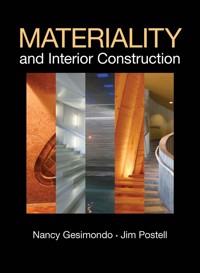
A comprehensive reference of materials for interior designers and architects Choosing the right material for the right purpose is a critical--and often overlooked--aspect in the larger context of designing buildings and interior spaces. When specified and executed properly, materials support and enhance a project's overall theme, and infuse interior space with a solid foundation that balances visual poetry and functionality. Materiality and Interior Construction imparts essential knowledge on how materials contribute to the construction and fabrication of floors, partitions, ceilings, and millwork, with thorough coverage of the important characteristics and properties of building materials and finishes. Individual coverage of the key characteristics of each material explores the advantages and disadvantages of using specific materials and construction assemblies, while helping readers discover how to make every building element count. In addition, Materiality and Interior Construction: * Is highly illustrated throughout to show material properties and building assemblies * Supplies rankings and information on the "green" attributes of each material so that designers can make informed decisions for specifications * Is organized by application for easy and quick access to information * Includes a companion website, featuring an extensive online image bank of materials and assemblies Rather than a typical catalog of materials, Materiality and Interior Construction is efficiently organized so that the reader is guided directly to the options for the location or assembly they are considering. Reliable and easy to use, Materiality and Interior Construction is a one-stop, comprehensive reference for hundreds of commonly used materials and their integration as building components--and an invaluable resource that every interior designer or architect should add to their set of tools.
Sie lesen das E-Book in den Legimi-Apps auf:
Seitenzahl: 999
Veröffentlichungsjahr: 2011
Ähnliche



















CONTENTS
Preface
Acknowledgments
Foreword
Chapter 1: Why Materials Matter
Design Intentions
Historical Overview
What It’s Made Of and How It’s Made
Environmentally Sustainable Design Considerations
Material Properties and Performance Characteristics
Applications
Installation Methods
Maintenance Requirements
Relative Material Cost
Resources and Sources
Chapter 2: Flooring
Design Intentions
Circulation and Conveyance: Stairs, Ramps, and Slopes
Subfloor Preparation Methods
Installation Methods
Maintenance Requirements
Relative Cost of Materials for Flooring
Flooring Materials
Chapter 3: Walls, Partitions, and Vertical Components
Design Intentions
Walls and Partitions: Construction and Fabrication Types
Walls, Partitions, and vertical components: Materials
Chapter 4: Ceilings
Design Intentions
Ceilings: Construction and Fabrication Categories
Ceiling Materials
Chapter 5: Millwork
Design Intentions
Interior Millwork: Materials
Interior Millwork Finishes
Hardware
Wood Joinery
Appendix: Material Matters
Notes
Glossary
Bibliography
Index
John Wiley & Sons
Copyright © 2011 by John Wiley & Sons, Inc. All rights reserved.
Published by John Wiley & Sons, Inc., Hoboken, New Jersey.
Published simultaneously in Canada.
No part of this publication may be reproduced, stored in a retrieval system, or transmitted in any form or by any means, electronic, mechanical, photocopying, recording, scanning, or otherwise, except as permitted under Section 107 or 108 of the 1976 United States Copyright Act, without either the prior written permission of the Publisher, or authorization through payment of the appropriate per-copy fee to the Copyright Clearance Center, Inc., 222 Rosewood Drive, Danvers, MA 01923, 978–750–8400, fax 978–646–8600, or on the web at www.copyright.com. Requests to the Publisher for permission should be addressed to the Permissions Department, John Wiley & Sons, Inc., 111 River Street, Hoboken, NJ 07030, 201–748–6011, fax 201–748–6008, or online at http://www.wiley.com/go/permissions.
Limit of Liability/Disclaimer of Warranty: While the Publisher and author have used their best efforts in preparing this book, they make no representations or warranties with respect to the accuracy or completeness of the contents of this book and specifically disclaim any implied warranties of merchantability or fitness for a particular purpose. No warranty may be created or extended by sales representatives or written sales materials. The advice and strategies contained herein may not be suitable for your situation. You should consult with a professional where appropriate. Neither the Publisher nor author shall be liable for any loss of profit or any other commercial damages, including but not limited to special, incidental, consequential, or other damages.
For general information on our other products and services, or technical support, please contact our Customer Care Department within the United States at 800–762–2974, outside the United States at 317–572–3993 or fax 317–572–4002.
Wiley also publishes its books in a variety of electronic formats. Some content that appears in print may not be available in electronic books.
For more information about Wiley products, visit our Web site at http://www.wiley.com.
Library of Congress Cataloging-in-Publication Data:
Gesimondo, Nancy.
Materiality and interior construction / Nancy Gesimondo and Jim Postell ; foreword by James Hubbell.
p. cm.
Includes index.
ISBN 978-0-470-44544-0 (cloth : alk. paper); ISBN 978-1-118-01867-5 (ebk); ISBN 978-1-118-01868-2 (ebk); ISBN 978-1-118-01969-6 (ebk); ISBN 978-1-118-01970-2 (ebk); ISBN 978-1-118-01971-9 (ebk)
1. Building materials–Handbooks, manuals, Eec. 2. Interior architecture. I. Postell, James Christopher, 1958- II. Title. III. Title: Materiality and interior construction.
TA403.4.G47 2011
691—dc22
201004428
PREFACE
This book is a comprehensive reference of materials used in the design and construction of interior space. It integrates the properties and performance characteristics of materials with technical knowledge of how materials shape the built environment (see Figure P-1). It is intended to serve as a resource for architects, interior designers, and students.
Figure P-1 The fluid nature of mixed concrete makes it an ideal material for the sinusoidal curved ceiling in Jørn Utzon’s design of Bagværdes Kirke, Copenhagen, Denmark (1973–1976). Photography by Jim Postell.
A unique feature of this book is the way in which it is organized. Each chapter is dedicated to a different interior assembly (i.e., floors, walls, ceilings, and millwork). The materials are listed alphabetically, in order to direct the reader to the myriad choices that might otherwise be overlooked. Conventional and innovative materials are examined with special emphasis on environmental sustainability.
Visual poetics, relative cost, and technical matters, such as the integration of building systems, code compliance, and human factors, are considered holistically. Attention is given to the impact materials have on the making of interior assemblies and building components, including millwork, stairs, ramps, and slopes.
Chapter 1 presents the general criteria that direct the selection and specification of materials. These criteria apply to their use in all building assemblies. Technical and environmental issues form the template for which each material is surveyed. This rubric is outlined below.
Historical OverviewWhat It’s Made of and How It’s MadeEnvironmentally Sustainable Design ConsiderationsMaterial Properties and Performance CharacteristicsApplicationsMaterial DimensionsInstallation MethodsMaintenance RequirementsRelative Material CostResources and SourcesEnvironmentally Sustainable Design Considerations, noted as “ESD Considerations” throughout the text, cuts through all of the greenwashing and documents how the manufacturing, installation, and maintenance of a material contributes to the integration of a sustainable design solution throughout its life cycle. Each material section identifies fundamental information, as well as highlighting materials that exhibit unique characteristics. Specific manufacturers are identified in the body of the text only when there are distinctive factors to be considered or if the material is proprietary. In addition, manufacturers are listed in each section under the heading, “Resources and Sources,” which is by no means a complete list of all of the material suppliers. The intention in writing this book is to present an unbiased and holistic assessment of materials, interior components, and construction assemblies.
Chapters 2 through 4 are dedicated to flooring, wall, and ceiling assemblies. Within each chapter is an extensive overview of materiality and interior construction methods. The historical overview segment describes the development of a material relative to its particular application and highlights projects that used the materials innovatively. The performance and use of materials, relative to circulation assemblies, such as stairs, ramps, and slopes, is included in Chapter 2. Specific design challenges are presented relative to vertical circulation and human movement through buildings.
Chapter 5 examines how the fabrication of millwork, casework, and trim is integrated with the specification of material and joinery. Where and how interior components are fabricated (off-site or on-site) are explored in detail, with a focus on the contribution materials make on the overall quality of interior space.
Various approaches to material classifications are outlined and reviewed in the Appendix.
The collective aim in writing this book is to offer a comprehensive and extensive resource that uniquely integrates materiality, spatial design, and interior construction. It can be used as a textbook in teaching and learning, as well as a resource for professional practice, and is a complement to the myriad of books on materials for the disciplines of architecture and interior design.
ACKNOWLEDGMENTS
The writing of this book sparked the desire and need to reread the works of Edward Allen, David K. Ballast, Victoria Bell, George Beylerian, Andrew Dent, Kenneth Geiser, and Ezio Manzini. It also presented an opportunity to discover newer books on the subject, including Construction Materials Manual, compiled by Professor Manfred Hegger of the Department of Architecture, Technische Universität Darmstadt.
The authors wish to acknowledge the contribution and support given by Paul Drougas, acquisitions editor at John Wiley & Sons, with whom we have worked closely over the past two years. Paul and the team at Wiley have guided this project from conception to publication.
Generally, textbooks and reference manuals do not include a Foreword, but we are pleased that James Hubbell agreed to write one for this book. His use of materials is noted for its remarkable intertwining of technical knowledge and poetic depth. It abounds with improvisational and experiential insight, addressing both visual and visceral dimensions of materials. Considered together, these aspects influenced the development and thesis of this book.
We also wish to express our gratitude for the contribution of the learned professionals working in the technical departments of many industries who have helped decode the science that goes into the making of materials, notably, Bill Celentano at American-Biltrite; Jim More, Tony J. Campbell, and Dan H. Willard at Armstrong Technologies; Bob Upton at Benjamin Moore Paint; Bethany Richmond at the Carpet and Rug Institute; Donato Pompo at Ceramic Tile and Stone Consultants; Luca Laurentiu at Duro Design; Robin Roi at EverGreene Architectural Arts, Inc.; Brad Back and Howard Mees at Mees Distributors Inc.; Richard Bruns at the National Terrazzo and Mosaic Association; Frank Kroupa at the National Wood Flooring Association, Patti Fasan at Professional Attention to Tile Installations; Brendan McSheehy at Universal Fibers; Tom Hale and Mark Rounds at Wausau Tile, Inc.; and Agnes Freas at Zeftron Nylon.
We extend our sincere appreciation to Sina Almassi, Brad Back, Tom Bible, Brian Davies, James Eckler, Luke Field, Robin Geller, Amanda Hamberg, Anton Harfmann, Julie Hess, Peter Hilligoss, Taylor Holliday, Jerry Larson, Howie Mees, Lisa Rossi, Sibylle Ruefenacht, David Saile, Tyler Schaafsma, Sarah Sokoloski, Molly Storrs, Michael Toombs, Craig Vogel, Stephen Alastair Wanta, and Michael Zaretsky for their contribution to the review and editing of early drafts of the manuscript.
Images are very important in this book. We express our gratitude to Jim Alexander, Sina Almassi, John Arend, Iwan Baan, Ryan Ball, Stan Bedder, Michael Benkert, Noah Bergman, Terry Boling, Gil Born, Aya Brackett, Jay Chatterjee, James Eckler, Audrey de Filippis, Paul Fatkins, Luke Field, Erin Flynn, Forbo Industries, Formica Corporation, Whitney Hamaker, Amanda Hamberg, Mike Hamberg, Anton Harfmann, James Hermann, Peter Hilligoss, Scott Hisey, Kelly Hogg, Per Jensen, Jerry Larson, Signe Larson, Malcolm Lee, Richard M. Marshall, Ben Meyer, Nate Morgan, Mairo Notton, David O’Connell, Marilyn Ott, Megan Painter, Liam Ream, Marco Ricci, Brian Ringley, Jamie Roudebush, Kingkini Roy, Ingrid Schmidt, Nina Siber, David Lee Smith, Sarah Sokoloski, Patrick Snadon, Daniel Snider, John Bigelow Taylor, Jeff Tilman, Michael Toombs, Bethany Tozar of Impulse Photography, Gil Vaknin, Yvette Njoki Waweru, Michael Wigle, William A. Yokel, and Michael Zaretsky for permission to include their photographs in this book.
Finally, we are indebted to the individuals and organizations that are dedicated to the study of materials and to the health and well-being of our planet. These include the American Society for Testing and Materials (ASTM), Architectural Woodwork Institute (AWI), Construction Specifications Institute (CSI), U.S. Environmental Protection Agency (EPA), and U.S. Green Building Council (USGBC).
FOREWORD
As a young artist, I never distinguished the gulf between the physical world and the spiritual world. I have always thought of the materials I work with (cement, stone, iron, glass) as gifts to be handled with love and respect. For what is unveiled in the process of working with them is amazing. The rhythm and texture that develops from twisting red-hot iron or the many subtle patterns that arise from working with the grain of wood are the third element in the collaboration. Materials, like nature, help us to extend our imagination.
Yet architectural training seldom provides the opportunity to experience what the material actually feels like. Imagine sitting through four or five years of lectures about how to cook a steak. Could you prepare it? Yet many graduating architects have never mixed cement. This material, capable of such huge potential, begins as a liquid you can squeeze in your hand. It is not just post and beam.
The act of designing requires the left and the right sides of the brain to work together the same way the hand and the mind must come together. One has an idea for a structure. Instantly, the left side of the brain checks it for stability, material, space, etc. This constant balance of how to integrate one’s whole self in what we design is the challenge. Trusting one’s innate wisdom is the only way the creation of meaningful art is possible. Yet, without discipline, there are no tools to realize if it can be built. Where and why does wood break? How can we get gravity to work for a structure? Only through an understanding of how materials and structure work together can we begin to play with them.
I think about a building as a piece of music, having an introduction, quiet places, surprises, rhythm, texture, and time. Where music has notes and instruments, your music is composed of light, shadow, season, texture, color, vertical and horizontal lines. Even the client, contractor, workmen, inspectors, all are what will make part of the music. Can you see why I stress trust? It is what will bring it all together.
We are entering a new time in our world. It is up to you to define what the building is about and in so doing, how we see ourselves in this new world when the old habits such as labeling and defining life do not work. This book, Materiality and Interior Construction, aims at a more caring architecture that brings a love for the natural world, the materials you work with, and the science of structure, together harmoniously.
James Hubbell
CHAPTER 1
WHY MATERIALS MATTER
Specific characteristics of materials and consideration of their use in design and construction are detailed throughout this book. This chapter introduces the general issues pertinent to all materials in advance of examining their use within a specific building assembly in subsequent chapters. A holistic framework of interrelated considerations is established by examining the following topics:
Design intentionsHistorical overviewWhat it’s made of and how it’s madeEnvironmentally sustainable design considerationsMaterial properties and performance characteristicsApplicationsInstallation methodsMaintenance requirementsResources and sourcesDESIGN INTENTIONS
Every material possesses an inherent poetry that is interconnected with human experience and engages both the mind and the body (see Figure 1-1). The connections that materials have with human experience can, however, be highly subjective or have broad cultural associations. Our connotation of an object made out of wood may differ greatly from that of a similar object made out of metal or glass. The generally accepted notion is perhaps that glass is sleek, metal is cold, and wood is warm. However, it is not just the material of an object that imbues it with character. Rather, our perception of an object’s materiality is influenced by the distinctions of its particular color, surface texture, thermal conductivity, density, and finish. It is possible for wood to be highly figured, carved, knotty, stained, unfinished, weathered, or have either open or closed grain. Brickwork can appear rough, smooth, flat, or shiny. Glass can appear clear, translucent, opaque, textured, colored, or be laminated to other materials. Similarly, metals can range in color and surface texture, be polished or brushed, have a patina, or be rusted through. Therefore, objects made of the same material but with different finishes have their own unique character and sense of materiality.
Figure 1-1 Peder Vilhelm Jensen-Klint’s stairwell design of Grundtvigs Kirke in Copenhagen, Denmark (1913), intentionally uses whole brick masonry units throughout in order to draw associations between the integrity of the material and the church community. Photography by Sarah Sokoloski.
New technologies have expanded the range of materials and finishes available. The development of new manufacturing techniques has enhanced performance characteristics and broadened the spectrum of unique aesthetic properties (see Figure 1-2). These innovations make it necessary for architects and interior designers to frequently revisit the palette of contemporary materials.
Figure 1-2 The faceted soffit is clad in polished stainless steel with a pockmarked texture. Barcelona Forum, Barcelona, Spain, designed by Herzog & de Meuron (2004). Photography by Audrey de Filippis.
Aesthetics can significantly influence one’s sense of luxury and comfort, or the lack thereof. It has been said that 75 percent of an object’s monetary value lies in its visual appeal.1 Polished marble, highly figured wood, and lustrous velvet invoke a sensorial response quite unlike that of natural concrete, unfinished knotty pine, and vinyl upholstery. To articulate the range of associations that a particular material might invoke, we use descriptions such as elegant, casual, sleek, rustic, traditional, trendy, and so on. Just as there are no “ugly” colors, there are no “ugly” materials. Beauty, however, entails only one dimension of materiality. Environmental context and cultural bias collectively give materials their broader meaning, while interior space offers a spatial framework for daily experience (see Figures 1-3 and 1-4).
Figure 1-3 Salon Ovale, Hôtel de Soubise, Paris, France, designed by Germain Boffrand (1735–1740). Photography by Patrick Snadon.
Figure 1-4 Crafted and reserved woodwork in the Ministry Workroom on the second level of the Meeting House, Shaker Village, Pleasant Hill, Kentucky (ca. 1820–1910). Photography by William A. Yokel.
The Design Concept
A strong design concept demands the integration of many considerations. Intradependent upon a working knowledge of design and construction, material selection is guided by the desire to actualize the design concept. A single material or finish can inspire a design concept or the development of a color scheme. Choosing to install hardwood flooring versus carpeting conveys a different design intention that must be considered in the early phase of the design process. Beyond the selection of materials lies an equally important consideration of use, application, and detail. The deliberative use, application, and detail of materials can reinforce design principles such as rhythm and repetition, scale and proportion, and unity and variety, thereby creating ideological links among material, spatial experience, and design intention (see Figure 1-5).
Figure 1-5 Peter Behrens manifests the German expressionist movement of the 1920s with his use of masonry in the administration building of the IG Farben Company, Frankfurt, Germany (1920–1925). The use of gradated color bricks, corbelled from floor to ceiling, creates a dynamic visual experience of the interior space. Photography by Jerry Larson.
The inherent poetry of a material can imbue a strong design concept with the powerful sense of experience and meaning. Peter Zumthor’s Thermal Baths at Vals, in the canton of Graubünden, Switzerland (1996), is one example. Natural materials, including local Valser quartzite combined with elements of gently flowing water, ambient light, and the aroma of jasmine, infuse the space with a deep sense of relaxation that promotes well-being (see Figure 1-6).
Figure 1-6 The interior spaces of the Thermal Baths at Vals, in the canton of Graubünden, Switzerland (1996), seem cavelike, with the sound of moving water, the use of dry-stacked stone walls, and the play of daylight on the water. Designed by Peter Zumthor. Photography by James Herrmann.
St. Petri, Klippan, Sweden (1962–1966), designed by Sigurd Lewerentz, is another example of a building and its interior spaces in which the flooring, walls, and vaulted ceiling are all made with dark brick masonry, creating a quiet and somber sacred place for meditation, worship, and prayer (see ).
Lesen Sie weiter in der vollständigen Ausgabe!
Lesen Sie weiter in der vollständigen Ausgabe!
Lesen Sie weiter in der vollständigen Ausgabe!
Lesen Sie weiter in der vollständigen Ausgabe!
Lesen Sie weiter in der vollständigen Ausgabe!
Lesen Sie weiter in der vollständigen Ausgabe!
Lesen Sie weiter in der vollständigen Ausgabe!
Lesen Sie weiter in der vollständigen Ausgabe!
Lesen Sie weiter in der vollständigen Ausgabe!




