


2,49 €
Mehr erfahren.
- Herausgeber: Marna
- Kategorie: Gesellschafts- und Liebesromane
- Sprache: Englisch
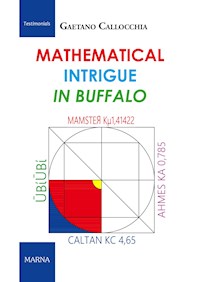
This is the story, a bit true and a bit fantastic, of Domenico, a young Abruzzese who at the beginning of the 20th century left his hometown with his uncle to go to work, like many other Italians, abroad, in the hope of securing a better future, at least from an economic point of view.
Translated by Francesco Canizzi
Das E-Book können Sie in Legimi-Apps oder einer beliebigen App lesen, die das folgende Format unterstützen:
Veröffentlichungsjahr: 2020
Ähnliche











Separazione
COLOPHON
Translation by Francesco Cagnizzi
MARNA
www.marna.it
ISBN 978-88-6670-120-0
© 2020 Publishing VELAR
24020 Gorle (Bg)
www.velar.it
All rights, translation and reproduction
text and images
carried out by any means,
are reserved in all countries.
First digital edition: September 2020
COMPENDIUM
It is the story, a bit real and a bit fantastic, of Domenico, a young Abruzzese who, together with his uncle, in the early 1900s, leaves his native town (Aielli in the heart of the Marsica) to go to work, like many other Italians, abroad with the hope of obtaining a better future, at least from an economic point of view. He first reaches Prussia, where he works together with his uncle as an assistant carpenter in the coal mines of Essen, but he keeps within himself the memory and nostalgia of the years spent in his village, of the simple life and, despite everything, happy that he had lived, of the love for the beautiful Erminia who had been waiting for him. After a year, at the invitation of a cousin who worked in the United States, he leaves Prussia and crosses the ocean to attempt the great American adventure! He joins his cousin in Buffalo and together they work on one of the first projects of the great architect Frank Lloyd Wright. Always passionate about numbers, formulas and mathematical combinations Domenico, who since elementary school had stood out for his "passion", always continues to take an interest in and try his hand at mathematical formulas and relationships, and it is precisely this marked ability mathematics that arouses the wonder and admiration of the architect Wright, when he manages to define and interpret the proportions and building modules that were the basis of Wright's architectural project.
BIOGRAPHY
Gaetano Callocchia
Born in Aielli (AQ), he graduated in Architecture at the "La Sapienza" University of Rome. He is enrolled in the Order of Architects, with a studio in Rome. He deals with the design and construction management of monumental complexes, reception centers, religious and residential buildings, accommodation facilities and school complexes. Teacher of post-graduate training courses at the Faculty of Architecture in Rome and professional refresher courses. Consultant at the Order of Architects of Rome, at the CNEC, at the FACI, former member of the Technical Scientific Committee of the Ministry of the Interior on appointment of the National Council of Architects. He has published several monographs on fire prevention, and safety for Nuova Italia Scientifica, Carocci Editore, Il Sole 24 Ore, EPC, OCD, Editoriale Italiana. He writes articles for magazines: Together, the Friend of the Clergy, Magazine of the Order of Architects of Rome, CNEC News, and for "Ecclesia" in the "Spazio Convento" section. Author of the volume “John Paul II, April 2005: A Media Event” - OCD Editions (2006), and of “Notes for the management of the patrimony of Ecclesiastical Bodies” - Editorial 2000 (2012). He has obtained the following prizes and awards: Guinnes World Records (2017), "Dei Sign" Award - Diocese of Cuneo (2012), Honoris Causa Degree 110 and honors for the Restoration of the General Curia Sisters Daughters of Our Lady at Monte Calvario - Rome (2002), Broadcast "I cervelloni", First Prize (1997), Assisi Prize for the restoration - Project reported (1994/1995). He has participated in the following exhibitions: Exhibition of architects and artists, Casa dell'Architettura - Rome (2016, 2017, 2018) and Project Church monument to John Paul II, Krakòv (Poland) May 2016, Rome October 2006 and Massa Carrara December 2016. He is a designer, for religious Bodies and Institutes, of community real estates in Italy and abroad (Kenya, Tanzania, Poland, Argentina, Philippines).
e
BEGINNING
THE BEGINNING ALWAYS
FOLLOWS THE PRINCIPLE
Caltan
DEDICATION
Dedicated to you and all people
that I met in my life,
which I loved
and I continue to love.
Caltan
Separazione
MATHEMATICAL INTRIGUE IN BUFFALO
“Dominic, please come here!”
The architect who designed the work we were building in Buffalo suddenly called me. It was really him, Frank Lloyd Wright. I was working as an assistant carpenter on the construction of the “Darwin Martin House”, and architec Wright and the head carpenter took a liking to me for my marked mathematical sensitivity in defining and interpreting proportions and building modules in architecture.
It had always been my passion to experiment with mathematical formulas and relationships, so I immediately became a reference point in the development of the new huge construction.
Sorry, I’m really impolite, I haven’t even introduced myself: I’m Domenico P. born in 1886 in a small mountain village (Agellum) currently Aielli, in the heart of Abruzzo, in the center of the territory known as “Marsica”. My origins are modest, my father, Francesco, was a small merchant with little land and many children and I am the second child of the five in life.
The town is perched in a rocky hill and enclosed by perimeter walls in defense of the population who live there. According to what my grandfather told me, the town had been established before the eleventh century (it is mentioned as early as 814 AD as a property of the Farfa monastery), but the current configuration dates back to 1280 AD with important additions such as the circular tower close to the castle, built in 1356, and the church of the SS. Trinity of 1362 AD, all by will and under the domination of the counts of Celano. Perimeter walls enclose the whole town and access is only through the three gates (Montanara, Jannettella and Terra or Porta Nuova).
My house is inside the walls in a steep and narrow alley with the houses attached to each other and one intersected with the other. In some places the alley is no wider than five feet. In the village we are all rich and all poor, the houses are all the same, the economy is the same for everyone, we are all farmers with little land available for as many as we are. My father says that we are more than two thousand people in the village, we look like an anthill: people live in every corner, in every ravine, in every alley.
Life passes serene and festive also because all the needs are met, we all live in the same way, families are equal in everything, so many children, all working as children, not much school, the land is everything and without land you cannot survive; unfortunately the earth is scarce for everyone and therefore also the farthest, steepest, most difficult, least productive soils are cultivated.
To the whole country is assigned, as the grandfather says, a territory of 28 km; I had to ask the teacher what a territory of 28 km meant. The teacher, kind, explained to me that the 28 km made it simple. I could imagine them as a strip of land 28 km long. The explanation seemed difficult to me because I knew the distances and the territory of my country and, in my evaluations, the territory of the country was not 28 km long.
As my grandfather says, a territory of 28 km has assigned to the whole town; I had to ask my teacher what a territory of 28 km meant. The teacher kindly explained to me that to keep it simple I could imagine the 28 km. as a 28 km long strip of land. The explanation seemed difficult to me because I knew the distances and the territory of my village and, according to my evaluations, the territory of the village was not 28 km long.
So slowly, by myself, I began to think tha, if one km. is equal to one thousand meters, then 28 km. are equal to 28,000 square meters. If I divide 28,000 square meters by the number of inhabitants of the town, which my grandfather says are perhaps 2,100 in total, I can calculate that each Aiellese owns 13.3333 square meters. The accounts did not add up to me, the 13 square meters was too little considering houses, barns, and lands. In addition, what about the streets, and the mountain, and the church, and the city Hall? Something was wrong.
Thinking and thinking again I succeeded to understand what the mistake was: the 28 km. is not linear kms but square km. therefore the 28,000 square meters. x 1,000 sqm. equals to twenty-eight million square meters. Then if I divide this surface by the number of inhabitants of Aielli, we get that each inhabitant owns 13,333.33 square meters that is 1.333 hectare per person.
I went to the teacher happy to have found the solution that convinced me. It seemed like a good surface and I reported my reasoning. “Bravo Domenico” he said and, in return, he immediately asked me a question: “Do you know how many cups is equal to 28 million square meters?” Yes I can calculate it: if 28 million square meters is equal to 2,800 hectares and each hectare is 20 “cups” then the whole village has an area equal to 56,000 “cups”; if we are 2,100 souls, each one owns 26,666 “cups”.
My grandfather says he has 80 for the whole family, so apparently he is wrong. No he is right, in fact every family has about 80 “cups”. However, that is enough for now, you are numbing me with the earth, the kilometers, the hectares and the “cups”! If that’s not sufficient for you, then go to work abroad!” I left the school with the mind that there was too little land for so many people to survive; the Fucino Lake had recently been dried up and the family used to talk about it. Mum and dad remembered it and grandparents even more: they talked about it with tears in their eyes as if they were talking about a dead person.
The territory had changed a lot; thanks to the lake everything grew luxuriantly, the climate was mild and the lake was used for fishing. My grandfather had a boat that he used to fish and to go to the celebration of San Cesidio in Trasacco on August 24th. He was very devoted to San Cesidio and speaking of the Fucino lake anger and powerlessness reawakened in him, in memory of that August 9, 1862 when the containment barriers were opened and the water began to dizzily flow into the valley of the Liri River.




