


2,99 €
Mehr erfahren.
- Herausgeber: Marna
- Kategorie: Sachliteratur, Reportagen, Biografien
- Sprache: Englisch
The story of Domenico continues, the young Abruzzese who left his home town (Aielli nella Marsica) in the early 1900s to go and work abroad in order to secure a better future, at least from an economic point of view . He went first to Prussia, then to the United States in Buffalo where he worked on one of the first projects of the great architect Frank Lloyd Wright. He then returns to Italy to marry his Erminia, the beautiful girl he has always been in love with and who was waiting for him. Children are born and things are not going well economically, so he makes the heroic decision to return to America. He first worked in Bayonne, New Jersey, where he participated in the construction of the Saint-Henri church. He then moved to Cumberland, Maryland, where he worked at a brick kiln in nearby Frostburg. Domenico, in his free time, continues to be interested in and try his hand at formulas and mathematical relationships, his great "passion" which had already aroused the wonder of the famous architect Wright then, called by the American government, to serve at Camp Gordon, a recruiting camp for young Americans from all "all-American" states. The context changes, but the passion for life and the commitment to his mathematical research aimed solely at satisfying personal intuitions, at finding unexpected solutions, remain. Commitments change, needs and circumstances change, Domenico does not give up, he matures his life experience through suffering and difficulties. He has a goal to achieve, so he overcomes challenges, confirms his convictions: love for his wife Erminia; respect for his word; the interior honesty of the man in search of the good.
Das E-Book können Sie in Legimi-Apps oder einer beliebigen App lesen, die das folgende Format unterstützen:
Veröffentlichungsjahr: 2023
Ähnliche











COLOPHON
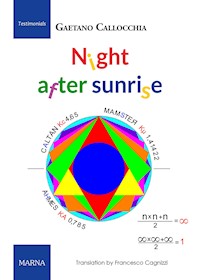
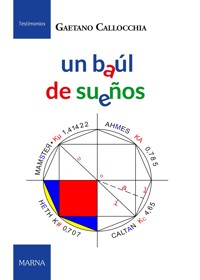
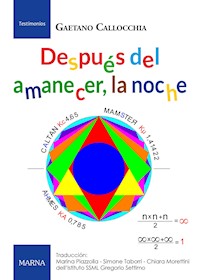
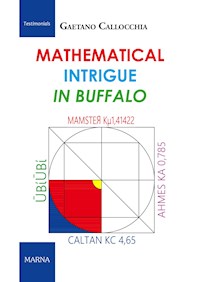
On the cover
Chromogeometric MANDALA elaborated
by G. Callocchia, as a symbolic representation
of human existence
Translation by Francesco Cagnizzi
MARNA
www.marna.it
ISBN 978-88-6670-155-2
© 2023 Publishing VELAR
24020 Gorle (Bg)
www.velar.it
All rights, translation and reproduction
text and images
carried out by any means,
are reserved in all countries.
First digital edition: January 2023
THE BOOK
The story of Domenico continues; the young Abruzzese who in the early 1900s leaves his native town (Aielli in the heart of Marsica) to go to work, like many other Italians, abroad and get a better future, at least from an economic point of view. He first goes to Prussia and then to the United States in Buffalo, where he works on one of the first projects of the great architect Frank Lloyd Wright. He then returns to Italy to marry his Erminia, the beautiful girl with whom he has always been in love, and who has remained in the village waiting for him. Children are born and things are not going well from an economic point of view, so he makes the heroic decision to return to America again.
He first works in Bayonne, New Jersey, where he takes part in the construction of St. Henry’s Church. He then moves to Cumberland in Maryland where he works in a brick kiln in the nearby town of Frostburg. Domenico, in his spare time, always continues to be interested and try his hand at mathematical formulas and relationships, his great «passion», that had already aroused the wonder of the famous architect Wright. Then, called up by the American government, serves in Camp Gordon, recruiting camp for young Americans from «all American» states.
The context changes, but the passion for life and the commitment to his mathematical research, aimed only at satisfying personal intuitions, sometimes reaching unexpected solutions, remains. Commitments change, needs and circumstances change; Domenico does not give up but matures his life experience through sufferings and difficulties. He has a goal to achieve, so he overcomes challenges and confirms his convictions: love for his wife Erminia; respect for one’s word; the inner honesty of man in search of good.
BIOGRAPHY
Gaetano Callocchia
Born in Aielli (AQ), he graduated in Architecture at the «La Sapienza» University of Rome with the maximum vote. He enrolled in the Order of Architects, and started his own office in Rome.
He took care of the design and construction management of monumental complexes, reception centers, religious and residential buildings, accommodation facilities and school complexes. Teacher of post-graduate training courses at the Faculty of Architecture in Rome and professional refresher courses. Consultant at the Order of Architects of Rome, at the CNEC, at the FACI, former member of the Technical Scientific Committee of the Ministry of the Interior on appointment of the National Council of Architects.
He has published several monographs on fire prevention, and safety for Nuova Italia Scientifica, Carocci Editore, Il Sole 24 Ore, EPC, OCD, Editoriale Italiana.
He has written articles for magazines: Together, the Friend of the Clergy, Magazine of the Order of Architects of Rome, CNEC News, and for «Ecclesia» in the «Spazio Convento» section. Author of the volume “John Paul II, April 2005: A Media Event” - OCD Editions (2006) - “Notes for the management of the patrimony of Ecclesiastical Bodies” - Editorial 2000 (2012) and of the novels “Mathematical intrigue in Buffalo” – Marna (2019) and “A trunk of dreams” – Marna (2021).
He has obtained the following prizes and awards: Guinnes World Records (2017), «Dei Sign» Award - Diocese of Cuneo (2012), Honoris Causa Degree 110 and honors for the Restoration of the General Curia Sisters Daughters of Our Lady at Monte Calvario - Rome (2002), Broadcast «I cervelloni», First Prize (1997), Assisi Prize for the restoration - Project reported (1994/1995). He has participated in the following exhibitions: Exhibition of architects and artists, Casa dell’Architettura - Rome (2016, 2017, 2018); Project Church monument to John Paul II, Krakòv (Poland) May 2016, Rome October 2006 and Massa Carrara December 2016 –
Monitor Patent Exhibition 2020, Casa dell’Architettura - Rome (2020).
He is a designer of community real estates for religious Bodies and Institutes, in Italy and abroad (Kenya, Tanzania, Poland, Argentina, Philippines).
BEGINNING
The beginning always follows the principle
Caltan
DEDICATION
Dedicated to the victims
of the earthquake of 13 January 1915
ACKNOWLEDGEMENTS
I thank all the people who daily
accompany me on the path of existence.
I thank, in particular:
Urszula Kukuc who has accompanied
me in the draftingof the novel and done
her utmost to translate it into Polish;
Bernardo Petit who enthusiastically has devoted himself
to transcribe the manuscript, revise the text and translate it into French;
Francesco Cagnizzi who, with self-denial,
put effort into translating the novel into English.
I thank all friends who have encouraged and enticed me to write this third novel.
For the data reported in the novel, I have used websites, Google, Wikipedia, my personal historical archive and
other sources that have allowed me to access texts, maps, translations and anything else useful.
NIGHT AFTER SUNRISE
It was January 25, 1914 when, for the second time, I found myself in
“Ellis Island”
To tell the truth, I could have arrived even earlier if the adverse weather conditions had not hindered both the disembarkation and the entire journey.
I had left my country and all my loved ones on Monday, December 29, 1913. There was snow; my brother Giuseppe accompanied me to the station, together with uncle Venanzio with his donkey that had the honor and the burden to bring my
suitcase. It was certainly less voluminous than the trunk I had when I returned but it was still a load that, walking on the snow, was doubled.
The suitcase was neither very heavy nor too full: few clothes, just enough for the trip and for the first days after arrival. I would then have all my clothes renewed as soon as I set foot in America and got my first salary. It is not that I needed much, so the expression “renewed” referring to clothing was reduced to two pairs of trousers, two shirts, a heavy jacket and a lighter one. For underwear, I had already everything, handmade with the wool of our sheep, shorn, carded, spun and knitted: underpants, long johns, socks, light and heavy knits.
I also had with me a black wool scarf made by my mother. I took it very willingly even when it was not very cold; it kept me company and I felt the warmth and protection of my mother, which gratified me a lot. My wife had put everything in the suitcase to guarantee me food, if not for the entire trip at least for a good part of it. Sausages, cheese, a loaf of bread sliced, walnuts, almonds and hazelnuts already peeled, chestnuts, dried rowanberries, roasted chickpeas, a little macaroons, a little “lemon apples” (yes, apples so called, even though the lemon did not resemble each other at all, except for the slightly yellowish color) and then donuts and long biscuits and short biscuits. Just seeing so much good stuff made your eyes shine! My wife had also prepared a packet of macaroons, perhaps a kilo, to take along with a bottle of Millefiori liqueur to Camillo, the son of the sister of my mother’s aunt’s sister-in-law. It was customary to bring a gift to distant relatives and friends to show gratitude, esteem and affection; in my village, there was the tradition of giving Amaretti from Aielli (unique and delicious!) together with a bottle of Millefiori liqueur. I never understood why a bottle of Millefiori liqueur, but so it was!
Camillo was already being in America since some years, in Bayonne in New Jersey, and had written to his relatives that there was work for carpenters, joiners, stonemasons and masons for the construction of the church of Saint Henry in Bayonne. Initially I had not given much weight to this news; however, when I decided to leave for America, without even informing my cousin Isidoro, I wrote to Camillo informing him that I was willing to leave. Therefore, I asked him to give me all the information to be able to prepare the necessary documents for the departure. Once the documents were received and prepared, it was easy for me to get the ticket and a visa for the travel.
We arrived at the station early, so I stopped by to greet the stationmaster who, with an astonished expression, seeing me, exclaimed: “Are you leaving again? Yes, here there is little to be happy about, you can only cultivate misery; you do right Domenico. You are still young and if you feel good there, as I wish you, let your family come further so you can give them a future with fewer sacrifices. I wish you all the best from the bottom of my heart”. I was a little surprised by the stationmaster’s words: he encouraged me to leave my land, my loved ones and the people I cared about! His words were certainly sincere and motivated but lacking in the “lived experience” of those who move away from their land, from his homeland.
Leave my beloved wife and three daughters, my father and my mother already advanced in age? Would I ever see them again? Leave my brothers, my father-in-law and his family, friends and acquaintances, is not that simple and only those who have tried it can understand all the bitterness, loneliness, discouragement, bewilderment of existence! The stationmaster, my brother and uncle Venanzio realized that I had suffered the blow: I was distracted and gloomy but, when the discussion was reopening, the train was coming, announced by a deafening “rattlement” and a cloud of smoke. I said goodbye to the stationmaster, hugged my uncle Venanzio and my brother Giuseppe and quickly and secretly reached the compartment, which was almost empty. Looking out the window, I made a last wave of my hand as a greeting; then slumped on myself, gathered in the spruce seat, I cried.
I looked in astonishment from the window, everything was flowing; I tried to please my eyes by giving them points of reference, traces, memories: Magliano with Santa Maria in Valle Porclaneta in the distance, the town of Nicola and Mariarosa. It occurred to me to think of Nicola, we had not seen each other again after our trip to Niagara Falls. Was he back? Was he married? Who knows! I would have liked to meet him again; he had been really nice to me. After Magliano, there is Scurcola dei Marsi, a town famous for the battle between Charles of Anjou and Corradino of Swabia in the plain of the Palentini Plains. Beautiful, all covered in snow and even bigger than I imagined. And again the Sanctuary of the Madonna Della Vittoria patron saint of Scurcola by the will of Charles of Anjou who in 1268. After winning the battle against Corradino I of Swabia, he wanted to erect the abbey of the Madonna della Vittoria in 1274 and enrich it with a statue of the Virgin. Following is Tagliacozzo, a city rich in history, where Tommaso da Celano chose to live after the death of San Francesco. After Tagliacozzo, after Pietrasecca, there is Carsoli, then Tivoli and immediately after the Eternal City! People who went up and took their seats, regardless of those present; all of them a little lost and cold, no friendly gaze, no confidence. Everything seemed unreal to me, even the snow that helped to flatten the images inside and out.
Before arriving at the station in Rome, I took my backpack; in fact, I also had a backpack with me in addition to the suitcase. It was useful in order to have both food and drink at hand, and also the Bible given to me in Prussia by Uncle Norante. I took the opportunity to refresh myself and, as soon as I arrived at the Rome station, at 14:28, I got off the train and went to look for the one for Naples as the boarding for America was right at the port of Naples, on December 30th at 18:48 hours. At the station there was a clamor and total confusion: each was looking for his own train and, not knowing which track it was positioned on, like in an anthill, people moved in a non-stop coming and going. I too was in this movement, and only after a long time was able to locate my train: Rome-Naples train no. 4868 at 10:28 pm on platform 14. I had a lot of time available, therefore I found a support and, taking the Bible, I began to read immersing myself in the history of man. Having to embark on December 30th at 6:48 pm I had more than enough time, based on my assessments and information taken when I purchased the train and ship tickets.
I got on the train and took my seat, placing my suitcase and backpack in plain sight; there was an indescribable confusion and a really deafening shouting: it was impossible to understand who was leaving, who was arriving, much less who was staying. I was always attentive to my suitcase, influenced by the stories of acquaintances who had lost their clothes and luggage while traveling. More than lost, it is better to say that someone, in the confusion, had appropriated a suitcase not belonging to him and certainly, then, you cannot think of finding it. At the whistle of the conductor, the controllers signaled those who were not leaving, to get off the train; with difficulty it was possible to find some peace and, once closed the doors, the train began to move quickly away from the station. I checked my suitcase: it was in its place, so I naturally sighed with relief!
The train stopped in I do not know how many stations; it was already late at night and every now and then, I would half close my eyes to rest a bit, but I was always attentive and vigilant. The journey lasted almost eight hours and at dawn I found myself in Naples. The advice given to me and the information obtained reassured me because, even if I still had to go through the checks, I had enough time for boarding. I arrived at the port safe and sound with the suitcase and with all the clothes and various accessories. A bedlam appeared in my eyes: to say that there was confusion, is an understatement! A gigantic ship was already waiting; never seen before for how big it was, with a rather extravagant name: “Strampalia”. At least it seemed so to me, but I read better and realized that there was no r, so the name was “Stampalia”. However, for me it changed very little; what meaning could it ever have? Who had come up with such a strange name? Bah! Amidst thrusts, elbowing and swearing, I approached the control area, presented the boarding documents and signed some papers in trust as there was such a thick and small piece of writing that it would take some time to understand its meaning. I learned later that he was reporting personal data of sound and robust constitution, travel information, political information, the reason for the trip, etc. Once I passed the controls and collected a pass sheet, I lined up with all the others to reach the boarding bridges.
I had already embarked in the ports of Bremen and New York, but I had not yet faced such confusion and shouting! I am not here to tell the whole experience; I can only say that, at a certain moment, two people came to blows for futile reasons and only the prompt intervention of the security officers prevented a big-time brawl. I reached the third class cabin that had been assigned to me and, to my surprise, I found that there were already three other passengers. They had boarded in Genoa as the ship did not depart from Naples but came from Genoa and then had to land in Palermo and, after a short stop, head directly to New York Harbor. I introduced myself saying: “I am Domenico P. and I come from Aielli in the Marsica area, in Abruzzo, in Italy!”
The others also took the floor to introduce themselves and, in turn, said: “I am Antonio, I am also Italian and I come from Pasquaro, Rivarolo in Piedmont. Nice to meet you!”, And then: “I am Arduino, I come from Pombia in Piedmont, Italy. Nice to meet you” and again: “I am Adriano, I am Piedmontese too and I come from Ivrea. Nice to meet you!”
I arranged my suitcase and backpack and took my place. The cabin was small and a bit narrow but it had a porthole and, if nothing else, you could see some light. It took some time to fill that “whale” of a ship but, in any case, the long-awaited moment of departure arrived and a loud “bellow” repeated three times gave the signal to leave; I made the sign of the cross, recited a short prayer and entrusted the journey to the will of God. A thought enveloped me then with a great regret for my family: my wife, my three daughters so young, so defenseless! But I held back the tears; the choice to leave had been very meditated and evaluated with my wife and together we had decided that maybe it was good to make some more sacrifices and then settle down and look to the future for us and for our children with more serenity.
The shouting of my traveling companions distracted me from this thought; I paid more attention to their speaking also because I could not understand many words. Piedmontese, like the other regional languages spoken in Italy that I knew, had accents and expressions that were not always comprehensible. With my Italian from Marsicano Aiellese, I addressed the word indiscriminately to the three asking for news about the ship, about the voyage, about their final destination. The most willing to speak was Antonio who, calmly, adjusting his hat on the head, said: “The ship, with the bizarre name of Stampalia, is an Italian ship built in the La Spezia shipyards in Liguria; she has a tonnage of about 9,000 tons… “. I interrupted him to ask: “Sorry Antonio, but what is the tonnage?” “The tonnage” he replied, “is the internal volume of a ship, therefore the load capacity is approximately 2.8 cubic meters per ton”. I immediately calculated the total volume on the basis of the tonnage data, equal to 9,000 tons; then I specified: “The ship has a volume of 25,200 cubic meters!” “Domenico, I did not try my hand at making the calculation, I only took the information reported on a card posted on a corridor near the bridge. However, I must say that you are really quick with math!” “Yes it is my passion” I replied, “but please go ahead”. “This ship has a length of 145 meters and a width of 17 meters, has two double-propeller steam engines and two funnels. It can reach a maximum speed, not fully loaded and in favorable winds, of 16 knots per hour”. “I am sorry again Antonio” I interrupted him again, “what are the knots? What does a speed of 16 knots mean? I am asking because I am interested; please answer me if you know this!” “To tell the truth, I cannot answer!” he said, but at this point unexpectedly, as he seemed distracted and not interested in our conversation, Adriano took the floor saying: “The speed of ships is measured in knots, equivalent to one nautical mile per hour. The word knot derives from an ancient system used to measure the speed of boats”. I had understood that it was a unit of measurement but I had not yet understood what the speed of the ship in kilometers per hour was. So I turned to Adriano with a little awkwardness and a little awe, as happens to us “peasants” when we turn to a person who seems a gentleman and a little educated, and asked: “Sorry Adriano, but how much does, a nautical mile, correspond to in kilometers?” “Domenico, to tell the truth I do not know exactly; it should be between 1.5 and 1.9 kilometers”. Arduino then solved the problem by specifying, in a rude voice, that a nautical mile was equivalent to 1.853 kilometers. I immediately thought that, perhaps, the four of us, made almost a cultured Italian! But Antonio immediately resumed speaking, exposing the other data on the ship that he was aware of:
“This ship can carry up to 2,500 passengers of which one hundred in first class and the other 2,400 in third class, ours. Its route is Genoa, Naples, Palermo, New York”. “Ah, 2,500 passengers; it carries so many people! Almost as many as the inhabitants of my town plus a little of the town of Cerchio! Thanks for all this information Antonio. Therefore, we have to stop in Palermo too“ I said. “Oh yeah” Arduino resumed, “to load up some Sicilians and maybe even Calabrians”. “Let’s hope the good ones” Adriano added, with an allusive and arrogant expression.
In silence, I did some calculations and found that each passenger had 10 cubic meters of air available. It was only a theoretical figure because the total tonnage volume of the ship also included corridors, common areas and more that was necessary for the navigation of the ship. Therefore, the cabin for four people had actually only 12 cubic meters, which was about three cubic meters per passenger. Not so many considering the travel conditions, poor hygiene and more. But that is the way it is in third class!
I then tried to calculate the travel days needed to reach New York by taking as a reference the most probable speed of 14 knots per hour. However, how could I calculate the time if I did not have the necessary data available? I did not know the Naples-Palermo distance and the Palermo-New York distance. I felt a little uncomfortable: I could start to ask questions again, but then whom to ask? I took courage and threw the question into the fray, without asking it to anyone specifically: “Excuse me, but is the Naples-Palermo distance more or less 350 kilometers? And the one between Palermo and New York is more or less 7,000 kilometers?” There was a short silence, then Arduino’s voice was heard: “Naples-Palermo are about 300 kilometers and Palermo-New York are about 7,000 kilometers”. “Thanks Arduino” I replied, but Arduino continued to speak: “Sorry Domenico, but why do you need to know the distances you asked for? The time required for the journey is not only due to the distance; there are many other components that could make the journey shorter or longer. According to my experience, I can tell you that going from Genoa to New York via Naples and Palermo can take between 20 and 25 days. So put your mind in peace: if we are lucky, we can arrive to New York between 18 and 20 January!” “Thanks Arduino, I understand from what you say that this is not the first time you have made this trip”. “It is just like that Domenico”.
I resumed my calculations, more for personal satisfaction than for anything else. I could verify this by calculating the time the ship would have taken to reach Palermo: at a speed of 25 kilometers per hour, it would have taken 12 hours to cover the distance of 300 kilometers, so by noon on December 31 we should had to arrive in Palermo. Night fell and then day came; it was raining and cold outside. The sea was rough and the ship was moving slowly, swaying fearfully. It was noon but we had not arrived in Palermo yet! Were my calculations wrong? Was Arduino right? Had the ship been in trouble?
We arrived in Palermo at maybe 4 pm or so and to the surprise of all of us, we noticed that there were very few people on the pier and certainly, they did not look like people who were going to get on the ship. As soon as we docked, we were told that the ship had had some technical problems and that it had to be repaired before we could leave. It was planned to stop for a couple of days so we were asked to remain calm on the ship and to follow the instructions of the crew. Certainly there was no need also for damage to the ship and such a prolonged delay, but we could not do otherwise so we just had to resign ourselves and wait for the moment to leave. This only happened on January 4th and, after loading perhaps another 500 or 600 passengers, we set sail in the hope of arriving safely.
The trip was very painful, starting with the stop in Palermo, and everything happened: rough sea with waves high meters and meters, people vomiting and a stench that made the air unbreathable. Measles, dysentery and more struck many passengers. For several days people sat on the ground so as not to fall due to the strong oscillations of the ship; weeping, moaning and cursing were everywhere. However, there were also some beautiful moments: I remember in particular January 11th when some women gave birth and there was a big party, also to ease the tension throughout the ship. Then another day, after a storm, not very violent to tell the truth, the rainbow appeared and this reassured us a little. The sight of the rainbow in the sea generated enthusiasm and hope in everyone’s heart. Some days the staff organized small dance parties, in which one could take turns taking part. I remember that about ten weddings were also celebrated and in particular there was a big party for the wedding of Lucy and Salvatore, two “special” characters, truly out of the ordinary!
Finally after days and days of sailing (to tell the truth I had lost count) we docked at the port; it was supposed to be the port of New York but we discovered that it was not, as it was instead a stopover port near Narrows, used to unload passengers suffering from cholera and typhus for quarantine. They were then transported to Hoffman Island and Swiburne Island. We left to immediately dock afterwards at the port of Manhattan; there was a lot of fog and therefore we were forced to stay aboard the ship. Another forced stop! Only on the morning of January 25, the fog began to clear, and on the horizon we could see the bust of the Statue of Libertyemerging on a sea of fog: a suggestive, truly exciting image. I was back again in America!




