


170,99 €
Mehr erfahren.
- Herausgeber: John Wiley & Sons
- Kategorie: Fachliteratur
- Sprache: Englisch
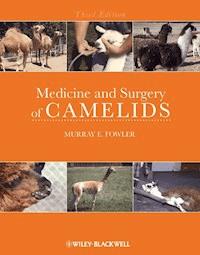
Medicine and Surgery of Camelids is the classic comprehensive reference on llamas, alpacas, vicunas, guanacos, and camels. With information on topics ranging from nutrition and management to infectious diseases and emergency care, this book provides information on the health and maintenance of these species. Updates to the Third Edition include new information on camels; full color throughout; significant revisions to the parentage verification, infectious diseases, anesthesia, restraint, and nutrition sections; and additional information on the alpaca genome. This is an essential resource for practicing veterinarians, zoo veterinarians, and veterinary students.
Sie lesen das E-Book in den Legimi-Apps auf:
Seitenzahl: 1486
Veröffentlichungsjahr: 2011
Ähnliche




















Murray E. Fowler is Professor Emeritus of Zoological Medicine, School of Veterinary Medicine, University of California, Davis.
First edition first published 1989
Second edition first published 1998
Third edition first published 2010
© 2010 Blackwell Publishing
Blackwell Publishing was acquired by John Wiley & Sons in February 2007. Blackwell’s publishing program has been merged with Wiley’s global Scientific, Technical, and Medical business to form Wiley-Blackwell.
Editorial Office
2121 State Avenue, Ames, Iowa 50014-8300, USA
For details of our global editorial offices, for customer services, and for information about how to apply for permission to reuse the copyright material in this book, please see our website at www.wiley.com/wiley-blackwell.
Authorization to photocopy items for internal or personal use, or the internal or personal use of specific clients, is granted by Blackwell Publishing, provided that the base fee is paid directly to the Copyright Clearance Center, 222 Rosewood Drive, Danvers, MA 01923. For those organizations that have been granted a photocopy license by CCC, a separate system of payments has been arranged. The fee codes for users of the Transactional Reporting Service are ISBN-13: 978-0-8138-0616-7/2010.
Designations used by companies to distinguish their products are often claimed as trademarks. All brand names and product names used in this book are trade names, service marks, trademarks or registered trademarks of their respective owners. The publisher is not associated with any product or vendor mentioned in this book. This publication is designed to provide accurate and authoritative information in regard to the subject matter covered. It is sold on the understanding that the publisher is not engaged in rendering professional services. If professional advice or other expert assistance is required, the services of a competent professional should be sought.
Library of Congress Cataloging-in-Publication Data
Fowler, Murray E. Medicine and surgery of camelids / Murray E. Fowler ; in collaboration with P. Walter Bravo. – 3rd ed. p. ; cm. Rev. ed. of: Medicine and surgery of South American camelids / Murray E. Fowler. 2nd ed. 1998.Includes bibliographical references and index.
Summary: “Medicine and Surgery of Camelids is the classic comprehensive reference on llamas, alpacas, vicunas, guanacos, and camels. With information on topics ranging from nutrition and management to infectious diseases and emergency care, this book provides information on the health and maintenance of these species. Updates to the Third Edition include new information on camels; full color throughout; significant revisions to the parentage verification, infectious diseases, anesthesia, restraint, and nutrition sections; and additional information on the alpaca genome. This is an essential resource for practicing veterinarians, zoo veterinarians, and veterinary students.”–Provided by publisher.
ISBN 978-0-8138-0616-7 (hardback : alk. paper) 1. Camelidae–Diseases. 2. Camelidae–Surgery. I. Bravo, P. Walter. II. Fowler, Murray E. Medicine and surgery of South American camelids. III. Title. [DNLM: 1. Camelids, New World–surgery. 2. Camels–surgery. 3. Animal Diseases–surgery. 4. Veterinary Medicine–methods. SF 997.5.C3 F787m 2010]
SF997.5.L35F68 2010
636.2′96–dc22
2009049315
A catalog record for this book is available from the U.S. Library of Congress.
Set in 10 on 12 pt Palatino by Toppan Best-set Premedia Limited Printed in Singapore
Disclaimer
The contents of this work are intended to further general scientific research, understanding, and discussion only and are not intended and should not be relied upon as recommending or promoting a specific method, diagnosis, or treatment by practitioners for any particular patient. The publisher and the author make no representations or warranties with respect to the accuracy or completeness of the contents of this work and specifically disclaim all warranties, including without limitation any implied warranties of fitness for a particular purpose. In view of ongoing research, equipment modifications, changes in governmental regulations, and the constant fl ow of information relating to the use of medicines, equipment, and devices, the reader is urged to review and evaluate the information provided in the package insert or instructions for each medicine, equipment, or device for, among other things, any changes in the instructions or indication of usage and for added warnings and precautions. Readers should consult with a specialist where appropriate. The fact that an organization or website is referred to in this work as a citation and/or a potential source of further information does not mean that the author or the publisher endorses the information the organization or website may provide or recommendations it may make. Further, readers should be aware that Internet websites listed in this work may have changed or disappeared between when this work was written and when it is read. No warranty may be created or extended by any promotional statements for this work. Neither the publisher nor the author shall be liable for any damages arising herefrom.
1 2010
Contents
Preface to the Third Edition
Preface to the Second Edition
1 General Biology and Evolution
TAXONOMY
GENERAL BIOLOGY
SOUTH AMERICAN CAMELIDS
OLD WORLD CAMELIDS
EVOLUTION
DOMESTICATION
USES OF CAMELIDS
REFERENCES
SELECTED GENERAL MEDICINE REFERENCES ON CAMELS
2 Feeding and Nutrition
FEEDING BEHAVIOR8,9,21,35,48,55,85,93,95,104,127
NUTRITION ANATOMY AND PHYSIOLOGY
STOMACH MICROBIOLOGY26,105
NUTRIENT REQUIREMENTS OF CAMELIDS6,72,76
VITAMINS
FEEDING CAMELS73,79,131,133
NUTRITIONAL PROBLEMS125
SPECIAL FEEDING SITUATIONS
REFERENCES
3 Restraint and Handling
CAMELID BEHAVIOR4,15,17,19,20
PHYSICAL RESTRAINT
PROCEDURES COMMON TO ALL CAMELIDS
REFERENCES
4 Clinical Diagnosis: Examination and Procedures
PHYSICAL EXAMINATION
DIAGNOSTIC PROCEDURES
REFERENCES
5 Anesthesia
LOCAL ANESTHESIA
GENERAL ANESTHESIA
NEONATE ANESTHESIA
SUPPORTIVE THERAPY DURING ANESTHESIA
REFERENCES
6 Surgery
HEAD
DENTAL DISEASE
CELIOTOMY (LAPAROTOMY)16
DIGESTIVE SYSTEM
REPRODUCTIVE SYSTEM
URINARY SYSTEM58
MUSCULOSKELETAL SYSTEM
REFERENCES
7 Infectious Diseases
VIRAL DISEASES OF CAMELIDS
TOGAVIRUS INFECTIONS
MISCELLANEOUS VIRAL DISEASES142
FUNGAL INFECTIONS146
BACTERIAL DISEASES68
ABSCESSES
PREVENTIVE MEDICINE FOR CAMELIDS165,166
GOVERNMENT REGULATIONS AND INFECTIOUS DISEASES
VALIDITY OF LABORATORY TESTING FOR INFECTIOUS DISEASES
REFERENCES
8 Parasites
EXTERNAL PARASITES70,71
INTERNAL PARASITES
REFERENCES
9 Multisystem Disorders
NEOPLASIA
CONGENITAL DISORDERS
STRESS
THERMAL STRESS
DEHYDRATION
FLUID THERAPY IN LLAMAS AND ALPACAS
GERIATRIC MEDICINE IN LLAMAS AND ALPACAS14,24,26,32
ELECTROCUTION
FAILURE OF PREDICTED GROWTH AND WEIGHT LOSS
RECUMBENCY7,8
REFERENCES
10 Integumentary System
SKIN
HAIR (FIBER COAT, WOOL)1,7,11,15,17,25,27,31,41,47
Hair Loss33
MAMMARY GLAND18,26,42,43,46,49
OTHER SKIN GLANDS
FOOT13
DIAGNOSIS OF DERMATOLOGIC CONDITIONS
DISEASES OF THE INTEGUMENT14,16,34
REFERENCES
11 Musculoskeletal System
ANATOMY
RADIOGRAPHY1,23
MUSCULOSKELETAL DISORDERS
REFERENCES
12 Respiratory System
ANATOMY
PHYSIOLOGY
SAC ADAPTATIONS TO ALTITUDE
DIAGNOSTIC PROCEDURES17
INFECTIOUS DISEASES
PARASITIC DISEASES
CONGENITAL DISORDERS
MISCELLANEOUS DISEASES10,15,30
ARTIFICIAL RESPIRATION
REFERENCES
13 Digestive System
ANATOMY AND PHYSIOLOGY84
GASTROINTESTINAL TRACT106,107
DIGESTIVE DISORDERS
DISEASES OF THE DIGESTIVE SYSTEM4,20,50,85
REFERENCES
14 Endocrine System
ANATOMY AND PHYSIOLOGY
DISEASES
REFERENCES
15 Hemic and Lymphatic Systems
ANATOMY AND PHYSIOLOGY
HEMATOLOGY
SERUM BIOCHEMISTRY3,36,67
LYMPHATICS
DIAGNOSTIC PROCEDURES
DISEASES
REFERENCES
16 Cardiovascular System
ANATOMY
PHYSIOLOGY
SPECIAL DIAGNOSTIC PROCEDURES
DISEASES
CARDIAC MASSAGE
REFERENCES
17 Reproduction
Murray E. Fowler and P. Walter Bravo
REPRODUCTIVE STRATEGIES
NORMAL REPRODUCTION62,65,109
INFERTILITY82
SELECTION OF BREEDING CAMELIDS
REFERENCES
18 Urinary System
ANATOMY
CHARACTERISTICS OF CAMELID URINE1,9,28,29
DIAGNOSTIC PROCEDURES
URINATION BEHAVIOR
DISEASES
REFERENCES
19 Organs of Special Sense
EYE
EAR
REFERENCES
20 Nervous System
ANATOMY
DIAGNOSIS
DISEASES
MISCELLANEOUS CONDITIONS OF THE NERVOUS SYSTEM
REFERENCES
21 Neonatology
Murray E. Fowler and P. Walter Bravo
CHARACTERISTICS OF THE CAMELID NEONATE1,2,4,14,32
IMMEDIATE CARE OF THE NEWBORN11,28,29,31
PREMATURITY6
IMMUNOGLOBULINS
FAILURE OF PASSIVE TRANSFER (FPT) OF IMUNOGLOBULINS1
CARING FOR THE ORPHANED CAMELID14,15
WEANING25
NEONATAL DISEASES26
IMMUNOPROPHYLAXIS
REFERENCES
22 Congenital/Hereditary Conditions
TERMINOLOGY
CAMELID GENETICS19,39,62,89
TERATOGENESIS
HEREDITARY TRAITS21,25,65,67,100,123
BREEDING MANAGEMENT SYSTEMS63
CONGENITAL CONDITIONS49
NEW CONGENITAL DEFECTS OF SACS
THE CAMELID IMMUNE SYSTEM
BLOOD-TYPING AND PARENTAGE VERIFICATION
CAMELID HYBRIDS
REFERENCES
23 Toxicology
ADAPTATION TO TOXICANTS
DIAGNOSIS OF POISONING6,25
TREATMENT OF POISONING
PREVENTION OF POISONING
CLASSES OF POISONS3,45
REFERENCES
24 Conformation and Gaits
CONFORMATION CHARACTERISTICS
REFERENCES
25 Disaster and Emergency Management
DISASTER AND EMERGENCY SITUATIONS
PLANNING AND PREPARATION
REFERENCES
Appendix 1 Abbreviations Used in this Book
Appendix 2 Conversion Tables
Appendix 3 Sources for Drugs Mentioned in the Text
Appendix 4 Generic Names, Common or Trade Names and Sources of Drugs Mentioned in the Text
Index
Dedication
The third edition is once again lovingly dedicated to my wife Audrey, who has been an intimate participant in all of the editions. She has not only tolerated the hours spent away from the family but has read, corrected, and reread the manuscripts more times than either of us would like to remember. This revision could not have been brought to fruition without her help.
Preface to the Third Edition
The purpose of a preface is to provide an overview of the book. The second edition was published in 1998. The medical challenges that have arisen since then have kept pace with the advances made in veterinary medicine in general. West Nile virus encephalitis entered the United States and has become endemic in all the mainland states. Ionophore coccidiostat toxicity is new to camelids as is red maple, Acer rubrum, poisoning which heretofore has only been reported in horses.
The scope of this edition has broadened materially, as refl ected in the new title. Information on Old World camelids has been added. While much of the anatomy and medical information is applicable to all camelids, where specifi c differences occur they will be discussed more fully.
The world literature has been scanned to provide an international approach to camelid medicine. Hundreds of new citations from the world literature provide details for the interested reader. References from sources that are less readily available to most readers have been deleted.
South American camelids are popular in the private sector in many countries in the world. They may become exposed to new infectious and parasitic diseases, such as West Nile virus disease, eastern equine encephalomyelitis, and encephalomyocarditis. In Europe, camelids have contracted Borna disease.
Camels suffer from a unique form of pox, which is the scourge of camels in their native countries. South American camelids may be experimentally infected, but are not known to be clinically infected naturally. Camels are also subject to surra (trypanosomiasis), which is caused by a protozoan parasite in countries where native camels exist.
The opportunities for continuing education in camelid medicine are numerous. Annual four - day workshops are now rotated between Ohio State University in Columbus and Oregon State University in Corvallis. Another conference is held at Kansas State University in Manhattan, Kansas. Sporadic seminars and conferences are held in conjunction with local camelid association meetings and at large regional veterinary conferences. Similar meetings are held in Australia, the United Kingdom, Ireland, and European countries.
The quantity and quality of research on camelid medical challenges have expanded exponentially. A signifi cant milestone in camelid research is the completion of the alpaca genome project, which has great potential for genetic studies. Research studies on camelid medicine are reported in many professional journals. The Journal of Camel Practice and Research is devoted entirely to camelids.
Color has been added to the third edition, with more than 500 color images and 250 black and white photos and diagrams. The author’s aim is to provide medical information on all camelids for clinical veterinarians, research scientists, students, and others interested in the health and well - being of these special animals that share this Earth with us.
Preface to the Second Edition
It has been ten years since the first edition of Medicine and Surgery of South American Camelids was written. Much has transpired during that time period. The population of llamas in North America has grown to over 120,000. Fewer than 200 llamas are exhibited in zoos, the rest being in private ownership. The astronomical prices paid for llamas a decade ago have dropped to a more reasonable level. Alpacas have become more popular, and over 2,000 animals have been imported from South America, bringing the North American alpaca population to greater than 10,000. Countries on other continents are experiencing a growth in South American camelids (SACs) as an alternate livestock enterprise; they include Australia, New Zealand, England, Scotland, France, and Germany.
Numerous regional and national organizations offer membership conferences, shows, sales, and other activities to maintain and stimulate interest in these unique animals. Llamas are now being used to guard fl ocks of sheep and to pack supplies and equipment for the U.S. Forest Service. Cottage industries making use of both llama and alpaca fiber abound. Camelid industries in North America are strong, and there is continued interest in learning about health care, hence the need for a second edition of this book.
Approximately 1,000 references from the world literature were cited in the first edition. In the intervening ten years the author has found another 1,300 references to add to that list. Considerable clinical experience has been gained by practitioners all over the world. A number of institutions are conducting basic investigations to solve problems. The camelid industries have contributed generously to fund research, but much more support is required to bring camelid veterinary medicine into the twenty-first century on a par with other livestock industries.
Articles appear regularly in professional veterinary journals. Books have been published dealing with medicine, reproduction, feeding, neonatology, and infectious and parasitic diseases. Veterinarians are no longer able to say that nothing is known about these animals. Likewise, owners should not say that veterinarians don’t know how to treat the disorders of camelids. Not only are there books and professional journal papers but also numerous state, regional, and national veterinary meetings that offer half to two days of information on camelid medicine to attendees.
A two-day annual workshop on “the cutting edge of llama and alpaca medicine” has alternated between the veterinary schools at Fort Collins, Colorado, and Davis, California, with forty to seventy veterinarians attending. Other veterinary schools have offered special programs for veterinarians and, in some cases, for owners/breeders. Similar programs for veterinarians have been held in Australia, England, Scotland, Italy, France, and Germany. Veterinary schools in California, Colorado, Oregon, and perhaps other states have offered special elective llama and alpaca medicine and surgery courses to undergraduate veterinary students.
The format of the second edition is similar to that of the first, with two new chapters added on conformation and disaster management. Some chapters did not warrant much change, but others were revised signifi-cantly and brought up to date. Considerable basic research has been conducted on reproductive physiology during the past ten years. The author invited Dr. P. Walter Bravo to contribute to the chapter on reproduction. Topics that were omitted or glossed over superficially in the first edition have been expanded in keeping with newer knowledge that has been acquired.
As with the first edition, numerous individuals provided input in the form of inspiration, encouragement, shared clinical experiences, and basic research. A second edition would not have been considered without the support of the reading public. Again, my special thanks to Dr. La Rue Johnson, a true friend, who has been willing to discuss philosophies, ideas, failures, and successes within a framework of mutual respect and admiration. I feel blessed to have shared so many good years with owners and managers of llamas and alpacas. I have learned from them and their animals. I hope this book will help to return the favor of friendship and support.
The basic stimulus for preparing this book has not been the owners/breeders or colleagues but the author’s desire to contribute to the longer, healthier life of the versatile camelids of this world.
Murray E. Fowler
2
Feeding and Nutrition
Camelid owners and managers develop strong views on what constitutes appropriate feeding, and newcomers to the industry are bombarded with, “This is the way you have to feed.” There are no absolutes in feeding practices for camelids. Veterinarians may be unable to clarify the issues without basic information. It is not what you feed but how you feed it!
Lesen Sie weiter in der vollständigen Ausgabe!
Lesen Sie weiter in der vollständigen Ausgabe!
Lesen Sie weiter in der vollständigen Ausgabe!
Lesen Sie weiter in der vollständigen Ausgabe!
Lesen Sie weiter in der vollständigen Ausgabe!
Lesen Sie weiter in der vollständigen Ausgabe!
Lesen Sie weiter in der vollständigen Ausgabe!
Lesen Sie weiter in der vollständigen Ausgabe!
Lesen Sie weiter in der vollständigen Ausgabe!
Lesen Sie weiter in der vollständigen Ausgabe!
Lesen Sie weiter in der vollständigen Ausgabe!
Lesen Sie weiter in der vollständigen Ausgabe!
Lesen Sie weiter in der vollständigen Ausgabe!
Lesen Sie weiter in der vollständigen Ausgabe!
Lesen Sie weiter in der vollständigen Ausgabe!
Lesen Sie weiter in der vollständigen Ausgabe!
Lesen Sie weiter in der vollständigen Ausgabe!
Lesen Sie weiter in der vollständigen Ausgabe!
Lesen Sie weiter in der vollständigen Ausgabe!
Lesen Sie weiter in der vollständigen Ausgabe!
Lesen Sie weiter in der vollständigen Ausgabe!
Lesen Sie weiter in der vollständigen Ausgabe!
Lesen Sie weiter in der vollständigen Ausgabe!
Lesen Sie weiter in der vollständigen Ausgabe!
Lesen Sie weiter in der vollständigen Ausgabe!
Lesen Sie weiter in der vollständigen Ausgabe!
Lesen Sie weiter in der vollständigen Ausgabe!
Lesen Sie weiter in der vollständigen Ausgabe!




