


1,49 €
Mehr erfahren.
- Herausgeber: The History Press
- Kategorie: Geisteswissenschaft
- Sprache: Englisch
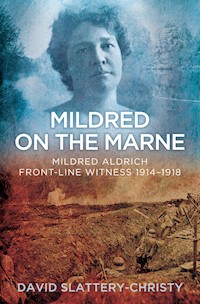
This is the story of 61-year-old Mildred Aldrich and her experiences of the Great War. She retired to a small hill-top house called La Creste in February 1914, with views across the Marne river and valley, little realising she would become embroiled in the first major battle of the war. In spite of the danger she decided to stay and help the British soldiers. Her home was for a few days behind German lines but the British pushed the Germans into retreat and La Creste remained in British territory for the duration. They entrenched in the Marne Valley and Mildred's 'beloved panorama' as she described the view, turned into the valley of horror and death. Informed by journalist Mildred's unpublished journals and voices of those serving in the BEF, along with historical military background, this book examines events from the unique perspective of a remarkable woman who lived through them.
Das E-Book können Sie in Legimi-Apps oder einer beliebigen App lesen, die das folgende Format unterstützen:
Veröffentlichungsjahr: 2013
Ähnliche




















Informed by the letters, diaries, journals and memoirs ofMildred Aldrich 1853–1928Chevalier de la Légion d’Honneur Nationale De la République Française
CONTENTS
Title
Dedication
Introduction
Acknowledgements
1 Drum Beats and Destiny
2 Yankee, Abolitionist and Patriot
3 La Creste: Renovation of a Ruin
4 First Days on the Hilltop
5 Assassination and German Invasion
6 Mobilisation and Preparations
7 The French Miracle
8 Paris is Saved!
9 Witness to Destruction on the Edge of the War Zone
10 The Long Road to 1918
11 The End Game
12 Aftermath and Légion d’Honneur
Appendix 1: Mini Biographies
Appendix 2: Forever Nineteen: Cast Details and Reviews
Further Reading and Sources
Copyright
Plates
In memory of my grandfathers – who both fought in the Great War 1914–18 – my father and stepfather, and members of my extended family, who all shared their memories of two world wars with me. Their experiences and first-hand accounts of both world wars enabled me to understand the sacrifices they made willingly for future generations.
Joseph John Slattery (1886–1974), Irish Guards
Walter Edward Reginald Pratley (1896–1939), Royal Berkshire Regiment
Leslie John Slattery (1921–96), Royal Berkshire Regiment
Patrick Walter Slattery (1922–67), Royal Air Force
Alec Aveyard (1919–2012), Royal Engineers (REME)
Harold Greenwood (1887–1961), Gunner, Lancashire Fusiliers
Harry Greenwood (1917–2008), Transport Corps, Lancashire Fusiliers
For my friend Alan Bardsley, who was so enthusiastic and supportive of this project, and the proposed revival in 2014 of my stage play Forever Nineteen, based on Mildred’s experiences, for which he had started constructing brilliant designs. Also Major James Houldsworth for his quiet determination, influence and friendship. Taken too soon, sadly missed.
We will remember them.
INTRODUCTION
A LONG JOURNEY
It is more than twenty years since I first discovered Mildred’s remarkable story. In the early 1990s I was researching an idea for a stage play based on my paternal grandfather, Joseph John Slattery, and his experiences of the Great War. He joined the Irish Guards in 1914 and was from Clon Mel, Tipperary, Ireland. He was sent to Gallipoli and later to France and survived. It was whilst undertaking this research that a vague mention was made of an elderly American lady who retired to a hilltop overlooking the Marne Valley, France, from where she experienced the first major battle of the war, which stopped the Germans from taking Paris. I was hooked and had to know more about her.
Forever Nineteen, the play I created, was set in Mildred’s house, La Creste, and told the story of how she stayed to help the British soldiers and how she coped when the Germans marched up her hill. The play went on to tour in the United Kingdom, where it played to packed houses at Manchester City of Drama and both the Buxton Festival and Edinburgh Festival. It even had a small production in New York. It received an award alongside Les Misérables in Manchester in 1993 – Mildred mentions Jean Valjean and Cossette, and Victor Hugo’s book. The French connection continues and illuminates Mildred’s foray into Edwardian theatre.
It always puzzled me why Mildred had been forgotten and so little was known about her. Perhaps the reason behind this was because she died in 1928, just before the great economic crash and depression, and then the rise of Hitler’s Nazi Germany. The subsequent outbreak of the Second World War pushed her remarkable story into a darkened corner of the twentieth century’s archive of history. It languished there for nearly a hundred years. It is time it was brought into the light, dusted off and appreciated once again.
My hope is that the publication of the story of this remarkable woman will bring her a new legion of admirers in the twenty-first century and, at the very least, will honour her with the respect her deeds in the Great War so justly deserve. Her letters, diary and journal, which outlined her intended autobiography (that was never actually published), along with her published books of letters from 1915 to 1919, have informed this biography. Her voice is strong and still shines through. She had great foresight and thought of us here in the future way back then.
You could say then that this book has been more than twenty years in the making – certainly so if you allow for all the years between Forever Nineteen and undertaking final research at the Schlesinger Library, Harvard University, which kindly gave me permission to use Mildred’s papers, to produce this book in time for the hundredth anniversary of the start of the Great War in 2014. My admiration for her achievements and her courage knows no bounds. I hope she would have approved and consider I have done her justice.
David Slattery-Christy
ACKNOWLEDGEMENTS
Special thanks to:
Ellen Aveyard; Allan Bardsley; Beinecke Library, Yale University; Eric Bogle; Meryl Bruen; Nica Burns; Nicki Casey; Eve Flint; Richard Kenneth French; Bill Greenwood; Graham Greenwood; Harvard Student Agencies (Research); Michael Harvey; Major James Houldsworth; Sarah Hutcheon – Harvard University; Gareth Johnson Ltd; Michael Lawson; Jenny Le – Harvard University HSA; Lyn Macdonald; Frederic Marchal; Lynn Nortcliff; Olivier Richomme; Rosy Runciman; Ellen M. Shea – Schlesinger Library; Florence Emily Slattery; Robert Smith Literary Agency; Schlesinger Library, Harvard University; John Ulrich – Harvard University HSA; Lee Wosltenholme; Eva Wrightson – Beinecke Library; Office of the Légion d’Honneur, Paris
Thanks to all my family and friends for putting up with my constant discussions about Mildred and the Great War. Not forgetting my mother for patiently reading and commenting on all the draft chapters.
This book would not have been possible without the kind permission of the Schlesinger Library, Harvard University, which allowed me to freely use previously unpublished documents and memoirs relating to and created by Mildred Aldrich held in its archive. The library staff and research assistants there were beyond compare and I thank them for their patience and courteous, efficient help at all times. It would also be fair to say that Mildred herself, by creating collections of letters to friends, and publishing them during the Great War, has brought that time to life, and given me an invaluable source of letters and documents to influence her story.
Finally I would like to thank author and historian Lyn Macdonald and her book 1914, which first brought Mildred to my attention many years ago. In a note to me she mentioned the differences a century on and the irony of another famous American moving close by – but with different consequences for those now living in the area:
Miss Aldrich did indeed have an exciting war – her house is still there and the village and surroundings much as she described them despite the encroachment of Euro Disney a few miles away.
Lyn Macdonald
1
DRUM BEATS AND DESTINY
Then suddenly one day the miracle happened – once again,
unannounced, the Giant Hands came out of the clouds,
and lifted me to a hilltop, and to my supreme adventure.
Mildred Aldrich
On a very cold, wintry but sunny November day in 1913, in northern France, a self-proclaimed ‘aged’ American lady stepped off the train at a small branch line at Esbly, near Voisons, a few miles outside of Paris. Mildred Aldrich was 60 on the sixteenth of that very month and she had come to view another potential retirement home, one that perhaps this time she could both like and afford – and more importantly one that would suit her needs, modest as she considered them to be.
Mildred had lived in Paris since 1898, where she had arrived from Boston, Massachusetts, with dreams and desires to continue to make a living as a journalist and writer. As a woman devoid of youth, unmarried and working in a world dominated by powerful men, her journey was far from easy and certainly not successful in any financial sense – although she did write as foreign correspondent for the Boston Herald and The New York Times for a period. However, this was a world where an unmarried career-driven woman was viewed with some suspicion. That a woman should want any kind of career apart from accepting a suitable husband and becoming respectably married was generally frowned on in the Victorian and Edwardian eras. Mildred let them all frown as much as they pleased; she was determined to march to the beat of her own drum.
Drums of another kind were also beating hard, following their allotted course and becoming more and more audible across the wider European continent in late 1913. The conflicts in the Balkans were getting out of control and the German Kaiser, Wilhelm II, was already planning his next move to take advantage of these ever-shifting and unstable political sands. The warning sound of those determined and ever-louder beating drums would very soon turn into the rattle of guns, bringing with them the stench of fear, turmoil and death, and changing the world forever.
A century later it is hard for us to imagine how age was perceived in 1913. Today, at the age of 60, Mildred would not be seen as an ‘aged’ woman at all, and certainly not someone who should be content to retire and feel her life was over because she seemingly had nothing useful left to offer or give to the world. Mildred herself stated that:
In spite of everything I was still tremendously interested in life – it was still to me a great show. But I was weary, and no longer physically strong. I was nearing the age when women who are not already successful don’t achieve much of importance. In my youth women of my world were usually grandmothers at sixty, and put on silk frocks and muslin fichus and lace caps, and sat at the fireside and knitted, with nothing to do but wait for the end.
There was to be no cosy fireside decline for Mildred. She was as yet oblivious to the fact that destiny was manoeuvring her to a particular place at the ‘right’ time, and that what she perceived as the beginning of the end of her life was in fact just the beginning of its most important phase, personally and creatively. Everything that happened before this was just a prelude for Mildred. Her most important role in history was about to unfold. Like the iceberg that had recently drifted towards the on-coming Titanic, Mildred drifted into the epicentre of what would arguably be the most catastrophic event in twentieth-century history. ‘What I really wanted was peace and quiet. But I had not earned them,’ declared Mildred in 1913. She was also only too aware of how desperate her financial situation had become – destitution was a real and worrying possibility:
It had been a stock joke among my friends who had known me longest that I should, of course, end up in the ‘poor house’, and they took great delight in telling me that I would be the ‘star boarder’ and ‘hold a salon’ and that they would all travel great distances to see me on my ‘reception days’. I enjoyed the joke when I was younger, and laughed as heartily as any of them. But the time came when it ceased to be a pleasant joke, but the habit of laughing at it persisted.
Mildred had, during her time living in Paris, been associated with the great and good of the arts and literature, such as Thornton Wilder, Picasso, Mira Edgerly, the Irish novelist James Stephens and later a youthful Ernest Hemingway. Mildred was also a close friend to Gertrude Stein, her brother Leo, and Gertrude’s partner Alice B. Toklas, and was thus a frequent visitor to their salons. It was these influential friends who turned out to be her financial saviours, enabling her to seek out that retirement home she secretly yearned for. Mildred’s health problems arose partly through her love of cigarettes and especially the Egyptian black tobacco brand she favoured; her heart problems and breathlessness were a direct result of, or at the very least exacerbated by, this destructive habit. She was therefore very aware that she possessed no skills aside from her writing talent that would garner her any employment. She could no longer clean, cook or do anything domestic, or ever could beyond basic requirements. Besides, this work could be better done by other women, usually half her age, of which there were plenty looking for suitable femme de menage positions. If anything, and much to Mildred’s annoyance, she would need the services of domestic help herself – a fact that irritated her fierce, independent spirit. Mildred was a feisty and determined woman who faced up to her physical problems; she would not give in to the vagaries of life, ever. ‘My head was more than tired – my memory was failing – which was very serious,’ declared Mildred in an attempt to face her fears head on. It would seem this was just what is accepted today as normal forgetfulness, but it was perceived by Mildred in her time as the creeping up of an ‘aged’ affliction that confirmed her inability to work or be useful to the world:
I remember things long past. Details of yesterday and today faded almost without any registering at all. That was disastrous. Then in the spring of 1912 a bad attack of bronchitis confined me to the house for weeks, and always after that it was difficult for me to climb my five flights of stairs and my doctor began to quietly insinuate into my mind the idea that I ought to be preparing to simplify my life – to find some way of living which would enable me to get more air and out-of-doors life than was possible to me living in a city, way up in the air, although I did have a balcony.
At first she derided and dismissed this implausible suggestion and, as was her way, heartily laughed it off as absurd. Besides, she had neither the means nor the inclination to leave Paris. It would, she mused privately, be nice to be able to have a garden, and more open space and fresh air in which to potter away her days, but she would not even consider returning to Boston and would always have to stay at least near Paris. How near or far seemed irrelevant because the financial situation put paid to any thoughts of a proper retirement.
In spite of her doubts and fears for the future, Mildred, to her credit, remained outwardly optimistic, as was her inclination when faced with life’s unpleasant surprises. She had many times come to accept the slings and arrows of fate upon her life and had made the most of all the good, and learned – or tried to – from all the bad. She attempted at all times to see the positive wherever possible. Her instinct when faced with this well-intentioned doctor’s advice was to rebel and throw caution to the wind, to take up her sturdy walking stick and march off into the French countryside, her favourite books in her satchel, and to live amidst nature under the stars as she walked and explored the endless beauty of that countryside. Her fantasy was quickly dashed aside when, on telling her doctor this delusional plan, he laughed uproariously and declared, ‘You’d better keep to flat country. You can’t climb hills, and how far do you think you would go before someone gave you a lift?’
‘That reminded me,’ reflected a dejected Mildred, ‘of what Ellen Terry had said so many years before – that if she had her life to live over again, when things went wrong she would just lie down and scream – and that if one kicked hard enough, and screamed loud enough, one was sure to be picked up. But that was not at all what I wanted. I was ready to do almost anything except scream.’
Thankfully for us Mildred didn’t scream. She began to find herself, and her sturdy determination once again prevailed. She decided to at least discuss the possibility and to start to look for somewhere she could live happily for her last years. She also began to write about and document this new phase of her life. Her diary and journal entries have brought her voice to life again and she can be heard clearly. Mildred’s voice, through her writing, will thankfully contribute considerably to this account of her life – a life that would not have been that remarkable had she not found herself on that path with destiny where she would meet head on the Great War. It is what she would later recall, with some resigned amusement, a moment of unexpected salvation, when ‘suddenly one day the miracle happened – once again, unannounced, the Giant Hands came out of the clouds, and lifted me to a hilltop, and to my supreme adventure’.
Before she arrived at that hilltop, for that adventure, Mildred spent time reflecting on her life and her years in Paris – she also admonished herself for not taking her doctor’s advice seriously, at least initially. But it made her think and it made her start to appreciate the past and the life she had enjoyed thus far. Her love of Paris and the French was paramount to her:
I had had all that Paris had to give me. Nothing could ever take that from me. My memories were my sacred possessions. I was conscious of not having wasted my time in Paris. I had kept myself alive and interested in my hardest hours by walking the streets (in the twelve years that walking had been possible for me) with all the writers and artistes who had loved Paris and immortalised it. I knew the Paris of all the historical periods. I had hunted out every inch that remained of her old walls. I knew the Paris of Victor Hugo’s Notre-Dame and all its errors. I knew the Paris of the romances of Dumas, and Balzac. I had wandered all over the left bank with Huysmans when I was reading Là-Bas and En Route, just as I had read La Cathédrale at Chartres. I had made all the day trips from Paris that were possible in every direction – not only the usual trips that every visitor to France knows, but Senlis, Étampes, Provins, Marly and Louveciennes, St. Leu, Ermonville and Montmorency, Pontoise and Montlery, and all the beautiful valley of Chevreuse from St. Rémy to the Abbaye of Cernay, and I had climbed on foot to the Hermitage St Sauveur, above Limay, across the river from Mantes. All this was in the days before automobiles opened up so many of these places to the traveller by road. My experience is that even now the ordinary tourist knows but little more about such places, than their names and sorts of food one can get. Getting from one place to another in a fixed length of time is altogether different from walking the road as we used to do in my day.
Mildred’s passion and love of her adopted country shines through and her voice comes alive again when she recalls her many adventures in Paris and in those last days living in the city. She recalled with delight her meeting with the Irish novelist James Stephens. His novel, The Crock of Gold, had enchanted and enthralled her and she was quick to enthuse about his talents to her friends – and indeed anyone else who cared to listen. Mildred was overjoyed to be able eventually to call him a friend.
‘I am never likely to forget my first reading of that whimsical book – so full of humour and fancy wisdom and charm,’ wrote Mildred, going on to explain, ‘I had a friend stopping with me at the time – and I remember how I could not resist sharing my delight of almost every page – and how I gloated over the Irish form of the phrases almost as much as I did over the humour of the book.’
Mildred had been introduced to Stephens by mutual friends from Dublin, who first wrote to her and told her that Stephens and his family were coming to Paris in the spring of 1913. They requested that she meet them and show them something of the city. Meeting and spending time with Stephens and his family was the happiest experience of what turned out to be the final months Mildred would live in Paris:
He is not only a poet – he is a great soul, and sometimes, if the spirit moves him to tell the story of the road by which he came into his own, as he told it to me as we sat on the terrace of the Lilas one afternoon, it will be one of the most moving documents in the history of the marching on to destiny of a lonely and abandoned boy on whose brow Art, in most untoward circumstances, laid her royal accolade.
That Stephens had endured a poverty-stricken existence growing up in Ireland is fairly well documented, but Mildred finds a romance in these facts that at times borders on the sentimental and overshadows her real appreciation of Stephens as a writer of note. One suspects from her sometimes gushing praise that she was a little star-struck by him and easily seduced by his engaging ‘Irishness’, which Stephens was adept at exuding to suit his audience. It was a quality he possessed that she admired; one that perhaps reminded Mildred of those old-fashioned, paternalistic values she had experienced growing up in Boston several decades before. She was smitten and didn’t care who knew about it:
Those who saw him in America know something of what he is like – and that he is just like his books – more so than any other writer that I know. The same sort of burr of the pure Irish, which the form of his sentences and his use of words puts on his writing – and his English is exquisite – hangs on his spoken words and gives it its charm. He has not a Brogue, really – it is better than that – but oh, he is so Irish.
Mildred goes on to consider, rather dreamily, if anyone had ever ‘remarked how strangely he suggested the Westall portrait of Byron – the same brow, the same line of chin, the same retreating of the curly hair on the temples – the one so beautiful – the other the reverse – but the resemblance is there’. Talented as Stephens undoubtedly was, Byron he was not, and this appraisal seems to mock his less than beautiful features and outward appearance. However, Stephens would meet Mildred again a few months later. This time he would visit her in the house she would find on the hill – just before the shadow and sound of the guns would stampede across the French countryside in the autumn of 1914.
Mildred, determined to be positive in the task, found herself exasperated whilst house hunting. She held out no great hope for the house she had been asked to look over at Huiry, overlooking the Marne Valley, less than 20 miles from Paris. As she climbed into the little diligence carriage, harnessed to a rather grumpy and weary-looking donkey, she started off on what she anticipated would be a rather jerky and uncomfortable journey to the top of the hill. Cold and somewhat miserable, she could only keep an open mind and count her blessings. Such as they were, she mused.
Gertrude Stein had told Mildred that a pension was possible, even for her. Mildred at first found the suggestion abhorrent lest it erode her firmly defended independence. Eventually though she found herself taking the offer a little more seriously. She had little choice in the matter, which irked her more if she chose to admit it. ‘One day Gertrude asked me what I would do if I could do just what I wanted. She had a mania for trying to sort out the lives of other people, so I answered her, after a bit of reflecting.’ One can imagine that initially Mildred perhaps humoured Stein and did not reply with total sincerity – a fact that is borne out in her rather flighty reply:
I should like nothing better, if it were possible – which it were not – than to retire from the world, and live out the rest of my life in some quiet place, where I should no longer have the need to keep up appearances – see no one except the few friends who cared enough to make a great effort – have no social duties – not feel any need to know what the prevailing shape of sleeves was – and, in finding rest, perhaps find peace – and in that peace – if I found it – who knew what might happen?
Mildred was then astounded to be told by Stein that all this was indeed possible. Mildred declared that, ‘I was at an age when many people, who had chosen as I had the worst paid career [as a writer] in the world … and that [after all] I could have a small pension.’ She seemed genuinely startled and was, probably for the first time in her life, truly speechless. Stein seems to have enjoyed the role of fixer for her friend, but she still had to work at Mildred to make her see it as genuine and acceptable with no loss of pride or independence:
Then I was reminded [by Stein] that that sort of aid had been extended to some very famous men and women just as proud as I was, to the everlasting honor [sic] of those, who by good luck or successful labor [sic], had a more than ordinary share of the world’s goods. That argument was not sound to me. I saw no grounds on which I was entitled to it.
Her main worry was the thought of taking money from someone and being a burden to them – perhaps even feeling she would become their responsibility in time. That she didn’t really grasp the concept of the pension at first suggestion is obvious. It also worried her that the benefactor was anonymous – this no doubt added an element of mystery and perhaps suspicion in her mind:
I was told that [the benefactor’s identity] was not my affair – if anyone able to do the pensioning chose to do it – that it was only the interest on a modest sum to be paid to me during my life, the principal to return to the person [or persons] in question on my death – that therefore the sacrifice was only that of the interest on the investment during my life – that there was no obligation – that I need never know from whom it came – or know anyone in the matter except the bank, which would regularly send me the money every month.
Mildred spent time thinking about this offer and looking at it from all angles, finally making a decision. ‘It was a long argument – and, at the end, it was the old law, – self preservation. I really did not know what else to do. It is difficult to make this part of my confession – but I did have a feeling that I must always thank God for the unexpected, especially when it meant escape from disaster.’ Disaster it would certainly have been, because without the pension Mildred would have been destitute and homeless; there was no welfare system to step in and support her.
It was never made clear to Mildred that the pension was provided partly by Stein. It is also likely that Stein was the proposer of the idea and behind the scenes the investment that provided Mildred with a modest monthly pension was put together by an artist friend, Mira Edgerly, along with others, as a way of helping her without her feeling in any way obliged to them. Edgerly was a fellow American in Paris and had been herself encouraged by John Singer Sargent to continue painting – her speciality was portraiture on small ivory panels.
‘Although I had achieved success as a miniature painter,’ recalled Edgerly:
I became more and more impressed with its limitations, and I rebelled against the limitations of conventional thinking … True I had the inspiration of the superb breadth and dignity of Holbein’s works and those small portraits of Cromwell by Cooper so justly called ‘life sized and little’, but the desire to include groups and full length likenesses brought me to go on and develop this entirely individual contribution in portrait-painting. Shortly after this came the comment of John Sargent, the turning point of my career … with renewed energy and confidence I attacked the resistance of conventions and the handicap of standardised miniature techniques.
Mildred had originally introduced Edgerly to Stein and encouraged her inclusion into the Paris salon set. Edgerly was lucky to be financially wealthy and could spend her time developing her talent without financial worries. That said, she remained a loyal friend. Mildred had no idea Edgerly and Stein were responsible for her pension.
It is also an indicator of the esteem in which Mildred was held amongst her friends at that time. Little did they realise they too were being drawn into and aiding the plans destiny had in store for Mildred. The peace and quiet she hoped for would be far removed from the reality of the situation she would find herself in. That was to come. She now had to focus on actually finding a suitable house. The search was well and truly on!
With suggestions from various friends she began to consider the possibilities. What became apparent early on was the cost and how she would have to widen her search to several miles beyond her beloved Paris. The rents, as with her current apartment, were far too high and would be impossible to meet when living expenses were added. There was no doubt that, generous as the pension was, it was meagre in terms of what it was able to provide. However, in spite of any setbacks, Mildred ploughed on with her search, honestly believing that out there somewhere was something suitable for her needs:
I had thought it had simply to be a house in the country – no matter where, provided it was not too far from the active world, and that the rent very cheap. But I had not been searching long before I was reminded that a leopard does not change its spots nor a woman her character. I wanted a place in the quiet and retirement of the country, but I did not want just any old place – I wanted a place that I could love at first sight. Also I was troubled by the fact that although I had been in Europe for sixteen years, I still reckoned values in dollars and cents … Francs don’t mean anything to me.
Fortunately Mildred had French friends who insisted on giving her a helping hand and also asked her to do nothing without them present – the French system where leases, rents and property matters generally are concerned tended to be complex and bewildering to the unfamiliar. The Code Napoléon was a minefield where family ownership rights were concerned, as she would soon find out.
‘The first place I saw that I liked,’ continued Mildred in her journal:
I found myself. I did not think it was far enough off [out of Paris] – but I loved it at first sight. It was a little house at Viroflay … It was high up on the hill above the [river] Seine, with the heights of Meudon and St. Cloud on the other side. A winding country road wound up to it, and the long white house stretched along the narrow street. I saw the two-storey front with its eight windows filled with boxes of ivy geraniums trailing their pink blossoms. The front door on the street level opened onto the landing in the middle of the staircase and one half descended to the kitchen and dining room and the garden and the other mounted to the salon and bedrooms. The salon was a long room extending right through the whole depth of the house from the street to the garden and had two windows at either end – a lovely room of great possibilities.
Mildred seemed to connect with this house but the problem lay with its location and small garden – which allowed for little in the way of food growing and keeping chickens for eggs, although it was not completely devoid of potential. That said it had serious security issues for a woman intending to live alone:
The garden was walled – in great disorder, but as inspiring with possibilities as was the salon – but on the other side of the wall ran the railway to Versailles – it was only twenty minutes’ walk there by road. I thought I wanted it at once, but it was vetoed – first because it was too accessible – right on the road travelled by the tramps from Paris; second, because the rent – 900 francs (then the value of 180 dollars a year, 15 dollars a month) – was pronounced too much for my means. I abandoned the idea at once.
Her French friends no doubt had her safety in mind and would have advised against the house even if it had been financially viable, which clearly it wasn’t. Mildred was unfazed by this initial disappointment and continued her search. However, her new found enthusiasm quickly waned.
Then a place near Rambouillet – an hour from there through the forest by diligence [carriage] was suggested. It was part of the country which I did not know. It was a tiny house of three rooms, with a tinier garden. It had no outlook at all – but the rent of only 180 francs a year – the value then of 36 dollars a year – three dollars a month – 75 cents a week. I did not like it at all. It said nothing to me except ‘shelter’. Still if shelter was to be had at that figure I expected that it was my duty to take it.
Her obvious lack of enthusiasm casts a gloom over her recollection and one suspects that even Mildred, a slave to her limited resources, would have rather foregone shelter of any kind rather than compromise and accept that particular house – cheap as the rent may have been. Her saviour turned out to be the owners of the property recalled a rather relieved Mildred: ‘I was willing, but the gods were not. The proprietor was anything but agreeable and it was impossible for us to come to an agreement regarding the long lease I wanted.’
So there ended yet another chapter in the search for a house. Mildred pondered these thoughts and wondered what awaited her at the top of this hill, as she was jolted along in the cart pulled by a grumpy donkey whose name she now knew was Ninette. Odd name for a donkey, she thought. As they trundled up the hill to Huiry, the surrounding landscape began to reveal itself and suddenly the air and space became inviting and invigorating – as did the view.
Her artist friend, Mira Edgerly, had originally found the house on the hilltop at Huiry and discovered it was for sale. It was in a tiny hamlet on the left bank of the Marne, just a few miles from the cathedral town of Meaux. Mildred’s reaction on first seeing the house, La Creste, was to agree with her friend that it did indeed have ‘a picturesque jumble of roofs’ and she described her first reaction on seeing the house thus:
I tumbled in adoration before the site and outlook – I always loved space and air … It stood – that jumble of six gable roofs – almost at the top of the hill. A little over a mile to the north flowed the Marne, and about the same distance to the south the Grand Morin hurried to flow into it. It was isolated, and it was not. It stood on a little road which ran across the fields from one river to the other – hardly more than a rough cart road for farm wagons. There was one house opposite. Above it half a dozen houses constituted the hamlet of Huiry, only two houses of which were visible, and a quarter of a mile down the hill was a street of houses which composed a little village calling itself at the east end, Voisins, at the west Joncheroy. It was isolated being the first or last house in the hamlet – according to the direction from which it was approached.
Mildred had an overwhelming sense of destiny that day, for reasons that baffled her and made no sense at all. Amidst the confusion in her mind she attempted to explain her feelings:
There was no doubt in my mind the moment I stood on the spot. It was my house. If it had been made for me the place could not have suited me better. I felt that I had lived sixty years just to arrive there. The rent was 250 francs a year – the value of 50 dollars – less than a dollar a week. I felt that no one could find fault with that.
It transpired that Mildred’s ‘artist friend’, whom she never named but it seems highly likely was Mira Edgerly, wanted to buy the house if Mildred liked it and let her have it on a lifetime lease at a small rent. She would then live in it herself once she retook possession, although Mildred declared that, ‘with my [family’s] tendency to long life she would be kept waiting!’ No matter; Mildred agreed and she went ahead with the purchase.
Although ideal in most ways, Mildred, practical as ever, declared there was one drawback to the house:
The house was not habitable. I did not think about that at once. I saw it first on a dry sunny day. The next time I saw it – it was a chilly rainy day. I knew then, that while it would do admirably for a summer retreat, and a picknicky life, it would do anything but well for an elderly woman, far from well, as an all-the-year-round residence – her only home. My common sense saw it as a risky venture. But risky or not, I was going to chance it.
Once these practical matters were addressed and the property purchased, Mildred faced the future with a newfound confidence and couldn’t wait to start making La Creste her own:
The house looked larger than it was. It consisted of but two rooms that were habitable – a living room – the once white-washed walls and rafters of which were smoked, stained and smeared with the damp and soot of many years – and up a walled staircase of plaster and rubble, the treads of which were worn away in the middle, a very small bedroom with still smaller room which could serve as a dressing room.
There was a dark double room opening from the west side of the living room, where I was told chickens and rabbits had once lived, and on the south side of the same room, extended under its own gable roof, what had once been the home of the cow, over the earth floor of which had been laid flooring of loose planks already well rotted.
There was no kitchen of any sort – the living room had been a real ‘living room’ for those who had occupied the house – they had cooked in it, and slept in it. It was in fact probably the only part of the house that had ever been lived in, except in summer. For that matter, so far as I could learn, the house had not been lived in for some years in winter.
All the rest of the picturesque jumble of buildings consisted of lofts (only reached from the outside by ladders and pulleys) and sheds – what the French call granges. There was one attached to the south-west side of the house, and another to the north-east, and between the main house and the latter there was a dilapidated lean-to, without door or windows, and with pitched roof already falling in. The only ingress was a hole about three feet square. What it had been originally used for I never knew – evidently as a place to throw debris.
The funny thing was that not all the six gables belonged to the same family. This is one of the results of the code Napoléon, and the equal distribution of a heritage among all the children. The grange at the south-west side was a separate piece of property, and the friend who had discovered the place purchased that to have a hold on the place.
Mildred had misgivings. She managed to silence them but later recalled how ‘they all came back to me, and when I had to shake myself very sharply to rid myself of a tendency to accept the affair as foredained [sic].’ With hindsight, once the war started in August 1914, Mildred would of course wonder if it was all just meant to be – her fate – her destiny.
However, that was as yet in the future. She now needed to think about how she was going to refurbish the house and make it habitable. She resigned herself to renovating perhaps just the main living room, and using that until such time as finances would allow her to complete other rooms. She was lucky in that she had furniture in her Paris apartment that would fit in her new home. In the habit of writing to an old friend in Boston, her tales of acquiring La Creste were no exception:
In the meantime – from the first idea of leaving Paris had entered my mind I had written to my American friend, to whom all my life I had had the habit of telling almost everything – not everything – never the worst – I kept that for myself. So sometime before the lease was ready, he knew all about the place [La Creste], and exactly what I thought. Then one day I got a letter from him telling me that he viewed with many misgivings my retirement from my scene of activities [in Paris], but adding:
‘If you are determined to do it, I suppose you must, but not until the little shanty has been made comfortable. You see, if you outlive me, you will be a little better off than you are now. I have meant, for a long time, to tell you this. If you should die before I do, I should always regret that you had missed your tiny heritage. So all things considered - your age among others – I don’t see why you should not have a part of it now, and let me have the joy – while I am living – of seeing you play with it. So go ahead with your game and make the place habitable. Of course you are quite mad – but thy will be done!’
For Mildred it was another miracle of good fortune, one which would allow her to renovate the complete house before moving in. ‘So that is how it happened,’ she enthused, ‘that one cold Sunday in January 1914 I found myself standing on the hilltop at Huiry, with a lease in one hand and a cheque in the other, and the feeling of “I am monarch of all I survey in my soul” while the village mason and carpenter stood in front of me, waiting for me to open the door with a huge key and tell them what I wanted done.’ Reality would soon bring her back to earth with a bump.
Making the journey up the hill again in that rickety, uncomfortable diligence carriage, she experienced the harshness of the exposed French countryside in winter. It chilled Mildred to the bone, the damp creating an ache in her joints she could never recall experiencing before – made worse by attempting to walk through the treacle-like mud surrounding the house, a walk that exhausted her. The mud and filth that swamped the house sucked and cloyed at her boots as if trying to drag her beneath its slimy surface. There were pools of water knee-high, as the site, and house, had never had adequate drainage to deal with the waste rainwater. It was perilous, miserable and the most attractive but unattractive house she had ever seen. She was determined to find its soul and restore its dignity – even if along the way she feared losing sight of her own. Something drove Mildred on, something even she didn’t understand fully.
As Mildred started the renovations to the house she would also start to appreciate the view across the Marne Valley from her elevated position at Huiry. Looking at the panorama before her, little did she realise that it would not be so beautiful and peaceful for much longer. Had she been able to see far off into the distance, past Belgium and into Holland, she would have seen the newly completed Peace Palace in The Hague, paid for with money donated by the steel magnate, and fellow American, Guggenheim, and completed only weeks before in 1913. In theory, this was a place where heads of government could meet and talk and ensure peace would prevail in Europe and the wider world. Sadly, Kaiser Wilhelm had other ideas and his drum beats for war were becoming louder and louder as 1914 progressed. Sarajevo and an assassination would create a massive shifting of the political sands.
The constant talk of war and the unstable political situation in the Balkans created an atmosphere of great uncertainty and fear among all her friends, and the speculation in the press was unbearable. All this talk of war brought to mind another war for Mildred, a war that had raged and torn apart her own country several decades before. That was called the Civil War – how can any war be called civil, Mildred wondered at the time. She also remembered the Siege of Paris in 1871 and how it ended the Franco-Prussian War. Bismarck’s newly unified Germany was the victor and it held France under its steely heel. It seemed inconceivable to her that there would be another war to endure in 1914. When war broke out, it would put Mildred, and her new house, La Creste, in the path of the invading German army as they marched on Paris.




