


18,49 €
Mehr erfahren.
- Herausgeber: The History Press
- Kategorie: Lebensstil
- Sprache: Englisch
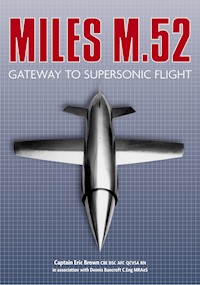
In December 1943, a top secret contract (E.24/43) was awarded to Miles Aircraft. The contract was to build the world's first supersonic jet capable of 1000mph. The only reliable source of data on supersonic objects came from the Armament Research Dept and their wind tunnel tests on ammunition. From this, Miles developed an exceptionally thin-winged, bullet-shaped aircraft. the research was inexplicably passed to the Americans in 1944. By December 1945, one prototype was virtually complete. The second, destined for an attempt at the sound barrier was 80 per cent complete. In February 1946, Capt Eric Brown was confirmed as the test pilot and October 1946 was set for the supersonic trials. However, on 12 February 1946, Miles were ordered to stop production. No plausible explanation was given for the cancellation when Britain was within six months of breaking the sound barrier. Eric Brown and others directly involved including Dennis Bancroft, the Chief Aerodynamicist on the M.52, have now come together to try and finally solve the mystery behind the cancellation.
Das E-Book können Sie in Legimi-Apps oder einer beliebigen App lesen, die das folgende Format unterstützen:
Veröffentlichungsjahr: 2012
Ähnliche



















The 1:48 scale model of the M.52 which appears on the title-page was built by Keith Sherwood and presented to Dennis Bancroft.
Contents
Foreword
Acknowledgements
Abbreviations
1 In the beginning
2 A big step into the unknown
3 A steep learning curve
4 The Supersonic Committee
5 In at the deep end
6 The Gillette Falcon
7 A fateful visit
8 The propulsion unit
9 The Churchill Directive
10 Barnes Wallis — éminence grise
11 The model concept gains ground
12 The Power Jets crisis
13 The final blow
14 Red herrings
15 Test history of the M.52 rocket models
16 The aftermath
17 The eternal enigma
18 Guessing games
Postscript
Appendices
Chronology of relevant events
Bibliography
List of appendices
Appendix 1
Preliminary note on Miles-Power Jets very high-speed aircraft by Group Captain Frank Whittle, 23 October 1943
Appendix 2
Memorandum from Norbert Rowe to Air Marshal Ralph Sorley, 11 November 1943
Appendix 3
Memorandum from Dr H.M. Garner to Norbert Rowe, 3 January 1944
Appendix 4
Memorandum from J.E. Serby to Dr H.M. Garner, 2 August 1944
Appendix 5
Memorandum from Dr H.M. Garner to J.E. Serby, 4 August 1944
Appendix 6
The Churchill Directive. Priorities for Research and Development, 15 January 1945
Appendix 7
Memorandum from Sir Ben Lockspeiser to Air Commodore G. Silyn Roberts, 20 February 1946
Appendix 8
Miles E.24/43: Latest known aerodynamics, spring 1946
Appendix 9
Extract from White Paper ‘The Supply of Military Aircraft’, February 1955
Appendix 10
Definitive list of M.52 models to various scales, by D.S. Bancroft, March 2000
Foreword
This is a book that tells the inside story of what should have been for Britain a supreme triumph in the annals of aviation – the breaking of the sound barrier to attain supersonic speed in a piloted aircraft, but it was not to be.
The standard bearer for this venture was the Miles M.52 research aircraft, arising from an exceptionally brief specification issued in 1943 by the Ministry of Aircraft Production, and assigned, to the astonishment of many, to one of Britain’s smaller aircraft manufacturers, but one with a reputation for innovatory thinking. However, as a safeguard the project was to be monitored by the Royal Aircraft Establishment at Farnborough (RAE), which would also provide a test pilot with wide jet flying and transonic flight testing experience.
Well, they always say if you want something to fall into your lap, you’ve got to be in the right place at the right time. It just so happened that I was a young, but fairly experienced, test pilot in the Aerodynamics Flight and the High-Speed Flight at RAE in 1944, when I was told I was nominated to be the RAE’s pilot for the M.52 project.
I realised I could only discuss this within a very limited circle, as the project was classified TOP SECRET, and this new circle contained some very senior figures in British aviation and politics. Although the majority of these showed strong support for the project, there was a hard core who had genuine concerns about the high risks associated with it.
However, a new factor cast its shadow over the project – the intrusive interest of the Americans, with the full support of the British Government. The American interest was understandable, because the M.52 had some very innovatory features – a bi-convex wing, an all-moving tailplane (flying tail), a pilot escape capsule and a revolutionary jet engine designed by Frank Whittle. From this point the M.52 story began to assume the nature of a conspiracy, and indeed one that today remains unsolved.
The dénouement was the tragic cancellation of the M.52. This drastic action was totally unheralded, caught everyone in the project team absolutely by surprise, particularly as the aircraft was over 90 % completed to flight status. For me this meant deep disappointment, total frustration, burning anger, and heartfelt sympathy for other members of the team. For our proud nation it meant betrayal of our leading position in highspeed flight technology.
Acknowledgements
I wish to acknowledge the assistance given to me in the writing of this book. In particular Dennis Bancroft, Peter Amos (The Miles Aircraft Collection) and Josh Spoor. Each of them has devoted many years to researching the mystery of the cancellation of the contract for the aircraft which would have ensured that Britain was the first nation to break the sound barrier.
As Chief Aerodynamicist on the M.52 Dennis Bancroft is in an unique position to confirm the technical details of the plane’s innovatory design, which Miles conceived in a remarkably short time. His wife, Elizabeth, has been invaluable in searching out and assembling the relevant papers.
Extra information has come from Jeremy Miles, son of F.G. and ‘Blossom’ Miles, from Jean Fostekew (Museum of Berkshire Aviation), Jim Pratt, George Miles’ son-in-law, Rod Kirkby.
Professor Brian Brinkworth’s paper ‘On the aerodynamics of the Miles M.52 (E.24/43) – a historical perspective’ in The Aeronautical Journal of the Royal Aeronautical Society is a wonderful technical assessment of the Miles’ achievement; his conclusion is that ‘Miles made an astute appraisal of the available information, and conceived a forward-looking machine, that was well fitted for its intended purpose … the most plausible estimates of available thrust and drag would indicate that sonic speed would not be exceeded in level flight, though speeds well into the supersonic range would be obtained in a dive. An opportunity to acquire a promising and most timely research tool was lost in its cancellation’.
The chronology of events on pages 173 to 212 was researched by Elwyn Blacker.
Abbreviations
A&AEE
Aircraft and Armament Experimental Establishment, Boscombe Down
AD/ARD
Assistant Director, Armament Research Department, MoS
AM
Air Ministry
ARC
Aeronautical Research Committee
ARD
Armament Research Department
CRD
Controller of Research and Development, MAP
DAF
Directorate of Aircraft Factories
DARD
Director of Aircraft Research and Development, MoS
DD/RDA
Deputy Director, Research and Development Administration, MAP
DDSR
Deputy Director of Scientific Research, MAP
DFS
German Research Institute for Glider Flying
DGP
Director General of Production, MoS
DGSR
Director General of Scientific Research, MAP
DGTD
Director General of Technical Development, MAP
DSP
Director of Special Projects, MAP
DSR
Directorate/Director of Scientific Research, MAP
DTD
Directorate/Director of Technical Development, MAP
GTTACC
Gas Turbine Technical Advisory and Coordinating Committee
ICAN
International Commission for Air Navigation
MAP
Ministry of Aircraft Production
MoS
Ministry of Supply
NACA
National Advisory Committee for Aeronautics (US)
NGTE
National Gas Turbine Establishment
NPL
National Physical Laboratory
RAE
Royal Aircraft Establishment, Farnborough
USAAF
United States Army Air Force
USAF
United States Air Force
1
In the beginning
Sub-Lt (A) Eric Brown RNVR, in 1940.
The winning Supermarine Schneider Trophy S6B seaplane, 1931.
One of the main catalysts to arouse man’s interest in high-speed flight was the Schneider Trophy series of air races for seaplanes, which took place between 1913 and 1931. The influence of this competition can be gauged from the fact that the first winning speed was 61mph and eighteen years later the last race was won at 340mph.
By coincidence, in the first six months of 1928, the year sandwiched between the first and second of the three victories that gave Great Britain outright possession of the Schneider Trophy, a 19-year-old cadet named Frank Whittle at RAF Cranwell was writing his required fourth term science thesis entitled ‘Future Developments in Aircraft Design’. In that remarkable document Flight Cadet Whittle postulated the possibility of flight at 500mph in the stratosphere where the air density was less than one-quarter of its sea-level value. To meet the power plant needs of such a high-speed/high-altitude aircraft, young Whittle discussed the possibilities of gas turbines driving propellers, but not the use of the gas turbine for jet propulsion; in the latter field he was shortly to lead the world.
In winning the Schneider Trophy, Britain’s greatest asset was not just to be the international prestige it gained, but the nurturing of the genius of R.J. Mitchell, the young designer who worked for the Supermarine division of Vickers-Armstrong Ltd, and was mainly responsible for the superb designs of the S4, S5, S6 and S6B, the latter three being the winning seaplanes in the years 1927, 1929 and 1931. The full potential of these racing machines was shown on 29 September 1931 when the S6B, fitted with a special ‘sprint’ engine, raised the World’s Speed Record by more than 40mph, to 407.5mph. With war looming on the horizon Mitchell went on to develop his Schneider Trophy masterpieces to the pinnacle of the most famous military piston-engined fighter of all time, the Rolls-Royce Merlin engined Supermarine Spitfire, which made its maiden flight on 6 March 1936.
R.J. Mitchell, designer of Britain’s Schneider Trophy winning seaplanes and the incomparable Spitfire.
Frank Whittle, by now a qualified RAF pilot, filed his patent for a jet propulsion engine on 16 January 1930 and it was granted in October 1932. This was all done without any scientific, moral or financial support, and although the Air Ministry was notified it expressed no official interest in the patent. So there was no suggestion that Whittle’s patent should be put on the secret list, and his invention could be published openly throughout the world.
In spite of the frustrations of the next four and a half years, Whittle succeeded in getting his first test engine running on 12 April 1937, but there were difficulties still ahead.
With the prospect of war coming ever closer there was frantic activity in the fighter manufacturing field, mainly represented in Great Britain by the Hawker Aircraft Company’s Hurricane and Supermarine’s Spitfire. Fortunately both products were available to participate in the Battle of Britain, and were a revelation in their handling characteristics, firepower and particularly their performance attributes.
The Royal Aircraft Establishment at Farnborough (RAE) was heavily involved in promoting the advancement of fighter performance and in October 1941 initiated a programme of transonic flight testing with a Spitfire Mark V.
The Mach numbers that could be attained by this aircraft were somewhat limited by its operating ceiling, but were of the order of 0.75 to 0.78. Excitingly enough, although these goings on were highly classified, new words like ‘compressibility’, ‘sound barrier’ and ‘supersonic’ began to appear in aviation magazines and even be heard in crew-room discussions.
Squadron Leader J.R. Tobin, who was CO of Aero Flight at RAE Farnborough in 1942.
By a twist of fate I was shortly to meet Squadron Leader J.R. Tobin, who was CO of Aero Flight at RAE Farnborough where he was involved in the new programme of transonic testing. At the same time I was to learn something of the innovatory reputation acquired by Miles Aircraft Ltd,1 located at Woodley, near Reading.
I had first met a Miles product when I carried out my elementary flying training in 1939 for the Fleet Air Arm on the Miles Magister, which I found a delight for such a task. This story now jumps to 21 December 1941, when I was a pilot flying Grumman Wildcat fighters aboard the escort carrier HMS Audacity, which was sunk by a German U-boat in the Bay of Biscay. I was subsequently on survivor’s leave, when I was recalled by Admiralty telegram to report to the RAE Farnborough to fly the Miles M.20 to assess its suitability as a possible fleet fighter.
I arrived at the RAE on 5 January 1942 and was handed over to Sqn Ldr Tobin, who had been assigned to show me over the M.20, bearing the Serial No. DR616. My first impression was of something that looked a sort of cross between the Hurricane and Spitfire, with a smaller wing span and a more pugnacious nose than either. However, its two striking features were the fixed undercarriage and the bubble type cockpit hood, the latter to become commonplace in fighters, but at that time a rare innovation. The aircraft was of wooden construction and powered by a Rolls-Royce Merlin XX engine.
Tobin showed me over the cockpit layout and said I should familiarise myself by flying it for about an hour, and then he would join me in a Hurricane for a spell of dogfighting.
In essence my report to the Admiralty expressed the view that the M.20, although surprisingly nippy in performance, could not match the Wildcat, Hurricane or Spitfire for manoeuvrability and did not offer enough speed performance over the Wildcat or Hurricane to give an offsetting advantage. However, my biggest misgiving was whether the wooden airframe could withstand the punishment of shipborne operations.
The Miles M.20 with its innovative bubble cockpit canopy.
I was reasonably impressed with the M.20, but more so with the Miles design team when Tobin told me the aircraft was designed, built, and flown in 65 days, this being made possible by using Miles Master trainer standard parts, the elimination of hydraulics, and the fitting of a fixed undercarriage. The concept was to offer a fighter capable of speedy production if we suffered heavy fighter losses in the Battle of Britain. Indeed the M.20 had some very attractive advantages in that it could carry 12 × .303 Browning machine guns in the wings, 5,000 rounds of ammunition, and 154 gallons of fuel – virtually double the fire power and endurance of the Hurricane and Spitfire. These hard facts convinced me of the innovative expertise of the Miles team.
Although at that time I knew nothing of Tobin’s involvement in transonic flight testing, just to make conversation over lunch I asked him what he made of the popular subject in aviation journals of the possibility of breaking the sound barrier in the future. He shrugged his shoulders and said that some boffins believed it could not be done, and that was certainly so of propeller-driven aircraft because of the drag of the propeller, but most felt it would be possible with jet or rocket-powered aircraft.
Britain’s first jet aircraft, the Gloster/Whittle E.28/39. It undertook a comprehensive test programme at RAE Farnborough between March 1944 and February 1945.
This gave me great food for thought, because by sheer chance I had witnessed the maiden flight of Britain’s first jet, the Gloster E.28/39, at Cranwell airfield on 15 May 1941, although I did not appreciate what it was at that time.
It happened like this – I was in 802 Squadron, equipped with Grumman Martlet (Wildcat) fighters, at Royal Naval Air Station Donibristle in the shadow of the Forth Bridge, and we were working up for our first operational assignment. But American designed aircraft had only a lap strap for pilot safety restraint and this was not deemed sufficient for arresting deceleration on an aircraft carrier. Modification was arranged to fit a full shoulder harness, but for this to be done each pilot had to fly his aircraft to Croydon airport, outside London.
I took off for Croydon on 14 May 1941 and ran into very bad weather near Lincoln and was lucky to creep into Cranwell before it clamped down. To my amazement the officers’ mess was alive with dozens of civilians, all looking and acting like conspirators, and I was roomed with a Flight Lieutenant Geoffrey Bone, who unknown to me was one of Frank Whittle’s team and indeed was the installation engineer for the jet engine in the E.28/39. He would not be drawn on what was afoot. Indeed it was not till the evening of the next day when the weather improved slightly that I saw the strange propellerless machine for the first time as it was wheeled out of the hangar and finally took off with a whistling noise for a short flight. On landing it was greeted by an RAF officer who was obviously a key player in whatever was going on. This then was my introduction to a machine I was eventually to test fly three years later at Farnborough, and to a man of genius who was the true inventor of the practical jet engine and with whom I was to enjoy an amicable working and social relationship for many years.
Today, when I look back on these past events, I get a strange sense of predestiny – 802 Squadron Wildcats; the E.28/39 historic first flight and the presence of Frank Whittle; flying the innovative Miles M.20 at Farnborough; meeting Squadron Leader Tobin who was to pioneer transonic flight testing at RAE. To my mind there is a clear line of connection running through those events which had an inevitability, culminating in my association with the Miles M.52 supersonic research project.
A rare view of the Gloster E.28/39 being flown by Eric Brown on its last flight on 20 February 1945.
1. Until 5 October 1943 the company was Phillips and Powis Aircraft Ltd.




