


18,49 €
Mehr erfahren.
- Herausgeber: The Crowood Press
- Kategorie: Lebensstil
- Sprache: Englisch
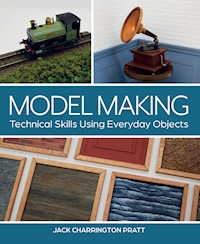
Learn to create miniature models using a wide range of objects and materials found in your own home. Model making can be an expensive endeavour, requiring investment in many tools, paints and materials. However, there are many model making techniques that can help to solve these problems and align the model maker with an ever-more sustainably focused world. Aimed at the student, hobbyist and professional alike, this book aims to demonstrate how everyday materials can be used to create the most amazing miniature effects while being more mindful of the environment and saving money. In addition, several chapters focus on general model making knowledge including tools and equipment, paints, washes and finishes, airbrushing, adhesives, health and safety and professional model making practice. The final chapters cover three projects relating to railway modelling, dioramas and wargaming. Each project explains the concept and why certain materials have been chosen, before exploring the build through a step-by-step process so that the true effect of these techniques can be shown.
Das E-Book können Sie in Legimi-Apps oder einer beliebigen App lesen, die das folgende Format unterstützen:
Veröffentlichungsjahr: 2023
Ähnliche



















First published in 2023 byThe Crowood Press LtdRamsbury, MarlboroughWiltshire SN8 2HR
www.crowood.com
This e-book first published in 2023
© Jack Charrington Pratt 2023
All rights reserved. This e-book is copyright material and must not be copied, reproduced, transferred, distributed, leased, licensed or publicly performed or used in any way except as specifically permitted in writing by the publishers, as allowed under the terms and conditions under which it was purchased or as strictly permitted by applicable copyright law. Any unauthorised distribution or use of this text may be a direct infringement of the author’s and publisher’s rights, and those responsible may be liable in law accordingly.
British Library Cataloguing-in-Publication DataA catalogue record for this book is available from the British Library.
ISBN 978 0 7198 4188 0
DedicationTo my family; proof the hoarding was worthwhile.
Cover design by Blue Sunflower Creative
CONTENTS
Preface
Introduction
Part I – Essentials and Model-Making Practice
Chapter 1 –Choosing your Approach
Chapter 2 –Tools, Equipment and Materials
Chapter 3 –Professional Practice
Part II – Techniques and Effects
Chapter 4 –Scenery
Chapter 5 –Weathering
Chapter 6 –Architecture
Chapter 7 –Interiors
Part III – Projects
Chapter 8 –Creating a Miniature Gramophone Using Found Objects
Chapter 9 –Creating a Scale Set Using Recycled Card
Chapter 10 –Creating a Scenic Diorama Using Household Materials
Conclusion
Glossary
Index
PREFACE
During the summer holidays, I would spend two weeks with my grandparents over in Blackpool. It was on their living room carpet, watching for the umpteenth time the launch sequence of Thunderbird 2, or Stingray weaving around a rather oversized goldfish, that my love of model making was born.
A fishing boat automaton made from found objects and materials. This was constructed during lockdown as an example to students showing how materials around the home could be used to implement their designs to great effect.
My inspiration has always come from a multitude of sources, not least my father and grandfather, who were both proficient model makers themselves, but it was these works by Gerry Anderson in particular that threw me into a world of fantastical fabrication. I remember hoarding cardboard at every opportunity to recreate these incredible vehicles, and my frustration at my inability to replicate them accurately.
Although I’m sure my family, at the time, would have thought that these cardboard contraptions were simply normal activities for a child to engage in, these early moments in my life would actually form the start of something much bigger. Not only was this my first step into the world of model making, this was also the beginning of my fascination of using found objects and materials to build things beyond even my own imagination.
Today, that journey has transformed into a career. Having studied Set Design for Screen at Wimbledon College of Arts, worked in film and television as a model maker and concept artist, and lectured across various academic institutions, I have been able to develop and refine my skills across a wide range of projects. This work continues both personally and professionally and, while my grandfather is no longer with us to see the outcome of this project, I hope that one day I can sit down with my grandchildren and pass along my experience much the same as he did.
Why I am Writing this Book
In March 2020 I was teaching in London. The students were coming to the end of the academic year and getting ready to start making their final designs. As they were at art college, these designs included miniature model making, props, concept art and full-scale set builds, to name but a few – all of which require substantial resources. In any normal year, sourcing materials would not be an issue. However, at the end of March, the UK entered its first lockdown.
Suddenly, resources were cut off left, right and centre. Academic institutions were ordered to close their doors and all teaching moved online. Understandably, students started to panic, wondering how they could possibly complete their projects without the resources that they had come to depend on.
In fact, we have all become so accustomed to being able to source every single thing we need in our lives at a moment’s notice, either from a store or online, that when lockdown came it threw us into a state of shock. From a teacher’s perspective, equipment and materials were suddenly restricted, meaning new ways of completing projects had to be found.
As I sat in my tiny flat, I realised that the hobby I had pursued for almost my entire life gave me an opportunity to solve at least one small part of this problem. Students could recognise that they in fact had a wealth of materials that they could access – right in their very homes. They could discover new techniques, new methods of making, without even having to leave the house, and (everybody’s favourite) without spending a single penny. Through using these materials, the environment would also benefit, as the students would simultaneously be recycling.
This is why I am writing this book – to open people’s minds to the treasure trove of materials that regularly go unappreciated, and to demonstrate some of the many wonderful techniques and processes that anyone of any skill can use to make some truly exceptional creations.
INTRODUCTION
What Material Should I Use for This?
I have heard this question time and time again in the studio. It often comes from panicking students who hold an undying belief that there is a holy model-making doctrine they must follow for anything they might want to make – for example, stating that a cobblestone wall must always be made from styrofoam. To go against this preconception would be to invite chaos into the world and wreak havoc upon their attempt to construct said wall out of any other material.
A sci-fi racing vehicle kit bashed from a wide range of found objects. It did not matter what the materials were – what mattered was shape, form, detail and narrative. What did each piece contribute to the build?
A little dramatic perhaps, but my time in education has shown that students really can be worryingly reluctant to venture into something blind and rely solely on trial and error to see them through it. By extension, this is also likely to apply to model makers of all backgrounds who may be taking their first steps into the medium and feel equally worried over making any form of mistake.
So, let us begin with the first important point: things will go wrong. This is not meant as a preachy form of encouragement, but as a practical starting point. Making mistakes in model making is how almost all of our knowledge is acquired. It is not necessarily knowing what to do, but what not to do. It bears particular relevance to this book, as many of the methods described in Part II have either been discovered or developed by pure accident, as none of the materials each process requires were actually intended for that purpose.
Which brings us back to the original question and the overarching concept of this book: what material should I use for this? The answer is to ask a different question.
What is the Aim of this Book?
The overall aim of this book is to educate the reader on how to use found objects and materials for model making. Underpinning this is the need to eradicate the idea that a certain material is required for any one job. Instead, a model maker should ask what qualities does the material need to be effective in a particular situation, and to achieve the desired texture and finish? A model maker should be analytical and objective, and not rely on a job list of materials.
Consequently, this book should form a stepping stone into experimentation, and to begin a better observation of the model maker’s environment. Objects and materials should transform themselves into a wealth of potential surfaces and creations.
While there are many practical teaching points in this book, the main hope is that the first question – what should I use for this? – can be replaced with a question that will not only solve the immediate problem, but open so many doors into the world of model making: what can I do with this?
How is this Book Arranged?
This book is divided into three sections. Part I, composed of three chapters, will cover all of the introductory information needed to commence a standard miniature project, including construction methods, materials, paints, adhesives and much more.
Part II will explore step-by-step processes that demonstrate how a wide range of textures and surfaces can be created with household materials. This section has been split into four chapters that cover common effects found in model making – scenery, weathering, architecture and interiors.
Part III consists of three projects that bring together everything covered in the previous two sections and offers an opportunity to apply that knowledge to a specific build, again in a step-by-step format.
Why a Scratch-Build Section in a Book for Found Materials?
It may be confusing that, given the emphasis of Part II on the use of found objects and materials, that Part I focuses predominantly on scratch-building techniques; the reason for this is twofold.
Firstly, it is important to grasp the fundamentals of model making before attempting the bigger challenge of using found objects and materials that were never intended for this purpose. These materials have noticeable limitations in their new role and, to use them effectively, it is important to have a good understanding of material properties.
Secondly, many of the materials discussed in Chapter 1 are routinely integrated in kit-bashing projects, just not necessarily in their raw sheet form (more on that later). For example, an understanding of how to work with wood will support the use of common kit-bashing objects such as coffee stirrers and popsicle sticks.
Making Literacy
Making literacy is all about the reasoning and understanding behind what we make. It is a broad term that a thousand-word essay would struggle to define satisfactorily, but in this book, it is used to explore why a model is being made, its function and purpose. It is used to explain the way a piece of equipment is used as opposed to what it is used for, and even to appreciate the very thing we are trying to make. It is difficult to accurately depict a wave in miniature without an understanding and appreciation for what it is in real life.
In Part I, making literacy takes the form of how to prepare for making a model, and all of the questions that need to be asked in order to ensure the best possible outcome. In Part II, making literacy is more directly addressed through the analysis of texture, and how crucial it is to identify the real-world qualities of the intended build before actually commencing it.
An academic would no doubt offer a more succinct yet all-encompassing definition, but at the very least this book can offer an introduction to what should be recognised as one of the most fundamental principles of model making. Why we do things, as opposed to how we do things, tends to be what defines the difference between an amateur and a professional – a principle most of us understand but are often completely unaware of!
Sustainability
One key reason to adopt found objects and materials into projects is that it is an incredibly sustainable form of making. It is simply another way of recycling and, in today’s world, any change to our lives that can be made to benefit the environment is worth consideration. Throughout this book, materials have been chosen for a number of reasons and sustainability is a significant factor. The methods taught in this book may not be 100 per cent sustainable, but I hope that it goes some way to promoting more environmentally friendly methods of making within the model making industry.
PART I: ESSENTIALS AND MODEL-MAKING PRACTICE
CHAPTER 1
CHOOSING YOUR APPROACH
Things to Consider
It is often difficult to know where to begin when first considering model making. The actual physical build is just one element of many that goes into the process of creating a miniature, and when all other aspects are taken into account, the process can suddenly seem quite daunting. For this reason, it is of great importance to consider the best approach and formulate a plan of action before diving straight in.
The term ‘approach’ in this instance can include a great many things. It does not just refer to the method of making that will be employed, but rather a range of criteria based on the role and purpose of the model. Five important variables to consider in all scenarios are:
• How will the model be used?
• Where will the model be stored?
• What materials will be used?
• Where will materials be sourced from?
• How much time do you have?
These considerations are crucial as they will define everything about the model, and thus form our first encounter with making literacy. These questions will determine whether or not a model needs to be functional, if it needs to be made so that it is easy to repair or replicate, and the one that is almost always forgotten – if it will need cleaning! While this level of detail may seem excessive, even if the model concerned is just an Airfix kit, considering these points before commencing a project can save hours of additional work and ensure that the completed model will be presented in the best possible way. The worst scenario is to be proud of a finished model and then to have it spoiled by complacency.
Purpose
‘Purpose’ concerns the practical side of the build. Does the model need to function? If so, how will this be achieved? How will mechanics or electrics need to be accounted for in the build? Will the model be touched? If so, what materials will be needed to ensure it withstands brute force, or even the occasional accident?
For the majority of model makers, this point may seem irrelevant, but even hanging a model airplane from the ceiling requires some thought with regards to practicality. How will it be suspended? How will the model be reinforced to withstand its own weight? Can it be easily repaired if it drops? With just these few questions, it is hopefully beginning to become clear how much time and effort thinking about these basic issues can save.
Storage
A crucial point that is so often overlooked, the question of storage can cause immense frustration. Imagine constructing, painting and finishing a superb diorama before realising that there is nowhere safe to put it. Notice the word ‘safe’ – if a model is going to be on display, it is important to ensure that nothing else can fall onto or knock it. Make sure there is some resistance on the display surface so that it cannot slide easily (living on a boat, I am all too familiar with this). Display cases are fantastic, although often expensive, and just a quick thought on this point will avert cost from a number of angles.
If the model is not going to be on display, ensure it is packaged with care and consideration. This means that it is protected and secure, not wrapped up in several inches of cardboard and tape! Improper wrapping and containers can damage a model more extensively than carelessness, so use soft packing like foam, place supports where the model is strong and leave free space where it is delicate. If the model cannot be seen through the packaging, clearly label it on the outside so the container cannot be mistaken.
Choice of Material
This point is slightly moving ahead, as it assumes that the method of construction has already been decided. Although this comes later, it is important to have in mind the effects that the previous two points will have on the chosen materials. For instance, if a model will be stored somewhere damp, or even exposed to the elements, then porous materials such as wood will not be an ideal choice. Likewise, a model made from styrene will not fare particularly well if exposed to extreme heat. Remember that even moderate environments such as living rooms, over time, will have some form of effect on a model, even if it is just the simple gathering of dust. The choice of materials can make maintenance like dusting much easier and can significantly increase the longevity of a model.
Sourcing Materials
This is especially important to consider if working to a deadline. Ensure that a thorough sweep of the local area has been completed before starting a build so that there is a firm understanding of where materials can be sourced quickly. It is no good, when working to a deadline, to have the one supplier of an essential material two weeks’ shipping away. Even for the humble hobbyist, this can be irritating. Another important consideration is overseas shipment. If materials or equipment needs to be sourced abroad, have allowances for shipping and tax been made? Establishing reliable and accessible suppliers can not only save money, but can also help to build a relationship with store owners, who are often sources of incredibly useful knowledge.
Time
Do not think that this applies only to those working to deadlines, for all model makers will at some point fall foul of steadily lengthening lead times. How many projects have been started and ten years later still await completion? This point concerns both the time that will be dedicated towards a build and the setting of a goal to move the project forward when difficult or tedious processes are encountered. Model makers always seem to reach a specific moment in a build that they just wish would end, and it is in these moments that motivation starts to fade away. Setting a time goal, a checklist, or a simple period throughout the day in which to work solidly on a project will help to eliminate several problems – the most important being keeping it off of the ‘still to complete’ shelf!
ESSENTIAL SUMMARY
• A model can last a lifetime and beyond. Ensure that as much planning goes into what comes after construction as before.
• Gather the resources needed to complete the build before it starts to ensure efficient workflow.
• Create a checklist of tasks to complete – this is not just to improve organisation but to help encourage you through more tedious parts of the project.
• Practise – do not just decide to use a certain material. Try out your selection first to familiarise yourself with its qualities and limitations.
Construction Methods
Once the important organisational details have been finalised, it’s time to think about one of the biggest decisions when commencing any project – what construction method will be used? This generally falls into three categories:
• Scratch building
• Kit bashing
• Model kits
A kit-bashed engine prior to priming. Sci-fi and fantastical objects can be given an amazing level of credibility if they reference real world objects. In this instance, I was trying to create a NASA-esque booster.
A small Star Wars diorama. The AT-ST stands atop an ice floe made from filler. The properties of the filler mimic snow beautifully, even down to the odd reflective particle.
The decision over which method to use is generally quite straightforward. It is more often a case of tailoring a method to a specific skill set than averting future problems, so will tend to come down to simply what is easiest for a particular individual.
Looking solely at ease, beginner modellers will find no better introduction than plastic kits, which can be found anywhere from hobby shops to supermarkets. Familiar brands such as Revell and Airfix provide a wide range of model kits, from aircraft to ships, including more specialised accessory kits for dioramas. These kits vary in difficulty and can be easily assembled with a minimal toolkit. The downside is that one is completely at the mercy of the quality of the kit as it is presented. With increased skill, modellers can use putty, styrene and many other model-making materials to increase the detail and overall quality of the model, which starts to bring in those scratch-building skills that the professional model maker relishes.
Both scratch building and kit bashing represent an increase in difficulty. Both are wonderful methods of making and both present their own unique challenges. Scratch building, the art of making a model predominantly from sheet and raw materials, allows for complete control and endless possibilities. With the right understanding, anything can be constructed. However, this can take years to acquire, and not every model maker will have access to the specific tools and equipment needed to work with certain materials.
Kit bashing, on the other hand, is a method of fabricating using found objects and materials, which eliminates the majority of the processes needed to mould the material itself. It is incredibly cheap, as materials are sourced not from specialist modelling stores but from recycling bins, old circuitry and model kits, to name but a few. A knowledge of adhesives is paramount, and training the eye to foresee what a model will become can be challenging with the kit-bashing method, particularly when the build consists of a jumbled-up mess of a weekend’s recycling!
So even just looking at the relative ease of each method opens up a world of possibilities, and may be a little overwhelming. Here is a quick breakdown of the pros and cons of each technique to make the comparison a little easier:
Pros
Cons
Scratch building
• Absolutely anything can be built; perfect for real-life modelling
• Scaling up or down often only involves changing the amount of material used
• Expense can be spared by bulk buying certain materials
• Scratch building typically requires greater technical skill
• Tools and equipment to work with certain materials may not be immediately accessible
• Can arguably increase the time required to complete a project as a result of fabricating everything from scratch
Kit bashing
• Incredibly cheap, as the materials are often sourced from found objects
• Sustainable, as it is effectively recycling
• Often much quicker than other processes, as forms can be hastily assembled
• Less control over the materials used
• Can be difficult to see the end product whilst constructing
• A quality paint finish is essential, so those who have less confidence in their painting skills may naturally be put off this method
Model kits
• Easy to assemble, often with step-by-step instructions
• Perfect for beginners, as very little skill is initially required
• Fun – this is how almost every model maker starts!
• Some instructions can be difficult to follow for a novice
• Improving the quality and detail of the model will require more specialist skill
• Risk of losing a piece…
Kit Bashing
A thorough understanding of kit bashing is essential to appreciating the underlying essence of this book and will hopefully be the first step into a wonderful exploration of what the process can achieve. The step-by-step guides presented in Part II have their foundations in this technique.
Kit bashing is the art of fabrication using found objects and materials. It is a term that rose in popularity following its masterful use in productions such as Star Wars and Thunderbirds. Instead of creating a design that was set in stone, forms and details of spaceships and vehicles were built up using readily available objects. In the case of Star Wars, it literally was kit bashing, as plastic model kits were torn apart and repurposed to detail the surface of models such as the timeless Star Destroyer.
True kit bashing involves taking pieces from model kits and using their form and detail to build something entirely different. However, kit bashing has evolved into an umbrella term for all things made of ‘junk’ – a term used lightly and the source of so many arguments… Included in this term are computer and electronics components, general recycling and a wide variety of miscellaneous materials. The general rule is that the build is constructed from pre-formed objects, no matter if they are complex technological components or a humble bottle cap. Most first forays into kit bashing come in the form of the traditional plastic bottle rocket.
The second key point is that kit bashing involves the combination of any and all materials. There is no one single dominant material, no immediate supply of an identical object, and no amount of control can avoid a build that will naturally evolve of its own accord. Metal is bonded to plastic, plastic to rubber, rubber to sponge and somehow back to metal again. A plastic piece is randomly thrown in but annoyingly, after realising ten more would add a great deal to the overall aesthetic of the build, only one such piece can be found. Subsequently, concessions must be made that ultimately sends the build down an unforeseen avenue. Kit bashing is chaotic and unpredictable, and embracing this fact will unlock its full potential.
A kit-bashed post box. This project was a single-day challenge to use whatever I could find in that day to create a final object that was recognisable.
So how does one take this introductory information and start unlocking said potential? What skills are there even to hone, if any and all materials can be used and planning is somewhat moot as a result of kit bashing’s natural and unavoidable evolution? The answer is two words: blending and credibility.
Blending is the make or break of the kit-bashing process. It is very easy to stick a bottle top to a container and call it a jet engine, but it will always stand out as just a bottle top if no further techniques are used. Chosen pieces need to be disguised and blended in to the surface of the model in order to add texture and detail without becoming an eyesore. This can be achieved in various ways, including altering the component by cutting, melting or combining it with others, using weathering effects to add additional texture, or by simply adhering more and more pieces. Be aware, however, that adding too much can cause its own problems.
This is where credibility comes in. Should a piece even be added in the first place? How does one determine what should and shouldn’t be added? The answer is credibility. This refers to how believable the build is, and it must always be believable if it is to be effective. Does a piece introduce much-needed texture? Is it square and angular like the rest of the build, or is it curved and more organic-looking? Does it look functional or decorative? Is there anything undesirable that can be easily hidden or removed? All of these questions effect the model’s credibility, which can be destroyed by the use of a single wrong piece.
These two concepts embody the skill of kit bashing. It is not quite as easy as raiding the recycling and mashing up whatever comes to hand (although this is a recommended starting point), but with time and dedication this technique can result in creations as imaginative, detailed and inspiring as any made for TV in former times.
ESSENTIAL SUMMARY
• Consider the best approach for the situation and your skill set.
• Scratch building requires great technical skill but with it, anything can be built.
• Kit bashing has limitations but these can be exploited to great effect if control is relinquished.
• Model kits are perfect for the beginner and form most people’s entryway into the craft.
CHAPTER 2
TOOLS, EQUIPMENT AND MATERIALS
It is difficult, when walking into a model shop or staring at an endless line of stalls at a trade show, to resist the urge to buy everything and anything in sight. Images of workshops full to the brim with tools and equipment suddenly flash before your eyes, and, before you know it, a basket full of items you barely understand what to do with is in your hands. The simple fact is that a model maker’s toolkit takes years to acquire and, in practice, only a handful of items are ever used frequently.
The purpose of this chapter is to identify exactly what those essentials are, including tools, equipment, paints and adhesives. Concentrate on these rather than items that have either one very specific purpose or require skill the novice will not yet have developed.
An Essential Toolkit
Those just starting out in the world of model making do not need to invest hundreds of pounds in fancy tools – these will build up over time (and eventually you may well have doubles and triples of the same item).
• Scalpel
• Steel ruler
• Cutting mat
To the miniature model maker, the scalpel, ruler and mat are the bread and butter of the craft. They will enable the maker to work with a wide range of sheet materials and tackle a good percentage of any project before any more technical piece of equipment is needed. In addition, they are incredibly compact, especially if the modeller opts for an A4-sized cutting mat or smaller, meaning the often large investment in storage can be postponed for a time. These three items will fit happily inside a typical rucksack. Finally, for the prospective student, turning up to work experience or your first job with these three things will ensure that you can contribute to the team right from the off.
A basic toolkit consisting of a cutting mat, a scalpel and a steel ruler. These three pieces of equipment will form the backbone of the majority of model-making processes.
Scalpel
A scalpel is typically composed of a metal handle and an interchangeable blade, although many starter sets will have a larger plastic grip to provide better control for the inexperienced. There are many variations, each accompanied by their own blades. The Swann-Morton No. 3 handle is a popular model.
Steel Ruler




