


18,49 €
Mehr erfahren.
- Herausgeber: The Crowood Press
- Kategorie: Lebensstil
- Serie: The Art of Sugarcraft
- Sprache: Englisch
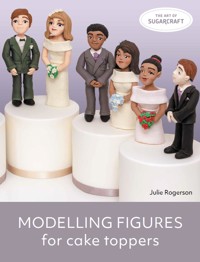
Celebration cakes are both more personal and more memorable when they include a model of the person (or people) who are the focus of the special day. With over 400 colour photographs, this book discusses the equipment and materials required; it explains the fundamental facial and body proportions for both adult and child figures and shows how to achieve the basic shapes required. Also included is information on obtaining realistic skin tones and step-by-step photographs demonstrate how to create sitting, standing and reclining figures. This new book demonstrates how to create figures for wedding cakes and how to use internal armatures for support. There are numerous ideas for completing the design of the cake and, finally a useful list of suppliers.
Das E-Book können Sie in Legimi-Apps oder einer beliebigen App lesen, die das folgende Format unterstützen:
Seitenzahl: 222
Veröffentlichungsjahr: 2022
Ähnliche



















MODELLINGFIGURES
for cake toppers
Julie Rogerson
MODELLINGFIGURES
for cake toppers
First published in 2022 byThe Crowood Press LtdRamsbury, MarlboroughWiltshire SN8 2HR
This e-book first published in 2022
© Julie Rogerson 2022
All rights reserved. This e-book is copyright material and must not be copied, reproduced, transferred, distributed, leased, licensed or publicly performed or used in any way except as specifically permitted in writing by the publishers, as allowed under the terms and conditions under which it was purchased or as strictly permitted by applicable copyright law. Any unauthorised distribution or use of this text may be a direct infringement of the author’s and publisher’s rights, and those responsible may be liable in law accordingly.
British Library Cataloguing-in-Publication Data
A catalogue record for this book is available from the British Library.
ISBN 978 0 7198 4010 4
Cover design: Sergey Tsvetkov
Acknowledgements
As a self-confessed book lover, it is an absolute privilege to be in a position to be writing my own book, and I have a few people to acknowledge and thank, as they have certainly been instrumental in getting me to this point. I am going to start with my family, as they are my whole world.
The most influential person in my life growing up was most definitely my late mum, Joan Rogerson, and I like to think I have inherited some of her stubborn nature and strong determination, which have definitely helped me in more recent years with starting and running my own business. It is with such sadness to think that although she was instrumental in my love of baking, she knew nothing of my adventures through cake decorating, which have led me to this point. But I do like to think that she would have been very proud of what I have achieved.
It seems natural to move on to thanking my dad, Jim Rogerson, next. An absolute rock of a man, always there for me, no matter what, and a very big part of my life. Such a family man, you couldn’t want for a better dad, and he has helped me through the bad times as well as the good. I hope I have made you proud, Dad.
Huge shoutout to my partner, Mark Wilde, who has taught me that I need to take chances and opportunities when they present themselves. ‘We only get one shot at life, it is not a rehearsal!’ is one of his favourite things to say to me (whilst I am being constantly indecisive), as well as ‘If you want to, just do it’. He has certainly helped me to believe in myself, and I really owe him so much for bringing out the best in me. I should also take this opportunity to thank Mark for some of the photography in this book (as well as for a few of my other projects).
I think perhaps my greatest achievements to date have been my three fabulous children (in age order – no favouritism): Andrew Towse, Rachel Towse and Jack Towse. They have brought me so much joy, and now they are older, they are so supportive in my chosen path. I love their enthusiasm for my seemingly never-ending parade of ‘Look what I have made!’ cakes and cake toppers – as well as for eating the cake offcuts, of course. I am so proud of you all.
To Suzi Witt I owe a huge gratitude, for mentoring and coaching me to believe I can and will succeed in whatever I put my mind to, and to know that I am never too old to do something new. You inspire me to be the best version of myself every day, to which I am very grateful: thank you.
I must also thank Melanie Underwood for being the first person to give me the opportunity to have one of my cake-decorating tutorials published in Cake International magazine, back in 2017. She gave me the confidence to believe I could do it, and it has also been a pleasure working with her on several projects over the past few years at the Cake International Show.
To the staff at Cake Decoration and Sugarcraft magazine, for whom I still write cake-decorating tutorials. Leeanne Cooper (former editor) and Joanne Garwell, you have both been amazing to work with: thank you for your support.
Finally, I would like to thank the amazing team at The Crowood Press Ltd for getting this book off the ground, from concept and into print.
Contents
Introduction
Chapter 1 Equipment Used for Figure Modelling
Chapter 2 Materials Used for Figure Modelling
Chapter 3 Basic Shapes and Proportions Used for Figure Modelling
Chapter 4 Male Figure in Sitting Pose
Chapter 5 Female Figure in Sitting Pose
Chapter 6 Simple Figure in Reclining Pose
Chapter 7 Making Figures with Additional Furniture
Chapter 8 Male Standing Figure
Chapter 9 Female Standing Figure
Chapter 10 Figures with More Complex Internal Armatures
Appendix I Recipes
Appendix II Stockist Information, Conversion Tables
Index
Introduction
As a cake decorator, whatever your skill level, and regardless of whether you make cakes as a hobby for family occasions or as a business owner, selling your creations to customers, you will probably have been asked to make a figure to be used as a cake topper at some point. Trust me, if you haven’t yet, it won’t be long, so prepare yourself!
Whether you are looking to create a figure to resemble the recipient of the cake, a cartoon-styled figure for a children’s birthday cake, or even just a generic figure to compliment the theme, being able to create a person to put on a cake is most definitely a useful skill to have.
One of my absolute favourite figures that I have created to date was this pirate mermaid figurine for a display table at the Cake International Show in 2018. She was modelled entirely from modelling paste and modelling chocolate, with an internal armature. The table of piratethemed exhibits was awarded first place in our category at the show, for a collective display by a group of international cake artists.
Figures make very popular choices for cake toppers, especially when they are made to resemble the recipient of the cake, along with their favourite things.
When you first start making models, particularly figures, it can be a daunting prospect, though I totally understand, I’ve been there too. Perhaps you have already tried without much success, or maybe you keep putting it off, as the thought just terrifies you?
What equipment do you need? There is such an array to choose from – how do you know what to buy, and maybe more importantly, what not to buy? Then there is the question of pastes: what is the difference between sugar paste and the other more specialist types of paste on the market? Which should you use? Why did your paste crack when you tried to model with it, or sag when you tried to stand it up?
I certainly remember thinking all of these things (and more besides) when I first started modelling figures back in my early days of cake decorating. I had many failed attempts, not really knowing where to go for help, as well as finding so many conflicting answers to my questions during my online searches. So I started to experiment, buying different pastes to test, seeing what worked and what didn’t. I bought lots of different tools and gadgets, many of which were relegated to the back of a drawer when I found they didn’t give me the results they had promised and that I wanted to achieve! But through this search, I narrowed it down to what I actually found worked.
The results of these trials, as well as years of practising and honing my modelling skills, are what you will find in this book, without having to go through the long experimental stages yourself. I will be sharing all my secrets, hints and tips with you, to save you money and shortcut your way to making fabulous figures. I will show you the basic set of tools that I use for all my models, as well as a few extras that are useful to have for more advanced modelling techniques. You will also find useful information about the different types of pastes available, and which is best to use for the different types of modelling.
One of my very first figure models, which started me off on a journey of learning and discovery. I remember being so proud of it at the time, and had no idea where this new venture would take me.
This book will take you on a journey through figure modelling, beginning with creating the simpler styles of sitting and lying figures. These are the perfect starting point for those new to modelling, or if you just want to perfect your skills before advancing.
We will then move up a level, looking at how to make figures stand up on cakes, as well as introducing the techniques for adding some simple clothing to your models and more intricate facial details.
Standing figures, often used as wedding-cake toppers, can also be used for a wide variety of other occasions.
A standing figure with internal armature support lends itself well to a whole range of sporting and action-themed cake designs.
Sitting or lying down figures make great cake toppers, are simple to create and a perfect introduction to modelling figures.
Finally we will explore figures with more complicated internal support armatures. These are fabulous for making sturdy figures in a variety of poses, especially useful for sporting and adventure-themed cakes. I will also show you how to fully dress a figure, including how to create your own templates. Through detailed instructions and full colour step-by-step photographs, I will guide you through everything you need to know, to start creating your own amazing cake toppers, which will delight and amaze your family, friends and customers alike.
For each model in the book there is also a finished cake design, giving you ideas and inspiration on how to use your models on a cake – but I am sure you will be able to come up with lots of your own ideas too.
So what are you waiting for? Let’s get started…
CHAPTER 1
Equipment Used for Figure Modelling
There is a huge range and choice of equipment and tools available on the market for modelling with edible pastes, and it can sometimes be hard to know what you actually need, particularly if you are new to cake decorating and sugar crafting. Start with a few basic tools, some of which you will probably already have, and then build up your tool box from there, depending on the types of model you want to make. In this chapter you will find the basics you need to start with, and also some more specialized tools that you may wish to use as you progress.
There is a wide range of equipment that can be used for modelling work.
BASIC EQUIPMENT
The following tools would be a good starting point for your modelling tool kit as a beginner. You can then build on this kit with more specialized tools as you progress, and improve your skill set in this genre of cake decorating.
My suggested basic set of equipment that you will need in order to get started with modelling figures.
Non-stick workboard: Although not absolutely essential, a non-stick workboard gives you a really good surface to work on, and is easily cleaned. Place a non-slip mat underneath to stop it sliding around on your surface.
Sharp knife/scalpel: Both of these are useful to have, as they serve different purposes. You can use a small, sharp kitchen knife for cutting larger pieces of paste, whilst the scalpel is perfect for making small, precise cuts. Instead of a scalpel, you could use a small, sharp craft knife instead – just remember to keep it to use for your modelling work only.
Scissors: Ideally you would benefit from having two different pairs of scissors: general kitchen-style scissors for cutting your internal supports and templates, as well as a small sharp pair of scissors for making precise cuts in your paste.
Paintbrushes: You will need to have a few different shapes and sizes of paintbrush, both for using with water or edible glue for sticking paste, as well as for dusting your models with edible dusts. New, clean make-up brushes are also suitable for using with your models. Soft, fluffy brushes are good for dusting cheeks, whereas thinner, flat brushes are good for dusting eyelids and lips. Very fine, precise brushes are good for adding thin lines of water to adhere eyelashes or eyebrows to faces. Make sure that any brushes you use have not been used for anything other than foodsafe purposes. Keep a separate set, just for use with your modelling work.
Small rolling pin: A small, non-stick rolling pin is a ‘must have’ tool for rolling small pieces of paste, for example for clothing. As a cake decorator, you will most likely already have one of these anyway.
Internal supports: For small, basic models, you will still need some internal support, particularly for keeping the head in place. Whilst you can use dried spaghetti strands for support, it isn’t always strong enough for heads, as they are too heavy for the thin pasta to cope with. I am speaking from experience here, after losing a few heads back in my early days of modelling! Instead, you could use cake pop sticks, as they are strong, food safe, and easy to cut to size with scissors. An alternative would be to use thin wooden skewers, as these are also food safe. These can be used for taller, standing figures, as the cake pop sticks are too short. Just be careful when cutting the skewers, as they can splinter.
Be sure always to tell the recipient about any internal supports that have been used within the figures you have made. I would never recommend that the models or figures I make should be eaten, but some people will do so anyway. However, they will need to be aware to dismantle the figure and remove any inedible supports before consuming.
Basic set of modelling tools: Modelling tools come in a wide range of sizes, shapes and materials, sold either in packs or individually. If you are new to modelling you would be best to choose a basic set of tools, such as the PME set in the photograph. This set contains a good selection of modelling tools you will need to get started with, and you can then add other individual tools as you need them. More detail about the different types of modelling tools, and what they are used for, will be given later in this chapter.
OTHER PIECES OF EQUIPMENT YOU MAY FIND USEFUL
Other equipment that you may want to add to your starter kit.
Metal ruler: Use to measure paste or to help you cut straight lines (for example for items of clothing/trims).
Pizza roller cutter: You may find it easier to cut strips of paste using a pizza roller cutter (either with or without the aid of a metal ruler).
Stitching tool: Roll along the paste to add a stitched detail effect for clothing. This small detail can add to the realism of your models, and is so simple to do.
Small plastic cutting wheel: This is a double-ended tool with two different sized cutting wheels. It is especially useful when using a non-stick workboard, to avoid scratching the surface, which you would do with a metal knife/cutter.
Small cake card/polystyrene cake dummy: You may find it easier to construct models and figures separately from the cake on a cake card or polystyrene dummy, adding them to the cake when they are complete. This helps to avoid accidentally damaging your cake whilst working on the figure. It also means you can make your figure in advance, ready to just transfer to the cake when required. The cake card is good when making sitting or lying figures for the top of cakes, whereas the dummy would be more useful for figures that will be sitting on the edge of a cake, as well as for standing figures.
Cornflour pouch: Sometimes when working with modelling paste or modelling chocolate, the paste can become a little sticky, especially if you have warm hands. Dabbing your hands with a little cornflour is very useful, to prevent the paste from sticking to you. You can also use a cornflour pouch to dust your work surface. You can buy different styles of cornflour pouches, or you can easily make your own.
Make Your Own Cornflour Pouch
To make your own cornflour pouch, use a square piece of muslin or cheesecloth (the style used for straining fruits in jam or wine making). Add some cornflour in the centre, then gather up the edges, securing with a piece of ribbon. You could store it in an empty cupcake case, or you could use a small plastic container.
How to make your own cornflour pouch.
MODELLING TOOLS
As mentioned earlier in this chapter, there is a wide variety of modelling tools available to buy, in addition to the basic modelling tool set. These include tools made from different materials, as well as specific tools to do a particular job, or to be used for a specialized technique. In this section I will introduce you to a few alternatives to the basic modelling tools, and explain how they differ.
A wide array of modelling tool types and styles.
Dresden Tool
This is quite possibly the tool that is most often used by cake decorators. It can be used for a wide variety of purposes, both for cake decorating and making models or figures. When making figures, it can be used for:
• texturing hair details
• marking detail on hands
• drawing and opening up details such as the mouth
• making creases for joints (elbow and knee)
• marking crease lines in clothing
• smoothing paste together
• creating and defining facial features
Different types/styles of the Dresden modelling tool.
In the basic PME tool set, the Dresden tool is a double-ended tool made from plastic, with a narrow, pointy end and a wider, spoon-like end. However, there are other different styles of this tool available, depending on the manufacturer, and also other variants made from hard silicone or metal. Each does a broadly similar job, but personal preference can be a deciding factor as to which you choose. You may wish to have more than one style of Dresden tool to use for different texturing effects.
Ball Tool
Again, this is a very popular type of modelling tool that is often used across a whole range of cake-decorating, flower-making and modelling projects. When modelling figures, the ball tool is used primarily to indent or hollow out paste (for example when creating eye sockets or sleeves in clothing, and when adding a neck into the body of simple figures). However, it is also useful for smoothing and blending pastes together.
A selection of ball tools.
The plastic ball tools can have a seam running around the centre, whereas the metal ball tools are generally seamless. This seam can cause issues with some decorating techniques, such as flower making, but on the whole it is not too much of a problem for figure making.
It is always a good idea to have at least two or three different sizes available to use, and they often come in sets of assorted sizes. The double-ended ball tools usually have a small and a large end, such as the one from the PME set, which are useful for when you are starting out. The metal ball tools are often bought as a set of double-ended tools with varying sizes, which are ideal for using on modelling projects.
Another type of ball tool that I use for figure making is the very tiny nail art-style ball tool. The fine point on these is ideal for marking in nostrils, and also for painting on a dot of white paint for highlights in eyes.
Silicone-Tipped Modelling Tools
Silicone-tipped modelling tools are particularly useful for more advanced figure making, in particular for making more detailed faces. The hard-tipped, pointy tools are good for making nostrils, drawing eye outlines and marking mouth openings.
A range of silicone-tipped modelling tools.
The softer-tipped tools are excellent for smoothing, blending and drawing softer lines on the face, as well as defining the lips and nose. Although these can be also be done with a Dresden tool, you need to be more careful not to leave hard lines behind on the paste. The softer silicone-tipped tools can be used very gently on the paste, for more subtle definition.
Other Modelling Tools/Tool Sets
You can also find lots of other modelling tools out there, with new sets being released on a regular basis, as new variations and techniques for modelling are developed. These tools range in price, are made from different materials, and include different-shaped tips. They can be multi-functional, used for a variety of techniques for both general cake-decorating projects and model/figure making. As skills and new techniques are developed over the years, there will always be new products to look at and consider using, to improve your results.
Other modelling tools and tool sets.
EQUIPMENT TO CREATE TEXTURE AND EMBELLISHMENTS WHEN DRESSING YOUR FIGURES
There is a wide range of products designed for cake decorating, which can also be used for adding more details, and creating embellishments for your figures. Here is a selection of products that you may want to consider using. Some you may already have, but may not have thought about using in this way.
Creating texture: Either textured impression mats (silicone or flexible plastic) or textured rolling pins can be used to add texture to your paste; this is particularly useful when making clothing for your figure.
Equipment for creating texture for clothing.
Creating embellishments: Silicone moulds can be used to easily create detailed embellishments such as bows or flowers. Geometric and flower-shape cutters are really useful for creating necklines, collars and sleeves for clothing. Very tiny shaped cutters can also be used to imprint a pattern on to clothing.
Equipment that can be used to create details and embellishments for your figures.
TOOLS AND EQUIPMENT FOR MAKING INTERNAL ARMATURES
For larger figures, or for figures that require gravity-defying features or poses, you will need to create an internal armature to support the paste. There are a variety of ways to do this, but the equipment and tools that I use in this book are as follows.
Tools and equipment to use when creating internal armatures for your figures.
Floral/florist wire and tape: Florist wire is referred to by a number gauge. The numbers refer to the thickness of the wire: the larger the number, the thinner the wire. Florist wires tend to range between the thickest 16-gauge down to 32-gauge, which are the finest wires. I use two different gauges within the same armature, 16-gauge and 18-gauge. These are strong enough to support the paste, but flexible enough to bend into the desired shape position, either by hand or with the help of pliers. The wires are held together with floral tape. I tend to use full width, white tape. When using the tape, you need to stretch it gently to release the adhesive, before wrapping it round the wires.
Pliers: Because of the thickness of the wires, especially when taped together in pairs, you will need pliers to cut through them. The pliers can also be used for bending the wires to shape if it is too difficult to do this by hand.
Polystyrene cake dummy: The ends of the wires in the internal armature are inserted into the polystyrene, to keep it stable whilst you work on it. It also leaves both of your hands free for the modelling process, whilst adding the paste to the structure.
Hollow cake dowels: These are used to insert the ends of the wires into, before putting them into the cake. Because the wires and tape are not food safe, they must not come into contact with the cake. You could also use flower picks, but I find the dowels better, because they can easily be cut to the correct length. Sometimes the flower picks are too short to give enough stability to the figure when it is added to your cake.
CHAPTER 2
Materials Used for Figure Modelling
The paste that you choose to use for your modelling projects depends on the size, style and complexity of the piece you are trying to make, as well as your own personal preference.
TYPES OF PASTE TO USE
Sugar Paste (Fondant)
Sugar paste (fondant) is widely used as a covering for decorated cakes, and is available in white, or there is a large range of pre-coloured pastes. Although sugar paste (fondant) is quite soft, you can use it for small pieces of simple modelling. Simply mix it with a little Tylose powder (or CMC) to enable the paste to dry firm. The ratio to use is ¼ teaspoon of powder mixed with 250g of sugar paste. For smaller quantities of paste, just sprinkle a pinch of powder on to the paste and knead to mix through.
Different types of paste that can be used for modelling work.
Tylose (or CMC) powder can be added to sugar paste (fondant) for simple modelling work.
Advantages:
• Sugar paste (fondant) tends to be a cheaper option.
• It is more widely available – you can just use your regular brand that you buy for covering cakes.
• Available in white, as well as in a wide range of colours and shades.
• Can be coloured with gel/paste colours.
Disadvantages:
• The paste is soft, so you may need to allow the piece to dry in stages to avoid the model ‘sagging’.
• The paste is likely to dry out quite quickly, which can cause cracking.
• You cannot re-work details, as the paste will have dried.
You could also use a 50:50 mix of sugar paste (fondant) with flower paste (gum paste) to make a firmer paste for modelling with, in a similar way to adding the Tylose or CMC powders.
Flower Paste (Gum Paste)




