


136,38 €
Mehr erfahren.
- Herausgeber: John Wiley & Sons
- Kategorie: Fachliteratur
- Serie: Automotive Series
- Sprache: Englisch
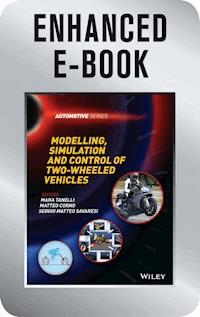
Enhanced e-book includes videos
Many books have been written on modelling, simulation and control of four-wheeled vehicles (cars, in particular). However, due to the very specific and different dynamics of two-wheeled vehicles, it is very difficult to reuse previous knowledge gained on cars for two-wheeled vehicles.
Modelling, Simulation and Control of Two-Wheeled Vehicles presents all of the unique features of two-wheeled vehicles, comprehensively covering the main methods, tools and approaches to address the modelling, simulation and control design issues. With contributions from leading researchers, this book also offers a perspective on the future trends in the field, outlining the challenges and the industrial and academic development scenarios. Extensive reference to real-world problems and experimental tests is also included throughout.
Key features:
- The first book to cover all aspects of two-wheeled vehicle dynamics and control
- Collates cutting-edge research from leading international researchers in the field
- Covers motorcycle control – a subject gaining more and more attention both from an academic and an industrial viewpoint
- Covers modelling, simulation and control, areas that are integrated in two-wheeled vehicles, and therefore must be considered together in order to gain an insight into this very specific field of research
- Presents analysis of experimental data and reports on the results obtained on instrumented vehicles.
Modelling, Simulation and Control of Two-Wheeled Vehicles is a comprehensive reference for those in academia who are interested in the state of the art of two-wheeled vehicles, and is also a useful source of information for industrial practitioners.
Sie lesen das E-Book in den Legimi-Apps auf:
Seitenzahl: 551
Veröffentlichungsjahr: 2014
Ähnliche
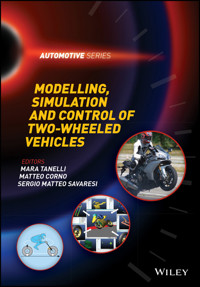

















Table of Contents
List of the Videos
Automotive Series
Series Editor: Thomas Kurfess
Title Page
Copyright
About the Editors
Mara Tanelli
Matteo Corno
Sergio M. Savaresi
List of Contributors
Series Preface
Introduction
Organization of the book
Part One: Two-Wheeled Vehicles Modelling and Simulation
Chapter 1: Motorcycle Dynamics
1.1 Kinematics
1.2 Tyres
1.3 Suspensions
1.4 In-Plane Dynamics
1.5 Out-of-Plane Dynamics
1.6 In-Plane and Out-of-Plane Coupled Dynamics
References
Chapter 2: Dynamic Modelling of Riderless Motorcycles for Agile Manoeuvres
2.1 Introduction
2.2 Related Work
2.3 Motorcycle Dynamics
2.4 Tyre Dynamics Models
2.5 Conclusions
Nomenclature
Appendix A: Calculation of Ms
Appendix B: Calculation of Acceleration
Acknowledgements
References
Chapter 3: Identification and Analysis of Motorcycle Engine-to-Slip Dynamics
3.1 Introduction
3.2 Experimental Setup
3.3 Identification of Engine-to-Slip Dynamics
3.4 Engine-to-Slip Dynamics Analysis
3.5 Road Surface Sensitivity
3.6 Velocity Sensitivity
3.7 Conclusions
References
Chapter 4: Virtual Rider Design: Optimal Manoeuvre Definition and Tracking
4.1 Introduction
4.2 Principles of Minimum Time Trajectory Computation
4.3 Computing the Optimal Velocity Profile for a Point-Mass Motorcycle
4.4 The Virtual Rider
4.5 Dynamic Inversion: from Flatland to State-Input Trajectories
4.6 Closed-Loop Control: Executing the Planned Trajectory
4.7 Conclusions
4.8 Acknowledgements
References
Chapter 5: The Optimal Manoeuvre
5.1 The Optimal Manoeuvre Concept: Manoeuvrability and Handling
5.2 Optimal Manoeuvre as a Solution of an Optimal Control Problem
5.3 Applications of Optimal Manoeuvre to Motorcycle Dynamics
5.4 Conclusions
References
Chapter 6: Active Biomechanical Rider Model for Motorcycle Simulation
6.1 Human Biomechanics and Motor Control
6.2 The Model
6.3 Simulations and Results
6.4 Conclusions
References
Chapter 7: A Virtual-Reality Framework for the Hardware-in-the-Loop Motorcycle Simulation
7.1 Introduction
7.2 Architecture of the Motorcycle Simulator
7.3 Tuning and Validation
7.4 Application Examples
References
Part Two: Two-Wheeled Vehicles Control and Estimation Problems
Chapter 8: Traction Control Systems Design: A Systematic Approach
8.1 Introduction
8.2 Wheel Slip Dynamics
8.3 Traction Control System Design
8.4 Fine tuning and Experimental Validation
8.5 Conclusions
References
Chapter 9: Motorcycle Dynamic Modes and Passive Steering Compensation
9.1 Introduction
9.2 Motorcycle Main Oscillatory Modes and Dynamic Behaviour
9.3 Motorcycle Standard Model
9.4 Characteristics of the Standard Machine Oscillatory Modes and the Influence of Steering Damping
9.5 Compensator Frequency Response Design
9.6 Suppression of Burst Oscillations
9.7 Conclusions
References
Chapter 10: Semi-Active Steering Damper Control for Two-Wheeled Vehicles
10.1 Introduction and Motivation
10.2 Steering Dynamics Analysis
10.3 Control Strategies for Semi-Active Steering Dampers
10.4 Validation on Challenging Manoeuvres
10.5 Experimental Results
10.6 Conclusions
References
Chapter 11: Semi-Active Suspension Control in Two-Wheeled Vehicles: a Case Study
11.1 Introduction and Problem Statement
11.2 The Semi-Active Actuator
11.3 The Quarter-Car Model: a Description of a Semi-Active Suspension System
11.4 Evaluation Methods for Semi-Active Suspension Systems
11.5 Semi-Active Control Strategies
11.6 Experimental Set-up
11.7 Experimental Evaluation
11.8 Conclusions
References
Chapter 12: Autonomous Control of Riderless Motorcycles
12.1 Introduction
12.2 Trajectory Tracking Control Systems Design
12.3 Path-Following Control System Design
12.4 Conclusion
Acknowledgements
Appendix A: Calculation of the Lie Derivatives
References
Chapter 13: Estimation Problems in Two-Wheeled Vehicles
13.1 Introduction
13.2 Roll Angle Estimation
13.3 Vehicle Speed Estimation
13.4 Suspension Stroke Estimation
13.5 Conclusions
References
Index
List of the Videos
Active Ridermodel
Vibration Sweep
Lane change
Lane change
Course of Adria
Circuit ride
Weave Mode - high co-contraction
Weave Mode - medium co-contraction
Weave Mode - low co-contraction
Benefit of active rider model
Application ride comfort
Automotive Series
Series Editor: Thomas Kurfess
Modelling, Simulation and Control of Two-Wheeled Vehicles
Tanelli, Corno and Savaresi
February 2014
Modeling and Control of Engines and Drivelines
Eriksson and Nielsen
February 2014
Advanced Composite Materials for Automotive Applications: Structural Integrity and Crashworthiness
Elmarakbi
December 2013
Guide to Load Analysis for Durability in Vehicle Engineering
Johannesson and Speckert
November 2013
This edition first published 2014
© 2014 John Wiley & Sons Ltd
Registered office
John Wiley & Sons Ltd, The Atrium, Southern Gate, Chichester, West Sussex, PO19 8SQ, United Kingdom
For details of our global editorial offices, for customer services and for information about how to apply for permission to reuse the copyright material in this book please see our website at www.wiley.com.
The right of the author to be identified as the author of this work has been asserted in accordance with the Copyright, Designs and Patents Act 1988.
All rights reserved. No part of this publication may be reproduced, stored in a retrieval system, or transmitted, in any form or by any means, electronic, mechanical, photocopying, recording or otherwise, except as permitted by the UK Copyright, Designs and Patents Act 1988, without the prior permission of the publisher.
Wiley also publishes its books in a variety of electronic formats. Some content that appears in print may not be available in electronic books.
Designations used by companies to distinguish their products are often claimed as trademarks. All brand names and product names used in this book are trade names, service marks, trademarks or registered trademarks of their respective owners. The publisher is not associated with any product or vendor mentioned in this book.
Limit of Liability/Disclaimer of Warranty: While the publisher and author have used their best efforts in preparing this book, they make no representations or warranties with respect to the accuracy or completeness of the contents of this book and specifically disclaim any implied warranties of merchantability or fitness for a particular purpose. It is sold on the understanding that the publisher is not engaged in rendering professional services and neither the publisher nor the author shall be liable for damages arising herefrom. If professional advice or other expert assistance is required, the services of a competent professional should be sought.
Library of Congress Cataloging-in-Publication Data
Tanelli, Mara.
Modelling, simulation and control of two-wheeled vehicles / Mara Tanelli, Sergio Savaresi and Matteo Corno.
pages cm
Includes bibliographical references and index.
ISBN 978-1-119-95018-9 (cloth)
1. Motorcycles— Dynamics. I. Savaresi, Sergio M. II. Corno, Mauro, 1970- III. Title.
TL243.T36 2014
629.2’31— dc23
2013036260
A catalogue record for this book is available from the British Library.
ISBN 9781119950189
About the Editors
Mara Tanelli
Mara Tanelli was born in Lodi, Italy, in 1978. She is an Assistant Professor of Automatic Control at the Dipartimento di Elettronica, Informazione e Bioingegneria of the Politecnico di Milano, Italy, where she obtained the Laurea degree in Computer Engineering in 2003 and the PhD in Information Engineering in 2007. She also holds an MSc in Computer Science from the University of Illinois at Chicago.
Her main research interests focus on control systems design for vehicles, energy management of electric vehicles, control for energy-aware IT systems and sliding mode control.
She is co-author of more than 100 peer-reviewed scientific publications and seven patents in the above research areas. She is also co-author of the monograph Active braking control systems design for vehicles, published in 2010 by Springer. She is a Senior Member of the IEEE and a member of the Conference Editorial Board of the IEEE Control Systems Society.
In the past few years, she has gained considerable experience in industrial projects carried out in collaboration with leading manufacturers of four- and two-wheeled vehicles, that involved – besides her scientific research activities – prototyping, implementation and experimental testing.
Matteo Corno
Matteo Corno was born in Italy in 1980. He received his MSc degree in Computer and Electrical Engineering (University of Illinois) and his PhD cum laude degree with a thesis on active stability control of two-wheeled vehicles (Politecnico di Milano) in 2005 and 2009, respectively.
He is currently an Assistant Professor at the Dipartimento di Elettronica, Informazione e Bioingegneria, Politecnico di Milano, Italy.
In 2011, his paper “On Optimal Motorcycle Braking” was awarded the best-paper prize for Control Engineering Practice, published in the period 2008–2010.
In 2012 and 2013, he co-founded two highly innovative start-ups: E-Novia and Zehus.
His current research interests include dynamics and control of vehicles; lithium-ion battery modelling; estimation and control; and modelling and control of human-powered electric vehicles. He has held research positions at Thales Alenia Space, University of Illinois, Harley Davidson, University of Minnesota, Johannes Kepler University in Linz, and TU Delft. He is author or co-author of more than 50 peer-reviewed scientific publications and of six patents. Most of his publications are the result of strong industrial collaboration with leading companies in the automotive and motorcycle industries.
Sergio M. Savaresi
Born in Manerbio, Italy, in 1968, Sergio Savaresi holds an MSc in Electrical Engineering and a PhD in Systems and Control Engineering, both from the Politecnico di Milano, and an MSc in Applied Mathematics from Università Cattolica, Brescia. After receiving his PhD, he became a consultant for McKinsey & Co., Milan Office. He has been a Full Professor in Automatic Control since 2006, and has been visiting scholar at Lund University, Sweden; University of Twente, the Netherlands; Canberra National University, Australia; Minnesota University at Minneapolis, USA and Johannes Kepler University, Linz, Austria.
He is an Associate Editor of several international journals and he has been on the international program committees of many international conferences.
His main research interests are in the areas of vehicles control, automotive systems, data analysis and modelling, nonlinear control and industrial control applications. He is co-author of the monographs Active Braking Control Systems Design for Vehicles, and Semi-Active Suspension Control For Vehicles. He is also author or co-author of more than 300 peer-reviewed scientific publications and of 28 patents.
He is the Chair of the Systems and Control Section of Politecnico di Milano, and Head of the MOVE research team (http://move.dei.polimi.it). He is a Lecturer on a Masters Course in “Automation and Control in Vehicles”, and has been Principal Investigator in more than 100 research cooperation projects between Politecnico di Milano and private companies, mostly in the fields of automotive and motorcycle dynamics and control.
List of Contributors
Series Preface
The motorcycle is the most prevalent form of mechanized transportation on the planet. In its human-powered form, the bicycle, it is one of the first pragmatic and useful vehicles that most people encounter. The dynamics of two-wheeled vehicles have been studied for many years, and provide the foundation for most vehicle dynamic analyses. Not only are these dynamics fundamental to the transportation sector, but they are quite elegant in nature, linking various aspects of kinematics, dynamics and physics. In fact, the dynamics of the motorcycle and bicycle are inherently linked to their functionality; one cannot easily balance these vehicles unless they are in motion!
Modelling, Simulation and Control of Two-Wheeled Vehicles is a comprehensive text of the dynamics, modelling and control of motorcycles. It provides a broad and in-depth perspective of all the necessary information required to fully understand, design and utilize the motorcycle. Topics covered in this text range from basic two-wheeled dynamics that are used as the foundation for most vehicle dynamic analyses to advanced control and estimation theory applied to fully developed complex systems models. This text is part of the Automotive Series whose primary goal is to publish practical and topical books for researchers and practitioners in industry, and for postgraduate or advanced undergraduates in automotive engineering. The series addresses new and emerging technologies in automotive engineering, supporting the development of the next generation transportation systems. The series covers a wide range of topics, including design, modelling and manufacturing, and it provides a source of relevant information that will be of interest and benefit to people working in the field of automotive engineering.
Modelling, Simulation and Control of Two-Wheeled Vehicles presents a number of different design and analysis considerations related to motorcycle transportation systems including integration dynamics, agile manoeuvring systems integration, rider biomechanical models, passive and active steering control and autonomous control of riderless motorcycles. The theory and supporting applications are second to none, as are the authors of this wonderful book. The text provides a strong foundational basis for motorcycle design and development, and is a welcome addition to the Automotive Series.
Thomas KurfessAugust 2013
Introduction
Mara Tanelli, Matteo Corno, and Sergio M. Savaresi
Dipartimento di Elettronica, Informazione e Bioingegneria, Politecnico di Milano, Italy
Plenty of books have been written on modeling, simulation and control on four-wheeled vehicles (cars, in short). As such, one would be tempted to ask: is a “two-wheeled-specific” book really needed or missing? The editors and authors of this book strongly believe that the answer is yes.
A thorough technical motivation for this answer will be implicitly given throughout the book. A simpler, somehow naive, but effective answer, however, is: we drive a car, but we ride a two-wheeled vehicle: this crucial difference highlights that they just cannot be “similar” vehicles. In the field of vehicle modeling and automatic control, the majority of scientists and practitioners have been working on automotive (car)-related modeling and control problems. As such, one may think that moving from four to two-wheeled vehicles just requires a small re-casting (re-modeling, re-design of the controllers, re-tuning, etc.) effort. This sort of prejudice typically vanishes when dealing with real problems, on real two-wheeled vehicles. Most of the authors of this book have been through this enlightening process. Discovering that two-wheeled vehicles are not just a “subset of cars” is both challenging and fascinating.
This book helps the reader discover all the peculiar features of modeling and control of this very special class of vehicles.
The potential interest for a book specifically dealing with two-wheeled vehicles is amplified by the current and future mobility trends: traffic congestion in urban and metropolitan areas and the need to reduce energy consumption and pollutant emission are pushing towards a strong downsizing of vehicles used for urban mobility. The number of E-Bikes, scooters, motorcycles, narrow-track vehicles (tilting or non-tilting) is expected to grow exponentially in the next decades, especially around large metropolitan areas. Along this trend, two-wheeled vehicles can play a key role: they have the appealing features of being light and having a very small energy footprint. Thus, there are good chances that the two-wheeled vehicles market will soon compete (in volume, and, possibly, in technology) with the today larger and more advanced automotive market.
Such an expansion, then, will see an increasing interest in finding innovative andoriginal solutions for solving many challenging problems that deal with the dynamic analysis and control of such vehicles, and this book can be one of the first comprehensive answer to such needs.
In this respect, this book lies in the class of edited-books, namely books that are a collection of chapters written by different authors. The price to pay is a limited homogeneity of notation and presentation style, but their main advantage is that a single book embeds the perspective of an (almost) entire scientific community, rather than that of a single research group.
This book has been carefully conceived in order to provide at the same time a broad perspective and a rigorous structure. Its contents have been clearly divided into two parts: in the first part, the modeling and simulation issues are considered, while in the second one the problem of controlling (mostly by feedback electronic control systems) the vehicle is analyzed. In many cases, there are pairs of chapters written by the same authors: one in the first, one in the second part, stressing the fact that modeling and control are just two sides of the same coin. The valuable coin is the dynamic behavior of a two-wheeled vehicle: weird, exhilarating, challenging. We want to understand it. We want to control it.
Organization of the book
The two parts of the book are organized as follows.
Part one:
Chapter 1 (by Vittore Cossalter, Roberto Lot and Matteo Massaro—University of Padova) is a comprehensive and introductory chapter that describes all the aspects of the kinematic and dynamic behavior of a two-wheeled vehicle.
Chapter 2 (by Yizhai Zhang and Jingang Yi—Rutgers University—and by Dezhen Song—Texas A&M University) further develops the modeling topic, with a special focus on a reduced-order model suited for modeling fast-dynamics maneuvers.
Chapter 3 (by Matteo Corno and Sergio M. Savaresi—Politecnico di Milano) explores the field of black-box control-oriented modeling, by presenting a case study of direct identification from experiments of the engine-to-slip dynamics, ancillary to traction-control design. The design-of-experiment in this context represents a major issue and is described in detail.
Chapter 4 (by Alessandro Saccon—TU Eindhoven—John Hauser—University of Colorado Boulder—and Alessandro Beghi—University of Padova) andChapter 5 (by Francesco Biral, Enrico Bertolazzi and Mauro Da Lio—University of Trento) present, with different approaches, the problem of simulating the motorcycle dynamics in a time-optimal maneuver. This problem is a combination of dynamics modeling, optimization and optimal control issues. This topic is highly relevant not only for the purpose of automatic (electronic) feedback control, but mostly for better understanding the sensitivity of the performance of a motorcycle, with respect to different parameter configurations.
Chapter 6 (by Valentin Keppler—University of Tubingen) deeply explores the issue of rider modeling and simulation. This issue is a key element of two-wheeled vehicles simulation, since the rider is so deeply linked with the vehicle dynamics that the two elements can hardly be simulated separately. In this chapter, the rider simulation is dealt with a sophisticated bio-mechanics approach.
Chapter 7 (by Vittore Cossalter and Roberto Lot—University of Padova) ends part one by presenting a research work that can be considered in-between simulation and control: the development of a virtual-reality system for the hardware-in-the-loop simulation of vehicle dynamics. The system described in this chapter might have multi-faceted applications: it can be used as a design and testing tool for advanced electronic control, as a rider-training system and…even as a sophisticated and fun-to-use
toy
).
Part two:
Chapter 8 (by Matteo Corno and Giulio Panzani—Politecnico di Milano) presents a complete (from model-based design to experimental validation) design procedure for a traction control system of a high-performance motorcycle. Traction control is the most used electronic control system in high-end motorcycles today, and has a key role both on the safety and the performance of a sport motorcycle. This Chapter is somehow the continuation of Chapter 3.
Chapter 9 (by Simos A. Evangelou—Imperial College—and Maria Tomas-Rodriguez— City University of London) focuses on the key issue of steer dynamics, with an approach that aims to improve the dynamic behavior by passive mechanical elements.
Chapter 10 (by Pierpaolo De Filippi, Mara Tanelli and Matteo Corno—Politecnico di Milano) addresses again the problem of steer dynamics, proposing a solution that employs closed-loop electronic control systems and relies on a semi-active damping technology.
Chapter 11 (by Diego del Vecchio—Politecnico di Milano, and Cristiano Spelta—University of Bergamo) focuses on vertical and pitch dynamics, by presenting a complete case-study of semi-active suspension control design. Semi-active suspensions have been first presented in motorcycle applications at the end of 2012, and they constitute—today—one of the fastest-growing electronic-control technology in motorcycles).
Chapter 12 (by Yizhai Zhang and Jingang Yi—Rutgers University—and by Dezhen Song—Texas A&M University) is the natural continuation of Chapter 2, and the problem of designing an electronic-rider for the autonomous control of a 2-wheeled vehicle is analyzed.
Chapter 13 (Ivo Boniolo—University of Bergamo, Giulio Panzani, Diego del Vecchio, Matteo Corno and Mara Tanelli—Politecnico di Milano, Cristiano Spelta—University of Bergamo—and Sergio M. Savaresi—Politecnico di Milano) is a sort of appendix chapter, where three important problems of variable estimation (or software sensing) are considered: roll-angle estimation, vehicle-speed estimation, and suspension stroke estimation. Variable estimation from indirect measurements is, today, a key element for the optimization of sensors layout, both for reducing the cost and for improving the safety of the control systems.
This overview of chapters shows that the book provides a broad perspective on all the main modeling, simulation and control issues of modern two-wheeled vehicles. Moreover, the style and content of the chapters (with a good balancing between theory and experimental results) make this book potentially useful for both practitioners and researchers. From a technological and industrial point of view, the content of the book is up-to-date: it contains the latest technologies both in terms of electronic control systems (traction control, suspension control, steer-damping control), vehicle-dynamics optimization, rider-modeling and virtual-reality hardware-in-the-loop frameworks.
A last comment about the authorship: Italy is largely represented and this reflects the fact that the motorcycle (and bicycle) Italian industry has been, and still is, one of the most vital and technologically advanced worldwide, with a vast number of large, medium and small bike and motorbike companies and prestigious brands. UK, USA and Germany are also represented, consistently with the location of the main motorcycle industries. The most evident missing contribution is from Japan, that has expressed, in the last 30 years, an enormous industrial power and potential, but, somehow, this potential has not been equally represented in the academic research activities (which, in this field, do exist but are quite fragmented).
A final comment for the reader: the books has been conceived for being readable both end-to-end or by cherry-picking some chapters. Each chapter is almostcompletely self-consistent, with the (partial) exception of the twin-chapters (one in part one, one in part two) written by the same authors.
Part One
Two-Wheeled Vehicles Modelling and Simulation
Chapter 1
Motorcycle Dynamics
Vittore Cossalter, Roberto Lot, and Matteo Massaro
University of Padova, Italy
This chapter aims at giving a basic insight into the two-wheeled vehicle dynamics to be applied to vehicle modelling and control. The most relevant kinematic properties are discussed in Section 1.1, the peculiarities of motorcycle tyres are reported in Section 1.2, the most popular suspension schemes are presented in Section 1.3, while Sections 1.4 and 1.5 are devoted to the analysis of the vehicle in-plane and out-of-plane vibration modes. Finally, Section 1.6 highlights the coupling between in-plane and out-of-plane dynamics.
1.1 Kinematics
From the kinematic point of view, every mechanical system consists of a number of rigid bodies connected to each other by a number of joints. Each body has six degrees of freedom (DOF) since its position and orientation in the space are fully defined by six parameters, such as the three coordinates of a point and three angles (yaw, roll, pitch). When a joint is included, the number of DOFs reduces according to the type of joint: the revolute joint (e.g., the one defining the motorcycle steering axis) inhibits five DOFs, the prismatic joint (e.g., the one defining the telescopic fork sliding axis) inhibits five DOFs, the wheel–road contact joint inhibits three DOFs when pure rolling is assumed (only three rotations about the contact point are allowed while no sliding is permitted), or one DOF when longitudinal and lateral slippage is allowed (the only constraint being in the vertical direction, where the compenetration between the wheel and the road is avoided).
1.1.1 Basics of Motorcycle Kinematics
Two-wheeled vehicles can be considered spatial mechanisms composed of six bodies:
the rear wheel;
the swingarm;
the chassis (including saddle, tank, drivetrain, etc.);
the handlebar (including rear view mirrors, headlamp, the upper part of the front suspension, etc.);
the front usprung mass (i.e., the lower part of the front suspension, front brake calliper, etc.);
the front wheel.
These bodies are connected each other and with the road surface by seven joints:
a contact joint between the rear wheel and the road surface;
a revolute joint between the rear wheel and the swingarm, to give the rear wheel spin axis;
a revolute joint between the swingarm and the chassis, to give the swingarm pivot on the chassis;
a revolute joint between the chassis and the handlebar, to give the steering axis;
a prismatic joint between the handlebar and the front unsprung, to give the sliding axis of the telescopic fork;
a revolute joint between the front unsprung and the front wheel, to give the front wheel spin axis;
a contact joint between the front wheel and the road plane.
Therefore, the two-wheeled vehicle has nine DOFs, given the 20 DOFs inhibited by the four revolute joints, five DOFs inhibited by the prismatic joint and the two DOFs inhibited by the two contact joints (tyre slippage allowed), subtracted from the 36 DOFs related to the six rigid bodies. It is also common to include the rear and front tyre deformation due to the tyre compliance, and consequently the number of DOFs rises to 11.
Among the many different sets of 11 parameters that can be selected to define the vehicle configuration, it is common (e.g. Cossalter et al. 2011b, 2011c) to use the ones depicted in Figure 1.1: position and orientation of the chassis, steering angle, front suspension travel, swingarm rotation and wheel spin rotations.
Figure 1.1 Degrees of freedom of a two-wheeled vehicle
Finally, it is worth mentioning that these DOFs are related to the gross motion of the vehicle, while additional DOFs are necessary whenever some kind of vehicle structural flexibility is considered, e.g. Cossalter et al. (2007b).
Lesen Sie weiter in der vollständigen Ausgabe!
Lesen Sie weiter in der vollständigen Ausgabe!
Lesen Sie weiter in der vollständigen Ausgabe!
Lesen Sie weiter in der vollständigen Ausgabe!
Lesen Sie weiter in der vollständigen Ausgabe!
Lesen Sie weiter in der vollständigen Ausgabe!
Lesen Sie weiter in der vollständigen Ausgabe!
Lesen Sie weiter in der vollständigen Ausgabe!
Lesen Sie weiter in der vollständigen Ausgabe!
Lesen Sie weiter in der vollständigen Ausgabe!
Lesen Sie weiter in der vollständigen Ausgabe!
Lesen Sie weiter in der vollständigen Ausgabe!
Lesen Sie weiter in der vollständigen Ausgabe!
Lesen Sie weiter in der vollständigen Ausgabe!




