


Erhalten Sie Zugang zu diesem und mehr als 300000 Büchern ab EUR 5,99 monatlich.
- Herausgeber: Arena Sport
- Kategorie: Lebensstil
- Sprache: Englisch
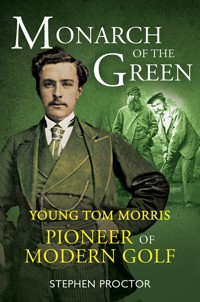
Shortlisted for The Telegraph Sports Book Awards Biography of the Year 'A splendid new biography. How good was young Tom Morris? Stephen Proctor makes his case cogently. Young Tom Morris was one of the greatest of them all' - Allan Massie Young Tom Morris, the son of the legendary pioneer of golf, Tom Morris, was golf's first superstar. Born at a pivotal moment in history, just as the new and inexpensive 'gutty' ball was making golf affordable and drawing thousands of new players to the game, his genius and his swashbuckling personality would set a game that had been frozen in amber for four centuries on the pathway to becoming worldwide spectator sport we know today. Exhaustively researched and beautifully illustrated, Monarch of the Green is a stirring and evocative history of Tommy's life (which also includes, for the first time, a compilation of his competitive record in stroke-play tournaments, singles matches, and foursomes) and demonstrates how, in one dazzling decade, this young superstar dominated the sport like few others have ever done.
Sie lesen das E-Book in den Legimi-Apps auf:
Seitenzahl: 352
Veröffentlichungsjahr: 2019
Das E-Book (TTS) können Sie hören im Abo „Legimi Premium” in Legimi-Apps auf:
Ähnliche


















First published in 2019 by
ARENA SPORT
An imprint of Birlinn Limited
West Newington House
10 Newington Road
Edinburgh
EH9 1QS
www.arenasportbooks.co.uk
Text copyright © Stephen Proctor, 2019
ISBN: 978-1-909715-75-2
eBook ISBN: 978-1-78885-166-4
The right of Stephen Proctor to be identified as the author of this work has been asserted by him in accordance with the Copyright, Designs and Patents Act 1988.
All rights reserved. No part of this publication may be reproduced, stored or transmitted in any form, or by any means electronic, mechanical, photocopying, recording or otherwise, without the express written permission of the publisher.
Every effort has been made to trace copyright holders and obtain their permission for the use of copyright material. The publisher apologises for any errors or omissions and would be grateful if notified of any corrections that should be incorporated in future reprints or editions of this book.
British Library Cataloguing-in-Publication Data
A catalogue record for this book is available on request from the British Library.
Designed and typeset by Polaris Publishing, Edinburgh
Printed by TJ International Ltd, Padstow
CONTENTS
CHAPTER ONE: HERO’S WELCOME
CHAPTER TWO: PRESTWICK
CHAPTER THREE: THRUST AND PARRY
CHAPTER FOUR: MASTER MORRIS
CHAPTER FIVE: THE GIFT OF GOLF
CHAPTER SIX: DASHING NEW BREED
CHAPTER SEVEN: 1870
CHAPTER EIGHT: TOMMY TRANSCENDENT
CHAPTER NINE: DREAM SEASON
CHAPTER TEN: MATCH PLAY
CHAPTER ELEVEN: A MORTAL BLOW
CHAPTER TWELVE: A WINTER OF MOURNING
CHAPTER THIRTEEN: FOR GOOD AND ALL
CHAPTER FOURTEEN: ETCHED IN STONE
CHAPTER FIFTEEN: FINAL ROUNDS
POSTSCRIPT
APPENDIX: TOMMY’S CAREER
NOTES ON CHAPTERS
BIBLIOGRAPHY
HISTORICAL CHRONOLOGY AND SYNOPSIS
ACKNOWLEDGEMENTS
A NOTE ON THE WRITING
INDEX
One
HERO’S WELCOME
As the ten o’clock train chugged into St Andrews, Young Tom Morris’s admirers hustled out to Station Road beside the golf links to welcome their champion home. It was Saturday night, 17 September 1870. By then everyone had heard the news. Young Tom had done it. For the third year in succession he’d won the Champion’s Belt, the trophy every one of Scotland’s leading golfers dreamed of fastening around his waist. Now it was Tommy’s to keep.
Since Thursday, when news of his feat had filtered into town, the Scottish flag had flown over his father’s golf shop heralding the victory. But it wasn’t the win alone that brought Tommy’s faithful out that night. It was the way he had played. Tommy had annihilated all records for the Open Championship, coming in with a score so low it would stand for the ages.
He was 19 years old.
Even at that age, Young Tom Morris was the defining player of his era. He stood five feet eight inches tall, with reddish-brown hair like his father’s and a wisp of a moustache. He was thin and wiry but capable of surprising strength, more likely than most to snap his wooden shaft in half with a ferocious swing. He dressed like a dandy, favouring tailored suits, silk ties and pocket watches, and he played the game with a reckless abandon that dazzled those who saw him compete.
‘I shall never forget – and no one can – his dash and style,’ recalled the Reverend William Weir Tulloch, his father’s first biographer. ‘His grand swipes, the Glengarry bonnet flying off his head every time he took a full drive.’
Young Tom was accompanied on the train from Prestwick, birthplace of the Open Championship, by his father, Old Tom, his best friend and competitor David Strath, and fellow golfer Bob Kirk. The four of them had made it a clean sweep for St Andrews men, with Davie and Bob tied for second and Old Tom in fourth. Not a single player from Musselburgh, St Andrews’ chief rival in golf, had finished in the top rank, making victory all the sweeter.
Tommy had barely stepped off the train when his worshippers, much to the champion’s delight, swept him up onto their shoulders and, with deafening cheers that roused the sleepy town, carried him all the way up the links to Mr Leslie’s Golf Inn. Inside they were greeted by a crowd of well-wishers that included every star in the golfing firmament of St Andrews.
The first to speak was James Glover Denham, a close friend of the Morris family. Denham had been injured in a railway accident and couldn’t play golf any more. But he was a devoted fan of the game known for the copious statistics he kept on leading players of the day. He proposed a toast to Tommy’s health. Young Tom, he said, had performed a feat that in all probability would never be repeated. He had brought St Andrews the highest honour a golfer could confer on the town and raised the profile of Scotland’s national game.
Then Tommy himself raised a glass. He thanked the crowd for its warm demonstration of affection and told them something no one in that room could have known, except perhaps Old Tom and Davie. Two years ago, when he was just 17, Tommy had made up his mind that it was his destiny to own the Belt. He would be the golfer who ended the decade-long quest for that red-leather trophy, with its gleaming silver buckle. He would be the one who earned the right to wear the Belt for all time by winning three consecutive Open Championships. Tonight, Tommy said, he relished the satisfaction of a dream realised.
His father spoke next. Old Tom had won the Open in consecutive years himself, losing narrowly in his attempt to claim the Belt with a third victory. It was his pleasure, he told the crowd, to see that coveted trophy worn by his greatest rival on the links, his own son.
Henry Farnie, who covered the Open for the Fifeshire Journal, must have sensed a passing of the torch from Old Tom and the great players of his day to Scotland’s new Champion Golfer. Old Tom was nearly 50 now. With his thick grey beard and ever-present pipe in hand, he was well on his way to becoming the most revered figure in the game. Farnie raised his glass to offer a toast of his own. To Old Tom Morris, he said.
The revelry went on into the night, as everyone in Mr Leslie’s savoured the opportunity to witness history – and, perhaps, took a turn trying on the Belt. They knew that golf had never witnessed a feat to match what Young Tom had accomplished two days ago on the links of Prestwick.
But they could not have known that by winning the Belt he was forging a new future for the royal and ancient game. Ever after golf would be driven by the feats of superstars like Tommy, coming along once in a generation, lifting the game onto their shoulders and carrying it to new heights.
Emboldened by his victories, Tommy set in motion changes that in decades to come would elevate the men who earned their living at golf, from disreputable caddies not welcome in any gentlemen’s clubhouse to men of stature with wealth of their own.
Tommy’s emergence would prove to be the pivotal moment in golf’s evolution from a Scottish pastime to a spectator sport, ushering in a period of phenomenal growth that saw the game spread to England, America and around the globe.
So lasting was Tommy’s impact that a generation later, during the 1896 Open at Muirfield, his memory was invoked by those who had come to see the game’s next prodigy, Englishman Harry Vardon, who would win the first of his record six Open Championships that year.
The question, inevitably, was who was the greater golfer. William Doleman, a baker from Glasgow, spoke from the perspective of a man who had competed in every one of Tommy’s Opens. His assessment was unequivocal.
‘I tell you, sir,’ he said in response to a question from a friend. ‘There isn’t a man, English or Scotch, in all this field that impresses me with the same sense of power, or golfing genius – call it what you like – as Tommy did the instant he addressed the ball.’
Sadly, those who toasted Tommy into the night at Mr Leslie’s also could not have known that all of his glorious achievements, before and after the Belt, would be eclipsed by personal tragedy. Or that it would be James Denham, the very man who raised the first glass to the champion, who made certain the young golfer’s fame was etched in stone forever at the most sacred place in St Andrews, the cathedral’s burying ground.
Two
PRESTWICK
In a sombre ceremony on 19 April 1850, surrounded by ancient stone walls and ruins, Tom and Agnes Bayne Morris’s first-born son was laid to rest in the cathedral cemetery at St Andrews. The boy they called Wee Tom, after his father, was a month away from his fourth birthday.
Parents in the Victorian age knew their children might die young, as so many babies did, but the chances diminished with each year that passed. Wee Tom was not a baby any more. His death was more than any parent should have to bear. The inscription on his tombstone, still visible in that old churchyard, captures his parents’ anguish and their faith: ‘In the silent tomb we leave him, till the resurrection morn, when his saviour will receive him and restore his lovely form.’
Tom and Agnes, whom friends and family knew as Nancy, had been happily married and increasingly prosperous for six years before that crushing blow. They would be together another two and a half decades, years in which the Morris family would be destined to experience more than its fair share of both unbridled joy and unremitting sorrow. The dark cloud that descended over the couple when Wee Tom died was lifted almost exactly a year to the day later. On 20 April 1851, Tom and Nancy welcomed into the world another son. In the custom of the era, he too was named Tom Morris Junior.
Young Tom arrived at a time of upheaval in the Morris household. His parents were about to move to Prestwick, on Scotland’s west coast. Tom had been hired to lay out a proper golf course there and work as keeper of the green. That was a dream job, but it meant leaving the only home the couple had ever known, that old, grey town by the sea. Tom and Nancy could not have had any inkling of it then, but moving from St Andrews to Prestwick would give their newborn son the starring role to play in a drama about to unfold in the game that provided the family’s livelihood.
Tom and Nancy had grown up at a time when weaving linen by hand was a booming business in St Andrews. Tom was born in 1821, Nancy three years earlier. Both of their parents were hand-loom weavers, as were nearly all the families living on North Street, a thoroughfare that cuts through the heart of the town from the links to the cathedral churchyard. Weavers lived in two-room stone cottages, with the front room devoted to the loom and the back to living space and beds. If the family made fine linen, running the loom was a tough job reserved for the man of the house. Weaving coarse linen, however, as the Morrises did, demanded less physical strength and could be handled by wives and daughters. In either case, it was a cramped, difficult, hand-to-mouth existence.
In the early 1800s, St Andrews was a town of 4,000 souls that had become decidedly down-at-heel. Before the Scottish Reformation, it had flourished as the spiritual capital of a Catholic nation. Pilgrims flocked to its famed cathedral to receive blessings at the shrine of St Andrew, Scotland’s patron saint. The two centuries since had seen steady decline. By the time Tom and Nancy were born, the cathedral had long since gone to ruin with livestock roaming freely on the town’s narrow, filthy streets.
Not surprisingly, given that it was home to the most famous links in the land, golf was inextricably intertwined with life in St Andrews. The town was considered then, as it is now, the capital of the Scottish game. If it had any rival for that title it was Musselburgh, then home to The Honourable Company of Edinburgh Golfers, one of the oldest clubs in the kingdom. But the Musselburgh links paled by comparison to that of St Andrews, which in every age has been considered the ultimate test of a golfer’s skill.
‘The links of St Andrews – of The Royal and Ancient Golf Club of the East Neuk of Fife – hold premier place as indubitably as Lord’s Ground in the kingdom of cricket,’ the great British amateur and golf writer Horace G. Hutchinson wrote years later, summing up a sentiment that had prevailed since the first player struck a ball. ‘All the great mass of golfing history and tradition – principally, perhaps, the latter – clusters lovingly within sight of the grey tower of the old university town, and to most the very name of St Andrews calls to mind not a saint, nor a town, nor a castle, nor a university, but a beautiful stretch of green links with a little burn, which traps golf balls, and bunkers artfully planted to try the golfer’s soul.’
Weavers like Tom’s father, John, had always been among the regulars on the St Andrews Links. Linen merchants paid them by the yard, not the hour, so they were free to set their own schedule. That usually included playing golf and working as a caddie to help pay for it. By the time Tom and Nancy came of age, the Industrial Revolution was nearing its apex, and it was clear there would be no future in hand-loom weaving. Nancy became a domestic servant in the home of a prominent St Andrews couple. Tom was apprenticed to Allan Robertson, the town’s famous golf ball maker.
Every golfer who grew up in the 19th century – and Young Tom would have been no exception – was steeped in the legend of Allan Robertson. A small, feisty, jovial man, Allan sported bushy mutton chops that were fashionable in the 1800s and often wore a bright red jacket that was a popular uniform for golfers in the game’s early years. He was considered the greatest player of his generation – Scotland’s ‘King of Clubs’ – and was the first to hole the course at St Andrews in fewer than 80 strokes. Everyone in town recognised Allan as the unofficial custodian of the links and undisputed authority on anything having to do with golf. So beloved was Allan that when he died in September 1859, an admirer from The Royal and Ancient Golf Club, A. Gordon Sutherland, exclaimed, ‘They may toll the bells and shut up their shops in St Andrews for their greatest is gone!’
Becoming Allan’s apprentice opened a new world to Tom – a world of big-money golf matches that brought him wealth, fame and social advantages that would give Young Tom a head start in the game and in life. ‘Allan had a great deal to do with the making of me,’ Tom acknowledged at the dawn of the 20th century, when he had emerged as golf’s elder statesman. By the time he and Nancy’s second son arrived – they were married in 1844 – Tom had become a genuine golf celebrity. He had earned a reputation throughout Scotland as Allan’s toughest rival and had become a favoured partner of leading members of The Royal and Ancient.
Four years after his marriage, in 1848, Tom walked away from his apprenticeship and opened his own shop, which new research shows was located at 15 The Links. It was a perfect time to be starting a business. A few years earlier, in 1832, town provost Major Hugh Lyon Playfair had launched improvements that would bring new life to St Andrews and its famed links. The area would emerge as a thriving Victorian town built around the University of St Andrews, the prestigious new secondary school Madras College and the revered golf course. Tom made both clubs and balls at his new shop and, along with the money he won at golf, earned a far more comfortable living than most Scots born into a family of craftsmen.
Tom and Nancy’s future seemed set, until he received the job offer in Prestwick. It came from Colonel James Ogilvy Fairlie, a pillar of Scottish society, a gifted sportsman and Tom’s frequent golf partner at St Andrews. Fairlie and Tom were made for one another. Both were men of dogged determination and unflappable temperament and Fairlie also ranked with the best amateur players of his day. In 1862 he won the medal at all three of his golf clubs. He and Tom made a great pairing in a foursome or any other venture. Tom admired Fairlie so much that he would name a son after him. Still, moving all that way from St Andrews must have been a daunting prospect for Tom and Nancy. They may have had any number of reasons, beyond Tom’s respect for Fairlie, for accepting the post at Prestwick. Perhaps Tom wanted to step out of the long shadow Allan cast in St Andrews. Perhaps he and Nancy simply wanted a change of scenery after the death of their first-born son.
Whatever the reason, the Morrises set out for a new life on the west coast of Scotland when Young Tom was just three months old. It’s hard to imagine now what an arduous journey that would have been, loaded down as they were with their belongings and Tom’s club- and ball-making tools. The 100-mile trip would have taken at least eight hours, and would have involved a bumpy ride in a cart from St Andrews to Leuchars Station, three train changes, luggage and all, and one trip aboard a ferry. Poor Nancy had to endure the entire ordeal with a babe in arms.
In July of 1851, when the Morris family arrived, Prestwick was a town of 2,000 people situated along the road that leads to Ayr, the Royal Burgh and county seat of Ayrshire. Half the size of St Andrews, Prestwick was surrounded by farms that supplied Glasgow, the region’s largest city, with vegetables and milk. They also gave the town its name. Prestwick is derived from Old English words that translate as ‘priest’s farm’. The centre of town was marked by the Mercat Cross, a symbol of prosperity in burghs granted the right to host markets or fairs. It stood where the three main roads in Prestwick converged, flanked by offices and shops. The most prominent among them were the Burgh Hall and the Red Lion Inn, home to Tom’s new employer, Prestwick Golf Club. Years later, as the town grew, the Cross was moved to a quieter intersection.
The cottage the Morrises occupied, which came to be known as Golf House, stood directly across the street from the Red Lion. The layout would have been familiar to Tom and Nancy, as it was nearly identical to the stone cottage they had left behind in St Andrews. Tom’s shop occupied the front room, with the family’s living and sleeping quarters in the back. Rent was £6 a year, deducted from Tom’s generous salary of just under £50, five times what local farmers were making.
The Morrises’ neighbours across the street, Red Lion proprietors William and Elizabeth Hunter, would become their closest friends in Prestwick. Their eldest son James would be among Tommy’s childhood companions. Years later, James would marry Tommy’s sister and make the Morris family a fortune in the timber business. Both the Red Lion and Golf House still stand in Prestwick, although the town’s oldest pub is a faded jewel and Tom and Nancy’s cottage is unrecognisable, having been converted into a cafe.
During their years in Prestwick, Tom and Nancy would have three more children. Elizabeth arrived in 1852, James Ogilvy Fairlie Morris, or Jof, in 1856, and John in 1859. Poor John, to whom Young Tom would be especially close, was born with a hip deformity that could be corrected easily today. It left him unable to walk all his life and confined him to a trolley his father made for him.
Young Tom and his siblings grew up in a difficult period in Victorian Britain. The potato blights of 1845 and 1846 made food scarce everywhere and sent millions fleeing to America in search of a better life. Many children survived on nothing more than bread, porridge, oatcakes and beer. The situation wasn’t as bad in lowland Scotland, where Tommy’s family lived, as it was in much of the rest of the nation. Families there often had gardens and could supplement their diets with vegetables. Those who were better off, like the Morrises, could afford some eggs, sausages and meat, but even then the lion’s share would be reserved for the man of the house, whose work put food on the table.
Unless their family was extraordinarily wealthy, children who grew up in that age knew hunger as a constant companion. Even as late as the 1890s, when the food supply was greatly improved, the author of the Winnie-the-Pooh books recalled constant cravings during his boarding school days at Westminster College. ‘I lay awake every night thinking about food,’ wrote A.A. Milne. ‘I fell asleep and dreamt about food. In all my years at Westminster, I never ceased to be hungry.’
If the lack of food wasn’t trying enough, the work involved in day-to-day living was absolutely exhausting. In this age of technology, it is easy to forget that every task – from cooking to cleaning to personal grooming – was vastly more difficult and time-consuming in that era. Both parents and children worked tirelessly simply to keep the household going. These stark realities tend to be overshadowed by the quest for progress and remarkable discoveries that have come to define the reign of Queen Victoria.
Not much is known about Young Tom’s earliest days in Prestwick. But there can’t be any doubt that whatever free time he had was spent on the links his father laid out in Ayrshire. If Old Tom’s own childhood is any measure, his son would have been taking his first swings with a cut-down club as soon as he could walk. In an interview decades later, Tom recounted his own start in the game as a boy in St Andrews. ‘I began, then, to play golf down here, I am quite sure, as soon as ever I was able to handle or swing a club,’ he said. ‘Indeed, I must say that I don’t remember when I didn’t play, and I have been doing not much else ever since.’
Young Tom must have spent hours chasing shots around the sandy dells of Prestwick. By the time he made his first public appearance at the age of 12, he had earned a reputation as a prodigy. His childhood golf partners were James Hunter and Johnny Allan, son of a local stonemason. They were tough competitors. As young men, both won the Eglinton Medal presented by The Prestwick Mechanics’ Golf Club, an organisation for working-class players. Later both competed in the Open Championship. Johnny went on to devote his life to golf, working at The West of England Club in North Devon, better known as Westward Ho!
Precocious as he was in golf, Tommy’s parents clearly wanted their eldest son to be prepared for a life beyond the club- and ball-making shop. He hadn’t been attending the Burgh School at Prestwick long before he and James were enrolled at the prestigious Ayr Academy, which has educated such famous sporting Scots as rugby captain Ian McLaughlan and Olympic gold medal curler Margaret Morton. Founded in 1796 and still ranked with the nation’s finest schools, the Academy was an expensive investment for the Morris family. It cost more than a shilling a week, compared to a penny at the public school. That amounts to nearly 5 per cent of Tom’s annual salary. The Academy was also three miles from home. Travelling that distance every day would have been no easy matter.
At the Academy, Tommy traded the clothes his mother favoured – in the fashion of the day, Nancy dressed her son in sailor’s togs – for a jacket and tie. He sat beside the sons of wealthy merchants and landed gentlemen, learning to be at ease in their company. He studied an array of subjects far wider than what was available at the Burgh School, including astronomy and Latin, science and philosophy. Tommy wasn’t as gifted a student as James, but the experience made an indelible impression on him. Never again would he accept the notion that he was inferior to gentlemen golfers, a second-class citizen not welcome in their clubhouses. That would become clear years later when Tommy emerged as a driving force in elevating the status of men who earned their keep from Scotland’s national pastime.
The ideas Tommy absorbed at the Academy were reinforced by sweeping economic, social and political changes brought on by the Industrial Revolution. Tommy came of age at the height of that transformative era when men first became enchanted by machines and the possibilities they presented. It was an age of factories replacing artisans, of railroads replacing horse-drawn carriages, of a newly born working class overwhelming the ranks of farmers, craftsmen and seafarers.
The same year his parents moved to Prestwick, thousands flocked to London to ogle the latest inventions – the cotton gin and the telegraph, the microscope and the barometer, the daguerreotype and the voting machine. Queen Victoria’s husband, Prince Albert, had assembled them at the Great Exhibition of 1851, the first in a series of World’s Fairs that became popular in the 19th century. Three years earlier, Europe and Latin America had been swept by political revolutions, ultimately unsuccessful, that were sparked largely by demands from the downtrodden for relief from the harsh realities of industrial life, the grim working and living conditions described so vividly in the popular novels of the day by Charles Dickens.
The quest for improvement had come to golf five years before Tommy’s birth. In 1846 a ball made from gutta-percha, the sap of trees that grow on the Malaysian Peninsula, began circulating around St Andrews, Edinburgh and Musselburgh. At the time, golf was being played with the feather ball; before that players had used wooden ones. The feather ball got that name because it was made by stuffing hen, duck or goose feathers into a leather casing and sewing it together. The result was a hard, somewhat oblong ball, whose influence on the early years of golf is impossible to overstate.
Making featheries created a class of craftsmen – such as Allan and Tom – who, along with caddies and greenkeepers, became the first men to make their living from golf. More importantly, the ball was so expensive that few men who weren’t wealthy could afford to play the game, at least not with proper equipment. An experienced workman might make four featheries a day. A single ball cost more than a golf club and players were lucky if one survived two rounds, given that featheries often burst open in wet weather. Gutta-percha balls were ten times less expensive to make and many more people could afford them. They were also virtually indestructible. A ball damaged during a round could simply be heated up and remoulded.
Men like Allan, whose family had been making featheries for generations, saw the new ball as a threat to their livelihood. He forbade Tom and his other employees from playing with the gutty, as it was known, and went so far as to pay boys to fetch them from the links so he could burn them in his shop. Once, in a comical scene, Allan asked his caddie to tee up a gutty so he could show his fellow golfers how inferior a ball it was. He took a mighty swipe, purposely topping the ball, and remarked in feigned disgust, ‘Ach, it winna flee eva.’ To which his caddie promptly replied, ‘Flee, damn ye, nae ball cud flee when it’s tappit.’
It was a tiff over the gutty that led Tom to quit his apprenticeship. The break came one afternoon in 1848, when Tom was playing a round at St Andrews with Fairlie’s brother-in-law James Campbell, a handsome and popular member of The Royal and Ancient Golf Club. By the time they reached the turn for home, Tom had lost all of his featheries. It was easy to do in those days, when the course was extremely narrow and lined with thick gorse bushes. Campbell gave Tom a gutty to use, and he immediately started playing better than he had been while spraying all of his featheries into oblivion. As Tom and Campbell were finishing their round, Allan was starting out on his. Inevitably, they crossed paths on the crowded links.
‘It so happened,’ Tom recalled years later, ‘that we met Allan Robertson coming out, and someone told him that I was playing a very good game with one of the new gutta balls, and I could see fine from the expression on his face that he did not like it at all and, when we met afterwards in his shop, we had some high words about the matter, and there and then we parted company, I leaving his employment.’
It was a losing battle. Gutties were so cheap that within a few years the feathery was dying out. By the time Tommy was born, it was virtually extinct and even Allan had taken to making gutties.
The gutty did not revolutionise the game because it flew farther than the feathery. The great leap forward in distance would not come until the 20th century, with the invention of a rubber-cored ball known as the Haskell. The longest drives ever recorded with a gutty and a feathery were of comparable length. A typical drive with either ball flew 200 yards or less. Distance aside, however, the gutty was a far superior golf ball. Unlike the feathery, it could withstand the pounding of iron clubs, which would radically change how golf was played. It also putted vastly better than its predecessor, which wasn’t truly round. That made the toughest part of the game easier for every player.
Nothing that had happened until then – and nothing that has happened since – changed the game more dramatically than the coming of the gutty. Golf would no longer be the private preserve of gentlemen, as it had been to a large extent in the feathery era. The arrival of the gutty tilted the scales. It made golf affordable for everyone, and in the decades to come, thousands of new players from all walks of life would be drawn to the game. Wealthy gentlemen would continue to hold the positions of power and influence in golf, which even now is viewed as an elitist sport. But as Scotland’s national pastime grew exponentially, so too did the ranks of men who earned their living by tending greens, making clubs and balls, or carrying clubs, along with playing golf for money on the side. Laughable as it may have seemed at the time, these were the men who would one day gain the upper hand in the royal and ancient game.
One of the first clubs to sense what this tilting of the scales might mean for the future of golf was not a member of the old guard, The Royal and Ancient in St Andrews or The Honourable Company in Musselburgh, but the newly formed club in Prestwick. It is a curious side note that Allan’s fruitless effort to quash the gutta, the ball that started the revolution, paved the way for Tom Morris – and especially his gifted young son – to be living at Prestwick during that extraordinary moment of change.
Three
THRUST AND PARRY
Golf had been played for over 400 years before Young Tom was born and almost never the way it is done today: every man for himself and the lowest score wins. Tommy grew up in golf’s ‘age of match play’. During his childhood, the most popular way to play the game was foursomes, a format many modern golfers experience only in club competitions or international contests such as the Ryder Cup.
In foursomes, two golfers team up and play alternate shots from tee to green until their ball is holed. They might play against another pair of golfers or against a field of two-man teams. Foursomes became golf’s game of choice because it had everything players of the age wanted. It depended upon camaraderie, it was devilishly difficult and it was wildly unpredictable. Even picking a partner involved subtle strategy. Should two men with similar games pair up? Or should a long driver choose a steady putter? Would two partners inspire one another or drag each other down? How would one man react if his partner hit a shot that left him playing the team’s next one from desperate trouble? The complexities were endless – and sublime.
If a foursome couldn’t be had, golfers preferred to face off man to man. In both cases, matches were decided by who won the most holes, not who came in with the lowest score. Stroke play, the dominant game today, was usually a last resort. The universal popularity of match play, foursomes in particular, makes a powerful statement about the way players viewed the game when Tommy was a boy. Golfers of that age weren’t fixated on their score the way players are today. They were perfectly content to play a game in which they hit only half the shots. Grinding out a low score was considered a dreary business, vastly inferior to the thrill of hand-to-hand combat. ‘The match was the thing, and the keenly contested foursome rather than the exclusive single,’ wrote golf historian H.S.C. Everard.
It was this unquenchable thirst for thrust and parry and the drama it generated that first demonstrated the Scottish game’s potential to become a popular spectator sport. In the early years of the 19th century, while Tommy’s father was Allan’s apprentice, gentlemen gamblers took to staging big-money matches between artisan golfers, the crack players who emerged from the ranks of caddies and ball makers. A betting man from St Andrews, for instance, would put up £100 and issue a challenge to any man willing to match the stake and find a player to take on his favourite golfer. These challenge matches, sometimes singles, sometimes foursomes, captured the imagination of fans and drew increasingly fervent crowds. Old Tom and Allan both made their reputations playing in them.
Playing foursomes was also every gentleman’s favourite way to spend an afternoon at his club. A typical day at Prestwick Golf Club, or any other, would involve two foursome matches, one played in the morning, the other after lunch. Having arranged a match, members would consult their resident authority on golf to determine if any strokes had to be given to make for a fair fight. Old Tom played that role at Prestwick, as Allan did at St Andrews. Their ability to size up members – the caddie’s natural instinct for knowing his man’s strengths and weaknesses – was a highly prized skill. Handicapping systems like those that golfers use today would not develop until the turn of the century.
Club members never played without a caddie, usually the same man for every round, and were easily spotted on the links. Most of the caddies wore a uniform, usually a blue or red blazer with a handsome tie, fashionable waistcoat and ornate buttons made especially for their club. When their matches ended, gentlemen would spend the rest of the evening at a sumptuous dinner, swapping stories about their heroic deeds before heading home with a belly full of mutton and claret. In their earliest years, club members dined in rooms at inns like the Red Lion. Before long they would build lavish wood-panelled clubhouses that became their private inner sanctums.
Golf clubs may have been private, but the links weren’t. Joiners, masons and seafarers were out on the course too, as they had been since the time of Tommy’s grandparents and great-grandparents. Beyond the obvious disparities in class and comforts, a working man’s golf life wasn’t all that different from that of his wealthier counterpart. Playing the game was among the rare occasions in which men of vastly different classes had something in common. Working men competed in foursomes or singles just as gentlemen did. They wore jackets and ties too, although theirs weren’t as stylish and they couldn’t be bothered with uniforms. Every golfer, however shabby his clothes might look, needed multiple layers for comfort in Scotland’s brisk, blustery weather. Working men also looked forward to a bit of post-round fellowship, although it’s a safe bet that their toasts over a pint at the public house were more ribald than those raised at stately dinners for gentlemen.
The biggest difference in the golfing lives of working men was that most of them couldn’t play nearly as often as gentlemen did. Only caddies and ball makers, whose lives revolved around the game, could play as regularly. Club men were often landed gentry who didn’t need a job; they could take to the links three or four times a week. Working men had gruelling schedules. Their leisure time amounted to a few precious hours to spend playing the game they loved. Once the gutty came along, making it possible to afford a proper ball, artisans began forming their own clubs and staging their own competitions, including one to ring in the new year. They were, however, outnumbered by gentlemen golfers. When Old Tom helped found The Prestwick Mechanics’ Club in 1851, it had 28 members. The course’s fledgling club for gentlemen had nearly twice that number, and St Andrews ten times as many.
Among both lords and labourers, golf was an exclusively male bastion in Young Tom’s day. It wasn’t as if women had never played. There had been a few recorded instances of ladies on the links. In 1738 a couple of married women played at Bruntsfield Links, with their husbands as caddies, and in 1811 Musselburgh staged a competition for fishwives. But those were rarities. The truth is that Victorians were horrified by the image of a woman swinging away in a fashion that must inevitably reveal her ankle and perhaps her leg. The prevailing view was that proper women’s golf did not extend beyond putting. Even then it wasn’t until 1867, when Tommy was a teenager, that a Ladies’ Putting Club, with its separate putting course, was formed at St Andrews, the first in the world.
When the press paid any attention to golf, it focused solely on gentlemen. No one reading their local newspaper would have known that working men played the game, unless some unlucky craftsman was caught trying to sneak in a round on the Sabbath. The spotlight shone most brightly on gentlemen golfers during the spring and autumn meetings of major clubs, when members gathered to take care of business and compete for time-honoured prizes. Since 1744, when the City of Edinburgh bought a silver club to be played for annually on the Links of Leith, kings and noblemen had been supplying cups and medals that gentlemen battled for every spring and autumn. Local newspapers provided fawning coverage, something closer to society news than sports reporting, noting the names of the winners and those of prominent nobles in attendance, especially at the sparkling party that concluded the week’s festivities.
These medal competitions were among those last-resort occasions when golfers abandoned match play and tried to make their way around the links in the lowest possible score. Clubs had long ago discovered that with nearly every member on hand, the only sensible way to manage these events was to award the silver club or gold medal to the player who took the fewest strokes. Even smaller mechanics’ clubs for working men had to compete at stroke play in their tournaments. Golfers submitted grudgingly to playing with a card and pencil, but they admired men who could post low scores. When Allan came in with the first 79 on the Old Course in 1858, it caused a sensation. Still, every golfer’s passion was for a friendly match. Players could not get back to foursomes quickly enough. Chances are no one saw the need to count strokes on the biggest days of the year as a portent of changes that would unfold over the decades to come.
Whatever the format, golf in Young Tom’s day was all about gambling, proof that while golf balls and clubs may be radically different in the modern age, the soul of the game has changed not one whit over hundreds of years. Since the 1760s, and perhaps earlier, leading gentlemen’s clubs had kept bet books recording every wager between members, a handy document to have if a dispute arose in the clubhouse. Most bets were on foursomes, whose volatility made them ideal for wagering. Joiners and seafarers may not have had bet books to provide proof to future historians, but there can’t be any doubt that they also laid down a bob or two before heading out on the links.
Typically, gentlemen golfers staked a crown on the match and a shilling on each hole. Those were substantial wagers for a man playing several times a week. A hundred of those crowns could keep a working-class family in house and home for a year. But it is likely that victories and defeats evened out over time and no man won or lost too much. Bets on matches weren’t the only action available in the clubhouse. There were also wagers akin to the proposition bets offered today at gambling casinos. Members would bet one another, not only on who would win the club’s gold medal, but also on how low a score the winner might post.




