


9,49 €
Mehr erfahren.
- Herausgeber: Dulguun Maidar
- Kategorie: Geisteswissenschaft
- Sprache: Englisch
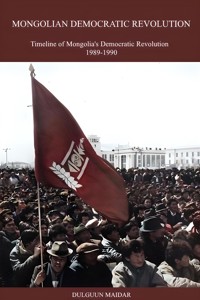
Mongolia's democratic revolution and first democratic election ended 70 years of communist control and ushered in a new period of pluralism from 1989 to 1990. Although the Mongolian People's Revolutionary Party won the election, the ruling party's head, G. Ochirbat, stated that one person's grip of power will not be repeated, and that a coalition government will most likely be created in the nation. The Mongolian Communist Party is divided into various groups. While one group is rejecting change, another is grappling with the need to accelerate political change. Newly created parties, selected their own MPs. This is a wonderful first step in the growth of democracy.
For example, the chairman of American experts stated that there were no abnormalities in the vote's final results. According to British observers, there was no attempt to frighten voters. It might be argued that voters in Mongolia voted for parties rather than particular candidates in this election. The first election in 1990 marked the beginning of democracy in Mongolia, and this book seeks to chronicle events leading up to the election in chronological sequence, from December 1989 to October 1990.
Das E-Book können Sie in Legimi-Apps oder einer beliebigen App lesen, die das folgende Format unterstützen:
Veröffentlichungsjahr: 2023
Ähnliche



















Mongolian Democratic Revolution
Timeline of Mongolia's Democratic Revolution, 1989-1990
Dulguun Maidar
Copyright © 2023 by Dulguun Maidar
All rights reserved.
No portion of this book may be reproduced in any form without written permission from the publisher or author, except as permitted by U.S. copyright law.
This publication is designed to provide accurate and authoritative information in regard to the subject matter covered. It is sold with the understanding that neither the author nor the publisher is engaged in rendering legal, investment, accounting or other professional services. While the publisher and author have used their best efforts in preparing this book, they make no representations or warranties with respect to the accuracy or completeness of the contents of this book and specifically disclaim any implied warranties of merchantability or fitness for a particular purpose. No warranty may be created or extended by sales representatives or written sales materials. The advice and strategies contained herein may not be suitable for your situation. You should consult with a professional when appropriate. Neither the publisher nor the author shall be liable for any loss of profit or any other commercial damages, including but not limited to special, incidental, consequential, personal, or other damages.
Table of Contents
Introduction
Mongolian political situation between December 1989 and April 1990
Mongolian political situation between April 1990 and September 1990
Chronological timeline towards the change and reform of the political system
The first political opposition structure
Prerequisites for transition towards the multi-party system
The multi-party democracy in reality
Timeline of steps to reform the Government structure
Preparatory processes for the first democratic elections
Some changes in the constitution of the highest state authority
Results of the first democratic elections in the country's history
A Few Words about the Democratic Revolution
Photo Section
Acknowledgments
I would like to express my deep gratitude to Ts. Maidar, my father for supporting me to analyze large chunk of historical data. Moreover, I have a deepest gratitude to O. Oyuntsetseg, my mother for the valuable support, in editing and publishing this book.
Introduction
(Mongolia prior to the reform revolution / Critical factors that influenced the political shift)
Since the mid-1980s, favourable conditions of the revolutionary change and reform processes have been forged in Mongolia and it can be rightly said that this was directly influenced by an innovative environment created in the Soviet Union. And it was normal for any events taken place in the Soviet-bloc countries usually replicated like echoes in Mongolia. Due to the efforts of Mikhail Gorbachev, President of the Soviet Union, who intended to revive the stagnant economy and change the political processes in the northern neighbouring country, some new terms like “perestroika”-"restructuring" and “glasnost”-"openness" were heard. Consequently, the meaning and essence of these words attracted Mongolian people and society.
Although new processes were not that consistent with interests of conservative leaders of the Mongolian ruling party, they did not have any “chance” to criticize or reject the innovative theory and practices as they used to follow the "big brother (Russia)" as a rule. The Soviet Union, that led the socialist-bloc countries and acted as a leading force of the world communism evaluated its nearly 70 years of “socialism-building” path in an innovative way by making fundamental changes in identifying the concept of foreign and domestic enemies. Meantime, famous Soviet writer Ch. Aitmatov’s statement at the Congress of People's Deputies of the Union of Soviet Socialist Republics saying that “real socialism can only be found in the countries such as Switzerland, Sweden, and Austria” made Mongolian people re-think and challenge the previous concepts and social beliefs.
Usual efforts were made just to copy or imitate the reorganization in Mongolia in a superficial form, as before. However, under the pressure of time and circumstances, new wave towards changes has been noticed in the press and media through critical articles on the political, economic and social policies. Innovative and critical articles were published on the topics of reviewing and developing history and culture, bringing agriculture out of stagnation, and protecting the environment. For instance, the article "Give Livestock to Herders" published in the “Hudulmur”-“Labour” newspaper, a radio program “Mother-Lake on the Scaffold” criticizing the plan to build a huge phosphorite plant on the shore of Khuvsgul Lake, which may have negative effects on the environment and economy, became “hot topics” of public discussions, demanding participatory policy reform for the common cause.
The ruling Mongolian People's Revolutionary Party recognized the existence of pluralist views in the society and had to support the realistic approach towards the vital and important issues of the country's prosperity. The ruling circles had to review their development agenda and identify priority areas towards improving human capacities, promoting economic reform and potentials, protecting environment, reviving history, culture, and traditional medicine. However, the Mongolian People's Revolutionary Party was too cautious to take significant steps towards changing the stagnant governance and administrative system in the country. Due to the absence of a comprehensive and innovative development concept, the party could not attract and lead the minds of general public towards the expected results, unfortunately.
Most of the laws passed hastily by the party leadership and legislators represented the interests of narrow circles of individuals and due to the lack of coordination; they served creating new ways of bureaucracy rather than changing “old, ineffective legislative mechanism”. These processes could not unfortunately meet the public expectations hoping to change social life and political system in the country. However, the situation continued as such even after the 5th Plenary Session of the Central Committee of the Mongolian People's Revolutionary Party held in 1988.
At the same time, “perestroika” started in the countries of the socialist commonwealth such as the Soviet Union, German Democratic Republic, Poland, Hungary, Czechoslovakia demanding political and economic reform and the pillars of totalitarianism began to shake one after another.
Mongolian political situation between December 1989 and April 1990
At the National Conference of Young Creative Workers held in Ulaanbaatar mid-November 1989, a group of writers and journalists agreed to establish an organization which could intensify economic reform and promote democratization processes in the country. This group decided to invite S. Zorig, 27, politologist and professor of Scientific Communism of the State University, who was undertaking studies on the improvement of the state political system of Mongolia, for the discussion and his advice. They then worked on an action plan for speeding up the political reform processes and S. Zorig was selected to become the key coordinator in implementing this plan.
The political situation in the country since then started changing rapidly. The group decided to create a new political movement called the Mongolian Democratic Union, the first organized opposition to the Mongolian People’s Revolutionary Party, the ruling party for 68 years since the people’s revolution in 1921.
Observing the Human Rights Day, on December 10 the Mongolian Democratic Union organized a rally near the Youth Palace in Ulaanbaatar. Initially, general public considered this group as a youth movement as almost all coordinators were young people in their early 30s. However, very soon, the second, third and fourth rallies were followed and the Mongolian Democratic Union was born by January 1990 as an influential organization with more than 100 branches throughout the country and its membership reached approximately 60,000 persons compared to the ruling party membership of about 90,000.
The first serious confrontation between the ruling party and the opposition occurred when a rally was announced to be held at the Sukhbaatar square in front of the Government House. The Mayor of Ulaanbaatar issued regulations prohibiting public meetings, demonstrations could not be held at several places, including the main square of the city. However, the meeting was held as scheduled because the regulations contradicted to the Constitution. At the meeting, the second opposition force namely, the Mongolian Social Democratic Movement, announced its birth. Initiators of this movement were mainly professors of the State University.
On February 18, 1990 over 600 delegates of the Mongolian Democratic Union gathered at the Central Palace of the Mongolian Trade Unions to hold their first Congress. About 30 foreign correspondents were present at the Congress. Without receiving official visas for Mongolia, the majority of them arrived in Ulaanbaatar as tourists, thus practicing a kind of a “political tourism”.
The following decisions were adopted by the Congress:
Renewal of the Constitution, approval of laws on political parties and freedom of press;
Provision of real freedom of consciousness;
The celebration of the 80th anniversary of independence (In 1911 the Manchu domination was overthrown and the Bogdo-khaan state was established);
Investigations on Yu. Tsedenbal, former state and party leader, and his supporters;
Resignation of the Political Bureau of the Central Committee of the Mongolian People’s Revolutionary Party;
Dissolution of the People’s Great Khural and the election in setting up a Provisional People’s Khural.
Another organization, the Mongolian New Progressive Union, then appeared. Also, at its extraordinary plenary meeting, the Mongolian Students’ Union adopted a resolution on separating from the Mongolian Youth Revolutionary League.
On 4 March, four newly founded political forces held a joint rally. Then they handed over their statement of demands to the state leadership and requested to get response to all their demands by public radio or TV within 3 days:
Hold an Extraordinary Congress of the Mongolian People’s Revolutionary Party in March 1990;
Fully change the Mongolian People’s Revolutionary Party’s Central Committee;
Separate the Mongolian People’s Revolutionary Party from the state;
Set up a Provisional People’s Khural in March of same year.
The official response was provided. However, it was not sufficient. So, 10 Mongolian Democratic Union members announced a hunger strike at Sukhbaatar square at mid-day of the 7th of March, on the eve of the International Women’s Day and 4 days before the Mongolian People’s Revolutionary Party’s Extraordinary Plenary session. The next morning a wife of one of the strikers and a rural dweller from Dornod aimag who learned of this by radio, joined the strike. Soon there were 33 people, lying on a frosty asphalt and surrounded day and night by hundreds of people who held spontaneous rallies and uninterrupted discussions on political situation. In the evening of March 7, the country’s leadership issued a statement criticizing the hunger strike. In response, the strikers demanded immediate resignation of the whole Political Bureau of the Mongolian People’s Revolutionary Party Central Committee. At 4 pm of March 8, a non-working day, D. Byambasuren, Deputy Chairman of the Council of Ministries, came to the square and later in the day D. Sodnom, Chairman of the Council of Ministries who had just returned from his official visit to Japan, had discussions with representatives of the “four forces” and the National Unity Patriotic Front of Mongolia, which was broadcasted directly by the public Radio and TV.
At the same time, 15 economists and lawyers, members of the Mongolian People’s Revolutionary Party, published an official letter to the party leadership in the national daily “Unen”. They demanded a radical change of the party system motivating this by the fact that nearly 50 percent of the members of the Central Committee were people above the pension age and one third had been re-elected since 1975. The opposition group inside the Mongolian People’s Revolutionary Party worked on and published in a newspaper an alternative Charter of the party for nation-wide public discussions.
Since the morning of March 9, the Mongolian People’s Revolutionary Party and opposition forces resumed the discussions. However, the situation started aggravating and became dangerously tense. National radio and TV broadcasted mostly the latest news and on-spot reportages. That day alone, several new political organizations such as the Committee for Defending the Mongolian People’s Revolutionary Party, “The Call of Sukhbaatar” and the Herders’ Union (Bayankhongor aimag) were born. The Mongolian Women’s Committee issued a statement calling to put an end to the strike. Several anti-strike rallies were held and even an “anti-hunger-strike” was about to begin. The Union of Mongolian Students organized a brief “teach-in” reminding that they could continue this on a larger scale. Various gatherings and other actions in support of the hunger strike were about to start at some enterprises. Rallies were held in a number of aimag administrative centres.
In the afternoon of March 9, there were strong rumours that the army was on alert and Martial Law could be introduced at night. That evening the dialogue between four main opposition forces and the Mongolian People’s Revolutionary Party, which was represented by D. Byambasuren, Deputy Chairman of the Council of Ministers, started again on direct TV and radio transmissions.
Finally a compromise agreement was reached as summarized below:
The Politburo members would not resign immediately however, this matter will be included in the agenda of the Plenary Session to be voted by all Central Committee members;
The Mongolian People’s Revolutionary Party Extraordinary Congress will be held as soon as possible, probably in early April, after the end of the breeding season (not in March as it was demanded);
A law on political parties will be discussed at the coming session of the People’s Great Khural (parliament);
The Mongolian People’s Revolutionary Party will suggest the drop from the Constitution all guarantees on Mongolian People’s Revolutionary Party’s leading role in the society;
The Provisional People’s Khural would not be established but a referendum on the trust of the people to the present Parliament members who were regarded by the opposition as not elected but simply appointed by the Mongolian People’s Revolutionary Party, should be held.
The ruling party and four opposition forces, taking part in the “round-table” discussions issued a Political Declaration, addressed to the public. The Declaration noted that the sides would abide by the principle of equality, mutual respect, non-interference in each other’s affairs and non-use of force against each other as well as agreed upon the principle that the ability of political parties and forces to represent public interests shall be determined on the basis of just and democratic elections of state power authorities.
Thus, after three days and 2 nights, in the late evening of March 9, the hunger-strike was ended. The Mongolian Red Cross informed that the health status of all hunger-strikers, except a few who caught a cold, was not seriously affected.
On 12-14 March, the Plenary Session of the Mongolian People’s Revolutionary Party Central Committee was convened and the following decisions were made:
Acceptance of resignation of all Politburo members;
Abandoning of the Constitutional article giving to the Mongolian People’s Revolutionary Party a monopoly right in society;
Exclusion of Yu. Tsedenbal, who led the Mongolian People’s Revolutionary Party and the Mongolian State for over 40 years, from the ranks of the Mongolian People’s Revolutionary Party;
Rehabilitation of high-ranking Mongolian People’s Revolutionary Party functionaries and statesmen who were repressed in the 60s for “nationalism and subversive activity against the party”.
G. Ochirbat, a former party official and trade union leader, 61 years old, who spent last two years at the editorial office of the journal “World Marxist Review” located in Prague, Czechoslovakia, as Mongolia’s representative, was elected as the party leader. A new Politburo team of the Mongolian People’s Revolutionary Party was agreed, composed of only four members namely, Ts. Gombosuren, Foreign Minister, L. Tudev, Editor-in-Chief of the Mongolian People’s Revolutionary Party’s daily “Unen”, T. Oold, Chairman of the Mongolian People’s Revolutionary Party Auditing Committee and N. Mishigdorj, Department Head of the Mongolian People’s Revolutionary Party Central Committee.
On 20 March, the day before the session of the People’s Great Khural, some opposition forces held a rally on the Sukhbaatar square urging to let J. Batmunkh remain as the Chairman of the People’s Great Khural during the transition period until the Parliament elections held in summer of the same year. This was mainly due to the fear that Ts. Namsray, Deputy Chairman of the People’s Great Khural, former Mongolian People’s Revolutionary Party Politburo member, who has been supposedly on the side of those who demanded to put an end to the hunger-strike and manifestations with the use of military force, might assume power. J. Batmunkh, on the contrary, having been a state and a ruling party leader, at this crucial moment in the history of the country, had showed an example of a “stateman’s wisdom” while insisting on peaceful way of regulating the conflict and advising all Politburo members, who lost support of the people, to resign. Participants in the manifestation held slogans:
The People’s Great Khural session was held on 21-23 March and the following decisions were made:
J. Batmunkh, Chairman of the People’s Great Khural Presidium, Ts. Namsray, Deputy Chairman of the People’s Great Khural, Ts. Gotov, Secretary of the People’s Great Khural Presidium were relieved from their posts while, P. Ochirbat, Minister of External Economic Relations and Supplies, Ch. Dashdemberel, 1st Secretary of the Mongolian People’s Revolutionary Party Committee of Khentii aimag and B. Chimid, Department Head of the People’s Great Khural Presidium, were elected as the Chairman, Secretary and Deputy Chairman of the People’s Great Khural Presidium respectively.
D. Sodnom, Chairman of the Council of Ministers, P. Jasray, 1st Deputy Chairman of the Council of Ministers, Chairman of the State Committee for Planning and Economics, Ch. Suren and M. Peljee, both Deputy Chairmen of the Council of Ministers, were replaced by Sh. Gungaadorj, Minister for Agriculture and Food, D. Byambasuren, Deputy Council of Ministers, Dr. K. Zardykhaan, Department Head of the Institute of Social Sciences and B. Sharavsambuu, Minister for Trade and Procurement, respectively. The post of the 4th Deputy Chairman left vacant.
Some Constitutional articles were changed including that provided constitutional guarantees to the Mongolian People’s Revolutionary Party to hold leading positions in the Mongolian society.
The session adopted the following laws on the:
Elections of the Parliament members;
Foreign investment;
The order on the accountability of actions against illegal acts of state management bodies and officials as well as legislative bodies which violate rights of the citizens;
Pensions including members of agricultural cooperatives.
Leaders of the main opposition forces were allowed to attend the session and S. Zorig, General Coordinator of the Mongolian Democratic Union, was even suggested to the post of the Deputy Chairman of the Council of Ministers which was left vacant. Dr. K. Zardykhaan, a new Deputy Chairman of the Council of Ministers, was one of those 15 scholars who initiated an opposition inside the Mongolian People’s Revolutionary Party. D. Byambasuren, 1st Deputy Chairman of the Council of Ministers, Chairman of the State Committee for Planning and Economics, was elected as a Deputy Chairman of the Council of Ministers in December previous year when the democratic movement had just started in the country. Earlier he was a Rector of the Management Institute of Training Senior Executives attached to the Council of Ministers and closely working with the UNDP’s project on the Management Development.
On the first Sunday, following the session of the People’s Great Khural on March 25, a joint rally was organized at the Sukhbaatar square, with over 10 newly founded organizations.
The main demands of the demonstrators were summarized as follows:
Set up a Provisional People’s Khural because a referendum would take too much time;
Expedite the elaboration of a law on political parties, so that an unofficial status of opposition forces should be changed by enabling new parties and unions participate in the forthcoming parliament elections on an equal basis with the Mongolian People’s Revolutionary Party. The recent session was to adopt this law but it was postponed due to the proposal to hold a nation-wide discussion of the draft. The draft law was issued in the national daily “Unen” on the 1st of April;
Separate the media institutions from the Mongolian People’s Revolutionary Party authority, as other political organizations are restricted using media facilities, especially TV and radio airing time.
The People’s Great Khural session was followed by various conferences, sessions and meetings arranged by almost all political and professional organizations, including:
The 7th Extraordinary Conference of the Union of Agricultural Cooperative Farms (March 26-27);
The 1st Conference of the Association of Livestock Breeders and Crop Farmers of Mongolia (March 27);
The 1st Conference of the Union of Production and Service Cooperatives (March 28). P. Jasray, former 1st Deputy Chairman of the Council of Ministers and the Chairman of the State Committee for Planning and Economics, was elected as the President of the Union.
The 1st Conference of the Party of Free Labour (March 29);
The 1st Conference of the Mongolian Social Democratic Party (March 31);
The Plenary Session of the Board of the Union of Mongolian Journalists (March 31);
The Extraordinary Session of the Mongolian Revolutionary Youth League (April 4-5);
The 1st Conference of the Mongolian Democratic Party (April 8);
The Extraordinary Session of the Mongolian People’s Revolutionary Party (April 10-12).
The Extraordinary Session of the Mongolian Women’s Committee, the 1st Conference of the Mongolian National Progressive Party, the Extraordinary Session of the Mongolian Trade Unions, the Extraordinary Session of the Union of Mongolian Journalists, the Extraordinary Session of the Mongolian Society for Nature and Environment Protection, as well as parliament elections are expected to come in a few months.
Numerous new organizations were set up as follows:
The “Gobi” Association (for nature protection and economic development of the region);
The Movement for Supporting the Herders (to give livestock back to herders);
The National Unity Patriotic Front of Mongolia held its constituency meeting on March 10;
Mongolian Union of Believers;
Mongolian Green Movements;
Mongolian Union of Non-Party People;
Mongol Gal Golomt (Hearth) Association;
Forum of “Chingis Khaan’s Hearth”;
Union of Miners;
Union of Mongolian Workers and Engineers;
United Association of Mongolian Auto Transport Workers;
Movement of Reform in Education;
Society of National Language and Culture (Kazakh nationality, Bayan-Olgii aimag);
Team for Cultural Heritage of the Uriankhai Nationality (Bayan-Olgii aimag);
“Biosphere” Association;
Mongolian Society of Disabled Persons;
Union of Young Sukhbaatar Followers;
Civic Movement for Renewing and Strengthening the People’s State (the town of Erdenet);
National Institute of Mongolian Script.
In addition, the Management Institute that trains senior public executives was given a task and responsibilities to provide management skills and theoretical knowledge to new managers and decision-makers at the national level, due to the change of the structure and functions of all ministries and state committees as unprecedented personnel cut is expected under the new structures.
Mongolian political situation between April 1990 and September 1990
The main events that took place between late March and early April
The 1st Conference of the Mongolian Free Labour Party was held, which emphasized the support to the co-operative movement should be the primary focus of the state policy on the socio-economic development. Within two days, the Mongolian Social Democratic Party also held its 1st Conference. Addressing the Conference, party leader Batbayar noted that for the first time in 300 years it was a unique possibility for Mongolians to start deciding their own destinies and pointed out the importance of using “evolutionary” rather than “revolutionary” methods of changing the society.
In early April, the Extraordinary Session of the Mongolian Youth Revolutionary Union started discussing organizational as well conceptual issues and its work ended in early morning of 7 April. Nearly 40 delegates of the session separated with the Union and called upon other Union members to create another youth organization. The session decided to consider the issue of forming a League of youth organizations and adopted a resolution on rejecting funding from state donation in 1991.
The People’s Great Khural Presidium issued a Decree on holding rallies and manifestations making the pertinent city and town authorities to be responsible for issuing permits. Rally organizers were to request permission in writing by stating the reason, duration of rallies, the number of participants, methods to be used, names, families and addresses of organizers as well as its agenda, at least a week before the scheduled day. The authorities have the right to delay the rally by 10 days. In certain cases, the organizers could be detained for 30 days or fined by 500 tugrugs (national currency MNT). The enterprise that loses profit due to a strike or a rally would be charged as well.
The People’s Great Khural Presidium also issued a Decree on restructuring all ministries and state committees. As a result of the measures undertaken, 8 ministries and state committees instead of 12 were set up. Nearly 440 ministerial officials were released and it was decided to provide them with unemployment allowance up to the end of the year which was Mongolia’s first experience of providing an unemployment allowance.
Addressing the 1st Conference (Congress) of the Mongolian Democratic Party, an establishment of a Coalition of Democratic Forces was called upon by Batbayar, Mongolian Social Democratic Party leader. The Coalition was formed including the Mongolian Democratic Union, the Mongolian Democratic Party, the Social Democratic Movement and the Mongolian Social Democratic Party, the Mongolian National Progressive Party as well as the Mongolian Students’ Union.
On the 10th of April, the Extraordinary Session of the Mongolian People’s Revolutionary Party was held. The Session adopted a new Chapter and an Action Plan based on drafts elaborated by the opposition group within the party, and set up a Commission which politically assessed the former “top party and state leaders” who worked with Yu. Tsedenbal for a long period of time.
The Mongolian Democratic Union / Mongolian Democratic Party called upon the State and Government authorities with the following demands:
Set up the People’s Provisional Khural;
Urge the Mongolian People’s Revolutionary Party Central Committee to vacate the Government House and provide the Mongolian Democratic Union / Mongolian Democratic Party with office premises;
Establish the People’s Special Commission to investigate those who worked under the patronage of Yu. Tsedenbal for a long period of time, with participation of all the political parties interested.
The demonstrators participating in a rally before the Government House, at noon of 27 April demanded official response to their claim and alcohol was prohibited until the official response was released.
Around end of April, the Chairman of the Presidium of the People’s Great Khural issued a statement saying that the Mongolian Democratic Union / Mongolian Democratic Party were offered office premises in the centre of the city, in the building of the Editorial Board of MONTSAME News Agency. However, they refused this, due to the fact that the premise required renovation and also it did not have a conference-hall. The statement pointed out that the Mongolian People’s Revolutionary Party’s location will remain in the Government House as it was a ruling party. It also recommended that a rally could not be held on 27 April as it was Friday, a working day.
However, this response was not considered sufficient and a decision to hold a rally remained unchanged. According to the prepared “scenario”, the demonstrators, after gathering in surrounding districts, were to march to the Sukhbaatar square from four directions. On day of the rally, militiamen and soldiers surrounded the Government House. An appeal was made through the loud-speaker from the Government building to end the rally and requested them to go back to work. Later, the provisions of a newly adopted Decree on holding rallies, including the punishment awaiting the rally organizers, were read out. After the provisions were read out several times, thousands of people who gathered at the square started moving towards the guarded line. In spite of protest of the organizers until no space existed between the soldiers who stood only on in line and the masses on the other side. If not Zorig, on the shoulders of the participants, started running to and from across the square, while calling through a loud speaker: “1, 2, 3, … - go back. Again 1, 2, 3, … - …” and then – “Who supports – sit down”, the consequences were unpredictable.
When the tension subsided and the supporters seated, Zorig said that the Decree provisions announced, could be regarded as an attempt to provoke riots which in turn would be a good reason to use the force. He then called on the demonstrators to end the rally. That evening he spoke on the national TV while, noting that he was informed about the armoured carriers that were seen approaching to the city. The State Prosecutor notified the Mongolian Democratic Union / Mongolian Democratic Party indicating the People’s Great Khural’s Decree on violation and the organization of a rally in a working day (the rally organizers were charged to pay a fine or to be detained for the loss of 800 thousand tugrugs’ income by the city enterprises). Information received from Khovd aimag indicated that a Mongolian Democratic Union member had told that they would soon organize a rally to surround the Government building, was the reason of placing special guards. As far as the armed force was concerned, the State Prosecutor pointed out that it was “a real distortion of facts”.
Next day, a meeting without permit was held once again. This time demonstration was held at another square – near the cinema “Yalalt”. The speakers criticized P. Ochirbat’s statement, the State Prosecutor’s notice and pointed out that there was a danger of the army being used by one political force to suppress others. The Decree No 86 was entitled “Bloody Sunday Decree” as it legalized the possibility of suppressing demonstrations and rallies which are usually held on Sundays. For the first time a political cartoon against the head of the state (showing a man with an iron mask) appeared in the streets. The Government statement issued on that day stressed that rally organizers violated provisions No 68, 75, 117, 217 and 239 of the MPR Criminal Code.
During his visit to Selenge aimag on 24 April, P. Ochirbat had a meeting with residents of the aimag center. While answering questions he noted among others that the state should have an “iron face”, a quotation from ancient scripts, and “recommended” the Aimag Prosecutor to investigate a man who misinformed some foreign relations, related matters while asking a question. On 27 April, the Government House was guarded. All these were probably understood by some functionary as a kind of “instructions” for acquiring a hard stand towards the opposition, and on 28 April, basing on Decree No 86 the Huvsgul aimag authorities arrested 8 Mongolian Democratic Union Aimag Branch Co-ordinators at the airport where they came to see off a member of the Mongolian Democratic Union Co-ordinating Council, who was about flying back after participating in a small rally in the aimag center. A decision was taken to detain 4 of them for 20-25 days and others – to be fined by 500 tugrugs. In response, they announced a hunger strike which began at 4 am of 29 April at the main square of the town. Soon the number of strikers increased up to 17 and on 2 May a 100 people “sit in” started. Firstly, local people did not react to this, mainly because of the fact that the May Day festivities were anticipated. However, after 5-6 days when four of the hunger-strikers fell ill and they were forcibly taken to the aimag hospital, thus the problem got exposed among local people.
On the 10th of May, supporting the Huvsgul strikers, the Coalition of Democratic Forces began a 24-hour sit-in on the Sukhbaatar square, Ulaanbaatar. Sit-ins and teach-ins started or announced to be held in the towns Darkhan, Choibalsan, as well as in Khentii, Sukhbaatar and some other aimags. Hunger strikes started in the towns Darkhan and Sukhbaatar. The Coalition also announced that preparing for hunger strike, several people started already “washing their stomach” in Zavkhan aimag, in the town Nalaikh, etc. Leaflets appeared every day. The loud speaker was fixed in one corner of Sukhbaatar square demanding P. Ochirbat, among other things, to delay his visit to China until the situation returns to normal. The Mongolian Herders and Crop Farmers Union called upon to refrain from mass rallies until 1 June which is the end of agricultural work. The National Unity Front of Mongolia, the Mongolian Union of Veterans, the Mongolian Women’s Committee, the Mongolian United Workers Association, the Mongolian Trade Unions, and the Mongolian Peace Committee urged that hunger strike should end because this could destabilize the situation in the country.
The People’s Great Khural’s Secretary read out the People’s Great Khural Presidium’s appeal which noted among others:
The Mongolian Democratic Union / Mongolian Democratic Party demanded to establish a People’s Provisional Khural once again although all political forces agreed in the preceding month that the issue should not be further discussed. The decision was based on the fact that the creation of the People’s Provisional Khural was not possible because the current People’s Great Khural’s mandate was not terminated. The setting up of another state management mechanism would require a referendum on the reliability of those presently working in the parliament.
The Mongolian People’s Revolutionary Party Central Committee will not leave the Government House as it continues to be the ruling party group.
There is no need in founding People’s Extraordinary Council as the Mongolian People’s Revolutionary Party established its own Commission to investigate those who supported plans and activities of Yu. Tsedenbal.
The last Decree No 86 does not contradict the Constitutional provision because it promotes the basic rights, and fully corresponds to provisions No 28, 29, and 30 of the Universal Declaration of Human Rights.
A team of workers of the Flour and Fodder Factory in Darkhan announced their non-stop work until the end of the hunger strike (they worked until 8 May, a total of 125 hours). The Ministry of Heavy Industry employees sent a letter to the newspaper noting that three main demands forwarded seemed to pursue the following goals: firstly, change the current State and party leaders; secondly, set up a new representative management team and thirdly, to restrict the authorities of the Mongolian People’s Revolutionary Party.
To resolve these demands by political means, the Social Democratic Movement / Mongolian Social Democratic Party proposed holding consultations of political parties with Parliamentary authorities. The Mongolian People’s Revolutionary Party, the Mongolian Democratic Party, the Mongolian Social Democratic Party, the Mongolian National Progressive Party, the Mongolian Students’ Union, the Mongolian Free Labour Party and the Mongolian Youth Revolutionary Union participated in a series of consultations, convened several times. And the final one was held on 5 May, Saturday, and was broadcast on TV.
The Mongolian Democratic Party members proposed to postpone the signing agreement by one day as they needed to talk with the strikers in Huvsgul aimag. And the demands proposed by strikers were positively responded as follows:
A set of measures towards creating of the People’s Provisional Khural instead of dissolving the present Parliament was agreed and the proposal to be submitted to the special session of the People’s Great Khural or to the meeting of the People’s Great Khural Presidium. These were aimed at:
Making amendments in the Constitution and in the recently adopted Election Law, forming of the State Small Hural (to elect the State Small Khural members not on the percentage of party mandates in the People’s Great Khural as envisaged in the Draft Law on the Amendments to the Constitution, but on the number of votes received by each party);
Setting up of a Consultative Council at the People’s Great Khural Presidium with participation of the Mongolian People’s Revolutionary Party, Mongolian Democratic Party, Mongolian Social Democratic Party and the Mongolian National Progressive Party representatives and experts of the People’s Great Khural’s Presidium, the Council of Ministers and the Ministry of Legislature and Arbitration. Other political parties were announced able to take part in its work;
Including representatives of all officially registered political parties in the central and constituency election commissions.
Issues of establishing, the People are Special Commission and of changing the Decree No 86 were decided to be discussed at the Consultative Council meetings.
The parties agreed not to hold rallies and manifestations until the formation of new state and governmental bodies, expressing their “strong belief” that the forthcoming People’s Great Khural session would not reject recommendations with regards to the election of the State Small Khural when the Amendments to the Constitution to be discussed.




