


35,49 €
Mehr erfahren.
- Herausgeber: Allen & Unwin
- Kategorie: Lebensstil
- Sprache: Englisch
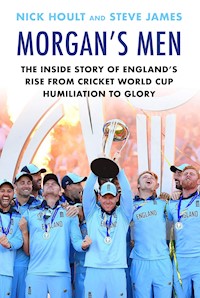
From English cricket's embarrassing failure at the 2015 World Cup to their heart-stopping victory four years later, Nick Hoult and Steve James vividly describe the team's dramatic journey from abject disappointment to finally lifting the trophy. Morgan's Men reveals how the team became the most aggressive limited-overs side in the world, led by their inspirational captain Eoin Morgan, whose vision and determination to succeed captured the imagination of the nation. Hoult and James follow England's journey from Bangladesh to Barbados, from Melbourne to Manchester, to present the inside story of the team's rebirth. They tell us how players dealt with the Ben Stokes court case, the sacking of Alex Hales for a drugs ban, and reveal the innovative new strategies and tactics that helped them become the best in the world, culminating in a World Cup final that was arguably the greatest one-day match of all time.
Das E-Book können Sie in Legimi-Apps oder einer beliebigen App lesen, die das folgende Format unterstützen:
Veröffentlichungsjahr: 2020
Ähnliche



















MORGAN’S MEN
NICK HOULT AND STEVE JAMES
MORGAN’S MEN
THE INSIDE STORY OF ENGLAND’S RISE FROM CRICKET WORLD CUP HUMILIATION TO GLORY
First published in Great Britain in 2020 by Allen & Unwin
Copyright © Nick Hoult and Steve James, 2020
The moral right of Nick Hoult and Steve James to be identified as the authors of this work has been asserted by them in accordance with the Copyright, Designs and Patents Act of 1988.
All photographs courtesy of Getty Images
All rights reserved. No part of this book may be reproduced or transmitted in any form or by any means, electronic or mechanical, including photocopying, recording or by any information storage and retrieval system, without prior permission in writing from the publisher.
Allen & Unwinc/o Atlantic BooksOrmond House26–27 Boswell StreetLondon WC1N 3JZ
Phone: 020 7269 1610Fax: 020 7430 0916Email: [email protected]: www.allenandunwin.com/uk
A CIP catalogue record for this book is available from the British Library.
Hardback ISBN 978 1 91163 093 7E-Book ISBN 978 1 76087 483 4
Printed in
10 9 8 7 6 5 4 3 2 1
CONTENTS
1 Fine Margins
2 From Rock Bottom to Revolution
3 Courage, Unity, Respect
4 Pushing the Boundaries
5 Enter Jofra
6 Fumbles, Fines and Frustration
7 Roy Lays His Ghosts to Rest
8 Root, the Walking Gluestick
9 Morgan Senses His Destiny
10 Crashing Back Down to Earth
11 Squeaky Bum Time
12 Bulletproof Bairstow
13 Fate Plays Its Hand
14 You English Have Won Nothing Yet
15 Ecstasy by the Barest of Margins
16 The Celebrations
Statistics
Acknowledgements
Index
To Bethan Amy James, daughter of Steve and Jane and sister of Rhys, who died aged just 21 in February 2020. Such a beautiful, kind and caring girl taken so early. She wanted to be a journalist like her dad.
ONEFINE MARGINS
THE WORLD CUP FINAL – ENGLAND V. NEW ZEALAND
LORD’S, LONDON
14 July 2019
Sunday, 14 July 2019 dawned grey and overcast in north-west London. Umbrellas were required for those arriving early at Lord’s for this the 12th Cricket World Cup final, the fifth at the grand old ground and the first there since 1999. But the forecast promised ever better weather throughout the day, and there was going to be a new name on the trophy by its end, with England in their fourth final and their first since 1992. New Zealand were beaten by Australia in their one final appearance in the previous tournament in 2015.
So, the frisson was understandable, but nobody could ever have envisaged what levels of excitement would be seen before that trophy finally was presented just after 8pm.
Because of the dampness, with the rain having only just stopped, the start was delayed by 15 minutes from its scheduled 10.30am slot. Once the covers had been removed, a green-looking pitch was revealed, although England captain Eoin Morgan, a Lord’s veteran, having only played his county cricket for Middlesex, had said the day before that its looks could be deceiving. ‘From afar, it looks greener than it is,’ he said. ‘There isn’t a lot of grass on it.’ He knew that would be bad news for his big hitters and good for New Zealand. It levelled the playing field between the two sides. Home advantage was significantly reduced now.
Speaking on the popular BBC Tailenders podcast, broadcast live from the ground that morning, England Test bowler James Anderson was adamant that it was a morning on which to bowl first.
The old adage at Lord’s when assessing what to do at the toss has always been to look up rather than down – in other words, take more notice of the skies above (it was still cloudy when Sky Sports’ Nasser Hussain gathered Morgan and Kane Williamson, the New Zealand captain, together with Sri Lankan match referee Ranjan Madugalle for the toss) than the pitch down below.
The further complication was that England had built a reputation in the previous four years for being supreme chasers. But this tournament had challenged that thinking considerably. A combination of the slow pitches and the pressures of the tournament meant that batting first had become ever more fashionable.
What to do? There was much to consider. The decision at the toss here at Lord’s was always going to be tricky.
Morgan tossed the coin, and Williamson called tails. It fell as tails. Williamson elected to bat, but he admitted some ‘confusion’.
‘It was a tough decision,’ he said. ‘If you look at the surface, I think it is a bat-first surface, but then you look up above and that brings in a bit of confusion.’
England were going to bowl. Just. Asked if he was disappointed to lose the toss, Morgan said: ‘No, not at all. It was a bit of a 50–50 call. It is always difficult here at Lord’s with the overheads.’
In the England dressing room, team performance analyst Nathan Leamon was happy. ‘Oh, thank God,’ he said. England had got what they wanted without the pressures of inserting the opposition.
‘We thought the wicket would get stodgier as the game went on, and we also knew that the first ten overs were going to be very difficult, so we were trying to make a decision that took New Zealand’s easiest routes to victory off the table,’ said Leamon to The Times after the final. ‘But we were on a knife edge. If the sun was shining, we were going to bat, and if it was cloudy, we were going to bowl. So, it was almost the perfect outcome. We didn’t have to decide, and we got to do what we wanted to do anyway. The idea of having got the decision wrong in a World Cup final and that affecting how the game went was not something I wanted to have to go through.’
And Morgan admitted afterwards to Sky Sports that it was a decision that took up too much of his time on that morning. ‘It took up so much of my head space,’ he said. ‘And it normally doesn’t.’
The first ten overs were going to be crucial. New Zealand’s openers had had a poor tournament up until that point. Martin Guptill was the leading run scorer at the 2015 tournament but was having a shocker here, while the left-handed Henry Nicholls had only been brought into the side after Colin Munro had failed to deliver and was dropped.
When in the third over Nicholls was adjudged lbw to Chris Woakes without scoring, it could have been a rather predictable tale. But Nicholls reviewed the decision by the Sri Lankan Kumar Dharmasena, who was not exactly the most reliable of the umpires in the tournament, and the ball was shown to be going over the top of the stumps.
Guptill, having survived a vociferous caught behind appeal off Jofra Archer in the second over – a brilliant piece of umpiring from South African Marais Erasmus, who saw that the ball had brushed the batsman’s back trouser pocket rather than bat – began to show signs of his aggressive best with an uppercut six over third man off Archer and then a drive down the ground for four in the fourth over after advancing down the pitch to the same bowler. It felt as though the first wheel was coming off.
At this moment Andrew Strauss, the director of England cricket at the start of this England team’s four-year plan in 2015 but now at the game working for Sky Sports, arrived in the writers’ section of the Lord’s press box. ‘Just hope that this is not the day Guptill comes off,’ remarked a member of the media to him in a moment when making conversation prompted a departure from impartiality to patriotism.
Calm as anything Strauss replied: ‘Just relax, there is nothing we can do about it up here.’ It was a fair point. It was also why he was such a fine captain of England, although even the excitement must have got to him by the day’s end.
Guptill soon went for 19, leg-before to Woakes, who bowled yet another probing opening spell, in a tournament full of them from him, of seven overs for just 19 runs. Guptill then wasted his side’s only review by referring his decision upstairs. It was plumb.
As Guptill walked off up the stairs into the Lord’s pavilion, Hussain remarked on the television commentary: ‘His tournament with the bat comes to an end.’ Nobody in his or her right mind could ever have thought that that statement would then be proved wrong later in the day. But then this was not going to be any normal day.
For New Zealand to end the opening powerplay of ten overs at 33 for one represented something of a triumph for them, though. Nicholls and Williamson, who took 12 balls to get off the mark, slowly and carefully built an important partnership.
In pulling Liam Plunkett for four, Nicholls moved to 31 and to his highest score of the tournament. His tenacity and grit epitomised the Kiwi spirit in these most high-pressured of circumstances. Plunkett, such an important bowler for Morgan, struggled in his opening spell as nerves looked to be taking hold.
The outfield might have been lightning fast, but this was not a belter of a pitch. Like so many in this tournament, it was a little too slow and a little too easy for the ball to linger in the surface rather longer than any batsman wishing to drive through the line of the ball would ever want.
The New Zealand score passed 100 in the 22nd over, and England desperately needed a wicket. Step forward Plunkett, who had swapped ends after his first three overs from the Pavilion End had gone for 19.
‘As soon as I came up the hill [from the Nursery End] I felt comfortable attacking the crease, it felt a lot better,’ Plunkett said afterwards.
Plunkett’s fourth ball was to Williamson and, as is so often his style, was held across the seam. It was pitched on a good length, but Williamson viewed it as being fuller than that and drove at it. It went through to wicketkeeper Jos Buttler, and, as he took it, Plunkett and the rest of the England team appealed demandingly. Umpire Dharmasena was unmoved.
Not out, he decided.
England reviewed immediately.
The edge seemed obvious and was soon proven as much. Williamson, a rock amongst Kiwi batting sandcastles for so much of the tournament (he was the fourth-highest run scorer overall with 578 runs at an average of 82.57 and had scored a staggering 30 per cent of New Zealand’s runs before the final), was gone for 30 from 53 balls. It was a huge wicket for England, and a huge moment.
‘Kane is a massive player, and to get a crucial wicket is what I do pride myself on. So, it was nice to get that,’ said Plunkett. ‘I tried to get as much out of the pitch with my variations as I could. That’s my role. I use the cross-seam ball more than the seam-up.’
Nicholls passed his half-century off 71 balls in the 26th over, with a single off the leg spin of Adil Rashid, who was bowling a decent spell from the Pavilion End. Indeed, in eight overs Rashid conceded just one boundary, a heave over wide mid-on for four by Williamson.
But Plunkett soon snared Nicholls as well with another cross-seamed delivery, with Nicholls bowled off the inside edge for 55 from 77 balls, so that the bowler had taken two for five in 14 balls, and the New Zealand innings suddenly took on a very different look.
This was gripping stuff. Lord’s was rapt. Trafalgar Square was too, with a big screen being watched by many thousands of fans. It was a wonderful advertisement for cricket, with the final also being shown on UK free-to-air television, after Sky, whose considerable investment in the game had contributed in no small way to England reaching this final, had allowed Channel 4 to screen it, the first time a live England international had been on that platform since the 2005 Ashes. And it attracted a peak viewership of 8.3 million. What a match this was for this expansion of the game’s audience to see.
It was a remarkable sporting day in general, with the men’s tennis final also taking place at Wimbledon, where Novak Djokovic eventually beat Roger Federer in what would turn out to be the longest final in the tournament’s history. Meanwhile, Lewis Hamilton was also winning a record sixth British Grand Prix at Silverstone.
Back at the cricket, by the time 30 overs had been bowled, New Zealand had reached 126 for three. It did not look an especially threatening platform from which to launch their push for a big score, but this was classic New Zealand: workmanlike and unfussy, crafting and grafting their way to a workable total. It was what they had done to India when shocking them in the semi-final at Old Trafford. There they had made just 239 for eight after electing to bat first, and then India had failed by 18 runs.
New Zealand were not going to break any run-scoring records again here, but they were damned determined to make a score that would test England. That has always been New Zealand cricket’s way: to make the very most of what they have, however unflashy it might appear.
Chasing in a World Cup final on a sticky pitch is the ultimate test of a one-day-international side. More so for a team at home that had entered the tournament as favourites, courtesy of their no. 1 world ranking. New Zealand were really going to investigate the true extent of England’s mettle here.
‘We sort of wanted 250, 260. We knew that it wasn’t easy,’ said Williamson afterwards. Given that totals of over 250 had only been successfully chased down twice in the tournament before this final (Bangladesh in making 322 for three to beat West Indies and India in surpassing Sri Lanka’s 264 for seven), it was not a bad aim.
Ross Taylor, in at no. 4, did not last long, however. The 35-year-old veteran, in his fourth World Cup, had made a vital 74 in the semi-final but scored just 15 here, adjudged leg-before to Mark Wood, who, though expensive in conceding 23 runs from his four overs, had bowled like the wind in his first spell from the Nursery End. He had hit 95mph at one stage and equalled (at 95.69mph to be exact) the fastest ball of the tournament, alongside Jofra Archer and Australia’s Mitchell Starc, and had swung the ball sharply.
Now Wood returned from the Pavilion End. As with Plunkett swapping ends earlier, this was more shrewd captaincy from Morgan. Wood’s first ball was again fast – 90mph – and nipped back into the right-handed Taylor down the slope.
Wood often falls over after delivering the ball, but not this time. Instead he was soon squatting with arms in the air pleading for the leg-before decision. Umpire Erasmus granted him his wish, but for once – he was the umpire of the tournament in many observers’ eyes – he was wrong. It looked high upon first viewing, and this was proven to be the case by subsequent replays, but because Guptill had already burned New Zealand’s only review, Taylor did not have the opportunity to use them. He walked off ruefully, but without any histrionics or any words of anger. He took it remarkably well.
To rub salt into the wound, Wood then changed to around the wicket to the new batsman, the left-handed Jimmy Neesham, and proceeded to bowl five dot balls. He had bowled a wicket maiden in the 34th over! It ended up as the only maiden of the innings.
Along with another southpaw, the wicketkeeper Tom Latham, Neesham set about guiding New Zealand towards that competitive total that they so desired. Neesham is strong on the leg side and was soon launching Ben Stokes for two fours in the 35th over to that side of the field.
Latham, a good enough batsman to have made 264 not out in a Test match, was another to have had a poor tournament up to this point, with his only score above 13 being the 57 he had made against England at Durham in the group stage. But he was another to rise to this grandest of occasions. He was especially quick onto the short ball, pulling Plunkett for a four that was so nearly a six and then later going the whole hog with a six off Wood over straightish deep mid-wicket, which, following Guptill’s earlier effort, was the second maximum of the innings.
Latham also played one glorious extra-cover drive for four off Wood, and Neesham had just cut Plunkett for four when, from the very next ball, he tried to loft the same bowler over mid-on but was caught by the fielder, Joe Root, positioned there. New Zealand were 173 for five at the end of the 38th over. It really was a struggle, but a wonderfully gripping struggle.
Wood continued to push his body to the limit – so much so that with three balls to go of his last over he suffered a side strain that, along with a knee condition that required an operation, kept him out for the rest of the season – as the speedometer kept going above 90mph. The fielding continued to dazzle, with Jonny Bairstow, despite a groin injury sustained while batting in the semi-final victory over Australia, throwing himself around the boundary edge as only a supreme athlete of his standing could. It was not bad work for the Test wicketkeeper.
Plunkett finished his allocation of ten overs with two dot balls to the new batsman, Colin de Grandhomme. He had taken three wickets for just 42. He brought his hands together as if to say that his prayers had been answered and then gave a thumbs up to his colleagues, who began to shout their congratulations. He took his cap from umpire Dharmasena and walked down to third man at the Nursery End, where he received a standing ovation. What a moment it was for the 34-year-old. He had certainly done his job.
Jofra Archer now returned at the Pavilion End. His third ball, timed at 87mph, was top-edged onto his helmet by de Grandhomme, a sharp reminder, in every sense, of the threat Archer had posed throughout the tournament with his pace and hostility. It hit the batsman hard. But de Grandhomme, a Zimbabwean by birth and upbringing, whose late father Laurie was a no-nonsense off-spinning all-rounder for the country before Test status came their way, is a tough man and was soon wearing a wry smile after undergoing the now mandatory concussion test.
Not that New Zealanders ever lack toughness, of course. The sight of former All Black hooker Sean Fitzpatrick, the utter epitome of that quality on a rugby field, sitting in the Lord’s crowd was a reminder of that.
England did not relent in their use of the short ball, with de Grandhomme being struck on the back as he tried to avoid another bouncer from Wood (timed at 91mph), with the ball flying off over wicketkeeper Buttler for four leg byes.
De Grandhomme is known as a decent player of the short ball but it simply did not look like it here against the brilliant Archer. Missing Archer’s slower-ball bouncer (timed at 74mph) – again hitting de Grandhomme on the back – did not present quite as much danger, but the fast bowler’s mixture of pace (two consecutive bouncers later in the over were bowled at 80 and 88mph respectively) was just so difficult for the batsmen to set up to hit.
Slower-ball bouncers are a very modern invention. Some of the old-timers chuckle and maintain that they were merely called long-hops back in the day, but they are only long-hops in today’s game if there is very little difference between their pace and those short balls delivered at full speed. Then a batsman can set himself for the slower one and know there is no danger of being hit by the quicker one. That is simply not possible with Archer. The physical threat is very real. Prime yourself for the slower one and you could be setting yourself up for a horrible ending if it happens to be the quick bouncer that is sent down.
Archer would bowl five overs on the trot at the death here, a significant ask for any bowler, let alone a 24-year-old who had only made his international debut just a few months previously. He would concede just 22 runs in those five overs – having gone for only 20 in his opening spell of five – and in the final over of the innings he would also take the wicket of Matt Henry.
Wood finished his ten overs with one for 49, but was in obvious pain because of the side injury. He should really have left the field there and then – and Jason Roy gestured for him to do so – but this was a World Cup final. It was not a stage that could be left easily. Wood understandably did not want to go. He remained on for two more overs, but then had to admit to the reality of the situation. It was no place for the injured – throwing is not easy with a side strain – even if we had not seen the last of this whole-hearted player for the day.
With four overs of the innings remaining, and New Zealand’s score standing at 214 for five, James Vince arrived as Wood’s fielding replacement. Vince was soon into the action. Chris Woakes returned to the attack, and his fifth ball was a slower off-cutter that de Grandhomme attempted to whip to the leg side. The leading edge looped gently to Vince at mid-off. De Grandhomme was gone for 16 from 28 balls. It had been hard work for him.
Latham began the 49th over by going a long way across his stumps to Woakes and attempting to swing to leg. England’s appeal for leg-before was turned down by Dharmasena, and the subsequent review confirmed that the ball had indeed pitched outside leg stump.
Latham had advanced to 47 from 56 balls when the substitute Vince was again in the action as he took a second catch at mid-off, from another slower Woakes off-cutter, which this time was a low full toss. The next ball, to Mitchell Santner, was of the much higher – and much more dangerous – variety, a beamer in fact, that was suitably punished by a call of no ball and therefore a free hit to come.
Woakes’s last ball was smashed over mid-wicket for four by Henry, but the bowler still finished with the hugely impressive figures of three for 37 from his nine overs and, remarkably, Archer’s over, the last of the innings, went for just three, including that wicket of Henry, bowled trying to heave away on the leg side.
The final ball of the innings was a bouncer, a slower-ball bouncer no less, and, unfathomably, Santner, the bespectacled left-hander, ducked underneath it. He might have been hoping for a wide to be called. He might have just had a brain fade. But would that be critical later on?
It is easy to look back on these small moments and extrapolate their significance to later in the match. In the 49th over there were five wides when a Woakes slower-ball bouncer to Latham went way down the leg side, and on its second bounce, which turned sharply, it defeated keeper Jos Buttler, who was trying to stop it with his pads. Four fewer runs to chase might have been quite handy for England later on.
New Zealand finished on 241 for eight. In a bilateral series you suspect that England would have quite fancied chasing that. But in a World Cup final was it enough for the New Zealanders? Opinions, unsurprisingly, were divided.
‘If you had offered that to Eoin Morgan at the start of the day, he would have bitten your hand off, I really believe that,’ said Andrew Strauss on Sky Sports. ‘If England are not bowled out, they will win this.’
‘It’s enough,’ argued the former New Zealand captain Brendon McCullum. ‘The wicket is wearing. If Trent Boult takes some wickets up front, then I think the captaincy of [Kane] Williamson will squeeze this middle order of England’s.’
Even in the England dressing room there was some mixed reaction. Coaches Trevor Bayliss and Chris Silverwood said the side had done well to restrict New Zealand to 241 and told them they would knock them off the runs if they batted well. The bowlers weren’t so sure.
As for Eoin Morgan, he said afterwards: ‘I thought it was a very chaseable total.’
Well, Trent Boult very nearly did take a wicket up front, as McCullum had hoped. He almost took the wicket of Jason Roy from the very first ball of England’s innings. Bowling from the Pavilion End, Boult swung the ball sharply down the slope, the ball crashing into the knee roll of Roy’s front pad. It looked out. But umpire Marais Erasmus rejected the appeal, and Kane Williamson reviewed almost immediately.
It was so close. The ball pitched in line. The ball hit Roy in line, but, agonisingly for the New Zealanders, it was only deemed as an ‘umpire’s call’ on where the ball was hitting the stumps.
‘I am almost speechless,’ said the quite brilliant Kiwi commentator Ian Smith on television. ‘I can’t believe that. I cannot believe it.’
It was another huge moment on this huge day. There were jitters in evidence everywhere. At the second ball of the second over of the innings, a good-length delivery bowled by Matt Henry, Roy drove hard and so nearly had his stumps tickled by a ball that nipped back up the slope. The next ball moved in the other direction down the slope and kicked off a length. Roy was nowhere near it. The ball was talking as much as the New Zealanders. ‘This is going to be fun,’ chuckled Smith.
Roy’s response? He decided to skip down the pitch next ball, if only to defend. Two balls later he played the most gorgeous on-drive for four. What cricket. What tension.
Jonny Bairstow was off the mark with a fortuitous insideedged single off Boult, who then ‘nutmegged’ Roy with a beautiful inswinging yorker that somehow missed the stumps too. Roy replied with a cover-driven four. Punch and counter-punch. With the sun now shining, this was fascinating and utterly engrossing cricket. There was fortune, but there was also tremendous skill being shown by both sides.
By the end of the fifth over, England were 24 without loss, the identical score that New Zealand had at the same stage. It was to be that sort of afternoon and evening.
New Zealand deserved a wicket, and in the sixth over they got it, as Henry dismissed Roy for 17 with a beauty of a ball. It was pitched on a good length and moved away from the batsman down the slope, with Roy unable to do anything more than edge behind for wicketkeeper Tom Latham to take a good low catch.
Joe Root arrived. He stayed some considerable time but did not score too many runs. In fact, he made just seven from 30 balls. The ball before he was out, he ran down the pitch and had a horrible slog at Colin de Grandhomme. He missed. He then drove wildly at a wide length ball to edge behind.
Root later described it as ‘the worst innings of my professional career’. It was certainly uncharacteristic, and it underlined both the difficulties of the pitch and the pressures under which England were batting. For a gifted batsman, who had played his entire career behind a paywall on Sky, this was a missed opportunity to showcase his talents to a wider audience.
De Grandhomme had been introduced as first change from the Pavilion End, bowling a maiden immediately in between two maidens from Henry, whose initial seven overs cost just 22. Three consecutive maidens! What was happening to England?
De Grandhomme’s nibbling medium pacers, unusually for ones so modest in pace, with the wicketkeeper standing back from the stumps (at least until Ben Stokes and Jos Buttler started advancing down the pitch later in his spell), were fabulously frugal on this surface. He might have snared Bairstow too on 18 had he taken the relatively simple return catch, but he ended up bowling his full allocation straight through, bowling another maiden (to Stokes) and finishing with the astounding figures of 10-2-25-1. Of those who bowled more than 50 overs in the tournament, he finished as the most miserly with an economy rate of 4.15.
‘He basically replicated what Tim Murtagh does here on a regular basis in County Championship cricket [and then did for Ireland in the Test against England just ten days later, with five for 13 in the first innings],’ said Eoin Morgan on Sky Sports. ‘He was extremely difficult to get away.’
It was time for a captain’s innings. But Morgan’s appearance at the crease, unsurprisingly given some previous travails with the short ball in the tournament, coincided with the introduction of New Zealand’s fastest bowler, Lockie Ferguson, who had bowled only one over before Morgan arrived. Ferguson regularly touched 90mph and often, predictably, tested Morgan with the short ball, once clipping his helmet as the left-handed Irishman turned his head away, and on another occasion even defeating keeper Latham such was the pace and bounce of his bumper.
But it was the wicket of Bairstow that Ferguson took first, persuading the opener to inside-edge onto his stumps for 36 from 55 balls. It was a familiar mode of dismissal for Bairstow, although his bottom-handed jabs away from the body can be mightily effective too, and indeed one of them had brought a majestic four through the covers just the ball before.
Morgan could easily have been caught at deepish midoff from de Grandhomme in the 24th over, and, like Root, he never really got going. He made nine from 22 balls. And it was indeed Ferguson who got rid of him, but not as the bowler. Instead, Ferguson, so recognisable in his black boots, took a catch for the ages on the deep-cover boundary, running in and diving forwards at full stretch after Morgan had slapped Jimmy Neesham’s very first ball, which was wide and short, in his direction.
As Morgan hit the ball he screamed ‘No!’ He knew it was going to Ferguson and not the boundary as intended. He knew the importance of this period of the game. He knew he had made a mistake to a poor ball. His side were 86 for four in the 24th over.
Jos Buttler joined Ben Stokes at the wicket. This was the game, surely.
‘We knew we just had to bat some time,’ Buttler said afterwards. ‘In one-day cricket recently, that hasn’t been the mode of operation. But we knew if we batted for 50 overs, we should be there or thereabouts.’
Sky’s win percentage predictor had it at 51–49 in England’s favour at this moment, and that was about how it felt. It was going to be tight, so tight.
‘I was distraught about getting out,’ said Morgan. ‘But I took my pads off, and I was sitting there trying to devise a plan and think how it would look in ten overs’ time. And the best possible scenario was that Buttler and Stokes were still there in ten overs’ time.’
The pair began conservatively, as you would expect. This was no time for frippery, or indeed undue aggression. By the middle of the 26th over, the required run rate had, for the first time, crept up to a run a ball: 147 runs required from 147 balls.
Today’s players playfully mock the old guard who recount tales of six-an-over being the top of the mountain in run chases. Anything above that was indeed often insurmountable. But this, with the pitch always asking awkward questions and the burden of history chipping in with some even weightier queries, was an old-school run chase. It required nous and character more than power and abandon. Risks had to be calculated carefully, and Stokes took one such successfully in running down the pitch to Neesham and smashing the ball back past him. When Buttler then decided to go aerial, to the very last ball of de Grandhomme’s spell, he needed some luck as the ball flew off the outside edge down to, but just short of, third man.
With 20 overs remaining, England still required 127. Stokes had been circumspect, making 18 from 38 balls. Buttler, who despite that edge off de Grandhomme had timed the ball probably better than any other batsman in the match, had made 13 from 15 balls.
Mitchell Santner’s jerky left-arm spin was afforded three overs, and they only cost 11 runs. Both he and his captain Williamson would have been extremely happy with that, especially with such an inventive player of spin as Buttler at the crease. It was almost as if Santner had bowled those overs without anyone noticing.
Buttler had a little more fortune when, in the 32nd over, his carve off Trent Boult just evaded Martin Guptill’s grasp at backward point and sped away for four. After 35 overs, England were 141 for four, requiring 101 runs at a rate of 6.73. The win predictor was swaying in their favour at 62 per cent.
Moments later, on 25, Buttler was rapped on the pads by Matt Henry as he looked to play to the leg side. Umpire Dharmasena ruled it not out, but Williamson reviewed. This was crucial. Williamson knew the value of Buttler’s wicket. The immediate impression was that the ball was slipping down the leg side, and that was confirmed by the technology. Buttler was not out.
The run rate required was on the rise, however, now going over seven for the first time. Though Stokes was beginning to find run scoring easier, it was Buttler who was still playing the more eye-catching strokes, hitting Jimmy Neesham down the ground in the air for four and then, more outrageously, ramping Henry for four down to fine leg, even if there was a man stationed there. The fielder was simply too wide.
Lord’s was starting to find its voice now, with the noise to greet that Buttler straight four being quite extraordinary. Just by dint of its tradition and the character and age range of the members it attracts – which is not a criticism, just a statement of fact – it is never going to possess an atmosphere like the raw raucousness the summer would later experience when Stokes played his miracle Ashes innings at Headingley, for example, but this was an occasion when it was very different from its norm. The ground was loud and buzzing now. The tension and the magnitude of the prize on offer saw to that.
England needed 72 off the last ten overs. Stokes had 43 from 68 balls, Buttler 42 from 45 balls. But only 13 runs came from the next three overs. The required run rate was now up to 8.42.
However, while England were desperate for a few more runs, so New Zealand were also desperate for a wicket. A summit meeting ensued between Williamson, Ross Taylor and wicketkeeper Tom Latham. The upshot was that Trent Boult’s left-armers were recalled. A wicket please, Trent, they pleaded.
On the flip side, Buttler sensed that it was time to up the tempo. Boult had his mid-off fielder up, and Buttler, always so strong just wide of mid-off because of both the natural shape of his stroke and also a head position that tilts slightly to the off side, decided that was his area to target, even if the resultant four eventually went more over extra cover. It took Buttler past his fifty, off just 53 balls, a truly incredible rate of scoring on this pitch and on this occasion. The celebration was muted, as it was later in the same over when Stokes passed his half-century too, this time off 81 balls. The milestones did not matter. There was a World Cup to be won.
Buttler hit a Lockie Ferguson full toss over extra cover for four, but three balls later he was gone, having made 59 from 60 balls, caught superbly by substitute Tim Southee diving forwards out on the cover boundary. The partnership had been 110.
The dismissal changed everything. ‘I thought we were in trouble,’ said Eoin Morgan. ‘We needed something.’
With the greatest respect to the incoming batsman, Chris Woakes, it was down to Stokes. No pressure, Ben. Just the burden of England never having won a global 50-over trophy.
England’s plan, as articulated by Buttler, had clearly been, in the modern parlance, to take the game as deep as they could, but that will always be rendered useless unless one or two of the batsmen who have taken it deep are still there. ‘I was disappointed we weren’t both there at the end to finish it off,’ admitted Buttler. In fact, he was a little more than disappointed. Apparently, he spent some time punching the physio’s couch in frustration at not having seen the chase through.
‘I was berating myself for getting out,’ Buttler told the Mail on Sunday. ‘I wanted to be there at the end. I’d had a quiet few games with the bat, and I felt this was my time and that maybe it was meant to be.
‘Every dot ball I would kick something. And then I thought: “This isn’t really helpful for the guys who are waiting to bat.”
‘You go through all the emotions: “Oh my God, we are going to lose, and I am going to have the rest of my life thinking about that.” Then Stokesy would hit a four or a six, and you are thinking: “We could actually do this, and how good would that be.”’
England needed 46 from the last five overs. The pitch was so slow now as to be funereal. This was why Williamson had opted to bat first. This was the situation on which he had been banking.
Stokes’s flicked four to the leg side from the last ball of Jimmy Neesham’s over meant it was then 39 required from four overs. Woakes needed to play some shots too, but he was out to the first ball of the 47th over, looking to hit Ferguson’s cross-seam ball away on the leg side and only skying to the keeper Latham.
Liam Plunkett walked out to bat. The run rate was rising and in the England dressing room there were people hiding behind chairs. Mark Wood apparently felt sick.
Plunkett almost immediately clubbed Ferguson over midwicket for four. Plunkett can strike a cricket ball, but this was an extraordinary shot in the circumstances.
Now it was 34 off three required. What a finale. And what a cricketer England had at the crease in Stokes. He was already absolutely shattered, as well as shouldering the responsibility of a cricketing nation, but the first ball of the 48th over, from Boult, was smashed into the leg side for four.
Plunkett hit two twos in that over, with Stokes having to summon every last drop of his incredible stamina to run each of them. At the end of the over, Stokes was down on his haunches in the middle of the wicket attempting to gather some more air. He could barely speak to his partner. He had made 62 off 89 balls at this stage. It was truly heroic stuff.
With two overs to go, and Plunkett on strike, England needed 24 to win the World Cup. After one ball of that 49th over, and a single off Neesham for Plunkett, commentator Ian Smith first mentioned the prospect of a Super Over should there be a tie. ‘A Super Over is still possible,’ he said. Yeah right, never going to happen, said everyone else. England had only tied six one-day internationals in their entire history, for goodness’ sake, even if two of them – against Australia in 2005 and India in 2011 – had occurred at Lord’s. There had only previously been four ties in World Cup matches too, even if England were involved in one of them, against India in 2011. The chances of a tie happening in a World Cup final at Lord’s? Come on.
From the third ball of the over, Plunkett was caught at long-off by Boult. But the batsmen had crossed. Jofra Archer came out, but Stokes was on strike. England needed 22 off nine balls. They needed a six really. They had needed one or two of them for a while. So, what did Stokes do? He only went and hit a six, sweep–slogging Neesham’s slower ball out towards wide long-on.
It required some good fortune. Coming around from long-on, Boult caught the ball, but, having done so, he trod on the boundary rope. Only then did he throw it to Martin Guptill, who was waiting nearby. If Boult had got rid of the ball immediately, Stokes would surely have been gone, and with it England’s World Cup chances too. It was another huge moment in a game studded with them.
It will be of no consolation whatsoever to Kiwi fans to point out that, previously in this tournament, Boult had taken a similar catch to dismiss West Indies’ Carlos Brathwaite and seal victory in an agonisingly tight group match. Guptill sportingly signalled with his arms that it was six as soon as he had received the ball. Stokes signalled it too, having initially, upon hitting the ball, given the impression that he was a goner, and then umpire Marais Erasmus raised his arms as well.
As Jonny Bairstow said: ‘I did think the game had gone. But it ebbs and flows, doesn’t it? I said to Nathan [Leamon], our analyst, with seven overs to go: “We need three sixes here.”’
That was the first of them.
Stokes took a single, leaving Archer to face the last ball of the over. It was another slower ball from the back of the hand from Neesham, and Archer slogged at it, missed it and was bowled.
England were eight wickets down with 15 needed from the final over. Stokes was on 70 from 92 balls. He could barely move he was so tired. The bowler was the left-armer Boult. The non-striker was Adil Rashid.
‘I would have had the Kiwis as big favourites,’ admitted Eoin Morgan afterwards. ‘Simply because Ben needed to face a lot of the balls, and it was against one of the best bowlers in the world. The angle a left-armer creates when he is accurate makes it difficult to get away.’
The first ball was a yorker that Stokes could only squeeze out to extra cover. No run. Fifteen needed from five balls now. The second ball was similar, full and wide outside off stump. Again, Stokes could only hit it to extra cover. No run again. Fifteen off four balls. This was only going one way. New Zealand’s way. England could not win from here, could they?
So, what did Stokes do now? Only hit another six, the second of those demanded by Bairstow all those overs ago. This time Boult could not quite find the yorker, and Stokes used the length to go down on one knee and sweep–slog the ball high over deep mid-wicket and onto the fence at the bottom of the Mound Stand. It was the sort of shot you play to a spinner, not a bowler of Boult’s pace. Not in a World Cup final. It was extraordinary. Stokes admitted it was the first time he had played a slog–sweep to a quick bowler. What a time to do it.
The crowd went bananas. Yes, even the Lord’s crowd went bananas. The scenes were incredible. It is fair to say that even the press box, supposed to be that haven of impartiality, objectivity, cynicism and reserved reaction, was becoming a little animated and noisy too.
On the cricket writers’ WhatsApp group, it is usual around this time of an international day for suggestions to be made to Danny Reuben, England’s hugely popular and highly effective head of team communications, as to whom the press corps might like to speak to at the post-match press conference. It was at this moment that one of the more mischievous of the group sent a message, reading: ‘Farby tonight?’
There were some chuckles at that. It was a reference to Paul Farbrace, the personable and likeable coach who had been an assistant to this England team until just before the World Cup, when he joined Warwickshire as their director of sport. During his time with the squad, he was often brought out to talk to the press on the really quiet days. This was not a quiet day. It was a day the like of which none of us had ever seen before and may never see again.
It was difficult not to feel some sympathy for Farbrace. He had been there right at the start, taking over as interim coach for England’s first ODI series against New Zealand in 2015 before Trevor Bayliss arrived. He had played a huge part. But he was not here now. Farbrace was actually listening to the last hour of the match on his car radio. He had been at Chelmsford watching Warwickshire’s County Championship match against Essex, and he was driving back to his rural home outside Birmingham. He arrived there just as both sides were about to complete their 50 overs. Little did he, or any of us, know what would happen next.
This was ridiculous, truly ridiculous now. Nine runs were needed from just three balls.
Cricket suddenly entered the realms of fantasy, because what happened next is still so difficult to believe. The ball bowled was a full toss. Stokes hit it out to deep mid-wicket, where Guptill was the fielder. Stokes and Rashid simply had to run two. Stokes came haring back for that second, and Guptill, sensibly given Stokes’s state of fatigue, threw to his end, the wicketkeeper’s end, even if it meant a much longer throw. It was going to be close to a run-out, close enough for Stokes to have to dive to make his ground.
As Stokes dived, so the ball arrived too, hitting his outstretched bat – right in its middle (‘It’s the only one I middled all day,’ Stokes may or may not have whispered in jest later on) – and sped away to the boundary under the pavilion, with Colin de Grandhomme chasing vainly after it.
‘I do not believe what I have just seen,’ screamed Ian Smith on the television commentary.
Stokes, still on his knees with his shirt dirtied from the dive, immediately raised his hands in apology. What had happened had been completely unintentional. He did not even look at the throw. He certainly did not change the direction of his run or the position of his bat. It was simply a freakish accident.
‘I said to Kane Williamson I’ll be apologising for that for the rest of my life,’ said Stokes afterwards. ‘I have apologised countless times for that fluke. It’s not how you want to get them.’
The irony was not lost on anyone. Here was Stokes, born in New Zealand, apologising to a group of New Zealanders for something that could easily now cost them the World Cup. ‘Playing against New Zealand is always a great event. They are a seriously good team and really good lads,’ said Stokes.
Stokes was even nominated for the New Zealander of the Year award after the final. He turned it down. He said he was ‘flattered’ and ‘proud’ of his New Zealand and Maori heritage, but that ‘it would not sit right’. Just like these runs, but he had to accept them. Cricket’s laws demanded so.
It was with typical magnanimity and calm that Kane Williamson said the overthrows were ‘unfortunate’ for his team. ‘I don’t wish to nitpick. I just hope it never happens in such moments ever again,’ said Williamson. You suspect many other captains, nay, most other captains, would have reacted rather differently. Williamson truly is a gentleman of our game, a wonderful guardian of its values and principles.
There was talk in some quarters that Stokes had asked for the four overthrows to be taken off England’s score, but that was simply not true. Had the ball not reached the boundary, of course, the batsmen would not have taken any extra runs. That is cricket’s etiquette. But it is also one of cricket’s laws that the runs must stand if the ball does cross the boundary. The only way England could benefit from the bat deflection was the ball reaching the boundary.
So it was that umpire Kumar Dharmasena signalled with the four fingers and thumb of his right hand, along with the thumb of his left hand, that it was six runs.
The England dressing room exploded in a flurry of excitement and noise. It had been exceptionally quiet up until that point. Players just could not watch. Most thought they were dead and buried. Jos Buttler was on his haunches. Jason Roy was on a table. Suddenly players were shouting things like: ‘Come on, you ginger ninja!’ The atmosphere had changed.
And Bairstow had his wish. ‘When Stokesy dived and it deflected for four, that was the third six,’ he said. ‘Then we [Bairstow and Leamon] looked at each other and went: “OK, we’ve got our three sixes!”’
After the match, it became clear that only five rather than six runs should have been given, that a horrible mistake had been made by the umpires. The claim came first from Simon Taufel, the Australian former umpire. Taufel said that, according to Law 19.8, which relates to overthrows, the second run should not have counted because Stokes and Rashid had not crossed when Guptill released his throw from the boundary.
‘They should have been awarded five runs, not six,’ said Taufel. ‘It’s a clear mistake. It’s an error of judgement. In the heat of what was going on, [the umpires] thought there was a good chance the batsmen had crossed at the instant of the throw. Obviously, TV replays showed otherwise.
‘The difficulty you [umpires] have here is you’ve got to watch batsmen completing runs, then change focus and watch for the ball being picked up, and watch for the release [of the throw]. You also have to watch where the batsmen are at that exact moment.’
Nobody even mentioned this at the time. Nobody, not even gnarled old veterans of the game, even thought about it. Most did not know that the laws were written like that.
Eoin Morgan had an inkling, though. ‘I probably thought it was five, not six, naturally,’ he said. ‘But I didn’t celebrate. I was still trying to work out what was going on. When the replay came up, I could not believe what I was seeing. I could not believe what had just happened.’
Dharmasena, who confirmed that Stokes did not ask for the four runs to be deducted, later admitted his error. ‘I made a judgemental call after consulting my colleague Marais Erasmus,’ he said in an interview with the Sri Lankan newspaper The Island. ‘It was like calling a no ball or a wide, and I couldn’t consult the third umpire. I was 100 per cent sure that the batsmen had crossed. I admit that I was wrong. I will never regret the decision I made.’
It was outrageously fortunate for England, outrageously unfortunate for New Zealand. But it is not something that will ever be altered now. And it does have to be said that England would, of course, have played very differently if they had had one run fewer going into the final two balls, even if Rashid had then been facing.
But with the decision made as it was, England now needed three runs from two balls. There was a lengthy delay. The umpires were conferring while Stokes was trying to regain his breath and composure. Then Williamson went to speak to Boult about his field.
It was pandemonium around the ground. People were seen praying. Some just could not watch. And all the while, on the England players’ balcony, captain Morgan was sitting with his cap on, arms folded and visage impassive.




