


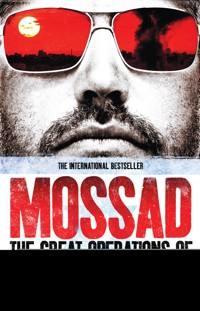
Erhalten Sie Zugang zu diesem und mehr als 300000 Büchern ab EUR 5,99 monatlich.
- Herausgeber: The Robson Press
- Kategorie: Fachliteratur
- Sprache: Englisch
Mossad is universally recognised as the greatest intelligence service in the world. It is also the most enigmatic, shrouded in a thick veil of secrecy. Many of its enthralling feats are still unknown; most of its heroes remain unnamed. From the kidnapping of Eichmann in Argentina and the systematic tracking down of those responsible for the Munich massacre to lesser-known episodes of astonishing espionage, this extraordinary book describes the dramatic, largely secret history of Mossad and the Israeli intelligence community. Examining the covert operations, the targeted assassinations and the paramilitary activities within and outside Israel, Michael Bar-Zohar and Nissim Mishal detail the great stories of Mossad and reveal the personal tales of some of the best Mossad agents and leaders to serve their country.
Sie lesen das E-Book in den Legimi-Apps auf:
Seitenzahl: 684
Veröffentlichungsjahr: 2012
Das E-Book (TTS) können Sie hören im Abo „Legimi Premium” in Legimi-Apps auf:
Ähnliche


















Dedications
CONTENTS
Title Page
Dedications
Introduction: Alone, in the Lion’s Den
1. King of Shadows
2. Funerals in Tehran
3. A Hanging in Baghdad
4. A Soviet Mole and a Body at Sea
5. “Oh, That? It’s Khrushchev’s Speech …”
6. “Bring Eichmann Dead or Alive!”
7. Where Is Yossele?
8. A Nazi Hero at the Service of Mossad
9. Our Man in Damascus
10. “I Want a MiG-21!”
11. Those Who’ll Never Forget
12. The Quest for the Red Prince
13. The Syrian Virgins
14. “Today We’ll Be at War!”
15. A Honey Trap for the Atom Spy
16. Saddam’s Supergun
17. Fiasco in Amman
18. From North Korea with Love
19. Love and Death in the Afternoon
20. The Cameras Were Rolling
21. From the Land of the Queen of Sheba
Epilogue: War with Iran?
Acknowledgements
Bibliography and Sources
Index
Copyright
INTRODUCTION
ALONE, IN THE LION’S DEN
On November 12, 2011, a tremendous explosion destroyed a secret missile base close to Tehran, killing seventeen Revolutionary Guards and reducing dozens of missiles to a heap of charred iron. General Hassan Tehrani Moghaddam, the “father” of the Shehab long-range missiles, and the man in charge of Iran’s missile program, was killed in the explosion. But the secret target of the bombing was not Moghaddam. It was a solid-fuel rocket engine, able to carry a nuclear missile more than six thousand miles across the globe, from Iran’s underground silos to the U.S. mainland.
The new missile planned by Iran’s leaders was to bring America’s major cities to their knees and transform Iran into a dominant world power. The November explosion delayed the project by several months.
Even though the target of the new long-range missile was America, the explosions that destroyed the Iranian base were probably set by the Israeli Secret Service, Mossad. Since its inception more than sixty years ago, Mossad has served fearlessly and secretly against the dangers threatening Israel and the West. And more so than ever before, Mossad’s intelligence gathering and operations affect American security abroad and at home.
Right now, according to foreign sources, Mossad is challenging the blunt, explicit promise of the Iranian leadership to obliterate Israel from the map. Waging a stubborn shadow war against Iran by sabotaging nuclear facilities, assassinating scientists, supplying plants with faulty equipment and raw materials via bogus companies, organizing desertions of high-ranking military officers and major figures in nuclear research, introducing ferocious viruses into Iran’s computer systems, Mossad allegedly is fighting the threat of a nuclear-armed Iran, and what that would mean for the United States and the rest of the world. While Mossad has delayed the Iranian nuclear bomb by several years, their covert battle is reaching its peak, before last-resort measures—a military strike—are employed.
In the fight against terrorism, Mossad has been capturing and eliminating scores of major terrorists in their strongholds in Beirut, Damascus, Baghdad, and Tunis, and in their battle stations in Paris, Rome, Athens, and Cyprus since the 1970s. On February 12, 2008, according to the Western media, Mossad agents ambushed and killed Imad Mughniyeh, the military leader of Hezbollah, in Damascus. Mughniyeh was a sworn enemy of Israel, but he was also number one on the FBI’s Most Wanted list. He had planned and executed the massacre of 241 U.S. Marines in Beirut. He had left behind a bloody trail strewn with hundreds of Americans, Israelis, French, and Argentineans. Right now, Islamic Jihad and Al Qaeda leaders are being hunted throughout the Middle East.
And yet, when Mossad warned the West that the Arab Spring could turn into an Arab Winter, no one seemed to listen. Throughout 2011, the West celebrated what they believed was the dawning of a new era of democracy, freedom, and human rights in the Middle East. Hoping to obtain the approval of the Egyptians, the West pressured President Mubarak, its strongest ally in the Arab world, to step down. But the first crowds that swept Tahrir Square in Cairo burned the American flag; then they stormed the Israeli embassy, demanded the end of the peace treaty with Israel, and arrested American NGO activists. Free elections in Egypt have brought the Muslim Brotherhood to power, and today, Egypt wavers on the brink of anarchy and economic catastrophe. A fundamentalist Islamic regime is taking root in Tunisia, with Libya likely to follow. Yemen is in turmoil. In Syria, President Assad is massacring his own people. The moderate nations like Morocco, Jordan, Saudi Arabia, and the Emirates of the Persian Gulf feel betrayed by their Western allies. And the hopes for human rights, women’s rights, and democratic laws and rule that inspired these landmark revolutions have been swept away by fanatic religious parties, better organized and better connected with the masses.
This Arab Winter has turned the Middle East into a time bomb, threatening the Israeli people and its allies in the Western world. As history unfolds, Mossad’s tasks will become riskier but also more vital to the West. Mossad appears to be the best defense against the Iranian nuclear threat, against terrorism, against whatever may evolve from the mayhem in the Middle East. Most important, Mossad is the last salvo short of open war.
The unnamed warriors of Mossad are its lifeblood, men and women who risk their lives, live away from their families under assumed identities, carry out daring operations in enemy countries where the slightest mistake can bring their arrest, torture, or death. During the Cold War, the worst fate for a secret agent captured in the West or the Communist bloc was to be exchanged for another agent on some cold, foggy bridge in Berlin. Russian or American, British or East German, the agent always knew he was not alone, there was always someone who would bring him back from the cold. But for the lonely warriors of Mossad, there are no exchanges and foggy bridges; they pay with their lives for their audacity.
In this book, we bring to light the greatest missions and the most courageous heroes of Mossad, as well as the mistakes and failures that more than once tarnished the agency’s image and shook its very foundations. These missions shaped Israel’s fate and, in many ways, the fate of the world. And yet, for Mossad agents, what they all share is a deep, idealistic love of their country, a total devotion to its existence and survival, a readiness to assume the most dramatic risks and face the ultimate dangers. For the sake of Israel.
CHAPTER ONE
KING OF SHADOWS
In the late summer of 1971, a fierce storm was lashing the Mediterranean coast, and tall waves battered the shores of Gaza. The local Arab fishermen prudently stayed ashore; this was not a day to brave the treacherous sea. They watched with astonishment as a ramshackle boat suddenly emerged from the roaring waves and landed heavily on the wet sand. A few Palestinians, their clothes and keffiyehs rumpled and soaked, jumped out and waded ashore. Their unshaven faces showed the fatigue of a long journey at sea; but they had no time to rest, they were running for their lives. From the angry seas, an Israeli torpedo boat emerged, pursuing them at full speed, carrying soldiers in full battle attire. As it approached the shore, the soldiers jumped into the shallow waters and opened fire on the fleeing Palestinians. A couple of Gazan youngsters, playing on the beach, ran toward the Palestinians and led them to the safety of a nearby orchard; the Israeli soldiers lost track of them but continued to search the beach.
Late that night, a young Palestinian man carrying a Kalashnikov snuck into the orchard to investigate. He found the fugitives huddled together in a remote corner. “Who are you, brothers?” he asked.
“Members of the Popular Front for the Liberation of Palestine,” came the answer. “From the Tyre refugee camp, in Lebanon.”
“Marhaba, welcome,” the youth said.
“You know of Abu-Seif, our commander? He sent us to meet with the Popular Front commanders in Beth Lahia (a terrorist stronghold in the south of the Gaza strip). We have money and weapons, and we want to coordinate our operations.”
“I’ll help you with that,” the young man said.
The following morning, several armed terrorists escorted the newcomers to an isolated house inside the Jabalia refugee camp. They were led into a large room and invited to sit at a table. Soon after, the Popular Front commanders they hoped to meet walked in. They exchanged warm greetings with their Lebanese brothers, and sat, facing them.
“Can we start?” asked a stocky, balding young man wearing a red keffiyeh, apparently the leader of the Lebanese group. “Is everybody here?”
“Everybody.”
The Lebanese raised his hand and looked at his watch. It was a prearranged signal. Suddenly, the “Lebanese envoys” drew their handguns and opened fire. In less than a minute, the Beth Lahia terrorists were dead. The “Lebanese” ran out of the house, made their way through the crooked alleys of the Jabalia camp and Gaza’s crowded streets and soon crossed into Israeli territory. That evening, the man with the red keffiyeh, Captain Meir Dagan, commander of the Israeli Defense Forces’ (IDF) secret Rimon commando unit, reported to General Ariel (Arik) Sharon that Operation Chameleon had been a success. All the leaders of the Popular Front in Beth Lahia, a lethal terrorist group, had been killed.
Dagan was only twenty-six, but already a legendary fighter. He had planned the entire operation: posing as Lebanese terrorists; sailing in an old vessel from Ashdod, a port in Israel; the long night of hiding; the meeting with the terrorist leaders; and the escape route after the hit. He had even organized the fake pursuit by the Israeli torpedo boat. Dagan was the ultimate guerrilla, bold and creative, not someone who stuck to the rules of engagement. Yitzhak Rabin once said: “Meir has the unique capacity to invent antiterrorist operations that look like movie thrillers.”
Future Mossad chief Danny Yatom remembered Dagan as a stocky youngster with a mane of brown hair, who had applied to join the most prestigious Israeli commando unit, Sayeret Matkal, and amazed everybody with his knife-throwing skills. With his huge commando knife, he could hit dead-on any target he chose. Although he was an excellent marksman, he failed the Sayeret Matkal tests and initially had to content himself with the silver wings of a paratrooper.
In the early seventies, he was sent to the Gaza strip, which had been conquered by Israel in the 1967 Six-Day War and had since become a hornet’s nest of deadly terrorist activity. The Palestinian terrorists murdered Israelis daily in the Gaza strip and in Israel with bombs, explosives, and firearms; the IDF had all but lost their control over the violent refugee camps. On January 2, 1971, when the Arroyo children, the five-year-old Avigail and the eight-year-old Mark, were blown to pieces when a terrorist threw a hand grenade into their car, General Ariel (Arik) Sharon decided he had to put an end to the bloody massacre. He recruited a few old friends from his battle-scarred youth, along with several talented younger soldiers. Dagan was one, a round-faced, short, sturdy officer who walked with a limp—he stepped on a land mine in the Six-Day War. While recuperating in the Soroka Hospital in Beer-Sheva, he had fallen in love with his nurse, Bina. They married when he recovered.
Sharon’s unit officially did not exist. Its mission was to destroy the terrorist organizations in Gaza using risky and unconventional methods. Dagan used to wander occupied Gaza with a cane, a Doberman, several pistols, revolvers, and submachine guns. Some claimed to have seen him disguised as an Arab, leisurely riding a donkey in the treacherous Gaza alleys. His infirmity didn’t cool his determination to carry out the most dangerous operations. His views were simple. There are enemies, bad Arabs who want to kill us, so we have to kill them first.
Within the unit, Dagan created “Rimon,” the first undercover Israeli commando unit, which operated in Arab disguise deep in enemy strongholds. In order to move freely in Arab crowds and reach their targets undetected, they had to operate in disguise. They quickly became known as “Arik’s hit team” and rumors had it that they often killed captured terrorists in cold blood. Sometimes, it was said, they escorted a terrorist to a dark alley, and told him: “You’ve got two minutes to escape”; when he tried, they shot him dead. Sometimes they would leave behind a dagger or a gun, and when the terrorist reached for it, he would be killed on the spot. Journalists wrote that, every morning, Dagan would go out to the fields, use one hand for peeing and the other for shooting at an empty Coke can. Dagan dismissed such reports. “There are myths that stick to all of us,” he said, “but some of what’s written is simply false.”
The tiny unit of Israeli commandos were fighting a tough, cruel war, risking their lives daily. Almost every night Dagan’s people donned women’s or fishermen’s disguises and went in search of known terrorists. In mid-January 1971, posing as Arab terrorists in the north of the Strip, they lured Fatah members into an ambush, and in the gunfight that erupted, the Fatah terrorists were killed. On January 29, 1971, this time in uniform, Dagan and his men traveled in two jeeps to the outskirts of the Jabalia camp (a Palestinian refugee camp). Their paths crossed with a taxi, and Dagan recognized, among its passengers, a notorious terrorist, Abu Nimer. He ordered the jeeps to stop and his soldiers surrounded the cab. Dagan approached, and at that moment Abu Nimer stepped out, brandishing a hand grenade. Staring at Dagan, he pulled its pin. “Grenade!” Dagan shouted, but instead of scrambling for cover, he jumped on the man, pinned him, and tore the grenade from his hand. For that action he was awarded the Medal of Courage. It’s been claimed that after tossing away the grenade, Dagan killed Abu Nimer with his bare hands.
Years later, in a rare interview with Israeli journalist Ron Leshem, Dagan said: “Rimon wasn’t a hit team … It was not the Wild West, where everybody was trigger-happy. We never harmed women and children … We attacked people who were violent murderers. We hit them and deterred others. To protect civilians, the state needs sometimes to do things that are contrary to democratic behavior. It is true that in units like ours the outer limits can become blurred. That’s why you must be sure that your people are of the best quality. The dirtiest actions should be carried out by the most honest men.
Democratic or not—Sharon, Dagan, and their colleagues largely annihilated terrorism in Gaza, and for years the area became quiet and peaceful. But some maintain that Sharon half-jokingly said of his loyal aide: “Meir’s specialty is to separate the head of an Arab from his body.”
Yet very few knew the real Dagan. He was born Meir Huberman in 1945 in a train car, on the outskirts of Herson, in the Ukraine, while his family was escaping from Siberia to Poland. Most of his family had perished in the Holocaust. Meir immigrated to Israel with his parents and grew up in a poor neighborhood in Lod, an old Arab town about fifteen miles south of Tel Aviv. Many knew him as an indomitable fighter; few were aware of his secret passions: an avid reader of history books, a vegetarian, he loved classical music and pursued painting and sculpting as hobbies.
He was a man haunted from an early age by the terrible suffering of his family and the Jews during the Holocaust. He dedicated his life to the defense of the newborn State of Israel. As he climbed the army hierarchy, the first thing he did in every new office he was assigned to was to hang on the wall a large photo of an old Jew, wrapped in his prayer shawl, kneeling in front of two SS officers, one holding a bat and the other a gun. “This old man is my grandfather,” Dagan would tell visitors. “I look at the picture, and I know that we must be strong and defend ourselves so that the Holocaust never happens again.”
The old man, indeed, was Dagan’s grandfather, Ber Ehrlich Slushni, who was murdered in Lukov a few seconds after the photograph was taken.
During the Yom Kippur War, in 1973, Dagan was among the first Israelis to cross the Suez Canal in a reconnaissance unit. In the 1982 Lebanon War, he entered Beirut at the head of his armored brigade. He soon became the commander of the South Lebanon security zone, and there the adventurous guerrilla fighter reemerged from the starched colonel’s uniform. He resurrected the principles of secrecy, camouflage, and deception of his Gaza days. His soldiers came up with a new name for their secretive chief. They called him “King of Shadows.” Life in Lebanon, with its secret alliances, betrayals, cruelty, phantom wars, was a place after his own heart. “Even before my tank brigade entered Beirut,” he said, “I knew this city well.” And after the Lebanon war ended, he did not give up his secret adventures. In 1984 he was officially reprimanded by Chief of Staff Moshe Levy for hanging out, dressed as an Arab, by the Bahamdoun terrorist headquarters.
During the Intifada (the Palestinian rebellion of 1987–1993), when he was transferred to the West Bank as an adviser to Chief of Staff Ehud Barak, Dagan resumed his old habits and even convinced Barak to join him. The two of them donned sweat suits, found a baby-blue Mercedes with local plates, and went for a ride in the treacherous Nablus Kasbah. On their return, they scared and then astonished the Military Headquarters sentries, once the latter recognized who was sitting in the front seat.
In 1995, Dagan, now a major general, left the army and joined his buddy Yossi Ben-Hanan on an eighteen-month motorcycle journey across the Asian plains. Their trip was cut short by the news of Yitzhak Rabin’s assassination. Back in Israel, Dagan spent some time at the head of the antiterrorist authority, made a halfhearted attempt to join the business world, and helped Sharon in his Likud electoral campaign. Then, in 2002, he retired to his country home in Galilee, to his books, his records, his palette, and his sculptor’s chisel.
Thirty years after Gaza, a retired general, he was now getting acquainted with his family—“I suddenly woke up and my kids were grown-ups already”—when he got a phone call from his old buddy, now prime minister, Arik Sharon. “I want you at the head of Mossad,” Sharon said to his fifty-seven-year-old friend. “I need a Mossad chief with a dagger between his teeth.”
It was 2002 and Mossad was losing steam. Several failures in the preceding years had dealt severe blows to its prestige; the much-publicized failure to assassinate a major Hamas leader in Amman and the capture of Israeli agents in Switzerland, Cyprus, and New Zealand had seriously damaged Mossad’s reputation. The last head of Mossad, Efraim Halevy, didn’t live up to expectations. A former ambassador to the European Union in Brussels, he was a good diplomat and a good analyst, but not a leader and not a fighter. Sharon wanted to have at the head of Mossad a bold, creative leader who would be a formidable weapon against Islamic terrorism and the Iranian reactor.
Dagan was not welcomed at Mossad. An outsider, focused mostly on operations, he didn’t care very much about learned intelligence analyses or secret diplomatic exchanges. Several top Mossad officers resigned in protest, but Dagan didn’t much care. He rebuilt the operational units, established close working relations with foreign secret services, and busied himself with the Iranian threat. When the second, disastrous Lebanon War erupted in 2006, he was the only Israeli leader who objected to the strategy based on massive bombardments by the air force. He believed in a land offensive, doubted the air force could win the war, and came out of the war unblemished.
Still, he was much criticized by the press for his tough attitude toward his subordinates. Frustrated retired Mossad officers, ran to the media with their gripes, and Dagan was under constant fire. “Dagan Who?” scribbled one popular columnist.
And then, one day, the headlines changed. Flattering articles loaded with superlatives filled the daily papers, lauding “the man who restored honor to Mossad.”
Under Dagan’s control, Mossad had accomplished the heretofore unimaginable: the assassination of Hezbollah’s mad killer Imad Mughniyeh in Damascus, the destruction of the Syrian nuclear reactor, the liquidation of key terrorist leaders in Lebanon and Syria, and, most remarkable of all, a relentless, ruthless, and successful campaign against Iran’s secret nuclear weapons program.
CHAPTER TWO
FUNERALS IN TEHRAN
On July 23, 2011, at four thirty P.M., two gunmen on motorcycles emerged on Bani Hashem Street in South Tehran, drew automatic weapons out of their leather jackets, and shot a man who was about to enter his home. They vanished after the killing, long before the arrival of the police. The victim was Darioush Rezaei Najad, a thirty-five-year-old physics professor and a major figure in Iran’s secret nuclear weapons program. He had been in charge of developing the electronic switches necessary for activating a nuclear warhead.
Rezaei Najad was not the first Iranian scientist who had recently met a violent end. Officially, Iran was developing nuclear technology for peaceful purposes, and they claimed that the Bushehr reactor, an important source of energy built with Russian help, was proof of their good intentions. But in addition to the Bushehr reactor, other clandestine nuclear facilities had been discovered, all heavily guarded and virtually inaccessible. Over time, Iran had to admit the existence of some of these centers, though they denied allegations of developing weapons. But by then, Western secret services and local underground organizations had exposed several major scientists in Iran’s universities who had been tapped to build Iran’s first nuclear bomb. In Iran, what could only be identified as “unknown parties” waged a brutal war to stop the secret nuclear weapons program.
On November 29, 2010, at seven forty-five A.M., in North Tehran, a motorcycle emerged from behind the car of Dr. Majid Shahriyari, the scientific head of Iran’s nuclear project. As he passed the car, the helmeted motorcyclist attached a device to the car’s rear windshield. Seconds later, the device exploded, killing the forty-five-year-old physicist and wounding his wife. Simultaneously, in Atashi Street in South Tehran, another motorcyclist did the same to the Peugeot 206 of Dr. Fereydoun Abassi-Davani, another major nuclear scientist. The explosion wounded Abassi-Davani and his wife.
The Iranian government immediately pointed its finger at Mossad. The roles these two scientists played in Iran’s atomic weapons project were veiled in secrecy, but Ali Akbar Salehi, the head of the project, declared that the attack had made a martyr of Shahriyari and deprived his team of its “dearest flower.”
President Ahmadinejad, too, expressed his appreciation of the two victims, in an ingenious way: as soon as Abassi-Davani recovered from his wounds, Ahmadinejad appointed him Iran’s vice president.
The men who attacked the scientists were not found.
On January 12, 2010, at seven fifty A.M., Professor Masoud Ali Mohammadi came out of his home at Shariati Street, in the Gheytarihe neighborhood in North Tehran. He was on his way to his lab at the Sharif University of Technology.
When he tried to unlock his car, a huge explosion rocked the quiet neighborhood. The security forces that rushed to the scene found Mohammadi’s car shattered by the blast and his body blown to pieces. He had been killed by an explosive charge, concealed in a motorcycle that was parked by his car. The Iranian media claimed that the assassination had been carried out by Mossad agents. President Ahmadinejad declared that “the assassination reminds us of the Zionist methods.”
Fifty-year-old Professor Mohammadi was an expert in quantum physics and an adviser to the Iranian nuclear weapons program. European media reported he had been a member of the Revolutionary Guards, the pro-government parallel army. But Mohammadi’s life, like his death, was shrouded in mystery. Several of his friends maintained that he was involved only in theoretical research, never with military projects; some also claimed that he supported the dissident movements and had participated in antigovernment protests.
Yet it turned out that about half of those present at his funeral were Revolutionary Guards. His coffin was carried by Revolutionary Guard officers. Subsequent investigations ultimately confirmed that Mohammadi, indeed, had been deeply involved in advancing Iran’s nuclear ambitions.
In January 2007, Dr. Ardashir Hosseinpour was allegedly killed by Mossad agents with radioactive poison. News of the assassination ran in the Sunday Times in London, citing information from the Texas-based Stratfor strategy and intelligence think tank. Iranian officials ridiculed the report, claiming that Mossad could never carry out such an operation inside Iran, and that “Professor Hosseinpour suffocated by inhaling fumes during a fire in his home.” They also insisted that the forty-four-year-old professor was only a renowned electromagnetic expert and not involved with Iran’s nuclear endeavors in any way.
But it turned out that Hosseinpour worked at an Isfahan secret installation where raw uranium was converted into gas. This gas was then used for uranium enrichment by a series (“cascades”) of centrifuges in Natanz, a faraway, fortified underground installation. In 2006, Hosseinpour was awarded the highest Iranian prize for science and technology; two years earlier, he had been awarded his country’s highest distinction for military research.
The assassinations of Iranian nuclear scientists were just one front in a much larger war. According to the Daily Telegraph in London, Dagan’s Mossad had rolled out an assault force of double agents, hit teams, saboteurs, and front companies and brought their strength to bear over years and years of covert operations against Iran’s nuclear weapons program.
Stratfor’s director of analysis, Reva Bhalla, was quoted as saying: “With cooperation from the United States, Israeli covert operations have focused both on eliminating key human assets involved in the nuclear program and in sabotaging the Iranian supply chain.” Israel, she claimed, had used similar tactics in Iraq in the early eighties, when Mossad killed three Iraqi nuclear scientists, thus hampering the completion of the Osiraq atomic reactor, near Baghdad.
In its purported war against the Iranian nuclear program, Dagan’s Mossad was effectively delaying the development of an Iranian nuclear bomb for as long as possible, and thereby thwarting the worst danger to Israel’s existence since its creation: Ahmadinejad’s threats that Israel should be annihilated.
Yet these small victories cannot atone for the worst mishap in Mossad’s history—its failure to expose Iran’s secret nuclear project at its outset. For several years now Iran had been building its nuclear might—and Israel had no clue. Iran invested huge sums of money, recruited scientists, built secret bases, carried out sophisticated tests—and Israel had no idea. From the moment Khomeini’s Iran decided to become a nuclear power, it used deception, ruses, and stratagems that made fools out of the Western secret services, Mossad included.
Iran’s shah, Reza Pahlavi, started building two nuclear reactors, both for peaceful and military purposes. The shah’s project, begun in the 1970s, didn’t cause any alarm in Israel; at the time, Israel was Iran’s close ally. In 1977, General Ezer Weizman, Israel’s defense minister, hosted General Hasan Toufanian, who was in charge of modernizing Iran’s army, in the Ministry of Defense in Tel Aviv—as allies, Israel supplied Iran with modern military equipment. According to the minutes of their confidential meeting, Weizman offered to supply Iran with state-of-the-art surface-to-surface missiles, while the director general of the ministry, Dr. Pinhas Zusman, impressed Toufanian by saying that the Israeli missiles could be adapted to carry nuclear warheads. But before the officials could act on their plans, the Iranian revolution transformed Israeli-Iranian relations. The revolutionary Islamic government massacred the shah’s supporters and turned against Israel. The ailing shah escaped from his country as it fell under Ayatollah Khomeini’s control and into the hands of his loyal mullahs.
Khomeini put an immediate end to the nuclear project, which he considered “anti-Islamic.” The building of the reactors was stopped and their equipment dismantled. But in the 1980s, a bloody war erupted between Iraq and Iran. Saddam Hussein used poison gas against the Iranians. The use of nonconventional weapons by their vilest enemy made the ayatollahs rethink their policy. Even before Khomeini’s death, his heir apparent, Ali Khamenei, instructed his military to develop new weapons—biological, chemical, and nuclear—to fight back against the weapons of mass destruction that Iraq had unleashed on Iran. Soon after, complacent religious leaders called from their pulpits to discard the ban on “anti-Islamic” weapons.
Fragmentary news about Iran’s efforts started spreading in the mid-eighties. With the collapse of the Soviet Union in 1989, Europe was inundated by rumors about Iran’s attempts to buy nuclear bombs and warheads from unemployed officers or famished scientists in the former Soviet military establishment. The Western press described, in dramatic detail, the disappearance of Russian scientists and generals from their homes, apparently recruited by the Iranians. Reporters with fertile imaginations wrote about sealed trucks rushing eastward from Europe, bypassing border controls to reach the Middle East. Sources in Tehran, Moscow, and Beijing revealed that Iran had signed an agreement with Russia for building an atomic reactor in Bushehr, on the Persian Gulf coast, and another agreement with China, for building two smaller reactors.
Alarmed, the United States and Israel spread teams of special agents through Europe on the hunt for the Soviet bombs sold to Iran and the recruited scientists. They came up with nothing. The United States put great pressure on Russia and China to cancel their agreements with Iran. China backed off, and canceled its Iranian deal. Russia decided to go ahead but kept delaying it. The reactor took more than twenty years to build and was limited in its use by strict Russian and international controls.
But Israel and the United States should have expanded their search when the leads went cold. The heads of both Mossad and the CIA failed to realize that the Russian and Chinese reactors were just diversions, a smoke screen for “the world’s best secret services.” Iran had surreptitiously launched a mammoth project intended to make it a nuclear power.
In the fall of 1987, a secret meeting was held in Dubai. Eight men met in a small, dusty office: three Iranians, two Pakistanis, and three European experts (two of them German) who were working for Iran.
The representatives of Iran and Pakistan signed a confidential agreement. A large sum of money was transferred to the Pakistanis, or—more precisely—to Dr. Abdul Qadeer Khan, the head of Pakistan’s official nuclear weapons program.
A few years before, Pakistan had launched its own nuclear project, to achieve military equality with its antagonist, India. Dr. Khan badly needed the fissile substances necessary for assembling a nuclear bomb. Yet he chose not to make use of plutonium, which is harvested in the classic nuclear reactors, but to utilize enriched uranium. Mined uranium ore contains only 1 percent of uranium-235, which is vital for the production of nuclear weapons, and 99 percent uranium-238, which is useless. Dr. Khan developed a method for converting the natural uranium into gas, and feeding this gas into a line of centrifuges connected in a chain, called a cascade. With the centrifuges churning the uranium gas at the extraordinary rate of 100,000 spins a minute, the lighter uranium-235 separates from the heavier uranium-238. By repeating that process thousands of times, the centrifuges produce an enriched uranium-235. This gas, when converted into solid matter, becomes the substance needed for a nuclear bomb.
Khan had stolen the centrifuges’ blueprints from Eurenco, a European company where he worked in the early 1970s, and then started manufacturing his own in Pakistan. Khan soon turned into a “merchant of death,” selling his methods, formulas, and centrifuges. Iran became his major client. Libya and North Korea were also clients.
The Iranians bought centrifuges elsewhere, too, and then learned how to make them locally. Huge shipments of uranium, centrifuges, electronic materials, and spare parts arrived in Iran now and then. Large facilities were built for the treatment of raw uranium, for storing the centrifuges, and for converting the gas back to solid matter; Iranian scientists traveled to Pakistan and Pakistani experts arrived in Iran—and nobody knew.
The Iranians were careful not to put all their eggs in one basket. They dispersed the nuclear project among sites spread throughout their country, in military bases, disguised laboratories, and remote facilities. Some were built deep underground, and surrounded with batteries of surface-to-air missiles. One plant was erected in Isfahan, another in Arak; the most important—the centrifuge facility—was established in Natanz, and a fourth center in the holy city of Qom. At even a hint that a location might be exposed, the Iranians would move the nuclear installations elsewhere, even removing layers of earth that could have been irradiated by radioactive substances. They also skillfully misled and deceived the inspectors of the International Atomic Energy Agency. Its chairman, the Egyptian Dr. Mohamed El-Baradei, behaved as if he believed every false statement of the Iranians, and published complacent reports that enabled Iran to continue with its deadly scheme.
On June 1, 1998, the American authorities saw the true extent of the Iranians’ work for the first time. A Pakistani defector appeared before FBI investigators in New York, asking for political asylum. He introduced himself as Dr. Iftikhar Khan Chaudhry and revealed the full extent of the secret cooperation between Iran and Pakistan. He exposed Dr. Khan, described meetings in which he had participated, and named Pakistani experts who had taken part in the Iranian project.
The facts and figures of Chaudhry’s testimony were checked by the FBI and found to be accurate. The FBI indeed recommended that Chaudhry be allowed to stay in the United States as a political refugee—but his extraordinary testimony was never given any follow-up. Perhaps out of sheer negligence, the Americans buried Chaudhry’s transcripts, initiated no action, and did not warn Israel. Four more years had to pass until the truth about Iran would come to light.
Suddenly, in August 2002, the Iranian dissident underground, Mujahedeen el Khalq (MEK), revealed the existence of two nuclear facilities in Arak and Natanz to the world media. In the following years, MEK kept disclosing more facts about the Iranian nuclear project, which aroused some suspicion that its information came from outside sources. The CIA was still skeptical and assumed that the Israelis and the British were trying to involve the United States in hazardous operations. Specifically, the CIA appeared to believe that Mossad and the British MI6 were feeding MEK intelligence they had obtained, using the Iranian opposition as a hopefully credible source. According to Israeli sources, it was, in fact, a watchful Mossad officer who had discovered the mammoth centrifuge installation at Natanz, deep in the desert. That same year, 2002, the Iranian underground handed over to the CIA a laptop loaded with documents. The dissidents wouldn’t say how they had got hold of the laptop; the skeptical Americans suspected that the documents had been only recently scanned into the computer; they accused Mossad of having slipped in some information obtained from their own sources—then passing it to the MEK leaders for delivery to the West.
But other evidence was now piling up on the desks of the Americans and the Europeans, who finally had to open their eyes. The rumors about Dr. Khan’s lucrative and deadly trade spread all over the world. Finally, on February 4, 2004, a tearful Dr. Khan appeared on Pakistani TV and confessed that he indeed had sold know-how, expertise, and centrifuges to Libya, North Korea, and Iran, making millions in the process. The Pakistani government hastened to grant full pardon to “Dr. Death,” the father of their nuclear bomb.
Israel now became a major source of information about Iran. Meir Dagan and his Mossad provided U.S. intelligence with fresh data about the secret facility the Iranians had built at Qom; Israel allegedly was also involved in the defection of several senior officers from the Revolutionary Guards and the atomic project; Mossad provided several countries with up-to-date facts, prompting them to seize ships carrying nuclear equipment to Iran from their ports.
But merely obtaining such intelligence would not suffice for Israel. While a fanatic Iran threatened it openly with annihilation, the rest of the world recoiled from any vigorous action. Israel was left with no choice but to launch an all-out undercover war against the Iranian nuclear program.
After sixteen years of colossal ignorance by his predecessors, Dagan decided to act.
In January 2006, a plane crashed in central Iran. All its passengers perished. Among them were senior officers in the Revolutionary Guards, including Ahmed Kazami, one of their commanders. The Iranians maintained that the crash was due to bad weather, but the Stratfor group hinted that the aircraft had been sabotaged by Western agents.
Only a month before, a military cargo plane had crashed into an apartment building in Tehran. All ninety-four passengers died. Many were also officers in the Revolutionary Guards and influential pro-regime journalists. In November 2006, another military aircraft crashed during takeoff from Tehran—and thirty-six Revolutionary Guards were killed. On national radio, the Iranian minister of defense declared, “According to material from intelligence sources, we can say that American, British, and Israeli agents are responsible for these plane crashes.”
Meanwhile, quietly, without any overt mention, Dagan had become the main strategist on Israel’s policy toward Iran. He believed that Israel perhaps might have no choice but to finally launch a full-scale, all-out attack on Iran. But such an action, Dagan thought, should only be a last resort.
The sabotage began in February 2005. The international press reported an explosion in a nuclear facility at Dialem that had been hit by a missile fired from an unidentified plane. And that same month an explosion took place close to Bushehr, in a pipeline supplying gas to the Russian-built nuclear reactor.
Another facility to be attacked was the test site Parchin, close to Tehran. There, Iranian experts were developing “the explosive lens,” the mechanism that would transform the bomb core into a critical mass and trigger the chain reaction for an atomic explosion. The Iranian underground claimed that the explosion at Parchin had caused major damage to the secret labs.
In April 2006, the Holy of Holies—the central installation in Natanz—was the scene of a festive assembly. A large crowd of scientists, technicians, and the heads of the nuclear project gathered underground, where thousands of centrifuges were churning around the clock. In a celebratory mood, they came to watch the first test activating a new centrifuge cascade. Everyone waited for the dramatic moment when the centrifuges would be started. The chief engineer pressed the activation button—and a powerful explosion shook the huge chamber. The pipes blew up in a deafening blast, and the entire cascade shattered.
Furious, the heads of the nuclear project ordered a thorough investigation. “Unknown persons” apparently had planted faulty parts in the equipment. CBS reported that the centrifuges had been destroyed by tiny explosive charges attached to them shortly before the test. It also claimed that Israeli intelligence had assisted American agents in causing the Natanz explosion.
In January 2007, again, the centrifuges became the target of a sophisticated sabotage. The Western secret services had established Eastern European front companies that manufactured insulation material used in the ducts between the centrifuges. The Iranians couldn’t buy theirs on the open market, because of the limitations imposed on them by the UN; so they turned to bogus Eastern European companies run by Russian and Iranian exiles, who were secretly working for the Western intelligence agencies. Only after the insulation was installed did the Iranians find that it was defective and couldn’t be used.
By May 2007, President George W. Bush had signed a secret presidential order authorizing the CIA to initiate covert operations to delay Iran’s nuclear project. Soon after, a decision was made by some Western secret services to sabotage the supply chain of parts, equipment, and raw materials for the project. In August, Dagan met with U.S. Undersecretary of State Nicholas Burns to discuss his strategy toward Iran.
Mishaps, sabotage, explosions have kept occurring in installations throughout Iran during the last seven years. One mysterious hitch caused problems in the cooling system of the Bushehr reactor, which delayed its completion by two years; in May 2008, an explosion in a cosmetics plant in Arak caused significant damage to the adjacent nuclear facility; another explosion devastated a high-security compound in Isfahan, where uranium was being converted to gas.
In 2008 and in 2010, the New York Times revealed that the Tinners, a Swiss family of engineers, had helped the CIA in exposing the nuclear programs of Libya and Iran, and were paid $10 million by the agency. The CIA also helped protect them from prosecution by the Swiss authorities for illegal traffic with nuclear components. The father, Frederic Tinner, and his two sons, Urs and Marco, had sold the Iranians a faulty installation for electric supply to the Natanz facility, which destroyed fifty centrifuges. The Tinners purchased pressure pumps from the Pfeiffer Vacuum Company in Germany, had them doctored in New Mexico, and then sold them to the Iranians.
Time magazine asserted that Mossad was involved in the hijacking of the ship Arctic Sea, which had sailed from Finland to Algeria with a Russian crew and under a Maltese flag, carrying “a cargo of wood.” On July 24, 2009, two days after setting out on her voyage, the vessel was seized by eight hijackers. Only after a month did the Russian authorities declare that a Russian commando unit had taken over the ship. The London Times and the Daily Telegraph maintained that Mossad had sounded the alarm. Dagan’s men, they said, had informed the Russians that the ship was carrying a cargo of uranium, sold to the Iranians by a former Russian officer. But Admiral Kouts, who leads the fight against piracy in the European Union, offered Time magazine his own version. The only plausible explanation, he said, was that the ship had been hijacked by Mossad to intercept the uranium.
But in spite of these continuous attacks, the Iranians did not remain idle. Between 2005 and 2008, in total secrecy, they built a new installation close to Qom. They planned to install three thousand centrifuges in the new underground halls. However, in mid-2009, the Iranians realized that the intelligence organizations of the United States, Britain, and Israel had full knowledge of the Qom plant. Iran reacted right away. In September 2009, Tehran surprised the world by hurriedly informing the IAEA about the existence of the Qom installation. Some sources claimed that the Iranians had caught a Western spy (possibly a British MI6 agent), who had gathered reliable information about Qom; so they disclosed its existence to diminish their embarrassment.
A month later, CIA director Leon Panetta told Time that his organization had known of Qom for three years and that Israel was involved in its detection.
The Qom discovery permitted a glimpse into the secret alliance that had been forged between three groups engaged in the battle against Iran: the CIA, MI6, and Mossad. According to French sources, the three services were acting together, with Mossad carrying out the operations inside Iran, and the CIA and MI6 helping the Israelis. Mossad was responsible for several explosions in October 2010, in which eighteen Iranian technicians were killed at a plant in the Zagros Mountains that assembled Shehab missiles. With the help of its British and American allies, Mossad had also eliminated five nuclear scientists.
This alliance had been established largely by the efforts of Meir Dagan. From the moment he became the director of Mossad, he had been pressuring his men to establish close cooperation with foreign secret services. His aides advised him against revealing Mossad secrets to foreigners, but he brushed off their arguments. “Stop this nonsense,” he grumbled, “and go, work with them!”
Beside the British and the Americans, Dagan had another important ally who brought precious information from inside Iran: the leaders of the Iranian resistance. In unusual press conferences held outside of Iran, leaders of the Iranian National Council of Resistance revealed the name of the leading scientist in the Iranian project. His identity had so far been kept secret. Mohsen Fakhri Zadeh, forty-nine years old, was a physics professor at Tehran University. He was said to be a mysterious, elusive man. The resistance disclosed many details about him, including his membershipin the Revolutionary Guards since the age of eighteen, his address—Shahid Mahallalti Street, Tehran—his passport numbers—0009228 and 4229533—and even his home phone number—021-2448413. Fakhri Zadeh specialized in the complex process of creating a critical mass inside the atomic device to trigger the chain reaction and the nuclear explosion. His team was also working on the miniaturization of the bomb, to fit it in the warhead of the Shehab missile.
Following these revelations, Zadeh was denied entry into the United States and the EU, and his bank accounts in the West were frozen. The resistance described in detail all his functions, disclosed the names of the scientists working with him and even the location of his secret laboratories. This abundance of detail and means of transmission leads one to believe that, again, “a certain secret service” ever suspected by the West of pursuing its own agenda, painstakingly collected these facts and figures about the Iranian scientist and passed them to the Iranian resistance, which conveyed them to the West. His exposure was meant to warn him that he might be “the next in line” for assassination and inspire him to either scramble for cover or choose the better solution: to defect to the West.
General Ali Reza Asgari, a former Iranian deputy minister of defense, vanished in February 2007 while traveling to Istanbul. He had been deeply involved in the nuclear project. The Iranian services searched for him all over the world but couldn’t find him. Almost four years later, in January 2011, Iran’s foreign minister, Ali Akbar Salehi, turned to the UN secretary general and accused Mossad of abducting him and jailing him in Israel.
But according to the Sunday Telegraph in London, Asgari had defected to the West; Mossad had planned his defection and had taken care of his protection in Turkey. Other sources maintain that he had been later debriefed by the CIA and supplied them with valuable information about Iran’s nuclear program.
A month after Asgari’s disappearance—in March 2007—another senior Iranian officer vanished. Amir Shirazi served in the “Al Quds” unit, the elite force of the Revolutionary Guards, charged with secret operations beyond Iran’s border. An Iranian source revealed to the London Times that besides the disappearances of Asgari and Shirazi, another high-ranking officer had vanished: the Revolutionary Guards commander in the Persian Gulf, Mohammad Soltani.
In July 2009, the nuclear scientist Shahram Amiri joined the list of defectors. Amiri, who was employed at Qom, disappeared in Saudi Arabia during a pilgrimage to Mecca. The Iranians demanded that the Saudis find out what had happened to him. Amiri surfaced a few months later in the United States, was thoroughly debriefed, got $5 million, a new identity, and a new home in Arizona. CIA sources disclosed he had been an informer to Western intelligence for years and had supplied them with “original and substantive” intelligence. Amiri revealed that the Malek-Ashtar University of Technology, where he had taught, served as an academic cover for a research unit designing the warheads for the Iranian long-range missiles; Fakhri Zadeh headed that university.
After a year in America, Amiri changed his mind and decided to go back to Iran. He supposedly couldn’t cope with the stress of his new life. In a homemade video, shown on the Internet, he claimed he had been abducted by the CIA; a few hours later, he posted another video, disclaiming the first, and then produced a third video, disclaiming the second. He got in touch with the Pakistani embassy, which represented Iranian interests in the United States, and asked to be sent back to Iran. The Pakistanis helped; in July 2010, Amiri landed in Tehran. He appeared at a press conference, accused the CIA of kidnapping and mistreating him—and disappeared. Observers accused the CIA of failure, but a CIA spokesman cracked: “We got important information and the Iranians got Amiri; well, who got a better deal?”
But the Iranians were not without resources against Mossad. In December 2004, Iran had arrested ten suspects for spying for Israel and the United States; three worked inside the nuclear installations. In 2008, the Iranians announced that they had dismantled another Mossad cell: three Iranian citizens who had been trained by Mossad to use sophisticated communications equipment, weapons, and explosives. In November 2008, they hanged forty-three-year-old Ali Ashtari, who was found guilty of spying for Israel. In the course of his trial, he admitted meeting three Mossad agents in Europe. They were said to have given him money and electronic equipment. “The Mossad people wanted me to sell earmarked shipments of computers and electronic equipment to the Iranian intelligence services and to plant listening devices in communications instruments that I sold,” Ashtari testified.
On December 28, 2010, in the grim courtyard of Evin prison in Tehran, Iranian officers hanged another spy, Ali-Akbar Siadat, who had been found guilty of working for Mossad and supplying it with information about Iran’s military capabilities and the missile program operated by the Revolutionary Guards. For the previous six years, Siadat had been meeting with Israeli agents in Turkey, Thailand, and the Netherlands, and receiving payments of $3,000 to $7,000 for each meeting. Iranian officials promised that more arrests and executions would follow.
But 2010 was the year of the greatest setback for the Iranian nuclear project. Was it because of the lack of high-quality spare parts for the Iranian equipment? Because of the faulty parts and metals that Mossad’s bogus companies sold to the Iranians? Because of planes crashing, laboratories set on fire, explosions in the missile and nuclear installations, defection of senior officials, deaths of top scientists, revolts and upheaval among the minorities’ groups—all those events and phenomena that Iran (correctly and incorrectly) attributed to Dagan’s people?
Or was it because of Dagan’s last “major coup,” according to the European press? In the summer of 2010, thousands of computers controlling the Iranian nuclear project were infected with the Stuxnet virus. Labeled one of the most sophisticated in the world, Stuxnet struck computers controlling the Natanz centrifuges and wreaked havoc. Its complexity left no doubt that it was the product of a large team of experts and considerable funds. One of the virus’s distinctive features was that it could be targeted to a specific system, causing no harm to others en route. Its presence in a computer was also difficult to detect. Once in the Iranian system, it could modify the speed of rotation of a centrifuge, making its product useless, without anyone being aware of it. Observers spoke of two countries as having the ability to carry out such cyberattacks: the United States and Israel.
President Ahmadinejad tried to downplay the effect Stuxnet had had, and declared that Iran had the situation well in hand. The truth, though, was that at the beginning of 2011, about half of Iran’s centrifuges were immobilized.
Dagan’s people allegedly delayed Iran’s nuclear weapons program with their incessant attacks on so many fronts over so many years: diplomatic pressure and sanctions imposed by the UN Security Council; counter-proliferation—keeping the Iranians from getting the materials needed to produce a bomb; economic warfare—prohibiting the banks in the free world from doing business with Iran; regime change, by supporting and fomenting political unrest and by fanning the ethnic divisions inside Iran, where Kurds, Azeris, Beloshis, Arabs, and Turkmen constitute 50 percent of the population; and most immediately, covert measures, black and special operations against the Iranian project.
But they couldn’t permanently stop it, no matter how good they were, nor how much cooperation they had. “Dagan is the ultimate James Bond,” a high-placed Israeli analyst said, but even James Bond couldn’t save the world in this case. At best, he could slow down the Iranians. Only an Iranian government decision or a massive attack from abroad can put an end to the Iranian dream of creating a formidable nuclear giant where the Persian Empire once stood.
And yet, when Dagan was appointed ramsad (the abbreviation for roshhamossad—head of Mossad), experts predicted that Iran would reach nuclear capacity in 2005; the date was later moved ahead to 2007, 2009, 2011. And when Dagan left office on January 6, 2011, he had a message for his country: Iran’s project has been delayed at least until 2015. He therefore recommended a continuation of the same actions, so effective in the last eight years, and a freeze of any military attack on Iran. Only when the dagger blade starts cutting into our flesh, he said, should we attack; that dagger blade remains four years away.
Dagan served as ramsad eight and a half years—more than most Mossad directors. He was replaced by Tamir Pardo, a veteran Mossad officer who started his operational career as a close aide to Yoni Netanyahu, the hero of the 1976 Israeli raid in Entebbe, and later distinguished himself as a daring agent, an expert in new technologies, and a creative planner of unusual operations.
When passing the torch to Pardo, Dagan spoke of the terrible solitude of Mossad agents operating in enemy countries, when they have no one to turn to, no one to rescue them in case of need. He also candidly admitted some of his failures; the most important being lack of success in finding the place where Hamas was hiding the Israeli soldier Gilad Shalit, kidnapped five years ago. (Shalit was later released in exchange for hundreds of Palestinian terrorists.) Yet, despite such failings, Dagan’s achievements honor him as the best ramsad so far. Prime Minister Benjamin Netanyahu thanked him “in the name of the Jewish people” and hugged him warmly. In an unprecedented, spontaneous reaction, the Israeli cabinet ministers stood up and applauded the sixty-five-year-old ramsad. George W. Bush saluted him in a personal letter.
But the most important tribute to Dagan came a year before, from a foreign source, the Egyptian daily Al-Ahram, a newspaper known for its virulent and hostile criticism of Israel. On January 16, 2010, it published an article by the well-known writer Ashraf Abu Al-Haul. “Without Dagan,” Al-Haul wrote, “the Iranian nuclear project would have been completed years ago … The Iranians know who was behind the death of the nuclear scientist Masud Ali Mohammadi. Every senior Iranian leader knows that the key word is ‘Dagan.’ Only few people are familiar with the name of the director of the Israeli Mossad. He works quietly, far from the media attention. But in the last seven years he has landed painful blows on the Iranian nuclear project and stopped its advance.
“Mossad is responsible for several daring operations in the Middle East,” Al-Haul added, and mentioned some of Dagan’s feats against Syria, Hezbollah, Hamas, and Islamic Jihad.
“All this,” he concluded, “has turned Dagan into the Superman of the State of Israel.”
There were no supermen around the crib of the Israeli Secret Service when it was born in May 1948, just a handful of veterans of the “Shai,” who had already acquired much experience in espionage and covert operations as the intelligence service of the Haganah, the major military underground of the Jewish community in Palestine. And in their first year, these modest and devoted undercover fighters, the nascent military secret service, were shaken by violence, internal strife, cruelty, and murder in what became known as the Be’eri Affair.
CHAPTER THREE
A HANGING IN BAGHDAD
Isser Be’eri, also known as “Big Isser,” was a tall, gangly man with sparse graying hair. His bushy eyebrows shielded dark, cavernous eye sockets, and a sardonic smile often hovered over his thin lips. Born in Poland, he was reputed to be an ascetic, a modest man of flawless integrity; but his rivals claimed he was a dangerous and fierce megalomaniac. A longtime member of the Haganah, Big Isser was the director of a private construction company in Haifa. He was a loner, silent and unsociable, and lived with his wife and son in a small, windswept house in the coastal village of Bat Galim.
Shortly before the creation of Israel, Be’eri had been appointed head of the Shai by the commanders of the Haganah. When independence was declared, on May 14, 1948, Israel was attacked from all sides by its neighbors, and Be’eri became the head of the newborn military secret service. Be’eri was active in the left wing of the Labor movement and had excellent political connections. His friends and colleagues praised his devotion to the defense of Israel. The Independence War would go on until April 1949.
Yet, soon after Be’eri became head of the secret service, strange events—seemingly unrelated—started to occur.
A couple of hikers on Mount Carmel made a grisly discovery. In a deep gully at the foot of the mountain they found a half-burned body riddled with bullets. It was identified as a well-known Arab informant, Ali Kassem. His assassins had shot him, and then tried to burn his body.
Some weeks later, at a secret meeting with Prime Minister Ben-Gurion, Big Isser accused Abba Hushi, an influential leader of Mapai—Ben-Gurion’s party—of being a traitor and a British agent. Ben-Gurion was stunned. Great Britain had been the ruling power in Palestine before the establishment of the State of Israel; the Haganah carried an underground struggle against its restrictions on the Jewish community. British intelligence had frequently tried to plant their spies inside the Jewish leadership. But Abba Hushi, a pillar of the Jewish community and the charismatic leader of Haifa’s workers—a traitor? It seemed impossible. At first, Israel’s leaders indignantly dismissed Be’eri’s accusation. But Be’eri had found two confidential telegrams sent by British intelligence from Haifa’s post office in May 1948. He laid them on Ben-Gurion’s desk—irrefutable evidence of Hushi’s treachery.
At the same time, Be’eri ordered the arrest of a friend of Hushi’s, Jules Amster. Be’eri had Amster brought to a salt deposit in Atlit, outside Haifa, had him beaten and tortured for seventy-six days, and pressured him to admit that Hushi was a despicable traitor. Amster refused to yield, and was finally released, a broken man. His teeth were gone, his legs were covered with wounds and scars, and he was haunted for years by fear.
On June 30, 1948, while shopping at a Tel Aviv market, army captain Meir Tubiansky was arrested and brought to Beth Giz, a recently occupied Arab village. It was suspected by military intelligence that Tubiansky, while in Jerusalem, had disclosed top-secret information to a British national, who, in his turn, had passed it to the Arab Legion, Jordan’s army. The Jordanian artillery, acting on that information, had heavily shelled several strategic targets throughout Jerusalem. In a summary court-martial that lasted less than an hour, Tubiansky was accused of being a spy for the Arabs,




