


Erhalten Sie Zugang zu diesem und mehr als 300000 Büchern ab EUR 5,99 monatlich.
- Herausgeber: Luath Press
- Kategorie: Lebensstil
- Sprache: Englisch
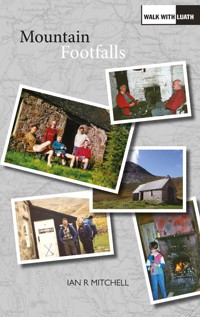
This is the story of the adventures of Stobcross Gentlemen's Climbing Club. Against all the odds thrown up by the Scottish weather, faulty map reading and the symptoms of physical decline, they strove to maintain the fine traditions of Scottish mountaineering. They battled through their Munros and Corbetts whilst valiantly trying to celebrate Burns' Night, Guy Fawkes Night and Hogmanay in a ritual calendar of the Scottish Hills. Alongside these adventures are explorations of a different kind – ones into the history of the bothies and the mountains that make up the present day landscape, as well as the stories of those who have vacated the bens and glens within living memory. Based on Ian Mitchell's research and experiences, Mountain Footfalls adds a new dimension to hillwalkers' appreciation and enjoyment of the Scottish Highlands.
Sie lesen das E-Book in den Legimi-Apps auf:
Seitenzahl: 253
Veröffentlichungsjahr: 2023
Das E-Book (TTS) können Sie hören im Abo „Legimi Premium” in Legimi-Apps auf:
Ähnliche
















IAN R. MITCHELL has written many mountaineering books, including the meticulously researched and acclaimed Scotland’s Mountains before the Mountaineers (1998), detailing the explorations and ascents in the Highlands before mountaineering became a sport. He was also the co-author with Dave Brown of the evergreen Mountain Days and Bothy Nights, still in continuous print more than 30 years after it first appeared in 1987. With Dave he also co-authored the Boardman Tasker Prize-winning A View from the Ridge (1991). More recently, with George Rodway he wrote Prelude to Everest (2011) the definitive biography of the Scot Alexander Kellas, who was the first person to die in attempting to conquer the world’s highest peak.
Born in Aberdeen, Ian has lived in Glasgow most of his life and has produced a series of books on his adoptive city, the most recent of which is Walking through Glasgow’s Industrial Past (2015). As well as in Scotland, Ian has mountaineered extensively elsewhere, including in Austria, Iceland, the Caucasus, Armenia, Morocco, Ethiopia and North America – both in Canada and in the United States. On the latter he has written Encounters in the American Mountain West (2012) based on his experiences.
By the same author:
Bismarck (Holmes McDougall, 1980)
A View from the Ridge (The Ernest Press, 1981; Luath Press, 2007) with Dave Brown
Mountain Days and Bothy Nights (Luath Press, 1988) with
Dave Brown
The First Munroist (The Ernest Press, 1993) with Pete
Drummond
Second Man on the Rope (Mercat Press, 1995)
The Mountain Weeps (Stobcross Press, 1997)
Scotland’s Mountains Before the Mountaineers (Luath Press, 1998)
On the Trail of Queen Victoria in the Highlands (Luath Press, 2000)
Mountain Outlaw (Luath Press, 2003)
This City Now: Glasgow and its working class past (Luath
Press, 2005)
Clydeside: Red, Orange and Green (Luath Press, 2009)
Winter in Berlin (Luath Press, 2009)
Aberdeen Beyond the Granite (Luath Press, 2010)
Prelude to Everest (Luath Press, 2011) with George Rodway
Walking Through Scotland’s History (Luath Press, 2011)
A Glasgow Mosaic (Luath Press, 2013)
Walking Through Glasgow’s Industrial Past (Luath Press, 2014)
First published by Mercat Press 1996
This edition 2023
ISBN: 978-1-80425-098-3
The author’s right to be identified as author of this book under the Copyright, Designs and Patents Act 1988 has been asserted.
Illustrations by Ross Gillespie
Typeset in 10.5 point Sabon by Lapiz
© Ian R. Mitchell 1996, 2023
This work is dedicated to the Bash Street Kids. And to the memories of Hamish Dhu, Coinneach an Airidh, Maggie, Bob and all the others – but most of all to that of Murdo MacDonald of Crola, Lewis.
Acknowledgements
SOME OF THE materials which form the basis of the present work have previously appeared in the following publications: The Great Outdoors, High, Countryman, the Press and Journal, the West Highland Free Press and The Herald.
Contents
Preface to the Second Edition
Introduction: The Echo Chamber
January: Immortal Memory
Echo: ‘Lochaber No More’ – The Empty Lands of West Arkaig
February: The Gallowa Hills
Echo: From the Cuillin to Kirkudbright
March: Easter Islands
Echo: The Last Deserted Village?
April: Rites of Spring
Echo: The Pollokshaws Mullach
May: Beltane
Echo: West Affric – Saints and Sinners
June: Solstice High-Route
Echo: The Drowned World of Mullardoch
A Movable Feast
Echo: Greeks Bearing Gifts
July: Mother’s Day
Echo: Glenbrittle – Climbers and Crofters
August: Father’s Days
Echo: Memories of Penmeanach and Ardnish
September: Indian Summer – Mad Horses and Scotsmen
Echo: The Minigaig and Access – History Repeated
October: October Country
Echo: Guarding Old Derry’s Gates – A Century of Luibeg Keepers
November: Guy Fawkes Night
Echo: The Other Queen of Royal Deeside
December: A Guid New Year
Echo: The Death of Deeside Gaelic
Preface to the Second Edition
RE-READING MOUNTAIN FOOTFALLS in preparation for its reissue, I was struck by how lucky I was in that the early 1990s were just about the last point in time where one could have contact with some of the – then very aged – survivors of the way of life of gamekeepers and shepherds in remote Highland glens before about 1950, a date by which that way of life had ended almost everywhere. One can be wise only after the event and I now almost regret dutifully handing back to them photographs and documents which they had lent for my researches, instead of holding on to them - not for myself, but for posterity. People are often unaware of the value of their own experience, and their descendants too often bin the relics of their lives. The various inquiries I have had over the years testify, I hope, to the continuing interest of this material, as the world it describes recedes ever further into the past.
As does our own! How modern we in the Stobcross Gentlemen’s Climbing Club thought we were in the early 1990s, almost three decades ago! We had caught up with the younger generation, had our Gortex gear and our modern ice axes, and some of us had even given up using primus stoves for the dreaded gas. It all seems rather quaint now – where is our gps, our downlaoded maps on our iPhones, our Facebook pages and blogs where every trip is minutely recorded, complete with a plethora of selfies? And beside the high-gloss, rather gentrified publications in the bookshops, linked as often or not to a tv series, our own publications look rather modest and from a past era, before bothies were en suite. Hopefully, however, the daring doings of the Stobcross will still find an echo with today’s mountaineers whose own experience, despite all the modern developments, may in the end not be all that different from ours. The past may not be such another country after all. Indeed, all the layers of the past live in memory and memorial and, as William Faulkner said, ‘The past is not dead. It is not even past’ – words with which I, who taught history in Further Education for over two decades, would heartily agree.
INTRODUCTION
The Echo Chamber
A MOUNTAINEERING PUBLISHER once advised me that if I had found a successful formula I should stick to it. Possibly the fact that he refused, in succession, three of my books later published elsewhere, led me to doubt the wisdom of his advice. I would hope that none of my books, the present work included, could be guilty of the charge of being written to a formula, though I leave judgement to the reader.
I would like to think that Mountain Footfalls carries on from my previous mountain writing, and also brings new angles to bear. On the one hand readers familiar with previous works will find here mountain tales, often bothy-focused, concerning the great middle ground of mountain experience. In these – as in previous tales – I have tried to point out, especially to novices, that there is a great tradition of Scottish mountaineering, whose footfalls you are echoing. The climbs, the paths, the howffs, did not appear yesterday. They have a history, which should be appreciated.
But the more I walk the hills, the more I become aware that I am hearing echoes which resonate with other echoes, footfalls on footfalls. The history of the pre-clearance Highlands is known to us largely through myth and legend, few of its marks remaining visible on the landscape we pass through. Yet the culture and social structure which replaced it has only recently undergone its death-agony over much of Scotland. The early mountaineers – and even those of the post World War II generation – were in a unique position to witness that culture, inter-relate with it and record it. Alas, how few of the mountaineers I meet listen for these footfalls.
Before you, reader, came other mountaineers whose doings are worthy of remembrance, and of becoming familiar with. But before them there were others: people who were there not for leisure, but for work. They did not have the choices you do, but they loved the land you walk in, though maybe in a different way, and they shaped the scenery you see with your eyes. They have a right to your respect and to your remembrance. And just as the history of mountaineering has as much, if not more, to do with the broad masses of the middle ground, rather than with the superstars, so too should the history of our bens and glens have more to do with its ordinary inhabitants – another great middle ground – than with the mythologies of Prince Charlie or the clan chiefs. Thus this work departs from my previous ones by delving into the history of the people who came before, and later coexisted with, the mountaineers.
When you make your footfalls on the mountains, you are not exercising as in a running track or a gym. Nor are you simply experiencing beauty, as in a museum or gallery. With your eyes and ears you can see and hear what has gone before you, appropriate it and immeasurably enrich your experience. With the hope that it might help you in that direction, I give you this book.
JANUARY
Immortal Memory
A HARD RAIN. The drops battering the window faster than the wipers could clear them. Kaleidoscopic light effects of oncoming car beams, then darkness with the hills invisible as the Moor was crossed, with the Lad at the wheel. Scotland. January. Rain, cold, darkness. Rain, wind, darkness. There was not much to say, and we had said it. So we passed silently through the Fort, heading for Glenfinnan.
The Young Pretender was invisible on his tower behind us, as was MacAlpine’s concrete viaduct before us, and we sat waiting, watching the rain – for nothing else was visible, though the wind made itself heard above the drumming of drops on the roof. The others had not yet arrived, so we were waiting. I felt the need to say something, to break the black spell the rain was casting.
‘It’slike,’ I ventured, ‘Yon bit in one o Marquez’s novels, where it rains and rains. They all watch it, and eventually ging mad, as hooses collapse and the graves gie forth their deid…’
‘But it least it was warm there. It’s freezing here. Let’s go tae the pub and wait for the rest o them,’ was the reply.
Winter in the Highlands is like one long, miserable Presbyterian Sunday: everything is shut. So, after ferreting about down wee lanes and finding every hotel around closed up, the Lad opted to drive back to the Fort – all of 15 miles for a pint. We were there in 15 minutes.
It took us a while to find it, in a rickle of outbuildings round the back of a very closed hotel, but we followed the lights and crossed the threshold. Instantly I felt we had made a mistake, and wondered whether we should be there at all. Not that it was a barn of a place, with all the charm of a Portakabin. Not that – although it had to be admitted it didn’t rain nor the wind blow inside – it was at least as cold as it was outside. Not that the barmaids were a pair of Amazons who looked like female mud wrestlers on their day off. Not that the denizens of the pub were that mongrel crew of the Fort’s housing estates – second generation Glesca keelies now on the dole with the pulp mill closed, and semi-urbanised tinker-types, who gave the High Noon eye when we walked in the door. Rather it was the uneasy feeling that this place might not have an official right to be open, and that those there might feel we were checking up on it. We were gulping our way through our pints when the barmaid came over, to be friendly. As she spoke, darts were poised in mid-throw, cues stilled mid-stroke. And lugs were cocked.
‘Hello, boys, where ye off to on a night like this?’ Now the Lad is charm itself, a walking encyclopaedia of social skills – and a good-looking fella forbye. So he soon had the Amazon relaxed and eating out of his hand, and virtually sitting on his lap, offering to refill our glasses. I saw problems. The Amazons might be won over, but we were still getting O.K. Corral looks from the guys. Never mess with the local women – if there are local lads around – is my motto. So I managed to extract him from the charming hostelry, as verbal equivalents of Haste Ye Back came from the wenches.
‘Ye cannae beat guid auld Scottish hospitality,’ I commented, as we drove back to Glenfinnan. To find that the others were already on their way to Corryhully, a fact witnessed by the unmistakable evidence of the rusting Boomerbus beside the road. There was nothing for it now, and no alternative to uncomfortable donning of apparel in the car, and trudging in their wake. Rivulets running down me, I began to feel that even mud wrestling with an Amazon would be better than this. Little was seen, and less said, till we won to the door of the bothy, Erchie’s lamp reflecting in the puddles by the front step.
He and Davie were already bedded against the cold, and we exchanged few comments as we hastened to follow suit. Though Erchie did observe that he doubted the capacity of the fire to add warmth to the next evening’s proceedings – our first Burns Supper. I glanced at the strange pillar-box mouth of a fireplace, low down on the wall, and felt he probably had a point. But one that would wait, I thought, as I climbed into my sleeping bag to listen to the wind trying to prise the roof off, the rain rattling and the river’s roar. Rising. And to the snores of my companions, who always seemed to fall asleep easier than I did, especially annoying on the occasions I was talking to them.
By morning the storm had abated, but the river had overflowed its banks, and was lapping at the front door of the bothy. The wind was still buffeting, and heavy clouds laboured across the sky. A day to go home if ever there was one, but we could not: the Dominie had indicated that he would come, after his father’s funeral. We could not have him stumble on an empty doss, but would have a welcoming fire and party for him. So it was decided: Dave and the Lad – who still had Munroist ambitions – would go and do Sgurr Thuilm, while Erchie and I, compleat men above (or below) such things, would do Streap.
‘Nae because it’s a Corbett,’ hastily I pointed out, ‘but because it’s a fine hill.’ Davie gave me a silent, knowing look.
Our routes went together up the glen, then forked as our companions began to mount a stalker’s path and we carried on to the bealach, which looked down onto Loch Arkaig. The weather had settled now, and become hazily sunny, with occasional sharp flashes of light through cloud breaks. We contoured round to the northern prow of Streap, its classic profile of near-perfect mountain shape providing our route. We had decided this was the proper way to do the hill, do it justice, rather than simply toil up its arse from the bothy. It was cold, and we moved swiftly over the skim of snow and thinly-iced rocks towards the summit.
Attaining it, we looked down on the wild, lonely corrie which is the southern side of the mountain, and along the ridge we would follow back to the bothy. It was cold, but not too cold to admire the drama of the sky, as cloud and shafts of light changed the scene continually behind the static actors in the foreground: the Sgurr of Eigg, Ben Sgritheall, Ladhar Bheinn. One especially sharp shaft of light lit up what looked like a copper cloud, fallen to earth at Strathan below us. I remarked on it to Erchie, who replied:
‘That’s the roof of the auld school at Strathan, built for the shepherds in Glen Pean and Glen Dessary. A freen o mine went tae it. I’ll get ye her address.’ We walked southwards along Streap’s narrow, but easy, ridge, which led us directly back towards the bothy in the falling darkness, carrying on our backs fallen timber for the fire we hoped to build, and praising ourselves for bringing kindling with us. We changed clothes, made tea, laid out the wood, and waited for our fellows, holding off the fire till their arrival. The rain came on again, and I nipped out by and by to watch the fireflies of their head-torches, slowly descending Sgurr Thuilm, and then bobbing along the path. I put on the kettle again, directed Erchie to begin his pyrolatry, and soon we had company. Wet and tired company.
‘See this Munro-baggin, it’s murder! Climbin’s much less hard work, and ye wouldnae dae it on a day like this. And my bloody knees, they’re laupin!’ observed Davie on arrival.
I gave him a couple of slugs of Bell’s ‘Islander’, which he took willingly, and a couple of ‘Brufen’, which he took unwillingly, but soon the aches had been anaesthetised, and he was cheery again, engaging in friendly banter.
‘Archie, ye are a disgrace. Yon’s no a fire tae greet a man that’s been on the hill wi! Corbetteering has corroded ye.’
Now Erchie could light a fire in an Amazonian swamp. He is extremely thorough, and usually starts by rebuilding the fireplace along blast-furnace principles. But he had met his match here – short of demolishing the wall. The fireplace was constructed so that only a little wood could fit in the mouth, and the heat from its combustion went almost exclusively up the chimney. We sat with our feet up the lum, and only about midnight, when the wall had warmed, did any heat emerge from the fireplace. The whisky and the blether warmed us more. But I was determined to go ahead with the Burns Supper.
We started off with half a dozen nips and a toast to the bard in lieu of a proper ‘Immortal Memory’, which I seemed to remember had originally been the Dominie’s remit. Then to the haggis and neeps. I had bought a huge Chieftain, with a proper sheep’s pluke, enough to feed an army. But I did overhear Davie saying he had brought his own provisions just in case. The stove was hissing and the neeps and haggis bubbling, Erchie was giving us a few Rabbie sangs, just as a pre-prandial, and everyone seemed to be forgetting the night outside, veritably one on which the De’il might have business on hand. It was a good idea I had had, I thought…
Erchie’s song stopped, and so, (I noticed) had the stove. I rushed over: the pluke had burst, and a mass of liquified meal, liver and onions had doused the primus. I confess I swore. Loudly and repeatedly. Erchie and the Lad were silent, possibly suspecting that a hungry night lay ahead of them, but Davie was roaring with laughter.
‘It’s a judgement! It’s a judgement! Trying tae provide themes for bothy weekends. Ye’ll be takkin us tae Theme Parks next, instead o bothies. I’m glad I took my gammon steak.’
I felt like shoving another dozen ‘Brufen’ down his throat to shut him up – permanently – when the Lad intervened. He extracted the disgusting burst pluke from the pan, and threw it – not, as I had hoped, at Davie – but into the fire. Then he drained the mess in the dixie and dried it out over another stove. And we ate our haggis and neeps – aggressively – under Davie’s nose. But without the ‘Address to the Haggis’, which no one had learned.
At that point the Dominie arrived in the bothy and he was invited in to join the party. Some party, I thought. No ‘Immortal Memory’, no ‘Address to the Haggis’, a culinary disaster and a miserable fire. Something had to be done.
Erchie has seldom let me down, and I hoped this would not be an exception. As the Dominie snuggled in to the knot of bodies round the lum, I asked the Boomer for ‘Tam o Shanter’. At first he resisted, saying that it was many years since he had recited it, but persistence paid off. By this time we were all pretty fou. I remember there was an Englishman there, who had arrived because his tent had been swept away, though I can’t quite remember when he came in. But I do remember his face, struck with amazement, as Erchie recited, almost word-perfect, Burns’ magnificent poem in as good a setting as you could get. Amongst a lot of drouthy drunken cronies, and on a night as wild as that described in the poem.
We had a party now. Though only the general outlines of it remain in memory rather than many specific details. There was a lot of singing: good from Erchie and the Dominie, bad from myself though drowned out mostly in chorus lines. I try to practise Safe Singing. As the strains of ‘My Love is Like a Red Red Rose’ faded, talk got onto the Women Question, and the demand arose for an extempore Address to the Lassies. Somehow, despite my objections that we should at least appoint a quasi-woman to reply for them, I was chosen for this task. Initially reluctant, I warmed to it.
I waded in. It seemed to me that Rabbie had the key to the vexed question of the female mind. There he was, I said, a renowned and successful lecher. Now it wasn’t just that he was a good-looking lad, I ventured. It was also his patter that was the key to his success. All this Red Red Rose, and Till the Seas Gang Dry stuff. Now you might think, went my argument, that the lassies were taken in by all this, believed it. Not a chance! They knew fine it was all lies, but it was a payment of the dues necessary. And also something they could pin the blame on the lad with later, even though they had never believed a word of it. I concluded, ‘So if ye want yer evil wye, tell them somethin ye baith ken is lees. Rabbie knew the score.’
A heated discussion emerged over this. Erchie thought I was being soft on the Monstrous Regiment, who were temptresses trying to get their hands on your wage-packet. The Dominie, post-macho to the core, defended the Lassies’ honour and tried to refute my analysis with the argument that in his school it was the women who recycled aluminium cans, but I didn’t quite follow his drift. Davie, high on Bell’s and Brufen, shook his head sadly and repeated his favourite line on the issue, ‘It’s a terrible indictment o wimmen!’ This may have been where the altercation with the Englishman began, for I recall demanding that he take an opinion on something, since he had drunk copiously of our whisky, and could not just sit on the fence. Erchie claimed our guest had to be rescued from my wrath, and true enough he must have gotten a fright, for he silently packed and skedaddled when we were all sleeping. The whisky and the miserable lowe of the fire gave out before the issue – whatever it was – was settled.
Next day Davie and Erchie headed back, but the Dominie wanted a walk, and I went with him a little way into the wilds of Loch Shiel. He disappeared into a glorious winter day, to be with his thoughts on the hill, while I sat beside a denuded birch grove, and warmed myself in the glint of sun. I was a bit tired after the strain of being Master of Ceremonies: keeping up the traditions is an exhausting task, I thought, dozing. On first waking I saw a hawk attacking a group of eider-ducks on a little lochan, without success. On second waking I saw the figure of the Dominie returning over the snow-powdered hills.
We drove, silently, back down to Inveraman for a pint. There we met Wee Onie, Hector and the Auld Crowd, who had had their own Burns Supper in the hotel, and swopped party tales. Then went home with our memories.
But there was still that little matter of the Strathan school…
ECHO
‘Lochaber No More’ – The Empty Lands of West Arkaig
It is well-known that large areas of the West Highlands were cleared for sheep in the aftermath of the failed rebellion of 1745. One such area was at the west end of Loch Arkaig, in Glens Dessary and Pean, where an observer wrote, ‘Families who have not been disturbed for four or five hundred years are turned out of house and home and their possessions given to the highest bidder.’ This was in 1804, when the lands belonged to Cameron of Lochiel. Contrary to the romantic Jacobite mythology, Lochiel had had difficulty in raising large numbers of his tenantry for the cause, and some took advantage of the forfeiture of the estate to help the Hanoverian troops burn down Achnacarry House in 1746, and destroy the estate records pertaining to their rents and debts. There was for some years a Hanoverian barracks at the head of Glen Dessary, and General Wade had made a rough road through the glen to Knoydart. But the Redcoats eventually left, and in their place Locheil came back, and then came the sheep.
Unlike most West Highland areas, this region did not later convert from sheep run to deer forest, but remained, for a century and a half, one of the biggest sheep farms in the Highlands. In order to run the farm, shepherds had to be brought in, and they occupied half a dozen houses at the loch head, and in the glens running westwards. The OS map of 1875 shows them all, and also shows, not a barracks, but a school at Strathan, product of the 1872 Education Act. It was the later replacement of the original school which Erchie had pointed out to me from the summit of Streap. While he tried to locate one of its former scholars, I did a bit of digging in old mountain journals.
The first man to complete his Munros, the Rev AE Robertson, traversed this area at Easter 1895, was given accommodation with two friends at Glen Dessary, and said ‘‘the people in the glen are kind, courteous and hospitable’ to walkers. The size of the operation is shown by the fact of the hills carrying 13,000 sheep at this time, and one walker arrived at Strathan in 1908, commenting, ‘I came upon a crowd of men clipping sheep and was met by a headlong rush of about 20 dogs.’ His name was William Barclay.
After World War I, Glen Dessary was occupied by a family of Stewarts who continued to offer climbers hospitality. One who had been there pre-war noted the changes coming into the area.
Glen Dessary farm was reached at 5.55. Mrs Stewart told us a hot bath would be ready in half an hour’s time. [The bath] had come up by motor launch from the east end of Loch Arkaig. [She] told us that a road was being made along the north side of the loch and that in a year or two Glen Dessary would be in motor communication with the world.
This was in 1926, and the writer, FS Goggs, regretted the breaching of isolation the road would entail. Prior to this, apart from when the sheep-drove was accompanied to Spean Bridge, the means of exit and entry was by boat. Up to World War II, supplies were ferried in to the shepherds twice yearly on board the yacht, Rifle, from Achnacarry, although the recent road brought the post-van twice a week, and the possibility of its utilisation as passenger transport. Another regular visitor to the area was the Rev Burn, second man to complete his ‘Munros’. He usually lodged with the Stewarts at Strathan. He spoke most warmly of the hospitality of his hosts, and the help given him in his studies of Gaelic place-names and in song-collection by the family up to the early 1920s. As this book was going to press, there appeared Elizabeth Allan’s Burn on the Hill (Bidean) which gives much information on ‘Wee Ronnie’s’ wanderings in this and other areas of the Highlands.
The yacht Rifle – main means of supply to the shepherds of Glen Dessary by Loch Arkaig
Another house serving a shepherd’s family was in Glen Pean. Built in 1894, it replaced a house on the opposite bank of the river, which was twice almost swept away in landslides! It was occupied by a family of Campbells (who had seven children) until 1915 when they vacated it. Mr Campbell had moved to Glen Pean in 1870 and his daughter Lexie recalled that he was often away for days gathering the sheep. He was a writer of Gaelic songs and poems, and all the children had only Gaelic when they went to school – to which they had to walk daily three miles down the glen to Strathan. Lexie recalled her days there:
We had many happy days at Glen Pean… I see Mother coming down the glen to meet us, carrying our dinners and getting us to help her to lift the peats. Some of us would bring the cattle home and mother would be helped by one of the girls to milk the cows.




