


Erhalten Sie Zugang zu diesem und mehr als 300000 Büchern ab EUR 5,99 monatlich.
- Herausgeber: Egoth Verlag
- Kategorie: Lebensstil
- Sprache: Englisch
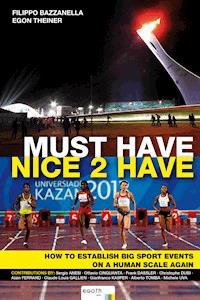
Written by major sports event organizer Filippo Bazzanella and sports communications/operations manager Egon Theiner, "Must Have, Nice to Have!" examines how major sports events are organized and gives an in-depth look into the synergies between sports, media, politics and business. It documents the excesses, wasted public investments, abandoned stadiums and "white elephant" projects that have been made in the name of sporting excellence in recent years, and that have caused increasing controversy. In addition, it discusses the often negative public attitudes toward event bidding and staging currently prevalent in many parts of the globe, and offers a practical response to the measures announced by the International Olympic Committee in its 40-step reform program Agenda 2020 at the end of 2014. Based on interviews, case studies and examples of good practice, the book provides pragmatic, constructive advice and examples of organizational systems that could be useful to future organizers adopting a structured and "human-scale" approach that trims budgets, refocuses events back on sports and that reflects the needs and views of all the different stakeholders involved. Including contributions by leading sports experts ranging from FISU World University Championships President Claude Louis Gallien, International Ski Federation President Gian Franco Kasper, International Skating Union President Ottavio Cinquanta, Olympic Games Executive Director Christophe Dubi, former World Ski super-star Alberto Tomba, World Federation of Sporting Goods Industry President Frank Dassler to Italian Football Federation General Director Michele Uva, this book goes beyond the present status quo, and makes proposals for future, possible solutions for dilemmas faced by event organizers, sports associations, governments and public bodies today.
Sie lesen das E-Book in den Legimi-Apps auf:
Seitenzahl: 263
Veröffentlichungsjahr: 2015
Das E-Book (TTS) können Sie hören im Abo „Legimi Premium” in Legimi-Apps auf:
Ähnliche



















MUST HAVENICE 2 HAVE
Imprint
Copyright ©2015
egoth Verlag GmbHUntere Weissgerberstr. 63/121030 ViennaAustria
All rights reserved. No part of this publication may be reproduced or transmitted, in any form or by any means, without the prior consent oft he copyright owner.
ISBN: 978-3-902480-27-9ISBN e-book: 978-3-902480-28-6Authors: Filippo Bazzanella, Egon TheinerTranslations & Copy Editing: Alison Flint Steiner & Robert SteinerGraphic design: Clemens Toscani, Klosterneuburg
Photos:Graham Brodie (Cover top)APA Picturedesk (Cover bottom)Fédération Internationale du Sport UniversitaireArchivio fotografico UniTrentoDominic Favre/EPA/picturedesk.comWinter Universiade 2013 TrentinoFrancesco Panunzio, MilanoVittorio Jannuzzi, MilanoGiovanni Minozzi, TorinoEgon TheinerFilippo Bazzanella
Printed in the EU
Produced byegoth Verlag GmbHwww.egoth.at
Filippo BAZZANELLAEgon THEINER
MUST HAVENICE 2 HAVE
HOW TO ESTABLISH BIG SPORT EVENTSON A HUMAN SCALE AGAIN
CONTRIBUTIONS BY: Sergio ANESI · Ottavio CINQUANTA · Frank DASSLER · Christophe DUBI · Alain FERRAND · Claude Louis GALLIEN · Gian Franco KASPER · Alberto TOMBA · Michele UVA
TABLE OF CONTENT
PREFACE
PROF. ALAIN FERAND
INTRODUCTION
PART I
THE FUTURE
INTERVIEW WITH FISU PRESIDENT
CLAUDE-LOUIS GALLIEN
INTERVIEW WITH FIS PRESIDENT
GIAN FRANCO KASPER
INTERVIEW WITH ISU PRESIDENT
OTTAVIO CINQUANTA
INTERVIEW WITH IOC EXEC. DIRECTOR
CHRISTOPHE DUBI
INTERVIEW WITH OLYMPIC CHAMPION
ALBERTO TOMBA
INTERVIEW WITH TOP SPORTS MANAGER
FRANK DASSLER
INTERVIEW WITH TOP SPORTS MANAGER
MICHELE UVA
PART II
CASE STUDIES
TRENTINO 2013 WINTER UNIVERSIADE
WUOC PRESIDENTSERGIO ANESI
A “SOCIAL RESPONSIBILITY REPORT MODEL”- DELOITTE
INNSBRUCK 2012 WINTER YOUTH OLYMPIC GAMES
YOWG MEDIA OPERATIONS MANAGEREGON THEINER
PART III
PROPOSAL FOR A NEW APPROACH
SOME INGREDIENTS AND RECIPES FOR A HEALTHY DIETWITH CONTRIBUTIONS BYPAUL FREUDENSPRUNGANDUBALDO PRUCKER
PART IV
CONCLUSION
APPENDIX
10 FACT SHEETSOF MAJOR WORLD SPORTING EVENTS
PREFACE
Alain Ferrand PhD. is Professor of management at the University of Poitiers, France, and Director of the Executive Master in Sport Organisations Management conducted in French (MEMOS). He is a visiting professor at the Catholic University of Louvain-la-Neuve, INEFC Catalunya, and “Scuola Dello Sport” in Rome (Italian Olympic Committee – CONI Servizi). His areas of expertise are strategic management, marketing and sport event management. He is an expert for the UEFA and a specialist adviser to the National Center for Sports Development (French Ministry of Sports) with regard to major sporting events management and marketing. Alain Ferrand has undertaken consultancy projects for international sport organisations, and local authorities. He has authored 12 books and over 30 journal articles. His most recent book is Olympic marketing (with Jean-Loup Chappelet and Benoît Séguin) Routledge 2012.
When I was asked to write the preface for this book, two thoughts came to my mind.
The first related to innovation through knowledge transfer (ITKT) in the field of major event management. The first time I met Filippo was in MEMOS 2003 (Executive Masters in Sport Organisations Management). At that time, he was the General Manager of the Marcialonga. This crosscountry skiing spectacle takes place in Val di Fassa and Val di Fiemme (Trentino – Italy), is part of the Worldloppet and has become an event not to be missed in the world of winter sports. MEMOS’ mission is to help professionals working in national or international sports bodies develop the knowledge required to improve the management of their organizations.
The primary goal of sports event management is to deliver quality to the main stakeholders, provide the right experience for everyone involved and raise the event’s brand profile. The organizing committee has to manage a complex system of stakeholders, resources and activities. “This organization must incorporate extremely severe constraints, not least of which is the need to deliver the event on time, the watch cannot be stopped! It must guarantee results not resources,” state Charmetant, Bergeri, Sordet and Geffroy in their guide about the organization of major sporting events.1 Major sports events are getting increasingly resource consuming. Such growing demands constitute a major risk to an event’s rights holders, the organizing committees and their partner committees. In the introduction, Filippo and Egon stress an important and highly frequent managerial issue, namely:
“How to manage a growth spurt and, in some cases, the uncontrolled, organizational costs imposed by this, in the face of sometimes uncertain returns, which are not necessarily sufficient to ensure the sustainability of the event”.
This book is part of the legacy of organizing the Winter Universiade XXVI 2013. The organizing committee demonstrated that it is possible to put on a big, high-quality international event (numbers) with only limited resources. This marks the transition between effectiveness in terms of the capability of producing a desired result to efficiency, which describes the extent to which time, effort or costs are well used for the intended task or purpose. The sub-title “towards a new model for managing major sporting events on a human scale” is a call to confront different experiences, share best practices and make everything we have learnt from the recent past available to improve management effectiveness through developing innovative solutions so that we can deliver high-quality events and reduce the resources required for their organization.
This challenge is a call for innovation. Innovation can be a continuous process, consisting of a series of changes made gradually in regards to their format and characteristics, organization and operational processes. This can be achieved by combining three types of innovation to achieve more with fewer resources. First, there is process innovation through implementing new or significantly improved methods in event organization. This refers mainly to functional areas and includes significant changes in techniques, equipment and/or software. Second, organizational innovation will bring new way of coordinating and putting on the event. Third, marketing innovation will promote a concept or strategy focusing on organizing mega sport events on a human scale in a sustainable perspective. Alternatively, innovation can be radical and correspond to the creation of an entirely new event.
My second most immediate thought on large-scale sports event management concentrated on changes in the meaning and scope of major sporting events. In 1995, I stated that sport events were much more than just competitions between participants. I wrote:
“A sports event is a collective celebration with an uncertain outcome, where men and women gather to attend a sporting spectacle”2
During that period, organizers wanted to demonstrate that sport events were much more than just competitions between athletes and teams. Their aim was to turn competitions into shows mainly for the public, media and sponsors. Furthermore, the uncertainty of the outcome made it essential to create and maintain levels of public interest.
Having said all this, the area of sports events has evolved considerably in the last 20 years. There are now many different kinds of sports events. They are social and media events that bring together anything from a handful to a huge number of people and involve different activities, depending on their scale. Sports events provide entertainment and can be festive occasions, but they are also showcases for communities and regions. They can forge an identity and create solidarity, bringing people together, giving them a sense of belonging and contributing to the development of the host region. They have both short- and long-term impacts. Indeed, the years of preparation required to produce a few days sporting celebration can have far-reaching effects that are felt for more than a generation. All of these facets have to be taken into account by the organizers before starting preparations.
Alain Ferrand - Director MEMOS and Professor of Management, University of Poitiers
Four dimensions need close attention:
First, a sports event is a social fact consisting of ways of acting, thinking and feeling. Sports events bring people together and create a sense of community, socializing each of that community’s members. Fans embrace the normative community behavior and share its values.
Second, participants are at the heart of the event because without their activity it would not exist. This is a shift in the organizers’ priorities, as they have tended to favor the media and sponsors in the recent past.
Third, sports events provide a unique branded experience -- an experience that is private and/or social that occurs in response to some form of stimulation. Such experiences involve the entire living being. They often result from direct participation in and/or the viewing of the event. The process of strategically managing the event and providing the desired experience for targeted stakeholders is in the hands of the organizers. The Stakeholders Experience Management (SEM) framework is an extension of the Customer Experience Management (CEM) framework3. It is based on five steps.
1) Analyzing the experiential world of the event’s main stakeholders
2) Building the experiential platform
3) Designing the event’s brand experience
4) Structuring the prioritized stakeholders’ experience and
5) Engaging in continuous innovation to demonstrate to the event’s main stakeholders that the organizers can create new and relevant experiences based on a collaborative process.
It is this experience that is branded and is the encapsulation of the combination of attributes (tangible and intangible), benefits, values and ideals and injects them into the event to give it the life and energy it needs.
Last, an event creates both short- and long-term value for the stakeholders involved. Sports events are managed from a stakeholder’s perspective)4. Consequently managers act to create value by taking into account the interests of all the targeted stakeholders. This value creation is the result of the integration of resources supplied by several different actors during exchanges. It centers on event legacy, which relates to what is left after the event has finished and whether this is of benefit to the event’s stakeholders, especially the host city and local community.
The integration of these dimensions leads to the following definition:
“A sports event is a social fact with an uncertain outcome, where participants are involved in a situation of achievement, performance or competition, which provides a unique branded experience and creates short- and long-term value for the stakeholders involved”.
In conclusion, effective mega sports-event management on a human scale leads to the development of new models to design and carry out operations so as to minimize the resources allocated and maximize benefits to all stakeholders, as well as society in general.
This book by Filippo Bazzanella and Egon Theiner is an initiative to promote and raise the profile of knowledge transfer and innovation, to manage mega sports events in a sustainable way. Enjoy the book.
Alain Ferrand
Professor of Management
MEMOS Director conducted in French
University of Poitiers - France
1 Charmetant, R., Bergeri, P., Sordet, P. & Geffroy, D. (2005). Guide to the organisation of sports events for sports officials, politicians and administrators. Lausanne: Sentedalps, p. 43).
2 Ferrand, A. (1995). La communication par l’événement sportif: entre émotion et rationalité, in A. Loret (Ed). Sport et management (280-294). Paris: Dunod. 1995, p. 281).
3 Schmitt, B.H. (2003). Customer Experience Management: A Revolutionary Approach to Connecting with Your Customers. New York: Wiley Schmitt
4 Parent, M. M., & Smith-Swan, S. (2012), Managing major sports events: Theory and practice, Oxfordshire, England: Routledge.
INTRODUCTION
How high is the revenue earned from major sports events? Billions of dollars? Perhaps, but no one knows precisely. There are some more detailed studies available, but in most cases we only use estimates to gauge money in sport. The machinery churning out more and more major occasions has ballooned in size over time, creating mass-produced mega experiences challenging and re-shaping sports event management. The event rights’ owners, among them many federations, have grown wiser and have experienced and achieved organizational standards unimaginable 20 years ago. Television and the web have changed people’s approach to sports occasions and the value of the events they watch.
The debate is certainly very open. Most recently, one of the most prevalent topics has been the ambivalence surrounding the bidding for major events at a time of economic crisis, with the fragmented race for the 2022 Winter Olympics and Paralympics a perfect example of this phenomenon. Four of the original six candidates dropped out, most of them citing financial concerns.
Lesen Sie weiter in der vollständigen Ausgabe!
Lesen Sie weiter in der vollständigen Ausgabe!
Lesen Sie weiter in der vollständigen Ausgabe!
Lesen Sie weiter in der vollständigen Ausgabe!
Lesen Sie weiter in der vollständigen Ausgabe!
Lesen Sie weiter in der vollständigen Ausgabe!
Lesen Sie weiter in der vollständigen Ausgabe!
Lesen Sie weiter in der vollständigen Ausgabe!
Lesen Sie weiter in der vollständigen Ausgabe!
Lesen Sie weiter in der vollständigen Ausgabe!
Lesen Sie weiter in der vollständigen Ausgabe!
Lesen Sie weiter in der vollständigen Ausgabe!
Lesen Sie weiter in der vollständigen Ausgabe!
Lesen Sie weiter in der vollständigen Ausgabe!
Lesen Sie weiter in der vollständigen Ausgabe!
Lesen Sie weiter in der vollständigen Ausgabe!
Lesen Sie weiter in der vollständigen Ausgabe!
Lesen Sie weiter in der vollständigen Ausgabe!




