


Erhalten Sie Zugang zu diesem und mehr als 300000 Büchern ab EUR 5,99 monatlich.
- Herausgeber: BoD - Books on Demand
- Kategorie: Lebensstil
- Serie: My Personal Karate Reading Book
- Sprache: Englisch
Since 1971, I have been practicing Shotokan Karate, just as taught technically by the Japan Karate Association (JKA). Already in the early 1970s, I had the good fortune of witnessing Karate demonstrations by Hiroshi Shirai, Keinosuke Enoeda, Koichi Sugimura, Yasuyuki Fujinaga, and Hideo Ochi, and I early on asked myself what made the difference in Karate technique when performed by these JKA masters compared to our execution here in Germany, even though we practiced the same Shotokan style. Were the differences merely the visual distinctions of the physical physiognomy of the Japanese compared to us Europeans, or were there essential differences in the execution of the Karate techniques? I was able to answer this question for myself through training at the JKA Honbu Dojo and at the Hozoji Dojo of Norihiko Iida.
Sie lesen das E-Book in den Legimi-Apps auf:
Seitenzahl: 209
Veröffentlichungsjahr: 2026
Das E-Book (TTS) können Sie hören im Abo „Legimi Premium” in Legimi-Apps auf:
Ähnliche
















My Personal Karate Reading Book
Author: Jochen Harms
Date of Birth 27. January 1955 in Rüdesheim Rhin River
Retired police officer; 43 years of service
Karate since 1971, 5. Dan Style Shōtokan
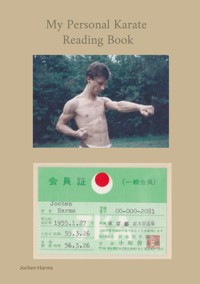
The Author in 1975 at the age of 20 as a Police trainee
I was raised in a small village called Assmannshausen in the Rhine River valley. At the age of 16, I began practicing Karate and have continued studying it consistently to this day. On October 1, 1973, at the age of 18, I joined the police service of the state of Hessen and attended the police school for 2½ years (today the Police Academy State of Hessen). Until my retirement on January 31, 2017, I went through all facets of police service. From patrolling as a police officer at an Downtown Police Station to working as an investigator in the field of money laundering. I enjoyed serving as a police officer, and it was the right decision for me to take this path. I am married and have an adult daughter, Jasmin, of whom I am very proud. As a Christian, I regularly attend Sunday church services and am grateful to God for my life so far.
Through Karate, I have had the privilege of meeting many gentle and special people during my more than 50 years of activity. I dedicate this book to them.
In Karate, it is not important how many strikes you can land on another Karateka's body, but how many strikes you can endure yourself.
Note
Karate is a martial art, and the techniques and training methods listed here should only be practiced under the guidance of a qualified instructor. In particular, children and adolescents should only practice under the supervision of a trained instructor. The author assumes no liability for personal injury, property damage, or financial loss.
Table of Contents
01 Prologue
02 My Beginnings in Karate
03 Training in the 70s in Germany
04 My first trip to Japan and arrival in Tokyo
First Accommodation and Japanese Lifestyle
Personal impressions of life in Tokyo
Everyday Life and Journey to the Honbu Dôjô
JKA Honbu Dôjô in Tokyo Ebisu
Karate training in the Honbu Dôjô in Ebisu
Karate instruction with Masahiko Tanaka Sensei
Karate lessons at the Hôzôji Dôjô
Kumite Training at the Dôjô of Iida Sensei
05 Basic techniques and examination regulations as a way to practice Karate including
What does physical contact mean in Karate?
06 The basic techniques of Karate
Shoulder of the thrusting arm
Technique with physical force
07 Kazukeiko
08 Randori -The relaxed free fighting
Basic Combinations and their Significance
Technical execution in Randori
Learning and Movement Principles in Randori
Practical verification of movement dynamics
Technical understanding execution form of the JKA
Example sequences in Randori
09 The Biomechanics of Karate Technique
10 Breathing in Technique - Hara
11 Essential Importance of Karate Techniques
12 Historical Background of Kumite Forms
13 Essay on Sports and Competitive Karate
Sport Karate versus Traditional Karate
14 Touring Germany with Tetsuhiko Asai
15 Mental Attitude in Kumite Forms
16 Martial Arts: Definition and Claim
17 Fighting Spirit
18 Overcoming Fear
19 The physical encounter with the Karate Technique in the Kumite forms
20 Kihon-Ippon-Kumite
21 Jiyû-Ippon-Kumite
22 The Importance of Kata in Karate
23 Tips for Training
24 Mae-Geri in Execution Technique and Application
25 Karate stance or step movement
26: Notes on the Makiwara
27 The Japanese Understanding of Karate-Dō
28 The Meaning of the Sensei Concept and Dan Rankings in Karate
29 Karate Dô as a Spiritual Experience
30 Essay What is Spirit
31 Essay on Being
32 Essay on Time - Does Time Exist?
33 Essay About Us Men
34 Karate as an Initiation Ritual into Manhood
35 Karate in Old Age
36 Karate and Social Influences
37 Summary of a Karate Life
Chapter 01: Prologue
After more than fifty years of continuous Karate practice, I would like to share my experiences related to Karate in the form of a reading book. It is equally about my experiences in learning and practicing Karate techniques as well as the spiritual and cultural aspects connected to it. Especially in the technical descriptions, I hope that readers will keep picking up the book to understand, learn, educate themselves, and seek inspiration. Of course, the presentation of the techniques cannot claim tobe exhaustive.
A technical book would have required a different structure and therefore would have thereby lost authenticity. Therefore, some content repetitions in connection with various topics cannot be avoided. My goal was to highlight those aspects that are not covered in conventional Karate textbooks. It is important to note that I practice Shōtokan Karate as it is technically taught by the Japan Karate Association (JKA).
As early as the 1970s, I had the luck to witness demonstrations by significant JKA masters like Hiroshi Shirai, Keinosuke Enoeda, Koichi Sugimura and Hideo Ochi. Even then, I questioned what the difference in technique was between the Japanese experts and our practice in Germany, despite all of us practicing the same Shōtokan Karate. Was it only the external differences between Japanese and European Karateka, or were there fundamental technical differences? I found answers to these questions at seminars in the Honbu Dôjô of the JKA as well as in the Hôzôji Dôjô of Norihiko Iida Sensei. My insights into the Japan Karate Association mainly stem from my trips to Japan between 1980 and 1986, as well as from 2003. I follow the latest developments on the internet as much as possible. I closely watched the Karate competitions at the 2022 Olympic Games in Tokyo on television and reviewed many fights multiple times for analysis. These impressions made me think a lot.
The intensive time with Tetsuhiko Asai Shihan as a personal companion during his stays in Germany in 1997, 1998, and 2002 also provided me with valuable impulses for my written works. My last private visit to Asai Sensei was in 2003 in Tokyo.
My approach to Karate has been shaped by a philosophical-meditative attitude from the very beginning. Even as a beginner, I spoke of the Karate-Dô, the way of Karate, but I didn't yet know what exactly that meant. Today, I have experienced this path for myself and would hardly discuss the topic of Karate-Dô in conversation anymore – silence has become more important to me. There are many ways to practice Karate, each person in their own style. Technically speaking, however, the great goal remains to achieve the optimal effect of the punch – the Ippon. For over four decades, a Makiwara has stood in my house, where I regularly train this.
To improve the description of the technique, it was necessary to also point out the deficiencies in the teaching of Karate in the past. My statements should not be understood as a raised finger – I am aware of the achievements of earlier Karate generations and that they often could not shape the teachings differently than how I view them critically today.
Until 2009, I trained in various Karate Dôjôs in Frankfurt, mostly under Sensei Efthimios Karamitsos, Germanys national coach for the Kata discipline. In October 2009, I switched to the Karate Dôjô of Zweites Deutsches Fernsehen (ZDF) in Mainz Rhein River and led two training sessions weekly there until March 2020. Without the pressure of competition and the stress of exams, I rediscovered my joy in the trainer role in the 50 Plus group. I thank my Karate friends Frank Fell-Bosenbeck, Mark Hugo, and Gerhard Sund for their suggestions and support in editing this work.
Chapter 02: My Beginnings in Karate
My Karate journey in the early years exemplifies this time: in 1971, at the age of 16, I met my then-trainer Ekkehard Schleis in a Disco. Ekkehard, then 20 years old, had started training in 1969 at the Karate Dôjô Lahnstein Rhine River with Günther Holzer, Udo Philippzik, and Harald Kwartitsch – about 50 kilometers away from his hometown Lorch Rhine River. After successfully passing his 7th Kyu exam with national coach Hideo Ochi, he found a small gym near his home, where he subsequently relocated his training. The gym was barely heated, and the linoleum had already come loose in places.
The first training years
The main focus was primarily on the shorter commute to training, not the conscious establishment of a new Dôjô – even though the latter quickly became evident. The first members were recruited from the circle of friends, and thus a 7th Kyu became a trainer. Ekkehard taught himself the Kata Tekki Shodan with the help of a textbook by Sensei Masatoshi Nakayama. Training took place on Tuesdays and Thursdays from 8:00 PM to 10:00 PM, and additionally on Sundays from 10:00 AM to 12:00 PM. The entire known technical repertoire was part of the training. Just the warm-up exercises, including conditioning exercises, took about 45 minutes – a workload that today would likely only be endured by competitive athletes. After just a few minutes, our Karategi was soaked with sweat as if it had just come out of the water. I did not know at that time that this conditioning-oriented training would pay off nine years later in Japan. Our goal was to become good Karateka and to understand Karate not just as a sport but as a way, as Karate Dô, even though we did not yet fully grasp the exact meaning of this term. Competitions were hardly held, except for the annual German Championships. The idea of pursuing Karate as a broadly based competitive sport did not yet exist. Training was characterized by strict discipline. Those who arrived late had to first run three laps in a 'duck walk' around the hall. Training breaks only occurred during the Easter and Christmas holidays; during the summer holidays, we trained outside on a meadow when the sports hall was closed. During this time, I missed not a single training session.
Exams and First Seminars After about 24 months and around 240 training sessions, I passed the exam for the 9th Kyu with Gerd Löw Sensei. In July 1973, my first major summer seminar – Gasshuku -took place in Kiel East Sea with renowned teachers such as Shiro Asano, Masaru Miura, Akio Nagai, Kazuhiro Sawada, Hiroshi Shirai, Shinseki Takano, and Hideo Ochi Sensei. At the campsite, we made friends with Karateka’s from Montabaur (Uwe, Heidi Zimmermann, Gerd, Gerald, Norbert Schwickert, Marianne Pohl) and Giessen (Ronny Repp, Bernd Gerich). I took the exam for the 8th Kyu with Sensei Nagai, who sat cross-legged on a chair throughout the entire exam and continuously looked down—regardless of who was up next. A young German examiner called the candidates by name and stated the techniques: first Kihon, then Gohon- Kumite and finally Heian Shodan. However, Ochi's name stamp is in the Karatepassport After the Kata Heian Shodan, a girl from Dôjô Montabaur approached me and said she had never seen this Kata performed so well. I still think today that I did really well at that time – after all, it was the only Kata I mastered at that point. If I multiply the approximately 250 training sessions I had completed up to that point with an average of five Heian Shodan, I arrive at around 1250 times performing Heian Shodan before the 8th Kyu exam. I took the exam for the 'Orange Belt' in October 1973 with Ochi Sensei in Montabaur. As often as possible, we went on weekends to training seminars with Ochi Sensei, who had an indescribable talent for motivating us. Especially impressive was his demonstration of the Mawashi Geri Jodan, where he held his leg high and changed the foot position from the instep to the ball of the foot.
1970: Sensei Hideo Ochi in Frankfurt Main River
1983 in Tokyo, Setagaya-Ku, Fukazawa. Chieko and I had been married for 12 years and had a wonderful time, as well as an amicable separation. This gave me insights into Japanese society. In Tokyo, at my in-laws' house, I felt at home. It was quite a peculiar feeling to travel from home to Yotsuya Sanchome by subway for training with Norihiko Iida Sensei in his Dôjô.
1986, tea ceremony at the family's
Formative experiences with Hideo Ochi Sensei
After disagreements with officials, Hirokazu Kanazawa ended his work for the DKB and introduced his successor Hideo Ochi in Krefeld on April 1, 1970. From June 1, 1970, Hideo Ochi was the official national coach of the DKB. At that time, there were 104 Dôjôs registered with the DKB. Over the following time, the national coach, whose task was officially in competitive sports, traveled to different regions on weekends and led seminars at various clubs. Numerous athletes regularly participated in these seminars. Ochi's role was utilized by both squad athletes and recreational athletes; they often trained and stayed overnight together in sports halls. It was unusual for an official not to actively train in Karate. Until the early 1980s, there were occasional joint training sessions between squad athletes and members of the federal board. Hideo Ochi, born on February 29, 1940, in Tajio/Ehime, began training in Karate at the age of 16. After graduating from Takushoku University in 1962, he completed his instructor training with the Japan Karate Association in 1964. In 1997, he received the Federal Cross of Merit for promoting international understanding and social engagement. The foundational work of Ochi Sensei has profoundly influenced generations of Karate practitioners in Germany. My first encounter with Ochi Sensei was in the autumn of 1971 at a seminar in Montabaur (Westerwald – Germany). He appeared in a blue suit with a tie, his Karate uniform neatly stored in a briefcase – very much in the Japanese manner. Ochi's foundational work has had a formative impact on generations of Karate practitioners in Germany. With his technical skills in Karate and his personality, he was and remains a role model for all of us.
Chapter 03: Training in the 70s in Germany
At the beginning of the 1970s, both the clubs and the training contents were far from being as structured as they are today. The coaches were often still at the beginning of their development and usually only held a Kyu grade. For example, my coach at that time had the 7th Kyu when I started with Karate. The number of trainees was small – rarely did more than six people participate in the training.
The training included everything that the coach was familiar with: from gymnastics and strength exercises to various Karate techniques. Especially at the beginning, it was common to spend up to 45 minutes on gymnastics and strengthening. By today's standards, this conditioning requirement would push many Karate athletes to their limits. Overall, a training session lasted two hours. Training took place in Kaub Rhine River on Tuesdays and Thursdays from 8 to 10 PM and on Sundays from 9:30 AM to 12 PM, meaning even 2.5 hours on the weekend. I particularly vividly remember how my instructor learned the Kata Tekki Shodan himself using a Kata textbook by Masatoshi Nakayama.
In October 1972, we attended a course with Ochi Sensei in Saarbrücken on a Sunday. Upon our arrival, Dan examinations were taking place. Out of about 16 candidates who wanted to take the Shodan test, only four passed. From the stands, I could observe how Karate pioneer Bernd Hinschberger faced off against his Kumite partner Ulli Buss in the 2nd Dan examination. It was the first time I saw a Karateka fighting with open hands. Since my trainer Ekkehard Schleis was personally acquainted with Ochi Sensei, he was given the opportunity to take the examination for 3rd Kyu. During this, he was corrected for the first time by Ochi Sensei himself during the Kata Tekki Shodan, which he had learned from the textbook. Ochi Sensei demonstrated the individual sequences, and my trainer passed the examination.
Back then, the focus was particularly on learning the fundamental techniques, the combinations and the formal sequence of the Katas. It was mainly about conveying this foundation to as many people as possible and thus providing a stable base for Karate in Germany. The technical level benefited from this foundational work for a long time before Karate slipped into mediocrity. Today, the mastery of the examination procedures is often in the foreground – less so the quality of the technique. Those who do not make serious mistakes during the examination generally pass the grading to 1st Dan without any problems. The Karateka’s who had failed the examinations for 1st or 2nd Dan in Saarbrücken back then could likely pass the examinations for 4th or 5th Dan today with their former level.
Chapter 04: My first trip to Japan and arrival in Tokyo
Like many Karate practitioners, I also felt the desire to train in the birthplace of Karate. During Karate training at the university in Mainz Rhine River, I met Kaiji 'Dashi' Miyauchi, who took me to Japan on March 23, 1980. Our flight with Japan Air Lines departed at 11:00 AM from Frankfurt, passed through Hamburg and Anchorage/Alaska, and arrived in Tokyo Narita on Monday at 5:30 PM local time. After 17 hours of flight time and a layover in Alaska, we were picked up at the airport by Dashi's classmate, Aritomi San. Since Dashi had not been to Japan for seven years, Aritomi San took over my care from then on.
1980 Chandra Jayatilleke and Jochen Honbu Dôjô Ebisu
1980 Honbu Dojo of the JKA in Tokyo/Ebisu. On the right in the background, Masahiko Tanaka with a shinai in his hand.
1981, Wolfgang, Jochen, Gudrun u. Norihiko Iida
1986, Hôzôji Dôjô Author Jochen Harms 21 years old
First Accommodation and Japanese Lifestyle
I spent my first night in Japan in a typical Japanese wooden house (Setagaya-Ku, 3-2-4 Unane). The sleeping arrangement consisted of a thick, kimono-like blanket on the floor. The house had no heating; the warmth came from a small table with a built-in gas stove, over which a blanket was placed – an unfamiliar but cozy system for me. In the neighboring house lived my host's parents. During breakfast, I ate miso soup, rice, and grilled fish with chopsticks for the first time; green tea was served alongside. The 80-year-old father of my host, Toyoo Aritomi, was thrilled to meet a young German who came to Japan for Karate training. Despite the language barrier, we managed to communicate well with a bit of English and a dictionary.
Own apartment in Tokyo and first contacts.
Shortly afterwards, I got a 3-room apartment in Shinjuku ku, Shinogawamachi 2, Edogawa Apart 7-2. The rent was equivalent to 600 DM for six weeks – a rarity, considering the housing shortage and rental prices in Tokyo. During the handover of the apartment by the caretaker, I received a stern warning: no female visitors! I replied with "Osu!" Afterwards, I was introduced to a family in the neighborhood and the kiosk operator of the apartment complex, who would also look out for me. Next, we went to a small Restaurant around the corner. In front of every Restaurant, the dishes are displayed in a showcase made of plastic. Dashi explained the dishes to me and introduced me to the two female waitresses in the Restaurant.
1980 My first breakfast with miso soup in Tokyo Unane Setagaya-Ku
1986, Author Jochen Harms Hôzôji Dôjô
Further Impressions in Japan
During my first stay in Japan, I had only stayed in Tokyo. Later, I took the time to see more of the country. Nippon has always impressed me, especially in terms of its landscapes, whether in the mountains or by the sea. Particularly on a domestic flight, I was very fortunate, and we had very clear weather. During the entire flight to Ube Airport in the south of the main island Honshu, we could see the landscape below us. We flew so close to the extinct volcano Fuji-san that I was able to take the photo shown above with my pocket camera. Afterwards, we visited the city of Hagi, which lies in a picturesque bay by the sea. Of course, I am now an enthusiastic supporter of Japanese cuisine. Whoever knows Japanese cuisine understands what I mean. There is only one dish that can drive me away: Natto! These are fermented beans with a corresponding smell. Whether Sushi, Sashimi, Tempura, or Miso Soup, I like all of that. In hotels and other larger accommodations, the guests all wear the same-looking house robes. I always found that quite funny. In some hotels, there is also an evening program where plenty of sake and other alcoholic beverages flow. Afterwards, there’s karaoke. I don't want to describe everything I've experienced here, but sometimes it was a very special experience.
Personal impressions of life in Tokyo
At the Honbu Dôjô, I met Wolfgang Weinhold and his then girlfriend Gudrun, who helped me better understand the training and the community. Wolfgang had a translation agency and mainly worked for business people. He explained how important it is in Japan tobe flexible when interpreting in order not to jeopardize business deals. When translating content, I always take Japanese culture into account. Otherwise, many business contracts would never even be concluded. I used my free time to explore Tokyo. The subway and train systems were excellent, and the helpfulness of the people impressed me. The department stores were more modern than those in Germany, and the service staff were always friendly and accommodating. The city presented itself as a mixture of old temples, bridges, and modern shopping centers. Many impressions – such as the uniforms of the students and the colorful street scene – were initially unfamiliar. Despite the traditional elements, Japan appeared as a modern industrial country with its own culture. I have only ever met Wolfgang in Japan, last in 1986 in Tokyo. Wolfgang Weinhold got in touch with me by phone during his visit to Germany in August 2016; unfortunately, he didn't have time to visit me at my house in the Rhingau district (Rheingau) by the Rhin River.
I took a lot of time to explore Tokyo. I managed very well with the train and subway lines. The Japanese were always very polite and helpful. When I asked a passerby for a station, I was often accompanied to the corresponding platform. I also always enjoyed looking around the department stores and small shops. At that time, there were no department stores or shops in Germany that were as beautiful as Tokyo in 1980. The individual departments in the department stores were independent businesses.
At every entrance and elevator, there were hostesses in uniforms welcoming the guests. The salespeople are very friendly and helpful, unlike what we are used to in Germany. In restaurants or cafés, just a glance is enough, and a server comes rushing over at high speed to ask for your order. In small restaurants, you could dine very cheaply. The design of the city, the buildings, temples, pedestrian bridges over intersections, and old wooden houses, is initially quite unusual. I found much of it tobe a very ugly sight at first. The young women mostly wore pleated skirts and silk knee socks in all colors. In between, there were always swarms of students in their school uniforms.
Women in kimonos, who were on their way to some festivities, could also be seen more often. Despite the many visual impressions that remind us Europeans of ancient Japan, one should not overlook that Japan is a modern industrial nation that simply derives from a different culture. The era of the Samurai is long gone. Although the Japanese like to identify with the Samurai, their everyday behavior is more similar to a rural culture. Karate practitioners are outsiders in Japan. The average Japanese person has no idea about Karate. Karate practitioners are viewed somewhat suspiciously by the Japanese and are also associated with right-wing parties. Martial arts disciplines such as Kendô, Kyudô, Judô, or Aikidô enjoy more respect than Karate. However, that was in the 1980s. I hope that through the worldwide success and acceptance of Karate by nations, Karate has since also gained the recognition and respect it deserves in Japan. The Japanese Karate instructors were and still are ambassadors of Japanese culture and have contributed to the positive image of their country.
Everyday Life and Journey to the Honbu Dôjô
From my apartment, it was only a ten-minutes walk to the Iidabashi train station. Dashi arranged a monthly ticket for me and accompanied me on the route to the Honbu Dôjô. The names of the train stations are still in my memory: Iidabashi, Ichigaya, Yotsuya, Shinanomachi, Sendagaya, Yoyogi (Transfer), Harajuku, Shibuya, and Ebisu. The JKA Honbu Dôjô was located in Ebisu, just a two-minutes walk from the train station on the first floor of a commercial building.
JKA Honbu Dôjô in Tokyo Ebisu




