


18,49 €
Mehr erfahren.
- Herausgeber: The History Press
- Kategorie: Geisteswissenschaft
- Sprache: Englisch
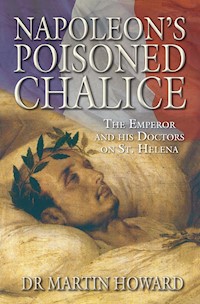
In 1815 Napoleon Bonaparte arrived on the island of St. Helena to begin his imprisonment following Waterloo. By 1821 he was dead. During his brief stay, he crossed paths with six medical men, all of whom would be changed by the encounter, whether by court martial, the shame of misdiagnosis, or resulting celebrity. What would seem to be a straightforward post became entangled with politics, as Governor Hudson Lowe became paranoid as to the motivations of each doctor and brought their every move into question. In Napoleon's Poisoned Chalice, Martin Howard addresses the political pitfalls navigated with varying success by the men who were assigned to care for the most famous man in Europe. The hostility that sprang up between individuals thrown together in isolation, the impossible situations the doctors found themselves in and the fear of censure when Napoleon finally began to die.
Das E-Book können Sie in Legimi-Apps oder einer beliebigen App lesen, die das folgende Format unterstützen:
Veröffentlichungsjahr: 2009
Ähnliche




















By the time I have finished, I think I shall have been in company with more liars than any living author.
Sir Harris Nicols, St. Helena historian, 1848
ACKNOWLEDGEMENTS
The staffs of the British Library (London), The National Archives (Kew) and the Wellcome Library (London) have given valuable help in the location of obscure sources and illustrations. I am very grateful to David Markham for allowing me to quote from his excellent book, Napoleon and Doctor Verling on St. Helena. A special thanks to Ian Robertson for his continued interest and moral support.
CONTENTS
Title
Dedication
Acknowledgements
1 The First Victim
2 Double Agent?
3 His Master’s Voice
4 Trafalgar Veteran
5 Court-Martial
6 A Missed Appointment
7 Corsican Upstart
8 A Mistaken Diagnosis
9 Death Mask
Appendix I Chronology of events
Appendix II Residents at Longwood 1816
Appendix III British Military and Naval Officers on St. Helena 1815–1821
Bibliography
Plates
Copyright
1
THE FIRST VICTIM
Napoleon never hated England. He had a begrudging admiration for the ‘nation of shopkeepers’. The Emperor respected his enemy’s courage in war and its tradition of hospitality to the fallen. In his youth the great Corsican patriot Pasquale Paoli, well known to his family, had sought refuge from French oppression in England. The young Bonaparte wrote a short story in which his hero, an ex-King of Corsica, is told by the writer and politician Horace Walpole, ‘You suffer and are unhappy. These are two reasons for claiming the sympathy of an Englishman.’ Theodore emerges from his dungeon to receive a pension of £3,000 a year. Thirty years later, at the time of his departure to Elba, Napoleon commented to the British Commissioner Sir Neil Campbell that he was convinced that there was more generosity in the British Government than in any other. It was natural that after his decisive defeat at Waterloo he expected more understanding from the British than from the Prussians. He was not to be disappointed. When Blucher demanded that he should be hanged, Wellington remonstrated with his friend and ally. The Duke did not wish his greatest victory to be tainted by his subsequent role as an executioner. It has to be admitted that not all Englishmen were so magnanimous. Lord Liverpool, the Prime Minister, declared that he hoped that the King of France would shoot Bonaparte as the ‘best termination of the business’.
After his last battle, Napoleon fled to the Élysée Palace and then to his old house at Malmaison in the suburbs of Paris, the scene of the happiest of times spent with Josephine. Here, he was still in real danger of falling into the hands of the advancing Prussian army and, on 29th June 1815, he left for Rochefort. In this Atlantic seaport the local people received him with enthusiasm; there were still a few cries of ‘Vive L’Empereur!’ The French authorities were less accommodating and were intent on his arrest. He was faced with a stark choice. He could either make a determined effort to escape or he could surrender to the most munificent of his adversaries. There was discussion of flight to America. Frigates manned by sympathisers were moored off the coast but there was also a British naval blockade and there was a serious risk of capture. His brother Joseph offered to impersonate him to buy vital extra time. The Emperor was unconvinced. In truth, he had long known that he would ultimately place himself at England’s mercy. In America he would be no safer than on mainland Europe; the emissaries of Louis XVIII would be sent to assassinate him. He remained calculating and pragmatic to the last.
There is always danger in confiding oneself to enemies, but it is better to take the risk of confiding to their honour than to fall into their hands as a prisoner according to law.
He reminded his followers of the incident in Greek history when Themistocles requested refuge from the King of Persia.
On 15th July, Napoleon, dressed in his favourite uniform of the Chasseurs of the Guard, boarded the British ship the Bellerophon. Her Captain, Frederick Lewis Maitland, had not been instructed as to the honours to be paid to the ex-Emperor and he therefore gave none, taking advantage of the rule that no salutes should be given before 8am or after sunset. Napoleon stepped on to the deck and removed his hat, before advancing to meet Maitland, ‘I am come to throw myself on the protection of your Prince and your laws.’ The Captain, careful to make no commitment as to his captive’s future treatment, introduced him to the other officers. A week later, the Dartmoor hills became visible and Napoleon changed his dressing gown for an overcoat to go on deck to have his first view of England. Was this to be his home?
When the Bellerophon was ordered to sail from Torbay to Plymouth, to the west and away from London, the French began to fear that they were not to be allowed to land. The crowds of sightseers at Plymouth were remarkable. The sailors of the Bellerophon displayed a blackboard on which they wrote the famous prisoner’s current occupation; ‘at breakfast’, ‘in the cabin’ and so forth. Napoleon had not forgotten his earlier allusion to Greek antiquity. He now composed a dramatic appeal to the Prince Regent, which perfectly expressed his hopes and emotions.
Royal Highness
A victim to the factions which divide my country, and to the enmity of the greatest Powers of Europe, I have terminated my political career, and I come, like Themistocles, to place myself at the heart of the British people. I place myself under the protection of their laws, which I claim of Your Royal Highness as of the most powerful, the most constant, and the most generous of my enemies.
Napoleon1
The British government was not willing to accommodate Napoleon’s further requests that he be treated as a guest and be given an English country house in which to live out the rest of his days. The appeal for clemency had saved his life but it was clear to Ministers that their prisoner would have to be exiled to a most isolated spot. The memory of his escape from Elba, when he had slipped through the fingers of the unfortunate Campbell to create havoc in Europe, was still fresh. Rumours started to circulate that the Emperor’s ultimate destination was the remote Atlantic island of St. Helena. Internment on St. Helena was not a novel idea; the conspirators of 1800 who had attempted to kidnap Premier Consul Bonaparte had planned to deport him there and the island had been suggested as an alternative to Elba at the Congress of Vienna. Liverpool wrote to Lord Castlereagh, the Foreign Secretary, to confirm the Government’s choice. The confinement of Napoleon in England had been ruled out as this could lead to ‘embarrassing legal questions’ and make him an object of public curiosity or, worse still, compassion. This would not happen on St. Helena. ‘At such a distance and in such a place, all intrigue would be impossible; and, being withdrawn so far from the European world, he would very soon be forgotten.’
Napoleon’s followers were in a state of despair at the prospect of being exiled to a remote island, quite possibly for the remainder of their lives. Their leader appeared surprisingly unaffected by the news of his fate. He was a realist and whilst making some routine protestations – ‘Je n’irais pas à Sainte-Hélène’ – he quizzed Maitland about the island’s size and climate and began to consider who he would take with him. He knew that the continental Allies at Paris supported the British decision and that there was little hope of a change of mind.2
What connotations did St. Helena have for Napoleon? Curiously, there is evidence that he probably had at least a dim recollection of the island’s existence. In 1788, when he was a poor student in Auxonne, he made notes on English possessions in an exercise book. One of the entries reads simply, ‘St. Helena, a small island’. After these few words, there is a blank page – perhaps he was interrupted. If the young Bonaparte had continued his account, he might have recorded that St. Helena is one of the most remote islands in the world, lying in the Atlantic Ocean 1,140 miles from the nearest land in South Africa, 1,800 miles from South America and 4,400 from England. It is about the size of Jersey, being ten miles long and seven wide. Seen from the sea, it appears as a massive barren rock rising sheer from the water. In the interior, ridges of mountains alternate with pleasant wooded valleys. Parts of the island are dull and desolate whilst others have a beautiful grandeur. In the early nineteenth century, the main settlement of Jamestown consisted of only two main streets and around one hundred and sixty buildings. A few country houses were dotted about, the most notable of which was Plantation House, the British Governor’s residence.
Apart from its total isolation, St. Helena had one other major advantage as a prison for the most dangerous of Britain’s enemies. It was a superb natural fortress manned by a garrison and with guns in position to defend all possible landing places. In 1812, the British Governor Major General Alexander Beatson expressed the opinion that the island was ‘absolutely impregnable’ and that it was more secure than Gibraltar or Malta, two famous British strong points. Telegraphs were placed on all the principal heights and no vessel could approach within sixty miles without it being common knowledge to the island’s defenders. The consequence of this combination of natural obstacles and military power was that a state prisoner could be allowed significant personal liberty with no opportunity for escape.
The climate of St. Helena might be supposed to be tropical – it lies one third of the way within the Tropic of Capricorn – but its distance from any large tract of land and the influence of the trade winds make it more temperate. Whether this moderate atmosphere meant a safe environment is a question that has been vigorously debated by historians of the Napoleonic period. The British Government insisted from the outset that they were sending the exile and his entourage to one of the healthiest places on earth. Certainly, British officers who resided on St. Helena in the years before Napoleon’s arrival were almost unanimous in their praise of the climate and the wellbeing of both locals and Europeans. Wellington spent two weeks on the island on his way home from India in 1805 and wrote to friends that it was beautiful and that the climate was ‘apparently the most healthy that I have ever lived in’. Previous Governors contested that the weather was especially suited to the constitution of Europeans and that it was possible to reside there for many years without any malady. Walter Henry, an Army doctor on St. Helena at the time of Napoleon’s internment, thought it to be ‘a healthy island – if not the most healthy of its description in the world’.
Others were less convinced of the island’s wholesomeness. Pro-Napoleon French historians have been keen to paint an entirely different picture, inferring that the Emperor was sent to die in a pestilential backwater. One contemporary doctor wrote:
The most trifling cold or irregularity is frequently succeeded by a violent attack of dysentery, inflammation of the bowels or fever proving fatal in a few days, if the most active and efficacious practice is not instantly followed … Dysentery especially, and liver affections (which are indeed frequently combined) appear with the most concentrated and fatal symptoms, baffling the prompt exhibition of the most active and powerful remedies.
The British authorities acknowledged that these diseases existed; an Admiralty secretary admitted that St. Helena was less healthy than widely believed, and a garrison report of 1817 indicated a high incidence of both fevers and dysentery. The most objective evidence we have are the mortality statistics. These are available for the decades after the exile and they suggest that nineteenth-century St. Helena, despite the prevalent bowel and liver diseases, was an unusually healthy place. For instance, in 1823, only two years after Napoleon’s death, the annual death rate was remarkably low at only ten per thousand. This compares favourably with the rates among troops in Great Britain (17 per thousand) and regiments stationed in India (85). Arnold Chaplin, a noted historian of the St. Helena period, has calculated the expected and actual longevities of the main British and French characters on the island during the exile and has shown that their sojourn did not shorten their lives. The Emperor died before his predicted age but, if the British Government were intent on this, there were many Crown possessions more insalubrious than St. Helena where he could have been incarcerated.3
The Bellerophon was too old and slow to carry the captives to the distant isle and, on 7th August, they were transferred to the Northumberland, which carried the flag of Rear-Admiral Sir George Cockburn who had been appointed Naval Commander-in-Chief of the Cape and St. Helena stations. Napoleon said farewell to a number of his entourage who were not to sail with him; most were weeping. On the short journey between the two vessels he was accompanied by Admiral Lord Keith. Captain Maitland, acting against the advice of ministers, gave Napoleon a royal salute on his final departure from the Bellerophon. Once aboard the Northumberland, Keith introduced him to Cockburn who recollected his prisoner’s first words, ‘Here I am, Admiral, at your orders!’ Napoleon then, as was his habit, introduced himself to all the British naval officers and asked them a few trifling questions such as their place of birth. Many were quickly won over by the disarming grace of the ‘Corsican Ogre’.
Napoleon’s relationship with the Royal Navy was close to being one of mutual admiration. He had always had a sure touch with the ordinary man and this was particularly so with sailors. During the Elba episode in 1814, the Emperor attended a reception to celebrate George III’s birthday on board the Undaunted and received a rousing ‘three cheers’ from all the crew. Little had changed on the Bellerophon and the Northumberland. The young British officers vied with each other for the chance of a few words with the fallen hero and wrote home enthusiastic descriptions. When Maitland asked his crew what they thought of Napoleon, the general view was that he was ‘a fine fellow who does not deserve his fate’. This was more than a perverse desire to kick sand in the eyes of landlubbers, who mostly despised the Emperor. It was a sure sign that Napoleon had retained his dangerous charm. ‘Damn the fellow,’ said Lord Keith after meeting him, ‘if he obtained an interview with His Royal Highness [the Prince Regent], in half-an-hour they would have been the best friends in England.’ On St. Helena, others were to fall under the spell.4
Napoleon was accompanied by an entourage of 27 people who were to follow him into what must have felt like oblivion. Among them were four men and two women who were the senior members of the party and who were all to become main players in the drama of the exile. Best known to the Emperor were the Bertrands. General Bertrand had been with his master at Elba and the Emperor’s Aide-de-Camp since 1807. He had thrived under the Empire, receiving the Legion of Honour, governing the Illyrian Provinces and commanding a corps of the Grande Armée. When Duroc died, he was chosen to perform the extravagant functions of the Grand Marshal of the Palace, a role that required a dazzling uniform. Despite these successes, Bertrand was more of an engineer than a soldier. He was still only forty-five years old but he was slight, round-shouldered and beginning to bald. By nature, he was timid and self-effacing; one colleague said that he was ‘a man incapable of any greatness. He is absent minded and undecided to the last degree.’ Napoleon valued his honesty and his sense of duty.
Madame Bertrand, previously Fanny Dillon, belonged to a reckless but influential Irish Catholic family. Her father fought with the Revolutionary army and was guillotined during the Terror. She was hoping to marry an Italian or German Prince but made do with the unprepossessing General. Having lived for a long time in England, she was essentially English in her tastes and thinking. From all accounts she had a singular charm and commanding appearance but her addiction to the pleasures of high society and her capriciousness made her a difficult companion in exile. She was distraught that the Emperor had not been allowed to settle with his followers in England. Napoleon was cool towards her; during one of her frequent illnesses on St. Helena he expressed the hope that the Countess would die so that he could have the Grand Marshal’s exclusive attention.5
The second man and wife in the Emperor’s inner circle were the Montholons. Charles Tristan de Montholon was thirty years old and was of an ancient family; one of his ancestors was reputed to have saved the life of Richard Coeur de Lion. His life was inextricably linked with the Bonapartes. He had been an acquaintance of Napoleon since he was a child of ten years old on Corsica when he had received lessons in mathematics from the young captain of artillery. Later, he was at school with the brothers, Lucien and Jerome, and it was his strange fate to accompany both Napoleon Bonaparte and Napoleon III into captivity. He was not a natural soldier and he left the army for ‘health reasons’ to be appointed as chamberlain to Josephine. He was the ultimate diplomat and courtier with perfect manners and a talent for scheming; he acquired the nickname ‘le menteur’. He was also a spendthrift and, in 1815, he was both out of favour with the King and heavily in debt. When he met Napoleon at the Élysée, he decided that he would follow him to the ends of the earth.
Madame de Montholon, originally Albine-Hélène de Vassal, had been divorced before her clandestine marriage to the Count. Napoleon initially frowned on the liaison and Montholon suffered a period of disapproval. Despite her colourful past, Madame Montholon was one of the peacemakers in the French party. A quiet unassuming woman, she was gracious and desirous to please. A French historian describes her as ‘an expert in praising’, an invaluable quality in the strained atmosphere of St. Helena. The Emperor later treated her generously, leading to speculation that she was his mistress.6
Unlike the aristocratic Count de Montholon, Gaspard Gourgaud was a born soldier. He joined the army at eighteen and fought through the great campaigns of Austerlitz, Jena, Friedland and Russia. He was ambitious and always keen to attract attention to himself. In Moscow, he discovered a mine which had been laid in the Kremlin, a service which earned him the title of Baron of the Empire. At the battle of Brienne in 1814 he saved Napoleon’s life by killing a Cossack who was intent on piercing the Emperor with his lance. As an experienced and capable officer, he might have survived the disaster of the Waterloo campaign and served under the Bourbon government, but he was entirely devoted to Napoleon. The Emperor must have been pleased to have an old soldier with him, but this brave, loyal man had none of the arts of the courtier. He had the unfortunate habit of humouring nobody and of saying exactly what he thought. He was self-assured and quick to criticise others. Napoleon was worn down by his sincerity: ‘Don’t worry me with your frankness’ he advised Gourgaud, ‘Keep it to yourself…’ This was painful for the Grande Armée veteran who, frustrated by the boredom and celibacy imposed by the exile, wanted to be all to the Emperor. Such relentless devotion also wearied Napoleon. He once snapped, ‘I am not his wife; after all I can’t go to bed with him.’7
The Emperor commented to Gourgaud that whilst he was ‘so rough’, Las Cases had the ‘delicacy of a woman’. Emmanuel Auguste Diéudonné, Marquis de Las Cases, was the final member of Napoleon’s intimate entourage. Born in 1766 in the Languedoc, he belonged to the old nobility. He was only five feet and one inch tall and could be nervous and fidgety. Conversely, he was well travelled and cultured and the possessor of exquisite manners. He understood that the Emperor liked nothing more than subservience and he hung upon his master’s every word. Las Cases was, like Montholon, a chamberlain at the Élysée at the time of Napoleon’s banishment. He expected to accompany the Emperor to England or America and probably would not have volunteered if he had known the prisoner’s true destination. Nevertheless, he quickly accommodated himself to his fate. Like some of his fellow travellers, Las Cases had an ulterior motive. He was a man of letters – he had already published a famous historical atlas – and he saw a chance to link his name inextricably with his time. He was determined to write the definitive history of the captivity; to be the Homer of this new Iliad.8
None of these men were fit companions for the greatest personality of the age. Bertrand was insignificant, Montholon and Las Cases were mere courtiers, and Gourgaud was an uncouth, self-seeking soldier. The Emperor was to lack congenial company but there was a more damaging omission from his immediate suite. Although he was healthy at the time of his departure for St. Helena, he needed a personal physician to tend to him should this change. He had always a favoured doctor in close attention during his military campaigns and his stays in Paris and yet he was now to be sent into exile with no expert medical help.
The obvious choice of doctor for Napoleon was Fourreau de Beaurégard. Fourreau had been a talented student of the famous Baron Corvisart, Napoleon’s First Physician in the early years of his rule. Following Corvisart’s resignation due to poor heath, he was attached to the Emperor’s household and he accompanied him through the campaign of 1814, the captivity on Elba, and then the Hundred Days. Napoleon greatly valued his consultations with Fourreau and intended to retain his services. When the Emperor returned to Malmaison after Waterloo, he instructed the doctor to stay on in Paris in order that he could receive his prestigious election to the Chamber of Representatives before rejoining the Emperor at Rochefort. The loyal Fourreau tried to leave the capital but he was delayed by the Prussians and was unable to reach the Bellerophon in time.
Deprived of his first choice of physician, Napoleon consulted the aging Corvisart who recommended another of his pupils, Louis-Pierre Maingault. The young doctor had recently obtained his diploma and was apparently willing to follow Napoleon to America where he had family connections. Maingault accepted his new employment on the Bellerophon but when he learnt of the actual destination of the exiles he had an abrupt change of mind. Bertrand tried to persuade him to stay, pointing out the embarrassment that the absence of a doctor would cause the Emperor. Maingault retorted that there had only been a verbal agreement and that he thought himself to be under no obligation. He had no intent of giving up a potentially lucrative private practice in Paris to spend much of the remainder of his days on a small rock in the South Atlantic. This was for the best as the Emperor would not have tolerated an unwilling attendant. Napoleon impulsively offered the vacant post to Barry O’Meara, an obscure naval surgeon aboard the Bellerophon. The seasoned sailor O’Meara had sympathetically tended the Imperial followers for sea-sickness and had also engaged the Emperor in conversation in fluent Italian.9
Having described Napoleon’s close entourage, we should consider the main British players on St. Helena. It is logical to start with Rear-Admiral Sir George Cockburn, as he commanded the squadron taking the Emperor into exile and was then entrusted with the governorship of the island and the surveillance of the prisoner for the first six months of the captivity. Cockburn entered the navy in 1786 as a captain’s servant at the age of fourteen. He had fought under Nelson and played a prominent role in the war against the United States including the attack on Washington. He was a typical old sea dog, fair but strict and determined to follow the Government’s instructions to the letter. When the Emperor became seasick and Bertrand asked for a larger cabin for him, Cockburn replied, ‘Tell the General it is contrary to the ship’s regulations to lend the Admiral’s cabin to anyone, much less a prisoner of war.’ He did, however, for the most part treat Napoleon with civility and respect and Las Cases summed up the ambivalent French attitude towards the Admiral when he described him as a good gaoler but a poor host. The veteran sailor no doubt believed that it was inappropriate to be overly hospitable to a state prisoner. 10
On 14th April 1816, Cockburn was replaced as Governor by Sir Hudson Lowe. The vitriolic relationship that developed between the French exiles and Lowe is the central theme of the St. Helena story. Whilst French historians are almost universally antagonistic towards the Governor, the British literature is largely defined by its pro- or anti-Lowe stance. This was particularly so in the nineteenth century when a number of authors rallied to the defence of the pilloried British officer. The Dutch historian Peter Geyle has written a classical double-edged account of Napoleon’s life entitled For and Against and it would be possible to produce an equally judgemental synthesis of Lowe’s St. Helena service.
The object of all this vitriol and praise was born in 1769, the same year as Napoleon and Wellington. He belonged to an old Lincolnshire family and his father was a surgeon who served in Germany in the Seven Years War. Becoming an Ensign at eighteen, the young Lowe participated in all the operations against France in the Mediterranean during the Revolution and Empire. He was an ambitious and scholarly officer, who learnt French, Spanish and Italian in his leisure time. During the British occupation of Corsica he was stationed at Ajaccio. He went on to Elba and then to Minorca where he organised a unit of Corsican refugees called the Corsican Rangers whom he led in Egypt. After service in Portugal and Capri, he obtained the rank of Colonel in 1812. Now, unusually for a British officer, he had the opportunity to view the continental Allies at first hand. Following a diplomatic mission to Scandinavia and Russia, he was present at the Battle of Bautzen in 1813 where he saw Napoleon for the first time. Attached to the Prussian army, he followed Blucher to Leipzig and then into France – it was Lowe who carried the news of Napoleon’s first abdication to London, an act which brought him a knighthood and a promotion to Major-General.
After the Waterloo campaign, Lowe was awarded the governorship of St. Helena with the local rank of Lieutenant General and a salary of £12,000 per annum. He was surprised at this offer but he did appear to be very well qualified to serve as Napoleon’s gaoler. Apart from his fluency in several languages, he had obtained his senior rank entirely by his own efforts, he was an experienced Governor of islands in the Mediterranean, he had knowledge of Corsica, and he was well acquainted with kings, statesmen and generals on the continent. Napoleon himself at first believed Lowe to be a sensible choice.
I am glad of it; I am tired of the Admiral [Cockburn] and there are many points I should like to talk over with Sir Hudson Lowe. He is a soldier and has served …
The Emperor knew of his connections with his home island and that he had been a participant in the campaigns of 1813 and 1814; surely this was a man with whom he would be able to discuss his former grandeur.
Lowe had good points. A number of witnesses testify to his intense sense of duty, his honesty and humanity. He was capable of making and keeping good friends. However, he also easily made enemies. He was narrow-minded, irritable and, despite his cosmopolitan background, strikingly ignorant. Crucially, for a man placed in such a sensitive situation, he lacked tact. The humanity witnessed by some was not always demonstrated and others found him unsympathetic. His introverted nature made him awkward in company and he often seemed ill at ease; he did not have the unconscious grace of a gentleman. Napoleon commented on first seeing him that his expression was that of ‘a hyena caught in a trap’.
One of Lowe’s assets, his extreme conscientiousness, became a handicap on St. Helena. Strained by the responsibility of the guardianship of such a notorious figure, he became preoccupied by minutiae, endlessly exploring the smallest events and generating copious amounts of turgid correspondence. This characteristic worsened during his time on the island such that his behaviour displayed profound pedantry; one author has reasonably suggested that he had developed a psychiatric illness termed obsessive-compulsive disorder in which everyday tasks are repeated ritually and the sufferer becomes a hapless slave to his self-imposed routine. Worse still, Lowe became gradually more suspicious of all around him. The foreign Commissioners on St. Helena dealt closely with the Governor and were shocked at his demeanour. The Austrian wrote:
I know not by what fatality Sir Hudson Lowe ends up by quarrelling with everybody. Overwhelmed with the weight of his responsibility, he harasses and worries himself unceasingly and feels a desire to worry everybody else … He makes himself odious … everyone agrees that he is half crazy.
The Russian Commissioner agreed.
The Governor is not a tyrant but he is troublesome and unreasonable beyond endurance … Lowe can get on with nobody and sees everywhere nothing but treason and traitors.
The man most tested by the Governor’s irrational tempers and bloody-mindedness was his Military Secretary, Major Gideon Gorrequer, who was in almost constant close contact with him.
Mach’s [Lowe’s] endeavoured to awe, by the severity of his tone and the strangeness of his aspect and his black frown, ragged and brutal manners. He wished to be surrounded by mean slaves, like a cruel Eastern tyrant. Gloomy, unsocial and ferocious … His countenance, his gesture, his tone of voice were all subjects of aversion. Darting glances of reproach; breaking out in sharp rebukes and overwhelming you with angry, bitter, wanton taunts.
Behind this austere façade, Gorrequer sensed that a gentler person existed, or might have existed.
Mach [Lowe] is but a machine – he is what his nature and circumstances have made him. He slogs the machine which he cannot control. If he is corrupt, it is because he has been corrupted. If he is unamiable, it is because he has been marked and spitefully treated. Give him a different education, place him in other circumstances, and treat him with as much gratefulness and generosity as he has experienced of harshness, and he would be altogether a different nature. A man who would be anxious to be loved rather than feared, and instead of having the accusation of being a man who was satisfied to spread around him anguish and despair, one who has an instinct for kindness.
Gorrequer’s description is the best psychoanalysis of Lowe. In simpler terms, he may be judged to be a fundamentally decent man who was promoted beyond his capacity and was then destroyed from within by his deficiencies.
Before taking up his new role, Lowe dallied long enough in London to marry. His new wife accompanied him to St. Helena. Lowe’s right hand man on the island was the Deputy Adjutant-General Sir Thomas Reade; Lady Lowe liked to say that he was the real Governor. Reade performed all his duties with zeal and was an enthusiastic proponent of all the measures designed to ensure the safe custody of Napoleon. He was probably the only man on the island who thought Lowe to be too lenient. The French, who grew to detest Reade, believed his perpetual smile to be one of malevolence. The only other member of the British party who is worthy of introduction at this stage is Dr Alexander Baxter who was appointed as Deputy Inspector of Hospitals on St. Helena at the request of the Governor. The 39-year-old Baxter had previously served under Lowe in the capacity of Surgeon to the Corsican Rangers. A tall, heavily built, distinguished man, he was for a time one of the favoured few on the island and he frequently dined with the Governor and Lady Lowe.11
If the St. Helena episode is a ‘Greek tragedy’ of the early nineteenth century, then we have just met the dramatis personae. The extras are conveniently divided up into five groups: the remainder of Napoleon’s entourage; the British military; the officers of the East India Company; the Foreign Commissioners; and the local population. At Plymouth, Napoleon had been allowed to take twelve servants with him. Most of these were to remain peripheral figures but two are worthy of mention as they were close to the Emperor and were valuable witnesses of events. Louis Marchand, the Emperor’s First Valet, had accompanied his master at Elba and through the Hundred Days. He was twenty-four years old, handsome, cultivated and talented. He wrote a fluent memoir and was also an able artist. More importantly, he was entirely loyal to Napoleon and a valuable friend to the end. The Second Valet, Louis Étienne Saint-Denis (also known as Ali), was equally devoted to his employer and also left a detailed memoir of St. Helena. In addition to his duties as valet, he was an outrider when Napoleon drove in his carriage and a copyist and amanuensis. He was given charge of the books in the Emperor’s library.
Prior to Napoleon’s arrival on St. Helena, there were round 1,000 British soldiers on the island. This number was nearly doubled to guard the prisoner. The detailed comings and goings of troops do not need description here but, essentially, Hudson Lowe brought with him a battalion of the 66th Foot to join a battalion of the 53rd already encamped at Deadwood, a large plateau in the centre of the island. The 20th Foot arrived in spring 1819. All these regiments had served in the Peninsular War and they included all the usual officers, including the ‘medical gentlemen’. By all accounts, the soldiers had an uneasy relationship with the sailors of the vessels stationed off St. Helena. Any attempt by the Army to lord it over the Navy was much resented. Among these professional military men, questions of seniority and rank were not easily resolved. For instance, Lowe was the Governor of the island but he was only a Major General with the temporary and local rank of Lieutenant General, whereas Cockburn, and his successor Lambert, had full right to their rank and, in different circumstances, would have had precedence over their army compatriot. Walter Henry, Assistant Surgeon in the 66th Foot, comments that the better pay of the soldiers in garrison ‘could scarcely fail of exciting some slight soreness and envy in the minds of our friends afloat’.
The bolstering of the Army establishment also caused resentment among the staff of the East India Company. The Company had controlled the island since the seventeenth century and its officials continued to be responsible for its civil administration during the captivity. They did not easily adapt to the sudden influx of 1,500 Europeans who immediately fell upon the limited provisions and conscripted the local workforce. Although the imprisonment of Napoleon had been entrusted to Britain, three continental powers – Russia, Austria and France – decided to send a Commissioner to St. Helena to watch over the common enemy and to ensure that the Governor was not duped by him as had happened at Elba. The British disapproved of these appointments and the Commissioners proved to be an ill-disciplined group only united in their hostility to Lowe, their belief that their salaries were inadequate, and the poor state of their health. ‘Far from acclimatising myself to this horrible rock,’ wrote the Russian, Balmain, ‘I suffer constantly from my nerves.’ Sturmer, the Austrian, developed a sort of hysteria. His nervous attacks became so violent that he had to be held down by four men and to be calmed with opium. The French representative, Montchenu, was an object of ridicule; his eagerness to accept any form of hospitality was such that he was known as ‘Monsieur Monter-chez-vous’.12
It was to this cosmopolitan but incestuous world that Napoleon set out on board the Northumberland on 9th August. The Emperor was given a cabin nine feet wide and twelve feet long – quite appropriate for a ‘distinguished general’. He quickly developed a routine. Cockburn describes this in his diary.
General Bonaparte, since on board the Northumberland, has kept nearly the same hours: he gets up late (between ten and eleven); he then has his breakfast (of meat and wine) in his bedroom, and continues in his déshabillé until he dresses for dinner, generally between three and four in the afternoon; he then comes out of his bed cabin and either takes a short walk on deck or plays a game of chess with one of his Generals until the dinner hour (which is five o’clock). At dinner, he generally eats and drinks a great deal and talks but little; he prefers meats of all kinds highly dressed and never touches vegetables. After dinner, he generally walks for about an hour or an hour and-a-half, and it is during these walks that I usually have the most free and pleasant conversations with him. About eight he quits the deck, and we then make up a game at cards for him, in which he seems to engage with considerable pleasure and interest until about ten, when he retires to his bedroom, and I believe goes almost immediately to bed. Such a life of inactivity, with the quantity and description of his food, makes me fear he will not retain his health through the voyage; he however as yet does not appear to suffer any inconvenience from it.
At first the Emperor’s moods matched the stormy weather and rough seas. Cockburn found him to be ‘uncouth and disagreeable’ and noted that he behaved in a most overbearing manner to his French friends. As the days passed, he became more placid and apparently more resigned; the Admiral’s secretary thought that he appeared ‘perfectly unconcerned about his fate’.13
Those who flew too close to the Emperor’s dimming sun could still have their wings burnt. In the light of subsequent events on St. Helena, an account of the experiences of William Warden might be regarded as a cautionary tale. Warden studied medicine at St. Andrews and entered the navy as a Surgeon’s Mate in 1795 at the age of seventeen. He was popular with the sailors – after the Mutiny of the Nore, it was one of the conditions of the crew of a return to obedience that their current surgeon should be replaced by the ‘little doctor’. His Captain advised Warden not to accept this promotion which would have been a black mark against his name, but he soon made full Surgeon and served at the Battle of Copenhagen. When war broke out with America in 1812, Warden accompanied Rear-Admiral Cockburn and was with the joint naval and military forces which entered Washington the following year. Cockburn was well disposed towards the young doctor and when the Admiral received the command of the Northumberland with orders to convey Napoleon to St. Helena, he nominated Warden as the ship’s surgeon.
Warden wrote regular letters home and in these he described his conversations with the French aboard the Northumberland. He particularly talked to the Bertrands and Las Cases. His first impressions of the captives were mixed and he was relived that it was Surgeon O’Meara and not himself who had become Napoleon’s doctor. ‘Deuce take me if I would reside in the island of St. Helena with this gang if they would make me bishop of St. Asaph. They have got a volunteer, and I heartily rejoice at it.’ Warden took a dislike to Gourgaud who he dismissed as a ‘Cossack bully’. Conversely, he grew to like the Grand Marshal and his wife. ‘My friend Bertrand wins in every person’s opinion. He certainly is an honest man, the kindest friend and the best of masters. Such a father and such a husband will seldom be found.’
In a letter of 17th March, written to his future wife Miss Hutt, he admits that he has become quite close to the French. ‘You say I shall become an inmate [sic] among them. No, never! But, indeed, I have a fair opportunity for I know I am not a little in favour.’ The surgeon’s chance to befriend the exiles was limited by his lack of French. The Montholons spoke almost no English and the Emperor only a few words. Nevertheless, Warden did speak to the illustrious prisoner with Las Cases acting as an interpreter. Napoleon was interested in the health of the crew and also in the British doctor’s faith in the use of bleeding as a cure-all – Warden describes the sailors as ‘young, healthy and florid’ and says that their complaints ‘required a free use of the lancet’. The Emperor was bemused by this blood letting and, when he saw Warden on deck, he enjoyed ribbing him about it.
On meeting me, he would apply his fingers to the bend of the opposite arm, and ask, ‘Well, how many have you bled today?’ Nor did he fail to exclaim, when any of his own people were indisposed, ‘O, bleed him, bleed him! To the powerful lancet with him; that’s the infallible remedy.’
On one occasion, Napoleon summoned the surgeon to the quarter-deck and quizzed him both about bleeding and also blistering, another popular contemporary treatment. Warden’s contact with the French entourage did not end on their arrival at St. Helena. He remained on the island for nine months and, after attending Gourgaud for an attack of dysentery, he was invited to dine with Napoleon and his retinue. The Navy surgeon was seated next to the Emperor who was in the habit of referring to him as ‘Bertrand’s friend’. Napoleon first asked after Gourgaud’s health and then launched into a detailed and often critical discussion of other medical matters. Las Cases describes the evening in his Mémorial and he says that Warden was taken aback by the Emperor’s deep knowledge of the subject. When Warden left the island, he parted company with the captives on friendly terms. After being given the honour of breakfasting with Napoleon, he was presented with a chess set and buckles from some trousers that had belonged to the Emperor. Gourgaud remembers that the young doctor was enchanted.14
All this was harmless enough and would usually have been no more than a trivial footnote in the story of the exile. However, after his return to England, Warden edited his earlier letters and published them as a book, the full title of which was Letters written on board His Majesty’s Ship the Northumberland and Saint Helena in which the Conduct and Conversations of Napoleon Bonaparte and his suite during the voyage and the first months of his residence in that Island are faithfully described and related. In the introduction, the surgeon admitted that he had not originally intended to publish his writings but that he had been persuaded to do so by the entreaties of his friends and by the realisation that every word and action of Napoleon was of extraordinary interest to the British public. He was, he said, a reluctant author. As to the content of the letters, Warden acknowledged that he had procured the assistance of a ‘literary gentleman’ to make grammatical corrections but he vehemently insisted that they were factually correct.
In their style, the letters are a curious mix of picturesque detail, literary allusions and childlike conceit. The surgeon is continually astonished by his proximity to Napoleon and the attention he receives from the great man’s entourage. A short extract from his account of his dining with the French gives a flavour of the book.
A very short time before dinner was announced, General Montholon whispered in my ear that I was to take my seat at table between the Emperor and the Grand Marshal – Here are honours for you, and I will give you leave to figure your plain, humble, unassuming friend in his elevated station. I cannot say that my situation resembled that of Sancho Pancha [a character from Don Quixote] because every dish was at my service; but a piece of roast beef or a leg of mutton with apple sauce would have afforded a relief to my appetite which has never been familiarised with ragouts and fricassees – I had Napoleon on my right, and the Marshal on my left; and there was a vacant chair, that had the air of ceremonial emptiness, as a reserved seat for Maria Louisa. A bottle of claret and a decanter of water was placed by each plate…
Warden interspersed his descriptive prose with allegedly verbatim accounts of his conversations with the Emperor. Much of this dialogue was of a medical nature and was entirely inoffensive but Napoleon was allowed to give his version of a number of controversial events which had occurred during the wars, such as the poisoning of the French sick in Egypt. Far from demonising the former Emperor, the surgeon portrays him in a human light. On the Northumberland, he applauds the prisoner’s ‘placid countenance and unassuming manners’.15
In his original manuscript letters to his future wife, Warden is dismissive of his literary efforts; ‘If any person else than the best of friends were to read this trash I have been uttering I should bite my fingers off.’ His letters had now been polished and many fingers were leafing through the pages. The book was a resounding success, entering an astonishing sixteen editions in 1816 and the following year. Whereas the average British reader was desperate for any news of St. Helena and was unlikely to find fault with the surgeon’s reflections, more informed opinion was divided as to the merit of the work. In March 1817, news of the book reached St. Helena and Napoleon eventually obtained a copy. ‘Warden,’ he said, ‘is a man of good intentions and the foundation of his work is true; but many of the circumstances are incorrectly stated, in consequence of misconception and bad interpretation.’ Gourgaud, who believed himself to have been libelled by Warden, tried to convince his master that the book had caused harm but Napoleon was having none of it. The book had, to the contrary, done him ‘an immense good’ and there only remained the need to clear up some of Warden’s errors. The Emperor dictated his reply to the surgeon’s letters to Bertrand. In 1817, there arrived in London a small volume entitled Letters from the Cape of Good Hope in reply to Mr William Warden. It was generally attributed to Las Cases.
The British press divided along political lines. The Edinburgh Review gave Warden a thumbs-up, saying that it was one of the few works on Napoleon that was ‘neither sullied by adulation nor disgraced by scurrility’. The readers of the Quarterly Review were told that the work was a fake. The author was a ‘blundering, presumptuous and falsifying scribbler’. The official British response was equally scathing. Hudson Lowe, who also first read the book in March 1817, believed Warden to have been a puppet in the hands of the French, a view that he communicated to Earl Bathurst, Secretary for War and the Colonies.
General Bonaparte seems to have found in Mr Warden an instrument even out stepping his own immediate view. This person was at the time in the service of the Government, and had obtained access to Longwood [Napoleon’s residence] only through the ostensible pretext of his professional duty.
Lowe was also unconvinced of the veracity of the letters, reminding the Minister that Warden and Napoleon did not share a common language and that much of the information collected by the doctor was very likely second hand and garbled.
The British authorities at home were doubly displeased. It was bad enough that a British naval officer had published an account of his experiences on St. Helena without their prior approval and even worse that he had written it in a manner that was sympathetic to Bonaparte. Most of the British public remained antagonistic to their old enemy but there were an outspoken minority who admired the ex-Emperor. In 1815, this hero-worship was widespread enough for the Tory Sir Walter Scott to complain of the ‘nonsense’ that people spoke – it was ‘enough to make a dog sick’. Warden hardly helped himself by being a frequent visitor to Holland House, the seventeenth-century mansion in Kensington that was home to Lord Holland and the social headquarters for the Whig opposition and a clique of Bonapartists who were popularly caricatured as dupes of the French. The irritation of the Admiralty with the recalcitrant surgeon grew to the point that he was summarily erased from the Naval List. His immediate financial security was guaranteed by his book sales – Napoleon said that the doctor had made 50,000 francs – but he was disgraced and his promising naval career was apparently over.
Warden was reinstated to his surgeon’s post shortly after. The precise sequence of events is unclear but it is almost certain that he was saved by his old Captain, George Cockburn. The Admiral had remained friendly with the doctor despite being very disappointed at the contents of his book. This is proved by correspondence between the two men found among Warden’s papers. In January 1817 the Admiral wrote to Warden grieving the loss of his child from illness and regretting that Warden himself had not been there to tend him. Several years later, Cockburn was to congratulate the surgeon on the birth of his own son, the product of his marriage to Miss Hutt. Warden was forever grateful to the Admiral – the boy was given the Christian names ‘George Cockburn’. The doctor was later a senior surgeon in the Navy for many years, holding appointments at Sheerness and Chatham dockyards up until his death in 1849. He was a recipient of the war medal with ribbon and three clasps. If it had not been for a fortunate connection in the Admiralty, his dalliance with Napoleon and his circle would have cost him all this. 16
The voyage from England to St. Helena lasted for seventy-one days. On 1st October 1815 the Northumberland anchored in Jamestown roads and Napoleon came on deck to view the third island, together with Corsica and Elba, which was to be associated with his name. The British authorities, notably the retiring Governor Colonel Mark Wilks and Cockburn, inspected several houses on the island and decided that the most suitable for the Emperor and his entourage was Longwood, the home of the Lieutenant-Governor Colonel Skelton. This required some repairs and enlargement and, in the meantime, Napoleon was first lodged in the town and then at the summer house of ‘The Briars’ the residence of a local merchant, William Balcombe. Here, he was at first distracted by the charming setting and his friendship with the Balcombe family, particularly the children who he enjoyed teasing. By early December he had grown weary of his cramped surroundings and the incessant rain and he was relieved when Cockburn informed him that his definitive accommodation was ready.17
Longwood House had been built in 1753 as a cow-house and barn. In 1787 the Governor converted the cow-house into a four-room dwelling. Cockburn made numerous additions to try and make it a suitable abode for an ex-Emperor but it remained a hotchpotch of small rooms grouped around a court. Eventually there were thirty-six rooms on the ground floor and a number of garrets. Napoleon, who had slept in so many palaces, was confined to two rooms of equal size – about fourteen feet by twelve. Each was lit by two small windows from which he could see the regimental camp. In one corner was the small camp bed with green silk curtains that he had used at Marengo and Austerlitz.
There was no cellar or any air space between most of the rooms. Originally a farm, the wood flooring covered a soil still impregnated with the manure of the stables. The build quality may have been adequate for cattle, but Longwood was a damp and unhealthy human habitation. A Captain of the French Engineers who lived in the house a few decades later, complained that ‘Silk stuffs and gloves, even when placed in closed boxes, become quickly covered with ineffaceable reddish spots; leather articles are, in the space of a few days, thickly covered with mildew’. The Longwood residents fought a constant battle against rats that lived under the floors and in the wooden partitions. Bertrand was seriously bitten whilst asleep and special precautions had to be taken to protect the children at night.
Cockburn’s planned extensions had not been completed when Napoleon first moved into Longwood. Gourgaud originally had to make do with a tent but ultimately he, Las Cases, and the Montholons were all housed in hastily constructed additions and conversions. Madame Bertrand refused to live at such close quarters with so many people and the Grand Marshal asked the Emperor’s permission to use a small cottage at Hutt’s Gate a mile and a half away. The Bertrands eventually moved to a new house much closer to Longwood. Lowe was fully aware of the shortcomings of the prisoners’ accommodation and a second new house was built for Napoleon but this was never occupied. Outside Longwood there was park consisting of two or three rows of pine and about a hundred scattered gum trees. The latter were twisted and distorted by the relentless trade wind. Around this copse stood a low wall about four miles in circumference which was known as the ‘four mile limit’. Sentries were posted at intervals of fifty paces; they only came inside this perimeter at night. The enclosure covered around a third of the plateau on which the house was built. An imaginary line, called the ‘twelve mile limit’, encompassed it almost entirely. Within this second boundary, Napoleon was allowed to walk freely but outside it he had to be accompanied by a British officer.18
Despite the gloomy surroundings, Napoleon was determined that his entourage should retain the habits of his old Imperial Court. Thus Bertrand kept his appellation of Grand Marshal of the Palace and he remained the intermediary for presentations and was the representative of the Emperor on formal occasions. Montholon was styled ‘Lord Chamberlain’ and given responsibility for the service, provisioning and domestic details. Las Cases was ‘Secretary of State’ and Gourgaud was both ‘Aide de Camp General’ and ‘Master of the Horse’. The Pole, Piontkowski was ‘Equerry’ and Mesdames Bertrand and Montholon were ‘Dames d’honneur’.
A daily routine was soon established at Longwood. Napoleon rose early, had his cup of coffee and shaved himself. He then washed and dressed with the assistance of Marchand or Saint-Denis. In the early days, the Emperor went out as early as 6am for his morning ride dressed in his green hunting coat. After having completed the prescribed circuit, he took a hot soak in the zinc bath provided for him by Cockburn. He was inclined to take his breakfast either in the bath or immediately afterwards in his sitting room. Then there was the dictation of his memoirs. All the followers had to take a share in this daunting task; the unwilling Bertrand was given the Egyptian Expedition, Gourgaud had the Battle of Waterloo, Las Cases the first Italian Campaign and Montholon worked on more general subjects. Napoleon interspersed his dictation with extensive reading. He had brought with him a library of about six hundred volumes and he was always keen to acquire British and French newspapers. Batches of new books sporadically arrived and he would sometimes read through the night.




