


Erhalten Sie Zugang zu diesem und mehr als 300000 Büchern ab EUR 5,99 monatlich.
- Herausgeber: The Lilliput Press
- Kategorie: Lebensstil
- Sprache: Englisch
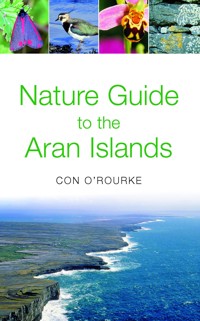
This consummate description of the wildlife of the Aran Islands – its flora, fauna, geology and climate – is by an expert intimately familiar with the landscape. The outcome of lifelong study and observation, it condenses key facts from the writings on Aran, illustrates them copiously with colour photographs, and fuses the whole into a concise source for exploring the diverse ecosystem of the islands. The Nature Guide to the Aran Islands throws open a window onto one of western Europe's environmental treasure-troves, and is an invaluable and enduring work of reference.
Sie lesen das E-Book in den Legimi-Apps auf:
Seitenzahl: 177
Veröffentlichungsjahr: 2015
Das E-Book (TTS) können Sie hören im Abo „Legimi Premium” in Legimi-Apps auf:
Ähnliche












Nature Guideto the Aran Islands
CON O’ROURKE
THE LILLIPUT PRESS • DUBLIN
NaBláthaCraige
Adúirtméleisnablátha:
‘Nachsuarachanáita fuairsibh
Lebheithagdéanamhaeir
Teanntasuasanseolebruachnahaille
Ganfúibhachanchlochghlas
Agussalacharnan-éan
Áitbhradach,lánleceo
Agusfarraigecháite
Níscairteanngriananseo
ÓLuangoSatharn
Legliondarachuroraibh.’
Adúirtnabláthacraige:
‘Iscumalinn,astór,
Táimidfaoidhraíocht
Agceolnafarraige.’
Liam O’Flaherty
Thrift (Sea Pink) at Synge’s Chair, Inis Meáin
Contents
Foreword
It gives me great pleasure to write the foreword for this beautiful publication, especially since Dr O’Rourke and I were fellow graduate students at Cornell University during the 1960s. It brings together in a single volume the forces of nature (geology, climate, flora, fauna and agriculture) that define the unique heritage of Aran, an extension of the renowned Burren in County Clare. Its appeal is broad-based, aimed both at casual visitors and those interested in natural history. It should also comprise a useful reference source for the various organizations involved in the islands’ development. The guide is copiously illustrated, mostly with the author’s own photographs. On a recent visit to the Royal Society of Antiquaries of Ireland, Merrion Square, on the occasion of their Presidential Lecture, I had the opportunity and pleasure to admire the striking photographs of the Irish countryside that Con O’Rourke has taken over the years.
Science has recently made a welcome return to our primary schools, as part of the government priority to increase public awareness of the vital role that science plays in national development. The series of scientific lectures and field forays in Aran organized by Dr O’Rourke and his colleagues for trainee primary teachers over the past twenty years should serve as a model for future teachers in interpreting their local natural environment for their pupils.
The author spent more than forty years as a research scientist in agriculture and was involved in the science awareness and youth programmes of the Institute of Biology of Ireland, the Royal Dublin Society and the Royal Irish Academy. He has applied his considerable experience and expertise to producing this comprehensive guide on the natural heritage of this truly unique and magnificent area.
Armed with the knowledge contained in this publication, the natural heritage of Aran is accessible to a wider audience and this will lead to a far greater appreciation of the need to ensure that the natural heritage of this unique area is safeguarded for future generations. Again let me congratulate Dr O’Rourke on the production of this lovely publication.
DrTomO’Dwyer, Chair The Heritage Council/An Chomhairle Oidhreachta
Acknowledgments
NUI Dublin: Gerard Doyle, Emer Ní Cheallaigh, Ian Somerville; NUI Cork: Ken Bond; NUI Galway: Ronan Browne, Micheline Sheehy Skeffington, Robert Wilkes; Trinity College Dublin: Paddy Cunningham, Shane Mawe; University of Limerick: John Breen; Galway-Mayo Institute of Technology: David McGrath; Royal Dublin Society Library: Mary Kelleher, Ger Whelan; Dublin Naturalists’ Field Club: Con Breen, Deirdre Hardiman, David Nash; Arramara Teoranta: Tony Barrow; Galway County Council: Kevin Finnerty; Botanic Gardens, Dublin: Matthew Jebb and (formerly) Maura Scannell; Met Éireann: Tom Sheridan; Geological Survey of Ireland: Andrew Sleeman; Fáilte Ireland; Ireland West Tourism; Bird Watch Ireland; Foras na Gaeilge; Department of the Environment, Heritage and Land Government; Áine de Blacam, Inis Meáin; Roger and Angela Faherty, Inis Meáin; Mícheál Ó Conaill, Inis Mór; Bríd Póil, Inis Óirr; Aisling Nic An tSithigh; Peter and Mary Carvill; Brendan Dunford; and Ruairí Ó hEithir
Permissions:
‘Na Blátha Craige’ by Liam O’Flaherty, by kind permission of Sáirséal – Ó Marcaigh and Caoimhín Ó Marcaigh
‘Cuimhne an Domhnaigh’ and ‘An tEarrach Thiar’ by Máirtín Ó Direáin, by kind permission of An Clóchomhar
‘Ireland with Emily’ by John Betjeman, by kind permission of John Murray Publishers
‘Inis Meáin, Seanchas agus Scéalta’ by Peadar Ó Concheanainn, by kind permission of An Gúm
‘The Aran Islands’ by Daphne Pochin Mould, by kind permission of David & Charles
‘Lovers on Aran’ by Seamus Heaney, by kind permission of the author
‘The Death of Irish’ by Aidan Mathews, by kind permission of the author
Illustration credits:
1.1 ERA-Maptec Ltd
2.1–2.3 by Helen Mathews
3.10, 3.44 by Con Breen
4.1–4.16 by Richard T. Mills
4.17–4.33 by Deirdre Hardiman
5.17 by Paul Kay, copyright Sherkin Island Marine Station
6.3 by Matt Nolan
All other photographs by the author.
Nature Guideto the Aran Islands
Introduction
The Aran Islands have been aptly described as one of the most written-about places in Ireland. This isolated rocky world midway up the west coast and at the north-western edge of Europe holds a particular fascination and appeals to a variety of interests. Most of the published works deal with the language (Irish/Gaelic), literature, social history, folklore and archaeology of the islands. Robert Flaherty’s classic documentary film ManofAran brought island life to the world’s attention in the 1930s.
Some of the many books on the Aran Islands include brief sections on their natural history, i.e. their flora, fauna and geology. This NatureGuide goes into greater detail on these and related topics, and aims to encourage visitors to linger, learn and perhaps return.
It is only in recent decades that Aran’s unique natural history has received official recognition. Some of the Aran rock formations, grasslands and marshes were classified by An Foras Forbartha in the 1970s as Areas of Scientific Interest (ASIS) of International, National or Local importance. On the basis of their unique flora, fauna and local environment, all three islands were later included in Natural Heritage Areas (NHAS). The large expanses of bare limestone currently comprise a Special Area of Conservation (SAC).
The impressive rock formations, the unique Burren-type flora thriving in what appears to be a barren ‘lunar’ landscape, the birds, the insects and the seashore life are of particular interest to that ever-increasing species, the eco-tourist.
The Aran Islands are a fragmented reef of the renowned Burren region of north-west County Clare, forming a breakwater across the mouth of Galway Bay. The geology, climate and farming practices of this elemental and fascinating region determine its unique natural environment. Thus, although the islands physically and environmentally belong to the wider Burren region of County Clare (Munster province), they are in County Galway (Connaught province) in terms of civil and church administration, Irish-language dialect and sporting loyalties.
The islands cover 43.3 km2 (4330 hectares), with a total population of 1280 in 2002 (compared to more than 3000 throughout most of the nineteenth century). Only about a third of the land can be farmed, with the rest comprising bare limestone rock or minimal rough grazing. A visitor’s main impression is of a maze of stone walls (totalling 2400 km in length) enclosing small, irregularly shaped fields.6.1
The islands are named Inis Mór, Inis Meáin and Inis Oírr, meaning the big island, the middle island and the east island, respectively. The origin of the name Aran is disputed, but is most likely to be from the Irish for kidney (ára), meaning, in the case of Inis Mór at least, a kidney-shaped ridge of land (see map at front). To distinguish them from the islands of Arranmore (County Donegal) and Arran in Scotland, they have often been called ‘The South Isles of Aran’. The islanders themselves often confine the wordÁrann to only the largest island, Inis Mór (also known as Aranmore). Since the islands are a Gaeltacht (Irish-speaking) area, all placenames in this NatureGuide, including the map, are in Irish, in accordance with the Placenames (CeantairGhaeltachta) Order 2004.
Although the Aran Islands and the wider Burren region are regarded as areas of elemental and timeless natural environment, their physical appearance today owes as much to man’s influence as to other factors over thousands of years. At the end of the last Ice Age about 10,000 years ago, plants recolonized the land. The pioneer vegetation comprised scrub woodland (dominated, in turn, by Juniper, willow, birch, pine and Hazel) on a thin cover of glacial drift soil. Early farmers cleared the woodland, starting from about 4000 BC in The Burren and somewhat later in Aran. A combination of farming practices and climatic changes over the years led to soil erosion and the extensive bare limestone karst landscape of today. The presence of so many impressive Bronze Age (2000–600 BC) forts, such as Dún Aonghasa on Inis Mór1.2 and Dún Chonchúir on Inis Meáin, suggests that the islands were once sufficiently fertile and prosperous to have supported a much larger population than that of today.
The Gaelic Revival of the late nineteenth century came to regard the Aran Islands as a pure and untarnished bastion of ancient Irish tradition. Many antiquarians, linguists and writers went there for study, inspiration or reflection. Before long, as Tim Robinson wryly observed, ‘the islands were in a perpetual state of being investigated’ (1995). Early visitors included George Petrie and John O’Donovan, followed by William Wilde, Samuel Ferguson, Thomas Westropp, Eugene O’Curry, Eoin McNeill, Fr Eoghan O’Growney, Kuno Meyer, W.B. Yeats, Lady Gregory, Patrick Pearse, J.M. Synge, Seamus Delargy and James Joyce.
The British Association for the Advancement of Science (BAAS) met in Ireland for their 1857 annual meeting and the programme included a study tour of Aran by seventy members of their Ethnological Section. These formidable savants, led by the president of the Section, Sir William Wilde, held their annual general meeting and banquet within the prehistoric Dún Aonghasa fort,1.2 with speeches in Irish, English and French, and dancing to bagpipes. Bemused islanders viewed the proceedings from the top of the ramparts.
Both the Anthropological Section of the BAAS and the Irish Ethnography Committee of the Royal Irish Academy (Haddon 1893) selected Aran for special study in the 1890s, as its inhabitants were considered to be racially and culturally the most representative of the original Celtic peoples. However, in the 1950s there was some dismay when newly available data on Irish ABO/rhesus blood groups showed that the Aran islanders were significantlyless ‘Celtic’ than the Connaught norm. Furthermore, recent DNA analyses carried out by Trinity College Dublin throw doubts on the supposed dominant Celtic strain in the overall Irish population.
Probably the first scientific visitor to Aran was the Welsh naturalist and Celticist Edward Lhwyd in 1700. However, systematic study of the islands’ natural environment dates only from the mid-nineteenth century. The flora, fauna and geology of Inis Mór were studied by Queen’s College Galway (now NUI Galway) and the Geological Survey in 1864. In 1895 the Irish Field Club Union organized a botanical foray on Inis Mór, led by Robert Lloyd Praeger. Since then a regular stream of scientists and students have studied the natural history of the islands.
Improved sea and air access to the islands has increased the number of visitors (mostly day-trippers) to approximately 200,000 per annum. Tourism has now replaced fishing and farming as the main economic activity. Increased tourism, however, inevitably affects the natural environment. The sandy coastal areas (machairs) of the islands are rich in flora and birdlife but are particularly vulnerable to damage by visitors. Even the hard limestone karst is not immune to incessant human traffic.
The entire flora and fauna of the Aran Islands comprises thousands of species and to describe them all is obviously beyond the scope of this NatureGuide. However, most of the plants, rock types, birds, insects and seashore species typical of Aran, and which visitors are likely to see, are included. More detailed information can be sourced from the bibliography.
This NatureGuide derives from the courses and field forays on Aran’s natural history organized by the author for the Institute of Biology of Ireland since the early 1980s. They were designed for tourists on cultural/environmental weekends, for second-level students on Irish-language summer courses, and for trainee primary teachers on their three-week Gaeltacht stints. As an aid to the courses, a bilingual video on Aran geology, climate, flora and birdlife was produced by the Institute in 1991, followed in 1993 by a poster on the local flora, BláthaÁrann. With the very welcome reintroduction of a Social, Environmental and Scientific module into the primary-school curriculum, the video, poster and this NatureGuide should serve as a useful model for teachers in interpreting the environment of their local areas.
The heritage of the Aran Islands is a unique but fragile combination of the Irish language, folklore, social history, archaeology, natural environment and traditional farming. Its natural environment, particularly its Burren-type flora, reflects current land-use practices. However, overall development of the islands’ economy will inevitably affect all aspects of their heritage. For this reason, the future development and maintenance of the islands’ tourism, natural environment and farming sectors requires sensitive management and coordination for their mutual benefit and long-term survival.
1
Geology
Mórchuidchlochisgannchuidcré
(Much rock and little soil)
Máirtín Ó Direáin, ‘Cuimhne an Domhnaigh’
Stony seaboard, far and foreign
Stony hills poured over space
Stony outcrops of the Burren
Stones in every fertile place
John Betjeman, ‘Ireland with Emily’
In geological and botanical terms The Burren (from Boireann, ‘a rocky place’) is defined as the approximately 300 km2 of karstic limestone of north Clare, south-east Galway and the Aran Islands. It is one of the largest stretches of exposed limestone in Europe. In the satellite image1.1 the bare grey limestone of Aran and The Burren can be clearly distinguished.
Geology is the study of ‘the bones of the earth’ and nowhere in Ireland are these bones more visible than in the Aran Islands. Limestone is Ireland’s commonest rock, laid down on the seabed from animal and plant remains in the Carboniferous Period. Geologically and botanically, the sedimentary limestone terrain of The Burren and Aran differs quite markedly from that of the igneous granites and metamorphic rocks of nearby Connemara on the opposite side of Galway Bay.
With the melting of the ice about 10,000 years ago, at the end of the last Ice Age, sea levels gradually rose by about 100 m. This not only created the island of Ireland but also separated the Aran Islands from the limestone mass of The Burren. They are the only limestone islands of any significant size off the Irish and British coasts.
1.1 Satellite image of Galway Bay. The bare limestone karst of the Aran Islands and The Burren (centre right) appears light grey
The Aran limestone is composed mainly of calcium carbonate, with dolomite (calcium magnesium carbonate) occurring in the darker strata. Limestone is more easily worked than granite and slabs for gravestones were regularly exported to Connemara (often in exchange for peat fuel). It was also exported in the form of lime for mortar and whitewash, and to ‘sweeten’ the acid soils of Connemara. The ruins of a lime kiln can be seen at Cill Éinne pier on Inis Mór.
The geology of The Burren and Aran has two main features:
Solid geology: Limestone from the Lower Carboniferous Period (formed more than 300 million years ago)Glacial geology: Glacial ‘erratics’ and boulder clay left behind after the relatively recent Ice Age of the Quaternary Period (1,700,000 to 10,000 years ago)Solid geology
The universe was created, according to the latest evidence, 13.7 billion years ago (BYA) during the ‘Big Bang’. Our own solar system dates from about 4.5 BYA, with life on earth starting about 3.5 BYA. On a geological timescale, the Aran rocks are not particularly ancient. To be tediously precise, they are from the Burren and Slievenaglasha formations of the upper part (Halkerian/Asbian/Brigantian) of the Viséan Stage of the Lower Carboniferous Period (Palaeozoic Era) of 345–325 million years ago (MYA) (Pracht etal. 2004). The oldest rocks in Ireland, dating from about 1750–1800 MYA (Precambrian Period), are on Inishtrahull off Malin Head, County Donegal, and on the Mullet peninsula, County Mayo.
The Aran limestone was formed by deposition on the seabed of the remains of various marine life forms. Each metre depth of Aran limestone would represent some tens of thousands of years of such deposition. This occurred not in its current position but at the bottom of a warm shallow sea near the equator. At that time what are now northern Europe, Greenland, North America and much of Asia were joined in a single landmass (Laurasia). Movements of the earth’s major tectonic plates have been continuous over geological time and about 270 MYA (Permian Period) the limestone drifted some thousands of kilometres northwards to its present position and rose above sea level in places.
The many animal and plant fossils1.8 1.9 in the Aran rocks are of tropical species from the Carboniferous Period, requiring a minimum annual temperature of 18°C. These were mostly primitive species, i.e. long before the evolution of birds, dinosaurs and mammals. However, some fish species from the Carboniferous Period, such as sharks and coelacanths, survive relatively unchanged to the present.
1.2 Cliff face at Dún Aonghasa, Inis Mór, showing two clay wayboard strata in the limestone
The Aran Islands rise to a maximum of 123 m above Galway Bay. The limestone bedding planes1.2 are almost horizontal, dipping 1-3° to the south. The limestone has been weathered into terraces, separated by escarpments 2–10 m high, giving a tiered or stepped appearance to the Galway Bay side of the three islands.1.3 The terraces comprise relatively hard limestone layers, separated by narrow and softer clay layers,1.10 which originated from a succession of changes in sea level.
The clay layers underlying each limestone terrace are defined as ‘clay wayboards’ (though often described as ‘shales’) and represent fossil soil horizons. There was sufficient time for these soil horizons to form over the limestone before sea levels rose and deposition resumed. The clay layers are more susceptible to weathering and erosion, leading to undercutting and eventual collapse of the overhanging limestone strata. Erosion of the clay has also created the numerous caves on the islands, with their associated legends of underground passages between the ancient forts, and even between the islands. The alternating layers of limestone and clay are seen to best advantage in the cliffs rising to 70 m on the south-western side of Inis Mór. Here, the erosion of the clay results in horizontal grooves and ledges between the limestone layers.1.2
Looking south-east across Galway Bay from Aran, a continuation of the distinct layers of limestone bedding planes that occur on Aran is visible on the Burren hills.1.4 Their contemporaneous origin is confirmed by the similarity of their fossils and limestone composition. The Burren strata dip gently south-south-west towards Doolin, where they run under the younger (Upper Carboniferous) sandstones and shales of the Cliffs of Moher.6.2 There is little folding or deformation of the strata in Aran, except for relatively minor faults at Poll na Brioscarnach, Maoilín an Ghrióra and a few other places on Inis Mór. This contrasts with the folding of some of the limestone hills in The Burren, such as the well-known and striking syncline at Mullach Mór.
Karst, clints and grykes
In geological terms, the Aran landscape is defined as a ‘glaciated karst’, the term ‘karst’ deriving from the Serbo-Croat krs and the Slovenian kras for an area of stony bare ground in what is now a part of Croatia and Slovenia (Daly etal. 2000). It is characterized by flat slabs of bare limestone, called smooth pavement or clints, interspersed with deep cracks called grykes.1.5 The most dominant gryke system runs south-south-west, with a less-developed secondary system at right angles to it. The vertical grykes (called scailp in Irish, as in The Scalp defile in the Dublin mountains) are usually straight and, combined with the horizontal bedding of the limestone, give a smooth, blocky (‘chocolate-bar’) structure to the landscape. This pattern is best seen in the perfectly rectangular, swimming-pool sized (33 x 12 m) Poll na bPéist (The Pool of the Sea Serpents) in Inis Mór.1.6 Tim Robinson (1986) has contrasted the striking oblong/cuboid rock structure of Aran with the more rounded ‘natural’ landscape of most other parts of Ireland.
1.3 Limestone terraces, Inis Meáin
1.4 Limestone karst of Aran (foreground) and The Burren, County Clare (distance)
1.5 Clints and grykes, Inis Mór
The clints often contain narrow white bands of calcite (calcium carbonate)1.7




