


Erhalten Sie Zugang zu diesem und mehr als 300000 Büchern ab EUR 5,99 monatlich.
- Herausgeber: The Crowood Press
- Kategorie: Lebensstil
- Sprache: Englisch
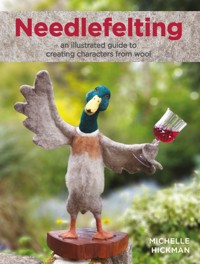
This practical guide explains how to needlefelt and make wonderful creations at your kitchen table with few specialist tools. The craft requires no sewing or needlework skills so is easy for beginners to try but has no limits for more experienced makers. Packed with inspiration, this beautiful book shows you the way and encourages you to create your own sculptures (large or small) and to experiment with your ideas.
Sie lesen das E-Book in den Legimi-Apps auf:
Seitenzahl: 96
Veröffentlichungsjahr: 2024
Das E-Book (TTS) können Sie hören im Abo „Legimi Premium” in Legimi-Apps auf:
Ähnliche


















CONTENTS
Introduction
1 Before You Begin
2 Starting to Needlefelt
3 A Furzie Hare: Step-by-Step
4 A Dog (and Other Animals): Step-by-Step
5 Birds
6 Human Figures
7 Where Next?
Useful Resources
Acknowledgements
Index
INTRODUCTION
Felt, produced by variations on a wet-felting process – like when you accidently felt a jumper in the washing machine – has been with us for thousands of years, even though the washing machine obviously hasn’t. To wet-felt you basically use friction or agitation of the wool with soap and water, thus opening the scales on the fibres and causing them to bond to each other. It might be said to be the oldest manufactured textile.
However, the production of felt by the use of needles – needlefelting or dry-felting – was first introduced in the mid-nineteenth century, originally producing cloth from scrap material from other weaving processes. Large banks of needles, each with small notches, were used to entangle the wool fibres to form large sheets of material. In the 1980s, an American couple named Eleanor and David Stanwood began to experiment with the production of small pieces by hand using needles from a local textile factory. Their intention was to use these to produce their own range of quilts, scarves and wraps.
Cat Fish – a cartoon cat holding up fish for eyes, although he does have his own beautiful eyes underneath of course! Shiny Angelina fibre has been added to look like water droplets. His wired tail has been used as a handy prop to help him stand and his wired fingers greedily clutch the fish.
Their work became known to Californian textile artist Ayala Talpai, who also began to experiment with the needles as an art form. She has written books on the subject including The Felting Needle from Factory to Fantasy and The Felting Needle Further Fantasies, and a visit to her website is highly recommended. In turn her work inspired the Danish artist Birgitte Krag Hansen, who produced three-dimensional figures using the process. Her trolls and fantasy figures soon became popular, and the new craft spread rapidly around the world. There are now artists and makers in many countries and many variations on the original methods, but all stem back to the wool and the needle.
Such a young craft is still evolving and there is therefore no particular right or wrong way to practise it – just what works for you. Every day we learn something new and so we continue to practise and experiment. Everyone felts differently, some compacting the wool quite densely and some, like me, who like the felt to be slightly squidgy so that there is something to sculpt into. In this book I will introduce you to my methods and foibles, in the hope that you will then find your own way in needlefelting, gaining confidence to experiment and just have a go. I hope you enjoy reading this book and are inspired to create your own sculptures as, with these transferable techniques, the only limit is your imagination.
CHAPTER 1
BEFORE YOU BEGIN
The concept behind this book is to guide, encourage and introduce the reader to the fascinating craft of needlefelting. Like some sort of magic trick, soft fluffy wool can be transformed through needlefelting into a ball that will bounce, or you can compact and transform the fibres into a piece of fabric or a solid shape. As the needle pushes through the fibres, the notches on the shaft tangle and mat the fibres together.
Although needlefelting can be a little repetitive, it is also extremely satisfying and the word that most often comes to mind is therapeutic. Like many creative crafts, it can also promote mindfulness and mental health therapy. It is a craft that requires few tools and can be easily picked up or put away until you have more time. You won’t forget where you were in your project and it might even be of benefit to have a break from creating so that you return to it with fresh eyes.
Needlefelting does not require many tools. You can start simply with wool, needles and a mat, adding wire, cutters and pliers for working with armatures.
There is something magical about wool. Not only is it renewable – a sheep once shorn can re-grow its fleece – it is also biodegradable, returning to the soil. It is a natural insulator, is breathable and can be worn in all seasons, keeping things warm as well as cool. It is naturally flame-retardant and provides UV protection. It is also very tactile, squishy and malleable. I must admit I do like to sniff my wool – I like it to smell clean but still slightly ‘sheepy’.
Another magical property of working with wool is how the character you are working on eventually ‘pops out’. This doesn’t happen at a particular point and is nothing to do with whether or not it has a face. You just fall in love with or bond with your creation as it seems to respond or co-operate with you.
Although I have divided the book into chapters and provided step-by-step or detailed instructions for projects, my intention is that it should be read as a whole. Think of your fibre as a medium which, by the use of a few tools, you can manipulate to produce a piece of work, in the same way as artists use their brush and paints or sculptors their chisel and stone to produce a piece of art. The techniques, tricks and tips in the individual chapters are all transferable, and together with the small selection of tools required will enable you to transform your fibre into something personal and individual to you.
My aim is to provide the foundations on which you can build your own personal style. Needlefelting is a comparatively young craft, and as such there are no right or wrong ways to achieve results. Don’t be afraid to try something different; just be confident.
TOOLS
Very few tools are required for needlefelting – at the most basic just a few felting needles, a felting mat and of course wool or fibre. If like me you are a lover of tools, you will soon find other useful things to add to your collection. The stork embroidery scissors in the photograph were my grandmother’s – did you know that the original stork scissors were actually clamps for the umbilical cord, used by midwives?
There are many needle handles available. This is a small selection of my favourites.
The Felter
The most important tool – look after yourself, make sure you are comfortable and felting sensibly. Relax your shoulders and do not use the whole force of your arm. Let the needle do the work. If you are flat felting on your mat with a multi-needle tool, and as a beginner, you could try using alternate hands to give your dominant hand a rest – unless this is dangerous in your case! Needlefelting is a craft that can be easily put to one side and resumed later, so although it is addictive you should know when to stop.
A close-up of a 38-star needle, showing the notches.
Needles
Felting needles are very delicate and will bend and break easily. They are not strong like sewing needles. Use them in a gentle straight in and out motion. They have notches on the shaft of the needle and there are different shaft shapes and numbers of notches for different purposes:
• Star, crown, triangle – these shapes relate to the arrangement of sides on the shaft
• Twisted or spiral – as you would imagine the shaft is twisted and gives a neater finish when using smoother, finer fibres
• Forked – used mainly for rooting in doll hair; the notches are on the tip of the needle
• Reverse – where the notches pull the fibres out giving a fluffy surface, although if you want a long coat for your animal it is easier to attach this separately
Needles come in different sizes, or gauges, ranging from 32 to 42. The higher the number, the finer the needle. I use a 38 star needle most of the time, as this is a general purpose needle and suits the wool that I like to use. It is very difficult to see the difference between them so they are generally colour-coded by the supplier. Make sure you buy your needles from a reputable source as cheap needles can break easily or rust. As a beginner you do not need to have a full complement of needle sizes – you can add these later, if you feel you need them.
When using the needle, be observant and notice how the notches push the fibres through the wool, causing it to tangle and compact. Notice that physical force is not required and the needle should be held like a pen and not like a dagger. Always look where you are stabbing – you wouldn’t cut with a knife without watching your hands. You can actually be quite gentle and go slowly, certainly at first, paying great attention to where your fingers are in relation to the needle – respect that delicate needle, treat it gently and it will be kind to your fingers.
Over time needles may become blunt, so if it seems that your felting does not seem effective, try a new needle to compare. Do not use bent needles or try to bend them straight again.
DISPOSING OF BROKEN AND BENT NEEDLES
Store broken and bent needles safely in a sealable container or glass jar and dispose of responsibly. That tiny sharp point can be difficult to spot and dangerous, especially to children and animals. One of those magnetic pick-up tools on an extending pole could be useful for finding and picking up stray needles. Ideally broken and damaged needles should be added to a needle sharps box which you can purchase from and return to a chemist.
Needle Holders
It is a good idea to use a needle holder as it is more comfortable to hold and use, plus you are more likely to bend your needle if putting direct pressure on it with your fingers. There are different types of single needle holders, pen tools that hold one to three needles and multi-needle holders available in plastic, wood and metal. More needles mean quicker felting, but it is not a good idea to use a multi-needle tool on a sculpture that has a wire armature or where it might put your fingers in danger. The number of needles used and the arrangement in the holder can be factors when you are felting something densely. If the wool feels like it is resisting, switch to fewer needles or experiment with different arrangements. I like to use two needles in a pen tool for sculpting and felting the surface, but a single needle for details and more delicate areas.
Felting Mat
You need some sort of surface to work on, one that is thick enough to protect your needles from being broken on a hard surface and to protect your hands. Please try to avoid working in your hands rather than on the mat; we all think we will be careful, but accidents do happen. I like to use a thick piece of dense upholstery foam as this does not break up but merely compacts over time, unlike cheap sponges which shed little pieces into your felt. Treat your mat gently – remember needlefelting is not about how much physical effort you put into your stabbing.




