


Erhalten Sie Zugang zu diesem und mehr als 300000 Büchern ab EUR 5,99 monatlich.
- Herausgeber: Team Service
- Kategorie: Geisteswissenschaft
- Sprache: Englisch
Renata Sorba was born in Asti and got her high school diploma at the Art School of the city. She spent a period of her life in London, where she refined her knowledge of the English language. She worked as an interpreter, a librarian and a bookseller.During her adolescence she was diagnosed with a bilateral hearing impairment that was a real trauma both for her and her family. With the help of hearing prosthesis she regularly went to school and participated to voluntary works. Even though her hearing, despite the help of the prosthesis, wasn't perfect, she tried to adopt some strategies and she didn't think it was appropriate to tell everyone about her situation.She practiced, in spite of her disease, every kind of sport, and in particular she loved swimming. However, during her period abroad she started having problems seeing at night, in fact she found it difficult to return home or to find her seat at the theatre.When she came back to Italy she went to see a specialist who told her she had retinitis pigmentosa. For a couple of years she ignored her disease, but when she was almost thirty her sight field started to narrow and she was having more and more problems going out at night.Renata Sorba is a member of the Equal Opportunities Commission of the city. During these years she has organized events, public performances and campaigns to raise awareness for people with sensorial disabilities. Recently Renata was nominated to be a honorary member of the Lions Guide Dogs Service Center in Limbiate and she will be given a prize on May 10th.
Sie lesen das E-Book in den Legimi-Apps auf:
Seitenzahl: 77
Veröffentlichungsjahr: 2016
Das E-Book (TTS) können Sie hören im Abo „Legimi Premium” in Legimi-Apps auf:
Ähnliche




















The proceeds from the sale of this book will be entirely
allocated to Association under at the author's discretion.
We used a bigger font in the printing of this book
in order to help those who have reading problems.
Renata Sorba
Neither different,
nor identical,
but free
Translated by Manuela Mastroianni
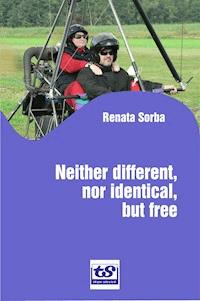
Cover photo: Renata Sorba with the pilot Fabrizio Bedana
at the event “Disabili Volando” (disabled who fly)
in Boglietto di Costigliole (Asti), in October 2008.
Renata Sorba
Neither different, nor identical, but free
2016, Team Service s.a.s. di Alberto Viarengo & C.
Centro stampa digitale, copisteria, grafica, casa editrice, TNT Point e Coworking
Via Nazario Sauro, 6 14100 Asti - Tel. 0141599781 Fax 0141598187
www.teamserviceasti.it
Cover: Laura Campagnolo
Composition: Elisa Labanca, Signum
Printed in Lagonegro (Potenza) at Tipolitografia Zaccara
I dedicate this book to all the people
That I met in my life, and in particular to all those that supported me
In different moments and that let me share with them
Many experiences, coming along with me in the path that brought me
From seeing to not seeing without asking too many questions
And without having too many prejudices about my previous and present life.
Thank you all, and I’d like to share this quote:
“Neither different, nor identical, but free”.
Letter to my mother Emi
It’s been a few months since you’re gone and the emptiness you left is immense. Our relationship got stronger during the last ten years in which we faced together all the stages of the disease that brought me to blindness. You’ve always been close to me, without ever being intrusive. You’ve always tried to encourage me to be free and most of all to defend my independence with all my heart. The dialogue and the heated discussions we had, typical of a mother-daughter relationship, led us to build a constructive bond. If today I am the person I am, I owe it to you. Even though you’re not physically with me anymore, you inspired me with your tenacity, your strictness, your determination and your generosity towards the other people. Every day I try to remember the qualities that characterized you, the freedom of thought and of actions was your strong point and I’m treasuring it. Thank you, Mum, for everything you’ve done for me, I will always keep you in my heart and everything I’ll do from now on, I’ll dedicate to you.
Renata
My story
My name is Renata Sorba and my oldest friends describe me as a shy, quiet and happy child that had a normal relational life.
Unfortunately during that period I was diagnosed with a bilateral hearing impairment and this was a shock for my family. My parents were able to live this situation with more serenity thanks to some people close to us and sensitive to this matter, whose help was fundamental. I remember that every time we went to see a specialist, the doctor reassured my anxious relatives by telling them that my hearing deficit was correctable with the help of some prosthesis.
After that, I started to study harder, I devoted myself to voluntary works and, when I reached the adult age, I went abroad, to London, where I worked as an au pair.
Even though my hearing, in spite of the prosthesis, was not perfect, I used replacement strategies because at the time I didn’t find it appropriate to inform people about my situation.
I’ve always been a very active person and I’ve never had limits, so I practiced every kind of sports. Since I was a girl, during summer time, I’ve been attending sports centres and in particular a swimming pool, where I learnt by myself to swim and to love this sport.
I remember that when I was a teenager I used to spend every afternoon in the public swimming-pool in Asti with some friends, and we used to challenge each other in diving and swimming.
I’ve always seen water as a mean of transport and I had confidence with it, so I let it “cradle” me for hours. I used to alternate swimming with water plays such as “the candle” or “the bridge”. I have always tried to nurture this passion until my sight allowed me to do so, and I was able to see the line indicating the lane on the bottom of the swimming pool, and this allowed me to swim backstroke, freestyle or other. When my sight gradually started to lower, I developed the strategy of getting acquainted with the pool, searching it with somebody guiding me. I got used to swim breaststroke, thanks to which I still have the possibility to swim alone, taking as a reference point the side of the pool.
Today, just like some years ago, when I dive in the pool (I use to attend private swimming pools now) I feel completely free, relaxed, peaceful and loose.
I have the same relationship with the sea, but it is too wide, so it is difficult for me to maintain the orientation and the trajectory, and it is important for me to have some help, especially a vocal help, in order to have reference points and to be able to swim freely.
The feeling that I have every time I swim or that I’m in the water, is that of not having barriers. My sensorial insufficiency is not indenting the atmosphere of symbiosis and well-being I feel in this space.
My parents have always prompted me to do it and my brother Paolo has always prompted me to practice some outdoor sports that would help me socialize and meet people of our age: as a matter of fact my brother was part of the Asti soccer team for years.
Sport also taught me to operate in the working environment, in fact I had several jobs: I was an interpreter, an employee, a librarian and a bookseller.
I started having the first symptoms of night-blindness when I was abroad, when I had difficulties returning home or finding my seat in a cinema. When I came back to Italy I went to see an ophthalmologist, and I was diagnosed with retinitis pigmentosa. I decided to ignore the problem for a couple of years, but when I was working as a librarian I ended up cataloguing a pamphlet on my disease: I read it really fast and I got discouraged.
When I was almost 30 my field of view started to narrow and I started having more and more problems going back home alone at night.
Considering the serious health problems of my father and the efforts my mother was making to face the money problems that came from them, I decided not to involve them in what I was facing.
During that period, at work, an article from the magazine Lumen, fell in my hands. Its title was “From grief...to peace” and it was written by Lucas Mathiessen, who described Elizabeth Kubler-Ross’ grief phases: shock, denial, compromise, anger, depression and finally acceptation. While reading it I recognized myself in the phases described because I was living the moment of compromise, so I decided to see a psychologist.
My sight was at a stage that didn’t allow me to have a “normal” job, but it was also not so serious to allow me to be part of the legally protected people. My sight destabilised me and the people that surrounded me: for example it was difficult to make them understand that I could climb the stairs by myself, but that I couldn’t climb them down as easily. In fact, it is not easy for visually handicapped people, to explain to those who ignore their condition, the reality and the problems connected to the disease.
A visually handicapped person often finds himself in an intermediate condition and if for example he’s able to see a fly, it happens that right after that he cannot see a wardrobe. Episodes like these can lead the visually impaired to live a situation that hinder the people near him, so it is important that they know the problems connected to blindness without being superficial or rhetorical.
It is necessary to understand that this is a disability condition that cannot be cured; it is not a disease, but it can produce dramatic effects and people need to learn to cure by themselves.
You have to take into account that society knows very little of these problems, and often “normal” people tend to get rid of the question by treating the affected person as unlucky, as a handicapped or as someone who has to resign himself and accept his destiny.
You have also to consider the difference between being visually impaired since you were born and becoming visually impaired after: in the first case the person lives the condition (in part similar to a blind person) as if it was “normal” for him, in the second case the person suffers a lot more the disability trying to adapt to the new reality.
The family of the visually disabled can’t often understand the limitations of the disability, and sometimes they diminish the problems or they act as if they don’t see it. They often try to cover for their relative in every action, as if he was not able to do things by himself.




