


31,99 €
Mehr erfahren.
- Herausgeber: John Wiley & Sons
- Kategorie: Geisteswissenschaft
- Sprache: Englisch
Solidly grounded in Chinese primary sources, Neo Confucianism: Metaphysics, Mind, and Morality engages the latest global scholarship to provide an innovative, rigorous, and clear articulation of neo-Confucianism and its application to Western philosophy.
- Contextualizes neo-Confucianism for contemporary analytic philosophy by engaging with today’s philosophical questions and debates
- Based on the most recent and influential scholarship on neo-Confucianism, and supported by primary texts in Chinese and cross-cultural secondary literature
- Presents a cohesive analysis of neo-Confucianism by investigating the metaphysical foundations of neo-Confucian perspectives on the relationship between human nature, human mind, and morality
- Offers innovative interpretations of neo-Confucian terminology and examines the ideas of eight major philosophers, from Zhou Dunyi and Cheng-Zhu to Zhang Zai and Wang Fuzhi
- Approaches neo-Confucian concepts in an penetrating yet accessible way
Sie lesen das E-Book in den Legimi-Apps auf:
Seitenzahl: 699
Veröffentlichungsjahr: 2017
Ähnliche




















Table of Contents
Cover
Title Page
Preface
Acknowledgments
Introduction
What Is Neo‐Confucianism?
Terminology
Chapter Synopsis
The Philosophers
Part I: Neo‐Confucian Metaphysics
1 From Nothingness to Infinity
Introduction
Historical Controversies over
Wuji
Being (
You
有) and Nothingness (
Wu
無)
The Boundless (
Wuji
) and the Supreme Ultimate (
Taiji
)
Conclusion
Primary Sources
Selection in English
2 The Basic Constituent of Things
Introduction
The Concept of Primordial
Qi
(
Yuanqi
)
The Initial Cosmic State: The Supreme Vacuity (
Taixu
太虛)
Vacuity Versus Vacuum
The Supreme Equilibrium (
Taihe
太和) and the Supreme Ultimate (
Taiji
)
Qi
as the Constituent of Material and Immaterial Things
A Necessitarian Theory of Principle (
Li
) in
Qi
Conclusion: Theory of
Qi
and Beyond
Primary Source
Selection in English
3 Cheng–Zhu School’s Normative Realism
Introduction
Cheng Hao’s Conception of Principle (
Li
): The Principle of Heaven
Cheng Yi’s Conception of Principle (
Li
): Principle is one but its manifestations are many
An Ontological Hierarchy of the Cheng Brothers: Non‐Reductionism of Principle
Zhu Xi’s Notion of Principle as a Holistic Order of the World
Zhu Xi’s Notion of the Supreme Ultimate and Its Instantiation in Particular Things
Zhu Xi’s Analysis of the Relationship between Principle and
Qi
Conclusion
Primary Sources
Selections in English
4 Wang Fuzhi’s Theory of Principle Inherent in
Qi
Introduction
Wang Fuzhi’s Moral Metaphysics—Principle Inherent in
Qi
The Unification of Substance and Function
Principle as the Necessary Law of the World
The Unification of
Dao
and Concrete Things (
Qi
器)
The Role of Humans in the World of Nature
Conclusion
Primary Sources
Selection in English
Part II: Human Nature, Human Mind, and the Foundation of Human Morality
5 Zhu Xi’s Internal Moral Realism
Introduction
What Is Human Nature (
)?
The Root of Good and Evil
Zhu Xi’s Moral Psychology of Emotion
The Role of Human Mind (
Xin
) in Moral Cultivation
Conclusion
Primary Sources
Selections in English
6 Lu Xiangshan and Wang Yangming’s Doctrine of Mind Is Principle
Introduction
The Mind Is Principle and Principle Is in the Mind
Humanistic Moral Realism
Pragmatist Metaphysics
Conclusion
Primary Sources
Selections in English
7 Wang Fuzhi’s Theory of Daily Renewal of Human Nature and His Moral Psychology
Introduction
The Daily Renewal and Daily Completion of Human Essence
Wang Fuzhi’s Moral Psychology—Functions of the Mind
The Affirmation of Human Desires: The Principle within Human Desires
Wang Fuzhi’s Moral Theory Based on His Moral Psychology
Conclusion
Primary Sources
Selection in English
Part III: The Cultivation of Virtue, Moral Personality, and the Construction of a Moral World
8 Zhang Zai on Cultivating Moral Personality
Introduction
The Socio‐Cognitive Model of Cultivating Moral Personality
Establishing A Moral Identity—How to Define A Moral Self through Volition (
Zhi
)
The Transformation of Moral Personality through Learning (
Xue
)
Cultivating Moral Expertise through the Accumulation of Righteousness (
Jiyi
) and Habituation (
Xi
)
Identifying the Moral Goal: Moral Exemplars and the Extraordinary Moral Commitment of the Sages
Rites and Rules of Propriety (
Li
) and Situational Fit (
Shizhong
)
Self‐Regulation (
Keji
) and Desire (
Yu
)
The Ultimate Goal: The Effortlessness of Moral Exemplars
Final Assessment of Zhang Zai’s Socio‐Cognitive Theory in the Contemporary Discourse
Conclusion
Primary Source
Selection in English
9 The Cheng Brothers’ Globaist Virtue Ethics and Virtue Epistemology
Introduction
Moral Skepticism and the Cheng Brothers’ Globalist Virtue Ethics
The Virtue of Humaneness (
Ren
): Universal Altruism
The Virtue of Authenticity (
Cheng
) and the Virtue of Respectfulness (
Jing
)
The Cheng Brothers’ Virtue Epistemology
The Aim of Knowledge
The Conditions for True Knowledge
The Methodology of Knowledge: The Investigation of Things
Answers to Skepticism about Robust Character Traits
Conclusion
Primary Source
Selection in English
10 Zhu Xi’s Methodology for Cultivating Sagehood
Introduction
Zhu Xi’s Moral Epistemology: The Investigation of Things for the Extension of Moral Knowledge
The Psychological Preparedness for Moral Knowledge: Reverence (
Jing
) in the Heart
Zhu Xi’s Theory of Moral Motivation: From Moral Knowledge to Ethical Action
Conclusion
Primary Sources
Selections in English
11 Wang Yangming’s Intuitionist Model of Innate Moral Sense and Moral Reflexivism
Introduction
The Innateness of Morality
An Innate Moral Compass:
Liangzhi
(良知) as an
A priori
Moral Intuition
Wang Yangming’s Moral Reflexivism
Moral Methodology: The Method of Retrieving One’s Innate Moral Intuition is to Remove Selfish Desires
The Unity of Knowledge and Action
Conclusion
Primary Sources
Selections in English
12 Constructing a Moral World
Introduction
Wang Fuzhi’s Sentimentalist Theory of Moral Motivation
Enlarging Our Circles of Concern—Expanding on Wang Fuzhi’ Social Sentimentalism
Conclusion
Primary Sources
Selection in English
References
Index
End User License Agreement
List of Illustrations
Chapter 01
Figure 1.1 Zhou Dunyi’s
Taiji
Diagram
Figure 1.2 Chen Tuan’s
Wuji
Diagram
Guide
Cover
Table of Contents
Begin Reading
Pages
iii
iv
v
ix
x
xi
xii
1
2
3
4
5
6
7
8
9
10
11
12
13
14
15
16
17
18
19
20
21
22
23
24
25
26
27
28
29
31
32
33
34
35
36
37
38
39
40
41
42
43
44
45
46
47
48
49
50
51
52
53
54
55
56
57
58
59
61
62
63
64
65
66
67
68
69
70
71
72
73
74
75
76
77
78
79
80
81
82
83
85
86
87
88
89
90
91
92
93
94
95
96
97
98
99
100
101
102
103
104
105
106
107
108
109
110
111
112
113
114
115
116
117
118
119
120
121
29
125
126
127
128
129
130
131
132
133
134
135
136
137
138
139
140
141
142
143
144
145
146
147
148
149
150
151
152
153
154
155
157
158
159
160
161
162
163
164
165
166
167
168
169
170
171
172
173
174
175
176
177
178
179
181
183
184
185
186
187
188
189
190
191
192
193
194
195
196
197
198
199
200
201
202
203
205
206
207
208
209
210
211
212
213
214
215
216
217
218
219
220
221
222
223
224
225
226
227
228
229
230
231
232
233
234
235
236
237
238
239
240
241
242
243
245
246
247
248
249
250
251
252
253
254
255
256
257
258
259
260
261
262
263
265
266
267
268
269
270
271
272
273
274
275
276
277
278
279
280
281
282
283
284
285
286
287
288
289
290
291
292
293
294
295
296
297
298
299
301
302
303
304
305
307
306
308
309
310
311
312
313
314
315
316
Neo‐Confucianism
Metaphysics, Mind, and Morality
JeeLoo Liu
California State University, FullertonCA, USA
This edition first published 2018© 2018 John Wiley & Sons, Inc.
All rights reserved. No part of this publication may be reproduced, stored in a retrieval system, or transmitted, in any form or by any means, electronic, mechanical, photocopying, recording or otherwise, except as permitted by law. Advice on how to obtain permission to reuse material from this title is available at http://www.wiley.com/go/permissions.
The right of JeeLoo Liu to be identified as the author of this work has been asserted in accordance with law.
Registered OfficesJohn Wiley & Sons, Inc., 111 River Street, Hoboken, NJ 07030, USA
Editorial Office350 Main Street, Malden, MA 02148‐5020, USA
For details of our global editorial offices, customer services, and more information about Wiley products visit us at www.wiley.com.
Wiley also publishes its books in a variety of electronic formats and by print‐on‐demand. Some content that appears in standard print versions of this book may not be available in other formats.
Limit of Liability/Disclaimer of Warranty
While the publisher and author have used their best efforts in preparing this book, they make no representations or warranties with respect to the accuracy or completeness of the contents of this book and specifically disclaim any implied warranties of merchantability or fitness for a particular purpose. It is sold on the understanding that the publisher is not engaged in rendering professional services and neither the publisher nor the author shall be liable for damages arising herefrom. If professional advice or other expert assistance is required, the services of a competent professional should be sought.
Library of Congress Cataloging‐in‐Publication Data
Names: Liu, JeeLoo, author.Title: Neo‐Confucianism : metaphysics, mind, and morality / JeeLoo Liu, California State University Fullerton, CA, US.Description: First edition. | Hoboken : Wiley, 2018. | Includes bibliographical references and index. | Identifiers: LCCN 2017016337 (print) | LCCN 2017017858 (ebook) | ISBN 9781118619322 (pdf) | ISBN 9781118619186 (epub) | ISBN 9781118619148 (hardback) | ISBN 9781118619414 (paper)Subjects: LCSH: Neo‐Confucianism. | BISAC: PHILOSOPHY / Eastern.Classification: LCC B127.N4 (ebook) | LCC B127.N4 L574 2017 (print) | DDC 181/.112–dc23LC record available at https://lccn.loc.gov/2017016337
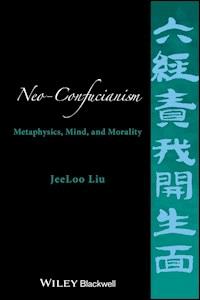
Cover image: (Texture) © Lightspring/Shutterstock; (Caligraphy) Yue Feng (岳峰); (Text) Wang Fuzhi, translating to “The Six Classics make it incumbent upon me to break a new path and present a new facet.”Cover design by Wiley
This book is dedicated to my mother Chu‐Wei Lin Liu ( 劉林祝闈), whose high standards made me who I am today.
Preface
This book is not about the history of Chinese philosophy, and it does not confine neo‐Confucianism to its historical contexts. Instead, it aims to extract the philosophical core of neo‐Confucianism in the Song‐Ming era to make it relevant to contemporary philosophical discourse. The methodology of this book is comparative philosophy, and the angle of comparison is that of analytic philosophy. The analytic reconstruction of neo‐Confucianism is chosen on the grounds of my philosophical training and expertise. It provides one credible analysis of neo‐Confucianism among many other respectable approaches to Chinese philosophy. My intent behind writing this book is not to define what neo‐Confucianism is, but to demonstrate how one could philosophically engage neo‐Confucianism.
In this book, many contemporary philosophical theories in the analytic tradition are employed to provide a hermeneutic entry to the ancient philosophical ideas in neo‐Confucianism. The claim is of course not that neo‐Confucians of the eleventh to the seventeenth century did embrace these contemporary doctrines, since such a claim would result in anachronistic or Procrustean interpretation. The contemporary recontextualization, however, can liberate neo‐Confucianism from its particular historical contexts and make it relate to contemporary readers. I believe that most philosophical ideas, though having their contextual roots, emerge out of shared human concerns, and can thus be recontextualized in different eras. A text should live on through its interpreters and readers.
At the same time, such a comparative approach, that is, using Western philosophical concepts to interpret Chinese philosophy, could incur the criticism of epistemological colonization, or the so‐called reversed matching of meaning (fanxiang geyi 反向格義, borrowing Xiaogan Liu’s terminology), to which many Chinese historians and Sinologists strongly oppose. Some Chinese scholars have vehemently argued against using any Western philosophical ideas to explicate Chinese thought, in that such Westernization would maim “the essence” of Chinese thinking. What I want to challenge in this book is exactly this kind of philosophical nationalism or essentialism that takes Chinese philosophy to be exclusively of Chinese intellectual lineage, and intelligible only to Chinese readers. Using Western terminology to explicate Chinese philosophy is not necessarily to force the latter into the former’s conceptual framework. If the interpretation remains true to the text, and does not distort the philosophical ideas of the philosophers, then the comparative angle can serve as a bridge for outsiders to gain intellectual access to Chinese philosophy. At the same time, scholars familiar with Chinese philosophy can also be motivated to learn more about Western philosophical theses. By reconstructing neo‐Confucianism with the terminology of contemporary analytic philosophy in this book, I hope to render these philosophical ideas accessible and philosophically inspiring. To be true to the philosophical import of neo‐Confucianism, the reconstruction is based on careful textual analysis, in consultation with other relevant interpretations both in English and Chinese secondary sources.1 What I hope to present to the readers is a refreshing, innovative and perspicuous articulation of the philosophical dimension of neo‐Confucianism.
Note
1
Unless otherwise specified, all translations from Chinese into English are my own.
Acknowledgments
This book was made possible by a generous grant from the John Templeton Foundation. I wish to thank its past and present directors Hyung Choi, Michael J. Murray, and John Churchill for their assistance.
This book serves as the sequel to my first book, An Introduction to Chinese Philosophy: From Ancient Philosophy to Chinese Buddhism (Blackwell, 2006). I am deeply indebted to the former philosophy editor of Wiley‐Blackwell, Jeff Dean, for helping launch my writing career. In the late 1990s, when I was a junior assistant professor at SUNY Geneseo with little writing credentials, I approached Jeff with my idea of writing an introduction to Chinese philosophy with an analytic approach. He embraced the idea enthusiastically and provided me with helpful feedback along the way. I am very grateful to Jeff for trusting me to write the book the way I wanted to write it. We agreed at the time that an introduction that spans into neo‐Confucianism would have made the book too long, so neo‐Confucianism would have to wait for the second volume. It took me nearly 10 years to complete this project. With this book, Jeff was again welcoming and encouraging, and offered his shrewd editorial suggestions including the current title for this book. I was sorry that Jeff left Wiley‐Blackwell before the book could be completed; however, I am thankful that the current editor Marissa Koors took over the project for publication. I would also like to thank the two reviewers of this book for their friendly and very helpful suggestions for improvement.
Neo‐Confucianism has always been my passion. When I was an undergraduate at National Taiwan University, I loved reading neo‐Confucian writings on the rooftop balcony at my parents’ apartment. Watching the sunsets and beautiful clouds, I often thought that this was the same sky that these neo‐Confucians shared hundreds of years ago and felt connected with them. The person who instilled this passion in me was my undergraduate professor and later my master’s thesis advisor, Yongjun Zhang 張永. He is a living neo‐Confucian in our times, dedicated to learning, teaching, and passing on the torch of Dao. I am extremely grateful to him for opening the door to neo‐Confucianism for me.
In 2009, when my idea for writing this book first emerged, I was invited to conduct an experimental summer course on the same topic at National Chengchi University in Taiwan. I would like to thank the Philosophy Department of National Chengchi University for giving me this great opportunity to develop my thoughts through engaging discussions with students. I must credit the participants for helping make this book possible: my teaching assistant Zili Zhang 張子立, the fellow scholars as well as the students in this class. I am also grateful to the Philosophy Department of the Chinese University of Hong Kong for providing a sponsored sojourn during the final stage of my manuscript revision.
Last, but most important, I also want to thank my husband Michael Cranston and our two sons Collin and Dillon, for they have provided a loving, supportive, and stress‐free environment for me to work on my book over the years.
Introduction
This book gives a detailed philosophical analysis of eight central figures in Chinese neo‐Confucianism from the Song‐Ming era (between the eleventh and the seventeenth centuries). It is a sequel to the author’s first book An Introduction to Chinese Philosophy: From Ancient Philosophy to Chinese Buddhism (Blackwell, 2006), which examines five major philosophical schools in the ancient period as well as four principal schools of Chinese Buddhism. This book continues the analytical introduction to Chinese philosophy given in the first book and focuses on neo‐Confucianism.
The book draws comparisons to analytic philosophy in regard to its main issues and concerns. This approach helps to bring neo‐Confucianism into the context of contemporary philosophy and to show how issues expressed in distinctively neo‐Confucian terminology relate to issues in contemporary philosophy. One of the aims of this comparative approach is to show that even though Chinese philosophers used different terms, narrative strategies, and analytic modes, their concerns were often similar to those of their Western counterparts, for example: What is the nature of reality? Wherein lies the foundation of our moral values? Is human nature fundamentally good or bad? How do human beings connect to the whole universe? What is the foundation of our knowledge of the world and of moral reality? Such an approach will make these issues accessible to Western thinkers by shedding light on their universality through the analytic explication of these texts. This book will enable Western readers who are not familiar with Chinese philosophical terminology or its intellectual history to gain a philosophical appreciation of neo‐Confucianism. Furthermore, by consulting both English secondary sources and representative Chinese works on neo‐Confucianism, it will facilitate a more active philosophical exchange between Western philosophers working on neo‐Confucianism and contemporary Chinese scholars by coming to see the shared concerns as well as the common pursuits laid out in a clear and accessible language.
What Is Neo‐Confucianism?
“Neo‐Confucianism” typically refers to the revival of classical Confucianism developed between eleventh and eighteenth centuries in China, spanning over four dynasties in Chinese history: Song, Yuan, Ming, and Qing dynasties. Neo‐Confucianism was a new form of Confucianism that came after the dominance of Daoism and subsequently Buddhism within Chinese intellectual circles. Comparable to what “Modern Philosophy” accomplished in Western philosophy, neo‐Confucianism also revitalized classical philosophy and expanded the traditional philosophical discourse, adding new dimensions and attaining new heights. The transformation of Confucianism as a result of the challenge and influence of Daoism and Buddhism was the most remarkable and significant development in the history of Chinese philosophy. Neo‐Confucianism invigorated the metaphysical speculation found in classics such as the Yijing, and incorporated different concepts and perspectives derived from Daoism and Buddhism into its discourse. Also, partly as a response to the Daoist skeptical attitude toward the possibility of knowledge, neo‐Confucianism brought the theory of knowledge asserted in classics such as The Great Learning to a much more sophisticated level.
Frank Perkins gives neo‐Confucianism an apt summary: Neo‐Confucianism “can be broadly characterized as the attempt to integrate a speculative, systematic metaphysics influenced by Buddhism and Daoism into the ethically and socially oriented system of Confucianism” (Perkins 2004, 20–21). Neo‐Confucians were fundamentally concerned with the role humans play in the moral reconstruction of the world around them. In their view, humans not only endow the world of nature with meaning but also share moral attributes with natural phenomena. Neo‐Confucians’ metaphysical views lay the foundation for their moral theories. The goal of this book is to explicate Song‐Ming neo‐Confucianism in its three major themes (metaphysics, mind, and morality) and to show how they exemplify a coherent underlying concern: the relation between nature and human beings. In their various debates, neo‐Confucians touched on the possibility of an innate moral sense and the various means of moral knowledge. In addition, neo‐Confucianism contains an intriguing discourse on the possibility and foundation of morality. In neo‐Confucians’ views, morality takes its root either in the universal goodness of human nature or in the individual’s moral reflection and cultivation of the human mind. This debate between the School of Nature and the School of Mind was one of the major themes in neo‐Confucianism. Finally, in neo‐Confucianism we see a consistent effort not only to redefine a realist worldview that affirms the world as existing independently of human conception, but also to reassert a humanist worldview that places human beings at the center of meaning and values. Both the realist and the humanist commitments were direct responses to the challenges of Daoism and Buddhism, and they delineate the spirit of neo‐Confucianism.
Neo‐Confucians were generally concerned with establishing a moralistic naturalism, that is, the natural world in which we live demonstrates many good attributes that are worthy of humans’ emulation. We may say that they developed a form of moral metaphysics. According to a contemporary scholar on neo‐Confucianism, Yong Huang, “what is more unique about neo‐Confucianism is its development of moral metaphysics as an ontological articulation of moral values advocated by classical Confucians” (Huang 2014, 195). What distinguishes neo‐Confucianism from classical Confucianism is exactly this moral metaphysics. According to neo‐Confucians, there is a higher order governing the world, which they call “heavenly principle,”, and the content of this higher order is also the objective moral principle for human beings. At the same time, neo‐Confucians also embraced the Chinese philosophical tradition (founded in the Yijing) of positing a basic element of qi as the material/physical foundation of the universe. The core thesis in Neo‐Confucian metaphysics is view that qi is the primary constituent of all things and that there is an inherent order in the operation of qi.
With regard to the psychological foundation of human morality, neo‐Confucians were predominately in the Mencian camp. Mencius advocates moral internalism—the foundation of human morality lies within the agent’s internal psychological makeup. According to Mencius, humans are different from other animals because they are born with moral sentiments. Humans alone are moral creatures. This is what defines the notion “human” (ren 人), which in his usage is not a natural kind but a moral category. There are, according to Mencius, four universal moral sentiments in the mankind: (i) the sentiment of commiseration, (ii) the sentiment of shame and disgust, (iii) the sense of reverence and deference, and (iv) the sense of right and wrong. Since humans are endowed with these moral sentiments, morality is a natural extension of what humans have within themselves. Evil is the result of not cultivating one’s “moral sprouts.” According to him, morality is not the sheer result of social conditioning and is not derived from social contract or rational consensus based on calculated mutual self‐interests. On the contrary, human morality is possible only because we humans are moral creatures.
Neo‐Confucians identified the internal source of moral agency in humans’ moral sense, moral judgment, moral intuition, or moral sentiments. What they shared in common was the view that moral action is an autonomous act springing from an individual’s heart. They dismissed Xunzi’s teaching that morality is the product of humans’ contrived conditioning (wei 偽). According to Xunzi, we need to use rules of propriety and rituals to curtail the bad traits in human nature. Morality is the result of human endeavor and social institutions, while evil is simply the result of following inborn human nature without societal restraints. There is no such thing as “innate goodness,” though Xunzi does claim that humans have reason and can appeal to the mind’s moral cognition to learn good. From a moral externalist’s point of view, morality derives from social conditioning for the purpose of peaceful coexistence. The external social environment is responsible for the existence or the lack of our moral sense. According to this view, humans’ moral consciousness and sense of morality are taught and learned. Hence, different social backgrounds and cultural rearing could generate incompatible moral views or even create diverse moral standards. In other words, cultural relativism is a natural extension of moral externalism. One characteristic in neo‐Confucianism is their unequivocal conviction in the existence of the objective, universal moral standard, which they identify as heavenly principle. To them, the existence of a moral reality is an indisputable fact of nature, and the universality of moral truths is grounded in humans’ shared moral sense.
Neo‐Confucians based their moral theories on their metaphysical view of the objective moral reality in the world of nature. This worldview originated in the Yijing, and the four attributes of heaven and earth (origination, advancement, enrichment, and perseverance) are the four virtues of each cosmic state represented by 64 hexagrams in the Yijing. With a sympathetic reading, we may render this perspective of nature as a version of teleology—the world is governed by the principle of life and the overarching telos assumed in this worldview is simply the creation and sustenance of life. From the contemporary viewpoint, we may see that the world of nature operates under the principle of life, as demonstrated by the fact that evolution continues and multiple forms of organism exist to this day. It is the subject matter of natural sciences to investigate which natural phenomena function to sustain life and what causes natural disasters that destroy life. Looking at aspects of the world of nature from a humanistic perspective, on the other hand, we can say that many natural phenomena, such as sunshine and raindrops from heaven and the richness of the soil from earth, are conducive to the continuation of life. Some natural phenomena such as hurricanes do indeed destroy lives; nevertheless, seasons rotate and life continues after destruction. Ancient Confucians found great solace in the continuation of life as they observed in the world of nature, and this natural fact became the foundation for their conviction that the dominant principle in nature is the continual generation and regeneration of life (shengsheng buxi 生生不息). Given this conviction, they viewed the world of nature itself as a “beneficent” universe. From this observation of nature, they concluded that there is an ultimate moral mission for human beings: to contribute to the fulfillment of the principle of life.
Neo‐Confucian moral theories are best understood as falling within the category of virtue ethics.1 Virtue ethics is the approach of ethical theories that emphasize the virtues, or moral character, of the moral agent. As a form of normative ethics, virtue ethics gives the precept of what kind of virtues one ought to cultivate, or what kind of moral character one ought to develop. It is an agent‐centered approach, in contrast to the act‐centered approaches such as deontology, which judges the moral worth of an act in terms of its adherence to some specified moral duties, or consequentialism, which prescribes or prohibits moral acts in consideration of their possible consequences. Virtue ethics focuses less on defining rules for moral acts; instead, it stresses more on defining moral personhood. A virtuous act is one performed by virtuous agents. To define virtuous personhood, virtue ethicists have to identify the essential moral traits that anyone ought to cultivate in order to become a moral agent. They have to address the following question in their attempts to define virtue: What are the virtues such that as long as an agent possesses them, he or she is morally good? Their goal is thus to define those moral virtues that they deem to be enduring and causally efficacious in bringing about moral behavior in individuals. The highest moral character that these neo‐Confucians all share in their moral image of the world is that of a sage: the ideal moral agent who has a sanguine vision of what one ought to do in all situations and unwavering moral character. Cultivating sagehood is the common moral aim for neo‐Confucianism.
However, among virtue ethicists there are still different approaches. Philip J. Ivanhoe distinguishes two types of virtue ethics: virtue ethics of flourishing (VEF) and virtue ethics of sentiments (VES). The former approach “is grounded in a comprehensive and detailed conception of human nature” and conceives the condition of flourishing for an ideal moral agent as the teleological aim of moral cultivation. The latter, on the other hand, considers a moral agent’s virtue in terms of social interactions, and places virtue on the basis of certain emotions or sentiments of human beings as part of humans’ psychological makeup (Ivanhoe 2013, 29–30). Both approaches begin with a theory of human nature, and the difference could be characterized as one between an ideal versus an empirical conception of human mind. Hence, the latter (VES) is more empirically grounded. It is particularly in the works on VES that we see the alliance between normative ethics and moral psychology. However, neo‐Confucian moral philosophy should be regarded as a form of VEF. Neo‐Confucianism grounds its conception of ideal moral agent in sagehood, and all neo‐Confucians aimed to present their methodology of arriving at sagehood as the aim of moral cultivation.
Terminology
The Notion of Principle (li 理)
The most important notion in neo‐Confucianism is undoubtedly that of principle (li 理). This explains why neo‐Confucianism is called “the Studies of Principle” (lixue 理學) in Chinese intellectual history. We shall explain first its origin and significance.
The substantial usage of the word li is particularly a neo‐Confucian earmark, even though it was already employed in Huayan Buddhism to designate ultimate reality. The word was initially used as a verb, which means “to carve jade” (the Chinese character has jade as a radical). A fine jade craftsman must carefully study the lines and grooves of an uncut jade in order to produce a beautiful piece of jade. By extension, li as a noun means the veins or detailed markings of a thing, and li as a verb means to regulate, to administer, and to manage. In neo‐Confucian discourse, the meaning of li includes pattern, sequence, logic, order, and norm. The Cheng–Zhu school also established a normative dimension of the concept li for they claim that everything in the world ought to meet the standard set by its own principle.
The English translation of the word li in the context of neo‐Confucianism includes reason, law, organization, order, pattern, coherence, and principle. Of these translations, “principle” has now become a standard usage. As Wing‐tsit Chan explains his choice of “principle”: “Li is not only principle of organization, but also principle of being, nature, etc. ‘Principle’ seems to be the best English equivalent for it” (Chan 1967, 368). To see why principle is equivalent to the Chinese notion of li, we need to understand how the word is understood in the philosophical context. The word “principle” comes from principium in Latin, which was used as the translation for the Greek word arché, meaning origin or beginning. In pre‐Socratic philosophy, the pursuit of arché was the attempt to define the ultimate underlying principle of all things. Thus, “principle” can be said to be the short form for “first principle.” Aristotle applied the notion arché (principle) to particular things. The principle of a particular thing defines the conditions of possibility for that thing: for a thing to exist, there has to be its principle, and without having its principle, no thing could possibly come into existence. This sense of “principle” comes very close to the neo‐Confucian conception of li. Hence, we shall adopt this translation as well.
In the neo‐Confucian discourse, principle is the unifying principle of the universe, and thus it can be rendered as the cosmic order, the cosmic pattern, “the network of veins” (Graham 1992, 13), or as the neo‐Confucians have it: heavenly principle (tianli 天理). At the same time, in each particular thing there is its particular principle. Principle in particular things can be understood as the norm of particular things; it stands for the paradigmatic state of the particular thing toward which it should and would develop if aided by humans. Principle is not only the principle of the natural world but also the principle of the human world. As principle of the human world, it includes human’s inborn essence (the li of human nature), the way to handle affairs (the li of affairs), the norm of human relationships (the li of humans), and so on.2 In particular, the unifying principle in nature and the multiple principles in particular things prescribe the norm of conduct for human beings: We have a moral obligation to interact with nature and to handle particular things in accordance with their natures, so that the world will flourish under our care and particular things will thrive under our treatment. This is a shared neo‐Confucian conviction in their pursuit of the ultimate Principle.
According to Sir Martin Rees, “Science advances by discerning patterns and regularities in nature, so that more and more phenomena can be subsumed into general categories and laws” (Rees 2000, 1). Among neo‐Confucians, Zhu Xi3 may have come closest to developing a systematic knowledge of the natural world (Kim 2000).4 However, even Zhu Xi’s notion of particular principle ends up being more a moral norm for human beings than a natural scientific notion. Later scholars in the Cheng–Zhu school did not inherit Zhu Xi’s interest in natural knowledge. The opposing school led by Lu Xiangshan and Wang Yangming further turned the investigation inward: to study the principle inside one’s mind since mind is principle.
In the history of Chinese philosophy, the two important notions of dao and principle (li) are often used together or interchangeably. Both designate the ultimate order of the world. Initially, the two concepts were slightly different. Dao is universal, while principle (li) is particular. According to the Hanfeizi, “Dao is the ground for everything and the sanction for all principles of things. The principle (li) for a particular thing is what makes up the thing’s pattern, while Dao is what completes all things…. The principle is what regulates a thing, thus different things have different principles. Dao comprehensively sanctions all principles of the myriad things” (The Hanfeizi 2007, 106). This distinction is sometimes preserved in neo‐Confucian discourse on principle, as Zhu Xi claims, “Dao is the unifying name, while principle concerns particular things” (Zhu 2002, 236). According to Wang Fuzhi, “Dao is the common principle (li) of heaven and earth, humans and things” (Wang 1967, 1). However, the universal/particular distinction between dao and principle is not commonly observed in neo‐Confucian discourse, since most neo‐Confucians also separate both dao into universal Dao and particular daos, and “principle” into universal principle (“heavenly principle”) and particular principles.
A second distinction between dao and principle is that dao represents the progressive order of nature, while principle represents the finished pattern. Dao has a dynamic sense, while principle has the static sense. In Zhang Zai’s usage, dao refers to the ongoing progression of the transformation of qi, while li refers to the pattern in such transformations.5 Wang Fuzhi also takes dao to represent the dynamic interchange between yin and yang, and he takes li to represent the internal logic of qi. In other words, Dao produces things, while principle represents their order. A related distinction that can be drawn between dao and li is that the former has a sense of origination, universality, and comprehensiveness, while the latter simply denotes the essence of particular things. Dao is regarded as the contributor of our moral endowments, the fundamental root of humans’ ethical norms. It stands for the highest moral precept exemplified in the world of nature. Only “principle” used in the sense of “heavenly principle” has this connotation.
A final plausible distinction between the two concepts is that dao has the normative connotation of “what should be the case,” whereas li generally denotes “what is” or “what is necessarily so,” except in the usage by the Cheng–Zhu school. In other words, dao is prescriptive, while li is descriptive. Li is how things naturally are and how qi naturally is. All things have their internal principles and all developments of qi have their internal logic. But only humans possess Dao since the normative dimension pertains to what humans could and ought to do.
Even though we can make the above preliminary distinctions, in most neo‐Confucian discourses, dao and li do not have such a clear divide. The Cheng brothers use the two words almost interchangeably. According to a contemporary scholar Dainian Zhang’s analysis, the theory of principle developed by Cheng Yi is truly a continuation of the theory of Dao in ancient Chinese philosophy, and his li can be seen as an alias of Dao (Zhang 1958/2005, 52). Cheng Yi’s famous slogan: “Principle is one but the manifestations are many,” should be taken to be “Dao is one but the manifestations are many” (Zhang 1958/2005, 73).
The concerns of neo‐Confucians regarding principle (li) can be summarized in the following list of questions:
Has the universe always followed the same principles (
li
)? What is the relation between the operation of the world and these principles? Do principles precede existence or are they formed after existence?
Are universal principles prescriptive (i.e., they determine the way things are) or merely descriptive (i.e., they are the summary of the way things are)?
What is the nature of the ultimate principle of the universe? Are principles natural or moral, or both?
What is the content of heavenly principle? Is it the same universal principle that governs all things, or do individual things have individual principles (
li
)?
With what capacities do we know the principles of myriad things or the universal heavenly principle? Do humans have any intellectual intuition (
intellektuelle Anschauung
as Kant calls it), through which we could suddenly perceive the universal cosmic principle? Or should we accumulate knowledge of particular principles in order to understand the universal cosmic principle?
Neo‐Confucians share some common assumptions on certain aspects of principle. For one thing, they all believe that there is only one universal principle, though its manifestations are many. Cheng Yi and Zhu Xi, for example, often likened the relation of the One and the Many to the moon and its multiple reflections in rivers or lakes. Zhang Zai also stressed that principle is one but manifestations are many. Secondly, neo‐Confucians share the view that this universal principle is inherent in all particular things. Zhang Zai’s “Western Inscription” depicts the universe as one big family, in which all things are related to one another as brothers, sisters, or companions. Cheng Yi and Zhu Xi’s view is that the principle inherent in each object constitutes the nature of the thing. Lu Xiangshan and Wang Yangming hold the view that the universal principle is inherent in man’s mind. Thirdly, neo‐Confucians understand the universal principle and the myriad principles to be fundamentally the same, though the myriad things may not completely manifest the inherent principle. Different explanations were offered as to why there are differences in the manifestations of the one Principle; for example, Zhang Zai attributed them to the varying qualities of the constituting qi. Finally, neo‐Confucians share the view that the highest form of principle is simply heavenly principle or the great ultimate (taiji). In this context, principle takes on a moral dimension. According to Zhu Xi, “The great ultimate is simply the principle of the highest good” (Chan 1963, 640). This supreme principle is a principle with moral attributes, such as humanity, righteousness, propriety, and wisdom. Since there is only one all‐encompassing principle of the whole universe, the universe itself is endowed with moral attributes. It is a moralistic universe. That the universe has moral attributes seems to be the view shared by Zhou Dunyi, the Cheng brothers, Zhang Zai, Zhu Xi, and Wang Fuzhi.
What kind of cosmic principle could fit the above descriptions? What could be shared by widely different myriad things and yet remain the same? What could be inherent in both natural objects and moral agents alike? The content of principle is not explicitly defined by neo‐Confucians. In Part I of this book, we will analyze the various conceptions of principle among neo‐Confucians.
Common Assumptions on Principles of Particular Things
Neo‐Confucians believe that particular things have particular principles. As Cheng Yi puts it, “As there are things, there must be their specific principles. One thing necessarily has one principle.”6 Zhu Xi also says, “There is only one principle. As it is applied to man, however, there is in each individual a particular principle.”7 Under this view, different things would have different particular principles, even though all particular principles seem to be integrated into one universal principle.
With regard to particular principles in things, we can provide the following analyses:
Principle in things is the way things ought to be (the norm of things, the highest standards of things, and the ideal state of things).
Principle in things is the way things naturally are (the essence of things).
Principle in things is what makes the things what they are (the blueprint, the foundation of their existence).
Principle in things is the
raison d’être
(the ultimate purpose) of the particular thing.
Principle in things is the law that governs or regulates things.
In Parts I and II, we will see lots of discussions on the concept of particular principle in things.
The Notion of Qi—Cosmic Energy
Another essential notion in neo‐Confucianism is that of qi 氣 (sounding like ‘chi’)—commonly translated as cosmic energy, material force, vital energy, or even ether in some early translations. In this book, this Chinese word will be used as it is, as no English translation could completely convey its connotation. According to a contemporary intellectual historian Dainian Zhang, “The so‐called qi in Chinese philosophy is the being before form and matter and what constitutes form and matter. It can be seen as the “primary stuff” [Xunzi’s phrase] for form and matter. In today’s terminology, qi is the original material for all things” (Zhang 1985/2005, 66). Chung‐Ying Cheng gives an enigmatic description of qi that captures the richness of this concept well:
[Qi], an ancient term referring to the indeterminate substance which generates and forms any and every individual thing in the cosmos, no doubt has a rich content. It is formless, yet is the base of all forms. It is the source of everything and the ultimate into which formed things will eventually dissolve. It is non‐stationary and forever in a state of flux. It might be conceived as the fluid state of becoming which reveals itself in actualization of natural events and natural objects. But it is best conceived as the indeterminate unlimited material‐in‐becoming which, through its intrinsic dynamics of alternation and interpenetration of the yin‐yang process, generates Five Agencies, and through their union and interaction generate the ten thousand things.
(Cheng 1979, 262–3; italics added)
Even if the above two analyses did not help elucidate what qi really is, there is no denial that the notion of qi is fundamental to the Chinese worldview. Laymen and experts alike employ this notion in their daily lives, with more or less different understanding of what qi is. Chinese herbology has an elaborated system on the constitution of yin and yang in various plants and roots; Chinese medicine is the study of the distribution of yin and yang in the human body. Chinese cooking is an art of creating a harmonious balance, a Taiji, between foods of yang nature and yin nature. Chinese martial arts, finally, are manifestations of the individual’s internal strength of yin and yang. In terms of the philosophical notion of qi, from the beginning, Chinese ontology is built on the notion of qi. Qi is taken to be the constituent of all natural phenomena and every concrete thing; qi is also associated with life’s conditions and the world’s state of affairs. However, even though the notion is frequently employed, there has been no systematic analysis of qi and its many characteristics. We will explain the historical developments of the notion of qi and see how Zhang Zai reconstructed Confucian qi‐monism in Chapter 2.
In general, neo‐Confucians shared the following assumptions on certain aspects of qi:
The whole universe is composed of
qi
, which has two forms:
yin
and
yang
. These two forms of
qi
work against each other in their perpetual motion.
All things contain both
yin
and
yang
to varying degrees. Nothing is purely
yang
or purely
yin
.
Qi
condenses to form material objects. When material objects disintegrate, on the other hand, their concrete
qi
returns to a rarified form.
The nature of
qi
can be pure or turbid—in this distinction lies the differences of good and bad, intelligence and lack of it, and so on.
Particular things partake
qi
in varying degrees of quality (pure or turbid, lucid or opaque, light or dense, etc.) as well as in different combinations of
yin
and
yang
. Variances among individual things are extensive not only in the manifestation of principle but also in the distribution of
qi
.
It is
qi
, not principle, which plays the actual causal role in the physical realm.
However, these neo‐Confucians disagree on whether principle is an abstract order or a pattern superimposed onto the physical realm, or principle is simply the inherent order of qi’s operations. We will see the different views in Part I of this book.
Chapter Synopsis
This book is divided into three parts. Part I deals with neo‐Confucian metaphysics. Part II examines the neo‐Confucians’ theories of the origin of morality and its foundation in the objective moral reality, whereas Part III delineates their moral methodologies.
Part I. Neo‐Confucian Metaphysics: From Cosmology to Ontology
The major common themes in neo‐Confucian metaphysics include (i) how the universe began and what the original state of the world might have been; (ii) what the ontological hierarchy of the world is—whether there is an abstract, overarching principle presiding over the development of qi; and (iii) what is the relationship between the two essential elements of the universe: principle (li) and qi. These are the key points that will be discussed in Part I on neo‐Confucian metaphysics.
Chapter 1 focuses on Zhou Dunyi’s controversial thesis about the initial cosmic state, which he calls wuji and taiji. The controversy revolves around the question of whether Zhou Dunyi holds the view that there was nothing (wu) at the beginning of the cosmos. The first section of this chapter will explain the historical controversies on the interpretation of this work. The second section will introduce the philosophical debate on being (you) and nothingness (wu) prior to Zhou’s times, to see whether his wuji notion is related to the notion of wu. The final section will give a new interpretation of Zhou Dunyi’s notion of wuji and further develop his cosmological view.
Chapter 2 introduces Zhang Zai’s theory of qi as a form of qi‐naturalism. Zhang Zai constructed a systematic philosophy that builds on the traditional notion of qi. He incorporated the notion of qi into his metaphysics as well as his ethics. Before Zhang Zai, there had been cosmogony originating with primordial qi (yuanqi) and ontology with qi as the basic constituent of all things primarily in the Daoist tradition. This chapter will trace the theory of qi to its Daoist roots, and see how the notion of qi was employed both in Daoists’ cosmological explanation and in their ontological analysis. It will then introduce the theory of qi as developed by Zhang Zai, and examine how he went back to the theory of qi in the Yijing and used it to develop a neo‐Confucian theory of qi.
Chapter 3 presents the metaphysical views held by the Cheng brothers as well as Zhu Xi. In contemporary terms, the main focus in Chapter 3 is on the existence of the law of nature, that is, whether the universe is a cosmic accident or is driven by specific eternal laws of nature. The notion of principle (or heavenly principle) was already present in Zhang Zai’s theory of qi, but it was the Cheng brothers, in particular, Cheng Yi, who expanded on the notion, and their discussion paved the way for the neo‐Confucian discourse on the “principle of Heaven” (tianli).8 This chapter begins with the explication of the notion of principle (li) and its various renditions in English. It then analyzes how the Cheng brothers, and later Zhu Xi, developed an ontological hierarchy that posits nonreductionism of principle. It also investigates the relation between the universal Principle and particular things. The chapter analyzes the metaphysical worldview presented by Cheng Yi and Zhu Xi as a form of “normative realism.”
In Chapter 4, we focus on the further development of the philosophy of qi under Wang Fuzhi’s elaboration. Due to the scarcity of translations (Wing‐tsit Chan’s A Sourcebook in Chinese Philosophy contains only a snippet of Wang’s 20‐some volumes), Wang Fuzhi is by far the most undeservingly neglected neo‐Confucian in the English‐speaking world. Wang Fuzhi was a great synthesizer of the theory of qi and the theory of principle: his basic view is that principle is inherent in qi. This chapter will open with Wang Fuzhi’s metaphysics and extend to his views on the human world. For Wang Fuzhi, the realm of heaven and the realm of humans are simply one unified whole. There is no transcendent realm beyond the human world, and it is the same element, qi, and the same principle, which permeate the realm of heaven as well as the realm of humans. Hence, his metaphysical view underlies his philosophy of human affairs—in particular, his philosophy of human nature, his moral philosophy, as well as his philosophy of human history. This chapter depicts Wang Fuzhi’s philosophy as the philosophy of Principle Inherent in qi, since it is the relationship between principle and qi that explains everything for him.
Part II. Human Nature, Human Mind, and the Foundation of Human Morality
What is the origin of human morality? What makes morality possible in human society? Are human beings intrinsically moral creatures, or are we conditioned to be moral agents through social and political regulations? Do we have moral “instincts” and natural moral sentiments? Classical Confucianism, represented by Confucius and Mencius, takes the stance that humans are intrinsically good and that morality is the natural development originating from humans’ innate goodness. If morality derives from humans’ inborn nature, then how do we explain the lack of morality in some human conduct? How do we explain the fact that not everyone became a moral agent?
One of Chinese Buddhism’s basic tenets is that the root of suffering as well as the origin of immorality is humans’ emotions and desires. Chinese Buddhist philosophers denounce our natural emotions and desires; along with the denunciation, they also renounce natural human relationships such as family, marriage, and kinship. In the wake of the dominance of Chinese Buddhism, neo‐Confucian philosophers were intent on analyzing the relationship between heavenly principle and human emotions/desires.
The main topic of Part II consists in a major debate between the school of nature and the school of mind. The former school is represented by Cheng Yi and Zhu Xi, who claim that human nature exemplifies the universal moral principle. The latter school is represented by Lu Xiangshan and Wang Yangming, who take the human mind to be the actual realization of the universal moral principle. This debate concerns whether the foundation of morality is primarily metaphysical or mental. The first school constructs metaphysics of morality that takes moral attributes to be intrinsic to human existence; the second focuses on moral intuitions and moral knowledge as ways to foster moral agency. The analysis of this rich and longstanding debate will be presented from the fresh perspective of contemporary moral psychology. Construed broadly, moral psychology investigates the connection between humans’ moral behavior and their psychological makeup. Neo‐Confucians had varying responses to the question of what makes human morality possible, and many of them developed a sophisticated moral psychology, in which they analyzed the relation between morality and the mind’s many functions.
Chapter 5 focuses on Zhu Xi’s famous slogan: “Human nature is Principle” or “Cosmic principle is exemplified in human nature.” It places Zhu Xi’s theory of human nature in the context of his moral metaphysics. According to Zhu Xi, the highest form of principle is simply heavenly principle or the supreme ultimate (Taiji 太極). Zhu Xi takes the supreme ultimate to be the principle of the highest good. This supreme principle is the principle with moral attributes, such as humanity, righteousness, propriety, and wisdom. There is only one all‐encompassing principle of the whole universe, and it is inherent in our very existence. Under this worldview, Zhu Xi advocates the theory of moral essence (“nature” (xing 性)). The moral reality lies in our moral essence. This is Zhu Xi’s moral realism. This chapter analyzes Zhu Xi’s theory as internal moral realism.
Chapter 6 continues the investigation of the universal moral principle realized in the human mind, and turns to the contrasting view presented by Lu Xiangshan and Wang Yangming. Lu Xiangshan advocates the view that the universal principle is inherent in the human mind. Wang Yangming goes further and asserts that the mind is principle itself. This chapter analyses the views of Lu and Wang and shows how they depict a different metaphysics of mind from that of the Cheng–Zhu school. It further explains Wang’s famous one‐body thesis “We are one body with the world” in the context of his metaphysics, which we will compare with contemporary pragmatist metaphysics.
Chapter 7 introduces Wang Fuzhi’s revolutionary thesis that treats human nature as developing, rather than as some inborn essence complete at birth. Wang Fuzhi’s theory of human nature is grounded in his metaphysics of qi: since qi is constantly changing, human nature is not simply what one is endowed with at birth, it is also what is developed throughout one’s life. According to Wang Fuzhi, as we continue to interact with the natural environment and human conditions, we are immersed in the ongoing permeations of qi. We make decisions and take actions, and our essences are shaped by our experiences in life. As a result, not only our natural qualities but also our moral essence would become more developed and perfected on a daily basis. In other words, we do not have a determinate essence fixed for life. This is his ingenious thesis of daily renewal of human nature. He developed a sophisticated moral psychology to analyze the connection between morality and mind. This chapter analyzes Wang Fuzhi’s moral psychology and explains how he establishes the foundation of morality on humans’ moral sentiments, natural emotions, desires, volition, and furthermore, reflection.
Part III. The Cultivation of Virtue, Moral Personality, and the Construction of a Moral World
Part III continues from Part II and reconstructs neo‐Confucians’ moral philosophy in the context of contemporary virtue ethics and developmental psychology. While Part II provides the metaphysical foundation of moral attributes, Part III deals with the implementation of neo‐Confucian moral programs. We will be analyzing various neo‐Confucians’ views on the realization of moral ideals both in the individual and in the world. In this context, we will also examine the various methods of moral knowledge proposed by these neo‐Confucian philosophers.
In contemporary research on Confucianism, there is now an emerging direction to consult empirical sciences as a new way to resituate and reassess its ethical teachings. For example, Edward Slingerland (2011b) cites empirical evidence from cognitive science to support the ethical model of virtue ethics; in particular, he argues that Mencius’s moral theory anticipates some of the scientific observations about the human mind, and can be a useful resource for “formulating a modern, empirically responsible ethical model” (Slingerland 2011b, 97). Reber and Slingerland (2011) appeals to empirical findings in cognitive science to validate Confucius’s pedagogy of internalizing social norms through intensive, lifelong practice. Bongrae Seok (2008) places Mencius’s theory of four moral sprouts in the context of recent developments in cognitive science regarding humans’ mental faculty as the foundations of morality. Flanagan and Williams (2010) compares and contrasts Mencius’s four moral sprouts against Jonathan Haidt’s five psychological modules for human morality and culture. By comparing classical Confucian ethical theories against modern scientific assertions about the human mind and human nature, we can give these ancient theories new meanings, thereby to understand why Confucianism has had such a wide‐ranging, long‐lasting impact on Asian culture. As Donald J. Munro points out, “Ethical principles must be consistent with human nature in order for people to find them compelling and motivating” (Munro 2002, 131). Part III of this book continues this direction to connect issues in neo‐Confucianism with contemporary perspectives in psychology and moral philosophy.
More than 2,000 years ago, Hanfeizi already launched an attack on Confucius’s moral ideals from the perspective of empirical evidence: “People within the four seas loved his doctrine of humanity and praised his doctrine of righteousness. And yet only 70 people became his devoted pupils. The reason is that few people value humanity and it is difficult to practice righteousness” (The Hanfeizi, Chapter 49, translated by Wing‐tsit Chan, in Chan 1963, 258). Hanfeizi’s point is that the majority of ordinary people would not act the way Confucius implored, and thus the Confucian ethical teaching does not have any empirical validity. In the contemporary ethical discourse, there are also criticisms of virtue ethics using empirical studies in social psychology and cognitive science as evidence. A great challenge to virtue ethics comes from situationism. John Doris in Lack of Character (2002) argues that changes in people’s behavior are more due to situational factors than their character traits. Doris advocates situationism and argues that moral traits are situationally sensitive.
Doris characterizes virtue ethics in terms of globalism. Globalism is the view that personality is “an evaluatively integrated association of robust traits,” traits that can help their possessors maintain stable and consistent behavioral patterns against situational pressures (Doris 2002, 23). Doris thinks that personality or characterological psychology presupposes globalism, and virtue ethicists are typically concerned with this kind of psychology in their emphasis on cultivating virtue. Personality psychology and characterological moral psychology appeal to people’s character or personality traits in their explanation of human behavior. Such explanations, however popular among common folks, are empirically unfounded according to Doris. There are no global character traits, which empirical scientists can invoke as the explanatory basis for human’s moral behavior. With case studies in social psychology, Doris shows that people routinely behave inconsistently across different situations, and a large contributing factor to their behavior is situational variables, many of which are morally trivial.




