


19,99 €
Mehr erfahren.
- Herausgeber: John Wiley & Sons
- Kategorie: Ratgeber
- Sprache: Englisch
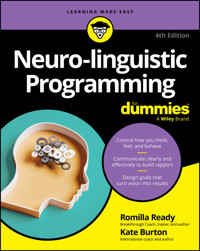
Change your behavior with neuro-linguistic programming
Neuro-linguistic programming (NLP) is a psychological, practical, results-focused approach to understanding the relationship between thoughts, feelings, and behavior, and how they shape the everyday reality that people experience.
Neuro-linguistic Programming For Dummies walks you through the fundamentals of NLP, helping you gain insights into how and why you—and others—think, communicate (both verbally and non-verbally), and behave; often the result of early experiences, emotional conditioning, and unconscious beliefs formed over time.
Understanding the patterns that you operate daily enables you to consciously do more of what works for you to create the results you want in your life and less of what gets in the way of your success. With this deeper understanding about yourself, your goals become more tailored to who you truly are—and more achievable as a result.
By understanding how others operate, you can adjust the way you communicate to create deeper rapport and exercise greater trust, influence, and clarity.
Inside:
- Effective, straightforward strategies to increase self-awareness, build confidence, and become a clearer communicator
- Techniques that, when combined with other forms of health- and self-care, can help you find relief from phobias, anxiety, and depression
- Clear descriptions of the central models and assumptions that underpin NLP
Perfect for therapists, business coaches, counselors, and other helping professionals, Neuro-linguistic Programming For Dummies is also a must-read for busy executives, managers, entrepreneurs, and employees doing their best to navigate contemporary life.
Sie lesen das E-Book in den Legimi-Apps auf:
Seitenzahl: 731
Veröffentlichungsjahr: 2025
Ähnliche


















Neuro-linguistic Programming For Dummies®
To view this book's Cheat Sheet, simply go to www.dummies.com and search for “Neuro-linguistic Programming For Dummies Cheat Sheet” in the Search box.
Table of Contents
Cover
Table of Contents
Title Page
Copyright
Introduction
About This Book
Foolish Assumptions
Icons Used in This Book
Beyond the Book
Where to Go From Here
Part 1: Getting Started with NLP
Chapter 1: Getting to Know Neuro-linguistic Programming
Introducing NLP
Encountering the Pillars of NLP: Straight Up and Straightforward
Discovering Models and Modeling
Using NLP to Greater Effect
Chapter 2: Identifying Some Basic NLP Assumptions
Introducing NLP Presuppositions
Final Words on Presuppositions: Give Them a Whirl
Chapter 3: Discovering Who’s Directing Your Life
Grasping How Your Fears Can Drive You in the Wrong Direction
Delving inside the Brain
Tracking Information: Your Reticular Activating System
Examining How Memories Are Created
Accepting That Beliefs and Values Make a Difference
Daydreaming Your Future Reality
Chapter 4: Taking Charge of Your Life
Taking Control of Your Memory
Seeing It Because You Believe It
Following the Path to Excellence
Spinning the Wheel of Life
Part 2: Winning Friends and Influencing People
Chapter 5: Seeing, Hearing, and Feeling Your Way to Better Communication
Getting to Grips with the Senses
Listening to the World of Words
Acknowledging the Importance of the Eyes
Making the VAK System Work for You
Chapter 6: Creating Rapport
Knowing Why Rapport Is Important
Introducing Basic Techniques for Building Rapport
Knowing How to Break Rapportand Why You May Want To
Understanding Other Points of View
Chapter 7: Understanding to Be Understood
Getting to Grips with Meta-Program Basics
Being Proactive/Reactive
Moving Toward/Away From
Discovering Options/Procedures
Delving into the Internal/External
Going Global/Detailed
Recognizing Sameness, Sameness with Difference, and Difference
Tackling Time Perspectives
Combining Meta Programs
Developing Your Meta-Program Skills
Chapter 8: Pushing the Communication Buttons
Understanding the Process of Communication
Introducing the NLP Communication Model
Giving Effective Communication a Try
Part 3: Opening the Toolkit
Chapter 9: Dropping Anchors
Starting Out with NLP Anchors
Going through the Emotions: Sequencing States
Becoming Sophisticated with Anchors
A Final Point about Anchors
Chapter 10: Sliding the Controls of Your Experience
Recording Your Experiences with Your Submodalities
Grasping the Basic Info: What You Need to Know Before You Begin
Understanding Your Critical Submodalities
Making Real-Life Changes
Chapter 11: Working with the Logical Levels
Understanding Logical Levels
Finding the Right Lever for Change
Figuring Out Other People’s Levels: Language and Logical Levels
Teambuilding at Work and Play: A Logical Levels Exercise
Chapter 12: Driving Habits: Uncovering Your Secret Programs
Witnessing the Evolution of Strategies
The Eyes Have It: Recognizing Another’s Strategy
Flexing Your Strategy Muscles
Using NLP Strategies for Love and Success
Chapter 13: Traveling in Time to Improve Your Life
Understanding How Your Memories Are Organized
Discovering Your Timeline
Changing Your Timeline
Traveling Along Your Timeline to a Happier You
Chapter 14: Ensuring Smooth Running Below Decks
Getting to Grips with a Hierarchy of Conflict
Drifting from Wholeness to Parts
Help! I’m in Conflict with Myself
Becoming Whole: Integrating Your Parts
Resolving Bigger Conflicts
Part 4: Using Words to Captivate
Chapter 15: Getting to the Heart of the Matter: The Meta Model
Gathering Specific Information with the Meta Model
Using the Meta Model
Chapter 16: Unleashing the Power of Hypnosis
Discovering the Language of Trance: The Milton Model
Going Deeper into Hypnosis
Chapter 17: Telling Tales to Reach the Unconscious: Stories, Fables, and Metaphors
Processing Stories and Metaphors
Understanding the Stories of Your Life
Grasping the Power of Metaphors
Building Your Own Stories
Chapter 18: Asking the Right Questions
Question-Asking Tips and Strategies
Figuring Out What You Want
Asking Questions to Help Make Decisions
Challenging Limiting Beliefs
Finding the Right Person for the Job: A Question of Motivation
Checking In with Yourself
Part 5: Integrating Your Learning
Chapter 19: Dipping into Modeling
Developing New Skills through Modeling
Discovering Modeling Case Studies
Key Stages in Modeling
Chapter 20: Making Change Easier
Finding Clarity and Direction
Understanding the Structure of Change
Holding On to Values
Grasping the Importance of Clear Communication
Creating the Mindset for Change
Getting Help on the Way
Taking One Step Forward
Part 6: The Part of Tens
Chapter 21: Ten Applications of NLP
Developing Yourself
Managing Your Personal and Professional Relationships
Negotiating a Win–Win Solution
Motivating and Leading Staff
Creating Powerful Presentations
Managing Your Time and Precious Resources
Being Coached to Success
Using NLP to Support Your Health
Connecting to Your Audience: Advice for Trainers and Educators
Getting the Best Job for You
Chapter 22: Ten Books to Add to Your Library
Changing Belief Systems with NLP
The User’s Manual for the Brain
Core Transformation
Frogs into Princes
Influencing with Integrity
An Insider’s Guide to Sub-Modalities
The Magic of Metaphor
Metaphors We Live By
Persuasion Skills Black Book
Presenting Magically
Chapter 23: Ten Films and TV Series That Demonstrate NLP in Action
A Complete Unknown
Avatar
Conclave
Ferris Bueller’s Day Off
Dune
Field of Dreams
Forrest Gump
Ted Lasso
Inside Out
Stand and Deliver
Index
About the Authors
Connect with Dummies
End User License Agreement
List of Tables
Chapter 3
TABLE 3-1 Comparing the Conscious and Unconscious Minds
Chapter 5
TABLE 5-1 VAK Words and Phrases
TABLE 5-2 Accessing Cues
Chapter 7
TABLE 7-1 Pros and Cons of Past, Present, and Future Focus
Chapter 8
TABLE 8-1 Comparison of Introvert and Extrovert Meta Programs
Chapter 15
TABLE 15-1 Meta Model Patterns
Chapter 16
TABLE 16-1 Milton Model versus Meta Model
TABLE 16-2 NLP Milton Model Patterns
Chapter 20
TABLE 20-1 The Stages of Grief in the Change Curve for Change in the Workplace
TABLE 20-2 The Effects of Change on Your Logical Levels
TABLE 20-3 The Logical Level Matrix
Guide
Cover
Table of Contents
Title Page
Copyright
Begin Reading
Index
About the Authors
Pages
iii
iv
1
2
3
4
5
6
7
8
9
10
11
12
13
14
15
16
17
19
20
21
22
23
24
25
26
27
28
29
30
31
32
33
34
35
37
38
39
40
41
42
43
44
45
46
47
48
49
50
51
52
53
54
55
56
57
58
59
60
61
62
63
64
65
66
67
68
69
70
71
72
73
74
75
76
77
78
79
80
81
82
83
84
85
86
87
88
89
90
91
92
93
94
95
96
97
98
99
100
101
103
104
105
106
107
108
109
110
111
112
113
114
115
116
117
118
119
120
121
122
123
125
126
127
128
129
130
131
132
133
134
135
136
137
138
139
140
141
142
143
144
145
146
147
148
149
150
151
152
153
154
155
156
157
158
159
160
161
162
163
164
165
166
167
168
169
170
171
172
173
174
175
176
177
178
179
180
181
182
183
184
185
186
187
188
189
190
191
192
193
194
195
197
198
199
200
201
202
203
204
205
206
207
208
209
210
211
212
213
215
216
217
218
219
220
221
222
223
224
225
226
227
228
229
230
231
233
234
235
236
237
238
239
240
241
242
243
244
245
246
247
249
250
251
252
253
254
255
256
257
258
259
260
261
262
263
264
265
266
267
268
269
270
271
272
273
274
275
276
277
278
279
280
281
282
283
284
285
286
287
288
289
290
291
292
293
294
295
296
297
298
299
300
301
302
303
304
305
307
308
309
310
311
312
313
314
315
316
317
318
319
320
321
322
323
325
326
327
328
329
330
331
332
333
334
335
336
337
338
339
340
341
342
343
345
346
347
348
349
350
351
352
353
354
355
356
357
358
359
360
361
362
363
364
365
367
368
369
370
371
372
373
374
375
376
377
378
379
380
381
382
383
384
385
386
387
388
389
390
391
392
393
394
395
397
398
399
400
401
402
403
404
405
406
407
408
409
410
411
413
414
415
416
Neuro-linguistic Programming For Dummies®, 4th Edition
Published by: John Wiley & Sons, Inc., 111 River Street, Hoboken, NJ 07030-5774, www.wiley.com
Copyright © 2026 by John Wiley & Sons, Inc. All rights reserved, including rights for text and data mining and training of artificial technologies or similar technologies.
Media and software compilation copyright © 2026 by John Wiley & Sons, Inc. All rights reserved, including rights for text and data mining and training of artificial technologies or similar technologies.
No part of this publication may be reproduced, stored in a retrieval system or transmitted in any form or by any means, electronic, mechanical, photocopying, recording, scanning or otherwise, except as permitted under Sections 107 or 108 of the 1976 United States Copyright Act, without the prior written permission of the Publisher or authorization through payment of the appropriate per-copy fee to the Copyright Clearance Center, Inc., 222 Rosewood Drive, Danvers, MA 01923, (978) 750-8400, fax (978) 750-4470, or on the web at www.copyright.com. Requests to the Publisher for permission should be addressed to the Permissions Department, John Wiley & Sons, Inc., 111 River Street, Hoboken, NJ 07030, (201) 748-6011, fax (201) 748-6008, or online at http://www.wiley.com/go/permissions.
The manufacturer’s authorized representative according to the EU General Product Safety Regulation is Wiley-VCH GmbH, Boschstr. 12, 69469 Weinheim, Germany, e-mail: [email protected].
Trademarks: Wiley, For Dummies, the Dummies Man logo, Dummies.com, Making Everything Easier, and related trade dress are trademarks or registered trademarks of John Wiley & Sons, Inc. and may not be used without written permission. All other trademarks are the property of their respective owners. John Wiley & Sons, Inc. is not associated with any product or vendor mentioned in this book.
LIMIT OF LIABILITY/DISCLAIMER OF WARRANTY: THE PUBLISHER AND THE AUTHOR MAKE NO REPRESENTATIONS OR WARRANTIES WITH RESPECT TO THE ACCURACY OR COMPLETENESS OF THE CONTENTS OF THIS WORK AND SPECIFICALLY DISCLAIM ALL WARRANTIES, INCLUDING WITHOUT LIMITATION WARRANTIES OF FITNESS FOR A PARTICULAR PURPOSE. NO WARRANTY MAY BE CREATED OR EXTENDED BY SALES OR PROMOTIONAL MATERIALS. THE ADVICE AND STRATEGIES CONTAINED HEREIN MAY NOT BE SUITABLE FOR EVERY SITUATION. THIS WORK IS SOLD WITH THE UNDERSTANDING THAT THE PUBLISHER IS NOT ENGAGED IN RENDERING LEGAL, ACCOUNTING, OR OTHER PROFESSIONAL SERVICES. IF PROFESSIONAL ASSISTANCE IS REQUIRED, THE SERVICES OF A COMPETENT PROFESSIONAL PERSON SHOULD BE SOUGHT. NEITHER THE PUBLISHER NOR THE AUTHOR SHALL BE LIABLE FOR DAMAGES ARISING HEREFROM. THE FACT THAT AN ORGANIZATION OR WEBSITE IS REFERRED TO IN THIS WORK AS A CITATION AND/OR A POTENTIAL SOURCE OF FURTHER INFORMATION DOES NOT MEAN THAT THE AUTHOR OR THE PUBLISHER ENDORSES THE INFORMATION THE ORGANIZATION OR WEBSITE MAY PROVIDE OR RECOMMENDATIONS IT MAY MAKE. FURTHER, READERS SHOULD BE AWARE THAT INTERNET WEBSITES LISTED IN THIS WORK MAY HAVE CHANGED OR DISAPPEARED BETWEEN WHEN THIS WORK WAS WRITTEN AND WHEN IT IS READ.
For general information on our other products and services, please contact our Customer Care Department within the U.S. at 877-762-2974, outside the U.S. at 317-572-3993, or fax 317-572-4002. For technical support, please visit https://hub.wiley.com/community/support/dummies.
Wiley publishes in a variety of print and electronic formats and by print-on-demand. Some material included with standard print versions of this book may not be included in e-books or in print-on-demand. If this book refers to media that is not included in the version you purchased, you may download this material at http://booksupport.wiley.com. For more information about Wiley products, visit www.wiley.com.
Library of Congress Control Number is available from the publisher.
ISBN 978-1-394-38208-8 (pbk); ISBN 978-1-394-38210-1 (ebk); ISBN 978-1-394-38209-5 (ebk)
Introduction
Welcome to the fourth edition of Neuro-linguistic Programming For Dummies, which is packed with ideas and tips to increase your success and happiness. Most likely, you’re reading this book because you’ve heard neuro-linguistic programming (NLP throughout this book) mentioned as you go about your daily life — in companies, colleges, and coffee shops. We wrote the original version of this book because our experience of NLP transformed our own lives. We wanted to ignite the spark of curiosity in others about what’s possible with NLP. We also believed that the time had come for NLP to move away from academic- and business-speak to real-life plain English to be used by all people who want to make improvements in their lives.
In recent years, we’ve witnessed NLP growing ever more popular. Part of this popularity is because NLP offers enlightening “aha!” moments, and part is because it simply makes sense. As we celebrate 50 years of NLP, one of the true contributions of NLP has been to show people that they have choices: They can manage their emotional states, and they can make changes to their lives. It has also demystified the notion (and limitations) of innate talent by demonstrating that you can study excellence in any field. Yet the term NLP can be off-putting and the associated jargon may present a barrier to non-NLP professionals. So a little explanation is required:
Neuro
relates to what’s happening in your mind.
Linguistic
refers not only to the words you use in your communication but also your body language and how you use it.
Programming
tackles the persistent patterns of behavior, both effective and ineffective, that you learn and then repeat.
Some people describe NLP as “the study of the structure of subjective experience”; others call it “the art and science of communication.” We prefer to say that NLP enables you to understand what makes you tick: how you think, how you feel, and how you make sense of everyday life in the world around you. Armed with this understanding, your whole life — work and play — can be renewed.
It’s hard to believe that the first edition of this book was published in 2004, more than two decades ago. Over this period, Neuro-linguistic Programming For Dummies has presented us with amazing opportunities, primarily in the form of clients who’ve shared their lives, problems, and successes with us. We’ve had the chance to develop these ideas into a range of workshops and coaching programs for different audiences. In this fresh edition, we incorporate some lessons from our more recent work and life experiences as well as from the other books we’ve written in the For Dummies series on coaching, confidence, and career change. In particular, some of the biggest developments that we refer to in this updated edition are in the field of neuroscience, where technology such as brain imaging is constantly increasing knowledge and possibilities. The magic of NLP is joining with the rigor of neuroscience. Thanks to social media and the digital world, the way people connect and communicate has also changed dramatically in recent years, which makes understanding how to build rapport and manage relationships even more important. In particular, the COVID-19 pandemic encouraged more people to connect with friends and family online when travel and physical meetings weren’t possible. As the global world in which we live evolves, we hope you find more new ideas here to help you mitigate the negative effects of stress and have fun experimenting with and applying the tools in the NLP toolkit.
About This Book
This book aims to entrance anyone fascinated by people. Through its experiential approach, NLP encourages people to take action to shape their own lives. It attracts those willing to “have a go” and open their minds to new possibilities.
We try to make NLP friendly, pragmatic, accessible, and useful for you. We expect you to be able to dip into the book at any chapter and quickly find practical ideas on how to use NLP to resolve issues or make changes for yourself.
In displaying the NLP “market stall,” our choice of content is selective. We aim to offer an enticing menu if you’re a newcomer. And for those with more knowledge, we hope this book helps you to digest what you already know as well as treating you to some new ideas and applications. To that end, we make finding information such as the following easy for you:
How to discover what’s important to you so that you can pursue your goals with energy and conviction.
What the main NLP presuppositions are and why they’re important to you.
What the best ways are to understand other people’s style, helping you to get your own message heard.
When to build rapport and when to break it.
How to get your unconscious mind to work together with your conscious mind to make a strong team.
In addition, because the best way to discover NLP is to experience it, take full opportunity of playing with all the exercises we provide. Some of the ideas and exercises in this book may be quite different from your normal style of behavior, but don’t be put off. The NLP approach is about setting aside your disbelief, giving it a go, and realizing your potential.
It’s always easier to grasp a subject when you have a familiar “hook” to anchor it on to. We suggest you choose a theme or situation — perhaps training, coaching, a difficult manager, or stress — and keep that in mind as you work through the book, applying NLP principles to your chosen example.
Foolish Assumptions
In this book, we make a few assumptions about you. We assume that you’re a human being who wants to be happy. You’re probably interested in learning and ideas. You may have heard the term NLP mentioned, you may already work with the concepts or perhaps it’s just a new and intriguing subject for you. You need no prior knowledge of NLP, but this book is for you if any of the following situations ring a bell:
You’re tired or fed up with the way some things are for you now.
You’re interested in how to take your living experience to new levels of achievement, happiness, adventure, and success.
You’re curious about how you can influence others ethically and easily.
You’re somebody who loves learning and growing.
You’re ready to turn your dreams into reality.
Icons Used in This Book
The icons in this book help you to find particular kinds of information that may be of use to you.
This icon highlights NLP terminology that may sound like a foreign language, but which has a precise meaning in the NLP field.
This icon suggests ideas and activities to give you practice in NLP techniques and food for thought.
This icon contains practical advice to put NLP to work for you.
This icon is a friendly reminder of important points to note.
This icon indicates real-life experiences of NLP in action. Some are real, some people have had their names changed, and others are composite characters.
This icon marks things to avoid in your enthusiasm to try out NLP skills on your own.
Beyond the Book
In addition to the printed book or e-book you’re reading now, you can also benefit from reading some access-anywhere goodies on the web. Check out the free Cheat Sheet at www.dummies.com for a simple summary of the key points contained within this book. To find the Cheat Sheet for this book, just type Neuro-linguistic Programming For Dummies Cheat Sheet in the Search bar on the home page. You can print out this really handy sheet to carry with you throughout the day, so you can dip into it for some NLP any time you need to.
Where to Go From Here
You don’t have to read this book from cover to cover, but you benefit greatly if you capture everything at the pace and in the order that’s right for you. Use the table of contents to see what grabs your interest. For example, if you’re keen to understand someone else, first try Chapter 6. Or if you want to know what makes you tick, turn to Chapter 5 and discover the power of your senses. Feel free to dip and dive in. Have fun on the journey.
Part 1
Getting Started with NLP
IN THIS PART …
Get an overview of NLP and what it’s about.
Discover the power of your unconscious mind and understand how your beliefs can impact your reality.
Find out how to create the future you want for yourself.
Chapter 1
Getting to Know Neuro-linguistic Programming
IN THIS CHAPTER
Setting out on an neuro-linguistic programming journey
Exploring the key themes of neuro-linguistic programming
Getting the most out of neuro-linguistic programming
Here’s a little Sufi tale about a man and a tiger.
A man being followed by a hungry tiger, turned in desperation to face it and cried, “Why don’t you leave me alone?” The tiger answered, “Why don’t you stop being so appetizing?”
In any communication between two people, or in this case between human and beast, more than one perspective always exists. Sometimes people just can’t grasp that fact because they don’t know they need to change their behavior to communicate in a way that gets them what they want.
Neuro-linguistic programming (NLP) is one of the most sophisticated and effective methodologies currently available to help you communicate effectively. NLP centers on communication and change. NLP teaches about sensory awareness (more about this in Chapter 5), which, put simply, is paying attention to the cues people display when they communicate with you, such as a raised eyebrow, a sudden pause, or a change in voice tone. Communication isn’t just about what you say; it’s also about how others respond. By noticing those responses, you can adapt in the moment and build stronger connections. You also become more aware of your own habits and responses, which means you can focus on what helps you succeed and let go of what holds you back. In today’s climate of rapid change, flexibility is essential. It gives you more choices in how you respond to people and situations, which in turn enables you to exert greater influence over the outcomes you create (see Chapter 2 for more on presuppositions and flexibility).
So welcome to the start of the journey. We start by giving you a quick taster of the key NLP themes in this chapter.
Introducing NLP
All able-bodied humans are born with the same basic neurological system.
Your neurological system transmits the information you receive from your environment through your senses to your brain. Your environment, in this context, is everything external to you but also includes your organs, such as your eyes, ears, skin, stomach, and lungs. Your brain processes the information and transmits messages back to your organs. In response, your eyes, for example, may blink. The information can also create emotions, and you may cry or laugh. In short, your thought processes make you behave in a certain way.
Your ability to do anything in life — whether swimming the length of a pool, cooking a meal, or reading this book — depends on how you respond to the stimuli on your nervous system. Therefore, much of NLP is devoted to discovering how to think and communicate more effectively within yourself and with others.
The term neuro-linguistic programming breaks down as follows:
Neuro concerns your neurological system. NLP is based on the idea that you experience the world through your senses and translate sensory information into thought processes, both conscious and unconscious. Thought processes activate the neurological system, which affects your physiology, emotions, and behavior.
Linguistic
refers to the way you use language to make sense of the world, capture, and conceptualize experience and communicate that experience to others. In NLP, linguistics is the study of how the words you speak and your body language influence your experience.
Programming
draws heavily from learning theory and addresses how you code or mentally represent your experiences. Your personal programming consists of your internal processes and strategies (thinking patterns) that you use to make decisions, solve problems, learn, evaluate, and get results. NLP shows you how to recode your experiences and organize your internal programming so that you can get the outcomes you want.
To see this process in action, begin to notice how you think. Imagine a hot summer day. You’re standing in your kitchen and holding a lemon you’ve taken from the fridge. Look at the outside of it — its yellow, waxy skin with green marks at the ends. Feel how cold it is in your hand. Raise it to your nose and smell it. Mmmm. Press it gently and notice the weight of the lemon in the palm of your hand. Now take a knife and cut it in half. Hear the juices start to run and notice that the smell is stronger now. Bite deeply into the lemon and allow the juice to swirl around in your mouth.
Words have the power to trigger your salivary glands. Hear the word lemon, and your brain kicks into action. The word tells your brain that you have a lemon in your hand. You may think that words only describe meanings, but in fact, they create your reality — a concept we explore throughout this book.
Providing a few quick definitions
NLP can be described in various ways. The formal definition is that NLP is “the study of the structure of your subjective experience.” Here are a few more ways of answering the elusive question of “What is NLP?”
The art and science of communication
The key to learning
The way to understand what makes you and other people tick
The route to getting the results you want in all areas of your life
The way to influence others with integrity
The manual for your brain
The secret of successful people
The method of creating your own future
The way to help people make sense of their reality
The toolkit for personal and organizational change
Considering where NLP started and where it’s going
NLP began in California in the early 1970s at the University of Santa Cruz. Richard Bandler, a master’s level student of information sciences and mathematics, and Dr. John Grinder, a professor of linguistics, studied people who they considered to be excellent communicators and brilliant at helping their clients change. They were fascinated by how some people defied the odds to get through to so-called difficult or very ill people where others failed miserably to connect.
Thus, NLP has its roots in a therapeutic setting thanks to three world-renowned psychotherapists studied by Bandler and Grinder: Virginia Satir (developer of Conjoint Family Therapy), Fritz Perls (the founder of gestalt psychology), and Milton H. Erickson (largely responsible for the advancement of clinical hypnotherapy). In their work, Bandler and Grinder also drew upon the skills of linguists Alfred Korzybski and Noam Chomsky, social anthropologist Gregory Bateson, and psychotherapist Paul Watzlawick. Bandler and Grinder’s work was happening at the time as their computer science contemporaries Steve Jobs and Steve Wozniak were setting up Apple Inc., so programming concepts were gaining people’s awareness.
In the 1980s, Grinder became dissatisfied with some early coding work done in collaboration with Bandler, which he now refers to as Classic Code. Together with Judith DeLozier, Grinder initiated some new models known as New Code (documented in his book Whispering in the Wind [J&C Enterprises, 2001]) and he continues this work today with his partner Carmen Bostic St. Clair.
Since those early days 50 years ago, the field of NLP has exploded to encompass many disciplines in many countries around the world. New great teachers and practitioners in NLP are still emerging today to build on the work of the founders. Established teachers are collaborating with colleagues in other disciplines, such as neuroscience, education, and medicine to further the application of their work.
So what’s next for NLP? The discipline has certainly traveled a long way from Santa Cruz in the 1970s, and since we wrote the first edition of this book, the interest in NLP shows no sign of waning. Some of the early pioneers of NLP, such as Robert Dilts, are now celebrating 50 years of working to transform the lives of with thousands of people worldwide. New neuroscientific knowledge offers some scientific explanation for many ideas that NLP practitioners have developed more intuitively. In particular, the world of coaching is heavily influenced by NLP. Today, NLP applications are being used by doctors, nurses, taxi drivers, salespeople, therapists, coaches, accountants, teachers, animal trainers, parents, workers, retired people, and teenagers alike. In Chapter 21, we list just a few such practical applications.
Each generation takes current ideas, sifts through and refines them, adds knowledge discovered through its own experiences, and communicates it in its own way. Information about NLP is now shared across social media platforms and apps such as LinkedIn, YouTube, X (formerly Twitter), and Facebook — channels that were unheard of in the 1970s and are constantly evolving. The explosion of artificial intelligence (AI) will no doubt bring change to NLP that we cannot yet envisage.
Much of the development of NLP today focuses on the applications rather than the core models; people who are experts in one field incorporate NLP tools and take them into their own field. Collaboration is key to generating new ideas and applications. Given that NLP encourages new thinking and new choices and acknowledges the positive intention underlying all action, all we can say is the future remains bright with possibilities. The rest is up to you.
Offering a note on integrity and evidence
You may hear the words pseudoscience, integrity, and manipulation associated with NLP, and so we want to put the record straight now. NLP has never purported to be a scientific discipline. Human change is a highly subjective area that depends on many fluctuating variables, from the state of the person to the skill of the practitioner that they work with. Many practitioners have reported success using NLP techniques to help individuals overcome challenges, including trauma. Clients with post-traumatic stress disorder (PTSD) have found NLP interventions extremely helpful. The proof of NLP in education, health, and industry programs lies in the lasting change it creates for the client, working as it does from the inside thinking to the outward behavior.
NLP offers tools and techniques, which, like hammers and chisels, can be used for good or ill. The way that the overwhelming majority of practitioners and coaches use NLP is in service of their clients to achieve positive outcomes. You influence others all the time. When you do so consciously to get what you want, the question of integrity arises. Are you manipulating others to get what you want at their expense? Are you using NLP for good or just for personal gain?
To make sure you behave with integrity, ask yourself a simple question: what is my positive intention for the other person in this interaction? If your intention is to benefit the other party (perhaps in a sales situation), you have integrity — a win-win situation. If your intention is to benefit yourself alone, you’re manipulating the other person. When you head for win-win outcomes in your dealings with other people and organizations, you’re on track for success. And always bear in mind that what goes around comes around!
Professional bodies such as the Association for Neuro-linguistic Programming (ANLP) work tirelessly to set and uphold international standards and undertake due diligence on the qualifications of their members. Always check out the training and bona fide qualifications for any professional for any organization that you engage with.
Encountering the Pillars of NLP: Straight Up and Straightforward
NLP is based on four pillars (check out Figure 1-1). These four foundations of the subject can be described as follows:
Rapport:
How to build a relationship with yourself and others is probably the most important gift that NLP gives you. Given the pace at which most humans live and work, one big lesson in rapport is how you can say no to all the requests for your time and still retain friendships or maintain professional relationships. To find out more about rapport — how to build it and when to break it off — head to
Chapter 6
.
Sensory awareness:
Have you noticed how when you walk into someone else’s home, the colors, sounds, and smells are subtly different from yours? Or that a colleague looks worried when he talks about his job. Maybe you notice the color of a night sky or the fresh green leaves as spring unfolds. Like the famous fictional detective Sherlock Holmes, you begin to notice that your world is so much richer when you pay attention to all your senses.
Chapter 5
describes the power of your sensory perceptions and how you can use your natural sight, sound, touch, feelings, taste, and smell to your benefit.
Outcome thinking:
We use the word
outcome
a lot throughout this book. This term relates to thinking about what you want instead of getting stuck in a negative problem mode of thinking. The principles of an outcome approach can help you make the best decisions and choices to set you up for the future — whether those decisions are about what you’re going to do on the weekend, how you’re going to run an important project at work, or in discovering the true purpose of your life. Head to
Chapter 4
for tools that will enable you to get the results you deserve.
Behavioral flexibility:
This term means discovering how to do something different when what you’re currently doing isn’t working. Being flexible is key to practicing NLP, and you can find related tools and ideas in every chapter. We help you find fresh perspectives and build these into your repertoire. Information, exercises, and examples on how you can maximize your own flexibility can be found throughout the book.
FIGURE 1-1: The four pillars of NLP.
Here’s an example of what these four pillars may mean to you in an everyday event. Suppose you order a software package for storing the names, addresses and phone numbers of friends or clients. You load it onto your computer, use it a few times and then it mysteriously stops working. A bug is in the system, but you’ve already invested many hours in installing it and entering contacts’ details. You phone the supplier and the customer service people are unhelpful to the point of rudeness.
You need to employ all your rapport-building skills with the customer service manager before anyone listens to your complaint. You need to engage your senses — particularly your ears as you listen carefully to what the supplier says — and notice how to control your feelings and decide on your best response. You need to be very clear about your desired outcome — what do you want to happen after you make your complaint? For example, do you want a full refund or replacement software? And, finally, you may need to be flexible in your behavior and consider different options if you don’t achieve what you want the first time.
Discovering Models and Modeling
As we describe in the earlier section “Considering where NLP started and where it’s going,” NLP began as a model of how people communicate and grew out of studies of some great communicators. The concept of models and modeling is thus at the heart of NLP.
The NLP premise begins as follows: If you can find someone who’s good at something, you can then model how that person does that thing and learn from him. You can discover how to model anyone you admire — top business leaders or sports personalities, the waitress at your favorite restaurant, or your hugely energetic personal fitness trainer. You can find out more about modelling in Chapter 19.
Employing the NLP communication model
The NLP model describes how you process the information that comes at you from the outside. According to NLP, you move through life not by responding to the world around you, but by responding to your model or map of that world. The model is explained with examples in Chapter 8.
A fundamental assumption of NLP is that “the map is not the territory” and that each individual has different maps of how the world operates. This insight means that you and another person may experience the same event and yet do so differently.
Imagine that you go to a party — you have a good time, meet lots of friendly people, enjoy good food and drink, and perhaps do a bit of dancing. If we ask you and another guest to recount what happened at the party, however, you’d each tell a different story. That’s because your internal representations of that outside event are different from the event itself: “The map is not the territory.”
Alternatively, picture being suddenly transported to a country with a completely different culture on the other side of the world. The thoughts and assumptions that your new-found neighbors construct regarding how life operates will be very different to your own. NLP encourages collaboration between diverse groups of people to generate new thinking. You’ll experience the power and possibilities of many different perspectives at any live NLP training program or conference with a broad mix of delegates.
NLP doesn’t change the world — it simply helps you change the way that you observe, perceive, and react to both the world around you and the inner workings of your own mind. NLP allows you to create a clearer, more detailed map of your internal experience — helping you understand the how and why behind your thoughts and behaviors so you can become more effective at what you want to achieve. It gives you an understanding of patterns of behavior so that you can consciously stop doing what gets in your way and begin doing more of what helps you achieve your goals and desires.
John, an architect, rents expensive office space in a city center. He used to moan that the offices weren’t cleaned to a high enough standard, the staff were lazy, and the office manager wouldn’t address the problem. When we met John in his office, we discovered that he worked in chaos; every available surface was covered in paperwork, and he clearly never tidied things up. He frequently worked late and was grumpy if interrupted, so the cleaners came and went without daring to disturb him.
Through coaching, John came to recognize that he hadn’t considered anyone else’s point of view or noticed what a difficult task the cleaners faced trying to clean his office around him. His map of reality was completely different from that of the office manager and the cleaners. He subsequently built a new map that incorporated the reality of what life in the office was like for his colleagues, and he became more considerate towards them. By changing this one map of his experience, other aspects of his life also improved, and he grew more aware of the effect of his general untidiness on others. For example, he now feels more comfortable inviting girlfriends to his neater flat.
Modeling excellence
Modeling excellence is a theme much discussed in this book because so much of NLP is future focused and applied to creating change for the better — whether that’s a better-qualified individual, a better quality of life, or a better world for the next generation.
The NLP approach is that you learn best by finding someone else who already excels at whatever you want to learn. By modeling other people, you can break your discovering into its component parts. This perspective is empowering, and it’s an encouragement to convert large, overwhelming projects into lots of small ones and discover people who’ve already been there and can show you the way. More of this in Chapter 19.
Using NLP to Greater Effect
As you discover throughout this book, NLP is about increasing your options instead of being restricted by your experience and saying, “This is the way I do things, and this is how it has to be.” To benefit from NLP, you need to be open to questioning and challenging your norms, as well as allowing others to question and challenge you about your beliefs and patterns of thinking and behavior. Being challenged on your beliefs and patterns can feel uncomfortable, but you have a choice for how you handle it: Set your ego aside, reflect on what’s being offered, and choose to adapt or dismiss it. This section provides a few tips on how to adopt this mindset.
Understanding that attitude comes first
Essentially, NLP is about developing a positive attitude to life and its possibilities rather than dwelling on problems (although being curious about problems and obstacles is part of the learning journey). NLP provides the necessary tools and support to help you change anything about your life that doesn’t reflect who you want to be today. So much more is possible when you have the mindset and attitude to support your success; you tap into your natural human resourcefulness. If your attitude doesn’t support you in living a richly rewarding life, then consider changing it. Changing your mindset and attitude really does change your life.
Many people spend a lot of time looking at the negatives in their lives — how they hate their jobs or don’t want to smoke or be fat. By conditioning yourself to concentrate on what you do want, positive results can be achieved very quickly.
Being curious and confused are good for you
Here are two helpful attributes to bring with you: curiosity — accepting that you don’t know all the answers — and a willingness to be confused because, as the great hypnotherapist Milton H. Erickson said, “enlightenment is always preceded by confusion.”
If you find that ideas in this book make you feel confused, thank your unconscious mind because confusion is the first step to understanding. Take the sense of confusion as a sign that you’re processing information to enable you to find the way forward, and that you intuitively know more than you realize consciously.
Changing is up to you
Gone are the days when you needed to stay stuck in a downward spiral of repetitive behaviors and responses that were tedious and ineffective. Today, NLP is all about producing measurable results that enhance the quality of people’s lives without a lengthy and painful journey into the past.
As you read the chapters in this book, you discover the experiential nature of NLP. It’s about trying things out — giving things a go. Test out the ideas for yourself — don’t take our word for it.
The responsibility for change lies with you, and this book is the facilitator. If you aren’t open to change, you aren’t going to get the most from the book. So we encourage you to do the exercises, note your new processes, and share them with others — explaining something to someone else means that you learn it twice and thus really absorb it. By the time you complete the book, you may be surprised at how much you’ve already changed.
The post-pandemic world, marked by uncertainty, is creating growing mental health challenges, many people — from children to adults — are struggling to cope. But within every challenge lies an opportunity. In these pages, we share how NLP tools and techniques can help you not only manage your own stress but also support others in navigating theirs. The aim is to transform stress into a catalyst for growth, resilience, and connection — and to move toward greater hope, community, and love.
The neural network that makes up your brain has an amazing capacity to change and forge new connections (see Chapter 3 for more on the structure of the brain). You can change at any age thanks to this neuroplasticity — what an encouraging thought!
Having fun on the way!
When Clint Eastwood was interviewed on TV by journalist Michael Parkinson, he offered sound advice: “Let’s take the work seriously, and not ourselves seriously.” NLP involves much fun and laughter. If you set yourself up to become perfect, you put enormous and unrealistic pressure on yourself. So pack a sense of your own playfulness as you travel and try to make sense of a changing world: Learning is serious work that’s serious fun.
Chapter 2
Identifying Some Basic NLP Assumptions
IN THIS CHAPTER
Understanding the presuppositions of NLP
Testing the NLP presuppositions
Walking in someone else’s shoes
Developing flexibility to take full responsibility in any interaction
Belinda has a much-loved only daughter, Jasmine. Belinda and her husband indulged Jasmine because she was born after they’d given up hope of ever having a child. Consequently, Jasmine was a little spoiled, and unfortunately, she was prone to throwing tantrums, thrashing about on the floor, screaming, and flailing her arms and legs.
Belinda made no progress with Jasmine’s tantrums until one day she decided to join her. Belinda took two saucepans out of the cupboard and started banging them on the floor; she kicked and screamed even better and louder than Jasmine. Guess what? Jasmine lay still in stunned astonishment, staring at her mother. She decided there and then that her mother was the more expert “tantrummer” and that she’d lose the tantrum contest every time. She realized that pursuing this particular course of action was futile, and the tantrums duly stopped. Belinda took control of her interaction with Jasmine by displaying the greater flexibility of behavior.
This little anecdote illustrates that the person with the most flexibility in a system can influence the system. This statement isn’t the result of some experiment conducted in a laboratory. Instead, it’s an NLP presupposition (or assumption), which, if practiced and adopted, can help to ease your journey through life. Belinda’s story illustrates just one of several presuppositions — also called convenient beliefs — which form the basis of NLP.
This presupposition is known as the Law of Requisite Variety and derives from systems theory. This law was formulated by Ross Ashby, an English psychiatrist who was also a pioneer in the field of cybernetics. Put very simply, the Law of Requisite Variety means the ability of a person within a system to succeed is directly proportional to the level of flexibility of behavior that person chooses to exhibit.
In the context of communication, if someone doesn’t understand what you’re trying to communicate, show flexibility and creativity and change how you say it until you’re understood. Just raising the decibels while using the same words isn’t a strategy we recommend.
Introducing NLP Presuppositions
NLP presuppositions are no more than generalizations about the world that can prove useful to you when you act as if they’re true. In the following sections, we describe some of the presuppositions that we consider to be most influential out of several that the founders of NLP developed.
The map is not the territory
One of the first presuppositions is that “the map is not the territory.” This statement was published in Science and Sanity in 1933 by Korzybski, a Polish count and mathematician. Korzybski was referring to the fact that you experience the world through your senses (sight, hearing, touch, smell, and taste) — the territory. You then take this external phenomenon, pass it through your mental filters (Chapter 3 tells you more) such as your values, beliefs, and life experiences and make an internal representation (IR) of it within your brain — the map.
This internal map that you create of the external world, shaped by your experiences, is never an exact replica of the map made by someone else perceiving the same surroundings as you. In other words, what’s outside can never be the same as what’s inside your brain or the brain of another person.
Take the following analogy. If you ask a botanist what belladonna means, they may give you the Latin name for the plant and describe the flowers and slight scent while making a picture of the plant in their head. A homoeopath, in contrast, may explain its uses in treating certain symptoms and see a picture of a patient they treated. If you ask a murder-mystery writer about belladonna, they may say that it’s a poison.
Remember a trip on which you really enjoyed the food and decided one dish in particular was your favorite. On returning home, you may decide to recreate the experience by visiting a restaurant that you know serves the dish you loved. You’re filled with anticipation as you read through the menu choices, and they evoke the images, sounds, smells, and feelings from your trip. You order what you decide was your favorite meal; you see the waiter heading toward your table; you begin salivating; the plate is placed in front of you and … the presentation is all “wrong.” It doesn’t look or smell how you remember it. The meal you’re looking at just doesn’t match the “map” you had in your mind!
The point the examples illustrate is that, depending on the context and someone’s background, different people create different IRs of the same thing.
Putting perceptions through your own personal filter
Your senses bombard you with millions of different bits of information every second, and yet your conscious mind can deal with only a handful of individual pieces at any given moment. As a result, an awful lot of information is filtered out. This filtration process is influenced by your values and beliefs, memories, decisions, experiences, and cultural and social background; it allows in only what your filters are tuned to receive.
When you’re with another person or other people, choose something in your surroundings and have each person describe their observations — the view from a window, for example. Notice that people’s descriptions are individually tailored by their own life experiences.
Some Europeans and North Americans experience a major culture shock when visiting countries such as India or Mexico. Because of their cultural background, they may be deeply disturbed by the level of poverty in some areas, whereas local people accept the poverty as part of life. People accept the familiarity of their own landscape.
Traveling down another person’s map: Unfamiliar territory
The result of this personal filter is that everyone has a very individual map of the world. To make communication easier, a really useful exercise is to at least attempt to understand the IR or map of the person with whom you’re communicating.
Romilla was buying some fish and chips for supper and was asked to complete a short form about the quality, service, and value-for-money of the food. The women serving behind the counter were upset because a man who’d been in earlier in the evening had declined, quite rudely, to fill in the form. Romilla asked the women whether they’d considered how the poor man may have felt if he was illiterate and suggested that perhaps he was rude because he was embarrassed. The change in the perception of the two women was phenomenal: “I never even thought about that,” said one. Their attitude immediately changed from anger and resentment to sympathy. They also felt much better in themselves and were able to let go of the negative feelings they’d been holding on to for the last few hours.
The following short exercise helps you to be tolerant, or at least to gain some understanding, when you find yourself in a situation in which another person’s response or behavior surprises, irritates, or puzzles you:
Count all the blessings in your life.
With your focus on your good fortune, be generous.
Ask yourself what may be going on in this other person’s world that would warrant the behavior.
Rather than holding on to negative feelings, mentally send the person warmth and goodwill and let the feelings go
.
When you begin to master this process, you may find that not only are you happier with your situation but you also accept people and their idiosyncrasies with greater ease.
People respond according to their map of the world
Like all humans, you respond in accordance with the map of the world you hold in your head. This map is based on what you believe about your identity and on your values and beliefs, as well as your attitudes, memories, and cultural background.
Sometimes, the map of the world from which one person operates may not make sense to you. However, a little understanding and tolerance can help to enrich your life.
When Dr. Diwan was a junior doctor, she used to visit a psychiatric hospital. One of the patients was a very well-spoken, highly educated professor of English. One of the professor’s little foibles was to walk around at night with an open umbrella. He was convinced that the rays of the moon would give him “moon madness.” However, the professor took great delight in sharing his passion for English literature with members of staff, whose lives were certainly enriched by their daily interactions with him.
If the staff had been intolerant of the “mad professor” and ignored or sidelined him, unbeknownst to them, their lives would have been impoverished without the richness of his literary stories and his sense of humor — he often referred to himself as the “impatient patient.”
This is a particularly powerful presupposition when applied to coaching. As a coach, you must monitor your own behavior vigilantly to ensure you don’t try to influence the direction of a session so the results fit your own values and beliefs or, indeed, your skill set. American psychologist Abraham Maslow is reported to have said that if your only tool is a hammer, you treat everything as if it were a nail. You may have a favorite model when you’re coaching; for example, you always take your clients through a certain sequence of steps. If one day you find yourself working with someone who doesn’t suit that pattern of thinking or working, you won’t be as effective in helping them create the change they need.




