


Erhalten Sie Zugang zu diesem und mehr als 300000 Büchern ab EUR 5,99 monatlich.
- Herausgeber: Next Factory Ottensen
- Kategorie: Fachliteratur
- Serie: Edition NFO
- Sprache: Englisch
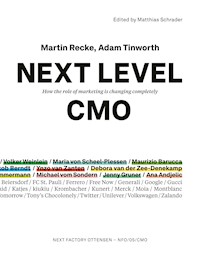
In the 21st century, marketing is in the midst of dramatic change - and the CMO role is changing with it. The marketing of the 20th century was defined by mass production and mass communication. It required an inside-out logic that began with the product and ended with the consumer. Today's marketing operates the other way around: it starts with people and their experiences and works its way backwards to products, technologies and processes. Marketing is about to hit the next level, and thus the chief marketing officer role needs to grow to match. This book profiles marketeers and CMOs from leading brands such as Banana Republic, Bayer, Generali, Gucci, Jägermeister, Katjes, Oatly, smart, Tony's Chocolonely, Unilever, Zalando and many more. What are their views, how do they perceive today's marketing and their role in it, and what skills will every CMO need to meet the challenges of marketing in the future?
Sie lesen das E-Book in den Legimi-Apps auf:
Seitenzahl: 269
Veröffentlichungsjahr: 2022
Das E-Book (TTS) können Sie hören im Abo „Legimi Premium” in Legimi-Apps auf:
Ähnliche


















Contents
Ready Player One
by Matthias Schrader
—
Laura Eschricht
Global Marketing Director, Zalando
Sven Markschläger
Chief Digital Officer, Krombacher
Justina Rokita
Chief Marketing Officer, Moia
Jenny Fleischer
CEO,
babymarkt.de
Volker Weinlein
Co-Founder of kiukiu, former CMO at Katjes International
Maria von Scheel-Plessen
Director EMEA Media, Gucci
Mauricio Barucca
Head of Marketing, Barmer
Isabelle Conner
Group Chief Marketing & Customer Officer, Generali
Patricia Corsi
Global Chief Marketing, Digital and Information Officer, Bayer Consumer Health
John Schoolcraft
Global Chief Creative Officer, Oatly AB
Lena Jüngst
Co-Founder & Chief Evangelist, air up
Jakob Berndt
Co-Founder, Tomorrow
Ynzo van Zanten
Post-Purpose Preacher, former Chief Evangelist at Tony’s Chocolonely
Debora van der Zee-Denekamp
Vice President Foods Benelux, Unilever
Martin Drust
Brand, Digital, Strategy, FC St. Pauli
Felix Jahnen
Digital Transformation Meister, Jägermeister
Björn Schick
Chief Experience Officer, smart Europe
Beate Rosenthal
Partner Global Consumer & Health Platform, Roland Berger, former CMO at Stada
Thomas Zimmermann
CEO, Free Now
Michael vom Sondern
Managing Director and CMO, onQuality, former Global Head of Digital Marketing & Sales at tesa
Jenny Gruner
Director Global Digital Marketing, Hapag-Lloyd
Ana Andjelic
Brand executive and one of Forbes’ “The World’s Most Influential CMOs”
—
Time to level up
Glossary
Introduction
Ready Player One
By Matthias Schrader
The world of marketing is changing dramatically. Over the past thirty years, marketing departments have fanned out along customer touchpoints. For their specific needs, corporate marketing has developed corresponding competencies: TV and print creative, content, design, direct, event, media, PR and, of course, digital.
At the same time, the internet has folded these channels into a few inches of screen size. As a universal simulation machine, the smartphone absorbs all traditional channels and continuously gives birth to emerging media such as games, social media, messenger and the metaverse. The explosion of channels and the implosion of touchpoints are grinding down the walls between marketing departments.
In addition, the boundaries between marketing and sales are blurring. Every digital touchpoint is becoming a point of sale and businesses are transforming into direct-to-consumer brands. The new trilogy of branding, performance marketing and commerce is reshuffling the distinctive teams in the marketing organisation. The sales funnel has had its day as a mental model and is evolving into a continuous stream of customer touchpoints constantly being analysed and optimised.
Performance marketing: a marketing strategy that is focused on measurable results (conversion rate, key performance indicators), using data for decision-making
Sales funnel: the steps a potential customer has to take from the first contact with a brand or company to becoming a customer; often divided into upper funnel, mid funnel and lower funnel (customer journey)
Any increase in optimising the experience and achieving relevance in brand, product and targeting generates excessive success in a media world that regulates customer access via an auction mechanism. Only those who master the continuum of the new marketing/commerce circle will grow.
Marketing, commerce and product innovation are a tech play. Many companies are faced with the challenge of often losing their software development expertise because they have become accustomed to buying engineering services as a standardised offshore product at the lowest possible price. In the eyes of the customer, however, standard means commodity. And commodity brands are now drowning in the sea of mediocrity.
Relevance to the customer can only be achieved through innovation and differentiation – in tech terms: a high level of customised software is imperative. Most CIO offices and procurement departments have forgotten this. Instead, custom development in software engineering is still too often confused with agile methods.
Agile: an iterative approach to software development, used to respond to change; also used in other contexts, like marketing
As a result, many firms are trapped in dysfunctional process monsters from hell. Ironically, software engineering capabilities often come through the back door via marketing and progressive business units. More and more enterprises are emancipating themselves from the sweet drug of standard software.
The demand for a cross-channel view – and thus infrastructure – of all data and the global roll-out of marketing and commerce solutions place high demands on the CMO and their organisation. However, another factor is much more important: speed.
The pandemic has radically changed customer behaviour. During the pandemic, e-commerce volume has grown as much as it did from 1995 to 2015. We also see tectonic shifts in qualitative terms. The market share of small and niche brands has exploded from under 20% in the physical world to over 60% in digital channels. Another data point: within two years, Shein has overtaken Zara and H&M as a pure player from China – without even running its own business in China.
The world is currently changing at a breathtaking pace. Digitisation, the Covid-19 pandemic, the Ukraine war and inflation – to list just the major exogenous shocks of recent times – are changing people’s behaviour faster than ever.
In the next level of marketing, it is no longer enough to optimise the continuum of communication, commerce and product; the brand must be made relevant to the everyday reality of customers.
A new breed of CMOs, raised on digital marketing, is taking up the challenge. For this book, we interviewed marketeers about how they see marketing and the profile of a next-level CMO. In these 22 interviews, a multilayered yet consistent picture emerged.
Today’s world calls for brands. But today’s brands are different because they start with the customer, the experience, and reach into the entire reality of people’s lives. This is the step from customer-centricity to life-centricity.
Marketing is a top priority again. It’s no coincidence that three of the marketeers we interviewed were appointed either CEO or managing director during the writing of this book.
It’s also no coincidence that the median tenure of CMOs is 28 months, just slightly above the lowest level on record. [1] The role of the CMO is under pressure. But it is a pressure to grow. Next-level CMOs are at the forefront of the digitally savvy customer, which forces the transformation. This makes perfect sense given that the digital economy is growing 2.5 times faster than the overall GDP. [2]
[1] — Welch, Gregory W. et al. (2022). CMO Tenure Study: Women outnumber men for the first time in the CMO role. Spencer Stuart.
[2] — Huawei and Oxford Economics (2017). Digital spillover. Measuring the True Impact of the Digital Economy.
This opportunity comes with enormous changes and complexity. The biggest challenge is our human nature, which is confronted with changes that can often be uncomfortable – and resists them. Therefore, marketeers must be change-ready, thorough generalists with empathy.
There is no single model, no secret recipe. We can only reach the next level of marketing if we create a consistent system from all these building blocks. These systems vary depending on the industry, the business and its level of digital maturity. They change over time to ensure their continuity, as is usual for systems.
The experiences of 22 marketeers from different industries with diverse backgrounds, distinguished careers and distinct perspectives, offer great insights into the exciting world of marketing today.
I learned a lot from them. Welcome to the next level.
—
Matthias Schrader leads Accenture Song in Germany, Austria and Switzerland. In 1996, he founded the agency SinnerSchrader – Accenture acquired it in 2017 – and in 2006, the renowned digital conference NEXT.
“Marketeers need to be more informed and agile than ever before.”
Laura Eschricht
Global Marketing Director, Zalando
— Born in Hamburg and raised in Düsseldorf
— Adventurous and fond of travelling
— Started publishing a neighbourhood magazine on a 386 PC when she was 12
— She always knew she wanted to go into marketing or advertising
Laura Eschricht thinks the role of a marketeer has never changed faster than in the past 15 years. It’s hard these days to imagine that when she started her career, companies routinely blocked internet access on staff computers. Or that being the website manager was considered a dead-end career. Everything we take for granted today was uncharted territory back then: social media didn’t exist, e-commerce was still new, and online marketing was just getting started.
The playbook of a marketeer used to be much simpler. There was print advertising, TV commercials, out-of-home, radio, and maybe cinema advertising, and the media still had an information monopoly. Communication was mostly one-sided: a brand spoke to the consumer and there was hardly any feedback. Now, the consumer is more informed and involved than ever. Social media has given everyone a platform and people are looking to engage in two-way communication and dialogue not just with brands, but also with content creators and people of influence.
“Marketeers need to be more informed and agile than ever before,” says Laura. And the stream of innovations doesn’t stop there. For example, brands can now have a presence in the metaverse, a half-virtual, half-real space. TikTok grew rapidly during the pandemic as a new social media platform and managed to get over 10 million users in Germany alone, many of whom are exclusively on TikTok and don’t use any other social platforms. “I ask myself, at what other time were there such fundamental changes in the marketing sector? Probably never before.”
Agile: an iterative approach to software development, used to respond to change; also used in other contexts, like marketing
And there are many examples like it. Consider the return of QR codes. Everyone thought they were dead. When they were first introduced as an amazing way to provide more information or link to another site, nobody outside of Asia wanted to take the time to scan them. Now the pandemic has thrust QR codes into daily life, and suddenly they have become part of our normal routine. For marketing, this means that if we now add a QR code somewhere, people are much more likely to scan it because the pandemic has helped us integrate this medium into our lives. “As a marketeer, you have to act fast. But the nice thing is that many things can simply follow a test-and-learn approach.”
This is what happened in spring 2021, when Clubhouse came seemingly out of nowhere and enjoyed several weeks of hype. Everyone was wondering: should our brand be on Clubhouse? “And then you can just try it. You can host something, and if it doesn’t work, and personally I am under the impression that Clubhouse has decreased massively, then you can just let it go.” Nevertheless, Laura notes, compared to 15 years ago, marketing has to be much more analytical and fact-driven. “This stereotypical marketing which is just beautiful pictures no longer exists because you have to use all available data and insights to make an informed decision.”
At the same time, marketing is a key cross-functional department and one has to be able to speak the same language as other departments like finance. “So if I have to talk to the CFO about whether my budget could be cut or not, I can’t say, ‘But everybody liked the TV spot.’
That’s not going to be enough. I have to use data and KPIs to prove in the organisation that my department isn’t just a cost centre, but really an important value driver.”
Key performance indicator (KPI): a measurable indicator for the desired goal
Laura spent most of her career in the beauty industry. What makes her such a fan of this industry is not only that beauty companies are marketing-driven organisations but also that brand and brand building are at the heart of each company. She worked in New York for nearly a decade before moving to Berlin to join Zalando, where she most recently built up a marketing team for the off-price business.
Zalando had fascinated her from afar for a long time. She saw them as one of the first digital companies to prove not only that Germany has a strong entrepreneurial spirit, and that German start-ups can be competitive on a European and global stage, but also how you can revolutionise a fairly traditional industry and even change consumer behaviour by taking a data- and technology-driven approach. So she was keen to work in such a tech company and take on the challenge of marketing for the biggest region at Zalando.
Our world is becoming more and more data-driven. In Laura’s view, that is a challenge for marketing, but also an opportunity. Marketing can use data to finally show its real value add and to be seen as a true growth driver even outside of classic brand-driven industries such as FMCG and beauty.
Fast-moving consumer goods (FMCG): products for daily consumption, also known as consumer packaged goods (CPG)
“I think companies have finally understood the value of brand marketing because performance marketing campaigns are finite. At the end of the day, it’s all about human emotions. And these cannot be comprehensively measured. That’s what I think distinguishes a good CMO from a less successful CMO. You have this so-called informed intuition: data gets you 85 per cent of the way, but for the last 15 per cent you have to rely on your gut instinct.”
Performance marketing: a marketing strategy that is focused on measurable results ( conversion rate, key performance indicators), using data for decision-making
She believes that marketeers need customer-centric thinking, strong analytical skills, and the ability to constantly absorb and evaluate new information and adjust their decisions accordingly. This does not mean changing the vision or the strategy all the time. “The North Star is fixed, but to get there, marketing needs to be able to make tactical changes when the situation calls for it.”
Today’s CMOs should be 65 per cent data-driven and 35 per cent creativity-driven. “If you are purely data-driven, you have a hard time in the end, because you simply don’t see the spark that you need to have your campaign evoke emotions from the audience or make a connection. At the same time, I see CMOs again and again who have difficulties justifying their marketing spend because they’re more old school, or the classic ‘ad men’. It is very important to be able to sit down at the table and convince key stakeholders in their words because there will always be a discussion around investments. If the company figures are not good, the easiest thing to do is to take the red pen and cut the marketing budget. And it’s a matter of using data and numbers to show why that’s actually not a good idea.”
Since persuasive data is seldom available beforehand, CMOs need the board’s trust. “‘We are going to sail through the dark night for a long time and I need your vote of confidence that it will work out in the end,’” as Laura puts it. That’s why she thinks it’s also critical that CMOs oversee the entire marketing funnel. That way, they can make investment decisions themselves: When is it better to act tactically in the short term and when does it make more sense to invest in brand awareness in the long term?
Sales funnel: the steps a potential customer has to take from the first contact with a brand or company to becoming a customer; often divided into upper funnel, mid funnel and lower funnel ( customer journey)
“Personally, I think a role model is a CEO who drives the business forward with his marketing skills. Because for me, marketing is always at the heart of the business.”
Laura notes that even at big US companies, CMOs have long had no seat at all at the board table. Marketing people were capped at being executive vice presidents, and there was no formal C-level title. For her, the fact that now there are more and more actual CMOs shows quite clearly that people have understood the importance of marketing as a value driver and not just as a cost centre.
“Personally, I think a role model is a CEO who drives the business forward with his marketing skills. Because for me, marketing is always at the heart of the business. Take Richard Branson, or Walt Disney before him: these are examples of CEOs who have clearly understood that marketing is going to be the tiebreaker and win them the game if they manage to build a love brand. These types of CEOs are my role models, because I believe so strongly that one can’t do it without brand marketing. And marketing has to matter to the boss.”
The most important priority she sees for marketing is to always put oneself in the customer’s shoes. What do they need? What do they want? What is the vision for them? “I often hear this argument, usually attributed to Henry Ford:
‘If I had asked people what they wanted, they would have said a faster horse.’ Customer-centric thinking doesn’t mean that I do one-for-one exactly what people tell me, without question. I think a good way is how product teams in tech companies approach problem-solving, to look at what the underlying challenge is instead of just the problem at hand, and then to solve it from that perspective.”
The second priority is building true brand love. The emotional connection is ultimately what makes consumers continuously choose, for example, Nivea products over the white-label equivalent from dm’s Balea, although Balea by now is pretty much a brand itself. Brand love is why consumers are ready time and time again to pay a premium for a brand whose added value from a pure product perspective is not clearly attributable.
“The third thing is always introducing a measurable framework and then truly adding value to the company. So not shying away from it or insisting that brand marketing can’t be measured. Sure, you can’t measure everything one-for-one, but you can always build bridges and create proxies that help you make informed decisions. That is the task of marketing. And you can’t do without it, because otherwise, you won’t be able to convince the other board members when it comes to investments. That’s always the common thread for me to say yes, let’s measure it; yes, let’s think about using social listening tools, for example, so we can even build our own metrics if needed. What can we do to support our decision-making and at the same time make our investments and their impact measurable?”
For Laura, the separation of offline and online marketing, or even digital and social media, is outdated because all marketing today starts with digital and social. That’s why it makes sense to organise a modern marketing team according to the marketing funnel and to put everything under the same roof. She often sees in digital-first or tech companies that performance marketing and brand marketing are separated. There is a CMO and now even a chief brand officer. But in her opinion, it really only works if teams have complete ownership of the entire funnel.
“That’s the only way to effectively lead potential customers through the different funnel stages. For me, it’s like a relay race: you have to hand over the baton smoothly. As a marketeer, you always notice when the different funnel stages are owned by different teams, and often there is too big of a disconnect between what happens in the upper funnel, in TV or out-of-home, mid-funnel on digital and what the bottom-funnel retargeting ads look like.”
Upper funnel: the part of marketing – often advertising – intended to build awareness of a brand or product, aimed at new audiences
Mid funnel: the part of the sales funnel where marketing meets sales and general awareness of a brand turns into consideration as a possible solution
With regards to the role of agencies in marketing, she urges: “Never outsource your strategy, because nobody knows you as well as you know yourself.” On the other hand, it makes sense to add an outside perspective.
“Because what you want to avoid is going around in circles and talking to yourself. That’s exactly why I think those who create the strategy themselves should get support at certain points to get new perspectives and insights. And then, once the strategy is in place, look for partners with whom you can execute and collaborate for the long term.”
Twenty years ago, it was a given that a client-agency relationship would last for five to ten years, sometimes even longer. At some point, this flipped to the other extreme, where every campaign was done by a different agency.
“You should think very carefully about who you choose as your agency partner, but then also give them a vote of confidence. They don’t have to get you from day one. But we have to build a relationship so that the agency can be an additional brain, eyes and ears, and even think and feel the same way as consumers, and give new ideas. The perfect agency would call you and say: ‘We have this amazing idea which is perfect for you, do you want to do it?’ But you don’t get that from one day to the next.”
Laura believes that brand marketing is more important today than ever. Many companies are now even introducing the role of a chief brand officer. Outside of FMCG, for years, the CMO title would be given to someone who only did performance marketing and could hit the right notes in that register. “These companies have now understood that to get to the next level, they need a chief brand officer, someone who understands how to increase awareness, build up consideration and establish an emotional connection with consumers in the long term. As I always say, the investments in your brand bank will continue to pay dividends long after your performance campaigns are no longer efficient.”
Takeaways
Marketing ought to be more informed and adaptable than ever before.Through data, marketing can prove its real value add and be seen as a growth driver, not just a cost centre.CMOs need complete ownership of the marketing funnel.Never outsource your strategy. Nobody knows you as well as you know yourself.“We have completely lost the feeling and empathy of how communication should be. Everything is just about conversion.”
Sven Markschläger
Chief Digital Officer, Krombacher
— Grew up between two brothers and two sisters
— In retrospect, this was the best management training he could imagine
— Was fascinated by everything with little buttons and lights
— As a Saarlander, he had to look for other hobbies than being a football fan
Don’t get Sven Markschläger started on the current state of advertising. He’ll swiftly assert that it’s broken on all sides. “We have completely lost the feeling and empathy of how communication should be. Everything is just about conversion, and how we can disrupt people to the maximum to get any response. And that’s it. We are ruining our own entertainment channels.” As a huge fan of YouTube and Twitch, he is deeply annoyed by irrelevant ads shown to him repeatedly without any frequency cap.
“We have completely forgotten how to tell stories. These days, the cat has to explode immediately, which of course is kind of good performance-wise. We didn’t understand at all how to transfer Mad Men into modern times, combining it with total push-pull advertising that comes out of the digital realm. We transferred that one-to-one without finding a sensible middle ground. And I find advertising really, really awful nine times out of ten today.”
It’s a bold opinion to hear from the chief digital officer of Krombacher, a leading German beer brand that is family-owned and a big spender on advertising. But Sven means every word. It’s going to be a challenge, he predicts, to find a form of advertising that people still accept and that doesn’t send them to ad-free subscription services.
“We screwed up. We didn’t manage to find a reasonable way of communication. When it comes to storytelling, maybe there are one or two Christmas spots that work well. Apart from that, we see hardcore performance acts pursuing consumers until they can no longer defend themselves, and all sense of proportion is lost.” That’s why he thinks one big challenge in the next few years will be conserving channels where marketeers can play out advertising in a reasonable way that people still accept. “We need to understand that advertising can’t get on everyone’s nerves so much that people don’t want it anymore.” How do we get out of this situation? Sven’s advice: make good advertising.
His verdict is close to Orlando Wood’s assessment in his 2019 book Lemon. How the advertising brain turned sour.[1] Marketing overemphasises analytical thinking, Wood argues, and creative effectiveness declines. Sven believes marketing has lost courage because everything has to be predictable. For him, this is a greater challenge than technology.
[1] — Wood, Orlando (2019). Lemon: How the advertising brain turned sour. Institute of Practitioners in Advertising.
“We have simply lost a lot of our gut feeling for marketing and are trying to squeeze all of that into metrics.” But it’s the connection of both sides – the creative instinct of “Mad Men” and the hardcore number cruncher – that makes a difference.
Sven believes in what he calls the triad of digital branding:
Understanding how the technology works
Having relevance for the brand
A clear benefit for the consumer, be it purely functional or rather emotional.
These three factors have to fit together. Asked for brands that are doing this well, he first mentions Sixt. Another exemplary case in his eyes was the launch of Gorillas. “I thought that was really, really good. It brought out the benefit and successfully conveyed the emotional and the rational.”
He also gives car manufacturers a high grade of praise. “They are the ones you can look at the most in Germany. They do a good job of combining rationality with emotionality. There’s always an insane amount of emotionality and at the end, with a twinkle in the eye, there’s still German engineering, and why it’s so great. They also do a good job in terms of content on YouTube and the way they present it. So if there’s any advertising in Germany that I think is excellent, then it’s coming out of the automotive industry.”
For Sven, data is one of the most important priorities in marketing today. For him, it starts with the structure, with what to do and how to do it. He warns about possible lock-in effects of enterprise solutions and calls for building cases agilely from the available data.
“With the Krombacher Freunde, we have a group of friends where we can see what they are doing and when they are doing it, with individual communication. That’s where digital has its absolute strengths, because we don’t have to do it manually. Using a customer intelligence solution, you can achieve a high degree of individualisation. It simply works and you just have to get smarter and better.”
Today, it should be a matter of course for marketing to deal with adtech, Sven argues, and he doesn’t feel like talking to media agencies anymore. He’d rather do self-service or have a demand-side platform.
“I think that will also have an effect in all areas. At some point, you will buy out-of-home or TV via such solutions. Of course, a big ProSiebenSat.1 group will always try to market its premium placement itself. But I think there is no way around it.”
When it comes to marketing organisation, Sven doesn’t believe in the classical agency model anymore. “That doesn’t mean anything,” he admits. “We also have colleagues in our house who see it differently.” For him, an agency can only support and give creative impulses that clients don’t come up with themselves because they are stewing in their own juice.
But the old model of giving a briefing to the agency, they sweat for three months and then come back with four proposals won’t work anymore. “One of those proposals is off the briefing, one is completely stupid, one is what the person in charge kind of wants. And the fourth is the one that is a little bit of everything and probably the one that gets accepted. It will no longer work, but the marketing of the future has to be an agile process, more like software development.”
Agile: an iterative approach to software development, used to respond to change; also used in other contexts, like marketing
That’s how Krombacher’s digital marketing works today. They carry out all marketing projects based on two-week sprints, estimate projects, link estimates with objectives and key results (OKRs), and conduct reviews. At the same time, Sven insists, it’s important to provide creative freedom to implement and invent. With around 40 people, Krombacher has its own development teams and is building technology themselves. “We are agile, albeit not in a dogmatic way, and we have brought that into the company. Currently, we are rebuilding our units according to the Spotify squad model. [2] In fact, the power goes into the squads, and the managers are more like mentors, coaches and political enablers rather than someone who sits at the top and tells the people how it works, and I’d say we’re doing extremely well with that.”
Objectives and key results (OKRs): a framework for measurable goal-setting and alignment in teams and organisations
[2] — Fernandes, Thaisa (2017). Learn More About the Spotify Squad Framework — Part I. PM101.
Spotify squads: cross-functional, self-organised teams focused on a specific product or feature (set)
Sven happily reports that Krombacher is today where maybe an e-commerce fashion shop was five years ago. “We have created a basis that enables us to become active in all directions. Now we have to build it up and expand it.” Only recently, Krombacher launched Ready2Drink, their own e-commerce store based on Shopify. As of early 2022, the shop doesn’t sell beer, but beverages like Dr Pepper, Orangina, Ahoj-Brause, DirTea, and White Claw. Having dipped their toes into direct-to-consumer (D2C), the challenge is now to show it can make a value contribution.
Direct-to-consumer (D2C): selling directly to consumers, without the need for wholesalers or retailers
With five years and counting, Sven has spent more time at Krombacher than at any other company. Born in Saarland into an entrepreneurial household, he came into contact with the beer industry early on when he wrote his thesis as a working student at the local brewery Karlsberg – not to be confused with Carlsberg, the Danish multinational. Having studied digital media and technology, he began his career in marketing at Karlsberg. Lacking funds for TV commercials, Karlsberg invested heavily in below-the-line advertising at festivals as well as in digital marketing. So they came up with one of the first livestreams with videos and interviews from festivals.
After a stint at Jägermeister, he joined StudiVZ as CMO right as Facebook was heavily pushing into the German market. So things went downhill fast. “StudiVZ ultimately failed on its own merits”, Sven looks back, “because they wanted to digitise Mr von Holtzbrinck’s publishing business. So a lot of attention was paid to how Bodensee Zeitung could appear digitally and not so much to what a social network needs in order to exist.”
In 2013, he went to IKEA as country manager of digital channels. At that time, e-commerce led a shadowy existence at the Swedish furniture store as a result of founder Ingvar Kamprad’s credo “The store is the media.” So his team harvested low-hanging fruits with simple usability tests, text adaptation and flow adaptation, tripling the online revenue relatively quickly. After two years, a growing tendency to discuss everything to death drove him away. So he switched from marketing and e-commerce to sales to become an account executive at Twitter.
For the first time in his life, he worked towards a numerical goal. In comparison, marketing KPIs




