


18,49 €
Mehr erfahren.
- Herausgeber: The History Press
- Kategorie: Lebensstil
- Sprache: Englisch
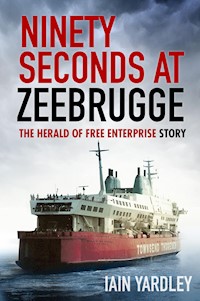
The Herald of Free Enterprise car ferry set sail on a routine voyage to Dover in March 1987, carrying hundreds of passengers, including British army personnel, day-trippers and truck drivers. Minutes after leaving the Belgian port of Zeebrugge, the ferry began to capsize. Terrified passengers were separated from loved ones in a seething mass of humanity, in freezing cold water and had to fight for their lives. This is the minute-by-minute account of those who lived through the disaster, from the event to rescue, reunion and repatriation. The Belgian people are also remembered for the care and comfort they gave to the bewildered and grief-stricken survivors. Including plans, photographs and records considering how this disaster impacted ferry operating procedures forever, Iain Yardley's thoughtful study covers every aspect of this tragedy. Many survivors, relatives and rescue workers have contributed to make this a fitting tribute to all involved from that night to the present day.
Das E-Book können Sie in Legimi-Apps oder einer beliebigen App lesen, die das folgende Format unterstützen:
Veröffentlichungsjahr: 2014
Ähnliche


















Dedicated to the memory of my mum, Barbara, my dad, Joseph, my cousin Lee, friends Natalie and Neil, and all those who are gone long before their time.
CONTENTS
Title Page
Dedication
Acknowledgements
1 Beginnings
2 Disaster
3 Rescue
4 Aftermath
5 Answers
6 Legacy
Bibliography
Glossary and Abbreviations
Plates
Copyright
ACKNOWLEDGEMENTS
There are a great many people who have contributed to the book in one way or another. I am extremely grateful to them all. This is by no means an exhaustive list, but I would particularly like to thank the following.
All the survivors, relatives and people who participated in the rescue and care in the aftermath, and who contributed to this book.
Pascale Bernard for French translations, and Christine Geyer for German translations; Inge Desmedt for being a better Belgian detective than Hercule Poirot ever could be (sorry for the chair); Jackie Badger and Paul Wightman for turning a blind eye when I should have been working; Nicola Dobson for proofreading; Eamonn Farrell for saving my laptop from the bin; Rebecca Sawbridge, Janet Johnson and Peter Southcombe for filling in the blanks; Patrick Mylon for his encouragement; Gary and Tracy Sexty, Steve and Jan Booth, Caroline Mylon, Mike Peach, Chris Mooney, Eric Sauder, Brian Hawley, Lynne Hawkins, Paul Rogers and Katie Beresford for their support and enthusiasm; and to Mick Goddard for his day-to-day support, reading, driving me around and putting up with my many tantrums.
Finally, I would like to thank Chrissy McMorris and Amy Rigg at The History Press for having enough faith in me to make this book a reality.
1
BEGINNINGS
Players
Former artillery officer Captain Stuart Townsend was fed up with being charged exorbitant fees to transport his car across the English Channel by steam packet boats. He decided to start his own shipping line and, after talks with the Automobile Association (AA) and Royal Automobile Club (RAC), Townsend Brothers Ferries Ltd was in business by 1928. The coal ship Artificer, capacity fifteen cars and twelve passengers, was chartered, and a shipping link between Dover and Calais was established in June of that year. The service became so popular that it became permanent in 1929. Owing to the demand, the Artificer was replaced by the Royal Firth, followed by a former minesweeper, renamed the Forde, in April 1930.
The Forde could carry thirty cars and 168 passengers. For six years, cars were lifted by mobile ramp onto the Forde, until a strike by Calais dockers and crane operators in 1936. For the duration of the strike, the Forde’s stern rails were removed and cars driven onto the ship via makeshift platforms. Although strictly a ‘one-off’ temporary arrangement, it undoubtedly gave Townsend the idea for roll-on/roll-off (RORO) ferries for the future. It wasn’t until fifteen years later, in 1951, that drivers were allowed to drive their own cars onto a ferry, when the Forde was replaced by a converted frigate.
The first RORO berths in Dover and Calais were installed in 1959. Then, in 1962 the frigate was superseded with the introduction of Townsend’s first purpose-built car ferry, Free Enterprise I, on the Dover–Calais route; so named because Townsend were celebrating their private sector status and breaking away from a state-run service.
The second purpose-built ferry, the Free Enterprise II, became the first British registered, seagoing, drive-through ferry with bow and stern doors, upon its introduction in 1965. A year later, Free Enterprise III was introduced onto Townsend’s second route, Dover–Zeebrugge.
Frank Bustard was an apprentice and friend of fellow Liverpudlian, J. Bruce Ismay, who was chairman of the White Star Line (WSL). Ismay survived the sinking of the Titanic in 1912. Bustard was awarded an OBE for services during the First World War, after which he became the passenger traffic manager for the WSL. In 1934 – the same year that the WSL merged with Cunard – Bustard set up the Atlantic Steam Navigation Company Ltd.
Bustard wanted to set up a line offering a moderately priced transatlantic passenger service between Europe and the United States. He was unsuccessful in acquiring surplus Red Funnel Line vessels and, despite approaching Vickers Armstrong for two new ships, the government was reluctant to see a new company operating in competition to Cunard White Star. The Bank of England refused him a loan.
The looming Second World War put paid to his intentions – Bustard was called up to the army reserve. During the war, he was present at the trials of landing craft loading and unloading vehicles on the beach at New Brighton, and after the war, in 1946, Bustard concentrated on vehicle-carrying ferries to operate on the short sea routes across the North Sea.
Atlantic used chartered converted tank carriers, 3519, 3534 and 3512, to start a service from Tilbury to Hamburg, predominantly for freight. Twelve years after being founded, Atlantic sailed its maiden voyage in 1946, using the converted 3519, now renamed Empire Baltic. Two years later, the world’s first commercial RORO service was established by Atlantic when the Empire Doric sailed between Preston, Lancashire and Larne.
A service to Rotterdam was established in 1960, also mainly for freight, and this lasted for six years. Atlantic’s Felixstowe–Rotterdam services, developed in 1964, and Felixstowe–Antwerp service in 1965, had led to the demise of the Tilbury operations. All services from Tilbury ended in 1968 as they became uneconomical. In 1968, Atlantic became part of the National Freight Corporation. The seven ships which had been its fleet all gave a nod to ships of the White Star Line.
Southampton based Otto Thoresen Shipping Company was set up in 1964 by a group of Norwegian investors. The Norwegian registered company operated RORO Services between Southampton and Cherbourg and Southampton and Le Havre. Thoresen Car Ferries, a wholly British-owned subsidiary company, was formed as an agent for these RORO services in the UK. Services began that same year with the ferries Viking I and Viking II. A year later these two ferries were joined by Viking III and Viking IV. The ferries were so named to reflect the company’s Scandinavian origins.
These three major players eventually became the same group in 1971 after a series of acquisitions by George Nott Industries, formerly Monument Securities, incorporated in 1935. Monument acquired all the capital of Townsend in 1959. It then acquired Otto Thoresen in 1968, liquidating the company but retaining its subsidiary Thoresen Car Ferries. With the merging of the two major ferry companies, George Nott changed its name to European Ferries Ltd (EFL). With the takeovers of the Stanhope Steamship Company Ltd, Monarch Steamship Company Ltd and Atlantic in 1971, the company used the name Townsend Thoresen to market their combined ferry services.
There were two types of traffic carried by EFL – freight and tourist. Freight comprised commercial road haulage vehicles and the importing and exporting of new cars. The vessels assigned to carry predominantly freight were mostly multi-purpose RORO ferries or purpose-built ferries. Tourist traffic was classified as foot passengers, cyclists and accompanied vehicle traffic, including the drivers and passengers of cars, coaches and caravans. Tourist traffic also included both pleasure and business travellers. These journeys were mostly undertaken by multi-purpose RORO or passenger and vehicle ferries.
The decline of cross-Channel overall profits in 1980 was blamed on the fall in freight due to the recession, competition and a blockade by French fishermen. EFL, on the other hand, enjoyed a 50 per cent rise in tourist traffic in 1980 compared to the previous year, with the Dover routes accounting for almost all shipping profits that year.
In the late 1970s the competition for cross-Channel passenger and cargo traffic in the Dover Straits was fierce. Most of the British short sea routes were still under the control of Sealink, the state-owned railway fleet. Freight completion had become crucial as firstly railway-owned hovercraft had grabbed a large share of the passenger market. Although a joint UK–French Government-backed scheme to build a channel tunnel between the two countries had been cancelled in January 1975, it was still anticipated that a tunnel would eventually be built, which would take an even bigger part of the passenger market. In answer to this, Sealink had planned to monopolise the market by building new ferries with double-decker vehicle decks, primarily for the Dover–Calais route, the shortest crossing between the United Kingdom and the European continent, and also the most profitable. By operating vehicles on one ferry at a time, it would ensure a high freight capacity, which was vital for business. When it learned of Sealink’s plans, the Townsend Thoresen response was immediate.
Debut
Traffic figures for Dover–Zeebrugge in 1980 showed that 1,560,881 passengers had utilised the service, whilst vessels had carried 291,683 accompanied and 158,368 freight vehicles. Clearly, the Dover–Zeebrugge run was becoming very popular.
It soon became clear that the four vessels on the Dover–Calais service would need to be replaced due to the increasingly high tourist demand. EFL introduced the ‘Spirit Class’, three brand new, state-of-the-art ferries that would offer their passengers higher speed, greater passenger and vehicle capacity, increased catering facilities and a faster turnaround. The three new ships would sail under the orange livery of Townsend Thoresen. The ‘Spirit’ vessels were designed to compete against the higher operation speeds and fast loading and unloading hovercraft capabilities. Plans for the new ships showed that up to 1,325 passengers and 350 cars could be carried, with the car capacity reduced according to the number of freight vehicles, coaches or caravans taking their place.
To finance the three ships, EFL undertook additional borrowing, an investment of £51 million, which was planned to cover anticipated traffic levels throughout the 1980s. EFL claimed no more shipbuilding commitments would begin until the future of the short sea shipping market could be ascertained. Although they didn’t know it, the Spirit vessels would become the last ever commissioned by EFL.
Townsend Thoresen’s in-house naval architect, Wallace Ayres, designed three ferries that would be faster and more spacious, capable of making five return trips per day each, and outperforming any rivals. Ayres’ ideas were unlike anything ever constructed. Ship design is usually governed by national and international regulations, with new ships making only small changes to existing designs. Ayres aimed to design ferries that would be capable of making Dover–Calais journeys of just seventy-five minutes, compared to Sealink’s one-and-a-half-hour crossings, with the emphasis on carrying freight.
Townsend Thoresen placed orders for three new ferries with their favoured shipbuilders, Schichau Unterweser AG, in Bremerhaven, West Germany. To power these faster ferries, each would be propelled by three 8,000bhp, 12ZV 40/48 internal combustion diesel engines, supplied by Sulzer Bros of Winterthur, enabling a speed of 24 knots. The three engines and propellers would provide excess power to make up time for any delays. Electrical power was provided by three internal combustion driven alternators with a capacity of 1,063Kva. Emergency power was provided by diesel driven alternators with a 515Kva capacity.
The triple screw RORO passenger/vehicle ferries would weigh 7,951 tonnes gross. They were 131.9m (433ft) long, 121m (397ft) between perpendiculars and 22.7m (74ft) wide. Each of the ferries would have a capacity of 1,325 passengers and 350 cars.
The centre of gravity was kept low to enhance stability, by reducing the distance from the waterline to the lower vehicle deck on G-deck amidships. The superstructure was narrowed, with the eight lifeboats stowed in recesses on either side of the upper vehicle deck on E-deck. On C-deck, which was primarily passenger accommodation, the superstructure sloped up and outwards to maximise the space inside, then sloped back inwards again on B-deck, where the crew accommodation was situated. This gave the ferries a dynamic, modern and angular appearance.
Further innovation was in the design of the bow and stern doors, which opened up ‘clam shell’ style, the doors not protruding beyond the ship itself, offering both operational and safety enhancements. It appeared that Ayres achieved his vision of making these new-design ferries much different from Sealink’s ferries.
For the purposes of nautical terms, ‘weathertight’ applies to doors and bulkheads (walls) that are only required to prevent the ingress of water from the side exposed to the weather. ‘Watertight’ refers to doors and bulkheads that are to keep in or keep out water. Of an all-welded steel construction, the ferries each had eight decks, above the tank top level and double bottom:
H-deck (below waterline) – sub-divided by thirteen watertight bulkheads and nine watertight doors for access between compartments. Four watertight flats were devoted to passenger accommodation (drivers’ cabins) and store spaces. The compartments between the watertight bulkheads were devoted to the steering gears (bow and stern), main and auxiliary machinery, fuel and fresh water storage, sewage plant, ballast tanks and voids.
G-deck (main deck) – a through-vehicle deck enclosed by a full superstructure. There was a single watertight door at the stern with a clear opening of 8.5m × 4.73m (28ft × 15ft) and double watertight doors at the bow with a clear opening of 6m × 4.9m (20ft × 16ft).
F-deck – mezzanine level car deck with ramps leading down to each side of G-deck. An emergency generator was situated starboard side of F-deck. The remaining space on the port and starboard side was crew accommodation.
E-deck – upper vehicle deck, through-deck enclosed by side houses with weathertight doors at both ends, and a clear opening of 6m × 4.9m (20ft × 16ft).
D-deck – suspended vehicle platform on a mezzanine level with ramps leading down to E-deck.
C-deck – main passenger accommodation with cafeteria, drivers’ restaurant, bar, duty-free and perfume shops, observation lounge, bureau de change and information office and galley.
B-deck – passenger lounge, Blue Riband restaurant, Salad Bowl cafeteria, bar, TV lounge, crew and officer mess rooms on port side, ratings mess room and crew accommodation on starboard.
A-deck – officers’ accommodation and radio room.
Wheelhouse – on mezzanine level between decks A and B.
The access between A and G-decks was by means of staircases at the port and starboard sides at the aft end, midships and forward. The staircase at the forward went all the way from top to bottom down to H-deck.
There was more than enough lifesaving equipment for everyone on board. Eight lifeboats, four of them motorised, were stowed in the external recesses of E-deck. They could carry 630 people. Sixteen inflatable life rafts with Marine Escape Systems (MES) were installed on each side of D-deck. An inflatable slide or chute, similar to those used when evacuating aircraft, enabled passengers to slide straight into waiting life rafts. These rafts could hold a total of 672 people. Other lifesaving devices aboard included seven ‘throw over’ life rafts (175 people), five buoyant apparatus (70 people), twenty lifebuoys and 1,525 lifejackets (including 139 for people weighing under 32kg).
In Bremerhaven, Schichau Unterweser was able to construct each ferry in only one year. The first completed was the Spirit of Free Enterprise, launched on 21 July 1979 (Yard No. 2279) and entered into service in January 1980, nine months before Sealink’s St Anselm was completed at Belfast’s Harland And Wolff shipyard. The Spirit of Free Enterprise became the first passenger carrying ferry with a double vehicle deck with simultaneous double loading on the Dover Strait. Townsend Thoresen marketed the route as their ‘Blue Riband Service’ after the ferry claimed the record for the fastest Dover–Calais crossing by conventional ferry.
On 12 December 1979, the Herald of Free Enterprise was launched (Yard No. 2280) and the Pride of Free Enterprise on 31 May 1980 (Yard No. 2281). The Pride was launched in a publicity stunt for BBC television.
The Herald was delivered to Townsend Car Ferries Ltd in Dover in May 1980, its official number 379260. The International Maritime Organisation (IMO) gave it the new ship number 7820405. Its call sign was GBJV. Apart from the name on her side, the Herald could be distinguished from her two sister ships by the paintwork. The bridge roof was white, along with the vents and lift housing and there were black surrounds to the bridge windows. On 29 May, the maiden voyage of the Herald took place between Dover and Calais.
In September 1980, John Hendy wrote in Sea Breezes (Vol. 54, No. 417) about a record-breaking crossing of the Herald on 10 July, during a Force 8 gale. The new ferry had beat by one minute the personal best record held by the Spirit, making it from Dover to Calais in fifty-four minutes and fifty-three seconds.
In early December 1982, the Herald suffered damage in a collision with a pier. It necessitated a visit to her builders in Bremerhaven at the end of January 1983 to replace plating on the starboard side and to straighten out deck plating. Two years later she went for refit. In February 1987, it was announced that during the refit planned for early March, a dedicated video lounge and additional passenger cabins would be fitted in the area of the present B-deck bar. The refit was scheduled to take place after completing her Zeebrugge–Dover voyage on 6 March.
The lower vehicle deck bow doors of the ‘Spirit Class’ sister ships were built by Cargospeed on Clydeside, Scotland, which ceased trading in the 1980s. They were designed to swing horizontally on vertical axes on radius arms. They were stowed against the ship’s sides when open, and when closing, the doors would meet at the centre point.
On a normal crossing, once all the vehicles had been loaded and the car ramp raised, the deck officer placed a chain across the width of the lower vehicle entrance, between the inner and outer doors. He then used a walkie-talkie to communicate to the bridge that vehicle loading was complete. Called ‘Neatstow’, the sets of two doors, internal and external, were set 12ft apart, on the vehicle deck of the ferries. Both of the doors were fitted with bells and flashing red warning lights.
The doors did not swing freely; they were held in place by a pneumatic power system run by two power packs. When the power packs were activated, the doors were operated from a horizontal control panel. A lever would be inserted. The external doors were slid shut first in a ‘clam-shell’ fashion, followed by the internal doors, which were watertight. The door control was moved to the ‘open’ position, raising the door clear of the latches. Then the latch control was moved to ‘off’ and the locking pin control moved to ‘out’, then it was held. The door control was then moved to ‘close’ and held again until the doors were fully closed. The warning bell was then cancelled.
Closing both sets of doors took around four minutes. The red warning light then turned green to indicate the doors were in place and secure. Additional lights indicated that the locking pins were locked vertically into the deck in the ‘in’ position. All the controls were then returned to the neutral position. Finally the telephone to the left of the control panel was used by the assistant bosun to report to the bridge that the bow loading doors were locked.
This four-minute door-closing procedure did not happen on the night of 6 March 1987.
Takeover
In December 1982, the EFL vehicle ferry European Gateway, sailing in Townsend Thoresen livery, collided with Sealink’s Speedlink Vanguard off Felixstowe. Consequently, the ship flooded and capsized, with the loss of six lives. This would not be the last time a Townsend Thoresen ferry would end up on its side in the North Sea.
The chairman of the EFL board was MP for Dorking, Keith Wickenden. In July 1983, whilst piloting a reconditioned Mark XIV Supermarine Spitfire aircraft, Wickenden was killed when the plane he and his brother Allen had lovingly rebuilt over the previous three and a half years crashed after taking off from Cranfield, Bedfordshire. Wickenden had often been described as the ‘guiding star’ of European Ferries. His successor was EFL Managing Director Ken Siddle.
After the death of Wickenden, two Canadian shareholders of Noramco, a company involved in EFL’s property interests, were appointed to the board of EFL that same month. In 1985, P&O Group sold their cross-Channel interests to EFL. By 1985, over 2.5 million vehicles per year were passing through Dover’s nine berths. The operating income of EFL that same year was £45.5 million.
A year later, in January 1986, P&O struck a deal with the board of EFH (European Financial Holdings: a company owned by Noramco) obtaining all of Noramco’s interests in European Ferries (EF). P&O purchased 50.01 per cent of EFH from Noramco for £35,920,549. Noramco retained 49.99 per cent. Effectively, P&O were now the major owners of European Ferries.
The P&O chairman since 1983, Sir Jeffrey Sterling, was appointed to the board of European Ferries with Managing Director Mr Bruce MacPhail as his alternative. A P&O representative was appointed to the board of EF International, EF’s property holding company in the US. The appointment of P&O’s chairman to the board had been a precondition of its purchase of Noramco’s interests.
July 1986 saw the resignation of Ken Siddle as chairman of the EF board. He had always been uncomfortable as the public face of EF. Siddle’s successor was Geoffrey Parker. Siddle remained with EF as its managing director until September 1986, when he resigned from the company, along with another executive director, Mr J.R. Parsons.
The resignation of Siddle and Parsons on 10 September 1986, happened at the same board meeting in which EF had to face the reality that P&O considered itself able to influence the policy of European Ferries. Takeover of the EF group was now inevitable, and Sir Jeffrey Sterling was instrumental in putting forward the action.
Other ferry operators using British ports had concerns over a P&O–European Ferries merger. Sealink and Brittany Ferries were worried that it would lose P&O’s Ferrymasters contract if P&O decided to keep the lucrative business ‘in-house’. Societe Nationale des Chemins de fer Francais (SNCF) expected to have to ‘rationalise’ its workforce.
Port operators were also expressing concerns. Harwich Harbour Board believed that a merger was likely to produce a decline in the port industry. Ipswich Port Authority thought that North Sea Ferries would transfer its services to Felixstowe, forcing the closure of its RORO terminal with the immediate loss of 100 jobs from a workforce of 430. Ken Weetch, MP for Ipswich, considered that a merger would have an adverse effect on employment in the area due to anticipated rationalisation.
The Road Haulage Association (RHA) feared that a merger would limit the choice of sea carriers, again down to probable rationalisation. The Automobile Association (AA) thought that there would be a possible reduction in competition.
The Transport and General Workers’ Union (TGWU) were convinced that a merger would have serious adverse effects on its members’ employment in P&O ports, particularly at Ipswich, Tilbury and Southampton. The TGWU agreed with Ipswich Port Authority, that relocation by North Sea Ferries to Felixstowe would result in job losses. The Transport Salaried Staff’s Association (TSSA) also expressed concerns that rationalisation would lead to job cuts at Southampton and Felixstowe, where P&O and European Ferries were in direct competition. The Department of Transport noted that a merged company would not only be a large ferry network, but also a large deep-sea-liner trading fleet, thus making it dominant in the UK shipping industry and swallowing up a large proportion of the profits earned by the industry. The Ministry of Defence said that rationalisation would lead to fewer ferries, and pointed out that there would be some loss of flexibility to meet its defence needs.
The concerns of other ferry operators, ports and their staff were at their height when P&O Group took over Townsend Thoresen European Ferries on 5 December 1986.
Notoriety
The White Star liner Titanic sank in 1912, with the loss of almost 1,500 lives. The disaster raised numerous questions about maritime safety, prompting the British Government to host the International Convention of Safety of Life At Sea (SOLAS), adopted in January 1914 but not enforced until July 1915 due to the outbreak of the First World War. Lessons learned from the disaster and incorporated into the regulations included the provision of lifeboats for every person on board. It does seem incredible that, at the time, people were willing to travel on a ship knowing that in the event of an emergency, there was no way to escape.
After the United Nations was formed in 1948, it was realised that an international treaty was essential to promote maritime safety. The Intergovernmental Maritime Consultative Organisation (IMCO) was established at a conference in Geneva. The IMCO changed its name to the simpler ‘International Maritime Organisation’ (IMO) in 1982.
There had been concern expressed about the safety of RORO ferries ever since they were introduced. ROROs are unique in design. On conventional ships, transverse bulkheads – many watertight – create a series of separate holds within the hull. If the hull is breached in any way, these bulkheads will control or delay the inrush of water, enabling the ship to stay afloat long enough for the evacuation of everyone on board or to stop it sinking at all.
In 1977, the ‘free liquid surface effect’ became a major concern at the Subcommittee on Subdivision, Stability and Land Lines. The effect of loose water due to leakage, fire extinguishing water and such, in enclosed spaces – such as a vehicle deck of a RORO ship extending the ship’s full length with no internal bulkheads – could lead to serious consequences. Internal drainage was offered as an answer to this problem. Adopted by the IMO in 1983, it was incorporated into the 1989 SOLAS amendments.
The whole point of a RORO ship is to be able to drive onto the ship at one end and off again at the other. To install transverse bulkheads or walls on these ‘through’ decks would be a major obstacle to vehicles. Even though ROROs are fitted with watertight collision subdivision, along with bulkheads in the engine room below the freeboard (uppermost watertight) deck, as prescribed by SOLAS, water can still rapidly enter the huge vehicle decks.
Fire can spread quickly in the same manner. Potential risks on ROROs include the cargo access doors at the stern and bow, and side doors, equipped on some ROROs. On older ferries, these access doors can become misaligned or damaged over time, particularly when the doors also double as access ramps.
The shifting of cargo on vehicle decks can affect the stability of a RORO ferry, causing it to list. A sudden inrush of water due to hull damage or watertight door failure can be even more rapid, endangering a ship. Stability can also be affected when the ferry has a very large superstructure which can be prone to buffeting by wind and bad weather.
Cargo-only ROROs often have cargo access doors very close to the waterline. A sudden list caused by the movement of cargo, for example, could push the entrance to the vehicle deck below the waterline. A sudden inrush of water would follow, resulting in an increased list, leading to possible capsize. Listing can cause cargo to break loose, if not stowed or secured correctly, and the crew of the ship are not usually aware of how individual lorry trailers are packed, which may worsen the problem. A heavy load breaking loose could cause others to follow suit, resulting in an increased list, or the spilling of dangerous substances as well as hull and structure damage.
There are several ways in which cargo can prove dangerous on board a RORO ferry. Designed for the road, every vehicle is packed differently, with no universal method in place. Different forces are present, and the lorries often lack securing points; a lorry’s suspension system could cause lashings to disengage and a toppling trailer could dislodge nearby units, causing a domino effect. Loading conditions cannot be arranged properly, since lorries and trailers arrive for the journey in random order. A spot check of loaded vehicles leaving RORO terminals in Sweden showed that 45 per cent of the cargo on trailers was partly or completely unsecured.
The first RORO ship lost at sea was the Princess Victoria, which sank with the loss of 133 lives on a 1953 voyage from Belfast. Heavy seas had battered in the stern door, exposing the vehicle deck to the open water.
In 1966, the Greek ferry Heraklion was lost off Piraeus after heavy seas caused it to sink, with 264 fatalities. The Heraklion was not strictly a RORO, but it did have a large car deck with transverse bulkheads. The deck flooded when a vehicle deck broke loose and smashed the loading hatch.
The Wahine capsized at the entrance to Wellington harbour, New Zealand, in 1968, after water flooded the vehicle deck when the ship grounded in a storm. Fifty-three people died.
The cargo RORO, Hero, was lost partly due to a leaking stern door in 1977 in the North Sea, with one crewman dying of injuries while being rescued by helicopter.
The Princess Victoria, Heraklion and Hero were all lost in heavy seas; other ROROs have been lost in port or sheltered waters.
The Straitsman sank in Melbourne in 1974, with two deaths, after the crew, unaware that the stern door was still below the waterline, opened the door as the ship approached land.
In 1977, the Seaspeed Dora listed and capsized while berthed at Jeddah, after cargo shifted and water seeped through an open bunker door.
The problematic design features of RORO ferries were still being mulled over by international maritime safety bosses when the Herald of Free Enterprise began its fateful journey in March 1987.
2
DISASTER
Departure
The Herald of Free Enterprise’s normal route was between Dover and Calais, which was the shortest and most profitable sea crossing between the UK and continental Europe. Vehicles could normally be loaded onto the three ferries in the Spirit class simultaneously through G-deck (the main vehicle deck) and E-deck (the upper vehicle deck) using double deck link-spans (ramps) in use at both ports.
However, there was no double deck link-span at Zeebrugge, and all vehicles had to be loaded one deck at a time. Also, the ramp at Zeebrugge did not extend to the higher E-deck, due to the high spring tides. This was common knowledge to the Herald’s crew and was overcome by ‘trimming’ the ferry, on this occasion filling the ferry’s forward ballast tanks to allow it to sit deeper in the harbour, bringing the E-deck in line with Zeebrugge’s single deck link-span. This allowed both vehicle decks to be loaded, albeit one after the other, and therefore taking longer than it would have on the Herald’s normal run. To prepare for this, ballast tank No. 14 (deep tank, capacity 268m3) began to fill about two hours before the Herald was due to arrive in Zeebrugge. This added an additional 268 tonnes. This was followed by the filling of No. 3 (port double-bottom ballast tank, capacity 42m3 – an additional 42 tonnes).
Officially 8,874 tonnes, it was estimated that an additional 250–270 tonnes in modifications, as well as overweight vehicles, made the Herald’s displacement 9,250 tonnes, 3ft lower in the water and ‘significantly overloaded’ at departure, for the conditions in which she set sail.
The Herald was designed for the Dover–Calais run, with the intention of rapidly disembarking passengers and vehicles, and embarking the same without delay for the return journey. Because of the fast turnaround to keep within tight schedules, the ships on this run were manned by a complement of a master, two chief officers and a second officer. However, this was reduced by management for the Zeebrugge run as it was believed that, because the journey time was four and a half hours, there was more time for the officers to relax. Therefore, for this journey, there was only one chief officer, Leslie Sabel, aged 40. Sabel’s duty on this trip was to oversee the loading of the vehicle decks, to ensure that Assistant Bosun Mark Stanley closed the doors and to be on the bridge at departure. It seemed that as soon as the last vehicle was aboard, Chief Officer Sabel would have to leave the vehicle deck. He would not be there to see if the doors were closed. Sabel couldn’t be in two places at once.
E-deck, the upper vehicle deck, was loaded first, using the single ramp. Then G-deck, the main vehicle deck, began to load.
The timings hereon use the twelve-hour clock for the UK (e.g. 1 p.m. or 1 a.m.) and the twenty-four-hour clock (e.g. 1300hrs or 0100hrs) for Continental Europe. Western Europe is generally one hour ahead of UK time, known as GMT+1. For example, if an event occurred in Belgium at 1400hrs, it would be 2 p.m. in the afternoon in Belgium, but 1 p.m. in the UK.
There were three shift patterns in operation aboard the Herald. On this sailing, the eighty-strong crew belonged to ‘C’ Watch. Their working day had begun at 11.30 a.m. when they joined the ship at Dover. The ship sailed at 12.30 p.m. for Zeebrugge, and the crew would leave the ship when it arrived back in Dover at 10.30 p.m. that same night.
Lorries (commercial transport) were the first vehicles to drive onto the Herald, followed by coaches, cars and foot passengers. That evening, for the return journey, lorry driver Paul Roberts, driving for Interox of Warrington, Cheshire, had actually driven onto the Herald, but was told to reverse off because the vehicle deck was full – they could not squeeze him on. One who did get on, was 39-year-old lorry driver Brian Gibbons, originally from Birmingham. He was returning to his wife and six children in Melton Mowbray, Leicestershire, after delivering a consignment of carpets to Belgium. His was the fourth lorry aboard the ferry, and so he had plenty of time to prepare for the four-and-a-half-hour journey back to Dover. He went straight to the drivers’ restaurant and was served his meal by Henry Graham, before going below to occupy one of the drivers’ cabins.
Non-commercial passengers had begun to embark the Herald for the return journey at 1830hrs, half an hour before the scheduled departure time. Assistant Purser Stephen Homewood was lying on his bunk listening to a tape of classical music when his walkie-talkie burst into life, signalling that the first passengers were coming aboard. He went to his post in the information office and made a tannoy announcement for the staff: ‘Attention catering department and catering personnel, open all services. Passengers on board.’ He then chatted briefly with fellow Assistant Purser, David Didsbury, who was in charge of the bonded stores and retail outlets on this trip. Didsbury was to have his meal first and then come back to take over from Homewood.
At 1840hrs local time, No. 14 ballast tank began to empty – its job done – to prepare for the journey home. Tank No. 3 would empty later. It was estimated that 50 tonnes had been emptied by the time of departure.
Assistant Bosun Mark Stanley (28) had finished tying down the last of the lorry trailers on G-deck and, at 1850hrs, had returned to his cabin for a short rest. He drank a cup of tea and sat on his bunk, intending to read for a few minutes before the call to report to harbour stations. He was due to return to G-deck to close the bow doors before the ferry got under way – that is if someone hadn’t done the job already, as was often the case. The warmth of the cabin and the welcome rest after a long and dreary shift overwhelmed him and he fell asleep. Stanley missed the call to report to harbour stations.
Lorry driver Ian ‘Jock’ Calderwood (44), originally from Stranraer, was almost the last to be loaded and had to walk round the front of his truck to get off the vehicle deck. Jock was returning home to his wife, Wendy, and four children in Dagenham, Essex. He estimated that he left his cab about six or seven minutes after the Herald had left the berth. ‘The doors were wide open. The ship was reversing out and I could see the whole of the harbour through the doors.’ He didn’t think it unusual, as experience told him that the freight deck doors were often left open until the ship reached the open sea, for fumes to clear. ‘I saw two crewmen banging furiously at the hydraulic mechanism with a hammer or spanner as I went up. I left the freight deck and didn’t think anything of it. I’ve seen the doors open like that umpteen times’.
Once Chief Officer Sabel had overseen the loading of the vehicle decks, he later testified that he thought he saw Assistant Bosun Stanley return to G-deck to close the bow doors. He saw a man dressed in orange overalls about 20ft from the bow door controls. Assuming that the crewman responsible for closing the bow doors was at his post, Sabel left for the bridge.
Bosun Terry Ayling (39) was the last man to leave the vehicle deck on G-deck and, as far as he was aware, there was no one there to close the doors. After the last vehicle was loaded, he merely put the chain across. Harbour stations had already been called, and he was in his cabin. When asked later why he had not ensured the doors were shut, he replied, ‘It has never been part of my duties to close the doors or make sure anybody is there to close the doors.’
Sean Trower (27) missed the ferry after being arrested following a row in a restaurant in Zeebrugge. He was locked up in a police cell.
Billy Schmidt (34) and Brenda Lamb (31) had reluctantly left their six children with relatives in Reynes Park, south London, to take a romantic break. Sammy (13) and Angie (12) were Billy’s daughters by his first marriage. John (15), Neil (13) and Lee (11) were Brenda’s sons by her previous marriage. Robyn (5) was both of theirs but all the children lived together with the couple. They had been together for ten years.
Brian Smith (29) had planned to leave the Royal Corps of Transport to be a lorry driver. He was taking his family – wife Donna-Marie (27), daughter Kerry (5) and son Sean (21 months) – back to their native Manchester for a last holiday before returning to Germany for his final three months of service.
Andrew Parker (33) of Herne Hill, south London, stopped by the information office to enquire if there were any spare cabins for his Filipino-born wife, Eleanor, and daughter Janice (12). Also travelling with them was family friend Oriana Gomez and her 12-year-old son, Jonathan. Stephen Homewood told them to come back after the ferry had departed, because the cabins and their forty-four bunks were automatically allocated to lorry drivers first and it was not yet known if there would be any left. (Pink tickets were issued to lorry drivers, which were included in the price of the freight ticket. A certain amount of time was given for drivers to take up a bunk if they wanted. Any tickets left over were then taken to the information office for resale to the rest of the passengers at a cost of £4.50 for a single bunk, or £9.00 for the whole two-berth cabin. There was usually a fairly long queue for these cabins, particularly for people who had driven through the night across Europe to join early morning ferries.)
Henry Graham (24) was supervising the commercial drivers’ restaurant on C-deck as a steward. The restaurant was situated next to the self-service cafeteria, between the servery and the eating area, in an area described as ‘like a greenhouse’, with a separate entrance on the starboard side. A port-side doorway led to the galley, feeding both restaurant and cafeteria. Henry was officially listed on the crew list as a kiosk steward (leading hand) but had been training to become a purser as part of a promotion. The training had taken him to every part of the ship except the engine room. The thirty-two-seat restaurant had begun to fill half an hour before sailing and with thirty-six trucks aboard and usually two drivers per truck, Henry was going to be busy. The normal routine was for drivers to eat first and then retire to their cabins on H-deck, below the waterline, for the rest of the journey.
Chief Cook Paul White then approached Assistant Purser Homewood about supplies. Homewood made two unsuccessful attempts to contact the radio operator, Robert Mantle, about having the additional supplies ready for loading at Dover. Whilst the ferry was still at berth stations, steward Paul Cormack handed Homewood the ship’s bag, holding the captain’s cargo, passenger and freight manifest. These figures would need to be radioed through to Dover for the port authorities to make proper arrangements for the Herald’s arrival.
The workers in Dover would need to know how many semi-trailers (detached rear half of an articulated lorry) there were, in order to allocate the same number of cabs to take them off the ferry. They would also need to know the number of foot passengers on board so that they could organise enough coaches to transport them to the terminal, as well as providing enough baggage trolleys. In addition, they would need to know if any animals would need to be quarantined. On this trip, there were none. Again, Homewood attempted to contact the radio operator but still could not get through. He never did speak to Robert Mantle.
By this time, many of the passengers had started to crowd into the bars in the public areas and it was getting quite noisy and rowdy. Clearly, people were determined to make the most of their day out.
Jan Willis was a ‘very lowly’ bank clerk at the NatWest Bank at Finsbury Circus in the City of London. ‘I hated the job, pushing pieces of paper around a desk and to be honest I did it very badly.’ Realising that she had achieved very little at school, and no one having any expectations or hopes for her, she had enrolled for a BTEC evening class in business and banking at Barking College of Technology, near her home in Essex.
The Sun national newspaper had been offering a Channel crossing aboard Townsend Thoresen ships to its readers for just £1, as part of a promotional campaign. In her second year at college, when Jan was 19, she and a group of six fellow students had decided to go on a day trip, using the Sun’s £1 tokens. Her friend, Karen Watson (18), organised it. With them were Karen’s boyfriend Tony Curley, two boys (both named Vijay) and two girls who Jan didn’t really know. After their ‘pretty uneventful’ day out in Belgium, the group had hoped to catch an earlier ferry but they had missed it.
Whilst waiting for the 1900hrs sailing in the ferry terminal building, Jan found herself chatting to a woman in a wheelchair who was from Dagenham, close to where she lived. Nora Woodhouse (54) was travelling with her husband and son.
Once aboard, Jan and four of the others made their way to the cafeteria, while two of the girls minded the group’s bags. Jan ordered chicken burger and chips at the counter but had to wait for it to cook. While she waited, she noticed the large deep fat fryers behind the counter. The others went to find a table.
Mrs Sheila McKenny (54) of Hastings, East Sussex, had been collecting the Sun tokens for her whole family to partake in a daytrip. Despite the uninviting weather, with drizzle and early morning fog, the family had been determined to enjoy their day out. Husband Richard (64) drove their car onto the ferry with Sheila, their son Wayne (15), Sheila’s daughter Lynette Carvley (37), of St Leonard’s, and Lynette’s 18-year-old daughter, Rebecca. Despite spending only four or five hours in Zeebrugge, and the poor weather, the trip to the continent had been a success. Lynette was enjoying a day off from her job at the Inland Revenue. Richard recalled:
My wife befriended a lady in a wheelchair as we waited to board. The lady became quite friendly with Sheila as it turned out they were from the same area, Lancashire, and they chatted, as women do, for quite some time … the lady in the wheelchair asked if she could sit with us [in the cafeteria], at the end of the table, but in her chair in the alley way, so that she and my wife could carry on chatting to each other.
The woman in the wheelchair was Nora Woodhouse, whom student Jan Willis had chatted to in the terminal building before boarding.
Also on a day trip, from Hastings, were five members of the Perkins family. Mother, Sheila (42), and her three sons Darren (21), Simon (18) and Anthony, and Darren’s fiancée, Nicola Payne (20). They had spent a great time in Zeebrugge and were ‘happy all day, laughing and joking about incidents that had happened during the day’.
A group of four friends from Kent had enjoyed a day out on the continent, and were now relaxing in the lounge on C-deck. Colin (44) and Jackie Virtue (46), of Bromley, were with Steven (38) and Janet Turner (30), of Meopham.
Bombardier John Gaylard (36), serving in the Royal Artillery, had left his base in Dortmund, Germany, intending to catch an early ferry to meet his brother at home that evening in St Albans, Hertfordshire.
Lance Corporal Gary Thomas (24) of the Royal Electrical and Mechanical Engineers, was returning home to Liverpool to marry airport shop supervisor, Susan Lambert (22) of Feltham, Middlesex. Their wedding was scheduled for the following Saturday, 14 March. They had met after becoming penfriends.
Warehouse manager Rosina Summerfield (24) had taken a large amount of cash with her to Eindhoven, Netherlands. She hadn’t planned to blow it all on a spending spree – Rosina was convinced that something bad was going to happen and that they would need the money to get them out of trouble. She thought there may be a problem with their car at the very least. She had been on a road trip to Eindhoven to visit her future mother-in-law, with her boyfriend Kevin Batten, their 4-year-old son Ryan and 20-year-old Julie Clark, who lived with them in Park Royal, west London. Julie had decided to go with the family at the last minute after Rosina’s friend Kim had to drop out. Julie worked as a receptionist at the local Asda superstore and had called in sick. ‘Little did she know that she would be splattered all over every newspaper in England a week later’, Rosina said.
The week went fine and nothing had happened to the car or anything so I started to relax. We got to the ferry early and were one of the first cars to load. We had time to park up and go out on the deck which is where I first noticed the name of the ship on a life ring. I remember thinking that you never really know the name of the ferries on which you travel.
School pals Cheryl Taylor and Nicola Simpson should have been in lessons at Monk’s Walk School, Welwyn Garden City, in Hertfordshire. Instead, the 14-year-olds had been to Belgium for the day with Nicola’s parents, Tony (41) and Patricia (39). Tony worked for British Aerospace as an engineer, while Patricia was a dental nurse. As a family, the Simpsons, including Nicola’s brother Darren (16) and sister Linda (17), had travelled all over Europe, having camped in Yugoslavia, Spain, Switzerland and Germany. They were no strangers to ferry travel. They had boarded the midnight ferry the night before in order to have a full day out.
Captain Brian Bunker (28) of the 1st British Corps, British Army of the Rhine (BAOR), had met Diane when they were both 16, at a Catholic social dance in Enfield, Middlesex. Brian was commissioned from the Royal Military Academy at Sandhurst before being posted abroad, including four years with the Gurkhas in Hong Kong, South Korea and Nepal. Brian and Diane were posted to Bielefeld, West Germany in 1984.
He had received a phone call from his father the day before to say that Brian’s grandfather was seriously ill and was not expected to live much longer. Urgent arrangements were made at Brian’s base in Bielefeld, Germany, for Brian and his family to return to Enfield, to support the family. Brian, his wife Diane (29) and their 9-month-old daughter, Nadine, arrived at Zeebrugge in time for the 1900hrs sailing to Dover – the route they had used so many times before. After parking up, the Bunker family made their way to the lounge on C-deck, opposite the duty-free shop. Settling them down in a corner of the lounge on the starboard side, Brian left his wife and daughter briefly to fetch some hot drinks and snacks. The cafeteria on C-deck was very busy so Brian made his way to the deck above, where he knew there was another cafeteria called the Salad Bowl.
A group of four, associated with Lancing College, West Sussex, were also on board. College marshal Peter Martin (53), his wife Kay (also 53), and their friends, groundsman Richard Davies and his wife Georgina, made their way to the lounge on C-deck.
The Rogers family from Cheltenham, Gloucestershire, had settled down to watch a cartoon on the lounge’s TV, after having a meal of chips in the cafeteria. Successful self-employed builder Alan Rogers (36) had been working flat out, and the trip was just what the family needed. He and his 27-year-old wife, Susan, had spent a happy day in Belgium and were now heading home with their children, ‘very happy-go-lucky’ twins William and Emma (3), and their 18-month-old brother Adrian, laden with shopping and early presents for the twins’ upcoming birthday.
Lorry driver Barry Ducker, of Narborough near Swaffham, Norfolk, had been reluctant to take the trip abroad for work as his wife was recovering in hospital from a cancer operation. He was desperate to get home.
A group of seven young friends from the Black Country in the West Midlands were having a great day out. They had started out from Dover at 5.30 a.m. when they had crossed to Zeebrugge on Townsend Thoresen’s smaller ferry Free Enterprise VI, using the Sun’s £1 tokens. Brothers Ian (21) and Nicholas Wood (18), of Lye; and their pals Ian Moore (18) of Netherton; Alan Cartwright (21), a labourer of Quarry Bank; Andrew Bridge (19) of Clent; Andrew Dingley (18) of Hagley; and Lawson Fisher (18) of Stourbridge, had all spent the day in Zeebrugge, mainly drinking in the bars. They had found the town itself a bit boring. Now, the seven friends were aboard the Herald of Free Enterprise for the long journey home to the Midlands. ‘We weren’t drunk, like, but we were a bit merry.’ Lawson said.
Lance Corporal Conrad Wilson (24) was taking his family home to Bury St Edmunds, Suffolk, for his parents’ twenty-fifth wedding anniversary celebrations. His wife, Angela, and their two children, Rebecca (4) and 6-year-old Steven, had left family quarters at their British Army base in Germany earlier that day. Steven was celebrating his sixth birthday that day.
A party of six were on their way back to Cotmanhay, Derbyshire, and had settled down in the bar, before the drive back to the East Midlands. Richard (31) and Hazel Hartley (38) had spent the day with Richard’s parents Joseph and Elsie (both 65), son Martin (8) and family friend Patricia Hawley (40) known to Martin as ‘auntie’. Hazel was using a wheelchair due to her severe arthritis, which made mobility very difficult. Martin’s stepbrother, Lance, and his girlfriend, Lesley, should have been on the trip but had to cancel after putting down a £2 deposit – ‘We were just flat broke’, he said.
Petar Zutic (22), a Lance Corporal in the British Army, was taking his wife Julie (also 22), and their 9-week-old daughter, Carly, to Halifax, West Yorkshire, where Carly was due to be christened. The Zutics lived on base at Sennelager, Germany, but when they were in the UK they called Dumfries, Scotland, home. Unable to book a cabin for the trip across the Channel, they made their way to the cafeteria. They were on two weeks’ leave, and it would be the first time that either set of grandparents would see their new granddaughter.
Cecil Naftel had hitched a ride with a lorry driver back to the UK after popping into the EastEnders bar in Zeebrugge for a pint and a chat with his friend, landlord Dave West. At least that’s what Dave knew him as – it later transpired that ‘Cecil’ was carrying a false passport and birth certificate.
Michael and Maureen Bennett, both 41, of Crawley, West Sussex, had never been to Belgium before and so had taken advantage of the Sun’s £1 offer, along with their daughter, Theresa Gander (20), and her fiancé Mark Webb (24). The Bennetts were being treated to the day out for their ninth wedding anniversary by Theresa, who worked as a secretary. They opted not to go to Bruges, like so many of their fellow day trippers, but instead had spent the day on the coast tram, visiting Ostend and Blankenberge.
Five members of the Drury family from Henlow, Bedfordshire, had settled themselves down in the ship’s cinema, a lounge on B-deck with a television showing videos. Parents, Graham and Julie, daughters Emma (4) and Margaret (6), and 1-year-old son Michael, hoped for a rest before the drive back home.
Devoted Polish couple Pitek Swietochowski, a 33-year-old civil engineer, and 22-year-old fourth-year medical student Malogosia Wieliczko, were returning home to London. They were known to friends as Peter and Margaret. Peter lived in Ealing, whilst Margaret was from Sydenham. They planned to marry in 1988.
Peter Hilling (47) and his fiancée Beverley Taylor (26) lived on an army base in Germany. They were going to Wiltshire to finalise plans for their wedding on 18 April.
Army captain Andrew Teare (25) of the Royal Electrical and Mechanical Engineers, and fiancée Susan Jacobs (28) were also on their way home from Germany.
Long lost brothers Christopher Moy (29), of Cheriton, Folkestone, and London fireman Stephen Smith (33), of Herne Bay, had been on a day trip with Stephen’s wife, Julie, a senior travel consultant. Chris’s wife, Janet, had been unable to go. They went to the Blue Riband restaurant.
A group from Somerset had also taken advantage of the Sun’s £1 offer and had enjoyed the day out, but faced a long drive back to Yeovil in the West Country. Paddy and Carole Buckley and 13-year-old daughter, Nicola, had invited their next door neighbour, Stuart Hurley (17), along for the ride. The Buckley’s’ 20-year-old son Ian awaited their return after being unable to go.
Keith Baddeley (53) of Wallasey, Merseyside and his wife, Eileen (41), were aboard with Eileen’s daughter, Gillian (16), and her two stepbrothers, Colin (14) and Mark (18). Their uncle, Eileen’s brother David Whitworth (38), was accompanying them. Once aboard, the family went their separate ways – Keith went to duty-free and the two boys went to the cinema room, while Eileen and her brother went to relax in the lounge. Gillian’s mother gave her some money for something to eat and she left them to take some air on the open deck, with the words ‘I’ll see you in a minute’.
Karen Ray (22) was on board with her fiancé Alan Woodall (24), of Luton, and her two brothers, Anthony (20) and Peter, with whom she lived at the family home in Wembley Park. Karen and Alan had recently made plans to buy a house together.
Brian Delafield (47) of Maidstone, and his wife Carol (44) were aboard with Brian’s daughter, Sharon (17), and Carol’s 11-year-old son, Andrew Fox. They were returning from a family outing.
The Lamy family of Bow, east London, had shared a meal and birthday cake the night before. They spent the day on the continent for George Lamy’s 54th birthday. Having taken a day off from the post office, he was taking his mother Victoria (75), wife Frances (42), daughter Kim (20) and 11-month-old grandson, Stevie, out for the day, using the Sun’s £1 foot passenger tokens.
George had booked his car on board with as many passengers as he could fit into it. Having spent the day in Bruges, they had bought toys for Stevie and some sweets for their other grandchild, 5-month-old Sarah, who should have been on the trip with the Lamys’ other daughter, Tracy Edwards. Tracy had decided to stay behind as there wasn’t enough room for two baby seats in the car, and it was the law in Europe for babies to be strapped in. She had suggested that her nan go with the family instead. They laughed at themselves for taking a picnic of cold chicken and salad on a freezing cold day like this. George drove the car and four generations of his family up the ferry ramp onto the Herald’s vehicle deck at 1846hrs.
Now on board, they made their way up to the lounge where it was warm. Just as the women decided to freshen up, George sneezed. Frances turned to him and said, ‘Before you catch your death of cold, I’m going to get some hot drinks’. His daughter Kim added, ‘We won’t be long’, as she took Stevie to the ladies with her mother and grandmother to change the baby’s nappy.
John Bray (32) had met Jenny Pierce (24) at the twenty-fifth anniversary celebrations of the Teynham and Lynsted Cricket Club, where he played cricket. He worked for Gillingham football boss, Ray Wood, as a fitter at R.J. Wood Distribution. ‘They met and fell in love at the dance, and they found they also needed one another because of the children’, said a family friend. John’s wife, Margaret, had died, tragically young, from a brain haemorrhage, leaving John to bring up their two sons Mark (12) and Jody (7). The boys’ grandmother, Eileen Bray, had helped care for them and they were living with her in Teynham.
Jenny Pierce’s marriage had broken up. She was now looking after her 4-year-old daughter, Emily, helped by Jenny’s parents, Vic and Edna Coleman. Carol Drury, who had been Margaret’s best friend before she died, said, ‘I was very pleased when he met Jenny – she was such a lovely girl. Her little girl was truly beautiful. Her mother was fair but Emily had long red hair. Everyone was struck by how pretty she was.’
Now John Bray and Jenny Pierce were together, they had taken their three children on a day trip to the Continent. Twelve-year-old Mark left his family behind to explore the Herald, ‘I went off alone to look at the amusements’. Jenny said, ‘We were in the bar area. We had only been sitting down a couple of minutes. We wanted to settle the kids down a bit.’
Passenger Simon Osborne (23) of Hinckley, Leicestershire, excused himself from the company of his six friends and went to the duty-free shop where he hoped he would be able to buy his girlfriend a decent bottle of perfume as a present.




